REVIEW 4 major objections 5 minor 49 references
Disorder induced helical-edge transport near $\nu$=0 of monolayer graphene
T0 review · 4 major / 5 minor · reviewed 2026-08-14 · deepseek-v4-flash
Pith's one-line read Disorder turns graphene's ν=0 state into a helical conductor
desk verdict Solid experimental paper with a genuinely new result—helical edge transport in the CAF phase of monolayer graphene reached via disorder—though the quantitative case for why disorder closes the edge gap rests on a shaky extrapolation. read the letter →
The pith
A machine-rendered reading of the paper's core claim, the machinery that carries it, and where it could break.
The reading
What carries the argument
The mechanism is the competition between the valley isospin anisotropy energy $u_\perp\approx 1$–$10B[T]$ K, which opens the CAF edge gap $\Delta_{\mathrm{edge}}$, and disorder-induced Landau level broadening $\Gamma\approx 67$ K, extracted from the zero-field intercept of the linear activation gap. When $\Gamma>\Delta_{\mathrm{edge}}$ (below $B_c$), the edge gap closes and helical edge states with oppositely canted antiferromagnetic spin textures form; the conductance for these states follows the contact-equilibration formula $G=e^2/h\left((N_1+1)^{-1}+(N_2+1)^{-1}\right)$.
What would settle it
Measure $B_c$ and the activation gap in a set of graphene devices with controlled disorder (for example, varying irradiation dose); if $B_c$ does not shift to lower fields as $\Gamma$ increases, or if a device with $\Gamma$ clearly below $u_\perp$ still shows conductance saturation near $2e^2/h$ below $B_c$, the disorder-closing mechanism is falsified.
Extended reading notes
Core claim
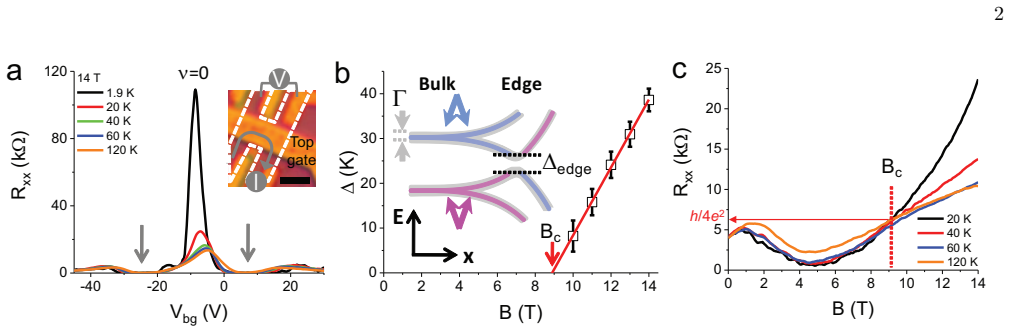
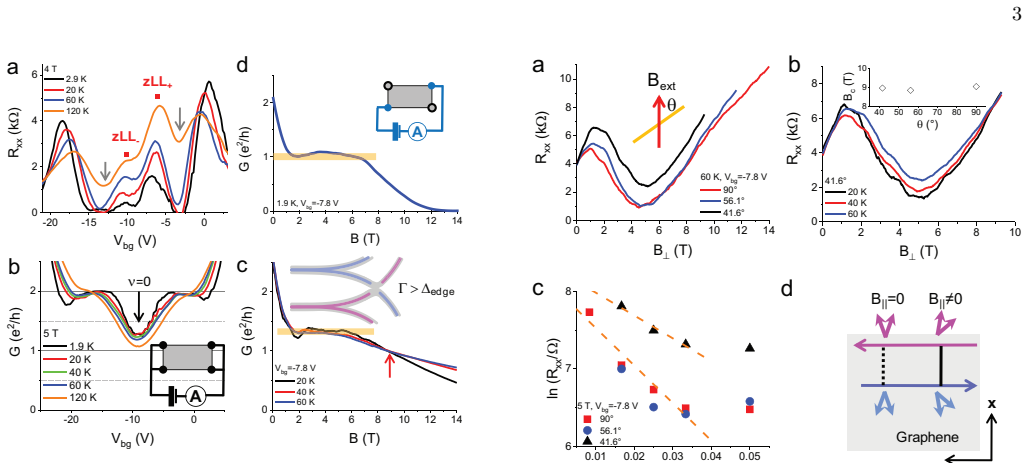
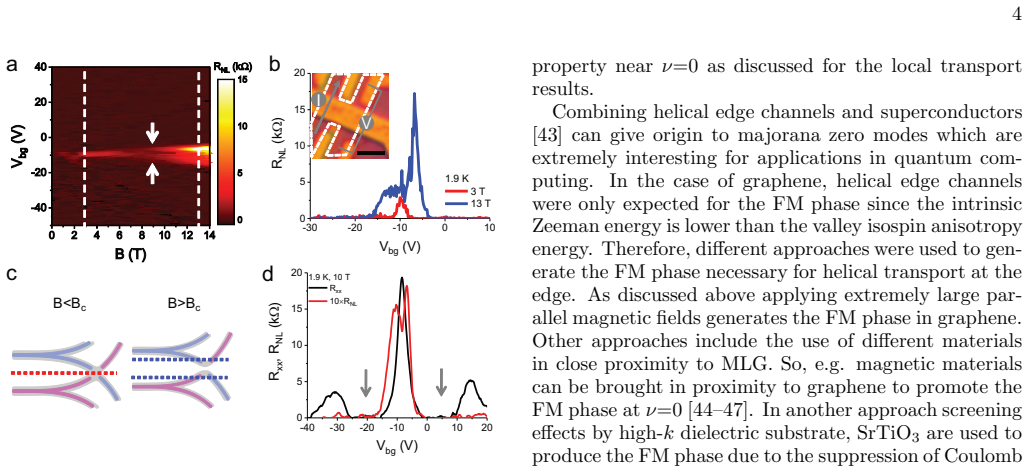
The central claim is that in the canted antiferromagnetic (CAF) phase of monolayer graphene at $\nu=0$, disorder-induced Landau level broadening $\Gamma\approx 67$ K exceeds the valley-isospin anisotropy energy that sets the edge gap for fields below $B_c\approx 8.9$ T. As a result the edge gap is effectively closed, leaving counter-propagating helical edge channels that carry quantized conductance. Evidence includes a metal–insulator transition in $R_{xx}$ and two-terminal conductance at the same $B_c$, a saturation of $G$ near $2e^2/h$ (one floating contact on each edge) and near $e^2/h$ (two floating contacts), the appearance of a zeroth-Landau-level splitting, and nonlocal resistance that is inconsistent with Ohmic or flavor-Hall origin but matches helical edge transport.
Load-bearing premise
The quantitative foundation is the assumption that the zero-field intercept $\Gamma\approx 67$ K of the thermal-activation-gap fit truly measures the disorder broadening of the CAF edge gap, and that comparing this with $u_\perp$ correctly predicts the gap closure below $B_c$.
Editorial extensions
If this is right
- Helical edge transport at $\nu=0$ can be obtained in pristine monolayer graphene by tuning disorder, without parallel magnetic fields or proximity to magnetic insulators.
- The metal–insulator transition at $B_c\approx 8.9$ T reflects the crossover where the CAF edge gap is washed out by Landau-level broadening.
- Conductance saturation values of $2e^2/h$ and $e^2/h$ in different contact geometries provide a quantitative fingerprint of helical edge modes with equilibration at floating contacts.
- Nonlocal resistance measurements can distinguish helical edge transport from classical Ohmic and flavor Hall contributions, since the single- and double-peak evolution tracks the gap opening.
- The reduction of the thermal activation gap under in-plane magnetic fields points to enhanced backscattering between the counter-propagating spin-textured edge states.
Reading between the lines
- If the mechanism is generic, there should be an optimal disorder strength for helical transport: too clean a sample stays insulating, while too much disorder would localize the edge modes; this could be tested with graded-disorder devices.
- The same gap-closing logic may apply to other quantum Hall ferromagnets where an isospin-anisotropy gap competes with disorder broadening, possibly explaining earlier reports of metallic $\nu=0$ behavior in lower-mobility samples.
- The parallel-field-induced backscattering suggests the helical edge modes have a spin texture that can be manipulated magnetically; spin-resolved or noise measurements could directly probe this texture.
- A quantitative re-analysis of the activation gap assuming a field-dependent $u_\perp$ might refine $B_c$ and produce a sharper prediction for where the conductance plateau should appear.
Signed reviews
Editorial analysis
A structured set of objections, weighed in public.
Referee Report
Summary. The paper reports magnetotransport experiments on hexagonal boron nitride encapsulated monolayer graphene in an H-bar geometry, focusing on filling factor ν=0 as a function of perpendicular magnetic field. The authors observe a metal-insulator transition at Bc≈8.9 T. Above Bc, the behavior is consistent with the canted antiferromagnetic (CAF) insulating phase, with a thermal activation gap that increases linearly with field. Below Bc, the system is metallic: the zeroth Landau level splits, two-terminal conductance saturates near e2/h or 2e2/h depending on contact geometry, and nonlocal resistance shows a single-peak to double-peak evolution. The central claim is that the CAF edge gap is effectively closed by disorder-induced Landau level broadening (Γ≈67 K, extracted from the zero-field intercept of the activation-gap fit), so that helical edge transport appears without the need for large parallel fields or proximity effects. The parallel-field experiments show a reduction of a measured activation energy with tilt and enhanced backscattering, which the authors interpret as spin-related scattering between helical edge states.
Significance. If the central claim is correct, the paper is significant: it proposes that a certain amount of disorder can turn the CAF phase at ν=0 into a platform for helical edge transport in pristine graphene, offering a simpler alternative to the FM phase induced by large parallel fields or by proximity to magnetic materials. The experimental dataset is rich, including local transport with two different contact configurations, parallel-field dependent measurements, and nonlocal resistance maps. The contact-geometry-dependent conductance saturation (close to 2e2/h and e2/h) is a concrete, nontrivial signature that is consistent with helical edge states, and the nonlocal data are checked against classical Ohmic and flavor-Hall alternatives. However, the quantitative foundation of the disorder-closing mechanism is not secure: the comparison between Γ and the edge gap relies on an indirect, extrapolated fit with no error bars and on a theoretical estimate for u⊥ that spans an order of magnitude. The significance of the paper is therefore conditional on resolving this quantitative gap.
major comments (4)
- [Section 2, paragraph after Fig. 1(b)] The identification of Γ≈67 K as the disorder-induced broadening of the CAF edge gap is an uncontrolled extrapolation. The activation data used for the linear fit exist only for fields above Bc≈8.9 T, where the insulating CAF phase is present, and the fit is extended through the metal-insulator transition down to B=0, into a regime where the gap is claimed to be closed. No error bars or confidence intervals are provided for Γ, Bc, or the activation energies, so the central inequality Γ>Δ_edge cannot be statistically assessed. The authors should provide a fit with uncertainties, justify the linear extrapolation, and preferably obtain Γ from a directly measured broadening, such as Landau-level linewidths or an independent transport probe.
- [Section 2, same paragraph] The comparison with the valley isospin anisotropy energy u⊥≈1−10B[T] K from Ref. [21] does not, by itself, establish Γ>Δ_edge below Bc. At B≈Bc the theoretical estimate spans roughly 9–89 K, so Γ=67 K lies inside that range; the claim requires selecting the lower branch. The authors should specify which u⊥ value they use and why, or demonstrate that the conclusion is robust over the entire theoretical range. As written, the inequality is not decided by the cited theory.
- [Sections 2–3] The activation gap Δ is extracted from bulk Rxx measurements (Fig. 1), whereas the disorder-closing claim concerns the edge gap Δ_edge. No model or experimental procedure connects the bulk activation intercept to the edge quantity; the schematic in Fig. 1(b) explicitly distinguishes bulk and edge, but this distinction is not carried through the analysis. This missing link is load-bearing because the central mechanism is specifically an edge-gap closure.
- [Section 3, Fig. 3(c)] The activation energies measured at B⊥=5 T in the regime below Bc (59 K at 41.6° and 97 K at 90°) are in tension with the claim that disorder (Γ≈67 K) closes the edge gap: at 90° the measured activation energy exceeds Γ. If this activation energy corresponds to the edge gap, then Γ<Δ_edge and the mechanism fails; if it corresponds to a different gap (e.g., a bulk gap or a backscattering gap), the paper should state that explicitly and explain the physical distinction. As written, the two quantitative statements are not reconciled.
minor comments (5)
- [Sample fabrication] There is a typo in the sample fabrication paragraph: 'perdiodic modulation' should be 'periodic modulation'.
- [Section 2, Fig. 2 caption and text] The word 'configuraten' in the text near Fig. 2(c) is a typo and should read 'configuration'.
- [Abstract] The abstract contains an extra space in 'm etal-insulator transition'; please correct it.
- [Fig. 1(b)] The axis label for the vertical axis of Fig. 1(b) appears corrupted in the manuscript rendering ('40/g39/g3 (K)'); please ensure the final figure has a legible label such as 'Δ (K)'.
- [Section 2, contact resistance] The contact resistance correction (Rc≈0.3 kΩ) is matched at ν=−2 only; the sensitivity of the conductance plateaus in Fig. 2(c) and (d) to this correction should be stated so that the reader can judge the closeness of the saturation to e2/h and 2e2/h.
Circularity Check
No significant circularity: the transport observations are independent of the disorder-broadening interpretation.
full rationale
The paper's central claims are experimental observations—metal-insulator transition near Bc≈8.9 T, conductance saturation close to e2/h or 2e2/h, zeroth-Landau-level splitting, and nonlocal resistance evolution—interpreted with a disorder-induced Landau-level-broadening picture for the canted antiferromagnetic phase. The parameter Γ≈67 K is obtained from the zero-field intercept of a linear fit to the thermal activation gap, and the statement that the edge gap is 'effectively closed' (Γ>Δ_edge) compares this fitted Γ with the theoretical valley-isospin anisotropy energy u⊥≈1–10B[T] K from Ref. [21]. This is an interpretive consistency check, not a prediction forced by construction: the inequality is not guaranteed by any defining equation, and the transport data remain valid independent of whether the comparison is secure. The only self-citation (Ref. [39], R. J. Haug, for the equilibration formula G=e2/h((N1+1)^{-1}+(N2+1)^{-1})) concerns a standard multi-terminal conductance relation and is not load-bearing or used to exclude alternative explanations. The quantitative fragility of the Γ≈u⊥ comparison—including the wide theoretical range and the absence of error bars—is a correctness risk, not a circularity.
Assumptions & free parameters
free parameters (5)
- Critical perpendicular field Bc =
8.9 T
- Disorder level broadening Gamma =
67 K
- Thermal activation gap at 90 deg =
97 K
- Thermal activation gap at 41.6 deg =
59 K
- Contact resistance Rc =
0.3 kOhm
assumptions (4)
- domain assumption The nu=0 insulating state in monolayer graphene is the canted antiferromagnetic (CAF) phase.
- domain assumption The CAF edge gap is controlled by the valley isospin anisotropy energy u_perp ≈ 1-10 B[T] K.
- standard math The longitudinal resistance obeys Rxx ∝ exp(Delta/2T) with a single activation gap.
- standard math Two-terminal conductance of helical edge states with floating contacts is G = e^2/h [(N1+1)^-1 + (N2+1)^-1].
Cite this review
Pith. "Pith review of Disorder induced helical-edge transport near $\nu$=0 of monolayer graphene." pith.science (2026). https://pith.science/paper/6YXNDG3A
@misc{pith2026190802420,
  author       = {Pith},
  title        = {Pith review of: Disorder induced helical-edge transport near $\nu$=0 of monolayer graphene},
  year         = {2026},
  howpublished = {\url{https://pith.science/paper/6YXNDG3A}},
  note         = {Machine review of arXiv:1908.02420}
}
abstract
The complex nature of filling factor $\nu$=0 of monolayer graphene is studied in magnetotransport experiments. As function of perpendicular magnetic field a metal-insulator transition is observed, which is attributed to disorder-induced Landau level broadening in the canted antiferromagnetic phase. In the metallic regime a separation of the zeroth Landau level appears and signs of the quantum spin Hall effect are seen near $\nu$=0. In addition to local transport, nonlocal transport experiments show results being consistent with helical edge transport.
Figures
Reference graph
Works this paper leans on
- [21]
-
[1]
K. S. Novoselov et al. , Nature 438, 197 (2005)
work page 2005
-
[2]
Zhang, Y.-W
Y. Zhang, Y.-W. Tan, H. L. Stormer, and P. Kim, Nature 438, 201 (2005)
2005
-
[3]
V. P. Gusynin and S. G. Sharapov, Phys. Rev. Lett. 95, 146801 (2005)
2005
- [4]
-
[5]
D. A. Abanin, P. A. Lee, and L. S. Levitov, Phys. Rev. Lett. 96, 176803 (2006)
work page 2006
-
[6]
H. A. Fertig and L. Brey, Phys. Rev. Lett. 97, 116805 (2006)
work page 2006
-
[7]
D. A. Abanin, K. S. Novoselov, U. Zeitler, P. A. Lee, A. K. Geim, and L. S. Levitov, Phys. Rev. Lett. 98, 196806 (2007)
work page 2007
Show all 49 references
-
[8]
Zhang et al
Y. Zhang et al. , Phys. Rev. Lett. 96, 136806 (2006)
2006
-
[9]
Fuchs and P
J.-N. Fuchs and P. Lederer, Phys. Rev. Lett. 98, 016803 (2007)
2007
-
[10]
I. A. Luk’yanchuk and A. M. Bratkovsky, Phys. Rev. Lett. 100, 176404 (2008)
2008
-
[11]
Y. Zhao, P. Cadden-Zimansky, F. Ghahari, and P. Kim, Phys. Rev. Lett. 108, 106804 (2012)
2012
-
[12]
Nomura and A
K. Nomura and A. H. MacDonald, Phys. Rev. Lett. 96, 256602 (2006)
2006
-
[13]
Jiang, Y
Z. Jiang, Y. Zhang, H. L. Stormer, and P. Kim, Phys. Rev. Lett. 99, 106802 (2007)
2007
-
[14]
J. G. Checkelsky, L. Li, and N. P. Ong, Phys. Rev. Lett. 100, 206801 (2008)
2008
-
[15]
J. G. Checkelsky, L. Li, and N. P. Ong, Phys. Rev. B 79, 115434 (2009)
2009
-
[16]
A. J. M. Giesbers, L. A. Ponomarenko, K. S. Novoselov, A. K. Geim, M. I. Katsnelson, J. C. Maan, and U. Zeitler, Phys. Rev. B 80, 201403 (2009)
2009
-
[17]
Jung and A
J. Jung and A. H. MacDonald, Phys. Rev. B 80, 235417 (2009)
2009
-
[18]
Zhang, Y
L. Zhang, Y. Zhang, M. Khodas, T. Valla, and I. A. Zaliznyak, Phys. Rev. Lett. 105, 046804 (2010)
2010
-
[19]
W. Zhu, H. Y. Yuan, Q. W. Shi, J. G. Hou, and X. R. Wang, New J. of Phys. 13, 113008 (2011)
2011
-
[20]
Kharitonov, Phys
M. Kharitonov, Phys. Rev. B 85, 155439 (2012)
2012
-
[22]
A. F. Young et al. , Nature Phys. 8, 550 (2012)
2012
-
[23]
Chiappini, S
F. Chiappini, S. Wiedmann, K. Novoselov, A. Mishchenko, A. K. Geim, J. C. Maan, and U. Zeitler, Phys. Rev. B 92, 201412 (2015)
2015
-
[24]
A. F. Young, J. D. Sanchez-Yamagishi, B. Hunt, S. H. Choi, K. Watanabe, T. Taniguchi, R. C. Ashoori, and P. Jarillo-Herrero, Nature 505, 528 (2014)
2014
-
[25]
P. K. Pyatkovskiy and V. A. Miransky, Phys. Rev. B 90, 195407 (2014)
2014
-
[26]
Murthy, E
G. Murthy, E. Shimshoni, and H. A. Fertig, Phys. Rev. B 90, 241410 (2014)
2014
-
[27]
Knothe and T
A. Knothe and T. Jolicoeur, Phys. Rev. B 92, 165110 (2015)
2015
-
[28]
Murthy, E
G. Murthy, E. Shimshoni, and H. A. Fertig, Phys. Rev. B 93, 045105 (2016)
2016
-
[29]
Tikhonov, E
P. Tikhonov, E. Shimshoni, H. A. Fertig, and G. Murthy, Phys. Rev. B 93, 115137 (2016)
2016
-
[30]
Lukose and R
V. Lukose and R. Shankar, Phys. Rev. B 94, 085135 (2016)
2016
-
[31]
Feshami and H
B. Feshami and H. A. Fertig, Phys. Rev. B 94, 245435 (2016)
2016
-
[32]
Takei, A
S. Takei, A. Yacoby, B. I. Halperin, and Y. Tserkovnyak, Phys. Rev. Lett. 116, 216801 (2016)
2016
-
[33]
Stepanov et al
P. Stepanov et al. , Nature Phys. 14, 907 (2018)
2018
-
[34]
D. S. Wei, T. van der Sar, S. H. Lee, K. Watanabe, T. Taniguchi, B. I. Halperin, and A. Yacoby, Science 362, 229 (2018)
2018
-
[35]
Wang et al
L. Wang et al. , Science 342, 614 (2013)
2013
-
[36]
D. A. Abanin, B. E. Feldman, A. Yacoby, and B. I. Halperin, Phys. Rev. B 88, 115407 (2013)
2013
-
[37]
B. Roy, M. P. Kennett, and S. Das Sarma, Phys. Rev. B 90, 201409 (2014)
2014
-
[38]
J. D. Sanchez-Yamagishi, J. Y. Luo, A. F. Young, B. M. Hunt, K. Watanabe, T. Taniguchi, R. C. Ashoori, and P. Jarillo-Herrero, Nature Nanotechnol. 12, 118 (2017)
2017
-
[39]
R. J. Haug, Semicond. Sci. Technol. 8, 131 (1993)
1993
-
[40]
D. A. Abanin et al. , Science 332, 328 (2011)
2011
-
[41]
Ribeiro, S
M. Ribeiro, S. R. Power, S. Roche, L. E. Hueso, and F. Casanova, Nature Commun. 8, 2198 (2017)
2017
-
[42]
A. Roth, C. Br¨ une, H. Buhmann, L. W. Molenkamp, J. Maciejko, X.-L. Qi, and S.-C. Zhang, Science 325, 294 (2009)
2009
-
[43]
In the case of graphene, helical edge channels were only expected for the FM phase since the intrinsic Zeeman energy is lower than the valley isospin anisotropy energy
can give origin to majorana zero modes which are extremely interesting for applications in quantum com- puting. In the case of graphene, helical edge channels were only expected for the FM phase since the intrinsic Zeeman energy is lower than the valley isospin anisotropy ener...
-
[44]
Ronen, Y
Y. Ronen, Y. Cohen, D. Banitt, M. Heiblum, and V. Umansky, Nature Phys. 14, 411 (2018)
2018
-
[45]
Wei et al
P. Wei et al. , Nature Mater. 15, 711 (2016)
2016
-
[46]
Song et al
H.-D. Song et al. , Nano Lett. 18, 2435 (2018)
2018
-
[47]
Wu et al
Y.-F. Wu et al. , Phys. Rev. B 95, 195426 (2017)
2017
- [48]
- [49]
Reviewed August 14, 2026 · model on record in the stance chip above.
Discussion (0). Continue with ORCID to comment.