REVIEW 3 major objections 4 minor 42 references
Spectra of "fattened" open book structures
T0 review · 3 major / 4 minor · reviewed 2026-08-14 · deepseek-v4-flash
Pith's one-line read For open book structures in 3D, the eigenvalues of the Neumann Laplacian on an epsilon-fattened neighborhood converge to those of a 2D limit operator as epsilon tends to zero.
desk verdict A clear research announcement that reduces the main spectral convergence theorem to a deferred construction of averaging and extension operators — the central claim is not proven in this manuscript. read the letter →
The pith
A machine-rendered reading of the paper's core claim, the machinery that carries it, and where it could break.
The reading
What carries the argument
The machinery is a pair of operator families: averaging operators $J^\epsilon$ mapping functions on the fattened domain to functions on the surface, and extension operators $K^\epsilon$ mapping in the opposite direction. They are required to be nearly isometries on low-energy spectral subspaces and to be nearly energy-nonincreasing, in the sense of Definitions 2.2 and 2.3. These inequalities let any finite-dimensional test space for one problem be transplanted into the other with only $o(1)$ changes to its Rayleigh quotient, which forces the min-max eigenvalues to coincide in the limit. The paper proves this implication (Theorem 2.4) and states the existence of such operators (Theorem 2.6) without proof.
What would settle it
Compute numerically the first few Neumann Laplacian eigenvalues on an epsilon-fattened open book built from two disks meeting along a diameter, for epsilon decreasing to zero, and compare them with the eigenvalues of the claimed limit operator with continuity and Kirchhoff conditions at the binding. If the differences fail to vanish, or if no such averaging and extension operators can be constructed for this geometry, the convergence claim would be refuted.
Extended reading notes
Core claim
The paper's central claim is Theorem 2.7: for any open book structure M satisfying the stated hypotheses, and for any index n, the n-th eigenvalue $\lambda_n(A^\epsilon)$ of the Neumann Laplacian on the fattened domain $M^\epsilon$ converges to $\lambda_n(A)$, the n-th eigenvalue of the operator $A$ on $M$. The operator $A$ is the 2D analog of a quantum graph: on each page it is the Laplace-Beltrami operator, and across each binding it imposes continuity of the function and the Kirchhoff condition that the sum of normal derivatives over the incident pages vanishes. The proof works by replanting test spaces between the two quadratic forms using averaging and extension operators, then applying min-max to force the Rayleigh quotients together. The existence of these operators appears as Theorem 2.6, which is stated but not proved in this manuscript.
Load-bearing premise
The whole argument rests on the existence of averaging and extension operators that transfer functions between the 3D fattened domain and the 2D surface while nearly preserving lengths and energies; this existence is stated as a theorem but proved in another text.
Editorial extensions
If this is right
- For every allowed open book structure, each Neumann eigenvalue of the thin 3D body converges to the corresponding eigenvalue of the 2D surface operator as the thickness goes to zero.
- The limit operator gives a 2D analog of quantum graphs, so thin branched surfaces can be modeled by 2D surface operators with continuity and Kirchhoff conditions at the bindings.
- Convergence holds eigenvalue by eigenvalue for each fixed index, so spectral gaps and multiplicities of the limit are inherited by sufficiently thin fattened domains.
- The result covers the previously known smooth-surface case as a special case and extends the graph-case theory to branching 2D strata.
Reading between the lines
- If the deferred construction of $J$ and $K$ can be carried out for structures with corners (0D strata), the same min-max comparison should yield convergence with vertex conditions at the corners, a case the paper leaves open.
- Varying the fattening rate at bindings relative to pages is expected to change the effective junction condition; a concrete test would be to compute the limit of the spectrum under anisotropic shrinking to see whether delta-like or Robin couplings appear.
- A numerical study on a simple open book, such as two rectangular pages meeting at a common edge, could validate the Kirchhoff condition as the correct junction rule and reveal how fast the convergence is in $\epsilon$.
- The proof structure suggests that adding a bounded potential to the Laplacian should preserve the convergence, since the operator inequalities are insensitive to lower-order terms; this is a testable extension of Theorem 2.7.
Signed reviews
Editorial analysis
A structured set of objections, weighed in public.
Referee Report
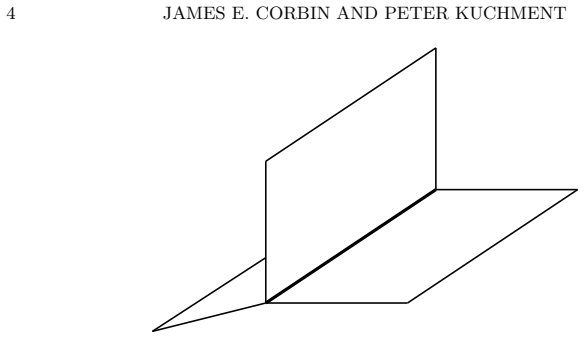
Summary. The manuscript studies the Neumann Laplacian on a thin ``fattened'' neighborhood $M^\epsilon$ of a two-dimensional stratified set $M$ in $\mathbb{R}^3$, where $M$ is an ``open book'' structure with smooth two-dimensional pages meeting transversely along one-dimensional bindings. The authors propose a limiting operator $A$ on $M$ acting as the Laplace-Beltrami operator on each page with continuity and Kirchhoff conditions at the bindings, and they claim that, as $\epsilon\to 0$, each eigenvalue $\lambda_n(A^\epsilon)$ of the Neumann Laplacian on $M^\epsilon$ converges to the corresponding eigenvalue $\lambda_n(A)$. The proof is reduced in Section 2 to the existence of averaging operators $J^\epsilon$ and extension operators $K^\epsilon$ satisfying near-isometry and energy inequalities (9)--(12). Theorem 2.4 proves that such operators imply spectral convergence; Theorem 2.6 asserts their existence but is explicitly deferred to another text; Theorem 2.7 states the main convergence result as an immediate corollary. The paper's original content is therefore the abstract reduction of the spectral convergence problem to the construction of $J^\epsilon$ and $K^\epsilon$, together with the formulation of the limiting operator.
Significance. If the missing technical construction were supplied, the result would be a natural and interesting two-dimensional analogue of the well-developed spectral convergence theory for fattened graphs, with potential applications in physics and engineering. The manuscript is clearly written and the limiting operator is formulated in a plausible way, including the expected continuity and Kirchhoff conditions at the bindings. The paper also honestly states the restrictions of its approach, such as the absence of zero-dimensional strata and the assumption that the pages meet transversely. Credit is due for isolating the precise sufficient conditions for spectral convergence in Definitions 2.2 and 2.3 and for stating Theorem 2.4 in a clean conditional form. However, the decisive technical step, the construction of the operators $J^\epsilon$ and $K^\epsilon$ with the required estimates near the binding, is not carried out in this manuscript and is deferred to a separate publication. Consequently the main theorem is not established here, and the paper functions as a research announcement or reduction rather than a proof of the advertised convergence result.
major comments (3)
- [Theorem 2.6, Section 2] The central claim of the paper, Theorem 2.7, depends entirely on Theorem 2.6, which asserts the existence of averaging and extension operators $J^\epsilon$ and $K^\epsilon$ satisfying (9)--(12). The manuscript states on page 8 that this is ``the long technical task, to be addressed elsewhere'' and provides no proof, no construction, and no reference to an available text. This is not a peripheral detail: inequalities (10) and (12) are exactly the estimates that must control the averaging and splicing near the binding, where traces of $H^1$ functions only lie in $H^{1/2}$. Without Theorem 2.6, Theorem 2.4 is a conditional statement and Theorem 2.7 does not follow. This omission cannot be repaired within the present manuscript's scope.
- [Proof of Theorem 2.4, inequalities (14)--(19)] The proof applies the estimates (9)--(12) to arbitrary $n$-dimensional subspaces $W_n$ and $W^\epsilon_n$ in (16)--(17), but those estimates are only assumed for vectors in the spectral subspaces $P^\epsilon_\Lambda$ and $P_\Lambda$. A subspace realizing the min-max maximum need not be contained in a spectral subspace. The argument can be repaired by fixing $\Lambda$ between $\lambda_n(A)$ and $\lambda_{n+1}(A)$, choosing $W^\epsilon_n$ as the span of the first $n$ eigenfunctions of $A^\epsilon$ and $W_n$ as the span of the first $n$ eigenfunctions of $A$, and using $K^\epsilon$ first to bound $\lambda^\epsilon_n$ within a spectral window before applying $J^\epsilon$. This ordering is not stated and should be made explicit.
- [Definitions 2.2--2.3] The definitions require the estimates (9)--(12) to hold uniformly over spectral subspaces corresponding to an arbitrary $\Lambda$ not in the spectrum, with an $\epsilon_0$ that may depend on $\Lambda$. In the proof of Theorem 2.4 one must pass from a fixed $\Lambda$ for $A$ to a corresponding $\Lambda$ for $A^\epsilon$ for sufficiently small $\epsilon$. The manuscript does not discuss this uniformity or the role of spectral gaps near the limiting eigenvalues. This is likely fixable by a standard spectral-window argument, but it should be part of the proof rather than left implicit.
minor comments (4)
- [Proposition 1.5] The characterization of the domain $G_2$ with the Kirchhoff condition (8) is stated without proof and described as standard. Since the binding is a singular set and the normal derivatives are traces of $H^2$ functions, a reference or a short justification of the precise sense in which the sum in (8) vanishes would be helpful.
- [Section 3, final remarks] The remarks about phase transitions and corners are interesting but do not compensate for the absence of the main technical proof; they should be clearly labeled as conjectural or planned work rather than results of this paper.
- [General presentation] There are minor typographical issues, including a duplicated reference [22] in the introduction and some informal spacing in displayed formulas; these do not affect the mathematics.
- [Reference [31]] The manuscript cites Post's book for the statement that averaging and extension operators are sufficient for spectral convergence. Since this is the backbone of Theorem 2.4, the precise theorem or proposition in [31] should be cited, not only the book as a whole.
Circularity Check
No circularity: the spectral convergence claim is conditional on an explicitly deferred existence theorem, but no step of the derivation reduces to its own inputs.
full rationale
The derivation is not circular. The paper defines a limiting operator A with continuity and Kirchhoff conditions at bindings, then reduces spectral convergence to the existence of averaging and extension operators in Definitions 2.2-2.3. Theorem 2.4 proves, via the min-max principle, that existence of such operators implies eigenvalue convergence; that proof is explicit and does not use the target eigenvalues as inputs. The limiting operator is not defined from the eigenvalues of A^epsilon, and no parameters are fitted to spectral data. The only load-bearing unresolved ingredient is Theorem 2.6, which the paper states without proof, saying 'The long technical task, to be addressed elsewhere, consists in proving the following statement.' This is a missing proof or deferred construction, not a self-referential reduction: no equation makes Theorem 2.7 equal to its assumptions by construction. Self-citations such as [2], [24], and [31] are used for context and for the standard sufficiency criterion, which is reproved as Theorem 2.4, so they are not load-bearing in a circular way. Thus there is no significant circularity, with the caveat that Theorem 2.7 is conditional on a theorem not established in this manuscript.
Assumptions & free parameters
assumptions (5)
- domain assumption M is a compact open book structure with finitely many smooth 2D pages meeting transversely along smooth 1D bindings, and with no zero-dimensional strata.
- domain assumption The fattened domain is the union of epsilon-balls around M with the same shrinkage speed around all strata, for all epsilon below a positive threshold.
- domain assumption The limiting operator A is defined by the quadratic form Q with continuity across bindings and, on the operator domain, the Kirchhoff condition at bindings.
- ad hoc to paper Existence of averaging operators J^epsilon and extension operators K^epsilon satisfying Definitions 2.2 and 2.3.
- standard math Standard min-max characterization of eigenvalues of self-adjoint non-negative operators with discrete spectrum.
Cite this review
Pith. "Pith review of Spectra of "fattened" open book structures." pith.science (2026). https://pith.science/paper/6Z5FIQCA
@misc{pith2026190806222,
  author       = {Pith},
  title        = {Pith review of: Spectra of "fattened" open book structures},
  year         = {2026},
  howpublished = {\url{https://pith.science/paper/6Z5FIQCA}},
  note         = {Machine review of arXiv:1908.06222}
}
read the original abstract
We establish convergence of spectra of Neumann Laplacian in a thin neighborhood of a branching 2D structure in 3D to the spectrum of an appropriately defined operator on the structure itself. This operator is a 2D analog of the well known by now quantum graphs. As in the latter case, such considerations are triggered by various physics and engineering applications.
Figures


Reference graph
Works this paper leans on
-
[1]
Arnold, V. I. ; Gusein-Zade, S. M. ; Varchenko, A. N. Singularities of differ- entiable maps. Volume 1. Classification of critical points, caustics and wave fronts, Birkh¨ auser/Springer, New York, 2012
work page 2012
-
[2]
G. Berkolaiko and P. Kuchment, Introduction to Quantum Graphs, AMS 2013
work page 2013
-
[3]
G. Dell’Antonio, A. Michelangeli, Dynamics on a graph as the limit of the dy- namics on a ”fat graph”. Mathematical technology of networks, 49–64, Springer Proc. Math. Stat., 128, Springer, Cham, 2015
work page 2015
-
[4]
Dell’Antonio, Dynamics on quantum graphs as constrained systems
G. Dell’Antonio, Dynamics on quantum graphs as constrained systems. Rep. Math. Phys. 59 (2007), no. 3, 267–279
work page 2007
-
[5]
G. Dell’Antonio, L. Tenuta, Quantum graphs as holonomic constraints. J. Math. Phys. 47 (2006), no. 7, 072102, 21 pp
work page 2006
-
[6]
D. E. Edmunds and W. Evans, Spectral Theory and Differential Operators , Oxford Science Publ., Claredon Press, Oxford, 1990
work page 1990
-
[7]
W. D. Evans and D. J. Harris, Fractals, trees and the Neumann Laplacian, Math. Ann. 296(1993), 493-527
work page 1993
- [8]
Show all 42 references
-
[9]
Exner and O
P. Exner and O. Post, Convergence of spectra of graph-like thin manifolds, J. Geom. Phys. 54 (2005), no. 1, 77-115
2005
-
[10]
Exner, P
P. Exner, P. Seba, Electrons in semiconductor microstructures: a challenge to operator theorists, in Proceedings of the Workshop on Schr¨ odinger Operators, Standard and Nonstandard (Dubna 1988), World Scientific, Singapore 1989; pp. 79-100
1988
-
[11]
Figotin and P
A. Figotin and P. Kuchment, Band-gap structure of the spectrum of periodic and acoustic media. I. scalar model, SIAM J. Applied Math. 56 (1996), no.1, 68-88. 10 JAMES E. CORBIN AND PETER KUCHMENT
1996
-
[12]
Figotin and P
A. Figotin and P. Kuchment, Band-gap structure of the spectrum of peri- odic and acoustic media. II. 2D photonic crystals, SIAM J. Applied Math. 56 (1996), 1561-1620
1996
-
[13]
Figotin and P
A. Figotin and P. Kuchment, 2D photonic crystals with cubic structure: as- ymptotic analysis, in Wave propagation in Complex Media , G. Papanicolaou (Editor), IMA Volumes in Math. and Appl., 96 (1997), 23-30
1997
-
[14]
Figotin and P
A. Figotin and P. Kuchment, Spectral properties of classical waves in high contrast periodic media, SIAM J. Appl. Math. 58 (1998), no.2, 683- 702
1998
-
[15]
Freidlin, Markov processes and differential equations: asymptotic problems , Lectures in Mathematics ETH Z¨ urich, Birkh¨ auser Verlag, Basel, 1996
M. Freidlin, Markov processes and differential equations: asymptotic problems , Lectures in Mathematics ETH Z¨ urich, Birkh¨ auser Verlag, Basel, 1996
1996
-
[16]
Freidlin and A
M. Freidlin and A. Wentzell, Diffusion processes on graphs and the averaging principle, Annals of Probability, 21 (1993), no.4, 2215-2245
1993
-
[17]
Freidlin and A
M. Freidlin and A. Wentzell, Diffusion processes on an open book and the averaging principle, Stochastic Processes and their Applications 113 (2004), 101 – 126
2004
-
[18]
Froese and I
R. Froese and I. Herbst. Realizing holonomic constraints in classical and quan- tum mechanics. Comm. Math. Phys. 220 (2001), 3, 489-535
2001
-
[19]
Gerasimenko and B
N. Gerasimenko and B. Pavlov, Scattering problems on non-compact graphs, Theor. Math. Phys., 75(1988), 230-240
1988
-
[20]
Goresky, Stratified Morse Theory, Springer Verlag 1988
M. Goresky, Stratified Morse Theory, Springer Verlag 1988
1988
-
[21]
Grieser, Thin tubes in mathematical physics, global analysis and spectral geometry, in [8], pp
D. Grieser, Thin tubes in mathematical physics, global analysis and spectral geometry, in [8], pp. 565–593, 2008
2008
-
[22]
Kuchment, The Mathematics of Photonics Crystals, in Mathematical Mod- eling in Optical Science, G
P. Kuchment, The Mathematics of Photonics Crystals, in Mathematical Mod- eling in Optical Science, G. Bao, L. Cowsar, and W. Masters (Editors), SIAM, 2001
2001
-
[23]
Kuchment, Differential and pseudo-differential operators on graphs as mod- els of mesoscopic systems, Analysis and applicationsISAAC 2001 (Berlin), 7– 30, Int
P. Kuchment, Differential and pseudo-differential operators on graphs as mod- els of mesoscopic systems, Analysis and applicationsISAAC 2001 (Berlin), 7– 30, Int. Soc. Anal. Appl. Comput., Kluwer Acad. Publ., Dordrecht, 2003
2001
-
[24]
Kuchment, and H
P. Kuchment, and H. Zeng, Asymptotics of spectra of Neumann Laplacians in thin domains. Advances in differential equations and mathematical physics (Birmingham, AL, 2002) , 199–213, Contemp. Math., 327, Amer. Math. Soc., Providence, RI, 2003
2002
-
[25]
Kuchment, Graph models for waves in thin structures, Waves Random Media 12 (2002), no
P. Kuchment, Graph models for waves in thin structures, Waves Random Media 12 (2002), no. 4, R1–R24
2002
-
[26]
Kuchment and L
P. Kuchment and L. Kunyansky, Spectral properties of high contrast band-gap materials and operators on graphs, Experimental Mathematics, 8 (1999), no.1, 1-28
1999
-
[27]
Kuchment and H
P. Kuchment and H. Zeng, Convergence of spectra of mesoscopic systems col- lapsing onto a graph, J. Math. Anal. Appl. 258 (2001), 671-700
2001
-
[28]
Springer-Verlag, New York-Berlin, 1980
Yung Chen Lu, Singularity theory and an introduction to catastrophe theory , Universitext. Springer-Verlag, New York-Berlin, 1980
1980
-
[29]
Maz’ja, Sobolev spaces, Springer-Verlag, Berlin, 1985
V. Maz’ja, Sobolev spaces, Springer-Verlag, Berlin, 1985
1985
-
[30]
Maz’ya and S
V. Maz’ya and S. Poborchi, Differential functions on bad domains , World Sci- entific, New Jersey, 1997
1997
-
[31]
Post, Spectral analysis on graph-like spaces, Springer-Verlag, Berlin, 2012
O. Post, Spectral analysis on graph-like spaces, Springer-Verlag, Berlin, 2012
2012
-
[32]
Ranicki, High-dimensional knot theory
A. Ranicki, High-dimensional knot theory. Algebraic surgery in codimension 2 , Springer Verlag, Berlin, 1998. OPEN BOOKS 11
1998
-
[33]
Reed and B
M. Reed and B. Simon, Methods of modern mathematical physics I: functional analysis, Academic Press, San Diego, 1980
1980
-
[34]
Rubinstein and M
J. Rubinstein and M. Schatzman, Spectral and variational problems on multi- connected strips, C. R. Acad. Sci. Paris Ser. I Math. 325 (1997), no.4, 377-382
1997
-
[35]
Rubinstein and M
J. Rubinstein and M. Schatzman, Asymptotics for thin superconducting rings, J. Math. Pures Appl. 77 (1998), no. 8, 801–820
1998
-
[36]
Rubinstein and M
J. Rubinstein and M. Schatzman, On multiply connected mesoscopic super- conducting structures, S´ emin. Th´ eor. Spectr. G´ eom., no. 15, Univ. Grenoble I, Saint-Martin-d’H` eres, 1998, 207-220
1998
-
[37]
Rubinstein and M
J. Rubinstein and M. Schatzman, Variational problems on multiply connected thin strips I: basic estimates and convergence of the Laplacian spectrum, Arch. Rational Mech. Anal. (2001), 160-271
2001
-
[38]
Ruedenberg and C
K. Ruedenberg and C. W. Scherr, Free-electron network model for conjugated systems. I. Theory, J. Chem. Physics, 21 (1953), no.9, 1565-1581
1953
-
[39]
Saito, The limiting equation of the Neumann Laplacians on shrinking do- mains, Elec
Y. Saito, The limiting equation of the Neumann Laplacians on shrinking do- mains, Elec. J. Diff. Eq. 2000 (2000), No. 31, 1-25
2000
-
[40]
Schatzman, On the eigenvalues of the Laplace operator on a thin set with Neumann boundary conditions, Applicable Anal
M. Schatzman, On the eigenvalues of the Laplace operator on a thin set with Neumann boundary conditions, Applicable Anal. 61 (1996), 293-306
1996
-
[41]
Whitney, Collected papers
H. Whitney, Collected papers. Vol. II. , Birkh¨ auser Boston, Inc., Boston, MA, 1992
1992
-
[42]
H. E. Winkelnkemper, Manifolds as open books, Bull. AMS 79 (1973), 45–51. Department of Mathematics, Texas A& M University, College Sta- tion, TX E-mail address : jxc8004@math.tamu.edu Department of Mathematics, Texas A& M University, College Sta- tion, TX E-mail address : kuc...
1973
Reviewed August 14, 2026 · model on record in the stance chip above.
Discussion (0). Continue with ORCID to comment.