REVIEW 3 minor 13 references
Energy Efficiency Optimization for Rotatable Antenna-Enabled Uplink NOMA Systems
T0 review · 0 major / 3 minor · reviewed 2026-06-27 · grok-4.3
Pith's one-line read Joint optimization of rotatable antennas, beamforming and power boosts energy efficiency in uplink NOMA.
desk verdict Competent incremental EE optimization for rotatable-antenna uplink NOMA; algorithm is standard but the setup is new enough to warrant review. read the letter →
The pith
A machine-rendered reading of the paper's core claim, the machinery that carries it, and where it could break.
The reading
What carries the argument
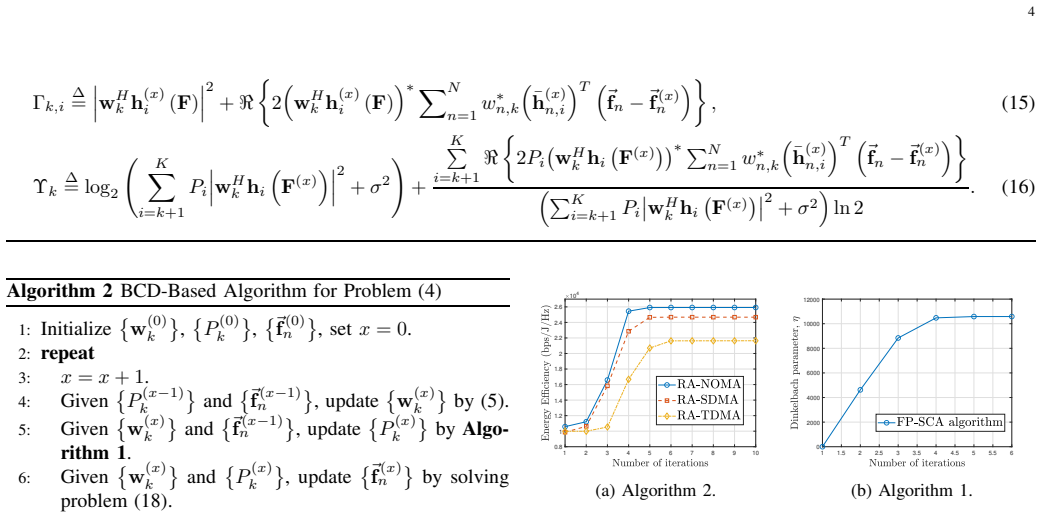
Block coordinate descent algorithm that decomposes the joint energy-efficiency problem into MMSE beamforming, fractional-programming power control, and successive-convex-approximation antenna rotation subproblems.
What would settle it
A hardware experiment with actual rotatable antennas and real channel measurements that shows no energy-efficiency advantage over fixed-antenna NOMA under the same user mix and power constraints would falsify the superiority claim.
Extended reading notes
Core claim
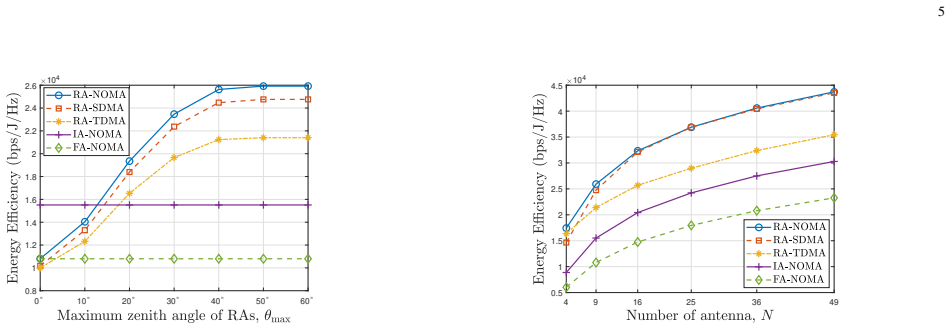
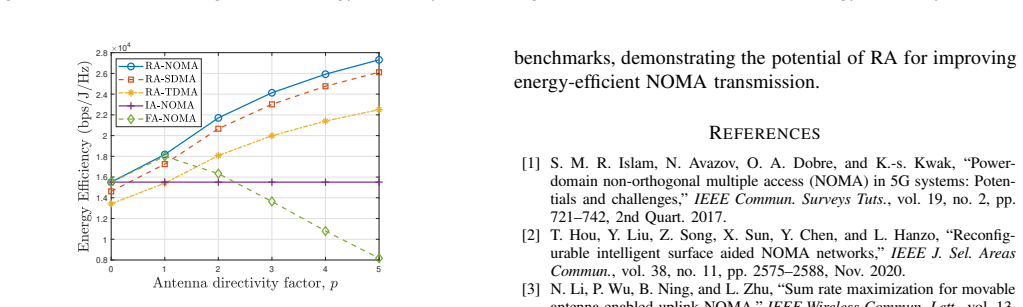
By jointly optimizing receive beamforming via the minimum mean square error criterion, power allocation via fractional programming, and rotatable-antenna angles via successive convex approximation inside a block coordinate descent loop, the RA-NOMA scheme achieves higher energy efficiency than several fixed-antenna and orthogonal-access benchmarks in uplink scenarios containing both ground and aerial users.
Load-bearing premise
The idealized channel models and perfect hardware assumptions used in the system model remain representative of real conditions when energy-efficiency gains are evaluated.
Editorial extensions
If this is right
- Rotatable antennas supply extra spatial degrees of freedom that improve energy efficiency when users are located at different elevations.
- The block coordinate descent procedure yields stationary points whose energy-efficiency values exceed those of schemes that fix antenna angles.
- Fractional programming combined with successive convex approximation renders the originally intractable joint optimization tractable while preserving the observed gains.
- The reported energy-efficiency ordering holds for both ground-only and mixed ground-aerial user populations under the stated NOMA decoding order.
Reading between the lines
- The same rotation optimization could be applied to downlink NOMA or to orthogonal multiple access to test whether the gains are specific to uplink NOMA.
- Mechanical constraints on rotation speed and precision would need to be incorporated before claiming real-time feasibility.
- Replacing perfect channel state information with estimated channels would reveal how robust the algorithm remains to estimation error.
- Extending the model to multiple cells would show whether inter-cell interference reduces or preserves the rotatable-antenna advantage.
Signed reviews
Editorial analysis
A structured set of objections, weighed in public.
Referee Report
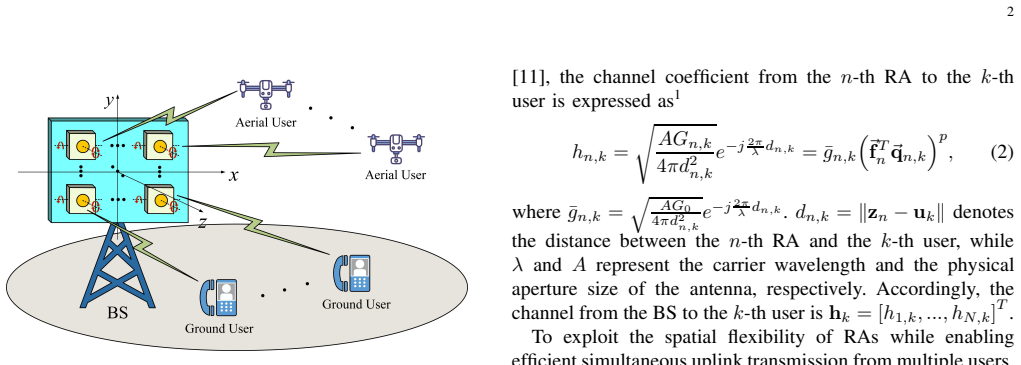
Summary. The manuscript formulates an energy-efficiency maximization problem for an uplink NOMA system in which a multi-antenna base station equipped with independently rotatable antennas serves both ground and aerial users. The joint optimization of MMSE receive beamforming, power allocation, and antenna rotation angles is solved via a block coordinate descent algorithm that alternates MMSE updates, fractional programming, and successive convex approximation. Numerical results are reported to demonstrate that the proposed RA-NOMA scheme achieves higher energy efficiency than several benchmark schemes under the considered channel and hardware model.
Significance. If the reported gains hold, the work supplies a concrete algorithmic demonstration that rotatable antennas can improve energy efficiency in mixed terrestrial-aerial NOMA deployments. The approach relies on standard, well-understood techniques (BCD, MMSE, FP, SCA) whose convergence behavior and benchmark comparisons are presented at a level typical for the venue; the idealized CSI and hardware assumptions are explicitly stated.
minor comments (3)
- [Abstract] The abstract states that the scheme outperforms 'several benchmarks' but does not name them; the introduction or simulation section should list the exact benchmark schemes (e.g., fixed-orientation NOMA, OMA, etc.) for reproducibility.
- [Section IV] Section IV (algorithm description) presents the BCD procedure but does not include a short monotonicity or convergence-rate argument; adding one sentence referencing the standard properties of FP and SCA would strengthen the exposition without lengthening the paper.
- [Numerical Results] Figure captions for the numerical results should explicitly state the number of Monte-Carlo channel realizations and the precise parameter values (e.g., noise power, circuit power) used to generate each curve.
Simulated Author's Rebuttal
We thank the referee for the positive assessment of our manuscript on energy efficiency optimization for rotatable antenna-enabled uplink NOMA systems and for recommending minor revision. No major comments were provided in the report.
Circularity Check
No significant circularity in derivation chain
full rationale
The paper formulates a standard EE maximization problem under an idealized system model and solves it via BCD with MMSE beamforming, fractional programming, and SCA. The central claim rests on numerical simulations comparing the RA-NOMA scheme to benchmarks; these results are generated from the optimization outputs rather than reducing any performance metric to a fitted quantity or self-citation by construction. No self-definitional steps, fitted-input predictions, or load-bearing self-citations appear in the derivation. The framework is self-contained against external benchmarks and uses conventional techniques without smuggling ansatzes or renaming known results.
Assumptions & free parameters
Cite this review
Pith. "Pith review of Energy Efficiency Optimization for Rotatable Antenna-Enabled Uplink NOMA Systems." pith.science (2026). https://pith.science/paper/6Z75GOFD
@misc{pith2026260605600,
  author       = {Pith},
  title        = {Pith review of: Energy Efficiency Optimization for Rotatable Antenna-Enabled Uplink NOMA Systems},
  year         = {2026},
  howpublished = {\url{https://pith.science/paper/6Z75GOFD}},
  note         = {Machine review of arXiv:2606.05600}
}
read the original abstract
This paper investigates a rotatable antenna (RA)-enabled uplink non-orthogonal multiple access (NOMA) system, where a base station equipped with multiple independently RAs serves both ground and aerial users. Specifically, we formulate an energy efficiency (EE) maximization problem by jointly optimizing receive beamforming, user power allocation, and RA rotation. To make the problem tractable, a new block coordinate descent-based algorithm is developed, in which the receive beamforming is updated via the minimum mean square error criterion, while the power allocation and RA rotation are handled by fractional programming and successive convex approximation. Numerical results demonstrate the EE superiority of the proposed RA-NOMA scheme over several benchmarks.
Figures
Figures from the paper (1 more)
Reference graph
Works this paper leans on
-
[1]
Pow er- domain non-orthogonal multiple access (NOMA) in 5G systems : Poten- tials and challenges,
S. M. R. Islam, N. Avazov, O. A. Dobre, and K.-s. Kwak, “Pow er- domain non-orthogonal multiple access (NOMA) in 5G systems : Poten- tials and challenges,” IEEE Commun. Surveys Tuts. , vol. 19, no. 2, pp. 721–742, 2nd Quart. 2017
2017
-
[2]
Reco nfig- urable intelligent surface aided NOMA networks,
T. Hou, Y . Liu, Z. Song, X. Sun, Y . Chen, and L. Hanzo, “Reco nfig- urable intelligent surface aided NOMA networks,” IEEE J. Sel. Areas Commun., vol. 38, no. 11, pp. 2575–2588, Nov. 2020
2020
-
[3]
Sum rate maximization fo r movable antenna enabled uplink NOMA,
N. Li, P . Wu, B. Ning, and L. Zhu, “Sum rate maximization fo r movable antenna enabled uplink NOMA,” IEEE Wireless Commun. Lett. , vol. 13, no. 8, pp. 2140–2144, Aug. 2024
2024
-
[4]
Exploring fairness for FAS-assisted communication systems: From NOMA to OMA,
J. Y ao, L. Zhou, T. Wu, M. Jin, C. Pan, M. Elkashlan, and K.- K. Wong, “Exploring fairness for FAS-assisted communication systems: From NOMA to OMA,” IEEE Trans. Wireless Commun. , vol. 24, no. 4, pp. 3433–3449, Apr. 2025
2025
-
[5]
Energy- efficient resource allocation for NOMA-assisted uplink pin ching-antenna systems,
M. Zeng, X. Li, J. Wang, G. Huang, O. A. Dobre, and Z. Ding, “ Energy- efficient resource allocation for NOMA-assisted uplink pin ching-antenna systems,” IEEE Wireless Commun. Lett. , vol. 14, no. 11, pp. 3695–3699, Nov. 2025
2025
-
[6]
A tutorial on six- dimensional movable antenna for 6G networks: Synergizing p ositionable and rotatable antennas,
X. Shao, W. Mei, C. Y ou, Q. Wu, B. Zheng, C.-X. Wang, J. Li, R . Zhang, R. Schober, L. Zhu, W. Zhuang, and X. Shen, “A tutorial on six- dimensional movable antenna for 6G networks: Synergizing p ositionable and rotatable antennas,” IEEE Commun. Surveys Tuts., vol. 28, pp. 3666– 3709, Nov. 2026
2026
-
[7]
Rotatable antenna-empowered wireless networks: A tutorial,
B. Zheng, Q. Wu, X. Xiong, Y . Tan, W. Zhu, T. Ma, C. Y ou, X. Sh ao, L. Zhu, J. Tang, R. Schober, K.-K. Wong, and R. Zhang, “Rotat- able antenna-empowered wireless networks: A tutorial,” arXiv preprint arXiv:2603.25559, 2026
work page Pith review arXiv 2026
-
[8]
Rotatable antenna enabled wireless communication and sensing: Oppor tunities and challenges,
B. Zheng, T. Ma, C. Y ou, J. Tang, R. Schober, and R. Zhang, “ Rotatable antenna enabled wireless communication and sensing: Oppor tunities and challenges,” IEEE Wireless Commun. , pp. 1–8, Early access 2025
2025
Show all 13 references
-
[9]
Rotatable antenna en abled wireless communication: Modeling and optimization,
B. Zheng, Q. Wu, T. Ma, and R. Zhang, “Rotatable antenna en abled wireless communication: Modeling and optimization,” IEEE Trans. Commun., pp. 1–1, Early access 2026
2026
-
[10]
Ro- tatable antenna-enabled secure wireless communication,
L. Dai, B. Zheng, Q. Wu, C. Y ou, R. Schober, and R. Zhang, “ Ro- tatable antenna-enabled secure wireless communication,” IEEE Wireless Commun. Lett. , vol. 14, no. 11, pp. 3440–3444, Nov. 2025
2025
-
[11]
Ro- tatable antenna-enabled spectrum sharing in cognitive rad io systems,
Y . Tan, B. Zheng, Y . Fang, D. W. Kwan Ng, J. Xu, and R. Zhang , “Ro- tatable antenna-enabled spectrum sharing in cognitive rad io systems,” IEEE Wireless Commun. Lett. , vol. 15, pp. 1732–1736, 2026
2026
-
[12]
Rotatab le antennas for integrated sensing and communications,
C. Zhou, C. Y ou, B. Zheng, X. Shao, and R. Zhang, “Rotatab le antennas for integrated sensing and communications,” IEEE Wireless Commun. Lett., vol. 14, no. 9, pp. 2838–2842, Sep. 2025
2025
-
[13]
CVX: Matlab software for disci- plined convex programming, version 2.1,
M. Grant and S. Boyd, “CVX: Matlab software for disci- plined convex programming, version 2.1,” 2014, [Online]. A vailable: http://cvxr.com/cvx/
2014
Reviewed June 27, 2026 · model on record in the stance chip above.
Discussion (0). Continue with ORCID to comment.