REVIEW 3 major objections 4 minor 1 cited by
Semiclassical analysis for Yang--Mills random connections on compact surfaces
T0 review · 3 major / 4 minor · reviewed 2026-08-15 · deepseek-v4-flash
Pith's one-line read On compact surfaces, the zero-area Yang–Mills limit is the Atiyah–Bott–Goldman symplectic measure, realized on singular currents from a Morse flow.
desk verdict A promising but under-built preprint: the zero-area limit is the right target and the anisotropic spaces are a real idea, but the central theorem is not proven in the manuscript — it leans on an unpublished companion and an appendix that concedes the key obstacle. read the letter →
The pith
A machine-rendered reading of the paper's core claim, the machinery that carries it, and where it could break.
The reading
What carries the argument
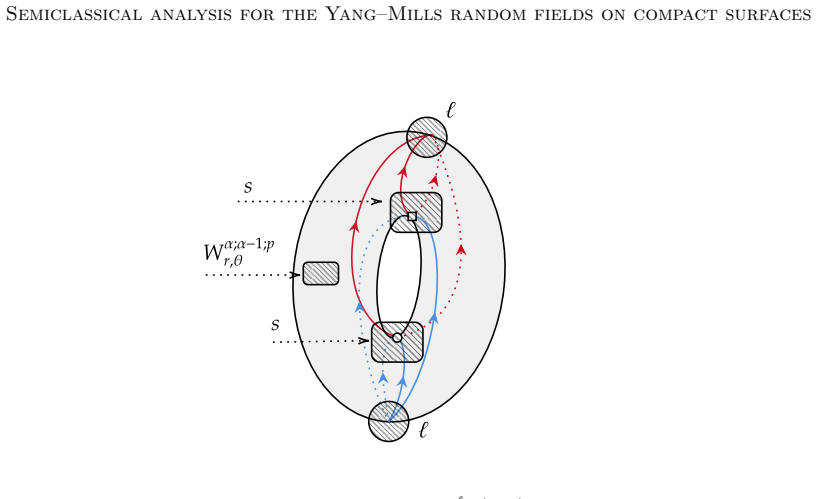
The carrying object is the decomposition $B^{\alpha,p,s,\ell}_{\mathrm{YM}}=W^{\alpha,p,s,\ell}\oplus(\mathfrak{g}\otimes\mathrm{span}\{U_a\})$, where $W^{\alpha,p,s,\ell}$ is an anisotropic Banach space of distributional one-forms with local Gagliardo regularity $\alpha$ along the flow and $\alpha-1$ transversely, weighted by parameters $s$ and $\ell$ near saddle points and extrema, and the $U_a$ are integration currents over unstable curves. The Morse gauge itself is the gauge transformation generated by the twisted transport equation $\partial_t g_t + L_V g_t + A(V)g_t=0$, whose large-time solution turns any smooth flat connection into the combinatorial object $\sum_a\left(\int_{W^s(a)}A\right)U_a$. This geometry supplies a formula for the Atiyah--Bott--Goldman symplectic form as a sum over intersection numbers of unstable curves, and the extraction maps $\pi_{\mathrm{noise}}$ and $\mathrm{Ext}_a$ split any random connection into its vanishing noise part and its surviving flat part.
What would settle it
On the torus with $G=\mathrm{SU}(2)$, the proof predicts that the noise moment $E\|\pi_{\mathrm{noise}} A_{\Sigma,t\sigma}\|^{2p}_{B^{\alpha,2p,s,\ell}}$ decays like a positive power of $t$ determined by $p$ and $\dim G$; if a direct computation shows the decay is slower than any positive power, tightness fails and the limit retains noise. Alternatively, if the holonomy functional $\mathrm{Hol}_{\max f-\epsilon}(A^{\mathrm{Free}}_{S,\sigma})$ cannot be realized as a measurable function of the $B$-space element, the conditioning that defines the closed-surface measure is undefined.
Extended reading notes
Core claim
The central claim (Theorem 2.4) is that, for $\alpha\in(1/3,1/2)$, $p\ge 2$, $s<0$, $\ell<-1$, the family of Yang--Mills measures $(A_{\Sigma,t\sigma})_{t>0}$ converges weakly on $B^{\alpha,p,s,\ell}_{\mathrm{YM}}$ to a measure supported on the finite-dimensional space $F$ spanned by the currents $U_a$ of integration over unstable curves of the Morse flow. The limit coincides with the push-forward of the normalized Atiyah--Bott--Goldman measure under the map $(g_a)\mapsto\sum_a \log(g_a)U_a$ restricted to the locus $\mathrm{Hol}_{\partial S}((g_a))=1_G$. The proof proceeds by uniform moment bounds that make the family tight, then shows the Gaussian noise component vanishes as $t\to 0$ while the finite-dimensional flat component survives and is identified with the symplectic volume through the heat-kernel regularization of $\mathrm{Hol}_{\partial S}$. This yields a semiclassical limit at the level of random distributional connections.
Load-bearing premise
The conclusion depends on the free-boundary Yang--Mills measure existing as a random element of these anisotropic spaces with measurable holonomy and the moment bounds used in Propositions 5.6--5.8; that construction is deferred to a companion paper and only sketched in Appendix A.
Editorial extensions
If this is right
- Bounded continuous functions on the anisotropic space $B^{\alpha,p,s,\ell}_{\mathrm{YM}}$ become admissible observables for both the Yang--Mills measure and the limiting Atiyah--Bott--Goldman measure.
- In the zero-area limit the Gaussian noise component of the connection vanishes, so the limiting random connection is almost surely a finite linear combination of integration currents over unstable curves of the Morse flow.
- The normalized Atiyah--Bott--Goldman symplectic volume acquires an explicit representative as the push-forward of a conditioned Haar measure on $G^{2g}$ under $(g_a)\mapsto\sum_a \log(g_a)U_a$.
- For genus at least two, singular points of the moduli space carry zero symplectic volume and can be ignored in the limit, while genus one requires and receives a separate treatment.
- Because the Yang--Mills action depends on the metric only through the area form, the small-area limit is the same as the strong-coupling, small-temperature, and semiclassical limits.
Reading between the lines
- If the identification is right, the Atiyah--Bott--Goldman measure can be sampled by drawing the finite-dimensional flat component from the conditioned Haar law and discarding the noise; this suggests numerical estimators for symplectic volumes from the distributional limit.
- The Morse-gauge description of flat connections is effectively a non-abelian analogue of the Morse--Witten complex, so the same device might compute intersection-pairing or symplectic invariants of character varieties from purely dynamical data on the surface.
- The same probabilistic convergence is expected for general compact Lie groups, but the geometric identification with the Atiyah--Bott--Goldman measure would need to handle reducible representations and non-trivial centers separately.
- A testable extension would be to prove that the conditioned holonomy process converges to the combinatorial holonomy in a rough-path topology, giving a quantitative rate for the zero-area limit rather than only weak convergence.
Signed reviews
Editorial analysis
A structured set of objections, weighed in public.
Referee Report
Summary. The paper develops a Morse-theoretic gauge fixing to construct Yang--Mills random connections as probability measures on anisotropic Besov-type spaces B^{α,p,s,ℓ}_{YM} of distributional 1-forms on compact surfaces. The geometric part (Section 3) represents flat connections by singular currents supported on unstable curves of a Morse gradient flow and gives a formula for the Atiyah--Bott--Goldman symplectic form in these 'Morse gauge' coordinates. The probabilistic part (Sections 5--6) defines the Yang--Mills measure by conditioning a free-boundary measure on trivial boundary holonomy, and claims that in the zero-area limit the family (A_{Σ,tσ}) converges in B^{α,p,s,ℓ}_{YM} to a measure supported on the finite-dimensional space F, identified with the normalized ABG symplectic volume. This is the content of Theorems 2.4 and 6.3. The proof of the existence and measurability of the free-boundary measure and its holonomy functional is delegated to Appendix A and to the unpublished companion paper [6], with Appendix A explicitly labeled a sketch.
Significance. If the main theorem is correct, it would be a substantial advance: it would give the first distribution-level semiclassical limit of two-dimensional Yang--Mills fields, going beyond the holonomy-level results of Witten, Forman, Liu, and Sengupta, and would answer a question of Lévy. The paper also contains genuinely interesting geometric material: the Morse-gauge description of the character variety in Section 3 is concrete and elegant, and the anisotropic spaces of Section 4 are designed in a principled way, with the decomposition and compactness arguments worked out in unusual detail. However, the central probabilistic claim rests on an unfinished construction: the companion paper [6] is 'in preparation', Appendix A is a sketch, and at the exact point where the conditioning holonomy crosses unstable curves the manuscript concedes that the required second-order rough-path term is not defined. In addition, the tightness proof in Section 6.1 contains a logical gap. For these reasons the paper cannot be accepted in its present form.
major comments (3)
- [Appendix A, Definition 5.3] Definition 5.3 defines the Yang--Mills pre-measure by conditioning on Hol_{maxf−ε}(A^Free_{S,σ})=1, so the holonomy functional must be a well-defined measurable function on the anisotropic space. The only in-manuscript support for this is Appendix A, which is explicitly a sketch. The gap is not cosmetic: in §A.3, footnote 13 states that 'when γ intersects unstable curves, it is no longer clear how to make sense of the Wick square', and equation (A.11) simply concatenates elementary parallel transports with group-element jumps, without proving Chen's identity across the jumps or the moment bounds needed to control the concatenated rough path. Since the level curve {f=maxf−ε} intersects ∪_a W^u(a), this is exactly the case needed for the conditioning. Thus Definition 5.3 is not fully justified, and Theorems 2.1 and 2.4 do not currently have a well-defined object.
- [Section 6.1, proof of Theorem 6.1] The proof of tightness states: 'Using the compact injections of the spaces B^{α,p,s,ℓ}_{YM}, it is enough to show sup_t E[∥A_{Σ,tσ}∥^p_{B^{α,p,s,ℓ}_{YM}}] < ∞.' This inference is invalid. Boundedness in the same Banach space B^{α,p,s,ℓ}_{YM} does not imply tightness there, even if compact injections into that space exist; one would need a uniform bound in a strictly finer space that compactly injects into B^{α,p,s,ℓ}_{YM}. Propositions 4.11 and 4.12 provide such finer spaces, but no uniform bounds in those finer spaces are proved. Consequently Theorem 6.1, and with it the convergence statements in Theorems 6.3 and 2.4, are not established by the arguments given.
- [Theorems 2.4, 5.4, 6.3 and Propositions 5.7–5.8] The parameter ranges of the main statements are mutually inconsistent. Theorem 2.4 requires α∈(1/3,1/2), p≥2, s<0, ℓ<−1, while Theorem 6.3 concludes the same convergence for α<1/2, p≥1, ℓ<0, and Theorem 5.4 states the existence of the measure for ℓ<1, s<0. The bounds proved in Proposition 5.7 and Proposition 5.8 involve conditions such as ℓ−1/p<0 and 2pℓ−2+dimG/q′−p<0, not ℓ<−1. Moreover the introduction indicates that the expected support condition is s<−1, while Theorem 2.4 assumes s<0. The proof therefore does not justify the range claimed in the paper's headline theorem, and the statements in Sections 5 and 6 do not agree with it.
minor comments (4)
- [Definition 4.1] The displayed second difference in the flow-box norm contains W(x1,y2) twice; presumably one of the terms should be W(x1,y1). As written the expression reduces to a first-order difference and would define a different space.
- [Section 6.2, proof of Proposition 6.2] The phrase 'From Paragraph 20' does not correspond to any numbered paragraph; it should refer to Section 5.3 or to a specific displayed estimate.
- [Appendix A.1] The Cauchy estimate in L^p(Ω,W^{α−ε,α−1−ε,p}) is followed by the conclusion of convergence in W^{α,α−1,p;s,ℓ}, but the loss of ε in the local regularity is never addressed.
- [Theorem 6.3] Theorem 6.3 does not specify the allowed range of the weight s, although the spaces B^{α,p,s,ℓ}_{YM} depend on s; this makes the statement of the theorem incomplete.
Circularity Check
The existence of the free-boundary Yang–Mills variable with a measurable holonomy is imported from same-author prior work, one 'in preparation', and the appendix admits the Wick square is undefined on curves crossing unstable curves; the ABG identification itself rests on independent published results.
-
self citation load bearing
[Theorem 5.2 (§5.1), Definition 5.3 (§5.2), Theorem 5.4 (§5.3), Appendix A.3 footnote 13 and A.5 eq. (A.11)]
"The following theorem is a rigorous result on the existence of the Yang–Mills measure. It has been proved in both [15] and [6]. ... In the appendix, we recall how to adapt the arguments of [6] ... / Beware that the Wick square is ill defined except when the curve is transverse to V and does not intersect unstable curves; in that case, the Stratonovich differential defines the Wick square. But when γ intersects unstable curves, it is no longer clear how to make sense of the Wick square."
The B^{α,p,s,ℓ}-valued free-boundary variable A^Free_{S,σ}, on which Definition 5.3 conditions to define the closed-surface Yang–Mills measure, is not constructed in this paper: Theorem 5.2 imports it from [15] (identical authors) and [6] (containing a present author, 'in preparation'). The appendix is explicitly a sketch and, at exactly the point where the conditioning level curve crosses unstable curves, concedes that the Wick square underlying the holonomy functional is undefined; formula (A.11) then concatenates elementary pieces with jumps without proving Chen's identity or measurability across the jumps.
full rationale
Most of the geometric derivation is self-contained or rests on published external results. The Morse-gauge description of M_g (Theorem 2.2, Proposition 2.3) is proved in-paper using the published spectral result [16] together with standard character-variety facts. The identification of the heat-kernel limit with the Atiyah–Bott–Goldman symplectic volume (Theorem 3.5) is explicitly delegated to Witten, Forman, Liu, and Sengupta, whose work is independent of the present paper and does not reduce to the authors' own assumptions. The genuinely load-bearing gap is the existence of the free-boundary Yang–Mills measure A^Free_{S,σ} as a B^{α,p,s,ℓ}-valued random variable with a measurable holonomy functional. This is imported from refs. [15] and [6]; [15] has exactly the present authors and [6] is 'in preparation'. The in-paper Appendix A is labelled a sketch, and its footnote 13 concedes that the second-order rough path term defining the holonomy is not well defined when the curve intersects unstable curves; formula (A.11) then assembles jumps without a proof of Chen's identity or of the required moment bounds. Since Definition 5.3 conditions on exactly this holonomy, Theorem 5.4 and hence the objects in Theorems 6.1, 6.3, and 2.4 inherit an unverified self-citation. This is a load-bearing support issue rather than a case where the final measure equals its input by construction: the limit identification with the ABG measure is obtained through independent published computations, and the anisotropic-space convergence is new content. Score 4 reflects the presence of a load-bearing self-citation while the central claim still has substantial independent content.
Assumptions & free parameters
assumptions (6)
- domain assumption Existence of a perfect Morse function f and Morse-Smale pair (f,h) on Σ, with h flat in Morse charts and V C^1 linearizable near critical points.
- standard math Dang-Riviere convergence: φ^{-t*}_f α → Σ_{a∈Crit_1(f)} (∫_{W^s(a)} α) U_a as t→∞ for Morse-Smale flows.
- domain assumption The free-boundary Yang-Mills measure A^{Free}_{S,σ} exists as a B^{α,p,s,ℓ}_{YM}-valued random variable with the properties of Theorem 5.2, as constructed in [6,15].
- standard math The heat-kernel identities of Witten, Forman, Liu and Sengupta (Equation 3.3 and Theorem 3.5) identify the ε→0 limit of p_ε(Hol_{∂S})/Z_ε with the normalized ABG symplectic volume.
- standard math Rough path theory (Friz-Hairer): existence, uniqueness and stability of RDEs driven by geometric rough paths of regularity α>1/3.
- domain assumption G=SU(N) is simply connected, so all G-bundles over Σ are trivial.
Cite this review
Pith. "Pith review of Semiclassical analysis for Yang--Mills random connections on compact surfaces." pith.science (2026). https://pith.science/paper/6ZAT3WSZ
@misc{pith2026260719037,
  author       = {Pith},
  title        = {Pith review of: Semiclassical analysis for Yang--Mills random connections on compact surfaces},
  year         = {2026},
  howpublished = {\url{https://pith.science/paper/6ZAT3WSZ}},
  note         = {Machine review of arXiv:2607.19037}
}
read the original abstract
We introduce anisotropic Banach spaces of distributional 1-forms on compact surfaces designed to capture the fine regularity properties of Morse gauge-fixed Yang--Mills random connections. Using singular connections supported on unstable curves of a Morse gradient flow, we provide a new description of the moduli space of flat connections and of its canonical Atiyah--Bott--Goldman symplectic form. When the group is the special unitary group, we prove that in the zero-area limit, the Yang--Mills random connection converges, within these anisotropic spaces, to a random distributional 1-form whose law coincides with our Morse-theoretic representative of the Atiyah--Bott--Goldman measure. Our approach extends the works of Witten, Forman, Liu, and Sengupta by establishing the zero-area limit of the Yang--Mills measure at the level of random distributional connections, rather than only at the level of holonomies. This answers a question of Thierry L\'evy on the semiclassical limits of Yang--Mills random connections.
Figures


Forward citations
Cited by 1 Pith paper
-
A PDE approach to the 2D Yang-Mills measure
The 2D Yang–Mills measure on the unit square admits a Coulomb-gauge representative in every Ω^1_β, β<1 — Gaussian-free-field regularity — with L^p moments growing like p^{(2+β)/2+δ}.
Reference graph
Works this paper leans on
-
[6]
G. Bonthonneau, R. Chhaibi, V. Dang, G. Rivi` ere, and T. Tˆ o, The Yang–Mills measure on surfaces via Morse theory, in preparation
-
[1]
”A Lefschetz fixed point formula for elliptic complexes: II
Atiyah, Michael F., and Raoul Bott. ”A Lefschetz fixed point formula for elliptic complexes: II. Applications.” Annals of Mathematics 88.3 (1968): 451-491
work page 1968
-
[2]
M. F. Atiyah and R. Bott, The Yang–Mills equations over Riemann surfaces,Philosophical Transactions of the Royal Society of London. Series A308(1982), 523–615
work page 1982
- [3]
-
[4]
Dynamical zeta functions and dynamical determinants for hyperbolic maps
Baladi, Viviane. Dynamical zeta functions and dynamical determinants for hyperbolic maps. Berlin: Springer, 2018
work page 2018
-
[5]
Baladi, Viviane. ”The quest for the ultimate anisotropic Banach space.” Journal of Statistical Physics 166.3 (2017): 525-557
work page 2017
-
[7]
I. Biswas and K. Guruprasad, Principal bundles on open surfaces and invariant functions on Lie groups,International Journal of Mathematics4(1993), 535–544
work page 1993
-
[8]
C. Bonatti, L. J. D´ ıaz, and M. Viana,Dynamics Beyond Uniform Hyperbolicity: A Global Geometric and Probabilistic Perspective, Springer, Berlin, Heidelberg, 2005
work page 2005
Show all 64 references
-
[9]
Bismut, H
J.-M. Bismut, H. Gillet, and C. Soul´ e, Analytic torsion and holomorphic determinant bundles I. Bott–Chern forms and analytic torsion,Communications in Mathematical Physics115(1988), 49–78
1988
-
[10]
Bismut and W
J.-M. Bismut and W. Zhang, An extension of a theorem by Cheeger and M¨ uller,Ast´ erisque 205(1992), 235
1992
-
[11]
Chevyrev and H
I. Chevyrev and H. Shen, Invariant measure and universality of the 2D Yang–Mills Langevin dynamic, arXiv preprint arXiv:2302.12160 (2023). 64 Nguyen Viet Dang and Elias Nohra
2023 arXiv
-
[12]
Chevyrev, Yang–Mills measure on the two-dimensional torus as a random distribution, Communications in Mathematical Physics372(2019), 1027–1058
I. Chevyrev, Yang–Mills measure on the two-dimensional torus as a random distribution, Communications in Mathematical Physics372(2019), 1027–1058
2019
-
[13]
Dahlqvist, LargeNlimit of Wilson loops on orientable closed surfaces in the light of Koike–Schur–Weyl duality and spin networks, arXiv:2603.11374
A. Dahlqvist, LargeNlimit of Wilson loops on orientable closed surfaces in the light of Koike–Schur–Weyl duality and spin networks, arXiv:2603.11374
-
[14]
Dahlqvist, T
A. Dahlqvist, T. Lemoine, Large N limit of the Yang-Mills measure on compact surfaces II: Makeenko-Migdal equations and the planar master field, Forum of Mathematics, Sigma, Volume 13, e17, 2025
2025
-
[15]
N. V. Dang and E. Nohra, The Yang–Mills measure on compact surfaces as a universal scaling limit of lattice gauge models, arXiv preprint arXiv:2602.08591 (2026)
2026
-
[16]
N. V. Dang and G. Rivi` ere, Spectral analysis of Morse–Smale gradient flows,Annales Scien- tifiques de l’ ´Ecole Normale Sup´ erieure52(2019), 1403–1458
2019
-
[17]
”Pollicott–ruelle spectrum and Witten laplacians.” Journal of the European Mathematical Society 23.6 (2021): 1797-1857
Dang, Nguyen Viet, and Gabriel Riviere. ”Pollicott–ruelle spectrum and Witten laplacians.” Journal of the European Mathematical Society 23.6 (2021): 1797-1857
2021
-
[18]
Dynamical residues of Lorentzian spectral zeta func- tions
Nguyen Viet Dang; Micha l Wrochna. Dynamical residues of Lorentzian spectral zeta func- tions. Journal de l’ ´Ecole polytechnique — Math´ ematiques, Tome 9 (2022), pp. 1245-1292. doi: 10.5802/jep.205
2022 doi
-
[19]
B. K. Driver, YM2: continuum expectations, lattice convergence, and lassos,Communications in Mathematical Physics123(1989), 575–616
1989
-
[20]
”Upper bound on the density of Ruelle resonances for Anosov flows.” Communications in mathematical physics 308.2 (2011): 325-364
Faure, Fr´ ed´ eric, and Johannes Sj¨ ostrand. ”Upper bound on the density of Ruelle resonances for Anosov flows.” Communications in mathematical physics 308.2 (2011): 325-364
2011
-
[21]
Fock, Vladimir V., and Alexei A. Rosly. ”Poisson structure on moduli of flat connections on Riemann surfaces andR-matrix.” arXiv preprint math/9802054 (1998)
1998 arXiv
-
[22]
Fran¸ cois and P
Q. Fran¸ cois and P. Tarrago, Positive formula for the product of conjugacy classes on the unitary group, arXiv:2405.06723
-
[23]
Fran¸ cois, D
Q. Fran¸ cois, D. Garc´ ıa-Zelada, T. L´ evy, and P. Tarrago, A positive formula for volumes of moduli spaces of flat unitary connections on compact surfaces, arXiv:2603.20517
-
[24]
Forman, Small volume limits of 2-d Yang–Mills,Communications in Mathematical Physics 151(1993), 39–52
R. Forman, Small volume limits of 2-d Yang–Mills,Communications in Mathematical Physics 151(1993), 39–52
1993
-
[25]
A course on rough paths
Friz, Peter K., and Martin Hairer. A course on rough paths. Berlin: Springer International Publishing, 2020
2020
-
[26]
W. M. Goldman, The symplectic nature of fundamental groups of surfaces,Advances in Mathematics54(1984), 200–225
1984
-
[27]
W. M. Goldman, Representations of fundamental groups of surfaces, inGeometry and Topol- ogy: Proceedings of the Special Year Held at the University of Maryland, College Park 1983– 1984, Springer, Berlin, Heidelberg, 2006, pp. 95–117. 65 Semiclassical analysis for the Yang–Mill...
1983
-
[28]
Finite Volume Flows and Morse Theory
Harvey, F. Reese, and H. Blaine Lawson. “Finite Volume Flows and Morse Theory.” Annals of Mathematics 153, no. 1 (2001): 1–25. https://doi.org/10.2307/2661371
2001 doi
-
[29]
Narasimhan
Harder, G¨ unter, and Mudumbai S. Narasimhan. ”On the cohomology groups of moduli spaces of vector bundles on curves.” Mathematische Annalen 212.3 (1975): 215-248
1975
-
[30]
Hsu, Brownian bridges on Riemannian manifolds,Probability Theory and Related Fields, 84, 103–118 (1990)
E. Hsu, Brownian bridges on Riemannian manifolds,Probability Theory and Related Fields, 84, 103–118 (1990)
1990
-
[31]
L. C. Jeffrey, Extended moduli spaces of flat connections on Riemann surfaces,Mathematische Annalen298(1994), 667–692
1994
-
[32]
Knudsen and D
F. Knudsen and D. Mumford, The projectivity of the moduli space of stable curves I: Prelim- inaries on ‘det’ and ‘div’,Mathematica Scandinavica39(1976), 19–55
1976
-
[33]
Komori, K
Y. Komori, K. Matsumoto, and H. Tsumura,The Theory of Zeta-Functions of Root Systems, Springer, 2023
2023
-
[34]
Koralov and Y
L. Koralov and Y. G. Sinai,Theory of Probability and Random Processes, Springer, 2007
2007
-
[35]
”On the Thom-Smale complex.” Ast´ erisque 205 (1992): 219-233
Laudenbach, Fran¸ cois. ”On the Thom-Smale complex.” Ast´ erisque 205 (1992): 219-233
1992
-
[36]
L´ evy, Two-dimensional Markovian holonomy fields,Ast´ erisque(2010)
T. L´ evy, Two-dimensional Markovian holonomy fields,Ast´ erisque(2010)
2010
-
[37]
L´ evy,Yang–Mills Measure on Compact Surfaces, American Mathematical Society, 2003
T. L´ evy,Yang–Mills Measure on Compact Surfaces, American Mathematical Society, 2003
2003
-
[38]
Lemoine, Universal dualities for Wilson loops in lattice Yang–Mills, arXiv:2604.16252
T. Lemoine, Universal dualities for Wilson loops in lattice Yang–Mills, arXiv:2604.16252
-
[39]
Liu, Heat kernel and moduli space,Mathematical Research Letters3(1996), 743–762
K. Liu, Heat kernel and moduli space,Mathematical Research Letters3(1996), 743–762
1996
-
[40]
Liu, Heat kernels, symplectic geometry, moduli spaces, and finite groups,Surveys in Dif- ferential Geometry5(1996), 527–542
K. Liu, Heat kernels, symplectic geometry, moduli spaces, and finite groups,Surveys in Dif- ferential Geometry5(1996), 527–542
1996
-
[41]
33 Colloquio Brasilero de Matematica
Transfer operators in Hyperbolic Dynamics An introduction, with Mark Demers and Niloofar Kiamari. 33 Colloquio Brasilero de Matematica. Editora do IMPA. pp.252 (2021). ISBN 978- 65-89124-26-9
2021
-
[42]
”Character Varieties.” (2025)
Maret, Arnaud. ”Character Varieties.” (2025)
2025
-
[43]
Wavelets, vibrations and scalings
Meyer, Yves. Wavelets, vibrations and scalings. No. 9. American Mathematical Soc., 1998
1998
-
[44]
M. Magee. Random unitary representations of surface groups I: asymptotic expansions. Comm. Math. Phys. 391 (2022)
2022
-
[45]
M. Magee. Random unitary representations of surface groups, II: The largenlimit. Geom. Topol. 29 (2025)
2025
-
[46]
A. A. Migdal, Phase transitions in gauge and spin-lattice systems,Zh. Eksp. Teor. Fiz.69 (1975), 1457. 66 Nguyen Viet Dang and Elias Nohra
1975
-
[47]
Mirzakhani,Simple Geodesics on Hyperbolic Surfaces and the Volume of the Moduli Space of Curves, Harvard University, 2004
M. Mirzakhani,Simple Geodesics on Hyperbolic Surfaces and the Volume of the Moduli Space of Curves, Harvard University, 2004
2004
-
[48]
Geometry of characteristic classes
Morita, Shigeyuki. Geometry of characteristic classes. Vol. 199. Providence, RI: American Mathematical Society, 2001
2001
-
[49]
King and A
C. King and A. Sengupta, A new 2-form for connections on surfaces with boundary,Letters in Mathematical Physics34(1995), 135–147
1995
-
[50]
King and A
C. King and A. Sengupta, A symplectic structure for connections on surfaces with boundary, Communications in Mathematical Physics175(1996), 657–671
1996
-
[51]
Seshadri
Narasimhan, Mudumbai S., and Conjeeveram S. Seshadri. ”Stable and unitary vector bundles on a compact Riemann surface.” Annals of Mathematics 82.3 (1965): 540-567
1965
-
[52]
Hitchhiker’s guide to the fractional Sobolev spaces
Di Nezza, Eleonora, Giampiero Palatucci, and Enrico Valdinoci. Hitchhiker’s guide to the fractional Sobolev spaces. Bulletin des sciences math´ ematiques 136.5 (2012): 521-573
2012
-
[53]
Sengupta, The Yang–Mills measure forS 2,Journal of Functional Analysis108(1992), 231–273
A. Sengupta, The Yang–Mills measure forS 2,Journal of Functional Analysis108(1992), 231–273
1992
-
[54]
Sengupta,Gauge Theory on Compact Surfaces, American Mathematical Society, 1997
A. Sengupta,Gauge Theory on Compact Surfaces, American Mathematical Society, 1997
1997
-
[55]
Sengupta,The moduli space of flat connections on oriented surfaces with boundary, Journal of Functional Analysis, 190(1):179-232
A. Sengupta,The moduli space of flat connections on oriented surfaces with boundary, Journal of Functional Analysis, 190(1):179-232
-
[56]
Sengupta, The volume measure for flat connections as limit of the Yang–Mills measure, Journal of Geometry and Physics 47.4 (2003): 398-426
A. Sengupta, The volume measure for flat connections as limit of the Yang–Mills measure, Journal of Geometry and Physics 47.4 (2003): 398-426
2003
-
[57]
Sengupta, The Semiclassical Limit for SU(2) and SO(3) Gauge Theory on the Torus, Commun
A. Sengupta, The Semiclassical Limit for SU(2) and SO(3) Gauge Theory on the Torus, Commun. Math. Phys. 169, 297-313 (1995)
1995
-
[58]
C. H. Taubes,Differential Geometry: Bundles, Connections, Metrics and Curvature, Vol. 23, OUP Oxford, 2011
2011
-
[59]
Estimates on translations and Taylor expansions in fractional Sobolev spaces
del Teso, F´ elix, David G´ omez-Castro, and Juan Luis V´ azquez. Estimates on translations and Taylor expansions in fractional Sobolev spaces. Nonlinear Analysis 200 (2020): 111995
2020
-
[60]
Viana and K
M. Viana and K. Oliveira,Foundations of Ergodic Theory, No. 151, Cambridge University Press, 2016
2016
-
[61]
Viana,Lectures on Lyapunov Exponents, Vol
M. Viana,Lectures on Lyapunov Exponents, Vol. 145, Cambridge University Press, 2014
2014
-
[62]
Witten, On quantum gauge theories in two dimensions,Communications in Mathematical Physics141(1991), 153–209
E. Witten, On quantum gauge theories in two dimensions,Communications in Mathematical Physics141(1991), 153–209
1991
-
[63]
Witten, Two-dimensional gauge theories revisited,Journal of Geometry and Physics9 (1992), 303–368
E. Witten, Two-dimensional gauge theories revisited,Journal of Geometry and Physics9 (1992), 303–368
1992
-
[64]
The monodromy group
Zoladek, Henryk. The monodromy group. Vol. 67. Springer, 2006. 67
2006
Reviewed August 15, 2026 · model on record in the stance chip above.
Discussion (0). Continue with ORCID to comment.