REVIEW 3 major objections 4 minor 1 cited by
Scalar vortex coronagraph mask design and predicted performance
T0 review · 3 major / 4 minor · reviewed 2026-08-14 · deepseek-v4-flash
Pith's one-line read Scalar vortex masks built from paired dielectric layers can, in theory, reach 3×10^-11 raw contrast, enough for Earth-like exoplanet imaging.
desk verdict A solid theoretical design study of scalar vortex masks; the headline 3e-11 contrast rests on an idealized mask model that omits central singularity and step-edge scattering. read the letter →
The pith
A machine-rendered reading of the paper's core claim, the machinery that carries it, and where it could break.
The reading
What carries the argument
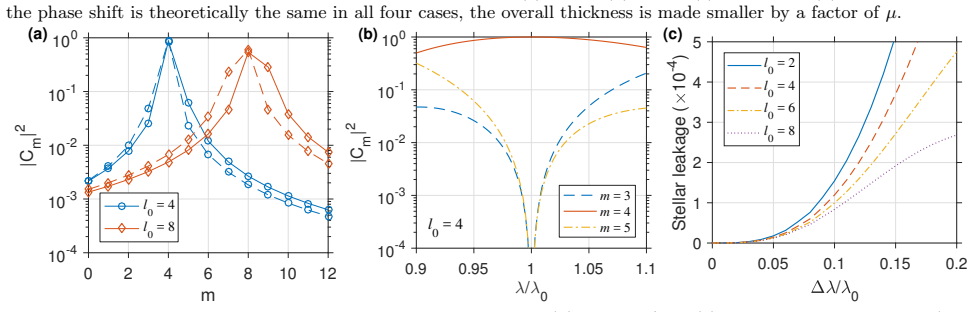
The vortex spectrum, the Fourier decomposition $C_m(\lambda) = \frac{1}{2\pi}\int_{-\pi}^{\pi} t(\theta,\lambda) e^{-im\theta} d\theta = \operatorname{sinc}(l(\lambda)-m)$, reduces chromatic leakage to a competition between the charge dispersion $l(\lambda)$ and the integer mode order. Even nonzero modes are perfectly rejected by the Lyot stop, so leakage below it is governed by $C_0$ and the odd modes; this makes $l(\lambda)$ the single design target. The multi-material spiral phase plate is the mechanism for shaping $l(\lambda)$: each plate contributes $l_j (n_j(\lambda)-1)/(n_j(\lambda_0)-1)$ times $\lambda_0/\lambda$, and the layer heights are optimized to keep the total charge near the design value across the passband.
What would settle it
Fabricate the two-material photoresist spiral phase plate, measure its transmitted phase profile with an interferometer, and place it in a coronagraph with a Lyot stop at $b/a=0.8$ and flat deformable mirrors; a normalized irradiance above roughly $10^{-10}$ across the 20% band, or any visible Airy-core leakage, would disprove the $3\times10^{-11}$ prediction.
Extended reading notes
Core claim
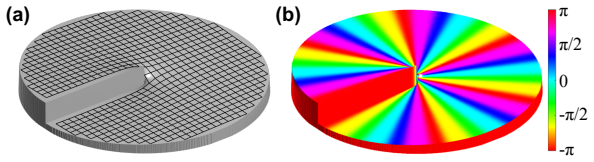
The paper's central claim is that scalar vortex coronagraphs, whose focal plane masks impart the same azimuthal phase ramp $t = \exp(i l(\lambda)\theta)$ regardless of polarization, can be made achromatic enough for terrestrial exoplanet imaging by stacking two dielectric spiral phase plates. The residual chromatic leakage follows from the vortex spectrum: $|C_m(\lambda)|^2 = \operatorname{sinc}^2(l(\lambda)-m)$. A single-material plate has $l(\lambda)=l_0\lambda_0/\lambda$, so power bleeds into neighboring modes; pairing two materials with complementary dispersion flattens $l(\lambda)$ near $l_0$. With photoresists and a charge-6 design over $\Delta\lambda/\lambda=0.2$, a Lyot stop at $b/a=0.8$ and flat deformable mirrors, the simulation gives normalized irradiance $3\times10^{-11}$ and 28% core throughput, which meets the benchmark for Earth-like planet detection.
Load-bearing premise
The predicted contrast assumes the real mask behaves exactly as an ideal azimuthal phase ramp $\exp(i l(\lambda)\theta)$ with no central defect, no radial phase variation, and no fabrication thickness errors; any of those would flood the dark zone with leaked starlight.
Editorial extensions
If this is right
- A working scalar vortex mask removes the circular polarizer/analyzer pair required by vector vortex masks, so planet throughput can double.
- At the example design, raw contrast $3\times10^{-11}$ with flat mirrors and $b/a=0.8$ shows wavefront control may be unnecessary for chromatic leakage if the mask is truly achromatic.
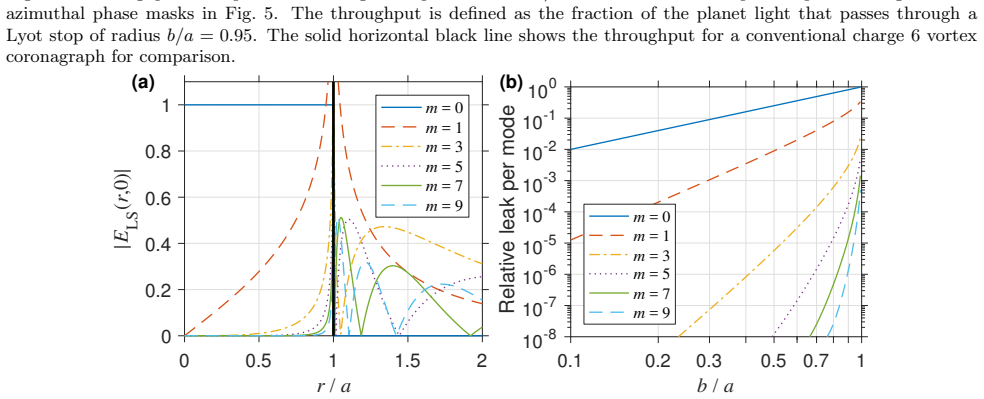
- Undersizing the Lyot stop suppresses high-order odd leakage modes, with larger charge $l_0$ gaining more suppression from the same reduction in stop radius.
- Even a single-material, strongly chromatic scalar mask can reach roughly $10^{-8}$ raw contrast with two deformable mirrors, making it viable for less demanding benchmarks.
- Generalized azimuthal masks with discrete etch steps can offer similar cancellation while being easier to fabricate, at the cost of azimuthal throughput variations.
Reading between the lines
- The paper leaves implicit that the same vortex-spectrum optimization should carry over to sector and staircase masks by tuning layer depths to minimize odd-mode weights, which would let discrete-etch fabrication reach achromatic performance without smooth spiral ramps.
- A testable extension is mapping the thickness-contrast Pareto front for higher-index material pairs such as diamond; if pitch multiplicity can reduce thickness, the design may become manufacturable at realistic tolerances.
- Because the $3\times10^{-11}$ prediction assumes no wavefront error, a real telescope would still need separate control of mirror aberrations; the mask contrast is necessary, not sufficient, for an Earth-like image.
Signed reviews
Editorial analysis
A structured set of objections, weighed in public.
Referee Report
Summary. The paper proposes scalar (polarization-independent) vortex coronagraph masks made from multi-layer dielectric structures as an alternative to vector vortex masks, arguing that these avoid retardance-error leakage and polarization splitting. It derives the modal decomposition and chromatic leakage of azimuthal phase masks with charge l(λ), studies the effect of an undersized Lyot stop and deformable-mirror wavefront control for the simple dispersion model l(λ)=l0 λ0/λ, and finally presents a two-material achromatic spiral phase plate whose charge is optimized to remain close to l0 across a passband. The best example reports a normalized irradiance of 3e-11 with a core throughput of 0.28, which the authors use to support the abstract's claim that such masks can, in theory, provide sufficient broadband starlight suppression for imaging Earth-like planets.
Significance. If the predicted performance is correct, the paper offers a credible path toward simpler, higher-throughput vortex coronagraphs for HabEx/LUVOIR-class missions. The strengths of the paper are the clean modal decomposition in Eqs. (7)-(8), the leakage analysis as a function of Lyot-stop radius (Fig. 7), and the use of an established simulation tool (FALCO) for the EFC results in Section 4 and Table 1; these parts are plausible and well matched to the stated model. However, the headline 3e-11 result in Section 5 rests on a single, minimally described example, and the entire study assumes an ideal azimuthal phase function with no central singularity, no finite edge transitions, and no fabrication errors. These omissions are load-bearing because they affect exactly the regime of raw contrast that the paper claims.
major comments (3)
- [Section 5 (Fig. 10)] The headline normalized irradiance of 3e-11 is presented without the simulation specification needed to reproduce or verify it. I could not find the passband, wavelength sampling, pupil model, final-image-plane dark-hole definition, or the propagation model used to convert the optimized l(λ) into the reported irradiance; the Fig. 10 caption reports only Inorm and core throughput. The optimization in Eq. (10) minimizes ∫|l(λ)-l0|² dλ, not contrast, so the 3e-11 value must be backed by an end-to-end propagation model or a closed-form leakage estimate with all assumptions stated. Because this number is the basis of the abstract's central claim, it is load-bearing and should be made fully reproducible.
- [Sections 2, 3.2.5, and 5] The performance model assumes an ideal azimuthal phase function t = exp(i l(λ)θ) with no radial dependence, no central singularity, and no finite transition at azimuthal discontinuities. A real two-material spiral phase plate has a finite central region and fabricated step edges (including pitch-multiplicity boundaries), whose scattering enters the Lyot stop and is not captured by the vortex-spectrum calculation. At a claimed contrast of 3e-11 this unmodeled leakage is plausibly at or above the headline level. Since the paper itself notes in Section 3.1 that scalar vortex masks have not been tested at high contrast, a sensitivity analysis for core size, edge rounding, and thickness or index errors is necessary before the predicted performance can be considered robust.
- [Section 5, Eq. (10)] The design objective is minimizing the integrated deviation of l(λ) from l0, which is a convenient proxy but not the coronagraph contrast. The reported 3e-11 appears to assume that residual deviations in l(λ) after optimization are the only leakage source; however, the actual raw contrast also depends on the Lyot-stop radius, the spectral weighting, and the exact residual l(λ) shape. Please state the relationship between the optimized l(λ) residuals and the reported irradiance, or replace the number with a direct propagation calculation of the optimized mask; otherwise the claim that the achromatic design achieves 3e-11 is unsupported.
minor comments (4)
- [Fig. 10] Please provide the optimized step heights Δd1 and Δd2, the material dispersion data used for the photoresists (including machine-readable numerical values rather than only URLs), and the values of λ0 and Δλ for both panels.
- [Section 3.2.4] The statement that the phase shift is 'theoretically the same' for all pitch multiplicities should be qualified as applying to the ideal mask, because the physical discontinuities and their finite transitions differ among the four cases.
- [Section 3.3] The assertion that a mask with dominant m = ±6 modes is 'at least as robust to aberrations as a charge 6 vortex coronagraph' appears heuristic; a short justification or a citation to the aberration-sensitivity analysis would make this claim precise.
- [Appendix A, Eqs. (21)-(33)] In the small-retardance approximations, please state explicitly that the expressions keep only first-order terms in ϵV and ϵQ, since Eq. (34) is then an approximation rather than an exact leakage formula.
Circularity Check
No circular derivation: the Section 5 contrast is a simulation output from an independent coronagraph model, not a refit of the optimization metric.
full rationale
Section 5's two-material achromatic design minimizes Eq. (10), the integral of |l(λ)−l0|^2, which is an intermediate chromatic-charge error rather than the final contrast. The reported normalized irradiance of 3×10^-11 is then obtained from the full Fourier-optics coronagraph model (vortex spectrum, Lyot stop b/a = 0.8, flat deformable mirrors), so it is a simulation output and not set equal to the optimization metric by construction. The vortex spectrum in Eqs. (7)–(8) is an analytic identity for a mask transmission t = exp(ilθ); propagating the optimized l(λ) through this spectrum into a leakage estimate is a derivation, not a tautology. The EFC results in Table 1 rely on FALCO, which the authors developed and cite, but FALCO is a general coronagraph simulation and wavefront-control package; the raw contrasts are outputs of that numerical model, not fitted inputs. Self-citations in the Fig. 1 caption and FALCO references are contextual or tool citations and do not carry the central argument. The paper explicitly defers fabrication effects such as the central singularity, finite phase-step edges, and thickness errors (Secs. 3.3 and 5), which affects physical realism but does not make the derivation circular. No load-bearing step reduces by construction to its own input.
Assumptions & free parameters
free parameters (4)
- Design vortex charge l0 =
6 or 8
- Relative Lyot stop radius b/a =
0.7, 0.8, 0.9, or 0.95
- Spectral bandwidth Delta lambda / lambda =
0.1 or 0.2
- Spiral plate step heights Delta d1 and Delta d2 =
Not reported numerically; optimized to minimize integral of |l(lambda) - l0|^2
assumptions (6)
- standard math Scalar Fourier optics applies to propagation through the coronagraph (pupil to focal plane to Lyot stop).
- domain assumption An ideal vortex mask t = exp(i l theta) completely cancels starlight inside the Lyot stop for nonzero even integer l.
- domain assumption The scalar mask is a pure phase element with no radial amplitude variation, described only by an azimuthal charge l(lambda).
- domain assumption The photoresist refractive index dispersion curves (MicroChem PMMA and SU-8) are accurate over the passband.
- domain assumption The telescope pupil is a clear, unobscured circular aperture.
- domain assumption The deformable mirror surfaces computed by EFC can be physically realized with negligible fitting error.
Cite this review
Pith. "Pith review of Scalar vortex coronagraph mask design and predicted performance." pith.science (2026). https://pith.science/paper/6ZLDPB5B
@misc{pith2026190809786,
  author       = {Pith},
  title        = {Pith review of: Scalar vortex coronagraph mask design and predicted performance},
  year         = {2026},
  howpublished = {\url{https://pith.science/paper/6ZLDPB5B}},
  note         = {Machine review of arXiv:1908.09786}
}
abstract
Vortex coronagraphs are an attractive solution for imaging exoplanets with future space telescopes due to their relatively high throughput, large spectral bandwidth, and low sensitivity to low-order aberrations compared to other coronagraphs with similar inner working angles. Most of the vortex coronagraph mask development for space applications has focused on generating a polychromatic, vectorial, optical vortex using multiple layers of liquid crystal polymers. While this approach has been the most successful thus far, current fabrication processes achieve retardance errors of 0.1-1.0$^\circ$, which causes a nonnegligible fraction of the starlight to leak through the coronagraph. Circular polarizers are typically used to reject the stellar leakage reducing the throughput by a factor of two. Vector vortex masks also complicate wavefront control because they imprint conjugated phase ramps on the orthogonal circular polarization components, which may need to be split in order to properly sense and suppress the starlight. Scalar vortex masks can potentially circumvent these limitations by applying the same phase shift to all incident light regardless of the polarization state and thus have the potential to significantly improve the performance of vortex coronagraphs. We present scalar vortex coronagraph designs that make use of focal plane masks with multiple layers of dielectrics that (a) produce phase patterns that are relatively friendly to standard manufacturing processes and (b) achieve sufficient broadband starlight suppression, in theory, for imaging Earth-like planets with future space telescopes.
Figures


Figures from the paper (7 more)




Forward citations
Cited by 1 Pith paper
-
Single-shot focal plane wavefront sensing with the spatially-clipped self-coherent camera
The Spatially-Clipped Self-Coherent Camera (SCSCC) senses wavefronts in a single shot and, in simulations, digs a 5-20 lambda/D dark hole to ~4e-10 intensity, about 50x deeper than pairwise probing for fast-evolving speckles.
Reference graph
Works this paper leans on
-
[1]
The Habitable Exoplanet Observatory (HabEx) Mission Concept Study Interim Report,
Gaudi, B. S., Seager, S., Mennesson, B., Kiessling, A., Warfield, K., Kuan, G., Cahoy, K., Clarke, J. T., Domagal- Goldman, S., Feinberg, L., Guyon, O., Kasdin, J., Mawet, D., Robinson, T., Rogers, L., Scowen, P., Somerville, R., Stapelfeldt, K., Stark, C., Stern, D., Turnbull, M., Martin, S., Alvarez-Salazar, O., Amini, R., Arnold, W., Balasubramanian, B....
arXiv 2018
-
[2]
The LUVOIR Mission Concept Study Interim Report
The LUVOIR Team, “The LUVOIR Mission Concept Study Interim Report,” ArXiv e-prints , 1809.09668 (2018)
work page Pith review arXiv 2018
-
[3]
Pueyo, L., Zimmerman, N., Bolcar, M., Groff, T., Stark, C., Ruane, G., Jewell, J., Soummer, R., Laurent, K. S., Wang, J., Redding, D., Mazoyer, J., Fogarty, K., Juanola-Parramon, R., Domagal-Goldman, S., Roberge, A., Guyon, O., and Mandell, A., “The LUVOIR architecture ”A” coronagraph instrument,” Proc. SPIE 10398, 103980F (2017)
work page 2017
-
[4]
Annular Groove Phase Mask Coronagraph,
Mawet, D., Riaud, P., Absil, O., and Surdej, J., “Annular Groove Phase Mask Coronagraph,” Astrophys. J. 633, 1191–1200 (2005)
2005
-
[5]
Optical vortex coronagraph,
Foo, G., Palacios, D. M., and Swartzlander, G. A., “Optical vortex coronagraph,” Opt. Lett. 30, 3308–3310 (2005)
2005
-
[6]
Vortex coronagraphs for the Habitable Exoplanet Imaging Mission (HabEx) concept: theoretical performance and telescope requirements,
Ruane, G., Mawet, D., Mennesson, B., Jewell, J., and Shaklan, S., “Vortex coronagraphs for the Habitable Exoplanet Imaging Mission (HabEx) concept: theoretical performance and telescope requirements,” J. Astron. Telesc. Instrum. Syst. 4(1), 015004 (2018)
2018
-
[7]
ExoEarth yield landscape for future direct imaging space telescopes,
Stark, C. C., Belikov, R., Bolcar, M. R., Cady, E., Crill, B. P., Ertel, S., Groff, T., Hildebrandt, S., Krist, J., Lisman, P. D., Mazoyer, J., Mennesson, B., Nemati, B., Pueyo, L., Rauscher, B. J., Riggs, A. J., Ruane, G., Shaklan, S. B., Sirbu, D., Soummer, R., Laurent, K. S., and Zimmerman, N., “ExoEarth yield landscape for future direct imaging space t...
work page 2019
-
[8]
Pancharatnam, S. Proc. Indian Acad. Sci. 44, 247 (1956)
work page 1956
Show all 64 references
-
[9]
Quantal Phase Factors Accompanying Adiabatic Changes,
Berry, M. V., “Quantal Phase Factors Accompanying Adiabatic Changes,” Proc. Royal Soc. Lond. A 392, 45–57 (1984)
1984
-
[10]
Generation of doughnut laser beams by use of a liquid-crystal cell with a conversion efficiency near 100%,
Ganic, D., Gan, X., Gu, M., Hain, M., Somalingam, S., Stankovic, S., and Tschudi, T., “Generation of doughnut laser beams by use of a liquid-crystal cell with a conversion efficiency near 100%,” Opt. Lett. 27(15), 1351–1353 (2002)
2002
-
[11]
Optical Spin-to-Orbital Angular Momentum Conversion in Inhomogeneous Anisotropic Media,
Marrucci, L., Manzo, C., and Paparo, D., “Optical Spin-to-Orbital Angular Momentum Conversion in Inhomogeneous Anisotropic Media,” Phys. Rev. Lett. 96(16), 163905 (2006)
2006
-
[12]
Optical Vectorial Vortex Coronagraphs using Liquid Crystal Polymers: theory, manufacturing and laboratory demonstration,
Mawet, D., Serabyn, E., Liewer, K., Hanot, C., McEldowney, S., Shemo, D., and O’Brien, N., “Optical Vectorial Vortex Coronagraphs using Liquid Crystal Polymers: theory, manufacturing and laboratory demonstration,” Opt. Express 17, 1902–1918 (2009)
2009
-
[13]
The Vector Vortex Coronagraph: sensitivity to central obscuration, low-order aberrations, chromaticism, and polarization,
Mawet, D., Pueyo, L., Moody, D., Krist, J., and Serabyn, E., “The Vector Vortex Coronagraph: sensitivity to central obscuration, low-order aberrations, chromaticism, and polarization,” Proc. SPIE 7739, 773914 (2010)
2010
-
[14]
The Vector Vortex Coronagraph: Laboratory Results and First Light at Palomar Observatory,
Mawet, D., Serabyn, E., Liewer, K., Burruss, R., Hickey, J., and Shemo, D., “The Vector Vortex Coronagraph: Laboratory Results and First Light at Palomar Observatory,” Astrophys. J. 709, 53–57 (2010)
2010
-
[15]
Formation of helical beams by use of Pancharatnam–Berry phase optical elements,
Biener, G., Niv, A., Kleiner, V., and Hasman, E., “Formation of helical beams by use of Pancharatnam–Berry phase optical elements,” Opt. Lett. 27(21), 1875–1877 (2002)
2002
-
[16]
Subwavelength surface-relief gratings for stellar coronagraphy,
Mawet, D., Riaud, P., Surdej, J., and Baudrand, J., “Subwavelength surface-relief gratings for stellar coronagraphy,” Appl. Opt. 44(34), 7313–7321 (2005)
2005
-
[17]
Polychromatic vectorial vortex formed by geometric phase elements,
Niv, A., Biener, G., Kleiner, V., and Hasman, E., “Polychromatic vectorial vortex formed by geometric phase elements,” Opt. Lett. 32(7), 847–849 (2007)
2007
-
[18]
Design and laboratory demonstration of an achromatic vector vortex coronagraph,
Murakami, N., Hamaguchi, S., Sakamoto, M., Fukumoto, R., Ise, A., Oka, K., Baba, N., and Tamura, M., “Design and laboratory demonstration of an achromatic vector vortex coronagraph,” Opt. Express 21, 7400–7410 (2013)
2013
-
[19]
Ultra-thin plasmonic optical vortex plate based on phase discontinuities,
Genevet, P., Yu, N., Aieta, F., Lin, J., Kats, M. A., Blanchard, R., Scully, M. O., Gaburro, Z., and Capasso, F., “Ultra-thin plasmonic optical vortex plate based on phase discontinuities,” Appl. Phys. Lett. 100(1), 013101 (2012)
2012
-
[20]
Generating optical orbital angular momentum at visible wavelengths using a plasmonic metasurface,
Karimi, E., Schulz, S. A., De Leon, I., Qassim, H., Upham, J., and Boyd, R. W., “Generating optical orbital angular momentum at visible wavelengths using a plasmonic metasurface,” Light Sci. Appl. 3, e167 (2014)
2014
-
[21]
Achromatic orbital angular momentum generator,
Bouchard, F., Mand, H., Mirhosseini, M., Karimi, E., and Boyd, R. W., “Achromatic orbital angular momentum generator,” New J. Phys. 16(12), 123006 (2014)
2014
-
[22]
Improving vector vortex waveplates for high-contrast coronagraphy,
Nersisyan, S. R., Tabiryan, N. V., Mawet, D., and Serabyn, E., “Improving vector vortex waveplates for high-contrast coronagraphy,” Opt. Express 21(7), 8205–8213 (2013)
2013
-
[23]
Vector vortex coronagraphy for exoplanet detection with spatially variant diffractive waveplates,
Serabyn, E., Prada, C. M., Chen, P., and Mawet, D., “Vector vortex coronagraphy for exoplanet detection with spatially variant diffractive waveplates,” J. Opt. Soc. Am. B 36(5), D13–D19 (2019)
2019
-
[24]
Astronomical demonstration of an optical vortex coronagraph,
Swartzlander, G. A., Ford, E. L., Abdul-Malik, R. S., Close, L. M., Peters, M. A., Palacios, D. M., and Wilson, D. W., “Astronomical demonstration of an optical vortex coronagraph,” Opt. Express 16, 10200 (2008)
2008
-
[25]
A broad-band scalar vortex coronagraph,
Errmann, R., Minardi, S., and Pertsch, T., “A broad-band scalar vortex coronagraph,” Mon. Notices Royal Astron. Soc. 435(1), 565–569 (2013)
2013
-
[26]
Vortex-phase filtering technique for extracting spatial information from unresolved sources,
Ruane, G., Kanburapa, P., Han, J., and Swartzlander, G. A., “Vortex-phase filtering technique for extracting spatial information from unresolved sources,” Appl. Opt. 53(20), 4503–4508 (2014)
2014
-
[27]
The phase rotor filter,
Khonina, S., Kotlyar, V., Shinkaryev, M., Soifer, V., and Uspleniev, G., “The phase rotor filter,” J. Mod. Opt 39(5), 1147–1154 (1992)
1992
-
[28]
Generation of optical phase singularities by computer-generated holograms,
Heckenberg, N. R., McDuff, R., Smith, C. P., and White, A. G., “Generation of optical phase singularities by computer-generated holograms,” Opt. Lett. 17(3), 221–223 (1992)
1992
-
[29]
Efficient radially polarized laser beam generation with a double interferometer,
Tidwell, S. C., Kim, G. H., and Kimura, W. D., “Efficient radially polarized laser beam generation with a double interferometer,” Appl. Opt. 32(27), 5222–5229 (1993)
1993
-
[30]
Achromatic optical vortex lens,
Swartzlander, G. A., “Achromatic optical vortex lens,” Opt. Lett. 31(13), 2042–2044 (2006)
2006
-
[31]
Terrestrial exoplanet coronagraph image quality: study of polarization aberrations in Habex and LUVOIR update,
Breckinridge, J. B., Kupinski, M., Davis, J., Daugherty, B., and Chipman, R. A., “Terrestrial exoplanet coronagraph image quality: study of polarization aberrations in Habex and LUVOIR update,” Proc. SPIE 10698, 106981D (2018)
2018
-
[32]
High-contrast imaging results with the vortex coronagraph,
Serabyn, E., Trauger, J., Moody, D., Mawet, D., Liewer, K., Krist, J., and Kern, B., “High-contrast imaging results with the vortex coronagraph,” Proc. SPIE 8864, 88640Y (2013)
2013
-
[33]
Broadband wavefront correction algorithm for high-contrast imaging systems,
Give’on, A., Kern, B., Shaklan, S., Moody, D. C., and Pueyo, L., “Broadband wavefront correction algorithm for high-contrast imaging systems,” Proc. SPIE 6691, 66910A (2007)
2007
-
[34]
ACCESS: A Space Coronagraph Concept for Direct Imaging and Spectroscopy of Exoplanetary Systems
Trauger, J., Alexander, J., Brugarolas, P., Dawson, O., Gappinger, R., Henry, C., Krist, J., Mawet, D., Mireles, V., Moody, D., Park, P., Pueyo, L., Serabyn, E., Shaklan, S., Stapelfeldt, K., Trauger, J., Traub, W., Guyon, O., Belikov, R., Kasdin, J., Spergel, D., Vanderbei, R...
-
[35]
Analysis of azimuthal phase mask coronagraphs,
H´ enault, F., “Analysis of azimuthal phase mask coronagraphs,” Opt. Commun. 423, 186–199 (2018)
2018
-
[36]
The Four-Quadrant Phase-Mask Coronagraph. I. Principle,
Rouan, D., Riaud, P., Boccaletti, A., Cl´ enet, Y., and Labeyrie, A., “The Four-Quadrant Phase-Mask Coronagraph. I. Principle,” Publ. Astron. Soc. Pac. 112, 1479–1486 (2000)
2000
-
[37]
An eight-octant phase-mask coronagraph,
Murakami, N., Uemura, R., Baba, N., Nishikawa, J., Tamura, M., Hashimoto, N., and Abe, L., “An eight-octant phase-mask coronagraph,” Publ. Astron. Soc. Pac. 120(872), 1112–1118 (2008)
2008
-
[38]
Experimental verification of an optical vortex coronagraph,
Lee, J. H., Foo, G., Johnson, E. G., and Swartzlander, G. A., “Experimental verification of an optical vortex coronagraph,” Phys. Rev. Lett. 97, 053901 (2006)
2006
-
[39]
Optical vortices generated by multi-level achromatic spiral phase plates for broadband beams,
Xie, Q. and Zhao, D., “Optical vortices generated by multi-level achromatic spiral phase plates for broadband beams,” Opt. Commun. 281(1), 7 – 11 (2008)
2008
-
[40]
Optical vortex coronagraphs on ground-based telescopes,
Jenkins, C., “Optical vortex coronagraphs on ground-based telescopes,” Mon. Not. R. Astron. Soc. 384, 515–524 (2008)
2008
-
[41]
Wide-band coronagraph with sinusoidal phase in the angular direction,
Ma, O., Cao, Q., and Hou, F., “Wide-band coronagraph with sinusoidal phase in the angular direction,” Opt. Express 20(10), 10933–10943 (2012)
2012
-
[42]
Wide-band six-region phase mask coronagraph,
Hou, F., Cao, Q., Zhu, M., and Ma, O., “Wide-band six-region phase mask coronagraph,” Opt. Express 22(2), 1884–1895 (2014)
2014
-
[43]
Generation of high-order optical vortices using directly machined spiral phase mirrors,
Campbell, G., Hage, B., Buchler, B., and Lam, P. K., “Generation of high-order optical vortices using directly machined spiral phase mirrors,” Appl. Opt. 51(7), 873–876 (2012)
2012
-
[44]
Helical-wavefront laser beams produced with a spiral phaseplate,
Beijersbergen, M. W., Coerwinkel, R. P. C., Kristensen, M., and Woerdman, J. P., “Helical-wavefront laser beams produced with a spiral phaseplate,” Opt. Commun. 112, 321–327 (1994)
1994
-
[45]
Production and characterization of spiral phase plates for optical wavelengths,
Oemrawsingh, S. S. R., van Houwelingen, J. A. W., Eliel, E. R., Woerdman, J. P., Verstegen, E. J. K., Kloosterboer, J. G., and ’t Hooft, G. W., “Production and characterization of spiral phase plates for optical wavelengths,” Appl. Opt. 43(3), 688–694 (2004)
2004
-
[46]
Fabrication of a three-dimensional optical vortices phase mask for astronomy by means of electron-beam lithogra- phy,
Prasciolu, M., Tamburini, F., Anzolin, G., Mari, E., Melli, M., Carpentiero, A., Barbieri, C., and Romanato, F., “Fabrication of a three-dimensional optical vortices phase mask for astronomy by means of electron-beam lithogra- phy,” Microelectronic Engineering 86(4), 1103 – 11...
2009
-
[47]
Fabrication and testing of l = 2 optical vortex phase masks for coronography,
Mari, E., Anzolin, G., Tamburini, F., Prasciolu, M., Umbriaco, G., Bianchini, A., Barbieri, C., and Romanato, F., “Fabrication and testing of l = 2 optical vortex phase masks for coronography,” Opt. Express 18(3), 2339–2344 (2010)
2010
-
[48]
Design, fabrication and characterization of phase masks for astronomical applications,
Massari, M., Romanato, F., Carli, M., Ongarello, T., Prasciolu, M., Tamburini, F., Mari, E., Bianchini, A., and Barbieri, C., “Design, fabrication and characterization of phase masks for astronomical applications,” Microelectronic Engineering 88(8), 2675 – 2678 (2011)
2011
-
[49]
Fabrication and characterization of high-quality spiral phase plates for optical applications,
Massari, M., Ruffato, G., Gintoli, M., Ricci, F., and Romanato, F., “Fabrication and characterization of high-quality spiral phase plates for optical applications,” Appl. Opt. 54(13), 4077–4083 (2015)
2015
-
[50]
Generating optical vortex with large topological charges by spiral phase plates in cascaded and double-pass configuration,
Wang, C., Liu, T., Ren, Y., Shao, Q., and Dong, H., “Generating optical vortex with large topological charges by spiral phase plates in cascaded and double-pass configuration,” Optik 171, 404 – 412 (2018)
2018
-
[51]
Broadband nulling of a vortex phase mask,
Swartzlander, G. A., “Broadband nulling of a vortex phase mask,” Opt. Lett. 30(21), 2876–2878 (2005)
2005
-
[52]
Complex apodized lyot coronagraph for exoplanet imaging with partially obscured telescope apertures,
Trauger, J., Moody, D., and Gordon, B., “Complex apodized lyot coronagraph for exoplanet imaging with partially obscured telescope apertures,” Proc. SPIE 8864, 886412 (2013)
2013
-
[53]
Fast linearized coronagraph optimizer (FALCO) I: a software toolbox for rapid coronagraphic design and wavefront correction,
Riggs, A., Ruane, G., Coker, C. T., Sidick, E., Shaklan, S. B., and Kern, B. D., “Fast linearized coronagraph optimizer (FALCO) I: a software toolbox for rapid coronagraphic design and wavefront correction,”Proc. SPIE 10698, 106982V (2018)
2018
-
[54]
Fast linearized coronagraph optimizer (FALCO) II: optical model validation and time savings over other methods,
Sidick, E., Riggs, A., Ruane, G., Krist, J., Moody, D., and Coker, C. T., “Fast linearized coronagraph optimizer (FALCO) II: optical model validation and time savings over other methods,” Proc. SPIE 10698, 106984S (2018)
2018
-
[55]
Fast Linearized Coronagraph Optimizer (FALCO) III: optimization of key coronagraph design parameters,
Coker, C. T., Ruane, G., Riggs, A., Sidick, E., Seo, B.-J., Kern, B., Marx, D., and Shaklan, S. B., “Fast Linearized Coronagraph Optimizer (FALCO) III: optimization of key coronagraph design parameters,” Proc. SPIE 10698, 1069851 (2018)
2018
-
[56]
Fast linearized coronagraph optimizer (FALCO) IV: coronagraph design survey for obstructed and segmented apertures,
Ruane, G., Riggs, A., Coker, C. T., Shaklan, S. B., Sidick, E., Mawet, D., Jewell, J., Balasubramanian, K., and Stark, C. C., “Fast linearized coronagraph optimizer (FALCO) IV: coronagraph design survey for obstructed and segmented apertures,” Proc. SPIE 10698, 106984U (2018)
2018
-
[57]
Diamond micro-optics: microlenses and antireflection structured surfaces for the infrared spectral region,
Karlsson, M. and Nikolajeff, F., “Diamond micro-optics: microlenses and antireflection structured surfaces for the infrared spectral region,” Opt. Express 11(5), 502–507 (2003)
2003
-
[58]
The W. M. Keck Observatory Infrared Vortex Coronagraph and a First Image of HIP 79124 B,
Serabyn, E., Huby, E., Matthews, K., Mawet, D., Absil, O., Femenia, B., Wizinowich, P., Karlsson, M., Bottom, M., Campbell, R., Carlomagno, B., Defr` ere, D., Delacroix, C., Forsberg, P., Gonzalez, C. G., Habraken, S., Jolivet, A., Liewer, K., Lilley, S., Piron, P., Reggiani, ...
2017
-
[59]
Deep Imaging Search for Planets Forming in the TW Hya Protoplanetary Disk with the Keck/NIRC2 Vortex Coronagraph,
Ruane, G., Mawet, D., Kastner, J., Meshkat, T., Bottom, M., Femen´ ıa Castell´ a, B., Absil, O., Gomez Gonzalez, C., Huby, E., Zhu, Z., Jenson-Clem, R., Choquet, ´E., and Serabyn, E., “Deep Imaging Search for Planets Forming in the TW Hya Protoplanetary Disk with the Keck/NIRC...
2017
-
[60]
Reference Star Differential Imaging of Close-in Companions and Circumstellar Disks with the NIRC2 Vortex Coronagraph at the W. M. Keck Observatory,
Ruane, G., Ngo, H., Mawet, D., Absil, O., Choquet, ´E., Cook, T., Gomez Gonzalez, C., Huby, E., Matthews, K., Meshkat, T., Reggiani, M., Serabyn, E., Wallack, N., and Xuan, W. J., “Reference Star Differential Imaging of Close-in Companions and Circumstellar Disks with the NIRC2...
2019
-
[61]
Efficient Spectroscopy of Exoplanets at Small Angular Separations with Vortex Fiber Nulling,
Ruane, G., Wang, J., Mawet, D., Jovanovic, N., Delorme, J.-R., Mennesson, B., and Wallace, J. K., “Efficient Spectroscopy of Exoplanets at Small Angular Separations with Vortex Fiber Nulling,” Astrophys. J. 867(2), 143 (2018)
2018
-
[62]
Vortex fiber nulling for exoplanet observations. I. Experimental demonstration in monochromatic light,
Echeverri, D., Ruane, G., Jovanovic, N., Mawet, D., and Levraud, N., “Vortex fiber nulling for exoplanet observations. I. Experimental demonstration in monochromatic light,” Opt. Lett. 44(9), 2204–2207 (2019)
2019
-
[63]
Vortex fiber nulling for exoplanet observations: conceptual design, theoretical performance, and initial scientific yield predictions,
Ruane, G., Echeverri, D., Jovanovic, N., Mawet, D., Serabyn, E., Wallace, J. K., Wang, J., and Batalha, N., “Vortex fiber nulling for exoplanet observations: conceptual design, theoretical performance, and initial scientific yield predictions,” Proc. SPIE 11117 (2019)
2019
-
[64]
The Vortex Fiber Nulling Mode of the Keck Planet Imager and Characterizer (KPIC),
Echeverri, D., Ruane, G., Jovanovic, N., Delorme, J.-R., Pezzato, J., Mawet, D., and Wallace, J. K., “The Vortex Fiber Nulling Mode of the Keck Planet Imager and Characterizer (KPIC),” Proc. SPIE 11117 (2019)
2019
Reviewed August 14, 2026 · model on record in the stance chip above.
Discussion (0). Continue with ORCID to comment.