Percolation of a cohesive fine particle in a static bed
Pith reviewed 2026-05-20 01:55 UTC · model grok-4.3
The pith
Cohesive fine particles trap in a bed of larger ones even when geometry allows passage.
A machine-rendered reading of the paper's core claim, the machinery that carries it, and where it could break.
Core claim
Sufficiently large cohesion and friction lead to non-geometric trapping of fine particles. Fines become trapped when they fail to rebound after a collision owing to large cohesion, low restitution, and low collision velocity, after which any rolling or sliding proves insufficient for detachment. This establishes that a sequence of local interactions—collision, adhesion, and post-contact motion—governs the ultimate fate of a fine particle. A collisional model with trapping probability per collision and collision frequency predicts trapping distance in the relevant regime, while a static force-balance condition predicts whether the particle remains stationary after contact.
What carries the argument
The sequence of collision followed by adhesion and post-contact motion that overrides geometric pore accessibility and decides whether the fine particle passes or sticks.
If this is right
- Trapping distance follows directly from a simple model using measured trapping probability per collision and the local collision rate.
- In non-rebounding collisions, cohesion amplifies frictional resistance enough to block later detachment.
- A force-balance equilibrium check after contact can forecast whether a fine particle stays put.
- Percolation of cohesive fines is set by particle-scale dynamics in addition to geometric accessibility.
Where Pith is reading between the lines
- In dense fines flows, particle-particle contacts among the fines themselves could shorten or lengthen the predicted trapping distances.
- The same adhesion-after-collision rule may control retention in aerosol filters or powder mixing equipment when cohesion is high.
- Varying bed motion or flow speed would test whether the static-bed trapping mechanism persists or gives way to shear-induced release.
Load-bearing premise
Fine particles interact only with the larger bed particles and not with each other, while the static randomly packed bed and chosen contact models fully capture the physics without collective or multi-body effects altering single-particle outcomes.
What would settle it
An experiment that measures the average distance cohesive fines travel before trapping in a packed bed of known size ratio and cohesion strength, then checks whether those distances match the collisional model's predictions for varying restitution and friction.
Figures






read the original abstract
Percolation of fine particles (fines) in a static bed of larger particles is central to many industrial and natural processes. Non-cohesive fines either pass through the bed or become trapped depending on multiple factors including particle sizes, friction and restitution coefficients, and size-polydispersity. Here we consider the additional factor of cohesion. We use the discrete element method to simulate gravity-driven percolation of cohesive fine particles through a static bed of randomly packed large particles; fines interact with bed particles but not with each other. A large-to-fine particle diameter ratio of 7 geometrically permits non-cohesive fines to pass the narrowest pore throats formed by the large particles so they can freely percolate. However, sufficiently large cohesion and friction lead to non-geometric trapping. Fines are trapped when they fail to rebound after a collision, due to large cohesion, low restitution, and low collision velocity, and any subsequent rolling or sliding is insufficient to cause detachment. This establishes a sequence of local interactions -- collision, adhesion, and post-contact motion -- that governs the ultimate fate of a fine particle. A collisional model that incorporates a trapping probability per collision and a collision frequency predicts the trapping distance in the regime dominated by collision-induced trapping. For non-rebounding collisions, frictional effects are enhanced by cohesion and, when large enough, prevent the fine particle from subsequently detaching. A static equilibrium condition based on force balance predicts whether a fine particle remains stationary after contact. These results show that percolation of cohesive fine particles is not determined by geometric accessibility alone, but also by particle-scale interaction dynamics that can override geometric expectations.
Editorial analysis
A structured set of objections, weighed in public.
Referee Report
Summary. The paper claims that percolation of cohesive fine particles through a static bed of larger particles (diameter ratio 7, which geometrically permits passage for non-cohesive fines) is governed by particle-scale dynamics rather than geometry alone. Using DEM simulations in which fines interact only with bed particles (not each other) in a fixed random packing, it shows that sufficiently large cohesion and friction produce non-geometric trapping: fines fail to rebound after collision due to cohesion, low restitution, and low velocity, after which rolling or sliding is insufficient for detachment. A collisional model incorporating a trapping probability per collision and collision frequency predicts the trapping distance in the collision-dominated regime; a force-balance equilibrium condition determines whether a particle remains stationary post-contact.
Significance. If the central claim holds, the work establishes that a specific sequence of local interactions (collision, adhesion, post-contact motion) can override geometric pore accessibility in cohesive granular percolation, with direct relevance to industrial and natural processes involving fine particles. The DEM results and the proposed collisional model supply a mechanistic account of how cohesion enhances frictional trapping in non-rebounding events, which is a clear strength when the simulations are reproducible and the model is independently validated.
major comments (2)
- [Abstract] Abstract: the collisional model is described as predicting trapping distance from a trapping probability per collision and collision frequency, yet the origin of the trapping probability (independent derivation/measurement versus extraction from the same DEM runs) is unspecified. If the latter, the prediction reduces to a re-expression of simulation outputs and does not constitute an independent test of the claimed mechanism.
- [Abstract] Abstract (simulation setup): the central claim that non-geometric trapping occurs via the stated collision-adhesion sequence rests on the assumptions that fines interact only with bed particles, the bed remains static and randomly packed, and no multi-body or collective effects alter single-particle outcomes. The manuscript provides no sensitivity tests or discussion of how these assumptions might fail at realistic fine concentrations or with bed mobility.
minor comments (1)
- [Abstract] Abstract: parameter choices for cohesion strength, friction coefficient, and restitution coefficient, as well as any validation against experiments or checks on sensitivity to random packing realizations, are not mentioned; adding a brief statement would improve clarity without altering the central claim.
Simulated Author's Rebuttal
We thank the referee for the careful and constructive review of our manuscript. We respond to each major comment below and have revised the manuscript to improve clarity on the model and to discuss the simulation assumptions.
read point-by-point responses
-
Referee: [Abstract] Abstract: the collisional model is described as predicting trapping distance from a trapping probability per collision and collision frequency, yet the origin of the trapping probability (independent derivation/measurement versus extraction from the same DEM runs) is unspecified. If the latter, the prediction reduces to a re-expression of simulation outputs and does not constitute an independent test of the claimed mechanism.
Authors: We thank the referee for highlighting this point. The trapping probability is determined directly from the DEM simulations by measuring the fraction of collisions that lead to permanent trapping for given cohesion, friction, and restitution values. The collisional model then uses this probability together with a collision frequency derived from the particle velocity and the geometry of the fixed bed to estimate the mean trapping distance. This provides a mechanistic scaling relation that interprets the simulation outcomes and allows extrapolation to different bed depths. We will revise the abstract and main text to state explicitly that the trapping probability originates from the DEM data and to clarify the interpretive role of the model. revision: yes
-
Referee: [Abstract] Abstract (simulation setup): the central claim that non-geometric trapping occurs via the stated collision-adhesion sequence rests on the assumptions that fines interact only with bed particles, the bed remains static and randomly packed, and no multi-body or collective effects alter single-particle outcomes. The manuscript provides no sensitivity tests or discussion of how these assumptions might fail at realistic fine concentrations or with bed mobility.
Authors: We agree that the idealized single-particle setup isolates the collision-adhesion mechanism. The simulations deliberately exclude fine-fine interactions and keep the bed fixed to focus on the local interaction sequence. We will add a dedicated paragraph in the discussion section that addresses the limitations of these assumptions, including possible changes at higher fine concentrations where multi-body contacts or bed-particle mobility could influence trapping statistics. While new sensitivity simulations are beyond the scope of the present revision, the added text will outline the parameter regimes in which the reported mechanism is expected to remain dominant. revision: partial
Circularity Check
Collisional model re-expresses simulation-derived trapping probability as a prediction
specific steps
-
fitted input called prediction
[Abstract and collisional model section]
"A collisional model that incorporates a trapping probability per collision and a collision frequency predicts the trapping distance in the regime dominated by collision-induced trapping."
The trapping probability is obtained by counting non-rebounding collisions in the DEM runs; the model then uses that same probability (plus collision frequency also measured in the runs) to 'predict' the mean trapping distance observed in those runs. The output is therefore statistically forced by the input statistics extracted from the identical dataset.
full rationale
The paper's central prediction of trapping distance relies on a collisional model whose key input (trapping probability per collision) is extracted from the same DEM simulations used to measure the output distance. This reduces the 'prediction' to a re-expression of simulation statistics rather than an independent derivation. The force-balance equilibrium condition is independent but does not carry the main claim. No self-citation load-bearing or ansatz smuggling is evident from the provided text.
Axiom & Free-Parameter Ledger
free parameters (3)
- cohesion strength
- friction coefficient
- restitution coefficient
axioms (2)
- domain assumption Fines interact with bed particles but not with each other
- domain assumption Bed remains static and randomly packed throughout
Reference graph
Works this paper leans on
-
[1]
Effects of cohesion and sliding friction Consider first the influence of cohesion, quantified by the Bond numberBo, and sliding frictionµon trap- ping of fine particles that would otherwise sift freely through the packed bed atR= 7. Figure 6 shows the dimensionless inverse trapping distance,d l/λ, as a function ofBofor sliding friction coefficientsµ∈ {0.0...
-
[2]
Effects of particle stiffness Particle stiffness, as controlled by the Young’s Modu- lus,E, can play a significant role in cohesive trapping be- havior. While the Hertzian contact force depends directly onE, the cohesive force in the DMT model used here is unaffected by particle stiffness. To consider the impact of stiffness, we simultaneously changeEfor ...
-
[3]
Because the Bond number based on the pull-off force in Eq
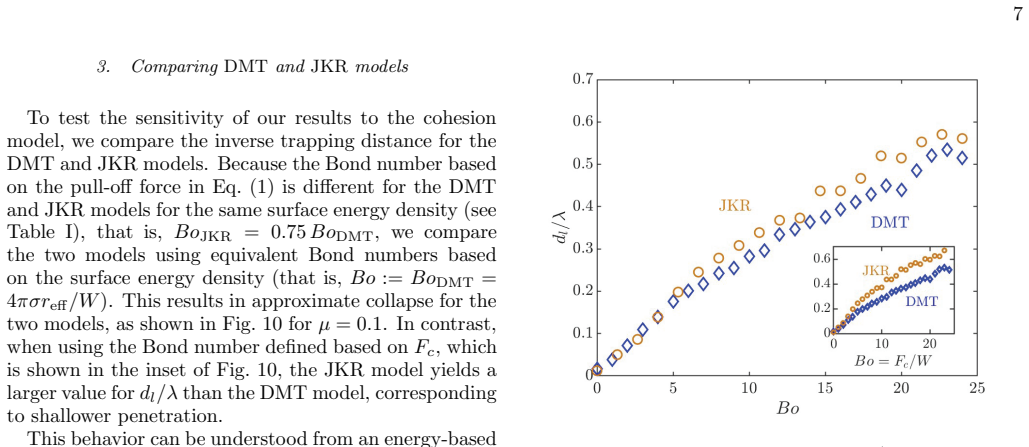
ComparingDMTandJKRmodels To test the sensitivity of our results to the cohesion model, we compare the inverse trapping distance for the DMT and JKR models. Because the Bond number based on the pull-off force in Eq. (1) is different for the DMT and JKR models for the same surface energy density (see Table I), that is,Bo JKR = 0.75Bo DMT, we compare the two...
-
[4]
Effective restitution coefficient and critical velocity When a particle contact is cohesive, the outcome of a collision depends on the relative impact velocity. For a normal collision between two particles with the particle contact colinear with the centers of the particles (no tan- gential velocity), the equation of motion in terms of the virtual overlap...
-
[5]
11(b, c)) where the fine particle does not rebound (Fig
Adhesion probability and collision frequency To isolate the role of collisions in the trapping pro- cess, we first consider an idealized case of purely adhe- sive trapping (Fig. 11(b, c)) where the fine particle does not rebound (Fig. 11(a)) or slide along the surface and eventually detach (Fig. 11(d)). This serves as an asymp- totic limit for systems cha...
-
[6]
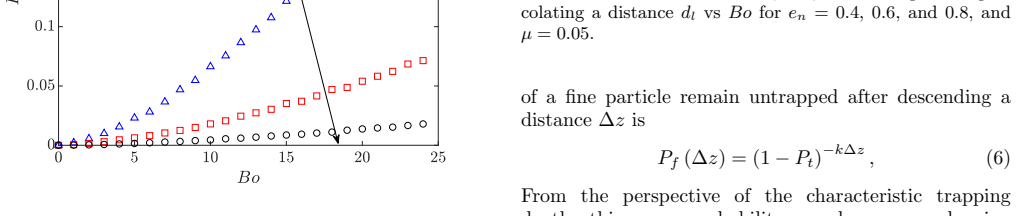
Connecting collisions with the trapping distance Consider now the collision of a cohesive fine particle with a bed particle. The fine particle sticks to the bed particle with trapping probabilityP t and rebounds from the bed particle with probability 1−P t. Afterncolli- sions, the probability that a fine particle is still free (not yet trapped) isP f = (1...
-
[7]
H. M. Jaeger, S. R. Nagel, and R. P. Behringer, Granu- lar solids, liquids, and gases, Rev. Mod. Phys.68, 1259 (1996)
work page 1996
-
[8]
J. Duran,Sands, powders, and grains: an introduction to the physics of granular materials(Springer Science & Business Media, 2012)
work page 2012
-
[9]
C. Bemrose and J. Bridgwater, A review of attrition and attrition test methods, Powder Technol.49, 97 (1987)
work page 1987
-
[10]
Schulze,Powders and bulk solids: behavior, charac- terization, storage and flow(Springer, 2008)
D. Schulze,Powders and bulk solids: behavior, charac- terization, storage and flow(Springer, 2008)
work page 2008
-
[11]
M. Sharma and Y. Yortsos, Fines migration in porous media, AIChE J.33, 1654 (1987)
work page 1987
-
[12]
W. Fang, S. Chen, S. Li, and I. Zuriguel, Clogging tran- sition of granular flow in porous structures, Phys. Rev. Res.6, 033046 (2024)
work page 2024
-
[13]
I. Ippolito, L. Samson, S. Bourles, and J.-P. Hulin, Diffu- sion of a single particle in a 3d random packing of spheres, Eur. Phys. J. E3, 227 (2000)
work page 2000
-
[14]
F. Lomin´ e and L. Oger, Dispersion of particles by spon- taneous interparticle percolation through unconsolidated porous media, Phys. Rev. E79, 051307 (2009)
work page 2009
-
[15]
D. R. Vyas, S. Gao, P. B. Umbanhowar, J. M. Ottino, and R. M. Lueptow, Impacts of packed bed polydispersity and deformation on fine particle transport, AIChE J.70, e18499 (2024)
work page 2024
-
[16]
J. Bridgwater, N. Sharpe, and D. Stocker, Particle mixing by percolation, Trans. Inst. Chem. Eng.47, T114 (1969)
work page 1969
-
[17]
J. Bridgwater and N. Ingram, Rate of spontaneous inter- particle percolation, Trans. Inst. Chem. Eng.49, 163 (1971)
work page 1971
-
[18]
J. Masliyah and J. Bridgwater, Particle percolation: a numerical study, Trans. Inst. Chem. Eng.52, 31 (1974)
work page 1974
-
[19]
S. Gao, J. M. Ottino, P. B. Umbanhowar, and R. M. Lueptow, Percolation of a fine particle in static granular beds, Phys. Rev. E107, 014903 (2023)
work page 2023
-
[20]
D. R. Vyas, R. M. Lueptow, J. M. Ottino, and P. B. Um- banhowar, Fine particle percolation dynamics in porous media, Phys. Rev. Res.8, 013201 (2026)
work page 2026
-
[21]
S. Remond, DEM simulation of small particles clogging in the packing of large beads, Physica A389, 4485 (2010)
work page 2010
-
[22]
R. S. Sharma and A. Sauret, Experimental models for cohesive granular materials: a review, Soft Matter21, 2193 (2025)
work page 2025
- [23]
-
[24]
J. Visser, Van der Waals and other cohesive forces affect- ing powder fluidization, Powder Technol.58, 1 (1989)
work page 1989
-
[25]
L. Bocquet, E. Charlaix, S. Ciliberto, and J. Crassous, Moisture-induced ageing in granular media and the ki- netics of capillary condensation, Nature396, 735 (1998)
work page 1998
-
[26]
T. C. Halsey and A. J. Levine, How sandcastles fall, Phys. Rev. Lett.80, 3141 (1998)
work page 1998
-
[27]
J. S. Marshall, Discrete-element modeling of particulate aerosol flows, J. Comput. Phys.228, 1541 (2009)
work page 2009
- [28]
-
[29]
H. Abbasfard, G. Evans, and R. Moreno-Atanasio, Ef- fect of van der Waals force cut-off distance on adhesive collision parameters in dem simulation, Powder Technol. 299, 9 (2016)
work page 2016
-
[30]
E. Murphy and S. Subramaniam, Binary collision out- comes for inelastic soft-sphere models with cohesion, Powder Technol.305, 462 (2017)
work page 2017
-
[31]
Y. Wang, Y. Wang, M. Zhou, and L. Duan, Energy dis- sipation mechanisms in particle collisions on submicron particle-layers: Experimental and DEM analysis, Chem. Eng. Sci.316, 121933 (2025)
work page 2025
-
[32]
A. Castellanos, J. Valverde, and M. Quintanilla, Aggre- gation and sedimentation in gas-fluidized beds of cohesive powders, Phys. Rev. E64, 041304 (2001)
work page 2001
-
[33]
Tomas, Fundamentals of cohesive powder consolida- tion and flow, Granul
J. Tomas, Fundamentals of cohesive powder consolida- tion and flow, Granul. Matter6, 75 (2004)
work page 2004
-
[34]
K. M. Kellogg, P. Liu, C. Q. LaMarche, and C. M. Hrenya, Continuum theory for rapid cohesive-particle flows: general balance equations and discrete-element- method-based closure of cohesion-specific quantities, J. Fluid Mech.832, 345 (2017)
work page 2017
-
[35]
K. M. Kellogg, P. Liu, and C. M. Hrenya, Discrete- element-method-based determination of particle-level in- puts for the continuum theory of flows with moderately cohesive particles, Processes11, 2553 (2023)
work page 2023
- [36]
- [37]
-
[38]
Plimpton, Fast parallel algorithms for short-range molecular dynamics, J
S. Plimpton, Fast parallel algorithms for short-range molecular dynamics, J. Comput. Phys.117, 1 (1995)
work page 1995
-
[39]
A. P. Thompson, H. M. Aktulga, R. Berger, D. S. Bolin- tineanu, W. M. Brown, P. S. Crozier, P. J. In’t Veld, A. Kohlmeyer, S. G. Moore, T. D. Nguyen,et al., LAMMPS-a flexible simulation tool for particle-based materials modeling at the atomic, meso, and continuum scales, Comput. Phys. Commun.271, 108171 (2022)
work page 2022
-
[40]
D. R. Vyas, J. M. Ottino, R. M. Lueptow, and P. B. Umbanhowar, Improved velocity-Verlet algorithm for the discrete element method, Comput. Phys. Commun.310, 109524 (2025)
work page 2025
-
[41]
C. Thornton, S. J. Cummins, and P. W. Cleary, An inves- tigation of the comparative behaviour of alternative con- 15 tact force models during elastic collisions, Powder Tech- nol.210, 189 (2011)
work page 2011
-
[42]
N. V. Brilliantov, F. Spahn, J.-M. Hertzsch, and T. P¨ oschel, Model for collisions in granular gases, Phys. Rev. E53, 5382 (1996)
work page 1996
-
[43]
R. D. Mindlin, Compliance of elastic bodies in contact, J. Appl. Mech.16, 259 (1949)
work page 1949
-
[44]
Luding, Cohesive, frictional powders: contact models for tension, Granul
S. Luding, Cohesive, frictional powders: contact models for tension, Granul. Matter10, 235 (2008)
work page 2008
-
[45]
Y. Wang, F. Alonso-Marroquin, and W. W. Guo, Rolling and sliding in 3-D discrete element models, Particuology 23, 49 (2015)
work page 2015
-
[46]
S. T. Nase, W. L. Vargas, A. A. Abatan, and J. Mc- Carthy, Discrete characterization tools for cohesive gran- ular material, Powder Technol.116, 214 (2001)
work page 2001
-
[47]
P.-G. De Gennes, F. Brochard-Wyart, and D. Qu´ er´ e, Capillarity and wetting phenomena: drops, bubbles, pearls, waves(Springer Science & Business Media, 2003)
work page 2003
-
[48]
V. Ralaiarisoa, P. Dupont, A. O. E. Moctar, F. Naaim- Bouvet, L. Oger, and A. Valance, Particle impact on a co- hesive granular media, Phys. Rev. E105, 054902 (2022)
work page 2022
- [49]
-
[50]
B. V. Derjaguin, V. M. Muller, and Y. P. Toporov, Effect of contact deformations on the adhesion of particles, J. Colloid Interface Sci.53, 314 (1975)
work page 1975
-
[51]
K. L. Johnson, K. Kendall, and A. D. Roberts, Surface energy and the contact of elastic solids, Proc. R. Soc. Lond. A324, 301 (1971)
work page 1971
-
[52]
Tabor, Surface forces and surface interactions, J
D. Tabor, Surface forces and surface interactions, J. Col- loid Interface Sci.58, 2 (1977)
work page 1977
discussion (0)
Sign in with ORCID, Apple, or X to comment. Anyone can read and Pith papers without signing in.