REVIEW 2 major objections 8 minor 31 references
Sinkhorn Normalization of Diffusion Kernels
T0 review · 2 major / 8 minor · reviewed 2026-08-06 · deepseek-v4-flash
Pith's one-line read The paper proves that any positive similarity matrix, rescaled by a symmetric Sinkhorn iteration, becomes a diffusion operator with mass preservation and spectrum in [0,1], and that for Gaussian and exponential kernels the construction is…
desk verdict Solid, useful paper: standard Sinkhorn core, honest citation, and credible applications; one repairable proof gap in the headline refinement theorem. read the letter →
The pith
A machine-rendered reading of the paper's core claim, the machinery that carries it, and where it could break.
The reading
What carries the argument
The central object is the symmetric Sinkhorn scaling matrix $\Lambda$, the unique positive diagonal matrix solving $\Lambda S \Lambda \mathbf{1} = \mathbf{1}$, computed by the iteration $\Lambda \gets \sqrt{\Lambda \oslash (S\Lambda)}$ until row sums converge, where $\oslash$ is element-wise division. Constant preservation is enforced by construction, and the spectral bound comes from the algebraic identity $$\sum_{i,j} K_{ij} \lambda_i \lambda_j (\sqrt{m_j}\, x_i - \sqrt{m_i}\, x_j)^2 = $2x^{{\top}}$(I - Q')x,$$ where $Q' = \sqrt{M}\,\Lambda K \Lambda \sqrt{M}$ and $x$ is any vector; since the left side is a sum of squares, $Q'$ has spectrum bounded above by 1, and positive semi-definiteness of $K$ gives the lower bound 0. The continuous-limit statement is carried by the Sinkhorn dual potentials $\lambda_s$ and $\lambda$, defined by the entropy-regularized optimal transport problem associated to the kernel, whose uniform convergence under weak measure convergence yields the uniform convergence of the operators $Q_s$ to $Q$.
What would settle it
Perturb the mass matrix $M$ of a point cloud with multiplicative log-normal noise of variance $\sigma^2$, recompute the normalized operator, and plot $\|Q_{\text{perturbed}} - Q_{\text{true}}\|_M$ against $\sigma$; Proposition 4.6 predicts linear growth, so a superlinear curve—or any positive smoothing operator for which the Sinkhorn iteration converges to a $Q$ that is not row-stochastic with spectrum in $[0,1]$—would falsify the central claim.
Extended reading notes
Core claim
On the paper's own terms, the discovery is a normalization theorem and a convergence theorem. For any finite discrete measure $\mu = \sum_i m_i \delta_{x_i}$ with positive weights, and any smoothing operator $S = KM$ with $K$ symmetric, positive semi-definite, and strictly positive entries, there exists a unique positive diagonal matrix $\Lambda$ such that $Q = \Lambda S \Lambda$ is a diffusion operator with respect to $\mu$: $Q$ is $M$-symmetric, $Q\mathbf{1} = \mathbf{1}$ (constant preservation, hence mass conservation), the spectrum of $Q$ lies in $[0,1]$, and $Q$ maps non-negative signals to non-negative signals. The scaling is found by the symmetric Sinkhorn algorithm, and the proof passes through a symmetric entropy-regularized optimal transport problem whose dual solution gives the scaling vector. When the kernel is Gaussian or exponential on a bounded domain, the discrete operators converge pointwise and uniformly to a continuous diffusion operator as the sampling measures converge weakly at fixed scale $\sigma > 0$. The paper further shows the normalization is stable under perturbations of the mass matrix: first-order relative errors in the masses are damped by a factor of at least two in the scaling factors.
Load-bearing premise
The mass matrix $M$ must be known and accurate, because all symmetry, mass conservation, and spectral properties hold only with respect to the measure that $M$ encodes; with poor mass estimates the normalized operator preserves the wrong measure and boundary bias reappears.
Editorial extensions
If this is right
- Any similarity or adjacency matrix, not just Gaussian kernels on manifolds, becomes a usable heat-diffusion operator: mass preservation and the spectral bound $[0,1]$ hold exactly, so un-normalized kernels' boundary bias and spectral explosion are removed.
- Laplacian-style processing becomes available on unstructured data (point clouds, sparse voxel grids, Gaussian mixtures, graphs) without a Laplacian, mesh, or factorization: spectral descriptors, smoothing, and feature-learning layers can be built directly on the normalized operator.
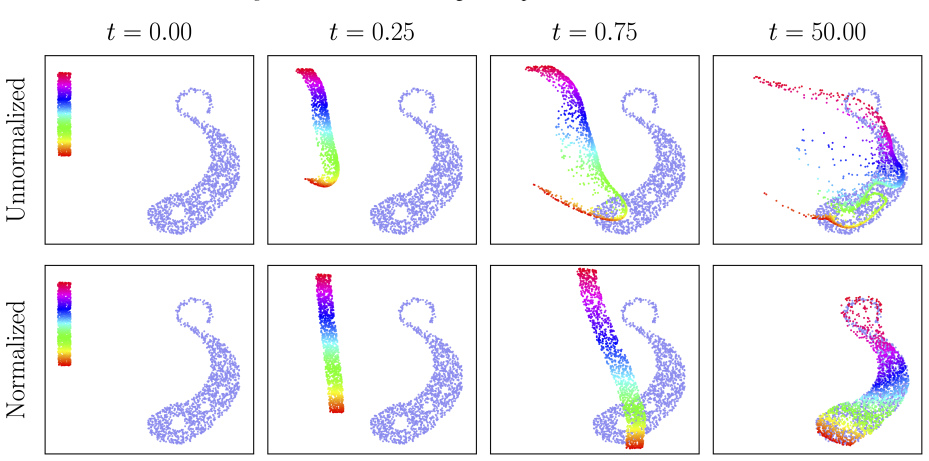
- The leading eigenvectors of $Q$ approximate low-frequency Laplacian modes and can be recovered by power iterations, giving an estimated Laplacian spectrum that matches the cotangent/FEM reference across point, voxel, and Gaussian-mixture representations of the same shape at fixed scale.
- The normalization is cheap and GPU-friendly (5–10 iterations, matrix-vector products only) and integrates with fast attention layers via a softmax reformulation, so it scales beyond where sparse LU Laplacian solvers are practical.
- Normalized kernels improve gradient flows and LDDMM geodesic interpolation by bounding the spectrum, removing the dominant-eigenvalue contraction that makes raw Gaussian kernels collapse shapes; a DiffusionNet variant using the operator is competitive on point-cloud shape correspondence.
Reading between the lines
- An immediate extension is to normalize attention scores the same way: the paper's softmax reformulation shows any attention layer can be made mass-preserving and spectrum-bounded by symmetric Sinkhorn scaling, which would give transformer layers an explicit diffusion interpretation.
- The framework suggests testing expressivity versus conservation: where high-degree amplification is useful in graph learning, exact mass preservation may be suboptimal, and a tunable partial normalization could interpolate between raw message passing and full diffusion.
- Since Theorem 4.5 holds for Gaussian and exponential kernels at fixed scale, a natural question is whether the uniform convergence extends to learned non-stationary kernels; positive evidence would make the operator a principled diffusion block in learnable multiscale networks, as Q-DiffNet already begins to do.
- The link to entropy-regularized optimal transport implies $Q$ is the transition kernel of a reversible Markov chain, which would let heat-flow gradient dynamics be defined on arbitrary discrete domains; the paper gestures at this direction in its future-work discussion.
Editorial analysis
A structured set of objections, weighed in public.
Referee Report
Summary. The paper proposes to turn arbitrary symmetric smoothing operators S=KM into diffusion-like operators Q=ΛSΛ via symmetric Sinkhorn normalization. The central theoretical results are Theorem 4.4 (existence and uniqueness of a positive diagonal scaling that makes the rescaled operator a diffusion operator) and Theorem 4.5 (pointwise/uniform convergence of these normalized operators under refinement at fixed kernel scale for Gaussian or exponential kernels), with a stability estimate for mass perturbations (Proposition 4.6). The authors position the contribution as a fixed-scale, unstructured-data alternative to Laplacian-based heat diffusion, and demonstrate it on spectral shape analysis, kernel-gradient flows, LDDMM interpolation, and a DiffusionNet-style shape-correspondence pipeline.
Significance. If the central claims hold, the paper gives a practical and principled recipe for obtaining mass-preserving, spectrum-bounded diffusion operators from arbitrary positive similarity matrices, which is genuinely useful for point clouds, voxel grids, and Gaussian mixtures where mesh Laplacians are unavailable. The main theorems are reductions to known Sinkhorn/entropic-OT results, and the paper is honest about this lineage; the fixed-scale convergence result and the systematic application to geometry processing are the novel parts. The manuscript is also strong on experimental breadth: spectral eigenvector comparisons across modalities, gradient-flow stabilization, LDDMM interpolation, and a neural correspondence benchmark, with code made available. The proofs in Appendix B are checkable and the finite-dimensional spectral argument via the sum-of-squares identity is clean. The main weakness is a load-bearing proof gap in Appendix C for the spectral bound of the limit operator, plus a smaller gap between the theoretical assumptions and the Gaussian-mixture kernel used in experiments.
major comments (2)
- [Appendix C, proof of Theorem 4.5] The damping property σ(Q)⊆[0,1] for the limit operator Q is asserted without a correct proof. The manuscript says this property 'derives from the fact that we can write Q as the limit of the sequence of discrete diffusion operators Q_s with eigenvalues in [0,1]', but this does not follow: each Q_s is self-adjoint on a different Hilbert space L²_{µ_s}, and the proven convergence is uniform convergence on C(X), which does not preserve spectral inclusion. This is load-bearing because Theorem 4.5 is part of the central claim that the normalized operators converge to a continuous diffusion operator. The gap is easily repairable: using the Sinkhorn identity (Eq. 25), one obtains ∫∫ λ(x)λ(y)k(x,y)(f(x)-f(y))² dµ(x)dµ(y) = 2(‖f‖²_µ - ⟨f,Qf⟩_µ) ≥ 0, giving the upper spectral bound, while positivity of the spectrum follows from positive definiteness of the Gaussian or exponential kernel. Please add this direct derivation.
- [Section 5, Eq. (5)] The Gaussian-mixture kernel S_ij = m_j exp[-½(x_i-x_j)ᵀ C_{ij}^{-1}(x_i-x_j)] with C_{ij}=σ²I+Σ_i+Σ_j is not of the form k(x_i,x_j) with a fixed Gaussian or exponential kernel, so Theorem 4.5 does not apply to it. Since Gaussian mixtures are one of the three advertised modalities and are used in several experiments, the paper should either extend the convergence analysis to this kernel family or explicitly state that Eq. (5) is a practical heuristic not covered by Theorem 4.5.
minor comments (8)
- [Table 1 and Section F] The headline runtime comparison in Table 1 mixes GPU timings for Sinkhorn with CPU timings for sparse LU factorization. Although this is stated in the caption, the main text should also mention that CPU Sinkhorn timings appear in Table 3, so that readers do not read Table 1 as an equal-hardware comparison.
- [Section 6, point feature learning] There is a typo: 'performs on par or botter than' should read 'performs on par or better than'.
- [Section 5, Gaussian Mixtures] The sentence 'We then use use the L2 dot product...' contains a duplicated word 'use'.
- [Appendix C, Eq. (26)] In the displayed equation defining ℓ_s, the left-hand side appears as ℓ_s(s); this should presumably be ℓ_s(x), matching the quantification 'for all x∈X'.
- [Section 4, after Definition 4.2] The text refers to 'Theorem 4.1' and 'Theorem 4.2' when describing properties of Laplace-like and diffusion operators; these should be 'Definition 4.1' and 'Definition 4.2'.
- [Section 7, Limitations] The sentence 'While Theorem 4.6 provides stability bounds' should refer to Proposition 4.6, not Theorem 4.6.
- [Appendix G, Eqs. (50)-(51)] The eigenvalue recovery formulas λ_i = -2/σ² log(λ_i^Q) are derived for regular-grid convolution and are then applied to arbitrary point clouds and voxels. This is a heuristic; the main text should state clearly that the spectral agreement in Figure 3 is measured after this heuristic conversion and not claim exact spectral recovery.
- [Section 7, Limitations] The dependence on the mass matrix M is acknowledged in the Limitations, but given how centrally M enters the definitions and theorems, it would be helpful to repeat this caveat at the point where the method is introduced and to add an experiment on a geometry task with deliberately misspecified masses.
Circularity Check
No circular derivation: the Sinkhorn normalization is imported from independent published results, and the fixed-scale diffusion construction adds its own spectral proof; the one load-bearing gap in Theorem 4.5 is a correctness gap, not a circular reduction.
full rationale
The paper's central construction (Theorem 4.4) is a direct application of classical symmetric Sinkhorn scaling (Knight et al. 2014) and entropic-OT duality (Feydy et al. 2019). Although Feydy is a co-author of the present paper, the cited lemmas (Feydy et al. 2019, Prop. 11, Eq. (25), Thm. 1, Prop. 13) are peer-reviewed, state explicit assumptions (compact metric space, continuous cost), are backed by the Geomloss codebase, and do not have the present paper's diffusion-operator conclusion as one of their inputs. The spectral bound in Theorem 4.4 is not taken from the citations: Appendix B proves it directly via the identity 2x^T(I-Q')x = sum Kij λi λj (√mj xi - √mi xj)^2 >= 0, plus positive semidefiniteness of K. Theorem 4.5's convergence is indeed imported from Feydy et al. Prop. 13, but that is a standard use of an external lemma, not a circular reduction; the fixed-scale framing, the mass-perturbation stability bound (Prop. 4.6), and the applications are independent additions. One load-bearing proof gap must be flagged for the correctness review, not the circularity score: Appendix C asserts 'The damping property derives from the fact that we can write Q as the limit of the sequence of discrete diffusion operators Q_s with eigenvalues in [0,1]'; uniform convergence on C(X) does not preserve spectral inclusion because each Q_s is self-adjoint on a different L2_{µ_s} while Q acts on L2_µ. The claim is nevertheless true by a direct argument (the Sinkhorn identity yields 2(||f||^2_µ - <f,Qf>_µ) = ∫∫ λ(x)λ(y)k(x,y)(f(x)-f(y))^2 dµ(x)dµ(y) >= 0, and Q >= 0 follows from positive definiteness of the kernel), so the gap is repairable and is not an equivalence between input and prediction. Accordingly, no fitted parameter is renamed as a prediction and no theorem is forced by self-citation; circularity score 0.
Assumptions & free parameters
free parameters (3)
- Gaussian or exponential kernel scale σ =
0.05 in Armadillo and horse experiments; σ_c learned in Q-DiffNet
- Graph regularization ε =
small positive, unspecified
- Sinkhorn stopping tolerance =
5-10 iterations in practice
assumptions (4)
- domain assumption For positive symmetric K, the symmetric Sinkhorn scaling ΛKΛ with prescribed marginals exists and is unique (Knight et al. 2014; Feydy et al. 2019).
- domain assumption Sinkhorn potentials converge uniformly under weak convergence of measures (Feydy et al. 2019, Prop. 13).
- domain assumption Weak convergence of the sampled measures μ_s to the continuum measure μ.
- standard math Kato's inequality and positivity of semigroups on L²_μ (Arendt 1984; Schaefer 1974).
Cite this review
Pith. "Pith review of Sinkhorn Normalization of Diffusion Kernels." pith.science (2026). https://pith.science/paper/72V4BBNC
@misc{pith2026250706161,
  author       = {Pith},
  title        = {Pith review of: Sinkhorn Normalization of Diffusion Kernels},
  year         = {2026},
  howpublished = {\url{https://pith.science/paper/72V4BBNC}},
  note         = {Machine review of arXiv:2507.06161}
}
read the original abstract
Smoothing a signal based on local neighborhoods is a core operation in machine learning and geometry processing. On well-structured domains such as vector spaces and manifolds, the Laplace operator derived from differential geometry offers a principled approach to smoothing via heat diffusion, with strong theoretical guarantees. However, constructing such Laplacians requires a carefully defined domain structure, which is not always available. Most practitioners thus rely on simple convolution kernels and message-passing layers, which are biased against the boundaries of the domain. We bridge this gap by introducing a broad class of smoothing operators, derived from general similarity or adjacency matrices, and demonstrate that they can be normalized into diffusion-like operators that inherit desirable properties from Laplacians. Our approach relies on a symmetric variant of the Sinkhorn algorithm, which rescales positive smoothing operators to match the structural behavior of heat diffusion. This construction enables Laplacian-like smoothing and processing of irregular data such as point clouds, sparse voxel grids or mixture of Gaussians. We show that the resulting operators not only approximate heat diffusion but also retain spectral information from the Laplacian itself, with applications to shape analysis and matching.
Figures


Figures from the paper (16 more)




Reference graph
Works this paper leans on
-
[1]
Since our set of axioms implies that −∆⊤µ 1 =−∆1 = 0 , we always have that 1 is a strictly positive subeigenvector of −∆⊤µ. This allows us to propose the following definition of a Laplace-like operator, which generalizes Theorem 4.1 to discrete measures: Definition A.5(General Laplace-like Operators).Let ∆ be a generator of a strongly continuous semigroup...
work page 2019
-
[2]
If k(x, y)is an exponential kernel at scale σ >0, the cost function is simply the Euclidean norm∥x−y∥and the entropic regularization parameterεis equal toσ. Continuous Scaling Functions.The theory of entropy-regularized optimal transport allows us to interpret the dual variables f, g and ℓ of Eqs. (13-14) as continuous functions defined on the domain X . ...
work page 2019
-
[5]
We note that, as noted in Micheli et al. (2012), standard LDDMM framework favors contraction-expansion dynamics, where area shrinks between source and target, then explodes when extrapolating. In contrast, the normalized kernel keeps a stable area at all times, even during extrapolation. Additional Example.Figure 20 displays a similar experiment as the on...
work page 2012
-
[6]
N., Desbrun, M., and Schr ¨oder, P
Grinspun, E., Hirani, A. N., Desbrun, M., and Schr ¨oder, P. Discrete shells. InProceedings of the 2003 ACM SIGGRAPH/Eurographics Symposium on Computer An- imation, SCA ’03, pp. 62–67, Goslar, DEU, July
work page 2003
-
[11]
We recover the expected symmetries, which correspond to the plateaus in the spectra and the fact that the eigenvectors cannot be directly identified with each other. We deliberately choose coarse point cloud and Gaussian mixture representations, which allow us to test the robustness of our approach. Although the Laplacian eigenvalues tend to have a slower...
work page 2019
-
[13]
Zhou, H. and L ¨ahner, Z. Laplace-Beltrami Operator for Gaussian Splatting.arXiv preprint arXiv:2502.17531,
-
[17]
Optimal Transport Formulation.We follow Eq. (1) in Feydy et al. (2019) and introduce the symmetric entropy- regularized optimal transport problem: OTreg(µ, µ) = min π∈Plans(µ,µ) NX i,j=1 πijCij +KL(π, mm⊤)(11) 15 Sinkhorn Normalization of Diffusion Kernels where Cij =−logK ij is the symmetric N-by-N costmatrix and Plans(µ, µ)is the simplex of N-by-N trans...
work page 2019
-
[19]
applied to matrix M KM, with marginals M1 =diag(M) . This equivalence explains the fast convergence in 5 to 10 iterations we observe in practice, which was studied in (Knight et al., 2014). Sinkhorn Convergence.We evaluate the convergence behavior of the symmetrized Sinkhorn algorithm across various settings. Specifically, we monitor the quantity: R Λ(i)S...
work page 2014
Show all 31 references
-
[20]
or xFormers (Lefaudeux et al., 2022). Note that the softmax normalization in the Attention layer is invariant to additive constants in ˜xi, allowing the implementation to be further simplified using only a (d+ 1)-dimensional embeddings for ˜Xand ˜Y Spectral Decomposition.The l...
2022
-
[21]
(iv)Grid convolution:O(N)for small filters,O(NlogN)for large filters using FFTs Baseline Complexity.Per diffusion step via Laplacian-based methods: (i)Matrix exponential (dense):O(N 3)time; rarely used at scale. (ii) Implicit Euler (I+t∆) −1 with sparse LU/Cholesky: worst case...
2019
-
[22]
This leads to the formulaσ 2 + 2τ2 =σ 2 + (2/2)trace(Σ). Spectrum on Animal Shape.Similarly to Figure 3, we display on Figure 8 the 8 th eigenvector for a galloping horse shape from the Sumner dataset (Sumner & Popovi´c, 2004), using different representation modalities. Stabil...
2004
-
[24]
stragglers
The target distribution is also sampled with M= 1 500 points using a reference image provided by the Geomloss library (Feydy et al., 2019). The entire optimization process takes a few seconds on a GeForce RTX 3060 Mobile GPU using KeOps for kernel computation. Visualization.In...
2019
-
[26]
In DiffusionNet, typical values are C= 256 , P= 1
Like DiffusionNet (Sharp et al., 2022), Q-DiffNet supports multi-scale diffusion: the layer takes input features of shape B×C×N×P and applies separate diffusion per channel, using learnable scales (σc)C c=1. In DiffusionNet, typical values are C= 256 , P= 1 . For speed efficie...
2022
-
[27]
Raw 3D coordinates ( xyz) are also used in some settings
or HKS (Sun et al., 2009), where WKS is generally preferred. Raw 3D coordinates ( xyz) are also used in some settings. Point Cloud Inputs.Although DiffusionNet (Sharp et al.,
2009
-
[28]
When working with point clouds, spectral descriptors like WKS (Aubry et al.,
can operate on point clouds since it does not require mesh connectivity, it still depends on (approximate) Laplacian eigenvectors (Sharp & Crane, 2020). When working with point clouds, spectral descriptors like WKS (Aubry et al.,
2020
-
[29]
This ensures consistent inputs across surface and point-based variants
on point clouds. This ensures consistent inputs across surface and point-based variants. Ablation on Input Features (XYZ).While using WKS inputs isolates the effect of the diffusion operator, we acknowledge that it propagates implicit mesh information into the network. To eval...
2020
-
[30]
We follow the standard train/test splits used in prior baselines (Donati et al., 2020; Sharp et al., 2022; Cao et al., 2023)
and SCAPE datasets (Anguelov et al., 2005), using only intra-dataset pairs within the training split. We follow the standard train/test splits used in prior baselines (Donati et al., 2020; Sharp et al., 2022; Cao et al., 2023). The 44 shapes from the remeshed SHREC dataset (Me...
2005
-
[31]
are reserved exclusively for evaluation. Training.We use the exact ULRSSM setup (Cao et al., 2023), where we train the network for 5 epochs with a batch size of 1, using Adam optimizer with an initial learning rate of 10−3 and cosine annealing down to 10−4. Training takes 6h o...
2023
-
[1967]
Laplacian Mesh Processing
Sorkine, O. Laplacian Mesh Processing. InEurograph- ics 2005 - State of the Art Reports. The Eurographics Association,
2005
-
[1984]
for proofs. In our case, we make a simplifying assumption and restrict ourselves to Hilbert spaces of the form L2 µ(X) , which include both finite-dimensional Euclidean spaces and infinite-dimensional L2 spaces. For any signalf∈L 2 µ(X), we definesign(f)pointwise as: sign(f)(x...
1984
-
[2005]
TIDE: Time Derivative Diffusion for Deep Learning on Graphs
Behmanesh, M., Krahn, M., and Ovsjanikov, M. TIDE: Time Derivative Diffusion for Deep Learning on Graphs. InProceedings of the 40th International Conference on Machine Learning, pp. 2015–2030. PMLR, July
2015
-
[2007]
Discrete Laplace operators: No free lunch
Wardetzky, M., Mathur, S., K¨alberer, F., and Grinspun, E. Discrete Laplace operators: No free lunch. InACM SIG- GRAPH ASIA 2008 Courses on - SIGGRAPH Asia ’08, pp. 1–5, Singapore,
2008
-
[2010]
ISBN 978-1-4244-6984-0
IEEE. ISBN 978-1-4244-6984-0. Bronstein, M. M., Bruna, J., Cohen, T., and Veli ˇckovi´c, P. Geometric Deep Learning: Grids, Groups, Graphs, Geodesics, and Gauges.arXiv preprint arXiv:2104.13478,
-
[2011]
Marcus, D
doi: 10.1016/j.jfa.2011.06.009. Marcus, D. S., Wang, T. H., Parker, J., Csernansky, J. G., Morris, J. C., and Buckner, R. L. Open Access Series of Imaging Studies (OASIS): Cross-sectional MRI data in young, middle aged, nondemented, and demented older adults.Journal of Cogniti...
2011 doi
-
[2014]
Bogo, F., Romero, J., Pons-Moll, G., and Black, M. J. Dy- namic FAUST: Registering Human Bodies in Motion. In 2017 IEEE Conference on Computer Vision and Pattern Recognition (CVPR), pp. 5573–5582, Honolulu, HI, July
2017
-
[2017]
ISBN 978-1-5386-0457-1
IEEE. ISBN 978-1-5386-0457-1. Bˆone, A., Louis, M., Martin, B., and Durrleman, S. Defor- metrica 4: an open-source software for statistical shape analysis. InShape in medical imaging: international workshop, ShapeMI 2018, held in conjunction with MIC- CAI 2018, granada, Spain,...
2018
-
[2019]
Pinkall, U
doi: 10.1561/2200000073. Pinkall, U. and Polthier, K. Computing Discrete Minimal Surfaces and Their Conjugates.Experimental Mathemat- ics, 2(1):15–36, January
-
[2020]
von Luxburg, U
doi: 10.1038/s41592-019-0686-2. von Luxburg, U. A tutorial on spectral clustering.Statistics and Computing, 17(4):395–416, December
-
[2022]
Laplace-Beltrami Eigenfunctions Towards an Al- gorithm That ”Understands” Geometry
Levy, B. Laplace-Beltrami Eigenfunctions Towards an Al- gorithm That ”Understands” Geometry. InIEEE Interna- tional Conference on Shape Modeling and Applications 2006 (SMI’06), pp. 13–13, Matsushima, Japan,
2006
-
[2023]
Synchronous Diffusion for Unsupervised Smooth Non-rigid 3D Shape Match- ing
Cao, D., L¨ahner, Z., and Bernard, F. Synchronous Diffusion for Unsupervised Smooth Non-rigid 3D Shape Match- ing. In Leonardis, A., Ricci, E., Roth, S., Russakovsky, O., Sattler, T., and Varol, G. (eds.),Computer Vision – ECCV 2024, volume 15063, pp. 262–281. Springer Na- tur...
2024
-
[2025]
off-diagonal
13 Sinkhorn Normalization of Diffusion Kernels A. Continuous Formulation of the Metzler Condition Let A be a real square matrix. We say that A is aMetzlermatrix if its off-diagonal entries are non-negative. This condition implies that the matrix exponential etA has non-negativ...
2000
Reviewed August 6, 2026 · model on record in the stance chip above.
Discussion (0). Sign in to comment.