REVIEW 4 major objections 4 minor 56 references
YINYANG-ALIGN: Benchmarking Contradictory Objectives and Proposing Multi-Objective Optimization based DPO for Text-to-Image Alignment
T0 review · 4 major / 4 minor · reviewed 2026-08-09 · deepseek-v4-flash
Pith's one-line read YinYangAlign and CAO claim that a multi-objective DPO extension can balance six contradictory text-to-image alignment goals at once, and provide a benchmark to measure the trade-offs.
desk verdict A useful benchmark idea buried under an unverifiable CAO claim and circular evaluation. read the letter →
The pith
A machine-rendered reading of the paper's core claim, the machinery that carries it, and where it could break.
The reading
What carries the argument
The load-bearing object is the CAO loss, which stacks three modules: local axiom-wise Bradley-Terry preferences over per-axiom losses $f_a(I)=\alpha_a L_p(I)+(1-\alpha_a)L_q(I)$; a global synergy preference over $S(I)=\sum_a \omega_a f_a(I)$; and axiom-specific regularizers using Sinkhorn-regularized Wasserstein distance. The synergy Jacobian $J_S=\partial S/\partial \theta$ is used to scale back gradients that benefit one axiom at the expense of others. This machinery is what lets the paper claim a Pareto-aware joint optimum rather than a winner-take-all alignment.
What would settle it
Take a held-out set of prompt-image pairs and have independent human judges rank them on one axiom, say cultural sensitivity; if the SCCM score orders pairs opposite to the human rankings on a majority of items, the cultural-sensitivity loss is not measuring the intended objective, and CAO's balanced gain on that axis would not transfer to real use.
Extended reading notes
Core claim
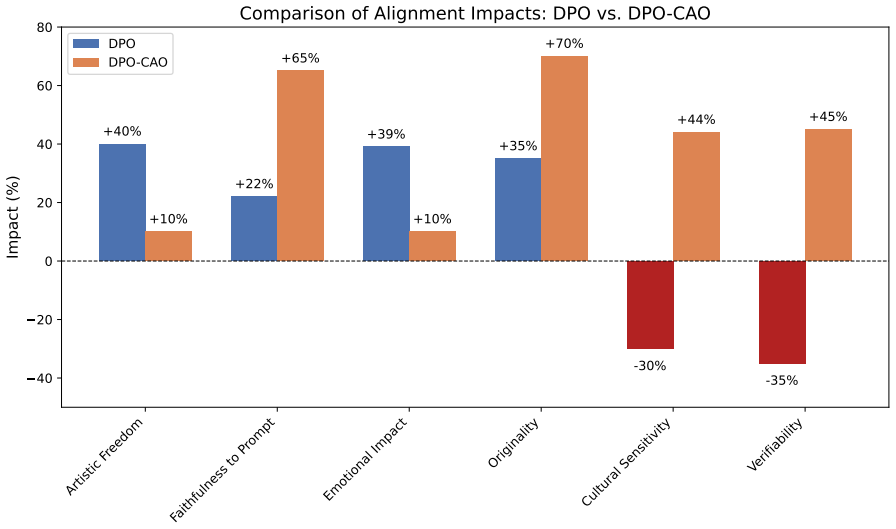
The discovery the authors claim is that contradictory alignment objectives in text-to-image models can be jointly optimized rather than traded off by accident. On six axiom pairs, single-objective DPO training improves the target by roughly 40% while dragging down others: for example, artistic freedom training reduces cultural sensitivity by 30% and verifiability by 35%. CAO instead builds each axiom into a Bradley-Terry preference over a per-axiom loss, aggregates these with a synergy function $S(I)=\sum_a \omega_a f_a(I)$, and regularizes the optimization with Sinkhorn-regularized Wasserstein distances and a synergy Jacobian that dampens conflicting gradients. The authors report that CAO achieves balanced gains across all six objectives, for instance +10% artistic freedom and +44% cultural sensitivity, and remains close to DPO in generalization as measured by the Weighted Alpha metric.
Load-bearing premise
The load-bearing premise is that the automated scoring rules and the machine-plus-human labels truly capture the human judgements they stand for, so if the scores misjudge what people care about, both the benchmark rankings and the claimed balance collapse.
Editorial extensions
If this is right
- Training DPO on a single axiom improves that axiom by about 40% but consistently lowers at least one other measured objective, so single-axis alignment is measurably lopsided.
- CAO's balanced profile, such as +10% artistic freedom alongside +44% cultural sensitivity versus baseline, shows the six objectives can be moved together rather than one at a time.
- Varying the synergy weights traces a Pareto frontier, so a developer can choose a point that favors, say, verifiability over artistic freedom without losing sight of the other five.
- The Weighted Alpha analysis indicates the extra multi-objective machinery costs only a small generalization drift, within about 0.1 on the reported metric, so the balance is not bought with catastrophic overfitting.
Reading between the lines
- If the per-axiom proxies hold up under human validation, YinYangAlign could become a shared measurement standard for text-to-image alignment, turning 'balanced alignment' from a slogan into a number that can be audited.
- A natural extension the paper does not run is to compare CAO against a DPO model trained on a convex combination of all six preference pairs; that comparison would separate the benefit of the synergy aggregator from the benefit of simply seeing all six objectives.
- The slider-to-weight mapping suggests CAO could serve as a controllable interface for deployed systems, letting operators trade verifiability for creativity per use case, but the paper does not demonstrate a deployed system with that interface.
- Because the six objectives are likely correlated, for instance cultural sensitivity and verifiability both suppress hallucinated detail, what looks like synergy may partly reflect redundancy; a PCA-style analysis of the six loss gradients could test this.
Editorial analysis
A structured set of objections, weighed in public.
Referee Report
Summary. The paper proposes YinYangAlign, a benchmark for evaluating Text-to-Image (T2I) alignment across six contradictory objective pairs, and Contradictory Alignment Optimization (CAO), a multi-objective extension of Direct Preference Optimization (DPO). The benchmark is constructed from multiple source datasets, T2I-generated outputs, VLM-based annotation with human review, and a reported final set of 40,000 images. CAO combines per-axiom losses, a weighted global synergy aggregator, Bradley-Terry preference terms, axiom-specific regularizers, and a "synergy Jacobian" intended to balance gradient conflicts. The central empirical claim is that CAO sets new performance benchmarks across all six contradictory alignment objectives while remaining stable and scalable.
Significance. If the claims were supported, the benchmark and CAO would be a useful step toward measuring and optimizing trade-offs in T2I alignment, and the paper's emphasis on contradictory objectives is timely. However, the current manuscript does not substantiate the headline claim: the evaluation is circular, the method is not fully specified, and no code, dataset, checkpoints, or standard baselines are provided. The paper also contains several internal inconsistencies in the dataset statistics and in the definition of the synergy Jacobian. The topic is valuable, but the evidence presented is not sufficient for acceptance.
major comments (4)
- [§5 and §6] The headline claim that CAO sets new performance benchmarks across all six contradictory objectives is not supported by the evaluation. Section 5 defines the per-axiom losses L_faith, L_artistic, L_emotion, L_originality, L_verifiability, and L_cultural, and Section 6 reports percentage impact figures for DPO and DPO-CAO computed on those same loss functions. Since the CAO training objective (Sections 4.1–4.3) is essentially a weighted sum of these losses, the reported gains are partially self-fulfilling. An independent evaluation—for example, human preference judgments, established T2I alignment benchmarks, or held-out reward models not used in training—is required to support the claim.
- [§4.5 vs. Appendix G] The Synergy Jacobian is defined inconsistently across the paper. Section 4.5 defines J_S = ∂S(I)/∂θ and gives the parameter update Δθ = η∇L − αJ_S, treating J_S as a gradient vector. Appendix G defines J_S as a p×A matrix of ∂f_a/∂θ_j and gives Δθ = −η J_S ∇S. These are different mathematical objects with different dimensions and opposite sign conventions. The paper must present a single consistent definition and show explicitly how J_S is computed and used in the optimizer.
- [§3.1 vs. Appendix B] The dataset statistics are internally inconsistent. Section 3.1 reports 50,000 VLM-flagged images, 10,000 images discarded during manual review, a final 40,000-image dataset, and a 5,000-image subset annotated by all 10 annotators. Appendix B says each annotator is assigned 5,500 images with a 500-image overlap between adjacent annotators, and the FAQ states that agreement was computed over 500 samples. These numbers cannot all be true, so the paper needs a single consistent account of the dataset size, overlap design, and annotator agreement computation.
- [§6 and Fig. 11] The empirical results are not reproducible as reported. No code, dataset, model checkpoints, prompt lists, evaluation scripts, or random seed details are provided, and no comparisons against standard T2I alignment baselines or existing benchmarks are included. The percentage-impact numbers in Section 6 and Figure 11 therefore cannot be verified by the community. The authors should release the YinYangAlign dataset and the CAO training/evaluation code, or explicitly mark the reported numbers as illustrative rather than benchmark results.
minor comments (4)
- [§1 and §6] There are typographical errors: "plarforms" in the introduction and "Directed Preference Optimization" in Section 6; the latter should be "Direct Preference Optimization."
- [§4.1, §5.1, §5.3] The symbol α is overloaded: it denotes the per-axiom mixing parameter in §4.1, the AFS weight in §5.1, and the TEMN weight in §5.3. Using distinct symbols would improve readability.
- [Fig. 11] The numeric values printed in Figure 11 are not clearly keyed to the bar colors and legend. For example, the caption states CAO achieves +44% Cultural Sensitivity, while the printed value list contains both +44% and +45% without indicating which corresponds to DPO and which to CAO. The figure and caption should be reconciled.
- [§7] Research Question 2 in Section 7 asks about "DPO and CPO" but the paper's method is called CAO; this typo should be corrected.
Circularity Check
CAO's headline SOTA is measured on the same per-axiom losses it optimizes; no independent evaluation supports the six-objective benchmark claim.
-
self definitional
[Sections 4.1-4.3 and 5]
"For each axiom a, CAO defines a loss function fa(I) that blends two competing sub-objectives, Lp(I) and Lq(I), via a mixing parameter αa: fa(I) = αa Lp(I) + (1 − αa) Lq(I). ... Concretely, each fa(I) enters a Bradley-Terry style preference: P a ij = exp(fa(Ii)) / (exp(fa(Ii)) + exp(fa(Ij))). Meanwhile, a combined preference over S(I) expresses the global tradeoff."
The CAO training objective is built directly from the per-axiom functions f_a and the synergy aggregator S(I)=Σ ωa f_a(I). Section 5 then defines those same f_a components as the evaluation losses: Lfaith, Lartistic, Lemotion, Loriginality, Lverifiability, and Lcultural. Thus the objective being optimized and the metrics used to claim 'new performance benchmarks across all six contradictory alignment objectives' are the same functions by construction. Training a model to increase Bradley-Terry likelihoods over f_a and S will move those exact scalar proxies, so any measured improvement on them is partly a tautology rather than an independent verification.
-
fitted input called prediction
[Section 6, Figure 11]
"The impact of this single-axiom optimization on the other five objectives was measured in terms of percentage changes compared to a baseline. ... Comparison of Alignment Impacts: ... CAO achieves a more balanced alignment with controlled tradeoffs (e.g., +10% Artistic Freedom and +44% Cultural Sensitivity)."
Section 6 reports percentage improvements for DPO and DPO-CAO on 'Artistic Freedom,' 'Faithfulness to Prompt,' 'Emotional Impact,' 'Originality,' 'Cultural Sensitivity,' and 'Verifiability' without specifying any evaluation instrument other than the Section 5 loss functions. The paper provides no human evaluation, no established external T2I benchmark, and no held-out metric definition for these percentages. Therefore the claimed CAO advantage over single-axiom DPO is a report of how the optimized training objectives themselves moved, not a prediction validated on independent ground truth. The absence of error bars, held-out prompt details, or code further prevents any independent check of the reported numbers.
full rationale
The paper's central claim — that CAO 'sets new performance benchmarks across all six contradictory alignment objectives' — is not supported by any instrument independent of the objective being optimized. Section 4 defines CAO's loss as local Bradley-Terry preferences over per-axiom losses f_a and a global synergy preference over S(I)=Σ ωa f_a(I). Section 5 then defines the six f_a components: Lfaith (Sinkhorn-VAE Wasserstein distance), Lartistic (style/content CLIP distances), Lemotion (emotion-classifier intensity), Loriginality (CLIP-retrieval divergence), Lverifiability (Google Image Search cosine similarity), and Lcultural (LLM-generated sub-prompt CLIP matching). Section 6 reports percentage improvements on 'Artistic Freedom,' 'Faithfulness,' etc., with no statement that these percentages come from a different, held-out, human-judged, or established benchmark. Consequently, the reported CAO advantage is largely a statement about the training loss itself: a method trained to increase the Bradley-Terry likelihood of f_a and S will move those same scalar proxies. This is a self-referential evaluation, not a verified external prediction. The benchmark dataset's human/VLM annotation pipeline (Section 3) is separate and gives the benchmark some independent content, but the headline SOTA claim is not validated against it in the paper. Internal inconsistencies (e.g., the Synergy Jacobian defined as ∂S/∂θ in Section 4.5 with Δθ = η∇L − αJ_S, versus a matrix of ∂f_a/∂θ with Δθ = −ηJ_S∇S in Appendix G) further prevent verification, but those are correctness and reproducibility concerns rather than circularity issues.
Assumptions & free parameters
free parameters (7)
- AFS weights alpha, beta, gamma =
alpha=0.5, beta=0.3, gamma=0.2
- Emotion-neutrality trade-off weights =
alpha=0.3, beta=0.7
- Per-axiom mixing parameter alpha_a =
alpha_a(0)=0.5, dynamically adjusted
- Global synergy weights omega_a =
initialized 1/6, tuned on validation
- Regularization coefficients tau_a =
tau_init=1e-3, range 1e-4 to 1e-2
- Global synergy scaling lambda =
lambda=0.7
- SCCM normalization bounds =
SCCM_min=0.70, SCCM_max=0.90
assumptions (6)
- domain assumption DPO and the Bradley-Terry preference framework apply to T2I generations as reward signals
- domain assumption Per-axiom losses are valid proxies for human alignment concepts
- domain assumption VLM consensus and human kappa validate chosen/rejected labels
- domain assumption A weighted sum of conflicting objectives traces a useful Pareto frontier
- domain assumption Heavy-tailed self-regularization theory transfers from LLMs to T2I diffusion models
- ad hoc to paper Data filtering rules do not bias the benchmark
invented entities (2)
-
Synergy Jacobian J_S
-
Simulated Cultural Context Matching (SCCM)
Cite this review
Pith. "Pith review of YINYANG-ALIGN: Benchmarking Contradictory Objectives and Proposing Multi-Objective Optimization based DPO for Text-to-Image Alignment." pith.science (2026). https://pith.science/paper/72VRMDZB
@misc{pith2026250203512,
  author       = {Pith},
  title        = {Pith review of: YINYANG-ALIGN: Benchmarking Contradictory Objectives and Proposing Multi-Objective Optimization based DPO for Text-to-Image Alignment},
  year         = {2026},
  howpublished = {\url{https://pith.science/paper/72VRMDZB}},
  note         = {Machine review of arXiv:2502.03512}
}
read the original abstract
Precise alignment in Text-to-Image (T2I) systems is crucial to ensure that generated visuals not only accurately encapsulate user intents but also conform to stringent ethical and aesthetic benchmarks. Incidents like the Google Gemini fiasco, where misaligned outputs triggered significant public backlash, underscore the critical need for robust alignment mechanisms. In contrast, Large Language Models (LLMs) have achieved notable success in alignment. Building on these advancements, researchers are eager to apply similar alignment techniques, such as Direct Preference Optimization (DPO), to T2I systems to enhance image generation fidelity and reliability. We present YinYangAlign, an advanced benchmarking framework that systematically quantifies the alignment fidelity of T2I systems, addressing six fundamental and inherently contradictory design objectives. Each pair represents fundamental tensions in image generation, such as balancing adherence to user prompts with creative modifications or maintaining diversity alongside visual coherence. YinYangAlign includes detailed axiom datasets featuring human prompts, aligned (chosen) responses, misaligned (rejected) AI-generated outputs, and explanations of the underlying contradictions.
Figures


Figures from the paper (13 more)




Reference graph
Works this paper leans on
-
[1]
Local per-axiom preferences to handle individual trade-offs
-
[2]
A global synergy mechanism for unified alignment
-
[3]
A regularization term to prevent overfitting to any single objective. ✽ How does YinYangAlign handle annotation challenges? ➠ YinYangAlign combines automated annotations using Vision-Language Models (VLMs) like GPT-4o and LLaV A with rigorous human verification. A consensus filtering mechanism ensures reliability, with a high inter-annotator agreement sco...
-
[4]
IEEE Transactions on Big Data, 7(3):535–547
Billion-scale similarity search with gpus. IEEE Transactions on Big Data, 7(3):535–547. Justin Johnson, Alexandre Alahi, and Li Fei-Fei
-
[5]
Artistic Freedom: Ensures factual accuracy without restricting creativity
Verifiability vs. Artistic Freedom: Ensures factual accuracy without restricting creativity
-
[6]
Provable subnetwork existence in large pre-trained models. In International Confer- ence on Machine Learning (ICML), volume 139 of Proceedings of Machine Learning Research, pages 6781–6792. PMLR. Hunter Lightman, Vineet Kosaraju, Yura Burda, Harri Edwards, Bowen Baker, Teddy Lee, Jan Leike, John Schulman, Ilya Sutskever, and Karl Cobbe. 2023. Let’s verify...
arXiv 2023
-
[12]
In Proceedings of the 29th ACM In- ternational Conference on Multimedia , pages 271–280
Cross-modal abstraction for text-to-image synthesis. In Proceedings of the 29th ACM In- ternational Conference on Multimedia , pages 271–280. ACM. Qi Zhao, Yunjie Li, and Shuang Wang. 2023. Mit- igating bias in text-to-image generation: Meth- ods and challenges. AI and Ethics Journal , 5(2):789–805. Lianmin Zheng, Wei-Lin Chiang, Ying Sheng, Siyuan Zhuang...
arXiv 2023
-
[16]
Artistic Freedom: Ensures adherence to user instructions while allowing creative reinterpretation
Faithfulness to Prompt vs. Artistic Freedom: Ensures adherence to user instructions while allowing creative reinterpretation
Show all 56 references
-
[17]
Neutrality: Balances generating emotionally evocative images with unbiased representation
Emotional Impact vs. Neutrality: Balances generating emotionally evocative images with unbiased representation
-
[18]
Artistic Freedom: Maintains photorealism while allowing artistic stylization when appropriate
Visual Realism vs. Artistic Freedom: Maintains photorealism while allowing artistic stylization when appropriate
-
[19]
Referentiality: Promotes unique outputs while avoiding style plagiarism
Originality vs. Referentiality: Promotes unique outputs while avoiding style plagiarism
-
[21]
Artistic Freedom: Preserves respectful cultural representations while fostering artistic freedom
Cultural Sensitivity vs. Artistic Freedom: Preserves respectful cultural representations while fostering artistic freedom. These were selected based on their prevalence in real-world applications and their alignment with academic and ethical considerations in AI image generati...
2014
-
[22]
Faithfulness to Prompt: Evaluate how well the image adheres to the user’s prompt
-
[23]
Artistic Freedom: Assess if the image introduces creative or artistic elements that deviate from, enhance, or reinterpret the original prompt
-
[24]
Output Format: Faithfulness Score (1-5), Artistic Freedom Score (1-5), Observations (Text)
Identify if artistic freedom significantly compromises faithfulness to the prompt. Output Format: Faithfulness Score (1-5), Artistic Freedom Score (1-5), Observations (Text). Emotional Impact vs. Neutrality Given the textual description (prompt) and an image, evaluate the alig...
-
[25]
Emotional Impact: Evaluate whether the image conveys specific emotions as implied by the prompt
-
[26]
Neutrality: Assess if the image avoids strong emotional biases and maintains an impartial tone
-
[27]
Output Format: Emotional Impact Score (1-5), Neutrality Score (1-5), Observations (Text)
Identify if the emotional intensity compromises the neutrality required by the prompt. Output Format: Emotional Impact Score (1-5), Neutrality Score (1-5), Observations (Text). Visual Realism vs. Artistic Freedom Given the textual description (prompt) and an image, evaluate th...
-
[28]
Visual Realism: Evaluate how accurately the image replicates real-world visuals, including details, textures, and proportions
-
[29]
Artistic Freedom: Assess if the image introduces artistic or creative elements that deviate from strict realism
-
[30]
Output Format: Realism Score (1-5), Artistic Freedom Score (1-5), Observations (Text)
Identify if artistic freedom compromises the visual realism implied or required by the prompt. Output Format: Realism Score (1-5), Artistic Freedom Score (1-5), Observations (Text). Table 1: Instructions for evaluating alignment across six key axioms in Text-to-Image generatio...
-
[31]
Dataset Consolidation: Collect all caption- s/prompts and original images from the men- tioned datasets to ensure diversity and coverage of the six alignment axioms
-
[32]
This ensures sufficient variation in artistic and real- istic interpretations of the same prompt
Image Generation: For each prompt, gener- ate 10 images using MidJourney 6.0. This ensures sufficient variation in artistic and real- istic interpretations of the same prompt
-
[33]
See Table 1
Preliminary Annotation by Vision- Language Models (VLMs): • Annotate all generated images using two VLMs: GPT-4 and LLaV A. See Table 1. • Evaluate each image for the six alignment ax- ioms (e.g., Emotional Impact, Visual Real- ism). • Retain images where both VLMs give a high...
-
[34]
Each annotator is assigned 5,500 images to ensure comprehensive coverage of the dataset
Human Annotation Process: • Engage 10 human annotators for manual evaluation. Each annotator is assigned 5,500 images to ensure comprehensive coverage of the dataset. • Include a 500-image overlap between adja- cent annotators to calculate inter-annotator agreement and ensure ...
-
[35]
– Improper color rendering or other significant quality issues
Further Filtering During Human Annota- tion: • Discard approximately 10K images during the manual annotation process due to quality issues, such as: – Distorted image generation (e.g., unrealistic artifacts). – Improper color rendering or other significant quality issues
-
[36]
in.visualart
Final Dataset: • The final YinYang dataset consists of 40K high-quality datapoints, carefully selected and annotated for the six alignment axioms. • This dataset will be released for research pur- poses, enabling studies in Text-to-Image align- ment and related areas. This sel...
2024
-
[37]
Local Axiom-Wise Loss Functions: Each align- ment axiom (e.g., Faithfulness to Prompt vs. Artis- tic Freedom) is assigned a specific loss function that balances two competing sub-objectives: fa(I) = αaLp(I) + (1 − αa)Lq(I), where: • Lp(I) and Lq(I) represent the sub-objectives...
-
[38]
• ωa represents the priority or weight assigned to each axiom a
Global Synergy Aggregator: To reconcile multi- ple axioms, a global synergy function S(I) aggre- gates the local losses: S(I) = AX a=1 ωafa(I), where: • A is the total number of axioms (e.g., A = 6 for the YinYang framework). • ωa represents the priority or weight assigned to ...
-
[39]
For example, increasing Artis- tic Freedom may reduce Faithfulness to Prompt, but Pareto efficiency ensures that these trade-offs are optimized globally
Pareto Frontiers: By varying the weights ωa, CAO explores Pareto frontiers, which represent sets of non-dominated solutions where improve- ment in one axiom necessitates a trade-off in an- other (Deb, 2001). For example, increasing Artis- tic Freedom may reduce Faithfulness to...
2001
-
[40]
- Separate learning rates are employed for the image encoder and text decoder to account for modality-specific training dynamics
applied over the training epochs. - Separate learning rates are employed for the image encoder and text decoder to account for modality-specific training dynamics. • Batch Size: - A batch size of 256 is used for stable optimization, balancing memory requirements and gradient v...
2013
-
[41]
to ensure efficient exploration and selection of Pareto-optimal solutions. The Weight-Objective Heatmap (see Figure 15) is a visual representation of how varying synergy weights (ωa) influences the alignment of a Text-to- Image (T2I) model across multiple axioms. Each row corr...
2020
-
[43]
Pre-train the T2I model using standard cross- entropy loss on the training dataset to initialize the image and text encoders
-
[44]
• Aggregate losses with the synergy function (S(I)) for global optimization
Fine-tune the model with the CAO objective: • Use local axiom-wise losses ( fa(I)) to ensure alignment for each axiom. • Aggregate losses with the synergy function (S(I)) for global optimization
-
[45]
Monitor alignment metrics (e.g., faithfulness scores, emotional impact) on a validation set and adjust hyperparameters (e.g., αa, ωa) to ensure balanced performance
-
[46]
D.5 Computational Resources • Training is conducted on NVIDIA A100 GPUs with 40 GB memory
Use early stopping based on the validation loss to prevent overfitting. D.5 Computational Resources • Training is conducted on NVIDIA A100 GPUs with 40 GB memory. A full training run (including hyperparameter tuning) requires approximately 72 hours. • Mixed precision training ...
2017
-
[48]
Embedding Computation: Compute the CLIP embedding of the generated image: ECLIP(Igen) ∈ Rd, where d is the dimensionality of the CLIP embed- ding space
-
[49]
The similarity metric is cosine similar- ity: Sim(Igen, Sretr,k) = cos(ECLIP(Igen), ECLIP(Sretr,k))
Database Query: Compare ECLIP(Igen) against precomputed embeddings of reference images in a database. The similarity metric is cosine similar- ity: Sim(Igen, Sretr,k) = cos(ECLIP(Igen), ECLIP(Sretr,k))
-
[50]
Top-K Selection: Retrieve the top-K reference images with the highest similarity scores: Sretr,k = arg max S∈Database Sim(Igen, S). L.4.3 Reference Databases We leverage large-scale artistic datasets to ensure diverse and meaningful reference styles: • WikiArt: A dataset conta...
2015
-
[51]
Embedding Generation
-
[52]
, E(Pk)}, where k is the total number of sub-prompts
Prompt Embedding: For each LLM-generated cultural sub-prompt Pi, compute embeddings us- ing a multimodal model (e.g., CLIP): {E(P1), E(P2), . . . , E(Pk)}, where k is the total number of sub-prompts
-
[53]
Image Embedding: Embed the T2I-generated image Igen using the same model: E(Igen)
-
[54]
Prompt-Image Similarity Calculate the se- mantic similarity between each sub-prompt Pi and the generated image Igen using cosine similarity: sim(E(Pi), E(Igen)) = E(Pi) · E(Igen) ∥E(Pi)∥∥E(Igen)∥
-
[55]
Sub-Prompt Aggregation Aggregate the sim- ilarity scores across all k sub-prompts to compute the raw SCCM score: SCCMraw = 1 k kX i=1 sim(E(Pi), E(Igen))
-
[56]
Generate an image of a Japanese garden during spring
Normalization Normalize SCCMraw to the range [0, 1] for consistent evaluation: SCCMfinal = SCCMraw − SCCMmin SCCMmax − SCCMmin . Here: • SCCM min and SCCMmax are predefined minimum and maximum similarity scores based on a vali- dation dataset of culturally diverse images and p...
2019
-
[755]
Haotian Liu, Wenhui Dai, Chunyuan Yang, et al
Springer. Haotian Liu, Wenhui Dai, Chunyuan Yang, et al
-
[2001]
In Advances in neural infor- mation processing systems, volume 13, pages 682–688
Using the nyström method to speed up kernel machines. In Advances in neural infor- mation processing systems, volume 13, pages 682–688. Tianyi Xiong, Xiyao Wang, Dong Guo, Qinghao Ye, Haoqi Fan, Quanquan Gu, Heng Huang, and Chunyuan Li. 2024. Llava-critic: Learn- ing to evalua...
2024 arXiv
-
[2008]
Journal of machine learning research, 9(11):2579–2605
Visualizing data using t-sne. Journal of machine learning research, 9(11):2579–2605. Cédric Villani. 2008. Optimal Transport: Old and New. Springer Science & Business Media. Bram Wallace, Meihua Dang, Rafael Rafailov, Linqi Zhou, Aaron Lou, Senthil Purushwalkam, Stefano Ermon,...
2008 arXiv
-
[2013]
minimal cost
in the alignment framework is motivated by their mathematical robustness, practical scala- bility, and suitability for high-dimensional tasks like Text-to-Image (T2I) generation. This section elaborates on the advantages of these techniques in the context of aligning generated...
2016
-
[2014]
with a probability of 0.2 is applied to pre- vent overfitting. • Loss Module: - Both local axiom-wise losses (Lp, Lq) and the global synergy loss ( S(I)) are implemented with efficient Sinkhorn iterations for computational efficiency (Cuturi, 2013). D.4 Training Pipeline
2013
-
[2016]
In European Confer- ence on Computer Vision (ECCV), volume 9906 of Lecture Notes in Computer Science , pages 694–711
Perceptual losses for real-time style trans- fer and super-resolution. In European Confer- ence on Computer Vision (ECCV), volume 9906 of Lecture Notes in Computer Science , pages 694–711. Springer. Joel Kaplan. 2025. More speech and fewer mis- takes. Accessed: 2025-01-12. Ter...
2025 arXiv
-
[2019]
IEEE Blockchain Ini- tiative, 7(2):90–99
Blockchain-based provenance tracking for ai-generated content. IEEE Blockchain Ini- tiative, 7(2):90–99. Liam F W Anthony, Benjamin Kanding, and Raghavendra Selvan. 2020. Carbontracker: Tracking and predicting the carbon footprint of training deep learning models. arXiv prepri...
2020 arXiv
-
[2021]
In Interna- tional Conference on Artificial Neural Networks (ICANN), pages 300–312
Watermarking neural networks for in- tellectual property protection. In Interna- tional Conference on Artificial Neural Networks (ICANN), pages 300–312. Springer. Leon A Gatys, Alexander S Ecker, and Matthias Bethge. 2016. A neural algorithm of artistic style. arXiv preprint a...
2016 arXiv
-
[2022]
In Ad- vances in Neural Information Processing Sys- tems (NeurIPS) Workshop
Pareto-based hyper-parameter search- ing for multi-objective deep learning. In Ad- vances in Neural Information Processing Sys- tems (NeurIPS) Workshop. Tsung-Yi Lin, Michael Maire, Serge Belongie, James Hays, Pietro Perona, Deva Ramanan, Pi- otr Dollár, and C Lawrence Zitnick...
2014
-
[2023]
arXiv preprint arXiv:2304.08485
Visual instruction tuning. arXiv preprint arXiv:2304.08485. Ilya Loshchilov and Frank Hutter. 2016. Sgdr: Stochastic gradient descent with warm restarts. arXiv preprint arXiv:1608.03983. Ilya Loshchilov and Frank Hutter. 2017. Decou- pled weight decay regularization. arXiv pre...
2016 arXiv
-
[2024]
Preprint, arXiv:2403.04132
Chatbot arena: An open platform for evaluating llms by human preference. Preprint, arXiv:2403.04132. Paul F Christiano, Jan Leike, Tom B Brown, Miljan Martic, Shane Legg, and Dario Amodei. 2017. Deep reinforcement learning from human pref- erences. In Advances in Neural Inform...
2017 arXiv
Reviewed August 9, 2026 · model on record in the stance chip above.
Discussion (0). Continue with ORCID to comment.