REVIEW 3 major objections 5 minor
SimWAM: A Simple World Action Model for End-to-End Autonomous Driving
T0 review · 3 major / 5 minor · reviewed 2026-08-10 · deepseek-v4-flash
Pith's one-line read A pretrained video generator can be used solely as a training signal, then discarded, leaving a planner that directly predicts trajectories.
desk verdict Strong empirical world-action baseline with a real but fixable ambiguity about what remains at inference; deserves serious refereeing. read the letter →
The pith
A machine-rendered reading of the paper's core claim, the machinery that carries it, and where it could break.
The reading
What carries the argument
The load-bearing mechanism is the isolated attention mask, which decouples the action expert from future-frame tokens in the shared attention stream: both video and action tokens attend to the current observation latent $z(o_t)$, but future-frame and action tokens are mutually invisible. This mask is the only structural change needed to make the policy factorization $p_\theta(a_{t+1:t+H} \mid z(o_t), s_t, l)$ valid, so the video DiT and future-frame decoder can be discarded after training. The co-training itself is carried by a joint flow-matching objective $L = L^{\mathrm{act}}_{\mathrm{FM}} + \lambda L^{\mathrm{vid}}_{\mathrm{FM}}$ over trajectory and video latents, and the reinforcement stage converts the deterministic flow ODE into a marginal-preserving SDE with tractable transitions so that group-relative policy-gradient updates can optimize a compositional driving reward.
What would settle it
Run the released inference code with the video DiT and future-frame decoder deleted, as the paper describes, and measure trajectory output and latency; if the action expert cannot produce trajectories or the reported latency requires video components, the self-contained claim fails. A second check is to swap $z(o_t)$ for a separately trained image encoder and see whether the PDMS gain from video co-training survives.
Extended reading notes
Core claim
The paper's central discovery is that future-scene synthesis is not needed at inference for a world-action model to improve action prediction. SimWAM factorizes the policy directly as $p_\theta(a_{t+1:t+H} \mid z(o_t), s_t, l)$, bypassing the imagine-then-act factorization that conditions planning on generated future latents. During training, the action expert and a pretrained video DiT are trained with a joint flow-matching loss over trajectories and future frames, and an isolated attention mask makes the action tokens attend only to the current observation representation, ego state, and navigation command. The paper reports that this joint training raises PDMS from 86.6 to 90.3, that a subsequent reinforcement-learning stage over the standalone action expert raises it to 91.5, and that the video backbone can be replaced while the action expert scales independently. It interprets these results as evidence that video generation can serve purely as a training signal for driving.
Load-bearing premise
The claim that the planner is self-contained depends on the unstated assumption that the observation encoding $z(o_t)$ is produced by a component that can run without the video generator; if $z(o_t)$ comes from the video VAE, then a video-stack component still lives in the deployed model.
Editorial extensions
If this is right
- If the training-time-only design works as claimed, world-action planning can be deployed with the same per-step cost as a lightweight diffusion planner, since no future frames are generated at inference.
- The unified attention interface gives two independent scaling axes: a stronger video generator can improve the learned prior without touching the action expert or the inference pipeline.
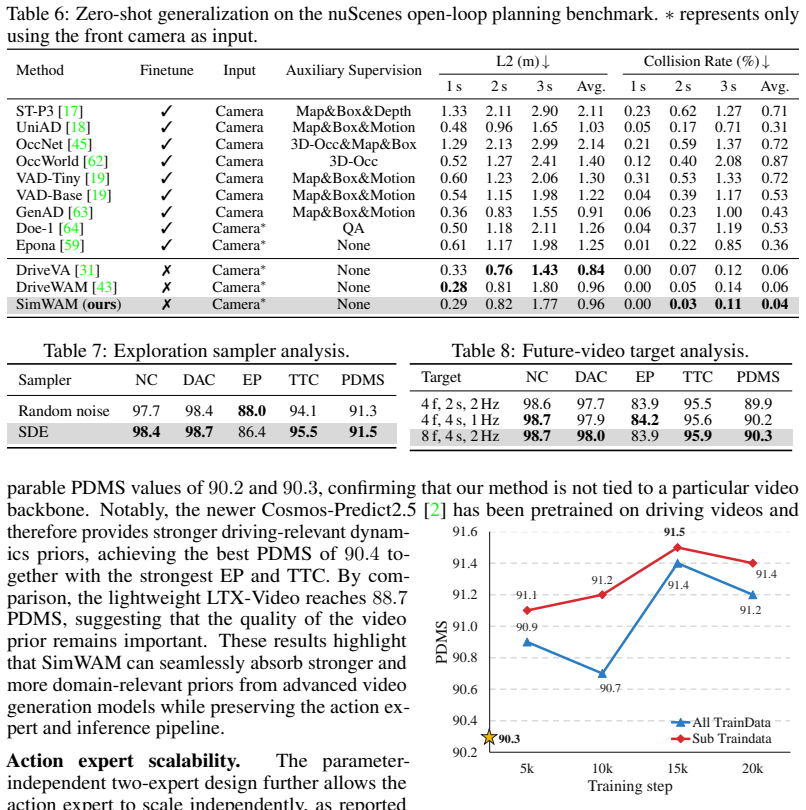
- Reinforcement learning can refine a self-contained planner directly, with the SDE-based exploration improving PDMS from 90.3 to 91.5 by balancing safety, compliance, and progress.
- The learned dynamics prior transfers zero-shot to nuScenes, where the model posts the lowest average collision rate among zero-shot baselines, suggesting the representation is not overfit to the NAVSIM benchmark.
Reading between the lines
- The paper leaves implicit that the reported inference latency depends on which component computes $z(o_t)$ after the video branch is removed; if that encoder is part of the video VAE, then the deployed stack still contains a video-network module and the latency figure should include it.
- A general recipe follows that is not limited to driving: any domain with a pretrained video generator and a separate action stream could adopt the same isolated attention mask to turn a generative world model into a cheap policy without changing the training objective.
- Because the RL stage optimizes the NAVSIM PDM reward, the gain over imitation is tied to that benchmark's weighting of collision, drivable-area compliance, progress, TTC, and comfort; reweighting the reward would likely move the operating point.
Editorial analysis
A structured set of objections, weighed in public.
Referee Report
Summary. The paper introduces SimWAM, a world-action model for end-to-end driving that co-trains a pretrained video generator and a lightweight action DiT using joint flow matching, with an isolated attention mask so that action tokens never attend to future frames. After training, the video DiT and future-frame decoder are removed, and the action expert is further refined with an SDE-based GRPO-style RL stage using the NAVSIM PDM reward. On the NAVSIM navtest split the method reports 91.5 PDMS with lower latency than world-model-based planners, and it transfers zero-shot to nuScenes. The ablations in Tables 2, 3, 4, 5, 7, 8, 9, and 10 support the main empirical gains: video co-training adds about 3.7 PDMS over the action-only baseline, RL adds about 1.2 PDMS, multiple video backbones are effective, and the isolated mask matches or exceeds coupled attention masks.
Significance. If the architectural ambiguity described below is resolved, this is a solid and practically relevant result: it demonstrates that a pretrained video generator can improve a driving policy purely through training-time co-training, while keeping inference cost close to a direct trajectory planner. The paper's strengths are the clean ablations, the consistency across multiple video backbones, the zero-shot nuScenes evaluation, and the promised release of code and weights. The significance of the central contribution depends on the self-contained-planner claim, which is currently under-specified because the computation of the observation representation z(o_t) after video-branch removal is not described.
major comments (3)
- [Section 4.1, Eq. (4); Section 4.2] The paper never specifies which component computes z(o_t) once the video DiT is removed. In Section 4.1 the video expert is defined to include the video VAE and T5 encoder, and the VAE maps the current frame into latent tokens, yet Section 4.2 says only that 'the video DiT and future-frame decoder could be discarded after training.' If z(o_t) is the video VAE encoding, then the video branch is not fully discarded and the reported latency and 'self-contained planner' claims must be revised. If a separate action encoder computes z(o_t), its architecture, initialization, and training objective are absent from the method. Because Eq. (4), the efficiency claim, and the abstract's 'entire video branch removed' statement all depend on this component, the authors must describe it explicitly and report its cost, for example by ablating inference with and without the VAE encoder and T5 encoder.
- [Section 4.1 (Reinforcement) and Eq. (6)] The RL stage optimizes the NAVSIM PDM reward, which is the same compositional function used to compute the reported PDMS metric in Eq. (6). Consequently, the +1.2 PDMS gain from RL is by design an improvement on the optimized objective rather than independent evidence for a general driving-quality reward. The paper should state this overlap plainly and support the RL benefit with at least one evaluation that is not the optimized function, such as a closed-loop collision-rate result on a held-out simulator or an RL reward variant that removes one of the PDMS submetrics.
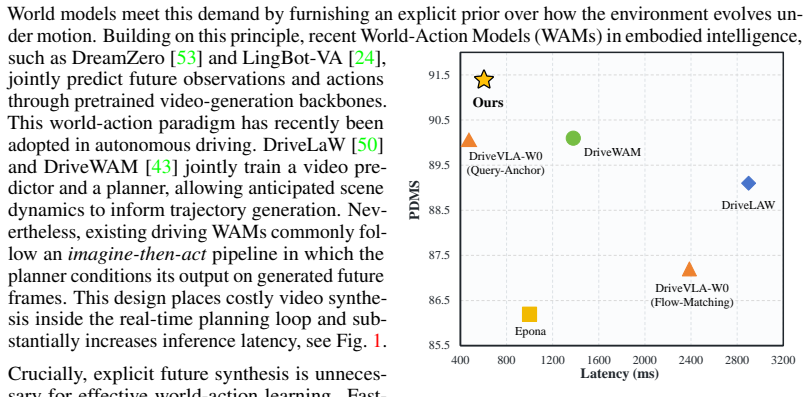
- [Section 5.1, Tables 9/10, Fig. 1] The reported inference latency is not defined. Tables 9 and 10 give A100 latencies for different input resolutions and sampling steps, but they do not state which modules are included in the measurement (action DiT only, or also the video VAE, T5 encoder, or action encoder), and Fig. 1 does not report numerical latency values for the baseline planners. Since the paper's central advantage over world-model planners is 'substantially lower latency,' the latency measurement protocol and a component-wise latency breakdown must be provided.
minor comments (5)
- [Table 1, AutoVLA row] The AutoVLA row shows '81.998.099.9' without separators; it should read '81.9 98.0 99.9' or use the same spacing as other rows.
- [Table 9] The column header 'navtestmetric' is missing a space and should read 'navtest metric'.
- [Section 4.2] The phrase 'shared attention stream' is ambiguous because the two experts are said to share no parameters; clarify whether the action expert attends to z(o_t) through a cross-attention layer with fixed embeddings or through some other mechanism, and whether this attention layer is part of the retained action expert.
- [Section 5.4, Fig. 3] The hard-subset threshold of imitation PDMS below 90 is used to select RL training data, but no sensitivity analysis for this threshold is reported; a short ablation over nearby thresholds would make the RL result more robust.
- [Section 5.1] The paper should state explicitly whether the video VAE and T5 encoders are frozen or trainable during joint co-training, since this affects the interpretation of the video-backbone flexibility results in Table 4.
Circularity Check
No significant circularity: the reported PDMS gains come from external NAVSIM evaluation and disclosed training procedures, not from equations that reduce to their own inputs.
full rationale
SimWAM's central claims are empirical. The 91.5 PDMS number is measured on the held-out NAVSIM navtest split against external baselines, and the component analysis (Table 2) shows the video co-training gain (86.6 to 90.3) and RL gain (90.3 to 91.5) as observed results rather than as consequences of the definitions. Eq. (4) does define the policy to depend only on z(o_t), s_t, and l, and the isolated attention mask enforces that dependency; the statement that the video DiT and future-frame decoder can be removed follows from that construction, which is a design property rather than a hidden equivalence. No fitted parameter is renamed as a prediction: the RL stage optimizes the NAVSIM PDM reward on navtrain while PDMS is reported on navtest, so the improvement is not forced by construction, though this reward-metric alignment is a benchmark-alignment risk. The main unresolved point is that the paper never specifies which component computes z(o_t) at inference: Section 4.1 says the video VAE maps each frame into latent tokens, and Section 4.2 only discards the 'video DiT and future-frame decoder', so if the VAE encoder is retained, the 'entire video branch removed' phrasing overstates the decoupling. This is an architecture/validity gap, not circularity. The citations to prior work are external or contextual; self-citations [12,13,31,65] appear only in related-work overviews and do not carry the derivation.
Assumptions & free parameters
free parameters (7)
- lambda (video loss weight) =
1.0
- RL group size G =
8
- LoRA rank and alpha =
rank=32, alpha=16
- Action DiT hidden size =
1024 (1.02B params)
- Sampling steps at inference =
10
- Input resolution =
384x672
- RL hard-subset threshold =
PDMS below 90
assumptions (5)
- standard math Flow matching and the SDE transformation preserve the same marginals.
- domain assumption The NAVSIM PDM reward is a valid proxy for driving quality.
- domain assumption Pretrained video foundation models provide transferable traffic dynamics priors.
- domain assumption The isolated attention mask does not reduce the quality of action learning compared to bidirectional attention.
- domain assumption Video generation as a training signal improves the observation representation for planning.
Cite this review
Pith. "Pith review of SimWAM: A Simple World Action Model for End-to-End Autonomous Driving." pith.science (2026). https://pith.science/paper/73RBKHSA
@misc{pith2026260807468,
  author       = {Pith},
  title        = {Pith review of: SimWAM: A Simple World Action Model for End-to-End Autonomous Driving},
  year         = {2026},
  howpublished = {\url{https://pith.science/paper/73RBKHSA}},
  note         = {Machine review of arXiv:2608.07468}
}
read the original abstract
World-Action Models (WAMs) improve end-to-end autonomous driving by transferring video dynamics priors to action prediction, but existing methods incur costly test-time future imagination. We present SimWAM, a simple yet effective WAM that leverages future-video prediction as a training-time supervision signal. It co-trains a pretrained video expert and a lightweight action expert with joint flow matching. An isolated attention mask keeps action prediction independent of future frames, allowing trajectory prediction without explicit future-frame generation at inference. Since the two experts share no parameters and interact only through a unified attention interface, the video backbone could be replaced and the action expert scaled independently without modifying the learning objective or inference pipeline. We further apply reinforcement learning to optimize a compositional driving reward beyond trajectory imitation. Our SimWAM achieves 91.5 PDMS on NAVSIM, surpasses state-of-the-art WAM-based planners with substantially lower latency, and transfers zero-shot to nuScenes. These results position SimWAM as a simple yet solid baseline that could readily benefit from advances in video generation for efficient autonomous driving. The code and model weights are available at https://github.com/H-EmbodVis/SimWAM/.
Figures

Figures from the paper (1 more)

Reviewed August 10, 2026 · model on record in the stance chip above.
Discussion (0). Continue with ORCID to comment.