REVIEW 2 major objections 5 minor 1 cited by
PySHRED: A Python package for SHallow REcurrent Decoding for sparse sensing, model reduction and scientific discovery
T0 review · 2 major / 5 minor · reviewed 2026-08-06 · deepseek-v4-flash
Pith's one-line read PySHRED unifies SHRED sensing, reduced-order modeling, and discovery in one Python package.
desk verdict PySHRED is a genuinely useful software release, but Appendix B's noise demonstration has a code-ordering bug that makes Table 1 meaningless as a noise test. read the letter →
The pith
A machine-rendered reading of the paper's core claim, the machinery that carries it, and where it could break.
The reading
What carries the argument
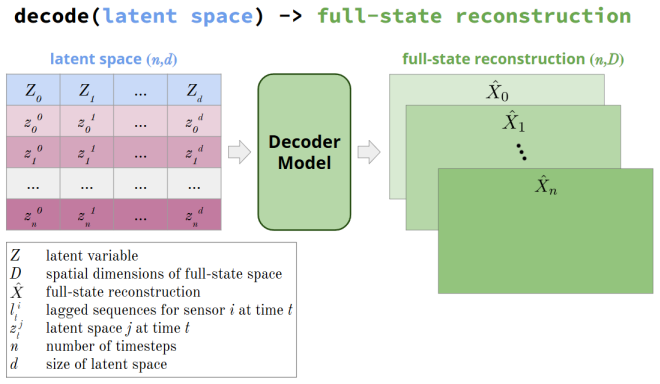
The load-bearing object is the SHRED model, written as $H(\{s_i\}_{i=t-k}^t) = F(G(\{s_i\}_{i=t-k}^t; W_{RN}); W_{SD})$, where $G$ is a sequence network (LSTM, GRU, or Transformer) that maps $k$ lagged sensor readings to a latent vector and $F$ is a fully connected decoder that maps the latent vector back to the high-dimensional state. Around this sit three modular components: a DataManager that handles lag selection, train/validation/test splits, sensor assignment, and optional compression via randomized SVD or a user-supplied basis such as Fourier modes; a SHRED object whose sequence, decoder, and optional latent forecaster can be mixed and matched; and a SHREDEngine that performs sensor-to-latent encoding, latent forecasting, decoding, and end-to-end evaluation. The argument for why this works rests on the time-delay embedding theorem, which justifies using a window of past sensor measurements, and on the decoding-only strategy, which avoids explicitly inverting a learned encoder.
What would settle it
A concrete check: install the package with a pinned environment, run the three Appendix workflows end-to-end (SST sensing, double-gyre SHRED-ROM with POD and Fourier compression, and SINDy-SHRED on SST), and compare the output figures and the reported mean relative test errors (0.0347/0.0379 for POD $u/v$, 0.0403/0.0609 for Fourier) against the paper's Table 1 values. If any workflow fails through the public API or the errors diverge well beyond run-to-run randomness, the paper's central usability claims would need qualification.
Extended reading notes
Core claim
The central claim is that the SHRED architecture—encoding time-lagged sensor measurements with a sequence model into a low-dimensional latent space, then decoding back to the full spatial field with a feedforward network—is general enough to cover sensing, model reduction, and physics discovery, and that all of these uses can live in one package. The paper works through concrete cases: weekly sea-surface temperature reconstructed from mobile and stationary sensors, the double-gyre flow modeled as a parametric reduced-order system under both POD and Fourier compression, with relative test errors reported for each, and global sea-surface temperature dynamics discovered as a linear latent ODE by the SINDy forecaster. In each case the same three-module pipeline is used, differing only in configuration, which is the evidence the paper offers for the package's modularity and breadth.
Load-bearing premise
The load-bearing premise is that the PySHRED code in the public repository actually runs as documented in a fresh environment, so the example scripts produce the reconstructions, error tables, and forecast figures shown in the paper.
Editorial extensions
If this is right
- New users can go from raw spatiotemporal data to a trained SHRED model with a handful of API calls, lowering the barrier for sensor-based reconstruction.
- Compressive training means the same code runs on a laptop for fields whose full state would normally require a GPU, as long as a low-rank representation exists.
- Parametric problems (varying parameters, noisy measurements) are handled by the same interface, so a practitioner can build a reduced-order model without writing custom training loops.
- Because the latent forecaster is pluggable, the package connects reconstruction to scientific discovery: SINDy-SHRED turns the latent dynamics into an explicit ODE that can be integrated forward for forecasting.
- The modular design makes it straightforward to swap sequence models or decoders, so new architectural variants can be tested without refactoring the data pipeline.
Reading between the lines
- A natural next test not reported here is a systematic sweep of the `compress` parameter to map how reconstruction error degrades as fewer SVD modes are kept; the package's interface makes this a one-line experiment.
- The same latent-forecaster slot could host equation-learning methods other than SINDy, and the paper's claimed extensibility implies such a swap should require no changes outside the forecaster module.
- If the paper's usability claims hold, PySHRED could serve as a common benchmark harness for comparing sensor placement, lag length, and architecture choices across SHRED variants.
- The reported SINDy-discovered SST ODE is specific to the 50 randomly chosen sensors; an implicit open question the paper leaves is how sensitive the discovered coefficients are to sensor choice.
Editorial analysis
A structured set of objections, weighed in public.
Referee Report
Summary. The paper introduces PySHRED v1.0, an open-source Python package implementing SHRED (SHallow REcurrent Decoder) and its extensions for sparse sensing, reduced-order modeling, and physics discovery. It describes the modular pipeline (DataManager, SHRED, SHREDEngine), presents examples for sea-surface-temperature sensing (Appendix A), SHRED-ROM with POD and Fourier compression (Appendix B, Table 1), and SINDy-SHRED latent dynamics discovery (Appendix C), and claims that the package is easy to install, thoroughly documented, and modularly extensible. The manuscript is primarily a software description; it contains no new algorithmic derivation, but it does include several code listings and a small numerical evaluation table.
Significance. If the package works as described, it would provide a unified, potentially valuable tool for a community that uses SHRED-based methods for sparse sensing, ROM, and scientific discovery. The modular design, support for compressed training representations, and the illustrated SINDy forecaster are real strengths, and the accompanying example gallery could lower the barrier to adoption. However, the manuscript's evidence is limited: there is no test suite, no pinned environment or commit hash, no seed control, and the only explicit noise-robustness demonstration in Appendix B appears to be internally inconsistent. The paper would be strengthened by a small, reproducible verification harness (e.g., a unit test or a script that generates Table 1) and by fixing the example ordering so that the reported results actually reflect the described pipeline. As written, the central claims of maturity and ease of use are plausible but not yet substantiated to the standard expected for a software-release paper.
major comments (2)
- [Appendix B, Listings 6-8] The noise-robustness example is internally inconsistent. Listing 6 calls manager_pod.prepare() and unpacks train_dataset, val_dataset, and test_dataset; Listing 7 then adds Gaussian noise to manager_pod.sensor_measurements_df; Listing 8 calls shred_pod.fit(train_dataset, val_dataset, ...). Under the DataManager contract described in Section 3.1 ('Once all data has been added, call prepare to obtain the train, validation, and test datasets'), prepare() materializes the training datasets at call time, so the noise added in Listing 7 cannot influence the datasets passed to fit() in Listing 8. Consequently, Table 1 and Figure 5 do not, as printed, demonstrate any noise robustness. If prepare() instead returns live views into the DataFrame, that contract is undocumented and the example is misleading. The fix is to inject the noise before calling prepare() (or to re-run prepare() after adding the noise) and to confirm that the reported table actually reflects the noisy measurements.
- [Abstract and Section 3.4 / Appendices A-C] The manuscript provides no reproducibility artifacts: no commit hash, no pinned dependency versions, no seed values, and no test suite, and the examples use unseeded random sensor selection (e.g., Listing 3 uses `random=3`, Appendix C uses `random=50`) and unseeded network initialization. As a result, the exact figures and Table 1 cannot be regenerated from the paper alone. This is load-bearing for the abstract's claims that the package is 'easy to install, thoroughly-documented, supplemented with extensive code examples': a software paper of this kind should include at least an installation command, a minimal smoke test, instructions for setting seeds, and a versioned release identifier. The repository may already contain these, but the manuscript must state them and ideally archive a snapshot for review.
minor comments (5)
- [Section 4, first sentence] The sentence 'The PySHRED package in an open-source project' should read 'The PySHRED package is an open-source project'.
- [Appendix A, Listing 1 paragraph] 'We being by loading the data' should be 'We begin by loading the data.'
- [Code listings throughout] Several code listings contain visible artifacts such as `D a t a M a n a g e r` and `S H R E D E n g i n e`; these should be fixed so that the code can be copy-pasted directly.
- [Section 2, paragraph after Eq. (2)] The statement that the SHRED loss landscape 'has been observed to be globally convex' cites an arXiv preprint [5]; this is a strong claim and should be either qualified as an empirical observation for specific architectures or omitted, as it is not central to the package description.
- [Appendix C, paragraph on SINDy thresholding] The claim that the thresholding procedure is 'equivalent to ℓ0 regression with ℓ2 regularization [10, 11]' is stated without proof or precise conditions; it would be helpful to cite the exact theorem or otherwise soften the equivalence claim.
Circularity Check
No significant circularity: PySHRED is an implementation of previously published SHRED methods, not a derivation that reduces to its own inputs.
full rationale
PySHRED is a software/implementation paper rather than a derivation of new scientific results. Its central claims are that the package implements SHRED and its extensions (SHRED-ROM, SINDy-SHRED, multi-field SHRED), is installable, documented, and modular. These claims are externally checkable against the public repository and do not rest on a fitted parameter being renamed as a prediction. The mathematical grounding cited in Section 2 (separation of variables, Takens embedding, SVD compression, and the l0/l2 equivalence for sparse deep learning) comes from established literature or from prior method papers that are implemented rather than re-derived here. The appendices demonstrate the cited methods on SST and double-gyre data; the reported reconstructions and the discovered SINDy model are outputs of those methods, not quantities defined in terms of the package's own outputs. Self-citations to the original SHRED, SHRED-ROM, and SINDy-SHRED papers are lineage references for the algorithms being packaged and are not load-bearing circularity, because the package's contribution is the implementation itself. One internal inconsistency does exist: in Appendix B, Gaussian noise is added to manager_pod.sensor_measurements_df in Listing 7 after prepare() has already created train_dataset, val_dataset, and test_dataset in Listing 6, so as printed the noise may not affect the SHRED-ROM training that produces Table 1. This is a reproducibility/correctness flaw, not a circularity of the derivation, and it does not change the circularity score.
Assumptions & free parameters
free parameters (6)
- SINDy latent ODE coefficients =
x0_dot = 0.048 - 0.122 x0 - 0.279 x1 - 0.103 x2, x1_dot = 0.012 + 0.066 x0 + 0.036 x1 + 0.070 x2, x2_dot = -0.165…
- POD retained modes =
4 per scalar field
- SINDy sparsity threshold =
0.05
- SINDy regularization strength =
1
- User-set hyperparameters =
lags=52 or 25, sensors=3 or 50, train/val/test split 0.8/0.1/0.1
- Noise standard deviation =
0.005
assumptions (6)
- standard math Takens embedding theorem: time-delayed sensor measurements form a diffeomorphic copy of the original state space.
- domain assumption Separation of variables and a decoding-only strategy avoid the ill-conditioned inverse of encoder-decoder pairs.
- standard math Randomized SVD provides a low-rank compressed representation with controllable reconstruction error.
- domain assumption Thresholding coefficients during SINDy training approximates l0 regression with l2 regularization.
- domain assumption The SHRED loss landscape is globally convex, as reported in a prior paper by the same group.
- domain assumption The double-gyre analytical velocity field is a valid ground-truth model for the ROM demonstration.
Cite this review
Pith. "Pith review of PySHRED: A Python package for SHallow REcurrent Decoding for sparse sensing, model reduction and scientific discovery." pith.science (2026). https://pith.science/paper/74WJPWOP
@misc{pith2026250720954,
  author       = {Pith},
  title        = {Pith review of: PySHRED: A Python package for SHallow REcurrent Decoding for sparse sensing, model reduction and scientific discovery},
  year         = {2026},
  howpublished = {\url{https://pith.science/paper/74WJPWOP}},
  note         = {Machine review of arXiv:2507.20954}
}
read the original abstract
SHallow REcurrent Decoders (SHRED) provide a deep learning strategy for modeling high-dimensional dynamical systems and/or spatiotemporal data from dynamical system snapshot observations. PySHRED is a Python package that implements SHRED and several of its major extensions, including for robust sensing, reduced order modeling and physics discovery. In this paper, we introduce the version 1.0 release of PySHRED, which includes data preprocessors and a number of cutting-edge SHRED methods specifically designed to handle real-world data that may be noisy, multi-scale, parameterized, prohibitively high-dimensional, and strongly nonlinear. The package is easy to install, thoroughly-documented, supplemented with extensive code examples, and modularly-structured to support future additions. The entire codebase is released under the MIT license and is available at https://github.com/pyshred-dev/pyshred.
Figures


Figures from the paper (6 more)


Forward citations
Cited by 1 Pith paper
-
A Shallow Recurrent Decoder for Dynamic State Estimation with a Limited Number of PMUs in Power Systems
SHRED reconstructs full power system state from limited PMU data, outperforming a shallow decoder benchmark on the IEEE 39-bus system under nonlinear disturbances.
Reference graph
Works this paper leans on
-
[1]
J. P. Williams, O. Zahn, and J. N. Kutz , Sensing with shallow recurrent decoder networks , Proceedings of the Royal Society A, 480 (2024), p. 20240054
work page 2024
-
[2]
J. J. D. CROZ and N. J. Higham , Stability of methods for matrix inversion , IMA Journal of Numerical Analysis, 12 (1992), pp. 1--19
work page 1992
-
[3]
F. Takens , Detecting strange attractors in turbulence , in Dynamical Systems and Turbulence, Warwick 1980, Lecture Notes in Mathematics, vol. 898, Springer Berlin Heidelberg, 1981, pp. 366--381. https://doi.org/10.1007/BFb0091924 https://doi.org/10.1007/BFb0091924
-
[4]
T. Sauer, J. Yorke, and M. Casdagli , Embedology , Journal of Statistical Physics, 65 (1991), pp. 579--616. https://doi.org/10.1007/BF01053745 https://doi.org/10.1007/BF01053745
-
[5]
M. L. Gao, J. P. Williams, and J. N. Kutz , Sparse identification of nonlinear dynamics and koopman operators with shallow recurrent decoder networks , arXiv preprint arXiv:2501.13329, (2025)
arXiv 2025
- [6]
-
[7]
J. N. Kutz , Data-driven modeling & scientific computation: methods for complex systems & big data , OUP Oxford, 2013
work page 2013
-
[8]
M. Tomasetto, J. P. Williams, F. Braghin, A. Manzoni, and J. N. Kutz , Reduced order modeling with shallow recurrent decoder networks , arXiv preprint arXiv:2502.10930, (2025)
arXiv 2025
Show all 12 references
-
[9]
S. C. Shadden, F. Lekien, and J. E. Marsden , Definition and properties of lagrangian coherent structures from finite-time lyapunov exponents in two-dimensional aperiodic flows , Physica D: Nonlinear Phenomena, 212 (2005), pp. 271--304
2005
-
[10]
Zheng, Y
Z. Zheng, Y. Fan, and J. Lv , High dimensional thresholded regression and shrinkage effect , Journal of the Royal Statistical Society Series B: Statistical Methodology, 76 (2014), pp. 627--649
2014
-
[11]
L. Gao, U. Fasel, S. L. Brunton, and J. N. Kutz , Convergence of uncertainty estimates in ensemble and bayesian sparse model discovery , arXiv preprint arXiv:2301.12649, (2023)
2023 arXiv
-
[12]
write newline
" write newline "" before.all 'output.state := FUNCTION fin.entry add.period write newline FUNCTION new.block output.state before.all = 'skip after.block 'output.state := if FUNCTION not #0 #1 if FUNCTION and 'skip pop #0 if FUNCTION or pop #1 'skip if FUNCTION new.block.check...
Reviewed August 6, 2026 · model on record in the stance chip above.
Discussion (0). Sign in to comment.