Chemo-dynamical Analysis of Eight UBC Open Clusters
Pith reviewed 2026-07-01 04:21 UTC · model grok-4.3
The pith
Eight open clusters show radial displacements under 0.5 kpc between birth and present-day positions.
A machine-rendered reading of the paper's core claim, the machinery that carries it, and where it could break.
Core claim
The analysis shows that the eight clusters follow nearly circular orbits in the thin disk and exhibit modest radial displacements of Delta R less than 0.5 kpc when comparing inferred traceback orbital radii to present-day guiding radii; these offsets match expectations for mild radial redistribution in young, dynamically cold open clusters rather than strong radial migration.
What carries the argument
Backward orbital integrations that compare inferred traceback orbital radii against present-day guiding radii to measure radial displacement.
If this is right
- The clusters belong to the thin disk based on their low eccentricities and small vertical excursions.
- Radial migration amplitudes for these clusters remain moderate rather than strong.
- Present-day spatial and chemical distributions of the clusters require accounting for mild radial redistribution.
- Distant open clusters at 2-5 kpc can be characterized with high precision from Gaia DR3 data.
Where Pith is reading between the lines
- If the modest displacements hold, chemical abundance gradients across the disk may be less smoothed by migration than strong-migration models assume.
- Extending the same traceback method to clusters of greater age could test whether displacement grows with time.
- The range of ages and metallicities in the sample may allow mapping how disk chemistry has evolved at different radii.
Load-bearing premise
Orbital integrations and guiding-radius calculations recover the clusters' birth radii without large uncertainties from Gaia proper motions, distances, or the assumed Galactic potential.
What would settle it
A larger sample of similar clusters showing radial displacements well above 0.5 kpc or metallicities inconsistent with disk gradients at the inferred birth radii.
Figures
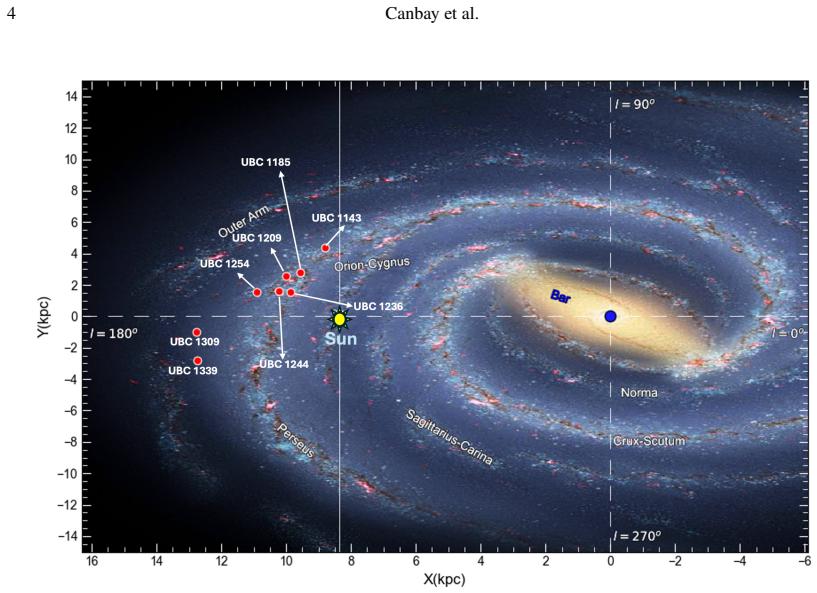
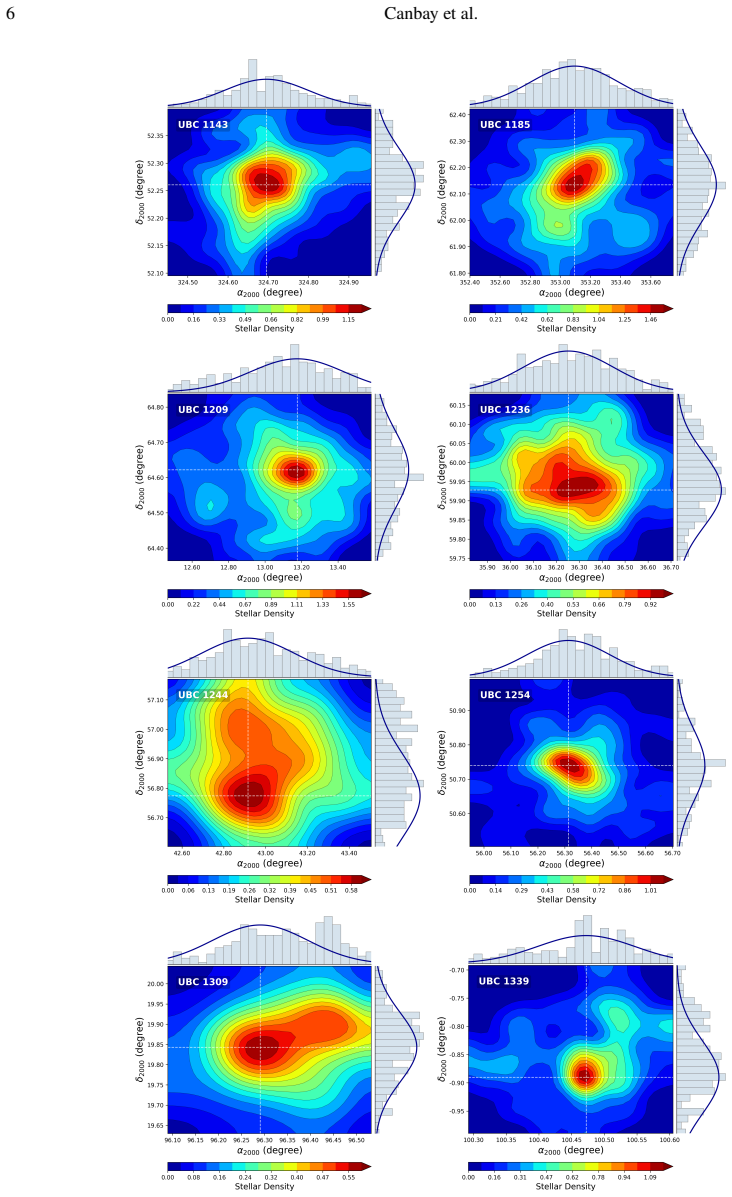
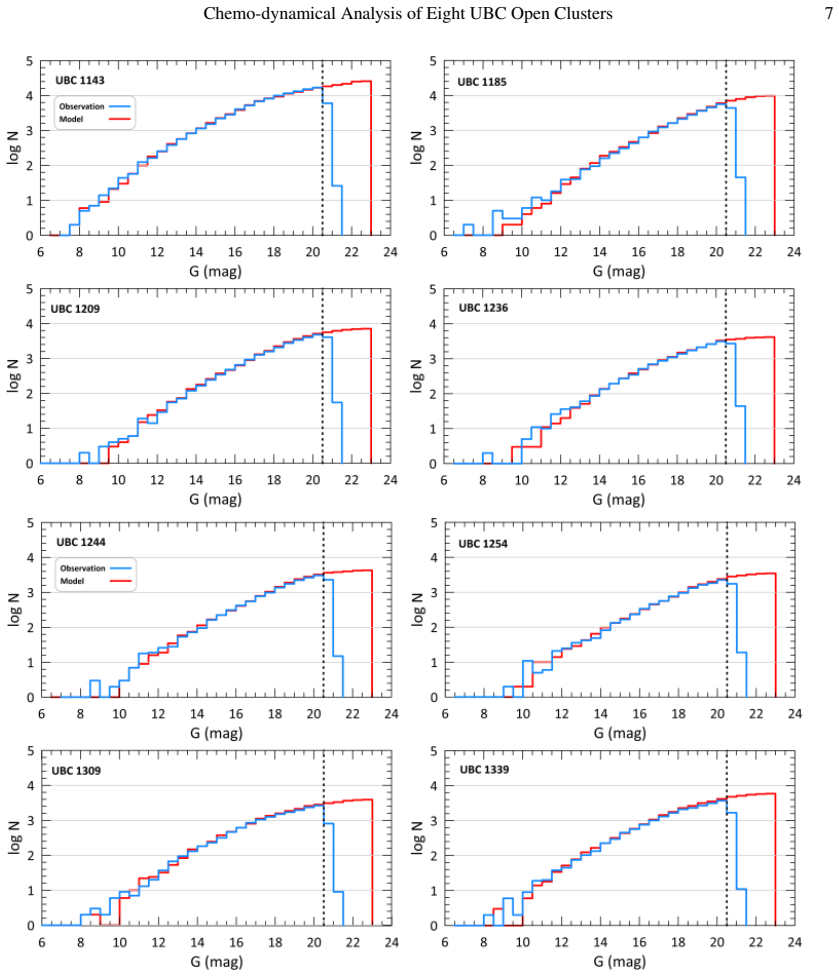

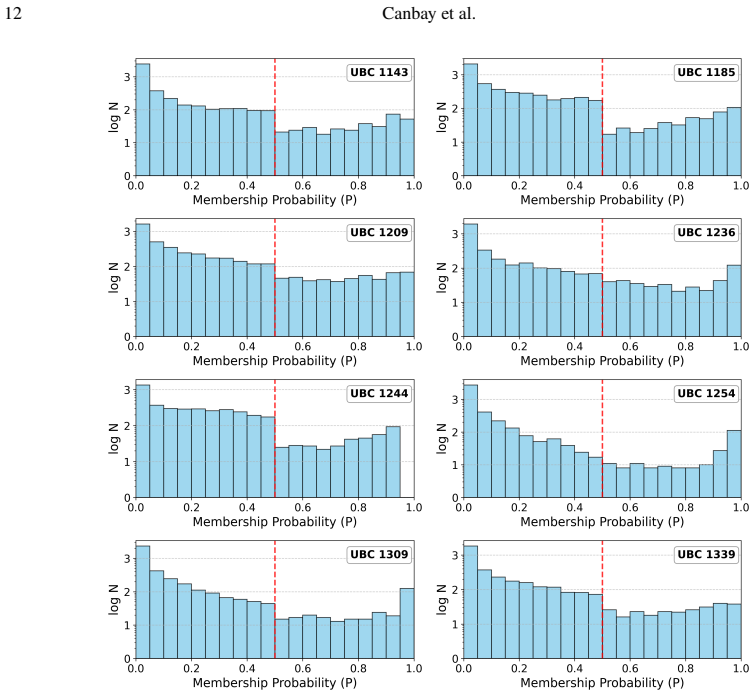




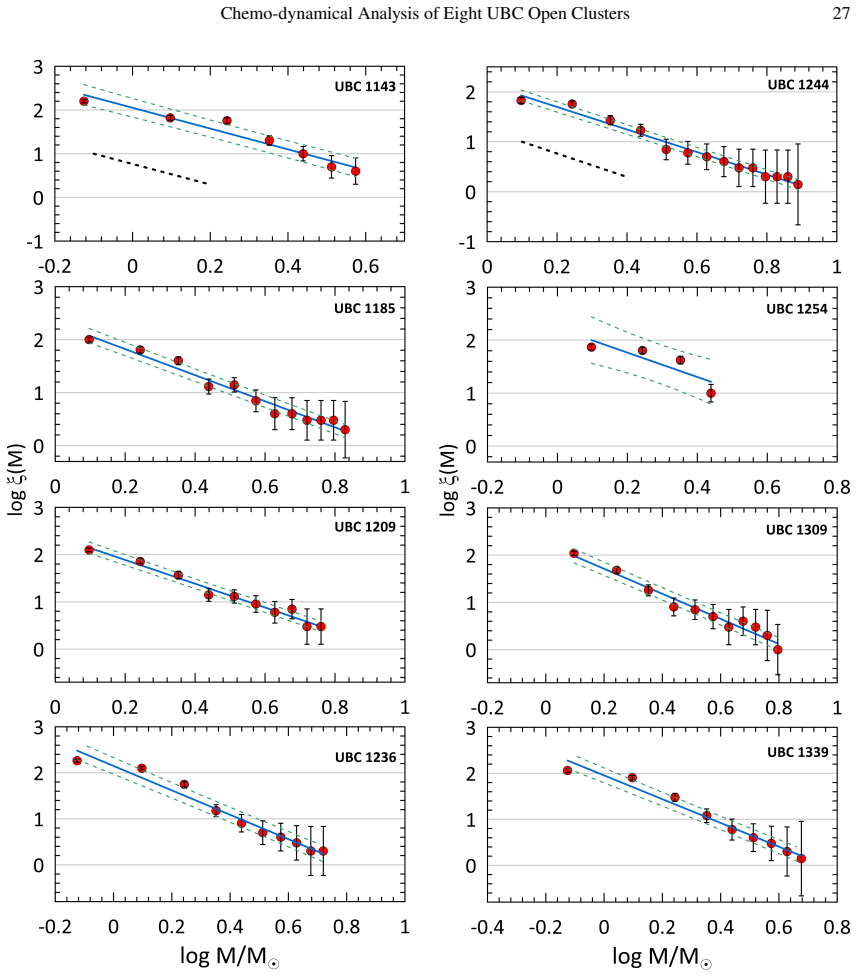
read the original abstract
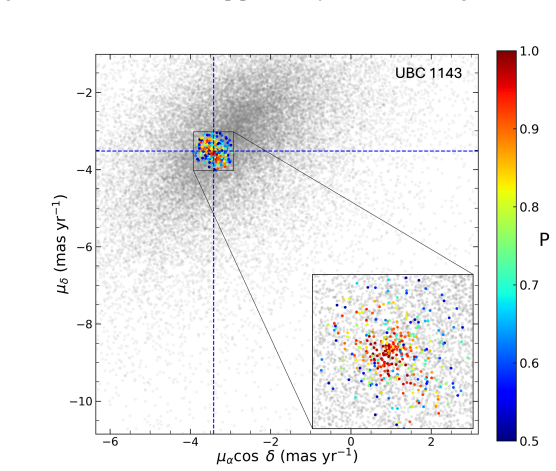
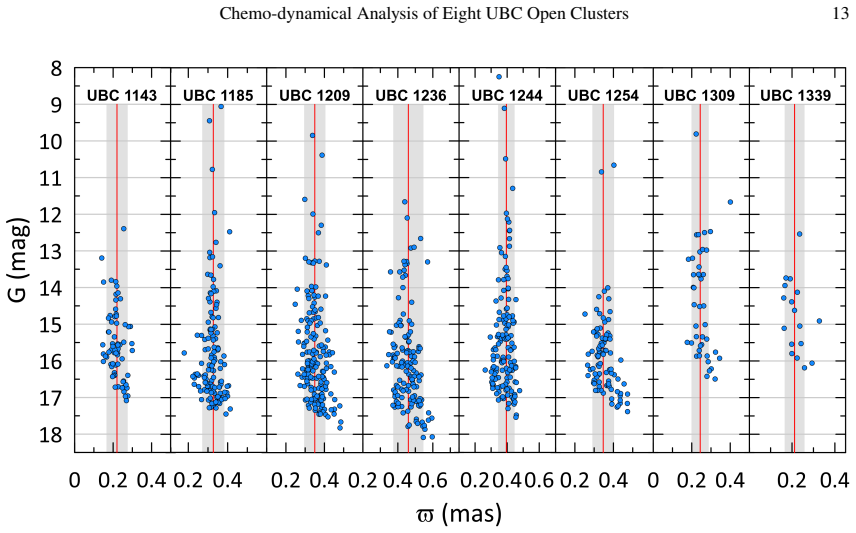
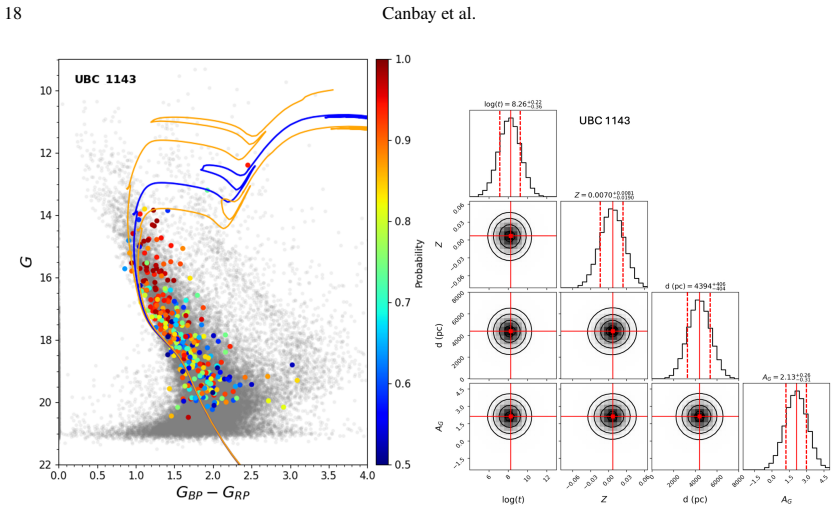
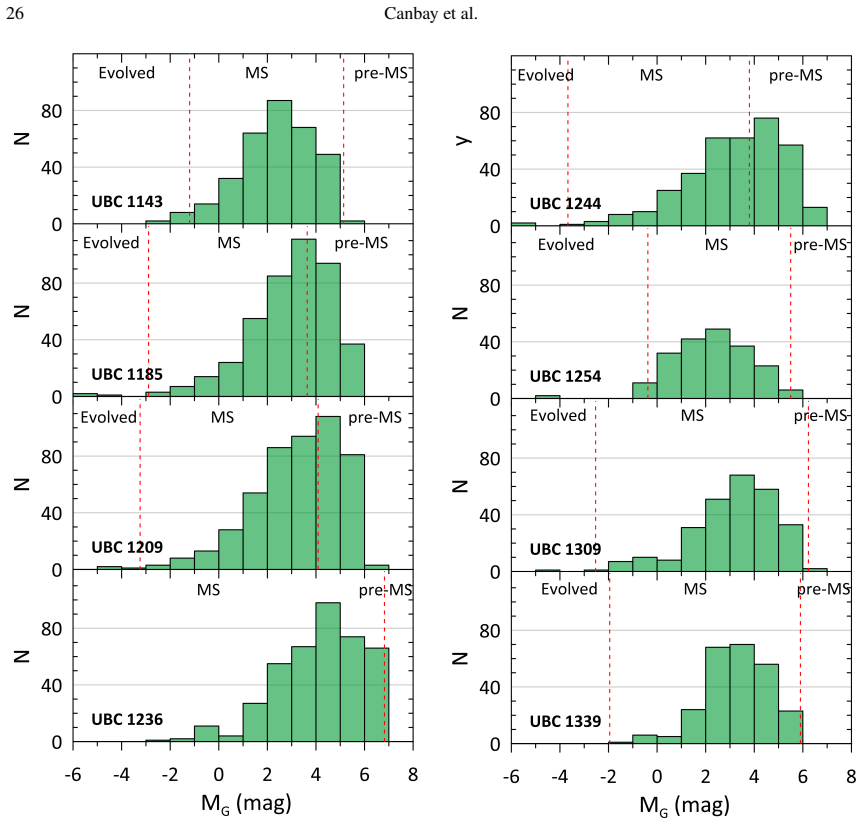
We present a comprehensive chemo-dynamical analysis of eight open clusters selected from the UBC catalog using Gaia DR3 data. These clusters are located at heliocentric distances of ~2-5 kpc, probing regions of the Galactic disk beyond the solar neighborhood. Cluster membership is determined using the UPMASK algorithm, while structural parameters are derived from radial density profiles through King model fitting combined with MCMC sampling. Their structural parameters reveal diverse internal configurations, from diffuse to moderately concentrated systems. Fundamental astrophysical parameters (extinction, distance, metallicity, and age) are obtained via Bayesian isochrone fitting based on PARSEC models. The clusters span a wide age range (~20 Myr to ~5 Gyr) and show a broad metallicity distribution (-0.34 <= [Fe/H] (dex) <= +0.25). Orbital analysis based on backward integrations shows that all clusters follow nearly circular orbits (e ~ 0.03-0.09) with low vertical distances from the Galactic plane (Zmax < 0.4 kpc), confirming their membership in the Galactic thin disk and dynamically cold kinematics. Comparison between inferred traceback orbital radii and present-day guiding radii indicates modest radial displacements, with Delta R < 0.5 kpc for the UBC sample. These offsets are consistent with mild radial redistribution expected for young, dynamically cold open clusters rather than strong radial migration. The results suggest that radial migration should be considered when interpreting the present-day spatial and chemical distribution of these clusters, although the inferred migration amplitudes remain moderate. Our results demonstrate that relatively distant open clusters can be characterized with high precision using Gaia DR3 data and that mild radial redistribution should be considered when interpreting the present-day distribution of stellar populations in the Galactic disk.
Editorial analysis
A structured set of objections, weighed in public.
Referee Report
Summary. The manuscript presents a chemo-dynamical analysis of eight UBC open clusters at heliocentric distances ~2-5 kpc using Gaia DR3. Membership is assigned with UPMASK, structural parameters are obtained from King-model fits via MCMC, fundamental parameters (age, metallicity, distance, extinction) come from Bayesian PARSEC isochrone fitting, and orbital properties are derived from backward integrations. All clusters show nearly circular orbits (e = 0.03-0.09), Zmax < 0.4 kpc, and Delta R < 0.5 kpc between traceback radii and present-day guiding radii; the offsets are interpreted as mild radial redistribution rather than strong migration.
Significance. If the Delta R result survives quantitative error propagation, the work usefully extends open-cluster chemo-dynamics beyond the solar neighborhood and supplies observational limits on migration amplitudes for young, cold thin-disk populations. The sample’s age range (~20 Myr to ~5 Gyr) and metallicity span (-0.34 to +0.25 dex) add leverage for disk-evolution models, and the demonstration that Gaia DR3 can yield precise parameters at 2-5 kpc is a concrete strength.
major comments (1)
- [Orbital analysis] Orbital analysis (abstract and corresponding section): the central claim that Delta R < 0.5 kpc indicates modest displacements is stated without reported uncertainties, Monte Carlo sampling of Gaia DR3 astrometry, or covariance propagation through the backward integrations. At 2-5 kpc distances and ages up to 5 Gyr, parallax and proper-motion errors can produce orbital-radius spreads comparable to or larger than 0.5 kpc; without this quantification the distinction between mild redistribution and stronger migration cannot be drawn from the data.
minor comments (1)
- The Galactic potential adopted for the orbital integrations is not named in the abstract or summary; specifying the model (e.g., axisymmetric or with bar/spiral components) would aid reproducibility.
Simulated Author's Rebuttal
We thank the referee for their careful reading and constructive feedback. The single major comment identifies a genuine gap in the orbital analysis. We agree that quantitative uncertainties on Delta R are required to support the claim of modest radial displacements and will revise the manuscript to include them.
read point-by-point responses
-
Referee: [Orbital analysis] Orbital analysis (abstract and corresponding section): the central claim that Delta R < 0.5 kpc indicates modest displacements is stated without reported uncertainties, Monte Carlo sampling of Gaia DR3 astrometry, or covariance propagation through the backward integrations. At 2-5 kpc distances and ages up to 5 Gyr, parallax and proper-motion errors can produce orbital-radius spreads comparable to or larger than 0.5 kpc; without this quantification the distinction between mild redistribution and stronger migration cannot be drawn from the data.
Authors: We agree that the current manuscript does not report uncertainties on Delta R or describe Monte Carlo error propagation. In the revised version we will (i) draw 1000 realizations of each cluster's astrometry from the Gaia DR3 covariance matrix, (ii) recompute the backward-integrated orbits for each realization, and (iii) report the resulting median and 16th/84th-percentile ranges on Delta R, guiding radius, and eccentricity. This will allow a statistically grounded assessment of whether the observed offsets remain smaller than the typical error-induced spread. revision: yes
Circularity Check
No circularity: standard data-driven analysis with independent orbital calculations
full rationale
The paper derives cluster parameters and Delta R via standard pipelines (UPMASK membership, MCMC King fits, Bayesian PARSEC isochrones, backward orbital integration in a Galactic potential) applied to Gaia DR3 astrometry. Traceback radii and guiding radii are computed separately from the same input data; their difference is not forced by any fit or self-citation. No equations reduce the reported Delta R < 0.5 kpc to a quantity defined by the analysis itself. The derivation chain is self-contained against external benchmarks and contains no load-bearing self-citations or ansatzes.
Axiom & Free-Parameter Ledger
axioms (2)
- domain assumption PARSEC stellar evolution models accurately reproduce the observed color-magnitude diagrams of these clusters for the derived ages and metallicities
- domain assumption The Galactic gravitational potential used for backward integration is a sufficiently accurate representation of the Milky Way for tracing orbits over the clusters' lifetimes
Reference graph
Works this paper leans on
-
[1]
F., Yontan, T., et al
Ak, T., Bostancı, Z. F., Yontan, T., et al. 2016, Ap&SS, 361, 126
2016
-
[2]
2024, Physics and Astronomy Reports, 2, 58
Ak, T., Canbay, R., & Yontan, T. 2024, Physics and Astronomy Reports, 2, 58
2024
-
[3]
2024, Astronomische Nachrichten, 345, e20240052
Akbaba, F., Ak, T., Bilir, S., et al. 2024, Astronomische Nachrichten, 345, e20240052
2024
-
[4]
2021, Astrophysics and Space Science, 366, 68
Akbulut, B., Ak, S., Yontan, T., et al. 2021, Astrophysics and Space Science, 366, 68
2021
-
[5]
J., Goodwin, S
Allison, R. J., Goodwin, S. P., Parker, R. J., et al. 2009, ApJ, 700, L99
2009
-
[6]
2020, Journal of Astrophysics and Astronomy, 41, 6 Barbá, R
Banks, T., Yontan, T., Bilir, S., & Canbay, R. 2020, Journal of Astrophysics and Astronomy, 41, 6 Barbá, R. H., Roman-Lopes, A., Nilo Castellón, J. L., et al. 2015, A&A, 581, A120
2020
-
[7]
M., Soares, J., & Barbuy, B
Bica, E., Dutra, C. M., Soares, J., & Barbuy, B. 2003, A&A, 404, 223
2003
-
[8]
2010, Ap&SS, 326, 139
Bilir, S., Güver, T., Khamitov, I., et al. 2010, Ap&SS, 326, 139
2010
-
[9]
2026, Research in Astronomy and Astrophysics, 26, 085002
Bilir, S., Tas,demir, S., Eraydın, E., et al. 2026, Research in Astronomy and Astrophysics, 26, 085002
2026
-
[10]
F., Yontan, T., et al
Bilir, S., Bostancı, Z. F., Yontan, T., et al. 2016, Advances in Space Research, 58, 1900
2016
-
[11]
2008, Galactic Dynamics: Second Edition
Binney, J., & Tremaine, S. 2008, Galactic Dynamics: Second Edition
2008
-
[12]
2016, ARA&A, 54, 529
Bland-Hawthorn, J., & Gerhard, O. 2016, ARA&A, 54, 529
2016
-
[13]
2014, A&A, 569, A24 Bostancı, Z
Borissova, J., Chené, A.-N., Ramírez Alegría, S., et al. 2014, A&A, 569, A24 Bostancı, Z. F., Ak, T., Yontan, T., et al. 2015, MNRAS, 453, 1095 Bostancı, Z. F., Yontan, T., Bilir, S., et al. 2018, Ap&SS, 363, 143
2014
-
[14]
2012, MNRAS, 427, 127
Bressan, A., Marigo, P., Girardi, L., et al. 2012, MNRAS, 427, 127
2012
-
[15]
2025, AJ, 169, 87
Canbay, R., Ak, T., Bilir, S., Soydugan, F., & Eker, Z. 2025, AJ, 169, 87
2025
-
[16]
2023, AJ, 165, 163
Canbay, R., Bilir, S., Özdönmez, A., & Ak, T. 2023, AJ, 165, 163
2023
-
[17]
2020, A&A, 633, A99
Cantat-Gaudin, T., & Anders, F. 2020, A&A, 633, A99
2020
-
[18]
2018, A&A, 618, A93
Cantat-Gaudin, T., Jordi, C., Vallenari, A., et al. 2018, A&A, 618, A93
2018
-
[19]
2020, A&A, 640, A1
Cantat-Gaudin, T., Anders, F., Castro-Ginard, A., et al. 2020, A&A, 640, A1
2020
-
[20]
2022, A&A, 658, A14
Carrera, R., Casamiquela, L., Carbajo-Hijarrubia, J., et al. 2022, A&A, 658, A14
2022
-
[21]
2019, A&A, 627, A35
Castro-Ginard, A., Jordi, C., Luri, X., Cantat-Gaudin, T., & Balaguer-Núñez, L. 2019, A&A, 627, A35
2019
-
[22]
2018, A&A, 618, A59 32 Canbay et al
Castro-Ginard, A., Jordi, C., Luri, X., et al. 2018, A&A, 618, A59 32 Canbay et al
2018
-
[23]
2020, A&A, 635, A45
Castro-Ginard, A., Jordi, C., Luri, X., et al. 2020, A&A, 635, A45
2020
-
[24]
Castro-Ginard, A., Jordi, C., Luri, X., et al. 2022, A&A, 661, A118 Çakmak, H., Yontan, T., Bilir, S., et al. 2024, Astronomische Nachrichten, 345, e20240054 Çalışkan, Ö., & Gökmen, S. 2025, Physics and Astronomy Reports, 3, 13 Çınar, D. C., Bilir, S., Şahin, T., & Plevne, O. 2025, AJ, 170, 13 Çınar, D. C., Bisht, D., Bilir, S., Qin, S., & Saker, L. 2026a...
work page internal anchor Pith review Pith/arXiv arXiv 2022
-
[25]
2025, PASJ, 77, 1050
Chi, H., Kong, L., Chen, Z., et al. 2025, PASJ, 77, 1050
2025
-
[26]
2024, Research in Astronomy and Astrophysics, 24, 115021
Chi, H., Lai, Z., Wang, F., Li, Z., & Mei, Y. 2024, Research in Astronomy and Astrophysics, 24, 115021
2024
-
[27]
2023b, ApJS, 265, 20 Coşkunoˇglu, B., Ak, S., Bilir, S., et al
Chi, H., Wei, S., Wang, F., & Li, Z. 2023b, ApJS, 265, 20 Coşkunoˇglu, B., Ak, S., Bilir, S., et al. 2011, MNRAS, 412, 1237
2011
-
[28]
S., Lépine, J
Dias, W. S., Lépine, J. R. D., & Alessi, B. S. 2002, A&A, 388, 168
2002
-
[29]
S., Monteir, H., Moitinho, A., et al
Dias, W. S., Monteir, H., Moitinho, A., et al. 2021, MNRAS, 504, 356
2021
-
[30]
S., & Monteiro, H
Dias, W. S., & Monteiro, H. 2025, Rev. Mex. Astron. Astrofis., 61, 3
2025
-
[31]
S., Monteiro, H., Alessi, B., Lépine, J
Dias, W. S., Monteiro, H., Alessi, B., Lépine, J. R. D., & Alves, R. P. 2026, AJ, 171, 24
2026
-
[32]
S., Monteiro, H., & Assafin, M
Dias, W. S., Monteiro, H., & Assafin, M. 2018, MNRAS, 478, 5184
2018
-
[33]
S., Monteiro, H., Caetano, T
Dias, W. S., Monteiro, H., Caetano, T. C., et al. 2014, A&A, 564, A79
2014
-
[34]
M., Cunha, K., et al
Donor, J., Frinchaboy, P. M., Cunha, K., et al. 2020, AJ, 159, 199
2020
-
[35]
1996, in Proceedings of the Second International Conference on Knowledge Discovery and Data Mining (KDD’96) (AAAI Press), 226
Ester, M., Kriegel, H.-P., Sander, J., & Xu, X. 1996, in Proceedings of the Second International Conference on Knowledge Discovery and Data Mining (KDD’96) (AAAI Press), 226
1996
-
[36]
W., Lang, D., & Goodman, J
Foreman-Mackey, D., Hogg, D. W., Lang, D., & Goodman, J. 2013, PASP, 125, 306
2013
-
[37]
Frankel, N., Rix, H.-W., Ting, Y.-S., Ness, M., & Hogg, D. W. 2018, ApJ, 865, 96
2018
-
[38]
2020, ApJ, 896, 15
Frankel, N., Sanders, J., Ting, Y.-S., & Rix, H.-W. 2020, ApJ, 896, 15
2020
-
[39]
Friel, E. D. 1995, ARA&A, 33, 381 Gaia Collaboration, Prusti, T., de Bruijne, J. H. J., et al. 2016, A&A, 595, A1 Gaia Collaboration, Brown, A. G. A., Vallenari, A., et al. 2018, A&A, 616, A1 Gaia Collaboration, Brown, A. G. A., Vallenari, A., et al. 2021, A&A, 649, A1 Gaia Collaboration, Vallenari, A., Brown, A. G. A., et al. 2023, A&A, 674, A1
1995
-
[40]
Gelman, A., & Rubin, D. B. 1992, Statistical Science, 7, 457
1992
-
[41]
2023, AJ, 166, 263
Gokmen, S., Eker, Z., Yontan, T., et al. 2023, AJ, 166, 263
2023
-
[42]
A., Elsanhoury, W
Haroon, A. A., Elsanhoury, W. H., Elkholy, E. A., Saad, A. S., & Çınar, D. C. 2025, Phys. Scr, 100, 055006
2025
-
[43]
1990, ApJ, 356, 359
Hernquist, L. 1990, ApJ, 356, 359
1990
-
[44]
L., & Reffert, S
Hunt, E. L., & Reffert, S. 2021, A&A, 646, A104
2021
-
[45]
L., & Reffert, S
Hunt, E. L., & Reffert, S. 2023, A&A, 673, A114
2023
-
[46]
L., & Reffert, S
Hunt, E. L., & Reffert, S. 2024, A&A, 686, A42
2024
-
[47]
R., Friel, E
Jacobson, H. R., Friel, E. D., Jílková, L., et al. 2016, A&A, 591, A37
2016
-
[48]
C., Deepak, & Malhotra, S
Joshi, Y. C., Deepak, & Malhotra, S. 2024, Frontiers in Astronomy and Space Sciences, 11, 1348321 Chemo-dynamical Analysis of Eight UBC Open Clusters 33
2024
-
[49]
2011, Publications of the Astronomical Society of Australia, 28, 95 Karagöz, H., Yontan, T., Bilir, S., et al
Karaali, S., Bilir, S., Ak, S., Yaz, E., & Coşkunoğlu, B. 2011, Publications of the Astronomical Society of Australia, 28, 95 Karagöz, H., Yontan, T., Bilir, S., et al. 2025, AJ, 170, 149
2011
-
[50]
V., Piskunov, A
Kharchenko, N. V., Piskunov, A. E., Röser, S., Schilbach, E., & Scholz, R. D. 2005, A&A, 438, 1163
2005
-
[51]
V., Piskunov, A
Kharchenko, N. V., Piskunov, A. E., Schilbach, E., Röser, S., & Scholz, R. D. 2012, A&A, 543, A156
2012
-
[52]
V., Piskunov, A
Kharchenko, N. V., Piskunov, A. E., Schilbach, E., Röser, S., & Scholz, R. D. 2013, A&A, 558, A53
2013
-
[53]
1962, AJ, 67, 471 Koç, S., Yontan, T., Bilir, S., et al
King, I. 1962, AJ, 67, 471 Koç, S., Yontan, T., Bilir, S., et al. 2022, AJ, 163, 191
1962
-
[54]
2014, A&A, 561, A57
Krone-Martins, A., & Moitinho, A. 2014, A&A, 561, A57
2014
-
[55]
Kruijssen, J. M. D., Maschberger, T., Moeckel, N., et al. 2012, MNRAS, 419, 841
2012
-
[56]
J., & Lada, E
Lada, C. J., & Lada, E. A. 2003, ARA&A, 41, 57
2003
-
[57]
A., Hernández, J., et al
Lindegren, L., Klioner, S. A., Hernández, J., et al. 2021, A&A, 649, A2
2021
-
[58]
2019, ApJS, 245, 32
Liu, L., & Pang, X. 2019, ApJS, 245, 32
2019
-
[59]
J., Robin, A
Marshall, D. J., Robin, A. C., Reylé, C., Schultheis, M., & Picaud, S. 2006, A&A, 453, 635
2006
-
[60]
2010, ApJ, 722, 112
Minchev, I., & Famaey, B. 2010, ApJ, 722, 112
2010
-
[61]
2018, MNRAS, 481, 1645
Minchev, I., Anders, F., Recio-Blanco, A., et al. 2018, MNRAS, 481, 1645
2018
-
[62]
W., Emerson, J
Minniti, D., Lucas, P. W., Emerson, J. P., et al. 2010, New Astron., 15, 433
2010
-
[63]
1975, Publications of the Astronomical Society of Japan, 27, 533
Miyamoto, M., & Nagai, R. 1975, Publications of the Astronomical Society of Japan, 27, 533
1975
-
[64]
R., & Cuillandre, J.-C
Moraux, E., Bouvier, J., Stauffer, J. R., & Cuillandre, J.-C. 2003, A&A, 400, 891
2003
-
[65]
F., Frenk, C
Navarro, J. F., Frenk, C. S., & White, S. D. M. 1996, ApJ, 462, 563
1996
-
[66]
A., Çakmak, H., Michel, R., & Karataş, Y
Netopil, M., Oralhan, İ. A., Çakmak, H., Michel, R., & Karataş, Y. 2022, MNRAS, 509, 421 Önal Tas,, Ö., Bilir, S., & Plevne, O. 2018, Ap&SS, 363, 35
2022
-
[67]
M., Frinchaboy, P
Otto, J. M., Frinchaboy, P. M., Myers, N. R., et al. 2026, AJ, 171, 91
2026
-
[68]
2015, PASA, 32, e043
Plevne, O., Ak, T., Karaali, S., et al. 2015, PASA, 32, e043
2015
-
[69]
2023, ApJS, 265, 12
Qin, S., Zhong, J., Tang, T., & Chen, L. 2023, ApJS, 265, 12
2023
-
[70]
C., Reylé, C., Derrière, S., & Picaud, S
Robin, A. C., Reylé, C., Derrière, S., & Picaud, S. 2003, A&A, 409, 523 Roškar, R., Debattista, V. P., Quinn, T. R., Stinson, G. S., & Wadsley, J. 2008, ApJ, 684, L79
2003
-
[71]
Salpeter, E. E. 1955, ApJ, 121, 161 Schönrich, R., & Binney, J. 2009, MNRAS, 396, 203
1955
-
[72]
2025, arXiv e-prints, arXiv:2507.07093, 10.48550/arXiv.2507.07093
Schuster, W. J., Moreno, E., Nissen, P. E., & Pichardo, B. 2012, A&A, 538, A21 SDSS Collaboration, Adamane Pallathadka, G., Aghakhanloo, M., et al. 2025, arXiv e-prints, arXiv:2507.07093
-
[73]
A., & Binney, J
Sellwood, J. A., & Binney, J. J. 2002, MNRAS, 336, 785
2002
-
[74]
H., Ann, H
Sim, G., Lee, S. H., Ann, H. B., & Kim, S. 2019, Journal of Korean Astronomical Society, 52, 145
2019
-
[75]
F., Cutri, R
Skrutskie, M. F., Cutri, R. M., Stiening, R., et al. 2006, AJ, 131, 1163
2006
-
[76]
2018, A&A, 619, A155
Soubiran, C., Cantat-Gaudin, T., Romero-Gómez, M., et al. 2018, A&A, 619, A155
2018
-
[77]
2022, Universe, 8, 87
Spina, L., Magrini, L., & Cunha, K. 2022, Universe, 8, 87
2022
-
[78]
Spitzer, Jr., L., & Hart, M. H. 1971, ApJ, 164, 399 Taşdemir, S., Çınar, D. C., Canbay, R., et al. 2025, Physics and Astronomy Reports, 3, 1 34 Canbay et al. Taşdemir, S., Elsanhoury, W. H., Çınar, D. C., Haroon, A., & Bilir, S. 2026, Research in Astronomy and Astrophysics, 26, 045016 Taşdemir, S., & Yontan, T. 2023, Physics and Astronomy Reports, 1, 1 Ta...
1971
-
[79]
2022, A&A, 659, A95 Tunçel Güçtekin, S., Bilir, S., Karaali, S., Plevne, O., & Ak, S
Tsantaki, M., Pancino, E., Marrese, P., et al. 2022, A&A, 659, A95 Tunçel Güçtekin, S., Bilir, S., Karaali, S., Plevne, O., & Ak, S. 2019, Advances in Space Research, 63, 1360
2022
-
[80]
F., et al
Yontan, T., Bilir, S., Bostancı, Z. F., et al. 2015, Ap&SS, 355, 267
2015
discussion (0)
Sign in with ORCID, Apple, or X to comment. Anyone can read and Pith papers without signing in.