Hot Degenerate Components in Blue Stragglers: A Multi-Wavelength SED Analysis of Nine Open Clusters with Swift/UVOT
Pith reviewed 2026-06-28 03:47 UTC · model grok-4.3
The pith
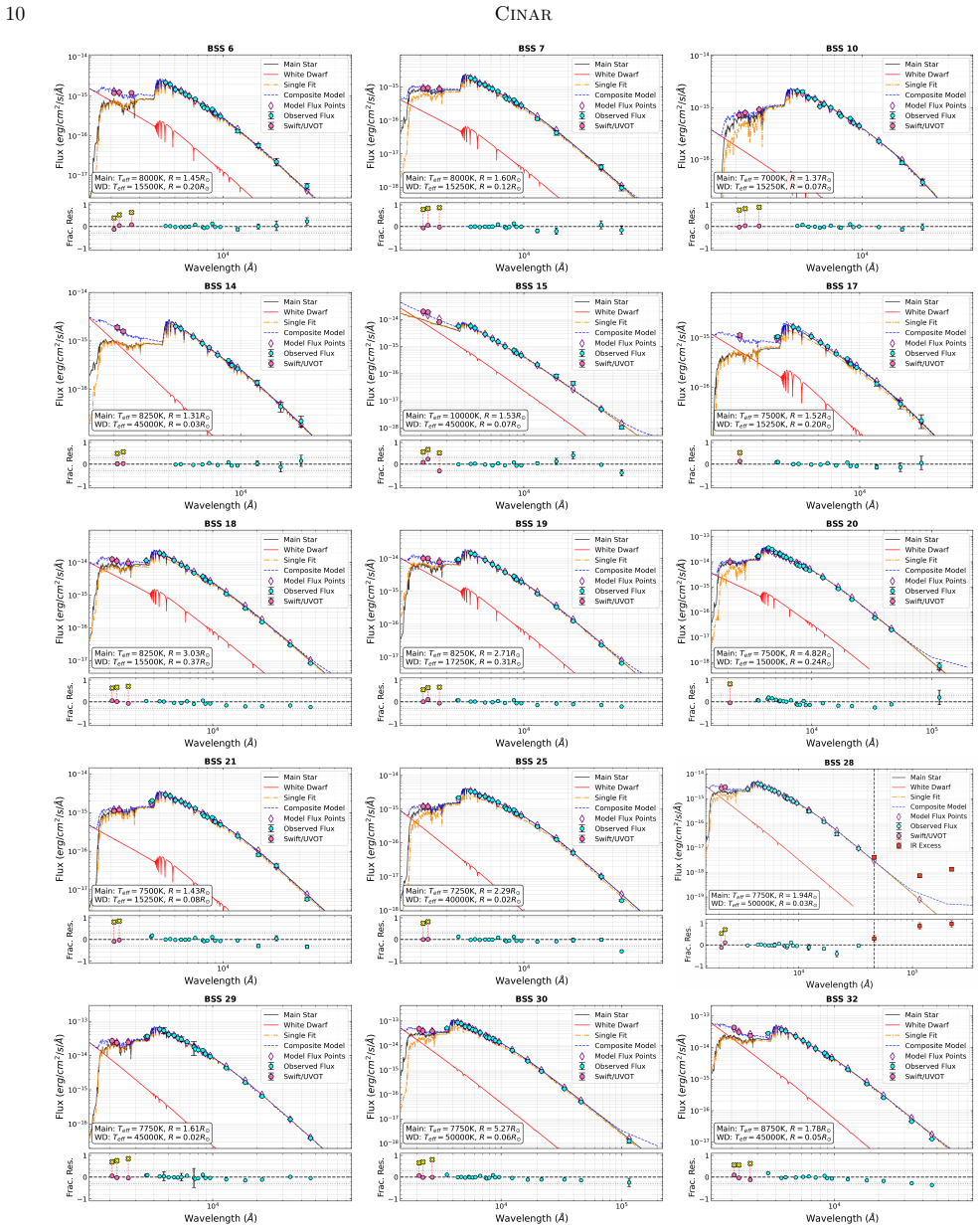
Roughly 43% of blue straggler candidates in nine open clusters show ultraviolet excesses best explained by hot white dwarf or pre-ELM companions.
A machine-rendered reading of the paper's core claim, the machinery that carries it, and where it could break.
Core claim
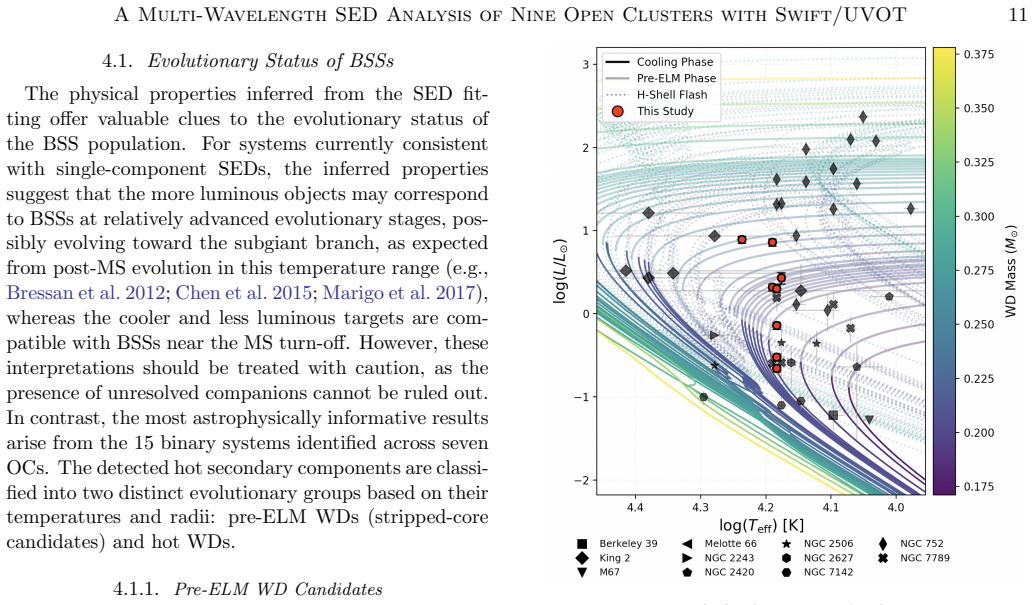
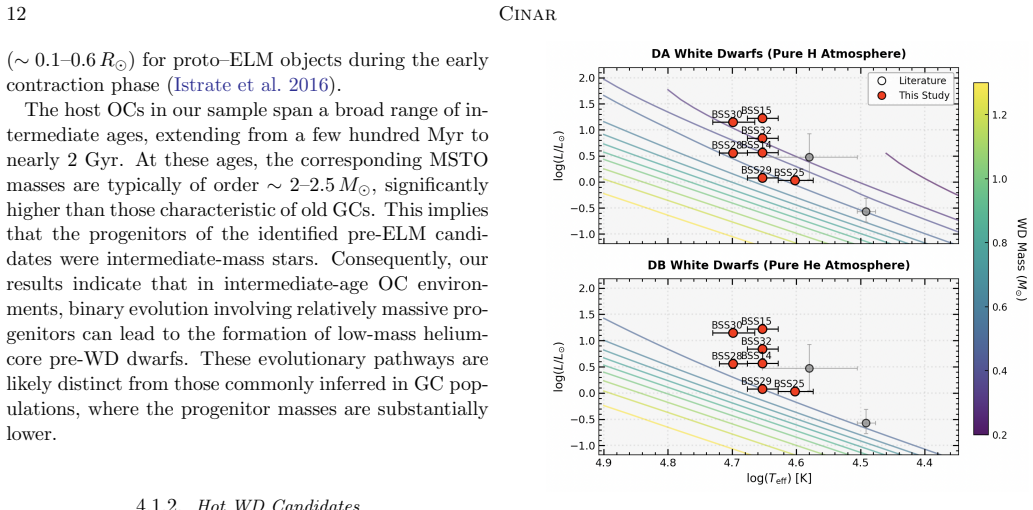
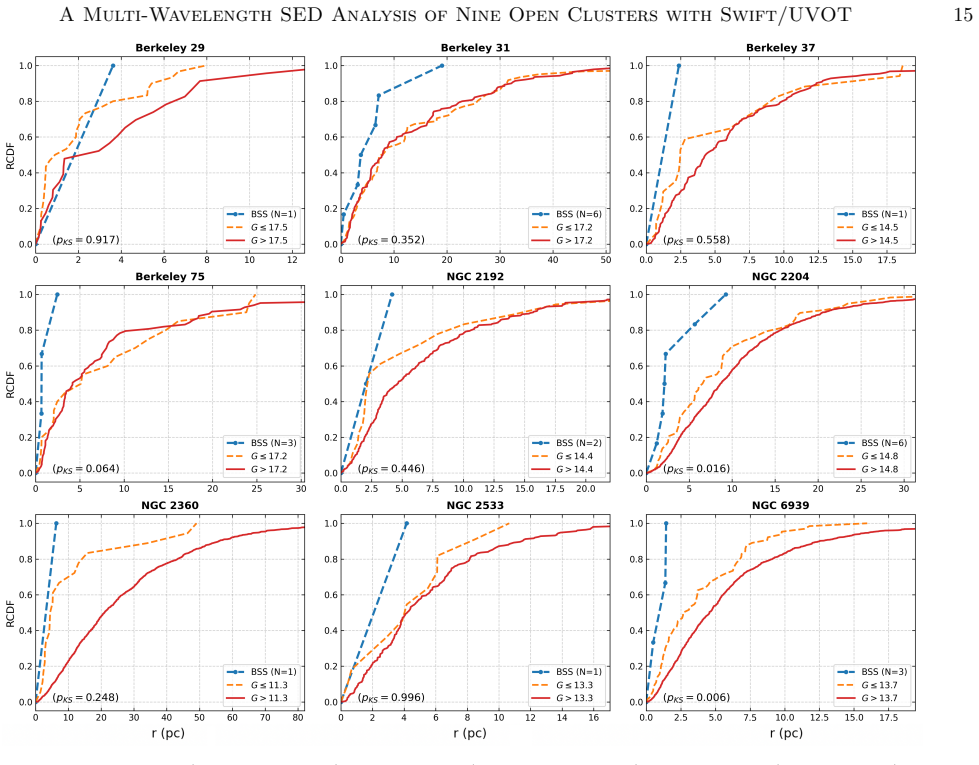
Among 35 blue straggler candidates across nine open clusters, 15 (~43%) display ultraviolet excesses that two-component SED fits describe more accurately than single-component fits. The second components have parameters matching hot white dwarfs and pre-ELM white dwarf candidates, indicating the systems are observed at varying stages after mass transfer. Radial distributions further indicate mass segregation in dynamically evolved clusters, and the clusters themselves follow low-eccentricity, disk-like orbits.
What carries the argument
Two-component spectral energy distribution (SED) decomposition that isolates ultraviolet excess from a hot secondary while fitting the primary blue straggler.
If this is right
- Binary mass transfer is the dominant channel forming the blue straggler population in these clusters.
- The identified systems sample different post-mass-transfer evolutionary stages.
- Mass segregation of blue stragglers occurs on timescales comparable to the clusters' half-mass relaxation times.
- A positive correlation exists between the half-number radius of the blue straggler population and the total number of blue stragglers.
Where Pith is reading between the lines
- Spectroscopic confirmation of the companions would allow direct measurement of mass-transfer efficiency and common-envelope outcomes.
- The same SED approach could be applied to field blue stragglers to test whether binary channels dominate outside clusters.
- If the pre-ELM candidates are confirmed, they would provide observational anchors for models of the transition from red-giant donors to extremely low-mass white dwarfs.
Load-bearing premise
The ultraviolet excess is produced by a physically distinct hot degenerate companion rather than by model degeneracies, chromospheric activity, or other single-star effects.
What would settle it
High-resolution optical or ultraviolet spectra of the 15 UV-excess objects that fail to show the expected hot-companion absorption or emission lines would falsify the two-component interpretation.
Figures
read the original abstract
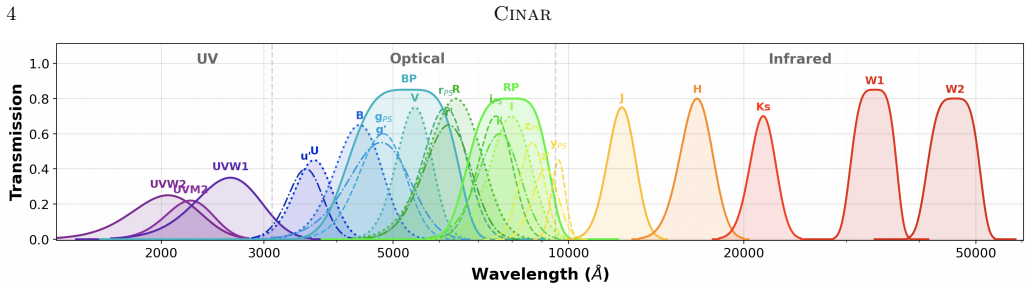
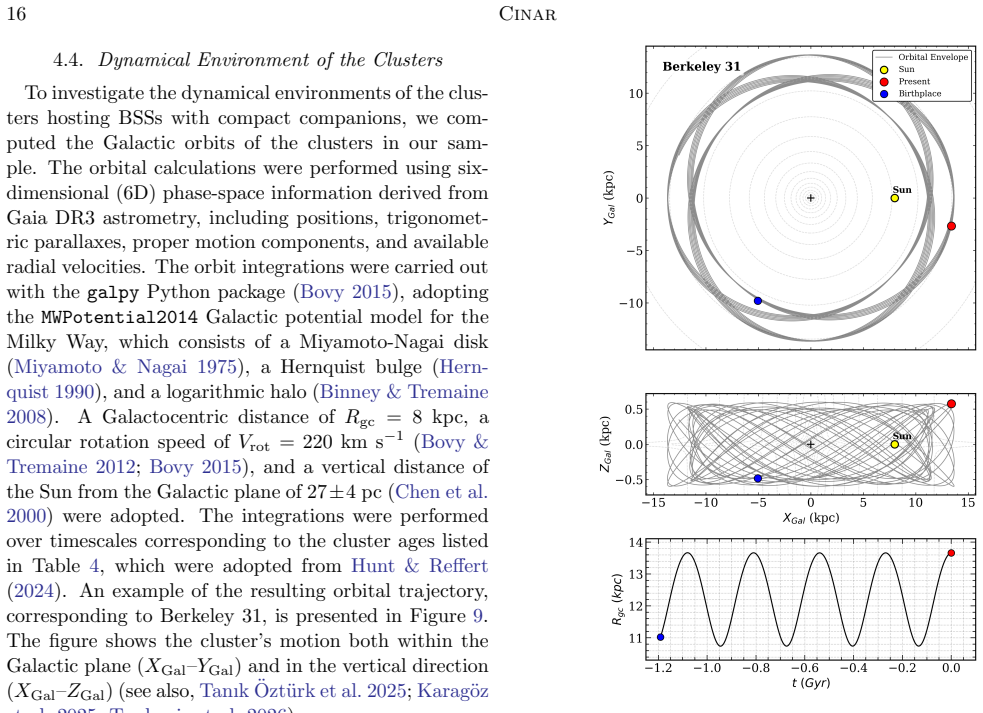
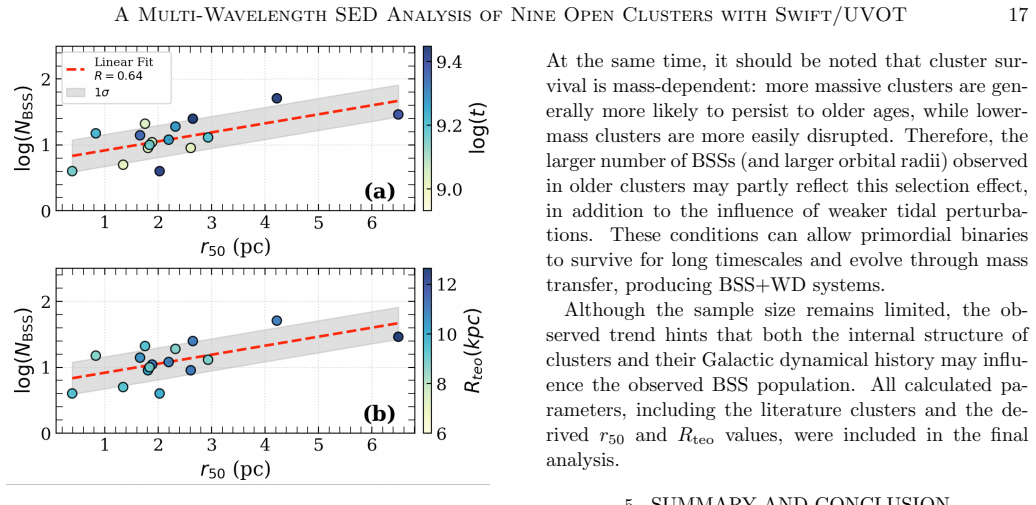
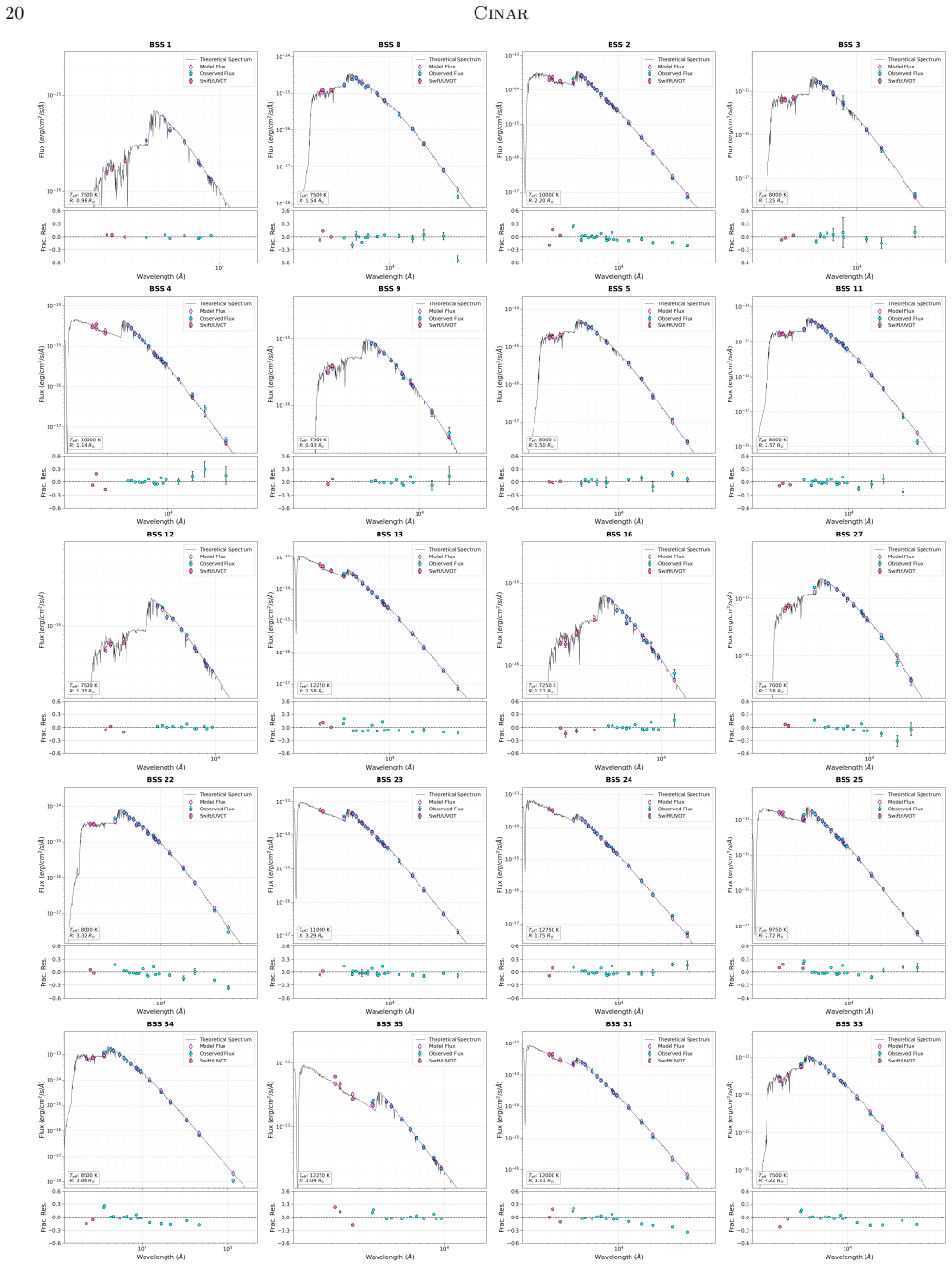
We present a homogeneous multi-wavelength analysis of 35 blue straggler star (BSS) candidates in nine open clusters, combining Swift/UVOT near-ultraviolet data with Gaia DR3 astrometry and optical-to-infrared photometry. We construct spectral energy distributions (SEDs) to search for signatures of hot companions associated with past mass transfer. Among the sample, 15 BSSs (~43%) show ultraviolet excesses that are better described by two-component SED fits. The inferred companions are consistent with hot white dwarfs and pre-extremely low-mass (pre-ELM) white dwarf candidates, suggesting systems observed at different stages following mass transfer. We examine the radial distribution of the BSSs and find evidence for mass segregation in dynamically evolved clusters, a result that is broadly consistent with the estimated half-mass relaxation timescales of the host systems. To place the clusters in a Galactic context, we compute their orbits using galpy, obtaining low eccentricities (e <= 0.1) and disk-like trajectories. We also find a positive relation between the half-number radius of the BSS population (r50) and the total number of BSSs. Overall, our results are consistent with a scenario in which the BSS population in these clusters is dominated by binary evolution. The systems identified here provide observational constraints on post-mass-transfer evolutionary phases. While the number of robust detections is limited and intrinsic degeneracies remain in SED-based decomposition, these results provide a useful foundation for future spectroscopic confirmation.
Editorial analysis
A structured set of objections, weighed in public.
Referee Report
Summary. The manuscript presents a homogeneous multi-wavelength SED analysis of 35 blue straggler star (BSS) candidates across nine open clusters, combining Swift/UVOT NUV photometry with Gaia DR3 astrometry and optical-to-IR data. It reports that 15 BSSs (~43%) exhibit UV excesses better described by two-component SED fits whose parameters are consistent with hot white dwarfs or pre-ELM white dwarf candidates, interpreted as systems at different post-mass-transfer stages. Additional results include evidence for mass segregation in dynamically evolved clusters, low-eccentricity disk-like orbits computed with galpy, and a positive correlation between BSS half-number radius (r50) and total BSS number, supporting a binary-evolution-dominated scenario for the BSS population.
Significance. If the two-component decompositions are shown to be robust, the work would supply useful observational constraints on post-mass-transfer evolutionary phases of BSSs in open clusters and strengthen the case for binary channels over single-star mechanisms. The homogeneous treatment across multiple clusters and the explicit acknowledgment of remaining degeneracies plus the call for spectroscopic follow-up are positive features.
major comments (2)
- [Abstract] Abstract: the central claim that 15 of 35 BSSs (~43%) show UV excesses better described by two-component SED fits (with companions consistent with hot WDs or pre-ELM candidates) rests on modeling choices whose details—fitting procedures, error bars, degeneracy handling, and data exclusion rules—are not provided, rendering the robustness of the companion interpretation impossible to assess from the presented information.
- [Abstract] Abstract: the inference that the systems are observed at different stages following mass transfer is not yet secured, because the manuscript reports no independent verification (radial-velocity orbits, Balmer-line profiles, or X-ray counterparts) to exclude chromospheric activity, single-star UV excesses, or fitting artifacts; the abstract itself notes that intrinsic degeneracies remain in SED-based decomposition.
minor comments (1)
- The discussion of radial distributions and mass segregation would benefit from explicit comparison of the observed BSS radial profiles against the estimated half-mass relaxation timescales for each cluster.
Simulated Author's Rebuttal
We thank the referee for the constructive and detailed report. The comments highlight important points about clarity in the abstract and the limitations of SED-based inferences. We address each major comment below and have made revisions to improve the manuscript.
read point-by-point responses
-
Referee: [Abstract] Abstract: the central claim that 15 of 35 BSSs (~43%) show UV excesses better described by two-component SED fits (with companions consistent with hot WDs or pre-ELM candidates) rests on modeling choices whose details—fitting procedures, error bars, degeneracy handling, and data exclusion rules—are not provided, rendering the robustness of the companion interpretation impossible to assess from the presented information.
Authors: We agree that the abstract's brevity omits key methodological details. The full manuscript describes the two-component SED fitting in Sections 3.2–3.3 (chi-squared comparison between single- and two-component models, Monte Carlo error propagation on photometry, and explicit rules for excluding saturated UVOT points or low-quality Gaia data) and discusses degeneracy handling in Section 4.2. To address the concern, we have revised the abstract to include a concise reference to the fitting methodology and robustness checks. revision: yes
-
Referee: [Abstract] Abstract: the inference that the systems are observed at different stages following mass transfer is not yet secured, because the manuscript reports no independent verification (radial-velocity orbits, Balmer-line profiles, or X-ray counterparts) to exclude chromospheric activity, single-star UV excesses, or fitting artifacts; the abstract itself notes that intrinsic degeneracies remain in SED-based decomposition.
Authors: We concur that the mass-transfer interpretation remains provisional without independent verification, as already noted in the original abstract. The manuscript frames the 15 systems as candidates whose parameters are consistent with hot degenerates at varying post-mass-transfer stages, while explicitly calling for spectroscopic follow-up. We have revised the abstract to strengthen the candidate language and expanded Section 5 to discuss possible alternative explanations (e.g., chromospheric activity) and their expected observational signatures. revision: partial
Circularity Check
No circularity; empirical SED fitting to external archives with no internal derivation chain
full rationale
The paper reports direct observational results from constructing and fitting SEDs to independent multi-wavelength photometry (Swift/UVOT, Gaia DR3, optical-IR archives) for 35 BSS candidates. No equations, derivations, or model predictions are presented that could reduce to fitted inputs by construction. The central inference (15/35 showing two-component UV excesses consistent with hot degenerates) is an output of standard SED decomposition against external data, with the text explicitly noting remaining degeneracies and the need for future spectroscopic confirmation. No self-citation load-bearing steps, uniqueness theorems, or ansatzes are invoked. This is a standard empirical analysis with no detectable circularity.
Axiom & Free-Parameter Ledger
Reference graph
Works this paper leans on
-
[1]
Ahumada , J. A., & Lapasset , E. 2007, , 463, 789, 10.1051/0004-6361:20054590
-
[2]
Althaus , L. G., C \'o rsico , A. H., Isern , J., & Garc \' a-Berro , E. 2010, , 18, 471, 10.1007/s00159-010-0033-1
-
[3]
Althaus , L. G., Miller Bertolami , M. M., & C \'o rsico , A. H. 2013, , 557, A19, 10.1051/0004-6361/201321868
-
[4]
Angelo , M. S., Santos , J. F. C., & Corradi , W. J. B. 2020, , 493, 3473, 10.1093/mnras/staa517
-
[5]
Angelo , M. S., Santos , Jr., J. F. C., Maia , F. F. S., & Corradi , W. J. B. 2023, , 522, 956, 10.1093/mnras/stad1038
-
[6]
Bailer-Jones , C. A. L., Rybizki , J., Fouesneau , M., Demleitner , M., & Andrae , R. 2021, , 161, 147, 10.3847/1538-3881/abd806
work page internal anchor Pith review doi:10.3847/1538-3881/abd806 2021
-
[7]
Bailyn , C. D. 1995, , 33, 133, 10.1146/annurev.aa.33.090195.001025
-
[8]
2008, , 492, 277, 10.1051/0004-6361:200810395
Bayo , A., Rodrigo , C., Barrado Y Navascu \'e s , D., et al. 2008, , 492, 277, 10.1051/0004-6361:200810395
-
[9]
2020, , 901, 93, 10.3847/1538-4357/abafbe
B \'e dard , A., Bergeron , P., Brassard , P., & Fontaine , G. 2020, , 901, 93, 10.3847/1538-4357/abafbe
-
[10]
Bilir , S., Ta s demir , S., Erayd n , E., et al. 2026, Research in Astronomy and Astrophysics, 26, 085002, 10.1088/1674-4527/ae587d
-
[11]
2008, Galactic Dynamics: Second Edition
Binney , J., & Tremaine , S. 2008, Galactic Dynamics: Second Edition
2008
-
[12]
Bisht , D., Jiang , I.-G., Belwal , K., et al. 2026 a , arXiv e-prints, arXiv:2604.12494, 10.48550/arXiv.2604.12494
work page internal anchor Pith review Pith/arXiv arXiv doi:10.48550/arxiv.2604.12494 2026
-
[13]
Bisht , D., Jiang , I.-G., Elsanhoury , W. H., et al. 2026 b , , 171, 72, 10.3847/1538-3881/ae285b
-
[14]
galpy: A Python Library for Galactic Dynamics
Bovy, J. 2015, The Astrophysical Journal Supplement Series, 216, 29, 10.1088/0067-0049/216/2/29
work page internal anchor Pith review doi:10.1088/0067-0049/216/2/29 2015
-
[15]
2012, The Astrophysical Journal, 756, 89, 10.1088/0004-637X/756/1/89
Bovy, J., & Tremaine, S. 2012, The Astrophysical Journal, 756, 89, 10.1088/0004-637X/756/1/89
-
[16]
A., Landsman , W., Holland , S
Breeveld , A. A., Landsman , W., Holland , S. T., et al. 2011, in American Institute of Physics Conference Series, Vol. 1358, Gamma Ray Bursts 2010, ed. J. E. McEnery , J. L. Racusin , & N. Gehrels (AIP), 373--376, 10.1063/1.3621807
-
[17]
Bressan, A., Marigo, P., Girardi, L., et al. 2012, , 427, 127, 10.1111/j.1365-2966.2012.21948.x
-
[18]
2025, Astronomische Nachrichten, 346, e20240118, 10.1002/asna.20240118
Camisassa , M. 2025, Astronomische Nachrichten, 346, e20240118, 10.1002/asna.20240118
-
[19]
2013, , 428, 502, 10.1093/mnras/sts038
Carraro , G., Beletsky , Y., & Marconi , G. 2013, , 428, 502, 10.1093/mnras/sts038
-
[20]
Carraro , G., Geisler , D., Villanova , S., Frinchaboy , P. M., & Majewski , S. R. 2007, , 476, 217, 10.1051/0004-6361:20078113
-
[21]
2019, , 490, 1821, 10.1093/mnras/stz2595
Casamiquela , L., Blanco-Cuaresma , S., Carrera , R., et al. 2019, , 490, 1821, 10.1093/mnras/stz2595
-
[22]
G., & Kurucz , R
Castelli , F., Gratton , R. G., & Kurucz , R. L. 1997, , 318, 841
1997
-
[23]
Castelli , F., & Kurucz , R. L. 2003, in IAU Symposium, Vol. 210, Modelling of Stellar Atmospheres, ed. N. Piskunov , W. W. Weiss , & D. F. Gray , A20
2003
-
[24]
Physics and Astronomy Reports , keywords =
C nar , D. C., Tasdemir , S., Koc , S., & Iyer , S. 2024, Physics and Astronomy Reports, 2, 1, 10.26650/PAR.2024.00002
-
[26]
---. 2024 b , , 168, 278, 10.3847/1538-3881/ad85d2
-
[27]
2000, in American Astronomical Society Meeting Abstracts, Vol
Chen , B., Stoughton , C., Yanny , B., et al. 2000, in American Astronomical Society Meeting Abstracts, Vol. 197, American Astronomical Society Meeting Abstracts, 13.08
2000
-
[28]
2015, , 452, 1068, 10.1093/mnras/stv1281
Chen , Y., Bressan , A., Girardi , L., et al. 2015, , 452, 1068, 10.1093/mnras/stv1281
-
[29]
Childs , A. C., & Geller , A. M. 2025, , 989, 104, 10.3847/1538-4357/ade9bc
-
[30]
M., Wright , E
Cutri , R. M., Wright , E. L., Conrow , T., et al. 2021, VizieR Online Data Catalog: AllWISE Data Release (Cutri+ 2013) , VizieR On-line Data Catalog: II/328. Originally published in: IPAC/Caltech (2013)
2021
-
[31]
Dattatrey , A. K., Yadav , R. K. S., Rani , S., et al. 2023, , 943, 130, 10.3847/1538-4357/acade0
-
[32]
S., Monteiro , H., Moitinho , A., et al
Dias , W. S., Monteiro , H., Moitinho , A., et al. 2021, , 504, 356, 10.1093/mnras/stab770
-
[33]
2023, , 675, A89, 10.1051/0004-6361/202245219
Donada , J., Anders , F., Jordi , C., et al. 2023, , 675, A89, 10.1051/0004-6361/202245219
-
[34]
Donor , J., Frinchaboy , P. M., Cunha , K., et al. 2020, , 159, 199, 10.3847/1538-3881/ab77bc
-
[35]
2024, Physics and Astronomy Reports, 2, 41, 10.26650/PAR.2024.00001
Eker , Z., Soydugan , F., & Bilir , S. 2024, Physics and Astronomy Reports, 2, 41, 10.26650/PAR.2024.00001
-
[36]
2015, , 149, 131, 10.1088/0004-6256/149/4/131
Eker , Z., Soydugan , F., Soydugan , E., et al. 2015, , 149, 131, 10.1088/0004-6256/149/4/131
-
[37]
2018, , 479, 5491, 10.1093/mnras/sty1834
Eker , Z., Bak s , V., Bilir , S., et al. 2018, , 479, 5491, 10.1093/mnras/sty1834
-
[38]
El-Badry , K., Rix , H.-W., Quataert , E., Kupfer , T., & Shen , K. J. 2021, , 508, 4106, 10.1093/mnras/stab2583
-
[39]
R., Beccari , G., Dalessandro , E., et al
Ferraro , F. R., Beccari , G., Dalessandro , E., et al. 2009, , 462, 1028, 10.1038/nature08607
-
[40]
Ferraro , F. R., Lanzoni , B., Dalessandro , E., et al. 2012, , 492, 393, 10.1038/nature11686
-
[41]
Fitzpatrick , E. L. 1999, , 111, 63, 10.1086/316293
-
[42]
Flewelling , H. A., Magnier , E. A., Chambers , K. C., et al. 2020, , 251, 7, 10.3847/1538-4365/abb82d
-
[43]
2022, , 668, A4, 10.1051/0004-6361/202243590
Fu , X., Bragaglia , A., Liu , C., et al. 2022, , 668, A4, 10.1051/0004-6361/202243590
-
[44]
Gaia Collaboration , Vallenari , A., Brown , A. G. A., et al. 2023, , 674, A1, 10.1051/0004-6361/202243940
-
[45]
2004, , 611, 1005, 10.1086/422091
Gehrels , N., Chincarini , G., Giommi , P., et al. 2004, , 611, 1005, 10.1086/422091
-
[46]
Geller , A. M., & Mathieu , R. D. 2011, , 478, 356, 10.1038/nature10512
-
[47]
Gieles , M., Portegies Zwart , S. F., Baumgardt , H., et al. 2006, , 371, 793, 10.1111/j.1365-2966.2006.10711.x
-
[48]
Gosnell , N. M., Mathieu , R. D., Geller , A. M., et al. 2015, , 814, 163, 10.1088/0004-637X/814/2/163
- [49]
-
[50]
G., & Day , C
Hills , J. G., & Day , C. A. 1976, , 17, 87
1976
-
[51]
Hunt , E. L., & Reffert , S. 2024, , 686, A42, 10.1051/0004-6361/202348662
-
[52]
Indebetouw , R., Mathis , J. S., Babler , B. L., et al. 2005, , 619, 931, 10.1086/426679
-
[53]
Istrate , A. G., Marchant , P., Tauris , T. M., et al. 2016, , 595, A35, 10.1051/0004-6361/201628874
-
[54]
V., Pandey , S., Subramaniam , A., & Sagar , R
Jadhav , V. V., Pandey , S., Subramaniam , A., & Sagar , R. 2021, Journal of Astrophysics and Astronomy, 42, 89, 10.1007/s12036-021-09746-y
-
[55]
Jadhav , V. V., & Subramaniam , A. 2021, , 507, 1699, 10.1093/mnras/stab2264
-
[56]
V., Subramaniam , A., & Sagar , R
Jadhav , V. V., Subramaniam , A., & Sagar , R. 2023, , 676, A47, 10.1051/0004-6361/202345907
-
[57]
2024, , 688, A152, 10.1051/0004-6361/202450780
---. 2024, , 688, A152, 10.1051/0004-6361/202450780
-
[58]
M., Torres , S., Rebassa-Mansergas , A., et al
Jim \'e nez-Esteban , F. M., Torres , S., Rebassa-Mansergas , A., et al. 2018, , 480, 4505, 10.1093/mnras/sty2120
-
[59]
2025, , 170, 149, 10.3847/1538-3881/adef16
Karag \"o z , H., Yontan , T., Bilir , S., et al. 2025, , 170, 149, 10.3847/1538-3881/adef16
-
[60]
Keller , S. C., Schmidt , B. P., Bessell , M. S., et al. 2007, , 24, 1, 10.1071/AS07001
-
[61]
2009, , 457, 288, 10.1038/nature07635
Knigge , C., Leigh , N., & Sills , A. 2009, , 457, 288, 10.1038/nature07635
- [62]
-
[63]
Kruijssen , J. M. D. 2012, , 426, 3008, 10.1111/j.1365-2966.2012.21923.x
-
[64]
Lanzoni , B., Ferraro , F. R., Alessandrini , E., et al. 2016, , 833, L29, 10.3847/2041-8213/833/2/L29
-
[65]
Leigh , N., Sills , A., & Knigge , C. 2011, , 415, 3771, 10.1111/j.1365-2966.2011.18995.x
-
[66]
D., Vanderburg , A., Gosnell , N
Leiner , E., Mathieu , R. D., Vanderburg , A., Gosnell , N. M., & Smith , J. C. 2019, , 881, 47, 10.3847/1538-4357/ab2bf8
-
[67]
2023, , 672, A81, 10.1051/0004-6361/202244998
Li , C., Zhong , J., Qin , S., & Chen , L. 2023, , 672, A81, 10.1051/0004-6361/202244998
-
[68]
2026, , 706, A62, 10.1051/0004-6361/202557529
Malhotra , S., Castro-Ginard , A., Anders , F., et al. 2026, , 706, A62, 10.1051/0004-6361/202557529
-
[69]
2017, ApJ, 835, 77, doi: 10.3847/1538-4357/835/1/77
Marigo , P., Girardi , L., Bressan , A., et al. 2017, , 835, 77, 10.3847/1538-4357/835/1/77
-
[70]
, year = 2009, month = dec, volume =
Mathieu , R. D., & Geller , A. M. 2009, , 462, 1032, 10.1038/nature08568
-
[71]
Mathieu , R. D., & Geller , A. M. 2015, in Astrophysics and Space Science Library, Vol. 413, Ecology of Blue Straggler Stars, ed. H. M. J. Boffin , G. Carraro , & G. Beccari , 29, 10.1007/978-3-662-44434-4_3
-
[72]
Maxted , P. F. L., Serenelli , A. M., Miglio , A., et al. 2013, , 498, 463, 10.1038/nature12192
-
[73]
McCrea , W. H. 1964, , 128, 147, 10.1093/mnras/128.2.147
-
[74]
Photometric Identification of Unresolved Binary Stars in Nearby Open Star Clusters
Mikhnevich , V. O., Plotnikova , A., Carraro , G., & Seleznev , A. F. 2026, arXiv e-prints, arXiv:2604.20722, 10.48550/arXiv.2604.20722
work page internal anchor Pith review Pith/arXiv arXiv doi:10.48550/arxiv.2604.20722 2026
-
[75]
Milone , A. P., Piotto , G., Bedin , L. R., et al. 2012, , 540, A16, 10.1051/0004-6361/201016384
-
[76]
2013, , 558, A9, 10.1051/0004-6361/201220189
Minchev , I., Chiappini , C., & Martig , M. 2013, , 558, A9, 10.1051/0004-6361/201220189
-
[77]
1975, Publications of the Astronomical Society of Japan, 27, 533
Miyamoto, M., & Nagai, R. 1975, Publications of the Astronomical Society of Japan, 27, 533
1975
-
[78]
1972, , 175, 417, 10.1086/151568
Nauenberg , M. 1972, , 175, 417, 10.1086/151568
-
[79]
A., C akmak , H., Michel , R., & Karata s , Y
Netopil , M., Oralhan , \.I . A., C akmak , H., Michel , R., & Karata s , Y. 2022, , 509, 421, 10.1093/mnras/stab2961
-
[80]
Onken , C. A., Wolf , C., Bessell , M. S., et al. 2024, , 41, e061, 10.1017/pasa.2024.53
-
[81]
Pandey , S., Subramaniam , A., & Jadhav , V. V. 2021, , 507, 2373, 10.1093/mnras/stab2308
discussion (0)
Sign in with ORCID, Apple, or X to comment. Anyone can read and Pith papers without signing in.