REVIEW 4 major objections 4 minor 121 references
A Systematic Review of Human-AI Co-Creativity
T0 review · 4 major / 4 minor · reviewed 2026-08-06 · deepseek-v4-flash
Pith's one-line read This review of 62 co-creativity user studies argues that high user control and transparent, editable AI outputs drive satisfaction, trust, and ownership, and that proactive AI helps mainly when adaptive and context-sensitive.
desk verdict A solid, useful synthesis of co-creativity research that overstates causal certainty and needs its missing corpus before it can be trusted as authoritative. read the letter →
The pith
A machine-rendered reading of the paper's core claim, the machinery that carries it, and where it could break.
The reading
What carries the argument
The central machinery is the six-dimension categorization scheme used to tag all 62 papers, together with the four evaluation themes used to organize user-study findings. The user-control dimension, spanning no control, limited control, and full control, and the proactivity subcategories, namely anticipating user needs, anticipating goal needs, information-seeking, opportunity-seeking, and not proactive, are the load-bearing constructs because they let the authors compare findings across very different systems and translate them into cross-cutting design considerations. The phase-of-creative-process dimension, covering clarification, ideation, development, and implementation, does the work of exposing gaps, most notably the near absence of systems that help with problem clarification.
What would settle it
A re-coding study in which two independent raters classify the same 62 papers on user control, proactivity, and creative phase, with inter-rater agreement reported, would test the stability of the taxonomy. A re-analysis showing that the apparent benefits of high user control weaken, disappear, or reverse when task domain or evaluation method is held constant would undercut the central claim.
Extended reading notes
Core claim
The central claim is that in human-AI co-creativity, keeping the human in control of the AI's contributions, by making outputs transparent, editable, and subject to approval, is what generates satisfaction, trust, and ownership, while proactive system behavior is beneficial only when it is triggered by contextual signals and does not override the user's creative vision. The review arrives at this claim by organizing 62 papers along six dimensions, namely creative task, phase of the creative process, proactive behavior, user control, system embodiment, and AI model type, and by grouping user-evaluation findings into themes of perceived intent, roles and expectations, transparency, and consistency. It reports, for example, that users in several studies explicitly welcomed systems that left decisions up to them, that giving users final editing control increased perceived agency, and that proactive suggestions were judged useful when the system was seen as a proposer but distracting when it was seen as a transcriber, patterns that ground the 24 design considerations.
Load-bearing premise
The conclusions depend on treating 62 very different user studies, with different tasks, AI models, and evaluation methods, as comparable evidence for cross-cutting claims about control, proactivity, satisfaction, and trust, and the paper reports no inter-rater reliability for the manual categorization that makes that pooling possible.
Editorial extensions
If this is right
- AI outputs in co-creative systems should be transparent and editable, with users able to approve or reject contributions, before designers invest heavily in more autonomous generation.
- Proactivity should be triggered by contextual signals such as hesitation, task state, or expressed user need, rather than by static rules or fixed schedules.
- The system's role, whether collaborator, assistant, or tool, should be made explicit and kept consistent with its behavior, because the same proactive suggestion is welcomed or resented depending on role perception.
- Future co-creative systems should target early creative phases like problem clarification, where current coverage is thinnest.
- Embodiment is worth its added complexity mainly in multimodal or improvisational tasks, where it increases engagement, whereas in text or digital art it matters less than control and transparency.
Reading between the lines
- A clean experimental test would run the same co-creative system in three control conditions, full, limited, and none, while measuring satisfaction, trust, and ownership; the review's pooling predicts a monotonic effect that no single study in the set establishes directly.
- The evidence suggests that role perception may follow from control rather than the reverse: when users can edit the AI's output they treat it as a tool or partner on their terms, and when they cannot they may read the same behavior as dismissive or rude.
- Because nearly all included evaluations are short lab sessions, the social-presence and trust effects highlighted by the review may be partly novelty effects, and longitudinal field studies would be needed to see whether they persist.
- The under-represented clarification phase is a concrete design opportunity: systems that help users define and reframe the problem before generating ideas could complement the dominant ideation-focused tools.
Editorial analysis
A structured set of objections, weighed in public.
Referee Report
Summary. The paper reports a PRISMA-guided systematic review of 62 papers on human-AI co-creativity, spanning 2015-2023 and covering visual arts, design, music, writing, game design, and performance. The authors identify six design dimensions (creative task, phase of the creative process, proactive behaviour, user control, system embodiment, and AI model type), four evaluation themes, and 24 design considerations. The central stated finding is that high user control leads to greater satisfaction, trust, and ownership over creative outputs, and that proactive systems can enhance collaboration when they are adaptive and context-sensitive. The paper also identifies gaps in the literature, such as limited support for early creative phases and challenges in user adaptation.
Significance. If its conclusions are supported, the review would provide a useful organizing framework and a set of practical design considerations for a fast-growing area of HCI and computational creativity. The paper's strengths include a detailed, PRISMA-style screening flow, a broad multi-database search strategy, coverage of the LLM transition period, and a substantial set of concrete design considerations (DC 1-24). The paper also makes a good-faith effort to relate design dimensions to user-study findings and to acknowledge limitations, including subjective evaluation metrics and the under-representation of the clarification phase. However, the load-bearing causal claim about user control is not matched by the reviewed evidence, and the review's reproducibility is weakened by the absence of an explicit list of included papers and by unreported coding reliability. The review is potentially valuable as a structured synthesis and heuristic design resource, but the central claims need to be either re-evidenced or reframed.
major comments (4)
- [§4.4, Abstract, Conclusion] The causal claim that 'systems offering high user control lead to greater satisfaction, trust, and a stronger sense of ownership over creative outcomes' is not supported by the synthesis as presented. The evidence cited in §4.4 consists of qualitative preference reports and user comments (Koch et al. [58], Oh et al. [85], Long et al. [70]) and one study where participants appreciated that the AI left decisions to them ([57]); these are not controlled comparisons of high versus low user control measuring satisfaction, trust, or ownership. The categorization method in §2.3 records control levels but does not systematically code which outcome constructs were measured or whether control was experimentally manipulated. The causal verb 'leads to' is therefore an interpretive overlay. Please either add a systematic outcome-evidence table and restrict causal claims to directly comparable studies, or soften the wording throughout to associational language such as 'is associated with' or 'users reported preferring'.
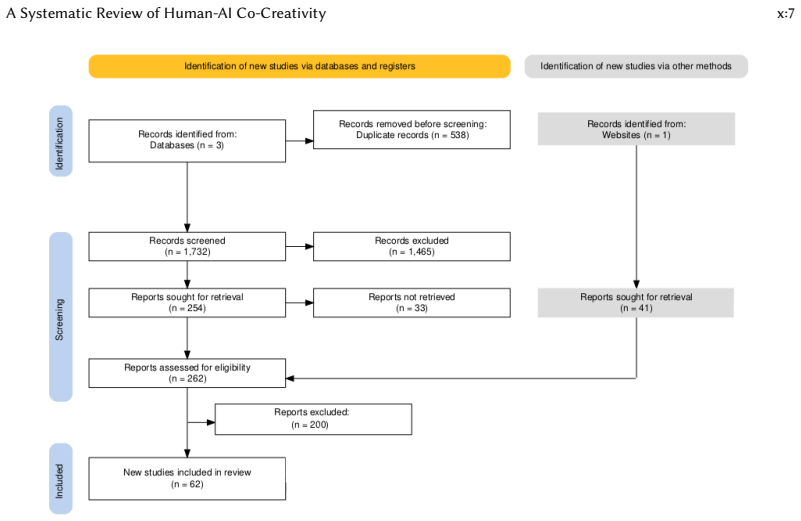
- [§2.2 and §2.3] The final set of 62 included papers is never enumerated. The PRISMA-style flow in Figure 3 ends with the count 62, but there is no list in the main text, appendix, or supplementary materials, and Table 2 lists only representative papers per category. Without the full list, readers cannot verify the inclusion criteria, reproduce the synthesis, or assess whether the selected papers support the claims. In addition, the first phase of screening was done by a single reviewer and the final paper categorization was applied manually by the first author, with no inter-rater reliability or agreement metric reported for either step. For a systematic review, reporting Cohen's kappa or a similar agreement measure for screening and coding, and providing the list of included papers, is essential.
- [§4.3] There is an internal count inconsistency for information-seeking behaviour. The text states '3 papers addressing information-seeking behaviour' and later says 'Despite only five papers focusing on information-seeking behaviour seen in Fig 9'; Table 2 lists three representative papers for this subcategory. The authors should correct the count and ensure that the numbers in the text, Figure 9, and Table 2 are reconciled. The overall proactivity counts (20 anticipating user needs, 3 information-seeking, 17 anticipating goal needs, 23 opportunity-seeking, 33 not proactive) also need a clear explanation of how duplicates are handled in each figure, since the sum of subcategory counts (63) exceeds the number of proactive papers (29).
- [Appendix B, Table 3] The 24 design considerations are presented as a single list without an explicit mapping to the papers or findings that support each one. Several considerations, such as DC 12 (balance user control with exploration) and DC 24 (give different features different names or identities), go beyond any single cited study and appear to be expert extrapolations. Because the paper's practical value rests on these considerations being evidence-based, each DC should cite the supporting papers or be explicitly labeled as a heuristic or expert suggestion, so that readers can distinguish synthesized findings from design hypotheses.
minor comments (4)
- [§1] There are several typographical and consistency issues: 'Pintrest' should be 'Pinterest', 'Mccormack' should be 'McCormack' where it appears in prose, and the paper alternates between 'co creativity' and 'co-creativity' in a few places.
- [§4.2, Figure 13] Figure 13 shows the relationship between proactivity and user control, but the text in §4.4 only says that non-proactive systems tend to have limited or no user control; the figure deserves a direct discussion in the text, including whether any proactive systems also allow full control.
- [§5.3] The statement that 'Around 30% of the papers in our review had comments about instructions' is not supported by a count or a citation to a table or figure; please provide the calculation or remove the precise percentage.
- [§2.3] The sentence 'Unlike dimensions, the papers were not tagged by the categories of evaluation themes they talked about' is confusing because Section 5 presents evaluation-theme findings as if they were systematically derived; please clarify whether these themes were identified post hoc and whether all papers were read for them.
Circularity Check
No significant circularity: the review's claims are qualitative syntheses of cited user studies, not derivations from fitted inputs or self-citation chains.
full rationale
This paper is a systematic literature review, not a formal derivation or predictive modeling effort. It contains no equations, no fitted parameters, and no quantities that are predicted from inputs in a way that could be circular. The central claims—such as the finding that high user control is associated with satisfaction, trust, and ownership—are presented as qualitative syntheses of the 62 reviewed user studies and are supported in Section 4.4 by explicit references to empirical findings (e.g., users requesting more control, appreciating that decisions were left to them, and reporting greater agency when editing was under their control). These are evidence-based generalizations from the reviewed literature, not conclusions that are equivalent to the review's own coding scheme by construction. The fact that the six dimensions 'arose organically from the literature' and are then used to organize that same literature is standard inductive practice in qualitative systematic reviews; it is an organizational framework, not a predestination of the findings. The review does cite prior frameworks (e.g., [94], [48]) for inspiration, but these are external prior works by other authors and are not invoked as self-citations, uniqueness theorems, or forbidden-alternative arguments. The acknowledged limitations—single-author coding without reported inter-rater reliability and reliance on subjective evaluation metrics—are methodological validity concerns rather than circularity. No load-bearing step in the paper reduces to its own inputs by definition, equation, or self-citation. Accordingly, the appropriate finding is no significant circularity.
Assumptions & free parameters
assumptions (4)
- domain assumption Creativity requires a vague, ill-defined problem and outcomes that are both novel and valuable, per Newell et al.; creative tasks were therefore restricted to artistic tasks with dynamically shifting end goals.
- domain assumption The Osborn-Parnes Creative Problem Solving model with Clarification, Ideation, Development, and Implementation is the correct process taxonomy for human-AI co-creativity; Wallas and Lubart models are set aside.
- domain assumption Proactivity definitions from organizational psychology and human-robot interaction transfer to co-creative AI systems, including the added 'opportunity-seeking' category.
- ad hoc to paper User-study results from heterogeneous tasks, systems, and evaluation instruments can be pooled into cross-cutting claims about user control, trust, satisfaction, and ownership.
Cite this review
Pith. "Pith review of A Systematic Review of Human-AI Co-Creativity." pith.science (2026). https://pith.science/paper/75ICO4MI
@misc{pith2026250621333,
  author       = {Pith},
  title        = {Pith review of: A Systematic Review of Human-AI Co-Creativity},
  year         = {2026},
  howpublished = {\url{https://pith.science/paper/75ICO4MI}},
  note         = {Machine review of arXiv:2506.21333}
}
read the original abstract
The co creativity community is making significant progress in developing more sophisticated and tailored systems to support and enhance human creativity. Design considerations from prior work can serve as a valuable and efficient foundation for future systems. To support this effort, we conducted a systematic literature review of 62 papers on co-creative systems. These papers cover a diverse range of applications, including visual arts, design, and writing, where the AI acts not just as a tool but as an active collaborator in the creative process. From this review, we identified several key dimensions relevant to system design: phase of the creative process, creative task, proactive behavior of the system, user control, system embodiment, and AI model type. Our findings suggest that systems offering high user control lead to greater satisfaction, trust, and a stronger sense of ownership over creative outcomes. Furthermore, proactive systems, when adaptive and context sensitive, can enhance collaboration. We also extracted 24 design considerations, highlighting the value of encouraging users to externalize their thoughts and of increasing the system's social presence and transparency to foster trust. Despite recent advancements, important gaps remain, such as limited support for early creative phases like problem clarification, and challenges related to user adaptation to AI systems.
Figures


Figures from the paper (12 more)




Reference graph
Works this paper leans on
-
[58]
Janin Koch, Nicolas Taffin, Michel Beaudouin-Lafon, Markku Laine, Andrés Lucero, and Wendy E. Mackay. 2020. ImageSense: An Intelligent Collaborative Ideation Tool to Support Diverse Human-Computer Partnerships. Proc. ACM Hum.-Comput. Interact. 4, CSCW1, Article 45 (May 2020), 27 pages. https://doi.org/10.1145/3392850
-
[85]
Changhoon Oh, Jungwoo Song, Jinhan Choi, Seonghyeon Kim, Sungwoo Lee, and Bongwon Suh. 2018. I Lead, You Help but Only with Enough Details: Understanding User Experience of Co-Creation with Artificial Intelligence. In Proceedings of the 2018 CHI Conference on Human Factors in Computing Systems (Montreal QC, Canada) (CHI ’18). Association for Computing Mac...
arXiv 2018
-
[70]
Tao Long, Dorothy Zhang, Grace Li, Batool Taraif, Samia Menon, Kynnedy Simone Smith, Sitong Wang, Katy Ilonka Gero, and Lydia B. Chilton. 2023. Tweetorial Hooks: Generative AI Tools to Motivate Science on Social Media. ArXiv abs/2305.12265 (2023). https://api.semanticscholar.org/CorpusID:258833277
arXiv 2023
-
[57]
Janin Koch, Andrés Lucero, Lena Hegemann, and Antti Oulasvirta. 2019. May AI? Design Ideation with Cooperative Contextual Bandits. In Proceedings of the 2019 CHI Conference on Human Factors in Computing Systems (Glasgow, Scotland Uk) (CHI ’19). Association for Computing Machinery, New York, NY, USA, 1–12. https://doi.org/10.1145/ 3290605.3300863
arXiv 2019
-
[1]
[n. d.]. ACM Digital Library — dl.acm.org. https://dl.acm.org/. [Accessed 20-11-2024]
2024
-
[2]
[n. d.]. Association for Computational Creativity — computationalcreativity.net. https://computationalcreativity.net/. [Accessed 20-11-2024]. , Vol. x, No. x, Article x. Publication date: x 2025. x:30 Singh et al
2024
-
[3]
[n. d.]. GALILEO@UGA Subject Guides: Using Rayyan for Systematic Reviews: Remove Duplicate References — guides.libs.uga.edu. https://guides.libs.uga.edu/rayyan/duplicates. [Accessed 20-11-2024]
2024
-
[4]
[n. d.]. GitHub - googlecreativelab/quickdraw-dataset: Documentation on how to access and use the Quick, Draw! Dataset. — github.com. https://github.com/googlecreativelab/quickdraw-dataset. [Accessed 16-12-2024]
2024
Show all 121 references
-
[5]
[n. d.]. GSU Library Research Guides: Rayyan for Systematic and Scoping Reviews: Resolving Conflicts — re- search.library.gsu.edu. https://research.library.gsu.edu/c.php?g=1059580&p=7702414. [Accessed 20-11-2024]
2024
-
[6]
[n. d.]. Rayyan — new.rayyan.ai. https://new.rayyan.ai/. [Accessed 20-11-2024]
2024
-
[7]
Gabriella Airenti. 2018. The Development of Anthropomorphism in Interaction: Intersubjectivity, Imagination, and Theory of Mind. Frontiers in Psychology 9 (2018). https://doi.org/10.3389/fpsyg.2018.02136
2018
-
[8]
Safinah Ali, Nisha Devasia, Hae Won Park, and Cynthia Breazeal. 2021. Social Robots as Creativity Eliciting Agents. Frontiers in Robotics and AI 8 (2021). https://doi.org/10.3389/frobt.2021.673730
2021
-
[9]
Alsharhan
Abdulla. Alsharhan. 2022. Natural Language Generation and Creative Writing A Systematic Review.. In International Journal of Advances in Applied Computational Intelligence . 69–90. https://doi.org/10.54216/IJAACI.010105
2022 doi
-
[10]
Alberto Alvarez, Steve Dahlskog, Jose Font, Johan Holmberg, Chelsi Nolasco, and Axel Österman. 2018. Fostering creativity in the mixed-initiative evolutionary dungeon designer. In Proceedings of the 13th International Conference on the Foundations of Digital Games (Malmö, Swed...
2018
-
[11]
Alberto Alvarez, Eric Grevillius, Elin Olsson, and Jose Font. 2021. Questgram [Qg]: Toward a Mixed-Initiative Quest Generation Tool. In Proceedings of the 16th International Conference on the Foundations of Digital Games (Montreal, QC, Canada) (FDG ’21). Association for Comput...
2021
-
[12]
Cronin, and Ana Paiva
Patrícia Alves-Oliveira, Patrícia Arriaga, Matthew A. Cronin, and Ana Paiva. 2020. Creativity Encounters Between Children and Robots. In Proceedings of the 2020 ACM/IEEE International Conference on Human-Robot Interaction (Cambridge, United Kingdom) (HRI ’20) . Association for...
2020
-
[13]
Patrícia Alves-Oliveira, Samuel Gomes, Ankita Chandak, Patrícia Arriaga, Guy Hoffman, and Ana Paiva. 2020. Software architecture for YOLO, a creativity-stimulating robot. SoftwareX 11 (2020), 100461. https://doi.org/10.1016/ j.softx.2020.100461
2020
-
[14]
Tyler Angert, Miroslav Suzara, Jenny Han, Christopher Pondoc, and Hariharan Subramonyam. 2023. Spellburst: A node-based interface for exploratory creative coding with natural language prompts. In Proceedings of the 36th Annual ACM Symposium on User Interface Software and Techn...
2023
-
[15]
Samangi Wadinambi Arachchi and Anishka A Hettiarachchi. 2023. An interactive conceptual multisensory model to elevate creativity of undergraduates: a review of literature. Built-Environment Sri Lanka 13, 2 (2023)
2023
-
[16]
Arnold, April M
Kenneth C. Arnold, April M. Volzer, and Noah G. Madrid. 2021. Generative Models can Help Writers without Writing for Them. In IUI Workshops. https://api.semanticscholar.org/CorpusID:235789381
2021
-
[17]
Trevor Ashby, Braden K Webb, Gregory Knapp, Jackson Searle, and Nancy Fulda. 2023. Personalized Quest and Dia- logue Generation in Role-Playing Games: A Knowledge Graph- and Language Model-based Approach. In Proceedings of the 2023 CHI Conference on Human Factors in Computing ...
2023
-
[19]
Seonghoon Ban and Kyung Hoon Hyun. 2020. 3D Computational Sketch Synthesis Framework: Assisting Design Exploration Through Generating Variations of User Input Sketch and Interactive 3D Model Reconstruction. Comput. Aided Des. 120, C (March 2020), 17 pages. https://doi.org/10.1...
2020
-
[20]
Debosmita Bhaumik, Ahmed Khalifa, and Julian Togelius. 2021. Lode Encoder: AI-constrained co-creativity. In 2021 IEEE Conference on Games (CoG) (Copenhagen, Denmark). IEEE Press, 01–08. https://doi.org/10.1109/CoG52621.2021. 9619009
2021
-
[21]
Uta Bindl and Sharon Parker. 2010. Proactive work behavior: Forward-thinking and change-oriented action in organizations. APA Handbook of Industrial and Organizational Psychology 2 (07 2010)
2010
-
[22]
Kyle Booten. 2019. Toward Digital Progymnasmata.. In International Conference on Computational Creativity . 1–8
2019
-
[23]
Marianne Bossema, Somaya Ben Allouch, Aske Plaat, and Rob Saunders. 2023. Human-Robot Co-creativity: A Scoping Review : Informing a Research Agenda for Human-Robot Co-Creativity with Older Adults. 2023 32nd IEEE International Conference on Robot and Human Interactive Communica...
2023
-
[24]
Brown, Toby Gifford, and Bradley Voltz
Andrew R. Brown, Toby Gifford, and Bradley Voltz. 2017. Stimulating Creative Partnerships in Human-Agent Musical Interaction. Comput. Entertain. 14, 2, Article 5 (Jan. 2017), 17 pages. https://doi.org/10.1145/2991146 , Vol. x, No. x, Article x. Publication date: x 2025. A Syst...
2017 doi
-
[25]
Sera Buyukgoz, Amit Kumar Pandey, Marine Chamoux, and Mohamed Chetouani. 2021. Exploring behavioral creativity of a proactive robot. Front. Robot. AI 8 (Nov. 2021), 694177
2021
-
[26]
Mar Canet Sola and Varvara Guljajeva. 2022. Dream Painter: Exploring creative possibilities of AI-aided speech-to- image synthesis in the interactive art context. Proc. ACM Comput. Graph. Interact. Tech. 5, 4, Article 33 (Sept. 2022), 11 pages. https://doi.org/10.1145/3533386
2022 doi
-
[27]
Bhanu chander, Chinju John, Lekha Warrier, and Kumaravelan Gopalakrishnan. 2024. Toward Trustworthy Artificial Intelligence (TAI) in the Context of Explainability and Robustness. ACM Comput. Surv. (June 2024). https://doi.org/ 10.1145/3675392 Just Accepted
2024 doi
-
[28]
Lee Cheatley, Margareta Ackerman, Alison Pease, and Wendy Moncur. 2020. Co-creative songwriting for bereavement support. In International Conference on Computational Creativity . 33–40
2020
-
[29]
Amandine Cimier, Beatrice Biancardi, Jérome Guegan, Frédéric Segonds, Fabrice Mantelet, Camille Jean, Claude Gazo, and Stéphanie Buisine. 2025. Multisensory objects’ role on creativity. Journal of Creativity 35, 1 (2025), 100092. https://doi.org/10.1016/j.yjoc.2024.100092
2025
-
[30]
Robin Cohen, Coralee Allaby, Christian Cumbaa, Mark Fitzgerald, Kinson Ho, Bowen Hui, Celine Latulipe, Fletcher Lu, Nancy Moussa, David Pooley, Alex Qian, and Saheem Siddiqi. 1998. What is Initiative? User Modeling and User-Adapted Interaction 8, 3–4 (Feb. 1998), 171–214. http...
1998 doi
-
[31]
Hai Dang, Karim Benharrak, Florian Lehmann, and Daniel Buschek. 2022. Beyond Text Generation: Supporting Writers with Continuous Automatic Text Summaries. In Proceedings of the 35th Annual ACM Symposium on User Interface Software and Technology (Bend, OR, USA) (UIST ’22). Asso...
2022
-
[32]
Hai Dang, Sven Goller, Florian Lehmann, and Daniel Buschek. 2023. Choice Over Control: How Users Write with Large Language Models using Diegetic and Non-Diegetic Prompting. In Proceedings of the 2023 CHI Conference on Human Factors in Computing Systems (Hamburg, Germany) (CHI ...
2023
-
[33]
Nicholas Davis. 2013. Human-computer co-creativity: Blending human and computational creativity. In Proceedings of the AAAI Conference on Artificial Intelligence and Interactive Digital Entertainment , Vol. 9. 9–12
2013
-
[34]
Davis, C
N. Davis, C. Hsiao, K. Y. Singh, B. Lin, and B. Magerko. 2017. Quantifying Collaboration with a Co-Creative Drawing Agent. ACM Trans. Interact. Intell. Syst. 7, 4, Article 19 (Dec. 2017), 25 pages. https://doi.org/10.1145/3009981
2017 doi
-
[35]
Nicholas Davis, Chih-Pin Hsiao, Kunwar Yashraj Singh, and Brian Magerko. 2016. Co-creative drawing agent with object recognition. In Proceedings of the Twelfth AAAI Conference on Artificial Intelligence and Interactive Digital Entertainment (Burlingame, California, USA) (AIIDE...
2016
-
[36]
Nicholas Davis, Chih-PIn Hsiao, Kunwar Yashraj Singh, Lisa Li, and Brian Magerko. 2016. Empirically Studying Participatory Sense-Making in Abstract Drawing with a Co-Creative Cognitive Agent. In Proceedings of the 21st International Conference on Intelligent User Interfaces (S...
2016
-
[37]
Davis, Mary Lou Maher, Kazjon Grace, and Omar Eltayeby
Nicholas M. Davis, Mary Lou Maher, Kazjon Grace, and Omar Eltayeby. 2018. Surprise Walks: Encouraging users towards novel concepts with sequential suggestions. In International Conference on Computational Creativity . https: //api.semanticscholar.org/CorpusID:52085776
2018
-
[38]
Maha Elgarf and Christopher Peters. 2022. CreativeBot: a Creative Storyteller Agent Developed by Leveraging Pre-trained Language Models. In 2022 IEEE/RSJ International Conference on Intelligent Robots and Systems (IROS) . 13438–13444. https://doi.org/10.1109/IROS47612.2022.9981033
2022
-
[39]
Maha Elgarf, Gabriel Skantze, and Christopher Peters. 2021. Once Upon a Story: Can a Creative Storyteller Robot Stimulate Creativity in Children?. In Proceedings of the 21st ACM International Conference on Intelligent Virtual Agents (Virtual Event, Japan) (IV A ’21). Associati...
2021
-
[40]
Jonas Frich, Lindsay MacDonald Vermeulen, Christian Remy, Michael Mose Biskjaer, and Peter Dalsgaard. 2019. Mapping the Landscape of Creativity Support Tools in HCI. In Proceedings of the 2019 CHI Conference on Human Factors in Computing Systems (Glasgow, Scotland Uk) (CHI ’19...
2019
-
[41]
Maliheh Ghajargar, Jeffrey Bardzell, and Love Lagerkvist. 2022. A Redhead Walks into a Bar: Experiences of Writing Fiction with Artificial Intelligence. In Proceedings of the 25th International Academic Mindtrek Conference (Tampere, Finland) (Academic Mindtrek ’22). Associatio...
2022
-
[42]
Christina Guillaumier. 2016. Reflection as creative process: Perspectives, challenges and practice. Arts and Humanities in Higher Education 15 (07 2016), 353–363. https://doi.org/10.1177/1474022216647381
2016 doi
-
[44]
Guzdial, Nicholas Liao, and Mark O
Matthew J. Guzdial, Nicholas Liao, and Mark O. Riedl. 2018. Co-Creative Level Design via Machine Learning. ArXiv abs/1809.09420 (2018). https://api.semanticscholar.org/CorpusID:52822277
2018 arXiv
-
[45]
Hennessey and Teresa M
Beth A. Hennessey and Teresa M. Amabile. 2010. Creativity. Annual Review of Psychology 61, Volume 61, 2010 (2010), 569–598. https://doi.org/10.1146/annurev.psych.093008.100416
2010
-
[46]
Pamela J Hinds. 1998. User control and its many facets: A study of perceived control in human-computer interaction . Hewlett Packard Laboratories California
1998
-
[47]
Shi Qiuc Muhammad Saqibd Saeed Anwarf Muhammad Usmanf Naveed Akhtarh Nick Barnesi Ajmal Mianj Humza Naveeda, Asad Ullah Khanb. 2024. A Comprehensive Overview of Large Language Models. https: //arxiv.org/pdf/2307.06435 [Accessed 11-11-2024]
2024 arXiv
-
[48]
Angel Hsing-Chi Hwang. 2022. Too Late to be Creative? AI-Empowered Tools in Creative Processes. In Extended Abstracts of the 2022 CHI Conference on Human Factors in Computing Systems (New Orleans, LA, USA) (CHI EA ’22). Association for Computing Machinery, New York, NY, USA, A...
2022 doi
-
[49]
Angel Hsing-Chi Hwang, Samy Badreddine, Frederick Gifford, and Tarek R. Besold. 2023. Recipe 2.0: Information Presentation for AI-Supported Culinary Idea Generation. In International Conference on Computational Creativity . https://api.semanticscholar.org/CorpusID:273496310
2023
-
[50]
Francisco Ibarrola, Tomas Lawton, and Kazjon Grace. 2024. A Collaborative, Interactive and Context-Aware Drawing Agent for Co-Creative Design. IEEE Transactions on Visualization and Computer Graphics 30, 8 (Aug. 2024), 5525–5537. https://doi.org/10.1109/TVCG.2023.3293853
2024
-
[51]
Mikhail Jacob and Brian Magerko. 2015. Interaction-based Authoring for Scalable Co-creative Agents.. In ICCC. 236–243
2015
-
[53]
Pegah Karimi, Nicholas Davis, Mary Lou Maher, Kazjon Grace, and Lina Lee. 2019. Relating cognitive models of design creativity to the similarity of sketches generated by an ai partner. In Proceedings of the 2019 Conference on Creativity and Cognition. 259–270
2019
-
[54]
Pegah Karimi, Mary Lou Maher, Nicholas Davis, and Kazjon Grace. 2019. Deep learning in a computational model for conceptual shifts in a co-creative design system. arXiv preprint arXiv:1906.10188 (2019)
2019 arXiv
-
[55]
Jingoog Kim, Mary Lou Maher, and Safat Siddiqui. 2021. Collaborative Ideation Partner: Design Ideation in Human-AI Co-creativity.. In CHIRA. 123–130
2021
-
[56]
Jingoog Kim, Mary Lou Maher, and Safat Siddiqui. 2021. Studying the Impact of AI-based Inspiration on Human Ideation in a Co-Creative Design System.. In Iui workshops
2021
-
[59]
Hatice Kose, Kerstin Dautenhahn, and Chrystopher Nehaniv. 2008. Emergent dynamics of turn-taking interaction in drumming games with a humanoid robot. Proceedings of the 17th IEEE International Symposium on Robot and Human Interactive Communication, RO-MAN, 346 – 353. https://d...
2008
-
[60]
Matthias Kraus, Nicolas Wagner, and Wolfgang Minker. 2020. Effects of Proactive Dialogue Strategies on Human- Computer Trust. In Proceedings of the 28th ACM Conference on User Modeling, Adaptation and Personalization (Genoa, Italy) (UMAP ’20). Association for Computing Machine...
2020
-
[61]
Max Kreminski, Melanie Dickinson, Noah Wardrip-Fruin, and Michael Mateas. 2022. Loose ends: a mixed-initiative creative interface for playful storytelling. In Proceedings of the Eighteenth AAAI Conference on Artificial Intelligence and Interactive Digital Entertainment (Pomona...
2022 doi
-
[62]
Meha Kumar, Duri Long, and Brian Magerko. 2020. Creativity Metrics for a Lead-and-Follow Dynamic in an Improvisational Dance Agent. In International Conference of Computational Creativity . https://api.semanticscholar. org/CorpusID:228097243 , Vol. x, No. x, Article x. Publica...
2020
-
[63]
Eun Kwon and Gerard Kim. 2010. Humanoid robot vs. projector robot: Exploring an indirect approach to human robot interaction. 157–158. https://doi.org/10.1109/HRI.2010.5453216
2010
-
[64]
Law, JiHyun Jeong, Amritansh Kwatra, Malte F
Matthew V. Law, JiHyun Jeong, Amritansh Kwatra, Malte F. Jung, and Guy Hoffman. 2019. Negotiating the Creative Space in Human-Robot Collaborative Design. In Proceedings of the 2019 on Designing Interactive Systems Conference (San Diego, CA, USA) (DIS ’19) . Association for Com...
2019
-
[65]
Roberto Legaspi, Wenzhen Xu, Tatsuya Konishi, Shinya Wada, Nao Kobayashi, Yasushi Naruse, and Yuichi Ishikawa
-
[66]
Yuyu Lin, Jiahao Guo, Yang Chen, Cheng Yao, and Fangtian Ying. 2020. It Is Your Turn: Collaborative Ideation With a Co-Creative Robot through Sketch. In Proceedings of the 2020 CHI Conference on Human Factors in Computing Systems (Honolulu, HI, USA) (CHI ’20). Association for ...
2020
-
[67]
Zhiyu Lin, Rohan Agarwal, and Mark Riedl. 2022. Creative wand: a system to study effects of communications in co-creative settings. In Proceedings of the Eighteenth AAAI Conference on Artificial Intelligence and Interactive Digital Entertainment (Pomona, CA, USA)(AIIDE’22). AA...
2022 doi
-
[68]
Yinhan Liu, Myle Ott, and Naman Goyal. 2019. Jingfei Du, Mandar Joshi, Danqi Chen, Omer Levy, Mike Lewis, Luke Zettlemoyer, and Veselin Stoyanov. 2019. Roberta: A robustly optimized bert pretraining approach. arXiv preprint arXiv:1907.11692 1, 3.1 (2019), 3–3
2019 arXiv
-
[69]
Duri Long, Mikhail Jacob, and Brian Magerko. 2019. Designing Co-Creative AI for Public Spaces. In Proceedings of the 2019 Conference on Creativity and Cognition (San Diego, CA, USA) (CC ’19). Association for Computing Machinery, New York, NY, USA, 271–284. https://doi.org/10.1...
2019
-
[71]
Switching On
Jackson G. Lu, Modupe Akinola, and Malia F. Mason. 2017. “Switching On” creativity: Task switching can increase creativity by reducing cognitive fixation. Organizational Behavior and Human Decision Processes 139 (2017), 63–75. https://doi.org/10.1016/j.obhdp.2017.01.005
2017 doi
-
[72]
Todd Lubart. 2001. Models of the Creative Process: Past, Present and Future. Creativity Research Journal 13 (10 2001), 295–308. https://doi.org/10.1207/S15326934CRJ1334_07
2001 doi
-
[73]
Todd Lubart. 2005. How can computers be partners in the creative process: Classification and commentary on the Special Issue. International Journal of Human-Computer Studies 63, 4 (2005), 365–369. https://doi.org/10.1016/j.ijhcs. 2005.04.002 Computer support for creativity
2005 doi
-
[74]
Todd Lubart and Branden Thornhill-Miller. 2019. Creativity: An overview of the 7C’s of creative thought. The psychology of human thought: An introduction (2019), 277–305
2019
-
[75]
Pedro Lucas and Carlos Martinho. 2017. Stay Awhile and Listen to 3Buddy, a Co-creative Level Design Support Tool. In International Conference on Computational creativity . https://api.semanticscholar.org/CorpusID:52884060
2017
-
[76]
Takuya Maeda and Anabel Quan-Haase. 2024. When Human-AI Interactions Become Parasocial: Agency and Anthropomorphism in Affective Design. In Proceedings of the 2024 ACM Conference on Fairness, Accountability, and Transparency (Rio de Janeiro, Brazil) (FAccT ’24). Association fo...
2024
-
[77]
Charles Martin, Henry Gardner, Ben Swift, and Michael Martin. 2016. Intelligent Agents and Networked Buttons Improve Free-Improvised Ensemble Music-Making on Touch-Screens. In Proceedings of the 2016 CHI Conference on Human Factors in Computing Systems (San Jose, California, U...
2016
-
[78]
Kory Wallace Mathewson, Pablo Samuel Castro, Colin Cherry, George Foster, and Marc G Bellemare. 2020. Shaping the narrative arc: Information-theoretic collaborative dialogue. In Proceedings of the 11th International Conference on Computational Creativity. 9–16
2020
-
[79]
Jon McCormack, Toby Gifford, Patrick Hutchings, Maria Teresa Llano Rodriguez, Matthew Yee-King, and Mark d’Inverno. 2019. In a Silent Way: Communication Between AI and Improvising Musicians Beyond Sound. InProceedings of the 2019 CHI Conference on Human Factors in Computing Sy...
2019
-
[80]
Jon McCormack, Patrick Hutchings, Toby Gifford, Matthew Yee-King, Maria Teresa Llano, and Mark D’inverno. 2020. Design Considerations for Real-Time Collaboration with Creative Artificial Intelligence. Organised Sound 25, 1 (2020), 41–52. https://doi.org/10.1017/S1355771819000451
2020 doi
-
[81]
Jon McCormack and Andy Lomas. 2021. Deep learning of individual aesthetics. Neural Computing and Applications 33, 1 (2021), 3–17. , Vol. x, No. x, Article x. Publication date: x 2025. x:34 Singh et al
2021
-
[82]
Rada Mihalcea and Paul Tarau. 2004. Textrank: Bringing order into text. In Proceedings of the 2004 conference on empirical methods in natural language processing . 404–411
2004
-
[83]
A Newell. 1962. The processes of creative thinking. Contemporary approaches to creative thinking/Atherton (1962)
1962
-
[84]
Eric Nichols, Leo Gao, and Randy Gomez. 2020. Collaborative Storytelling with Large-scale Neural Language Models. In Proceedings of the 13th ACM SIGGRAPH Conference on Motion, Interaction and Games (Virtual Event, SC, USA) (MIG ’20) . Association for Computing Machinery, New Y...
2020
-
[86]
Matthew J Page, Joanne E McKenzie, Patrick M Bossuyt, Isabelle Boutron, Tammy C Hoffmann, Cynthia D Mulrow, Larissa Shamseer, Jennifer M Tetzlaff, Elie A Akl, Sue E Brennan, Roger Chou, Julie Glanville, Jeremy M Grimshaw, Asbjørn Hróbjartsson, Manoj M Lalu, Tianjing Li, Elizab...
2021
-
[87]
SJ Parnes. 1967. Creative behavior guidebook. Charles Scribner’s Sons (1967)
1967
-
[88]
Cunningham, and David Preece
Steven Pattinson, James A. Cunningham, and David Preece. 2023. Harnessing creative tensions: A micro-level study of value creation. Journal of Business Research 166 (2023), 114150. https://doi.org/10.1016/j.jbusres.2023.114150
2023
-
[89]
Matthias Peissner and Rob Edlin-White. 2013. User Control in Adaptive User Interfaces for Accessibility. In Human- Computer Interaction – INTERACT 2013 , Paula Kotzé, Gary Marsden, Gitte Lindgaard, Janet Wesson, and Marco Winckler (Eds.). Springer Berlin Heidelberg, Berlin, He...
2013
-
[90]
Zhenhui Peng, Yunhwan Kwon, Jiaan Lu, Ziming Wu, and Xiaojuan Ma. 2019. Design and Evaluation of Service Robot’s Proactivity in Decision-Making Support Process. In Proceedings of the 2019 CHI Conference on Human Factors in Computing Systems (Glasgow, Scotland Uk) (CHI ’19). As...
2019
-
[91]
Jeffrey Pennington, Richard Socher, and Christopher D Manning. 2014. Glove: Global vectors for word representation. In Proceedings of the 2014 conference on empirical methods in natural language processing (EMNLP) . 1532–1543
2014
-
[92]
Janet Rafner, Blanka Zana, Peter Dalsgaard, Michael Mose Biskjaer, and Jacob Sherson. 2023. Picture This: AI-Assisted Image Generation as a Resource for Problem Construction in Creative Problem-Solving. In Proceedings of the 15th Conference on Creativity and Cognition (Virtual...
2023
-
[93]
Prashanth Thattai Ravikumar and Devangini Patel. 2020. Engendering co-creative experiences through agent parametric control. InInternational Conference on Computational Creativity. https://api.semanticscholar.org/CorpusID: 228097357
2020
-
[94]
Jeba Rezwana and Mary Lou Maher. 2023. Designing Creative AI Partners with COFI: A Framework for Modeling Interaction in Human-AI Co-Creative Systems. ACM Trans. Comput.-Hum. Interact. 30, 5, Article 67 (Sept. 2023), 28 pages. https://doi.org/10.1145/3519026
2023 doi
-
[95]
Maggioni
Domenico Rossignoli, Federico Manzi, Andrea Gaggioli, Antonella Marchetti, Davide Massaro, Giuseppe Riva, and Mario A. Maggioni. 2024. The Importance of Being Consistent: Attribution of Mental States in Strategic Human–Robot Interactions. Cyberpsychology, Behavior, and Social ...
2024
-
[96]
VN Ryssina and GN Koroleva. 1984. Role structures and creative potential of working teams. R&D Management 14, 4 (1984), 233–237
1984
-
[97]
Iris Saltiel. 2002. Defining Collaborative Partnerships. New Directions for Adult and Continuing Education 1998 (12 2002), 5 – 11. https://doi.org/10.1002/ace.7901
2002 doi
-
[98]
Keith Sawyer and Stacy Dezutter. 2009. Distributed Creativity: How Collective Creations Emerge From Collaboration. Psychology of Aesthetics, Creativity, and the Arts 3 (05 2009), 81–92. https://doi.org/10.1037/a0013282
2009 doi
-
[99]
Ljubinko Stojanovic, Vesna Radojcic, Slavica Savic, Djordje Sarcevic, and Aleksandar Sandro Cvetković. 2023. The Influence of Artificial Intelligence on Creative Writing: Exploring the Synergy between AI and Creative Authorship. International Journal of Engineering Inventions ...
2023
-
[100]
Maya Grace Torii, Takahito Murakami, and Yoichi Ochiai. 2023. : Generate a Board Game with Design Sprint Method on AutoGPT. In Companion Proceedings of the Annual Symposium on Computer-Human Interaction in Play (Stratford, ON, Canada) (CHI PLAY Companion ’23) . Association for...
2023
-
[101]
Milka Trajkova, Duri Long, Manoj Deshpande, Andrea Knowlton, and Brian Magerko. 2024. Exploring Collaborative Movement Improvisation Towards the Design of LuminAI—a Co-Creative AI Dance Partner. InProceedings of the 2024 CHI Conference on Human Factors in Computing Systems (Ho...
2024
-
[102]
Erin J. K. Truesdell, Jason Brent Smith, Sarah Mathew, Gloria Ashiya Katuka, Amanda E. Griffith, Tom Mcklin, Brian Magerko, Jason Freeman, and Kristy Elizabeth Boyer. 2021. Supporting Computational Music Remixing with a Co- Creative Learning Companion. In International Confere...
2021
-
[103]
Josh Urban Davis, Fraser Anderson, Merten Stroetzel, Tovi Grossman, and George Fitzmaurice. 2021. Designing Co-Creative AI for Virtual Environments. In Proceedings of the 13th Conference on Creativity and Cognition (Virtual Event, Italy) (CC ’21). Association for Computing Mac...
2021
-
[104]
Juan Vasquez, Koray Tahiroğlu, Niklas Pöllönen, Johan Kildal, and Teemu Ahmaniemi. 2017. Monitoring and Supporting Engagement in Skilled Tasks: From Creative Musical Activity to Psychological Wellbeing
2017
-
[105]
G Wallas. 1926. The art of thought. Franklin Watts (1926)
1926
-
[106]
Qian Wan and Zhicong Lu. 2023. GANCollage: A GAN-Driven Digital Mood Board to Facilitate Ideation in Creativity Support. In Proceedings of the 2023 ACM Designing Interactive Systems Conference (Pittsburgh, PA, USA) (DIS ’23). Association for Computing Machinery, New York, NY, ...
2023
-
[107]
Haonan Wang, James Zou, Michael Mozer, Anirudh Goyal, Alex Lamb, Linjun Zhang, Weijie J Su, Zhun Deng, Michael Qizhe Xie, Hannah Brown, and Kenji Kawaguchi. 2024. Can AI Be as Creative as Humans? arXiv:2401.01623 [cs.AI] https://arxiv.org/abs/2401.01623
2024 arXiv
-
[108]
Christina Wiethof, Navid Tavanapour, and Eva Bittner. 2021. Implementing an Intelligent Collaborative Agent as Teammate in Collaborative Writing: toward a Synergy of Humans and AI. https://doi.org/10.24251/HICSS.2021.047
2021 doi
-
[109]
Wikipedia contributors. 2024. ChatGPT — Wikipedia, The Free Encyclopedia. https://en.wikipedia.org/w/index.php? title=ChatGPT&oldid=1258252198. [Online; accessed 25-November-2024]
2024
-
[110]
Wikipedia contributors. 2024. DALL-E — Wikipedia, The Free Encyclopedia. https://en.wikipedia.org/w/index.php? title=DALL-E&oldid=1257439096. [Online; accessed 18-November-2024]
2024
-
[111]
Wikipedia contributors. 2024. Grammarly — Wikipedia, The Free Encyclopedia. https://en.wikipedia.org/w/index. php?title=Grammarly&oldid=1254826057. [Online; accessed 18-November-2024]
2024
-
[112]
Wikipedia contributors. 2024. IEEE Xplore — Wikipedia, The Free Encyclopedia. https://en.wikipedia.org/w/index. php?title=IEEE_Xplore&oldid=1237711452. [Online; accessed 20-November-2024]
2024
-
[113]
Wikipedia contributors. 2024. Pinterest — Wikipedia, The Free Encyclopedia. https://en.wikipedia.org/w/index.php? title=Pinterest&oldid=1255450088. [Online; accessed 18-November-2024]
2024
-
[114]
Wikipedia contributors. 2024. Scopus — Wikipedia, The Free Encyclopedia. https://en.wikipedia.org/w/index.php? title=Scopus&oldid=1248013438. [Online; accessed 20-November-2024]
2024
-
[115]
Lauren Winston and Brian Magerko. 2017. Turn-taking with improvisational co-creative agents. In Proceedings of the Thirteenth AAAI Conference on Artificial Intelligence and Interactive Digital Entertainment (Little Cottonwood Canyon, Utah, USA) (AIIDE’17). AAAI Press, Article ...
2017
-
[116]
Matthew John Yee-King and Mark d’Inverno. 2016. Experience Driven Design of Creative Systems. In International Conference on Computational Creativity . https://api.semanticscholar.org/CorpusID:6165764
2016
-
[117]
Selma Yilmazyildiz, Robin Read, Tony Belpeame, and Werner Verhelst. 2015. Review of Semantic Free Utterances in Social Human-Robot Interaction. International Journal of Human-Computer Interaction 32 (10 2015). https: //doi.org/10.1080/10447318.2015.1093856
2015
-
[118]
Paulina Yurman and Anuradha Reddy. 2022. Drawing Conversations Mediated by AI. 56–70. https://doi.org/10.1145/ 3527927.3531448
2022
-
[119]
Chao Zhang, Cheng Yao, Jianhui Liu, Zili Zhou, Weilin Zhang, Lijuan Liu, Fangtian Ying, Yijun Zhao, and Guanyun Wang. 2021. StoryDrawer: A Co-Creative Agent Supporting Children’s Storytelling through Collaborative Drawing. In Extended Abstracts of the 2021 CHI Conference on Hu...
2021
-
[120]
Chao Zhang, Cheng Yao, Jiayi Wu, Weijia Lin, Lijuan Liu, Ge Yan, and Fangtian Ying. 2022. StoryDrawer: A Child–AI Collaborative Drawing System to Support Children’s Creative Visual Storytelling. In Proceedings of the 2022 CHI Conference on Human Factors in Computing Systems (N...
2022
-
[121]
Kejun Zhang, Shixuan Cai, Wenjing Yang, Wenqi Wu, and Hanshu Shen. 2024. Exploring Optimal Combinations: The Impact of Sequential Multimodal Inspirational Stimuli in Design Concepts on Creativity. In Proceedings of the 2024 ACM Designing Interactive Systems Conference (Copenha...
2024
-
[122]
Yinglong Zhang and Robert Capra. 2019. Understanding How People use Search to Support their Everyday Creative Tasks. In Proceedings of the 2019 Conference on Human Information Interaction and Retrieval (Glasgow, Scotland UK) (CHIIR ’19). Association for Computing Machinery, Ne...
2019 doi
-
[124]
Together, these materials serve to complement the textual findings, reinforcing the broader discussion on how different design choices shape co-creative interactions
Readers are encouraged to refer to the figure captions and table descriptions for a detailed explanation of each visualization and its relevance to the analysis. Together, these materials serve to complement the textual findings, reinforcing the broader discussion on how diffe...
2015
-
[2024]
Knowledge-Based Systems 286 (2024), 111298
The sense of agency in human–AI interactions. Knowledge-Based Systems 286 (2024), 111298. https://doi.org/ 10.1016/j.knosys.2023.111298
2024
Reviewed August 6, 2026 · model on record in the stance chip above.
Discussion (0). Sign in to comment.