Lumping of reaction networks: Generic and critical parameters
Pith reviewed 2026-06-30 08:16 UTC · model grok-4.3
The pith
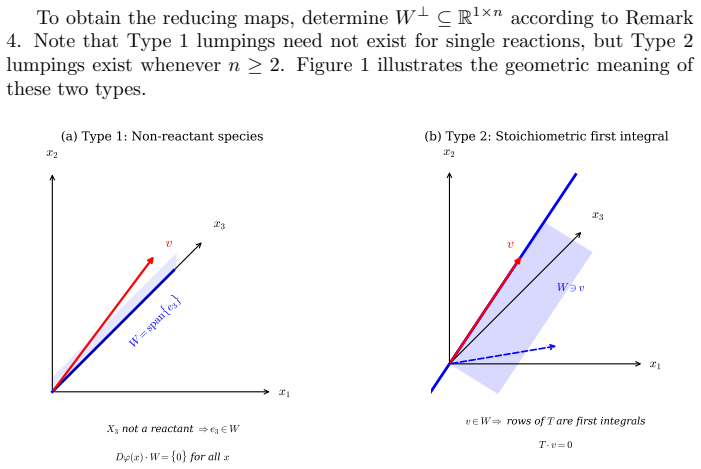
For generic parameters in reaction networks, exact linear lumping reduces only to eliminating non-reactant species or projecting along stoichiometric first integrals.
A machine-rendered reading of the paper's core claim, the machinery that carries it, and where it could break.
Core claim
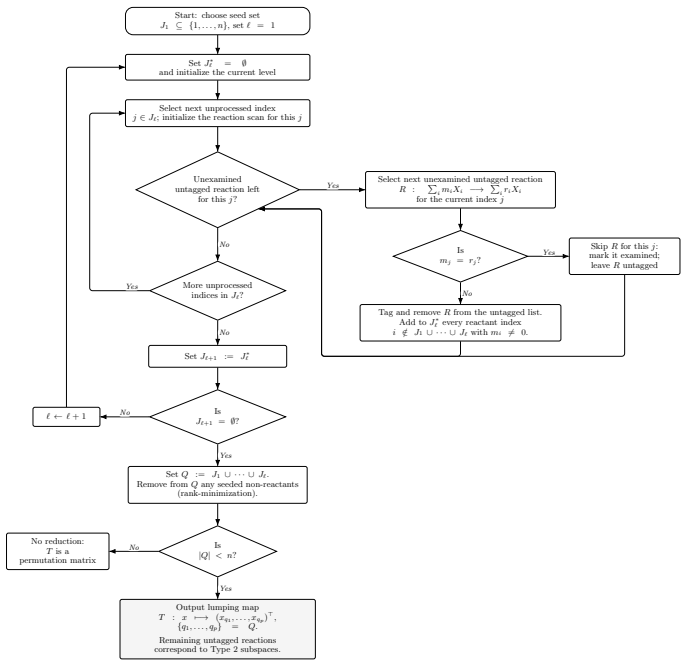
For generic parameters ranging in some non-empty open subset of parameter space, exact linear lumping yields only obvious reductions: elimination of non-reactant species or projections along stoichiometric first integrals. This characterization extends to reaction networks with product-form kinetics, including Michaelis-Menten and Hill-type rate laws. For mass action systems the work develops an algorithmic approach that reduces the determination of lumping maps to a system of finitely many polynomial equations, applicable also to constrained lumping.
What carries the argument
The partition of parameter space into a generic open regime (where only obvious lumpings exist) and critical algebraic subvarieties (where non-trivial lumpings become possible), located by solving polynomial equations in the parameters.
If this is right
- The same generic-only-obvious-lumping statement holds for product-form kinetics including Michaelis-Menten and Hill forms.
- Critical parameter sets can be found algorithmically by reducing the lumping condition to finitely many polynomial equations.
- The procedure applies equally to constrained lumping problems motivated by chemical considerations.
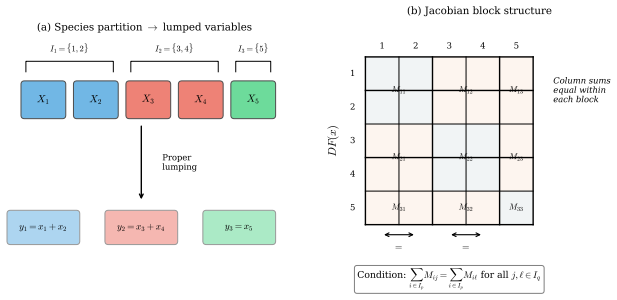
- Results on proper lumpings are reviewed and extended as part of the same framework.
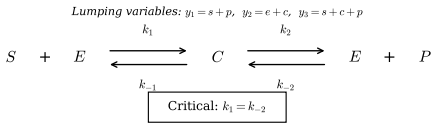
- Concrete examples (self-replicator system, two-pathway enzyme mechanism) confirm that the polynomial method locates the critical sets in practice.
Where Pith is reading between the lines
- Approximate lumping may remain useful even when parameters lie close to but not exactly on a critical set.
- The geometric view of critical sets as algebraic varieties suggests that their codimension could be used to quantify how rare non-trivial lumpings are.
- The same polynomial-equation approach could be adapted to search for lumpings that preserve additional structural properties such as positivity or monotonicity.
Load-bearing premise
Parameters lie in a non-empty open subset of the full parameter space, so that the exceptional algebraic sets where extra lumpings occur have measure zero.
What would settle it
An explicit reaction network together with a concrete choice of rate constants lying outside any algebraic subvariety that nevertheless admits an exact linear lumping not reducible to removal of non-reactants or stoichiometric integrals.
Figures
read the original abstract
We investigate linear lumping for parameter-dependent mass action reaction networks, distinguishing between generic and critical parameter regimes. For generic parameters -- those ranging in some non-empty open subset of parameter space -- we prove that exact linear lumping yields only "obvious" reductions: elimination of non-reactant species or projections along stoichiometric first integrals. This characterization extends to reaction networks with product-form kinetics, including Michaelis-Menten and Hill-type rate laws. For mass action systems we proceed to develop an algorithmic approach to identify critical parameter sets -- algebraic subvarieties in parameter space where non-trivial lumpings become available. This procedure reduces the determination of lumping maps to a system of finitely many polynomial equations. It also applies to constrained lumping scenarios (which are frequently motivated by chemical considerations). We then review and extend results about proper lumpings. Finally, we discuss lumpings of a self-replicator system, and of a two-pathway enzyme mechanism, to document the viability of our methods in relevant scenarios. Our results clarify the relationship between structural (parameter-independent) and fine-tuned (parameter-dependent) reductions, with implications for approximate lumping when system parameters lie near critical values
Editorial analysis
A structured set of objections, weighed in public.
Referee Report
Summary. The paper claims that for mass-action reaction networks (and extensions to product-form kinetics), exact linear lumping for generic parameters (a non-empty open subset of parameter space) yields only obvious reductions: elimination of non-reactant species or projections along stoichiometric first integrals. It develops an algorithmic reduction of lumping-map search to a finite system of polynomial equations to locate the critical algebraic subvarieties where non-trivial lumpings appear, reviews proper lumpings, and illustrates the methods on a self-replicator and a two-pathway enzyme mechanism.
Significance. If the central generic-case theorem holds, the work provides a precise structural distinction between parameter-independent and parameter-dependent reductions, with direct implications for model simplification and the validity of approximate lumping near critical values. The reduction to polynomial equations is a concrete algorithmic contribution that enables computational checks.
major comments (1)
- [abstract and algorithmic approach section] The generic-case theorem (stated in the abstract and developed in the main theoretical section) asserts existence of a non-empty open set where only obvious lumpings occur. This requires that the polynomial conditions for a non-obvious linear lumping (derived from the lumping map commuting with the vector field) are not satisfied identically. The manuscript does not explicitly verify or exhibit that these polynomials are non-zero for the networks under consideration; without this, the critical set could be the entire parameter space and the open generic regime would be empty.
minor comments (2)
- [preliminaries] Notation for the lumping map and the stoichiometric subspace should be introduced with a single consistent definition early in the paper rather than piecemeal.
- [examples] The examples in the final section would benefit from explicit display of the polynomial system solved for each network so that readers can verify the reduction step.
Simulated Author's Rebuttal
We thank the referee for the careful reading and the constructive major comment, which correctly identifies a point where the presentation of the generic-case result can be strengthened. We address the comment below and will revise the manuscript accordingly.
read point-by-point responses
-
Referee: [abstract and algorithmic approach section] The generic-case theorem (stated in the abstract and developed in the main theoretical section) asserts existence of a non-empty open set where only obvious lumpings occur. This requires that the polynomial conditions for a non-obvious linear lumping (derived from the lumping map commuting with the vector field) are not satisfied identically. The manuscript does not explicitly verify or exhibit that these polynomials are non-zero for the networks under consideration; without this, the critical set could be the entire parameter space and the open generic regime would be empty.
Authors: We agree that an explicit verification is needed to rigorously confirm that the critical set is a proper subvariety rather than the entire parameter space. The general argument in the theoretical section shows that the commutativity conditions yield a system of polynomial equations in the rate constants whose common zero set is the critical locus, but the manuscript does not include a direct check (e.g., evaluation at a specific point or explicit computation of the polynomials) for the self-replicator and two-pathway enzyme examples. In the revised manuscript we will add a short verification subsection (or remarks) demonstrating that the relevant polynomials are non-zero for these networks, thereby establishing that the generic open set is non-empty. This can be done by substituting a concrete numerical parameter vector outside any obvious degeneracy and confirming that the lumping equations are not satisfied, or by exhibiting the explicit polynomials. revision: yes
Circularity Check
No circularity: proof reduces lumping conditions to polynomial equations shown non-identical on open sets
full rationale
The derivation establishes that non-obvious linear lumpings satisfy a system of polynomial equations in the parameters; the generic claim follows from these equations defining a proper algebraic subvariety (hence their complement is a non-empty open set). This is a standard algebraic-geometry argument with no self-definition of the target lumping by the same parameters, no fitted inputs renamed as predictions, and no load-bearing self-citation. The procedure is algorithmic and applies uniformly, with the non-emptiness of the generic regime following directly from the equations not being identities (as required for the statement to hold). The paper is self-contained against external benchmarks of algebraic independence.
Axiom & Free-Parameter Ledger
axioms (2)
- domain assumption Parameter space contains a non-empty open subset on which the only exact linear lumpings are the obvious ones.
- standard math Lumping maps satisfy a system of polynomial equations derived from the reaction network stoichiometry and kinetics.
Reference graph
Works this paper leans on
-
[1]
Beutel, E
K.M. Beutel, E. Peacock-L´ opez:Chemical oscillations and Turing patterns in a generalized two-variable model of chemical self-replication.J. Chem. Phys.125, 024908 (2006)
2006
-
[2]
Cardelli, M
L. Cardelli, M. Tribastone, M. Tschaikowski, A. Vandin:Maximal aggre- gation of polynomial dynamical systems.PNAS114, 10029–10034 (2017)
2017
-
[3]
Cardelli, M
L. Cardelli, M. Tribastone, M. Tschaikowski, A. Vandin:Symbolic com- putation of differential equivalences.Theoret. Comput. Sci.777, 132–154 (2019)
2019
-
[4]
Cardelli, M
L. Cardelli, M. Tribastone, M. Tschaikowski, A. Vandin:Exact maximal reduction of stochastic reaction networks by species lumping.Bioinformatics 37, 2668–2676 (2021)
2021
-
[5]
D.A. Cox, J. Little, D. O’Shea:Ideals, varieties, and algorithms.Springer, Cham (2015)
2015
-
[6]
Craciun, M.D
G. Craciun, M.D. Johnston, Matthew D., G. Szederk´ enyi, E. Tonello, J. T´ oth, P. Yu:Realizations of kinetic differential equations.Math. Biosci. Eng.17, 862–892 (2020)
2020
-
[7]
Decker, G.-M
W. Decker, G.-M. Greuel, G. Pfister, H. Sch¨ onemann:Singu- lar4-3-0 — A computer algebra system for polynomial computations. https://www.singular.uni-kl.de (2022)
2022
-
[8]
Decker, S
W. Decker, S. Laplagne, G. Pfister, and H. Sch¨ onemann:primedec.lib. ASingular4-3-1 Library for computing the prime decomposition and radical of ideals (2022)
2022
-
[9]
Feinberg:Foundations of chemical reaction network theory.Springer, Cham (2019)
M. Feinberg:Foundations of chemical reaction network theory.Springer, Cham (2019)
2019
-
[10]
Fenichel:Geometric singular perturbation theory for ordinary differen- tial equations.J
N. Fenichel:Geometric singular perturbation theory for ordinary differen- tial equations.J. Differential Equations31, 53–98 (1979)
1979
-
[11]
Gijima, E
D.T. Gijima, E. Peacock-L´ opez:A dynamic study of biochemical self- replication.Mathematics8, 1042 (2020)
2020
-
[12]
Goeke, S
A. Goeke, S. Walcher:A constructive approach to quasi-steady state reduc- tion.J. Math. Chem.52, 2596 - 2626 (2014)
2014
-
[13]
small parameters
A. Goeke, S. Walcher, E. Zerz:Determining “small parameters” for quasi- steady state.J. Diff. Equations259, 1149–1180 (2015). 52
2015
-
[14]
Goeke, S
A. Goeke, S. Walcher, E. Zerz:Classical quasi-steady state reduction – A mathematical characterization, Physica D343, 11–26 (2017)
2017
-
[15]
Hadeler, S
K.P. Hadeler, S. Walcher:Reducible ordinary differential equations, J. Non- linear Sci.16, 583 - 613 (2006)
2006
-
[16]
F. Horn, R. Jackson:General mass action kinetics.Arch. Rational Mech. Anal.47, 81–116 (1972)
1972
-
[17]
Kemeny, J.L
J.G. Kemeny, J.L. Snell:Finite Markov Chains.Van Nostrand, New York (1960)
1960
-
[18]
Lam, D.A
S.H. Lam, D.A. Goussis:The CSP method for simplifying kinetics.Inter- nat. J. Chem. Kinetics26, 461–486 (1994)
1994
-
[19]
C. Lax, S. Walcher:Singular perturbations and scaling.Discrete Contin. Dyn. Syst. Ser. B25, 1–29 (2020)
2020
-
[20]
Leguizamon-Robayo, A
A. Leguizamon-Robayo, A. Jim´ enez-Pastor, M. Tribastone, M. Tschaikowski, A. Vandin:Approximate constrained lumping of chemical reaction networks.Preprint, arXiv:2411-14242.v1, 32 pp. (2024)
2024
-
[21]
G. Li, H. Rabitz:A general analysis of exact lumping in chemical kinetics. Chem. Eng. Sci.44, 1413 - 1430 (1989)
1989
-
[22]
G. Li, H. Rabitz:A general analysis of approximate lumping in chemical kinetics.Chem. Eng. Sci.45, 977 - 1002 (1990)
1990
-
[23]
G. Li, H. Rabitz:New approaches to determination of constrained lumping schemes for a reaction system in the whole composition space.Chem. Eng. Sci.46, 95 - 111 (1991)
1991
-
[24]
G. Li, H. Rabitz:Determination of constrained lumping schemes for non- isothermal first-order reaction schemes.Chem. Eng. Sci.46, 593 - 596 (1991)
1991
-
[25]
G. Li, H. Rabitz, J. Toth:A general analysis of exact nonlinear lumping in chemical kinetics.Chem. Eng. Sci.49, 343 - 361 (1994)
1994
-
[26]
G. Li, A.S. Tomlin, H. Rabitz, J. Toth:A general analysis of approximate nonlinear lumping in chemical kinetics. I. Unconstrained lumpingJ. Chem. Phys.101, 1172 - 1187 (1994)
1994
-
[27]
Maas, S.B
U. Maas, S.B. Pope:Simplifying chemical kinetics: intrinsic low- dimensional manifolds in composition space.Combust. Flame88, 239–264 (1992)
1992
-
[28]
Nestruev:Smooth manifolds and observables.Springer Nature, Cham (2020)
J. Nestruev:Smooth manifolds and observables.Springer Nature, Cham (2020). 53
2020
-
[29]
Okeke, M.R
B.E. Okeke, M.R. Roussel:An invariant-manifold approach to lumping. Math. Model. Nat. Phenom.10, 149–167 (2015)
2015
-
[30]
Ovchinnikov, I
A. Ovchinnikov, I. Perez Verona, G. Pogudin, M. Tribastone:CLUE: exact maximal reduction of kinetic models by constrained lumping of differential equations.Bioinformatics37, 1732 - 1738 (2021)
2021
-
[31]
Peacock-L´ opez:Chemical oscillations: The templator model.Chem
E. Peacock-L´ opez:Chemical oscillations: The templator model.Chem. Ed- ucator6, 202–209 (2001)
2001
-
[32]
Pepiot, L
P. Pepiot, L. Cai, H. Pitsch:Model reduction and lumping procedures. In: Computer-Aided Chemical Engineering, Volume 45, Ch. 16. Elsevier (2019)
2019
-
[33]
P´ erez Verona, M
I. P´ erez Verona, M. Tribastone, A. Vandin:A large-scale assessment of exact lumping of quantitative models in the BioModels repository.Theoret. Comput. Sci.892, 132–152 (2021)
2021
-
[34]
Segel, M
L.A. Segel, M. Slemrod:The quasi-steady-state assumption: a case study in perturbation.SIAM Rev.31, 446–477 (1989)
1989
-
[35]
Shoffner, S
S.K. Shoffner, S. Schnell:Approaches for the estimation of timescales in nonlinear dynamical systems: Timescale separation in enzyme kinetics as a case study.Math. Biosci.287, 122—129 (2017)
2017
-
[36]
Simon, M
P.L. Simon, M. Taylor, I.Z. Kiss:Exact epidemic models on graphs using graph-automorphism driven lumping.J. Math. Biol.62, 479–508 (2011)
2011
-
[37]
Sturmfels:Algorithms in invariant theory.Springer, Vienna (2008)
B. Sturmfels:Algorithms in invariant theory.Springer, Vienna (2008)
2008
-
[38]
Tikhonov:Systems of differential equations containing a small param- eter multiplying the derivative(in Russian)
A.N. Tikhonov:Systems of differential equations containing a small param- eter multiplying the derivative(in Russian). Math. Sb.31, 575–586 (1952)
1952
-
[39]
J. Toth, G. Li, H. Rabitz, A.S. Tomlin:The effect of lumping and expand- ing on kinetic differential equations.SIAM J. Appl. Math,57, 1531- 1556 (1997)
1997
-
[40]
Walter:Ordinary differential equations.Springer, New York (1998)
W. Walter:Ordinary differential equations.Springer, New York (1998)
1998
-
[41]
Wei, J.C.W
J. Wei, J.C.W. Kuo:A lumping analysis in monomolecular reaction sys- tems. Analysis of the exactly lumpable system.Ind. Eng. Chem. Fundamen- tals8, 114 -123 (1969)
1969
-
[42]
Wei, J.C.W
J. Wei, J.C.W. Kuo:A lumping analysis in monomolecular reaction sys- tems. Analysis of approximately lumpable system.Ind. Eng. Chem. Funda- mentals8, 124 -133 (1969)
1969
-
[43]
Wei, C.D
J. Wei, C.D. Prater:The structure and analysis of complex reaction sys- tems.Advan. Catalysis13, 203 - 392 (1962). 54
1962
discussion (0)
Sign in with ORCID, Apple, or X to comment. Anyone can read and Pith papers without signing in.