Bayesian Optimization of a Multi-Product Chemical Reactor Using Composite Models and Partial Physics Knowledge
Pith reviewed 2026-06-27 17:54 UTC · model grok-4.3
The pith
Composite Gaussian process models with an energy-balance penalty in the acquisition function achieve better economic performance and avoid temperature violations in multi-product reactor optimization.
A machine-rendered reading of the paper's core claim, the machinery that carries it, and where it could break.
Core claim
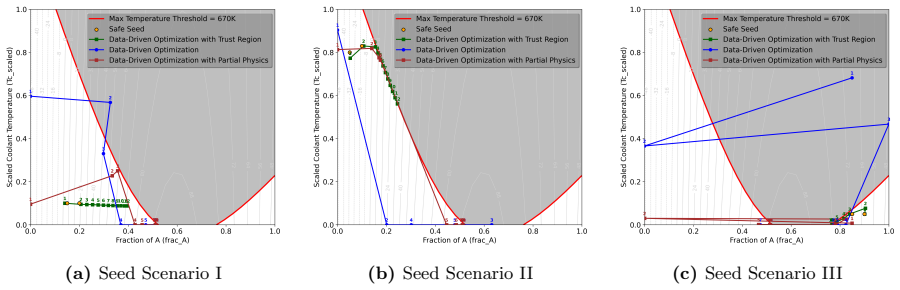
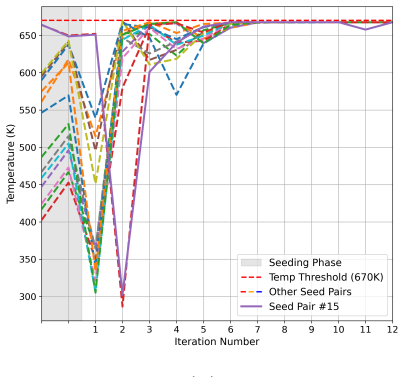
By predicting physically meaningful outputs with Gaussian processes and penalizing energy-balance mismatch in the acquisition function, the composite formulation improves simulated economic performance relative to trust-region safe Bayesian optimization while eliminating the temperature constraint violations observed in purely data-driven Bayesian optimization.
What carries the argument
Composite model in which GPs predict concentrations and temperature, profit is evaluated analytically from those outputs and prices, and the energy-balance residual supplies an additional penalty term inside the acquisition function.
If this is right
- The economic objective remains parametric in raw-material and product prices, so price changes require no retraining of the Gaussian processes.
- Upper-confidence-bound use of GP uncertainty provides a built-in mechanism for conservative temperature constraint satisfaction.
- The approach is directly applicable to any process for which a steady-state energy or mass balance is known even when the full dynamic model is unavailable.
Where Pith is reading between the lines
- The same composite structure could be applied to other unit operations where partial conservation laws are reliable but full first-principles kinetics are not.
- Because the penalty term is cheap to evaluate, the method may scale to higher-dimensional input spaces than black-box safe Bayesian optimization.
- Real-time deployment would require online updating of the Gaussian processes as new measurements arrive; the paper does not demonstrate this step.
Load-bearing premise
Substituting the GP-predicted outputs and candidate inputs into the available steady-state energy balance yields a useful, non-trivial penalty term that improves the acquisition function without introducing new failure modes.
What would settle it
A set of simulation trials in which the proposed method either violates the reactor temperature limit or records lower cumulative profit than the trust-region safe Bayesian optimizer within the same number of iterations.
Figures
read the original abstract
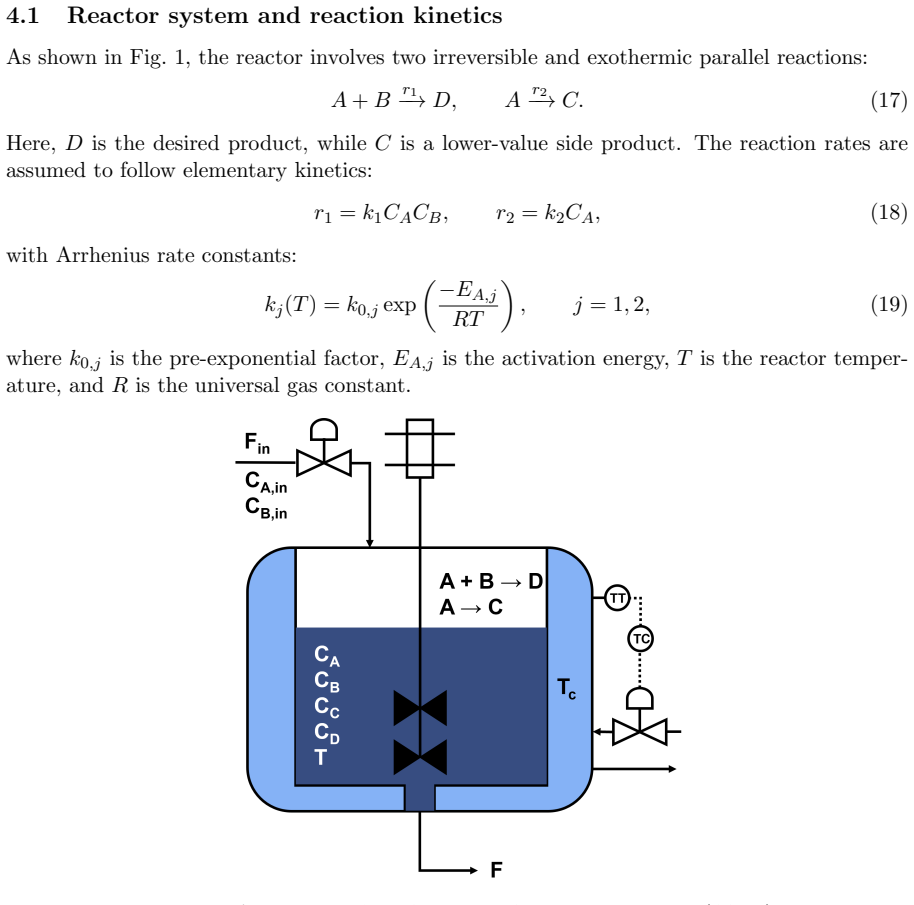
We study data-driven real-time economic optimization of a multi-product chemical reactor when no reliable first-principles model is available beyond a steady-state energy balance. Instead of learning the economic objective directly as a black-box function, we use a composite formulation in which Gaussian process (GP) models predict physically meaningful outputs, including product concentrations and reactor temperature, while profit is computed analytically from these predictions together with raw-material, product, and utility prices. This preserves the structure of the economic objective, makes it parametric in changing prices without needing retraining, and allows candidate operating points to be checked against the available energy balance through a physics residual. The GPs also provide predictive uncertainty, which is exploited in a Bayesian optimization (BO) framework both for data-efficient exploration and for conservative enforcement of the reactor temperature constraint through an upper confidence bound. The acquisition function additionally penalizes large energy-balance mismatch obtained by substituting the GP-predicted outputs and candidate inputs into the available steady-state energy balance. The approach is demonstrated on a benchmark simulation of a non-isothermal multi-product reactor. Relative to a trust-region safe BO implementation, the proposed method achieves better simulated economic performance within the available iteration budget. Relative to a purely data-driven BO approach that does not use the available physics information, it avoids reactor temperature constraint violations.
Editorial analysis
A structured set of objections, weighed in public.
Referee Report
Summary. The paper proposes a composite Bayesian optimization framework for real-time economic optimization of a multi-product chemical reactor. Gaussian process models predict physically meaningful outputs (product concentrations and reactor temperature), profit is computed analytically from these outputs and external price data, and a steady-state energy balance residual is incorporated as a penalty term in the acquisition function. Predictive uncertainty is used for exploration and for conservative enforcement of the temperature constraint via upper confidence bound. The method is evaluated on a benchmark simulation of a non-isothermal multi-product reactor, where it reports improved economic performance relative to a trust-region safe BO baseline and avoidance of temperature violations relative to a purely data-driven BO approach.
Significance. If the simulation results hold under the stated conditions, the work offers a practical way to incorporate partial physics knowledge into data-driven optimization without requiring a complete first-principles model. The composite formulation is a clear strength: it preserves the parametric structure of the economic objective (allowing price changes without retraining) and enables direct use of the energy-balance residual for constraint handling. The approach is relevant to process control and safe BO applications in chemical engineering.
minor comments (3)
- [Abstract] The abstract states that the method 'achieves better simulated economic performance' and 'avoids reactor temperature constraint violations,' but does not report quantitative metrics (e.g., final profit values, number of constraint violations, or statistical significance across runs). Adding these numbers would strengthen the central claim.
- [Acquisition function paragraph] The description of the acquisition function mentions penalizing the energy-balance mismatch obtained by substituting GP predictions into the steady-state balance, but does not specify the weighting coefficient relative to the UCB term or how the residual is normalized. Clarifying this scaling would improve reproducibility.
- [Benchmark simulation section] The benchmark simulation is described only at a high level; details on the underlying dynamic model, how data are generated for GP training, choice of GP kernels, and hyperparameter fitting procedure should be expanded in the methods or experimental section to allow independent verification.
Simulated Author's Rebuttal
We thank the referee for the positive assessment, recognition of the composite formulation's strengths, and recommendation for minor revision. No major comments requiring point-by-point rebuttal were provided in the report.
Circularity Check
No significant circularity detected
full rationale
The paper's central construction trains GP models on observed data to predict concentrations and temperature, computes profit analytically from external price data, and adds an independent steady-state energy-balance residual as a penalty term in the acquisition function. These elements are assembled from distinct sources (data, prices, physics equation) rather than being fitted to or defined by the final economic performance metric. The reported improvements are measured against external benchmark simulations and two baselines, with no load-bearing step reducing by construction to a self-citation, a renamed fit, or an ansatz imported from the authors' prior work. The derivation chain therefore remains self-contained against external benchmarks.
Axiom & Free-Parameter Ledger
axioms (2)
- domain assumption Gaussian process models trained on input-output data can produce sufficiently accurate predictions of concentrations and temperature for the profit calculation and residual check to be useful.
- domain assumption The provided steady-state energy balance equation is reliable enough to serve as a consistency penalty without introducing bias or instability into the optimizer.
Reference graph
Works this paper leans on
-
[2]
2022 , eprint=
Scientific Machine Learning through Physics-Informed Neural Networks: Where we are and What's next , author=. 2022 , eprint=
2022
-
[3]
Physics-Informed Machine Learning for Automatic Model Reduction in Chemical Reaction Networks , author =. Scientific Reports , volume =. doi:10.1038/s41598-025-92680-8 , urldate =
-
[4]
Physics-
Zheng, Yingzhe and Wu, Zhe , year = 2023, month = feb, journal =. Physics-
2023
-
[5]
Computers & Chemical Engineering , volume =
Physics-Informed Neural Networks for Dynamic Process Operations with Limited Physical Knowledge and Data , author =. Computers & Chemical Engineering , volume =
-
[6]
Processes , VOLUME =
Shen, Runqiu and Luo, Guihua and Su, An , TITLE =. Processes , VOLUME =. 2025 , NUMBER =
2025
-
[7]
Sui, Yanan and Gotovos, Alkis and Burdick, Joel and Krause, Andreas , year = 2015, month = jun, pages =. Safe. Proceedings of the 32nd
2015
-
[10]
2024 , eprint=
Physics-Informed Bayesian Optimization of Variational Quantum Circuits , author=. 2024 , eprint=
2024
-
[11]
2025 , author =
Physics-guided transfer learning for Bayesian optimization of chemical port-Hamiltonian systems , journal =. 2025 , author =
2025
-
[13]
Foundations and Trends® in Machine Learning , author =
Muandet, Krikamol and Fukumizu, Kenji and Sriperumbudur, Bharath and Schölkopf, Bernhard , year=. Kernel Mean Embedding of Distributions: A Review and Beyond , volume=. Foundations and Trends® in Machine Learning , publisher=. doi:10.1561/2200000060 , number=
-
[14]
Bai, Tianyi and Li, Yang and Shen, Yu and Zhang, Xinyi and Zhang, Wentao and Cui, Bin , year = 2023, month = feb, number =. Transfer. doi:10.48550/arXiv.2302.05927 , urldate =. 2302.05927 , primaryclass =
-
[15]
Shahriari, Bobak and Swersky, Kevin and Wang, Ziyu and Adams, Ryan P. and. Taking the. Proceedings of the IEEE , volume =. doi:10.1109/JPROC.2015.2494218 , urldate =
-
[16]
Journal of Basic Engineering , year=
A New Method of Locating the Maximum Point of an Arbitrary Multipeak Curve in the Presence of Noise , author=. Journal of Basic Engineering , year=
-
[17]
and Tiesis, Vytautas and Zilinskas, Antanas , year =
Mockus, J. and Tiesis, Vytautas and Zilinskas, Antanas , year =. The application of Bayesian methods for seeking the extremum , volume =
-
[18]
Thompson , journal =
William R. Thompson , journal =. On the Likelihood that One Unknown Probability Exceeds Another in View of the Evidence of Two Samples , urldate =
-
[19]
2011 , eprint=
Entropy Search for Information-Efficient Global Optimization , author=. 2011 , eprint=
2011
-
[20]
2014 , eprint=
Predictive Entropy Search for Efficient Global Optimization of Black-box Functions , author=. 2014 , eprint=
2014
-
[22]
and Lu, Congwen , year=
Paulson, Joel A. and Lu, Congwen , year=
-
[23]
2025 , journaltitle =
Bayesian Optimization of Gray-Box Process Models Using a Modified Upper Confidence Bound Acquisition Function , author =. 2025 , journaltitle =
2025
-
[24]
2024 UKACC 14th International Conference on Control (CONTROL) , pages=
Real-Time Optimization of Fuel Cell Cogeneration Systems with Safety-Aware Self-Learning Algorithms , author=. 2024 UKACC 14th International Conference on Control (CONTROL) , pages=. 2024 , organization=
2024
-
[25]
Dong, Liqiu and Zagorowska, Marta and Liu, Tong and Durkin, Alex and Mercangöz, Mehmet , year =. 2024
2024
-
[26]
and Zavala, Victor M
González, Leonardo D. and Zavala, Victor M. , year =
-
[27]
, year =
Krishnamoorthy, Dinesh and Doyle III, Francis J. , year =. Model-Free Real-Time Optimization of Process Systems Using Safe
-
[28]
, year =
Kudva, Akshay and Sorourifar, Farshud and Paulson, Joel A. , year =. Constrained Robust
-
[29]
Nonlinear Predictive Control of a Benchmark CSTR , journal =
Chen, Hong and Kremling, H and Allgöwer, Frank , year =. Nonlinear Predictive Control of a Benchmark CSTR , journal =
-
[31]
Nonlinear predictive control of a benchmark cstr
Hong Chen, H Kremling, and Frank Allgöwer. Nonlinear predictive control of a benchmark cstr. Proceedings of the 3rd European Control Conference, Rome-Italy., pages 3247--3252, 01 1995
1995
-
[32]
Real-time optimization of fuel cell cogeneration systems with safety-aware self-learning algorithms
Liqiu Dong, Tong Liu, and Mehmet Mercang \"o z. Real-time optimization of fuel cell cogeneration systems with safety-aware self-learning algorithms. In 2024 UKACC 14th International Conference on Control (CONTROL), pages 104--110. IEEE, 2024 a
2024
-
[33]
A muon-spin relaxation study of BiMnO3
Liqiu Dong, Marta Zagorowska, Tong Liu, Alex Durkin, and Mehmet Mercangöz. PI-CoF : A Bilevel Optimization Framework for Solving Active Learning Problems using Physics-Information . In 2024 IEEE Conference on Control Technology and Applications ( CCTA ) , pages 101--106, 2024 b . doi:10.1109/CCTA60707.2024.10666639
work page internal anchor Pith review Pith/arXiv arXiv doi:10.1109/ccta60707.2024.10666639 2024
-
[34]
George Em Karniadakis, Ioannis G. Kevrekidis, Lu Lu, Paris Perdikaris, Sifan Wang, and Liu Yang. Physics-informed machine learning. Nature Reviews Physics, 3 0 (6): 0 422--440, June 2021. ISSN 2522-5820. doi:10.1038/s42254-021-00314-5
-
[35]
Roy, Sina Hossein Zadeh, Richard Otis, and Raymundo Arr \'o yave
Danial Khatamsaz, Raymond Neuberger, Arunabha M. Roy, Sina Hossein Zadeh, Richard Otis, and Raymundo Arr \'o yave. A physics informed bayesian optimization approach for material design: Application to NiTi shape memory alloys. npj Computational Materials, 9 0 (1): 0 221, December 2023. ISSN 2057-3960. doi:10.1038/s41524-023-01173-7
-
[36]
Wataru Kobayashi, Takuma Otsuka, Yuki K. Wakabayashi, and Gensai Tei. Physics-informed Bayesian optimization suitable for extrapolation of materials growth. npj Computational Materials, 11 0 (1): 0 36, February 2025. ISSN 2057-3960. doi:10.1038/s41524-025-01522-8
-
[37]
Safe optimization of an industrial refrigeration process using an adaptive and explorative framework
Buse Sibel Korkmaz, Marta Zagórowska, and Mehmet Mercangöz. Safe optimization of an industrial refrigeration process using an adaptive and explorative framework. IFAC-PapersOnLine, 56 0 (2): 0 1400--1405, 2023. ISSN 2405-8963. doi:https://doi.org/10.1016/j.ifacol.2023.10.1811. 22nd IFAC World Congress
-
[38]
Dinesh Krishnamoorthy and Francis J. Doyle III. Model-free real-time optimization of process systems using safe Bayesian optimization. 69 0 (4): 0 e17993, 2023. ISSN 1547-5905. doi:10.1002/aic.17993
-
[39]
Carl Edward Rasmussen and Christopher K. I. Williams. Gaussian Processes for Machine Learning. The MIT Press, November 2005. ISBN 978-0-262-25683-4. doi:10.7551/mitpress/3206.001.0001
-
[40]
Niranjan Srinivas, Andreas Krause, Sham M. Kakade, and Matthias W. Seeger. Information-theoretic regret bounds for gaussian process optimization in the bandit setting. IEEE Transactions on Information Theory, 58 0 (5): 0 3250–3265, May 2012. ISSN 1557-9654. doi:10.1109/tit.2011.2182033. URL http://dx.doi.org/10.1109/TIT.2011.2182033
-
[41]
Safe Exploration for Optimization with Gaussian Processes
Yanan Sui, Alkis Gotovos, Joel Burdick, and Andreas Krause. Safe Exploration for Optimization with Gaussian Processes . In Proceedings of the 32nd International Conference on Machine Learning , pages 997--1005. PMLR, June 2015
2015
discussion (0)
Sign in with ORCID, Apple, or X to comment. Anyone can read and Pith papers without signing in.