REVIEW 4 major objections 4 minor 96 references
Bayesian inferences on covariant density functionals from multimessenger astrophysical data: The impacts of likelihood functions of low density matter constraints
T0 review · 4 major / 4 minor · reviewed 2026-08-16 · deepseek-v4-flash
Pith's one-line read Bayesian results for neutron-star structure are nearly insensitive to how low-density nuclear constraints are modeled.
desk verdict A clean, honest comparison showing likelihood choice barely matters for compact star bulk properties in data-rich scenarios, but the paper's own Baseline case shows it matters more when the data are weaker—worth reading and worth refereeing. read the letter →
The pith
A machine-rendered reading of the paper's core claim, the machinery that carries it, and where it could break.
The reading
What carries the argument
The central object is the uniform-Gaussian-combination likelihood defined in Eq. (10), in which the 1-sigma (UG1) or 2-sigma (UG2) central region of a Gaussian is replaced by a flat distribution of equal normalization while Gaussian tails remain; this makes the uniform likelihood directly comparable to the Gaussian one and lets posterior widths be compared quantitatively. That likelihood is attached to low-density nuclear-matter constraints from chiral effective field theory and saturation coefficients, and the inference is run through a seven-parameter density-dependent covariant density functional whose outputs are converted to stellar structure and to saturation parameters via the Taylor expansion of the energy density. Three astrophysical scenarios (Baseline, B, F) apply different combinations of pulsar-mass, NICER radius, and gravitational-wave tidal constraints, giving the comparison a range of data informativeness.
What would settle it
A decisive test would rerun the same analyses with a uniform-Gaussian plateau of a different width (say 3σ) and with the incompressibility prior extended beyond 310 MeV; if the mass-radius posteriors or maximum masses then shift by more than the quoted 0.1 km or 0.05 solar masses, the near-identity of the two likelihood choices is an artifact of the tested prior and plateau settings.
Extended reading notes
Core claim
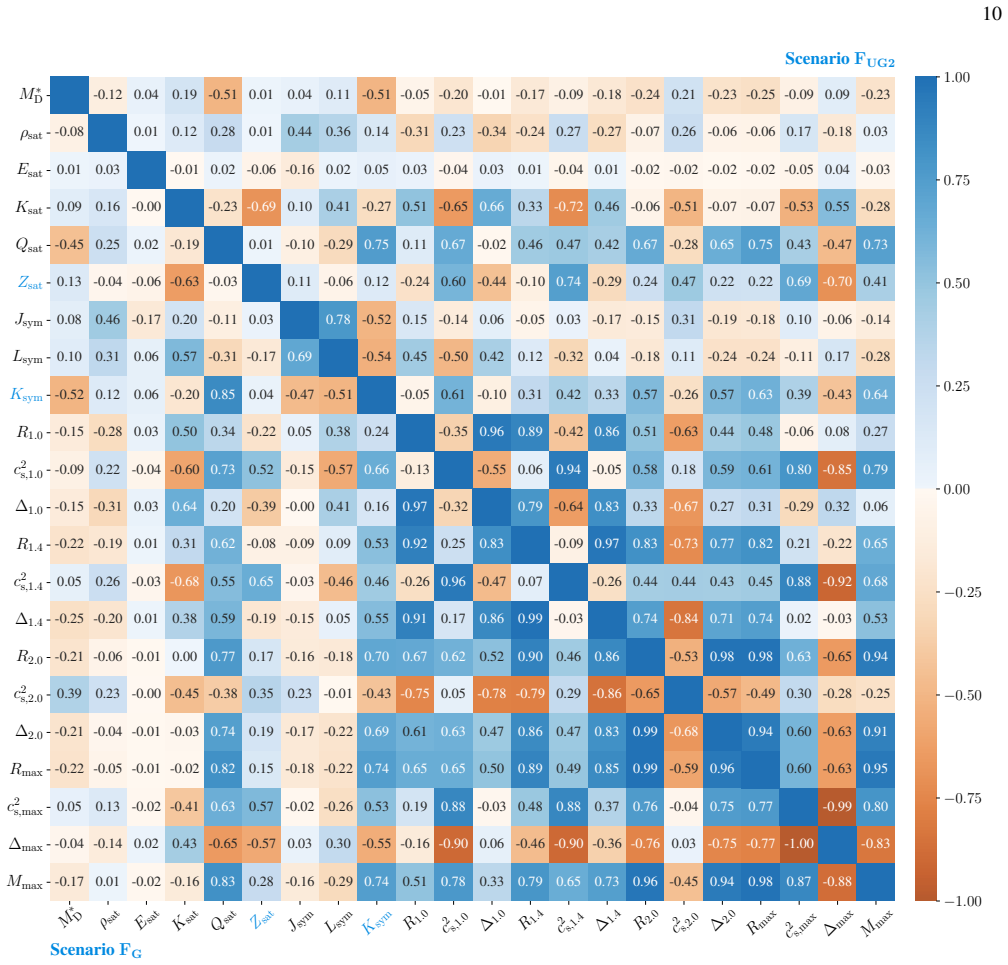
The central discovery is the near-invariance of compact-star bulk properties under a change of likelihood function for low-density matter constraints. Using the same seven-parameter covariant density functional, the same uniform priors, and the same astrophysical data, the authors compare a standard Gaussian likelihood with a normalized uniform-Gaussian combination. Across the Baseline, B, and F scenarios, the resulting mass-radius relations, density-pressure relations, and 95.4% credible regions essentially overlap; in the two NICER-rich scenarios, radii of stars above about one solar mass agree within 0.1 km and maximum masses within 0.05 solar masses. The differences that do appear are concentrated in the nuclear saturation parameters: the incompressibility is the most likelihood-sensitive, with the isoscalar skewness shifting in the opposite direction to compensate, while the isovector parameters retain Gaussian-like, strongly correlated posteriors. The authors interpret this as evidence that the integrated character of stellar observables obscures individual saturation parameters, so current multimessenger data robustly determine gross star properties but say less about individual nuclear-matter coefficients.
Load-bearing premise
The load-bearing premise is that the astrophysical data are informative enough to drive the final estimate on their own, so the flat-versus-Gaussian shape of the low-density nuclear-matter constraint barely matters.
Editorial extensions
If this is right
- Current multimessenger constraints on neutron-star radius, mass, and tidal deformability do not depend sensitively on whether low-density nuclear-matter constraints are encoded as Gaussian or flat-topped likelihoods.
- In the data-rich scenarios B and F, switching from Gaussian to UG2 changes radii by less than 0.1 km and maximum masses by at most 0.05 solar masses, so comparisons with future observations can attribute discrepancies to other sources.
- The incompressibility is the exception: its posterior is likelihood-sensitive and can pile up at the prior boundary (scenario F, near 310 MeV), so uniform-likelihood users must check marginalization effects and prior edges before quoting that parameter.
- The isoscalar skewness shifts in the opposite direction to the incompressibility, preserving the equation-of-state predictions, while the symmetry-energy parameters remain tightly correlated and Gaussian-like; symmetry-energy conclusions are therefore comparatively stable.
- The earlier conclusion that nucleonic direct Urca cooling is largely suppressed in stars below about two solar masses survives both likelihood choices.
Reading between the lines
- The present near-equivalence is likely conditional on how informative the astrophysical data are: in the Baseline scenario, which has the fewest constraints, the UG2 likelihood already widens the mass-radius posterior by about 0.2 km on each side, so weaker future data could make likelihood choice matter more.
- The discontinuous plateau boundary of the UG2 likelihood and the pile-up of the incompressibility at the 310 MeV prior edge suggest the shape of the transition, not just the plateau width, deserves testing; smooth-tapered plateaus would isolate whether this is a likelihood artifact.
- The same comparison should be revisited as NICER and gravitational-wave data improve: at higher precision, the low-density region where the two likelihoods differ most may start to dominate the posterior, eroding the near-equivalence found here.
- The compensation between the incompressibility and the isoscalar skewness indicates a degeneracy in density-functional inference: integrated stellar observables constrain combinations of saturation coefficients, so experiments specifically targeting those individual coefficients are needed to pin them down.
Signed reviews
Editorial analysis
A structured set of objections, weighed in public.
Referee Report
Summary. This paper compares two forms of the low-density nuclear-matter likelihood in Bayesian inference for covariant density functional (CDF) equations of state: a standard Gaussian and a hybrid "uniform-Gaussian" (UG1/UG2) likelihood with a flat plateau over 1σ or 2σ and Gaussian tails. The CDF has seven parameters with uniform priors. Nuclear constraints are the saturation characteristics in Table II and χEFT pure-neutron-matter points; astrophysical constraints are a massive pulsar, GW170817 (plus GW190425 in scenarios B and F), and NICER mass-radius samples. Three scenarios are studied: Baseline (PSR J0348+0432 plus GW170817), B (soft NICER choices), and F (stiff NICER choices). The main finding is that Gaussian and UG likelihoods produce nearly overlapping posteriors for compact-star bulk properties such as the mass-radius relation, pressure-density relation, maximum mass, and tidal deformability, while nuclear saturation parameters such as Ksat and Qsat show larger sensitivity; in scenario F the UG2 posterior for Ksat piles up at the 310 MeV plateau edge. The authors conclude that integrated compact-star properties mask information on individual saturation parameters.
Significance. If the conclusions are accepted, the paper is a useful methodological robustness check for the common practice of choosing Gaussian versus uniform likelihoods for low-density constraints. It is careful to construct normalized UG likelihoods (Eqs. 11-12), to separate isoscalar and isovector channels, and to present extensive posterior tables (Tables IV-V) and correlation matrices. The result that the equation of state and mass-radius relation are insensitive to this modeling choice in data-rich scenarios is reassuring. However, the evidence is incomplete: no quantitative posterior-distance metric is provided, the Baseline scenario shows about 0.2 km broadening under UG2, and the Ksat boundary pile-up in scenario F is an acknowledged likelihood-shape artifact. The lack of sampling diagnostics and full likelihood specifications limits reproducibility. If these issues are addressed, the paper would be a solid methodological contribution; in its current form the central generality claim is not fully supported.
major comments (4)
- [IV A, Figs. 1-2, Tables IV-V] The abstract's 'nearly identical' claim rests on visual overlap of 95.4% credible regions rather than on a quantitative measure. The paper's own numbers show non-negligible differences: in the Baseline scenario the UG2 M-R region broadens by about 0.2 km on both sides (Sec. IV A), and Table IV shows median Ksat shifting from 231.5 MeV (Gaus.) to 244.7 MeV (UG2) in Baseline and from 244.8 to 270.7 MeV in scenario F. Please add a quantitative comparison metric (e.g., KL divergence, overlapping coefficient, or percentile differences) for the M-R, P-epsilon, Mmax, and radius posteriors, and explicitly discuss whether the Baseline broadening is consistent with 'nearly identical.' Overlapping credible intervals are a weak metric that can hide large distributional differences.
- [IV B, item 3, and final paragraphs of Sec. IV B] Scenario F's UG2 posterior for Ksat peaks at the upper edge of the plateau, Ksat=310 MeV, which the authors themselves note is disfavored by giant monopole resonance studies [51,52]. The following paragraph warns that 'unless the prior range is sufficiently broad, inadequate treatment of marginalization can introduce unintended biases in the posterior inference.' This is a likelihood-shape artifact rather than astrophysical information, and it shows that the flat plateau can change conclusions for nuclear parameters. Because the abstract does not claim robustness for nuclear coefficients (it contrasts them), this does not refute the compact-star claim, but it does mean the paper should (i) explicitly scope the 'nearly identical' statement to compact-star bulk properties, (ii) show quantitatively that the Ksat pile-up does not feed back into the M-R posteriors beyond the quoted 0.1-0.2 km shifts, and (iii) test sensitivity to the plateau width rather than only UG1 versus UG2.
- [III B, Eq. (15), and Sec. IV] The manuscript does not provide any Markov-chain convergence diagnostics. The only sampling information is 'approximately 3 x 10^4 posterior EOS models' (Sec. IV). There is no mention of the sampler, number of chains, burn-in, thinning, or R-hat/effective sample size. Since the central comparison is between two posterior distributions, sampling noise could contribute to the apparent differences. Please report convergence diagnostics and, ideally, release the sampler and posterior samples. The reader should also know the bandwidth rule used in the NICER KDE (Eq. 15) and whether the TOAST interpolation (Eq. 14) is treated as exact; these details are needed to reproduce the analysis.
- [III A, Eqs. (9)-(12)] The hybrid likelihood (10) is discontinuous at the plateau boundary: the UG2 plateau height 0.9545/(4 sigma) does not match the Gaussian tails, and the text does not state this or discuss its effect on sampling. Also, the phrases 'Gaussian prior distribution' (Sec. III A) and 'uniform prior' (Sec. IV B, item 3) are misnomers: these are likelihood functions, because the EOS parameters carry uniform priors. Please correct the terminology and state the discontinuity explicitly; if the boundary jump is intended, explain why it is harmless for the comparison.
minor comments (4)
- [Table II] The table entries are numbered out of order (4, 6, 5, 7); renumber them sequentially to avoid confusion.
- [Figure captions and axis labels] Several figure captions and axis labels contain corrupted glyphs such as 'M/s9737' and 'PDF Mmax [M/s9737]'; ensure the solar-mass symbol and all subscripts render correctly in the production files.
- [III A] The claim that the hybrid likelihood has 'Gaussian-equivalent normalization factor and marginalization behavior' is not demonstrated; if the intended meaning is only that the distribution is normalized, please say so explicitly rather than invoking marginalization.
- [Abstract and Sec. V] The phrase 'we observe significant variation in the predicted isoscalar channel coefficients' should clarify that these are posterior distributions under chosen likelihoods, not independent predictions, since the low-density likelihoods are constructed from the same saturation parameters listed in Table II.
Circularity Check
No significant circularity: the Gaussian-vs-UG likelihood comparison is self-contained, and the paper's own caveats are limitations of evidence rather than input-output reductions.
full rationale
The paper's central comparison — how the choice between Gaussian and uniform-Gaussian likelihoods for low-density nuclear-matter constraints affects inferred compact-star and nuclear-matter properties — is not circular. The UG likelihood in Eqs. (10)-(12) is deliberately constructed with normalization constants 0.6827/(2σ) and 0.9545/(4σ) and Gaussian tails, but this only ensures that each likelihood is normalized; it does not algebraically force the posterior mass-radius, pressure-density, or nuclear-coefficient distributions to coincide. The near-agreement between the two approaches is an empirical Bayesian outcome driven by the shared astrophysical likelihoods (massive pulsar, GW170817/GW190425, NICER), and the paper explicitly documents cases where the two likelihoods do differ, such as the roughly 0.2 km widening of the Baseline M-R region under UG2 and the scenario-F Ksat posterior piling up at the 310 MeV plateau edge. The nuclear saturation coefficients in Table II enter as prior/likelihood inputs, and the paper states that they are used only to construct likelihoods and are updated in the posterior; no quantity fitted to the target M-R comparison is relabeled as an independent prediction. The higher-order coefficients Zsat and Ksym are transparently derived from the lower-order parameters that uniquely determine the CDF, as stated in Figs. 5 and 6, which is a functional transformation rather than a hidden reintroduction of the input. Self-citations to Refs. [31,33,71-74,94] supply model details and parameter-range constraints, but none is a uniqueness theorem invoked to forbid alternatives, and the load-bearing astrophysical constraints come from external data. The paper's own caveats — e.g., that large Ksat near 300 MeV is ruled out by recent GMR studies [51,52] and that inadequate treatment of marginalization can introduce biases — weaken the generality of the 'nearly identical' claim, but they are evidentiary limitations, not circularity. Overall, the derivation chain is self-contained and no step reduces by construction to its own inputs.
Assumptions & free parameters
free parameters (3)
- UG plateau width factor =
UG1: 1 sigma, UG2: 2 sigma
- chi-EFT error model =
Independent Gaussian 1 sigma at 0.08, 0.12, 0.16 fm^-3
- Constraint type assignment =
Gaussian for M*, rho_sat, E_sat, K_sat, J_sym; pass-band for Q_sat, L_sym
assumptions (5)
- domain assumption The CDF parametrization (Eqs. 2-5) with density-dependent couplings captures the relevant EOS behavior.
- domain assumption The mapping from the seven CDF parameters theta_EOS to the seven saturation characteristics theta_SNM is one-to-one and invertible over the prior range.
- domain assumption The NICER posterior samples can be accurately represented by a Gaussian KDE with the chosen kernel.
- domain assumption The TOAST interpolation (Eq. 14) provides a high-precision surrogate for the GW likelihood.
- domain assumption The chi-EFT N3LO band of Ref. [39] is the correct representation of low-density neutron matter.
Cite this review
Pith. "Pith review of Bayesian inferences on covariant density functionals from multimessenger astrophysical data: The impacts of likelihood functions of low density matter constraints." pith.science (2026). https://pith.science/paper/75TZ43P3
@misc{pith2026250500911,
  author       = {Pith},
  title        = {Pith review of: Bayesian inferences on covariant density functionals from multimessenger astrophysical data: The impacts of likelihood functions of low density matter constraints},
  year         = {2026},
  howpublished = {\url{https://pith.science/paper/75TZ43P3}},
  note         = {Machine review of arXiv:2505.00911}
}
read the original abstract
We systematically investigate how the choice between Gaussian and uniform likelihood functions in Bayesian inference affects the inferred bulk properties of compact stars and nuclear matter within covariant density functional-based equations of state. To enable direct comparison between the two approaches, we designed the uniform likelihood function with a Gaussian-equivalent normalization factor and marginalization behavior. Across three representative astrophysical scenarios, both approaches yield nearly identical mass-radius relations, density-pressure relations, and overlapping 95.4\% confidence level regions. Although our inference analysis is carried out using parameters of the density functional, we subsequently determine the associated nuclear matter characteristic coefficients derived from the Taylor expansion of the energy density around the saturation density. We observe significant variation in the predicted isoscalar channel coefficients (e.g., the nuclear incompressibility) across different astrophysical scenarios, while the isovector channel (e.g., the slope of symmetry energy) exhibits only minimal variation.
Figures


Figures from the paper (3 more)


Reference graph
Works this paper leans on
-
[1]
G. Raaijmakers, T. E. Riley, A. L. Watts, et al., A NICER view of PSR J0030+0451: Implications for the dense matter equation of state, Astrophys. J. Lett. 887, L22 (2019), arXiv:1912.05703 [astro-ph.HE]
arXiv 2019
- [2]
-
[3]
G. Raaijmakers, S. K. Greif, T. E. Riley, et al., Constraining the dense matter equation of state with joint analysis of NICER and LIGO/Virgo measurements, Astrophys. J. Lett. 893, L21 (2020), arXiv:1912.11031 [astro-ph.HE]. 12 TABLE V . Key quantities of compact stars from the posterior distributions for astrophysical scenarios Baseline, B and F with di ...
arXiv 2020
- [4]
-
[5]
P. T. H. Pang, I. Tews, M. W. Coughlin, et al. , Nuclear Physics Multimessenger Astrophysics Constraints on the Neu- tron Star Equation of State: Adding NICER’s PSR J0740+6620 Measurement, Astrophys. J. 922, 14 (2021), arXiv:2105.08688 [astro-ph.HE]
arXiv 2021
-
[6]
S. Altiparmak, C. Ecker, and L. Rezzolla, On the Sound Speed in Neutron Stars, Astrophys. J. Lett. 939, L34 (2022), arXiv:2203.14974 [astro-ph.HE]
arXiv 2022
- [7]
- [8]
Show all 96 references
-
[9]
E. V . Chimanski, R. V . Lobato, A. R. Goncalves, and C. A. Bertulani, Bayesian Exploration of Phenomenological EoS of Neutron/Hybrid Stars with Recent Observations, Parti. 6, 198 (2023), arXiv:2205.01174 [nucl-th]
2023 arXiv
-
[10]
Rutherford, M
N. Rutherford, M. Mendes, I. Svensson, et al., Constraining the Dense Matter Equation of State with New NICER Mass–Radius Measurements and New Chiral E ffective Field Theory Inputs, Astrophys. J. Lett. 971, L19 (2024), arXiv:2407.06790 [astro- ph.HE]
2024 arXiv
-
[11]
Fan, M.-Z
Y .-Z. Fan, M.-Z. Han, J.-L. Jiang, D.-S. Shao, and S.-P. Tang, Maximum gravitational mass MTOV = 2.25+0.08 −0.07 M⊙ inferred at about 3% precision with multimessenger data of neutron stars, Phys. Rev. D 109, 043052 (2024), arXiv:2309.12644 [astro- ph.HE]
2024 arXiv
-
[12]
Margueron, R
J. Margueron, R. Hoffmann Casali, and F. Gulminelli, Equation of state for dense nucleonic matter from metamodeling. II. Pre- dictions for neutron star properties, Phys. Rev. C 97, 025806 (2018), arXiv:1708.06895 [nucl-th]
2018 arXiv
-
[13]
Margueron and F
J. Margueron and F. Gulminelli, E ffect of high-order empirical parameters on the nuclear equation of state, Phys. Rev. C 99, 025806 (2019), arXiv:1807.01729 [nucl-th]
2019 arXiv
-
[14]
Zhang and B.-A
N.-B. Zhang and B.-A. Li, GW190814’s Secondary Component with Mass 2.50–2.67 M ⊙ as a Superfast Pulsar, Astrophys. J. 902, 38 (2020), arXiv:2007.02513 [astro-ph.HE]
2020 arXiv
-
[15]
C. Y . Tsang, M. B. Tsang, W. G. Lynch, R. Kumar, and C. J. Horowitz, Determination of the equation of state from nuclear experiments and neutron star observations, Nat. Astron. 8, 328 (2024), arXiv:2310.11588 [nucl-th]
2024 arXiv
-
[16]
Mondal and F
C. Mondal and F. Gulminelli, Nucleonic metamodeling in light of multimessenger, PREX-II, and CREX data, Phys. Rev. C 107, 015801 (2023), arXiv:2209.05177 [nucl-th]. 13
2023 arXiv
-
[17]
J. Zhou, J. Xu, and P. Papakonstantinou, Bayesian inference of neutron-star observables based on effective nuclear interactions, Phys. Rev. C 107, 055803 (2023), arXiv:2301.07904 [nucl-th]
2023 arXiv
-
[18]
M. V . Beznogov and A. R. Raduta, Bayesian Survey of the Dense Matter Equation of State Built upon Skyrme E ffective Interactions, Astrophys. J. 966, 216 (2024), arXiv:2308.15351 [astro-ph.HE]
2024 arXiv
-
[19]
M. V . Beznogov and A. R. Raduta, Bayesian inference of the dense matter equation of state built upon extended Skyrme in- teractions, Phys. Rev. C110, 035805 (2024), arXiv:2403.19325 [nucl-th]
2024 arXiv
-
[20]
Traversi, P
S. Traversi, P. Char, and G. Pagliara, Bayesian Inference of Dense Matter Equation of State within Relativistic Mean Field Models using Astrophysical Measurements, Astrophys. J. 897, 165 (2020), arXiv:2002.08951 [astro-ph.HE]
2020 arXiv
-
[21]
Malik, M
T. Malik, M. Ferreira, B. K. Agrawal, and C. Provid ˆencia, Rel- ativistic Description of Dense Matter Equation of State and Compatibility with Neutron Star Observables: A Bayesian Ap- proach, Astrophys. J. 930, 17 (2022), arXiv:2201.12552 [nucl- th]
2022 arXiv
-
[22]
Malik, B
T. Malik, B. K. Agrawal, and C. Provid ˆencia, Inferring the nu- clear symmetry energy at suprasaturation density from neutrino cooling, Phys. Rev. C 106, L042801 (2022), arXiv:2206.15404 [nucl-th]
2022 arXiv
-
[23]
Z. Zhu, A. Li, and T. Liu, A Bayesian Inference of a Relativistic Mean-field Model of Neutron Star Matter from Observations of NICER and GW170817/AT2017gfo, Astrophys. J. 943, 163 (2023), arXiv:2211.02007 [astro-ph.HE]
2023 arXiv
-
[24]
M. V . Beznogov and A. R. Raduta, Bayesian inference of the dense matter equation of state built upon covariant density func- tionals, Phys. Rev. C 107, 045803 (2023), arXiv:2212.07168 [nucl-th]
2023 arXiv
-
[25]
Malik, M
T. Malik, M. Ferreira, M. B. Albino, and C. Provid ˆencia, Spanning the full range of neutron star properties within a microscopic description, Phys. Rev. D 107, 103018 (2023), arXiv:2301.08169 [nucl-th]
2023 arXiv
-
[26]
Salinas and J
M. Salinas and J. Piekarewicz, Bayesian refinement of covariant energy density functionals, Phys. Rev. C 107, 045802 (2023), arXiv:2301.09692 [nucl-th]
2023 arXiv
-
[27]
Provid ˆencia, T
C. Provid ˆencia, T. Malik, M. B. Albino, and M. Ferreira, Neu- tron star equation of state: identifying hadronic matter charac- teristics, arXiv , 2307.05086 (2023), arXiv:2307.05086 [nucl- th]
2023 arXiv
-
[28]
P. Char, C. Mondal, F. Gulminelli, and M. Oertel, General- ized description of neutron star matter with a nucleonic rela- tivistic density functional, Phys. Rev. D 108, 103045 (2023), arXiv:2307.12364 [nucl-th]
2023 arXiv
-
[29]
Huang, G
C. Huang, G. Raaijmakers, A. L. Watts, L. Tolos, and C. Provid ˆencia, Constraining a relativistic mean field model using neutron star mass–radius measurements I: nucleonic models, Mon. Not. R. Astron. Soc. 529, 4650 (2024), arXiv:2303.17518 [astro-ph.HE]
2024 arXiv
-
[30]
Scurto, H
L. Scurto, H. Pais, and F. Gulminelli, General predictions of neutron star properties using unified relativistic mean- field equations of state, Phys. Rev. D 109, 103015 (2024), arXiv:2402.15548 [nucl-th]
2024 arXiv
-
[31]
J.-J. Li, Y . Tian, and A. Sedrakian, Bayesian constraints on co- variant density functional equations of state of compact stars with new NICER mass-radius measurements, Phys. Lett. B865, 139501 (2025), arXiv:2412.16513 [hep-ph]
2025 arXiv
-
[32]
Char and C
P. Char and C. Mondal, Exploring the limits of nucleonic meta- modeling using di fferent relativistic density functionals, Phys. Rev. D 111, 103024 (2025), arXiv:2502.04211 [nucl-th]
2025 arXiv
-
[33]
J.-J. Li, Y . Tian, and A. Sedrakian, Bayesian inferences on co- variant density functionals from multimessenger astrophysical data: Nucleonic models, Phys. Rev. C 111, 055804 (2025), arXiv:2502.20000 [nucl-th]
2025
-
[34]
Vretenar, A
D. Vretenar, A. V . Afanasjev, G. A. Lalazissis, and P. Ring, Rel- ativistic Hartree Bogoliubov theory: static and dynamic aspects of exotic nuclear structure, Phys. Rept. 409, 101 (2005)
2005
-
[35]
Niksic, D
T. Niksic, D. Vretenar, and P. Ring, Relativistic Nuclear Energy Density Functionals: Mean-Field and Beyond, Prog. Part. Nucl. Phys. 66, 519 (2011), arXiv:1102.4193 [nucl-th]
2011 arXiv
-
[36]
Oertel, M
M. Oertel, M. Hempel, T. Kl ¨ahn, and S. Typel, Equations of state for supernovae and compact stars, Rev. Mod. Phys. 89, 015007 (2017), arXiv:1610.03361 [astro-ph.HE]
2017 arXiv
-
[37]
Yang and J
J. Yang and J. Piekarewicz, Covariant Density Functional The- ory in Nuclear Physics and Astrophysics, Ann. Rev. Nucl. Part. Sci. 70, 21 (2020), arXiv:1912.11112 [nucl-th]
2020 arXiv
-
[38]
Sedrakian, J
A. Sedrakian, J. J. Li, and F. Weber, Heavy baryons in compact stars, Prog. Part. Nucl. Phys. 131, 104041 (2023), arXiv:2212.01086 [nucl-th]
2023 arXiv
-
[39]
Hebeler, J
K. Hebeler, J. M. Lattimer, C. J. Pethick, and A. Schwenk, Equation of state and neutron star properties constrained by nuclear physics and observation, Astrophys. J. 773, 11 (2013), arXiv:1303.4662 [astro-ph.SR]
2013 arXiv
-
[40]
J. E. Lynn, I. Tews, J. Carlson, S. Gandolfi, A. Gezerlis, K. E. Schmidt, and A. Schwenk, Chiral Three-Nucleon Interactions in Light Nuclei, Neutron- α Scattering, and Neutron Matter, Phys. Rev. Lett. 116, 062501 (2016), arXiv:1509.03470 [nucl- th]
2016 arXiv
-
[41]
Drischler, K
C. Drischler, K. Hebeler, and A. Schwenk, Chiral interactions up to next-to-next-to-next-to-leading order and nuclear satura- tion, Phys. Rev. Lett. 122, 042501 (2019), arXiv:1710.08220 [nucl-th]
2019 arXiv
-
[42]
S. Huth, C. Wellenhofer, and A. Schwenk, New equations of state constrained by nuclear physics, observations, and QCD calculations of high-density nuclear matter, Phys. Rev. C 103, 025803 (2021), arXiv:2009.08885 [nucl-th]
2021 arXiv
-
[43]
Typel and H
S. Typel and H. H. Wolter, Relativistic mean field calculations with density dependent meson nucleon coupling, Nucl. Phys. A 656, 331 (1999)
1999
-
[44]
G. A. Lalazissis, T. Niksic, D. Vretenar, and P. Ring, New rel- ativistic mean-field interaction with density-dependent meson- nucleon couplings, Phys. Rev. C 71, 024312 (2005)
2005
-
[45]
Dutra, O
M. Dutra, O. Lourenc ¸o, S. S. Avancini, et al. , Relativis- tic Mean-Field Hadronic Models under Nuclear Matter Con- straints, Phys. Rev. C 90, 055203 (2014), arXiv:1405.3633 [nucl-th]
2014 arXiv
-
[46]
B. Sun, S. Bhattiprolu, and J. M. Lattimer, Compiled properties of nucleonic matter and nuclear and neutron star models from nonrelativistic and relativistic interactions, Phys. Rev. C 109, 055801 (2024), arXiv:2311.00843 [nucl-th]
2024 arXiv
-
[47]
D. H. Youngblood, H. L. Clark, and Y . W. Lui, Incompress- ibility of Nuclear Matter from the Giant Monopole Resonance, Phys. Rev. Lett. 82, 691 (1999)
1999
-
[48]
B. G. Todd-Rutel and J. Piekarewicz, Neutron-Rich Nuclei and Neutron Stars: A New Accurately Calibrated Interaction for the Study of Neutron-Rich Matter, Phys. Rev. Lett. 95, 122501 (2005), arXiv:nucl-th/0504034
2005 arXiv
-
[49]
Shlomo, V
S. Shlomo, V . M. Kolomietz, and G. Col `o, Deducing the nuclear-matter incompressibility coe fficient from data on isoscalar compression modes, Eur. Phys. J. A 30, 23 (2006)
2006
-
[50]
Garg and G
U. Garg and G. Col `o, The compression-mode giant resonances and nuclear incompressibility, Prog. Part. Nucl. Phys. 101, 55 (2018), arXiv:1801.03672 [nucl-ex]. 14
2018 arXiv
-
[51]
Litvinova, Relativistic approach to the nuclear breathing mode, Phys
E. Litvinova, Relativistic approach to the nuclear breathing mode, Phys. Rev. C 107, L041302 (2023), arXiv:2212.14766 [nucl-th]
2023 arXiv
-
[52]
Z. Z. Li, Y . F. Niu, and G. Col`o, Toward a Unified Description of Isoscalar Giant Monopole Resonances in a Self-Consistent Quasiparticle-Vibration Coupling Approach, Phys. Rev. Lett. 131, 082501 (2023), arXiv:2211.01264 [nucl-th]
2023 arXiv
-
[53]
Le F `evre, Y
A. Le F `evre, Y . Leifels, W. Reisdorf, J. Aichelin, and C. Hart- nack, Constraining the nuclear matter equation of state around twice saturation density, Nucl. Phys. A 945, 112 (2016), arXiv:1501.05246 [nucl-ex]
2016 arXiv
-
[54]
Danielewicz, R
P. Danielewicz, R. Lacey, and W. G. Lynch, Determination of the equation of state of dense matter, Science298, 1592 (2002), arXiv:nucl-th/0208016
2002 arXiv
-
[55]
Fuchs, A
C. Fuchs, A. Faessler, E. Zabrodin, and Y .-M. Zheng, Prob- ing the nuclear equation of state by K+ production in heavy ion collisions, Phys. Rev. Lett. 86, 1974 (2001), arXiv:nucl- th/0011102
2001
-
[56]
Hartnack, H
C. Hartnack, H. Oeschler, and J. Aichelin, Hadronic mat- ter is soft, Phys. Rev. Lett. 96, 012302 (2006), arXiv:nucl- th/0506087
2006
-
[57]
Y . Wang, C. Guo, Q. Li, A. Le F`evre, Y . Leifels, and W. Traut- mann, Determination of the nuclear incompressibility from the rapidity-dependent elliptic flow in heavy-ion collisions at beam energies 0.4 A–1.0 A GeV, Phys. Lett. B 778, 207 (2018), arXiv:1804.04293 [nucl-th]
2018 arXiv
-
[58]
Oliinychenko, A
D. Oliinychenko, A. Sorensen, V . Koch, and L. McLerran, Sen- sitivity of Au +Au collisions to the symmetric nuclear matter equation of state at 2–5 nuclear saturation densities, Phys. Rev. C 108, 034908 (2023), arXiv:2208.11996 [nucl-th]
2023 arXiv
-
[59]
Russotto, P
P. Russotto, P. Z. Wu, M. Zoric, et al., Symmetry energy from elliptic flow in 197Au+197Au, Phys. Lett. B 697, 471 (2011), arXiv:1101.2361 [nucl-ex]
2011 arXiv
-
[60]
Russotto, S
P. Russotto, S. Gannon, S. Kupny, et al. , Results of the ASY-EOS experiment at GSI: The symmetry energy at suprasaturation density, Phys. Rev. C 94, 034608 (2016), arXiv:1608.04332 [nucl-ex]
2016 arXiv
-
[61]
Adhikari, H
D. Adhikari, H. Albataineh, D. Androic, et al. (PREX), Ac- curate Determination of the Neutron Skin Thickness of 208Pb through Parity-Violation in Electron Scattering, Phys. Rev. Lett. 126, 172502 (2021), arXiv:2102.10767 [nucl-ex]
2021 arXiv
-
[62]
Adhikari, H
D. Adhikari, H. Albataineh, D. Androic, et al. (CREX), Preci- sion Determination of the Neutral Weak Form Factor of Ca48, Phys. Rev. Lett. 129, 042501 (2022), arXiv:2205.11593 [nucl- ex]
2022 arXiv
-
[63]
B. T. Reed, F. J. Fattoyev, C. J. Horowitz, and J. Piekarewicz, Implications of PREX-2 on the Equation of State of Neutron-Rich Matter, Phys. Rev. Lett. 126, 172503 (2021), arXiv:2101.03193 [nucl-th]
2021 arXiv
-
[64]
Reinhard, X
P.-G. Reinhard, X. Roca-Maza, and W. Nazarewicz, Informa- tion Content of the Parity-Violating Asymmetry in Pb208, Phys. Rev. Lett. 127, 232501 (2021), arXiv:2105.15050 [nucl-th]
2021 arXiv
-
[65]
Essick, P
R. Essick, P. Landry, A. Schwenk, and I. Tews, Detailed exami- nation of astrophysical constraints on the symmetry energy and the neutron skin of Pb208 with minimal modeling assumptions, Phys. Rev. C 104, 065804 (2021), arXiv:2107.05528 [nucl-th]
2021 arXiv
-
[66]
Estee, W
J. Estee, W. G. Lynch, C. Y . Tsang,et al. (SpiRIT), Probing the Symmetry Energy with the Spectral Pion Ratio, Phys. Rev. Lett. 126, 162701 (2021), arXiv:2103.06861 [nucl-ex]
2021 arXiv
-
[67]
J. M. Lattimer, Constraints on Nuclear Symmetry Energy Pa- rameters, Particles 6, 30 (2023), arXiv:2301.03666 [nucl-th]
2023 arXiv
-
[68]
Giacalone, G
G. Giacalone, G. Nijs, and W. van der Schee, Determination of the Neutron Skin of Pb208 from Ultrarelativistic Nuclear Col- lisions, Phys. Rev. Lett.131, 202302 (2023), arXiv:2305.00015 [nucl-th]
2023 arXiv
-
[69]
Margueron, R
J. Margueron, R. Ho ffmann Casali, and F. Gulminelli, Equa- tion of state for dense nucleonic matter from metamodel- ing. I. Foundational aspects, Phys. Rev. C 97, 025805 (2018), arXiv:1708.06894 [nucl-th]
2018 arXiv
-
[70]
J. J. Li, W. H. Long, J. Margueron, and N. Van Giai, Superheavy magic structures in the relativistic Hartree–Fock–Bogoliubov approach, Phys. Lett. B 732, 169 (2014), arXiv:1303.2765 [nucl-th]
2014 arXiv
-
[71]
J. J. Li and A. Sedrakian, Constraining compact star properties with nuclear saturation parameters, Phys. Rev. C 100, 015809 (2019), arXiv:1903.06057 [astro-ph.HE]
2019 arXiv
-
[72]
J. J. Li and A. Sedrakian, Implications from GW170817 for ∆-isobar Admixed Hypernuclear Compact Stars, Astrophys. J. Lett. 874, L22 (2019), arXiv:1904.02006 [nucl-th]
2019 arXiv
-
[73]
J. J. Li and A. Sedrakian, New Covariant Density Functionals of Nuclear Matter for Compact Star Simulations, Astrophys. J. 957, 41 (2023), arXiv:2308.14457 [nucl-th]
2023 arXiv
-
[74]
S. Huth, P. T. H. Pang, I. Tews,et al., Constraining Neutron-Star Matter with Microscopic and Macroscopic Collisions, Nature 606, 276 (2022), arXiv:2107.06229 [nucl-th]
2022 arXiv
-
[75]
Antoniadis, P
J. Antoniadis, P. C. C. Freire, N. Wex, et al., A Massive Pulsar in a Compact Relativistic Binary, Science 340, 6131 (2013), arXiv:1304.6875 [astro-ph.HE]
2013 arXiv
-
[76]
B. P. Abbott, R. Abbott, T. D. Abbott, et al. (LIGO Scientific, Virgo), GW170817: Observation of Gravitational Waves from a Binary Neutron Star Inspiral, Phys. Rev. Lett. 119, 161101 (2017), arXiv:1710.05832 [gr-qc]
2017 arXiv
-
[77]
B. P. Abbott, R. Abbott, T. D. Abbot, et al. (LIGO Sci- entific, Virgo), Properties of the binary neutron star merger GW170817, Phys. Rev. X 9, 011001 (2019), arXiv:1805.11579 [gr-qc]
2019 arXiv
-
[78]
B. P. Abbott, R. Abbott, T. D. Abbott, et al. (LIGO Scientific, Virgo), GW190425: Observation of a Compact Binary Coales- cence with Total Mass ∼ 3.4M⊙, Astrophys. J. Lett. 892, L3 (2020), arXiv:2001.01761 [astro-ph.HE]
2020 arXiv
-
[79]
Hernandez Vivanco, R
F. Hernandez Vivanco, R. Smith, E. Thrane, and P. D. Lasky, A scalable random forest regressor for combining neutron-star equation of state measurements: A case study with GW170817 and GW190425, Mon. Not. R. Astron. Soc. 499, 5972 (2020), arXiv:2008.05627 [astro-ph.HE]
2020 arXiv
-
[80]
Salmi, D
T. Salmi, D. Choudhury, Y . Kini,et al., The Radius of the High- mass Pulsar PSR J0740+6620 with 3.6 yr of NICER Data, As- trophys. J. 974, 294 (2024), arXiv:2406.14466 [astro-ph.HE]
2024 arXiv
-
[81]
Vinciguerra, T
S. Vinciguerra, T. Salmi, A. L. Watts, et al. , An Up- dated Mass–Radius Analysis of the 2017–2018 NICER Data Set of PSR J0030 +0451, Astrophys. J. 961, 62 (2024), arXiv:2308.09469 [astro-ph.HE]
2024 arXiv
-
[82]
Choudhury, T
D. Choudhury, T. Salmi, S. Vinciguerra, et al. , A NICER View of the Nearest and Brightest Millisecond Pulsar: PSR J0437–4715, Astrophys. J. Lett. 971, L20 (2024), arXiv:2407.06789 [astro-ph.HE]
2024 arXiv
-
[83]
Salmi, J
T. Salmi, J. S. Deneva, P. S. Ray,et al., A NICER View of PSR J1231-1411: A Complex Case, Astrophys. J. 976, 58 (2024), arXiv:2409.14923 [astro-ph.HE]
2024 arXiv
-
[84]
T. E. Riley, A. L. Watts, S. Bogdanov, et al., A NICER View of PSR J0030+0451: Millisecond Pulsar Parameter Estimation, Astrophys. J. Lett. 887, L21 (2019), arXiv:1912.05702 [astro- ph.HE]
2019 arXiv
-
[85]
T. E. Riley, A. L. Watts, P. S. Ray,et al., A NICER View of the Massive Pulsar PSR J0740 +6620 Informed by Radio Timing and XMM-Newton Spectroscopy, Astrophys. J. Lett. 918, L27 (2021), arXiv:2105.06980 [astro-ph.HE]. 15
2021 arXiv
-
[86]
M. C. Miller, F. K. Lamb, A. J. Dittmann, et al. , PSR J0030+0451 Mass and Radius from NICER Data and Impli- cations for the Properties of Neutron Star Matter, Astrophys. J. Lett. 887, L24 (2019), arXiv:1912.05705 [astro-ph.HE]
2019 arXiv
-
[87]
M. C. Miller, F. K. Lamb, A. J. Dittmann, et al., The Radius of PSR J0740 +6620 from NICER and XMM-Newton Data, Astrophys. J. Lett. 918, L28 (2021), arXiv:2105.06979 [astro- ph.HE]
2021 arXiv
-
[88]
Abbott, T
R. Abbott, T. D. Abbott, S. Abraham, et al. (LIGO Scientific, Virgo), GW190814: Gravitational Waves from the Coalescence of a 23 Solar Mass Black Hole with a 2.6 Solar Mass Compact Object, Astrophys. J. Lett. 896, L44 (2020), arXiv:2006.12611 [astro-ph.HE]
2020 arXiv
-
[89]
Fujimoto, K
Y . Fujimoto, K. Fukushima, L. D. McLerran, and M. Prasza- lowicz, Trace Anomaly as Signature of Conformality in Neutron Stars, Phys. Rev. Lett. 129, 252702 (2022), arXiv:2207.06753 [nucl-th]
2022 arXiv
-
[90]
Klahn, T
D. Klahn, T. Blaschke, S. Typel, et al. , Constraints on the high-density nuclear equation of state from the phenomenol- ogy of compact stars and heavy-ion collisions, Phys. Rev. C74, 035802 (2006), arXiv:nucl-th/0602038
2006 arXiv
-
[91]
Boguta, Density Dependence of the Single Particle Potential in Nuclear Matter, Phys
J. Boguta, Density Dependence of the Single Particle Potential in Nuclear Matter, Phys. Lett. B 106, 250 (1981)
1981
-
[92]
Boguta and H
J. Boguta and H. Stocker, Systematics of nuclear matter prop- erties in a non-linear relativistic field theory, Phys. Lett. B 120, 289 (1983)
1983
-
[93]
J. J. Li, W. H. Long, and A. Sedrakian, Hypernuclear stars from relativistic Hartree-Fock density functional theory, Eur. Phys. J. A 54, 133 (2018), arXiv:1801.07084 [nucl-th]
2018 arXiv
-
[94]
J. J. Li and A. Sedrakian, Baryonic models of ultra-low-mass compact stars for the central compact object in HESS J1731- 347, Phys. Lett. B 844, 138062 (2023), arXiv:2306.14185 [nucl-th]
2023 arXiv
-
[95]
C. J. Horowitz and J. Piekarewicz, Neutron star structure and the neutron radius of Pb-208, Phys. Rev. Lett. 86, 5647 (2001), arXiv:astro-ph/0010227
2001 arXiv
-
[96]
Chen and J
W.-C. Chen and J. Piekarewicz, Building relativistic mean field models for finite nuclei and neutron stars, Phys. Rev. C 90, 044305 (2014), arXiv:1408.4159 [nucl-th]
2014 arXiv
Reviewed August 16, 2026 · model on record in the stance chip above.
Discussion (0). Continue with ORCID to comment.