REVIEW 5 major objections 5 minor 2 cited by
Selectively Blind Quantum Computation
T0 review · 5 major / 5 minor · reviewed 2026-08-16 · deepseek-v4-flash
Pith's one-line read The paper establishes that universal blind quantum computing cannot be made cheaper by any server-side local expansion of encrypted resource states, and that hiding one of a known set of computations instead can drastically cut the qubits…
desk verdict The SBQC construction is a real, useful protocol idea, but the impossibility half of the paper is not proven as stated; refocus the paper on the selective-blindness construction and it will be worth serious engagement. read the letter →
The pith
A machine-rendered reading of the paper's core claim, the machinery that carries it, and where it could break.
The reading
What carries the argument
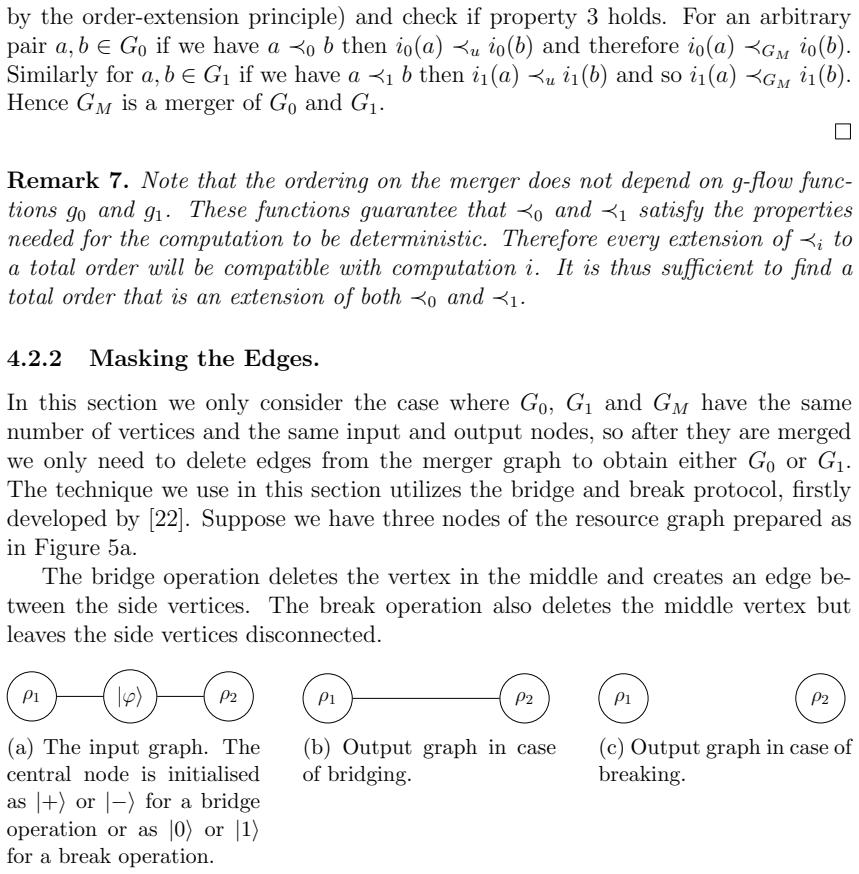
The argument runs on two machines. The no-go side is the 'remote state expander' (RSE): a hypothetical server-side CPTP map that turns one encrypted qubit $|+\theta\rangle$ into two resource qubits with independent hidden angles $\rho_A(\theta_1), \rho_B(\theta_2)$; the impossibility is driven by linearity (an isometry would have to map a two-dimensional input span into a restricted subspace) and, for entangled outputs, by Schmidt decomposition forcing equal subsystem entropies. The constructive side is hiding by difference: the future cone of a target node collects every measurement angle that depends on the target's outcome, and only qubit-masked nodes (those in the cone with non-Clifford default angles) require an extra physical qubit from the client; graph differences are concealed by merging $G_0$ and $G_1$ into a common graph $G_M$ and using bridge-and-break operations so the server cannot tell which edges were deleted.
What would settle it
Find any CPTP map $\Lambda$ with $\Lambda(|+\theta\rangle\langle+\theta|) = \rho_A(\theta_1)\otimes\rho_B(\theta_2)$ satisfying conditions (1)-(3) of Theorem 1 for all $\theta$ in the UBQC angle set; an explicit construction would refute the claimed no-go, and a UBQC protocol built from it that remains blind under an unbounded server would refute Proposition 1 directly.
Extended reading notes
Core claim
On the paper's own terms, the central discovery is a matched pair of limits. Proposition 1 states that in any UBQC protocol there is no server-side local operation that maps a resource state $|+\theta\rangle$ to states used on two or more graph nodes while preserving completeness and blindness; Theorem 1 backs this with a no-go for any map whose outputs have independent angle parameters and whose output state reveals nothing about $\theta_1$ and $\theta_2$ when $\theta$ is unknown, proved for isometries, quantum channels, and entangled outputs. Lemma 4 extends the damage: even approximate expanders that produce correlated angles allow differential attacks on the angle one-time pad. On the positive side, the paper defines Selectively Blind Quantum Computing (SBQC), where the client chooses one of a publicly known set of unitaries, and gives protocols that mask only the differences: angle masking via future cones (only nodes with non-Clifford angles need physical qubits) and graph masking via merger graphs with bridge-and-break operations. Theorem 2 states that these protocols perfectly construct the 1-of-2 Delegated Quantum Computation resource, so the protection is composable.
Load-bearing premise
The impossibility result hinges on condition (3) of Theorem 1, which demands that when the input angle $\theta$ is unknown the output state $\rho_{A,B}$ reveals no information about $\theta_1$ and $\theta_2$; this is stronger than UBQC's actual blindness requirement, where the transmitted $|+\theta\rangle$ states themselves leak some information about $\theta$ and security comes from masking the measurement transcript.
Editorial extensions
If this is right
- UBQC's quantum communication cannot be reduced by any server-side local expansion or recycling of encrypted resource states in the plain, information-theoretic model.
- Any approximate or correlated resource-state distributor is unusable in UBQC: known functional dependencies among angles open a differential attack on the angle one-time pad.
- The number of encrypted qubits a client must send for full blindness is superlogarithmic in the size of the computation, so some quantum communication is provably necessary.
- In SBQC, computations that differ by only a few gates require qubits only for the differing nodes and for non-Clifford nodes in their future cones; Clifford-only differences can be hidden classically.
- The 1-of-2 SBQC protocol is composably secure: it perfectly constructs the 1-of-2 Delegated Quantum Computation resource, so it can be run alongside other protocols without losing blindness.
Reading between the lines
- The no-go may be narrower than it appears: condition (3) is stricter than the blindness UBQC actually enjoys, so the impossibility result leaves open server-side processes that reduce communication while leaking some information about the resource angles, as long as the computation itself stays hidden.
- SBQC's cost rule suggests a new circuit-compilation objective: arrange non-Clifford gates so their future cones overlap as little as possible with the client's secret parameters, reducing the number of physical qubits the client must send.
- A natural test is to instantiate SBQC for a practical family such as parameterized quantum circuits where only weights are secret; the protocol predicts the quantum communication cost should scale with the number of weight-dependent non-Clifford gates rather than circuit width.
- The paper's merged-graph construction is not yet optimized; an efficient algorithm for optimal merger graphs, at least for brickwork or square lattices, would turn the asymptotic savings into concrete resource estimates.
Signed reviews
Editorial analysis
A structured set of objections, weighed in public.
Referee Report
Summary. This paper studies the communication complexity of blind quantum computing. In the first part, the authors propose an impossibility result (Theorem 1, Proposition 1) claiming that no server-side local quantum operation can map a single |+θ> resource state into two or more states usable as independent UBQC resource states, and therefore that such 'remote state expanders' cannot reduce the quantum communication of UBQC. The argument proceeds through a series of lemmas covering isometries, channels, and entangled outputs, plus a lemma on differential attacks against correlated parameters and a counting lower bound. In the second part, the authors introduce Selectively Blind Quantum Computing (SBQC), a functionality that hides which of a set of known computations is performed, and give protocols (Protocols 4 and 5) that mask angle differences, graph differences, and g-flow differences, with a claimed perfect construction of a 1-of-2 Delegated Quantum Computation resource in the Abstract Cryptography framework (Theorem 2).
Significance. The SBQC framework is a genuinely useful way to think about partial blindness, and the masking techniques (future cones, bridge/break operations, merger graphs) are creative and potentially applicable beyond this paper. The abstract-cryptography security proof, while sketched, is an appropriate goal for composable security. However, the impossibility result, which is one of the two headline contributions, is not established: Theorem 1's condition (3) does not match the blindness notion of UBQC, and the supporting lemmas contain invalid steps. If the no-go were correct, it would be a significant conceptual result; as it stands, the first half of the paper does not meet the standards needed to support Proposition 1. The 'communication-optimal' claim for SBQC also lacks a formal lower-bound statement.
major comments (5)
- [Sec. 3, Eq. (8)] Condition (3) of Theorem 1 requires that, when θ is unknown, no information about θ1 and θ2 is accessible from the output state ρA,B. This is substantially stronger than the blindness guarantee of UBQC. In Protocol 1 (Sec. 2.3), the resource states |+θ> are sent to the server, and the server may measure them and learn partial information about θ; blindness holds because the full transcript—states, angles δ = φ' + θ + rπ, and outcomes—is independent of the computation φ. The paper itself notes this leakage and compensates with the random bit r. Consequently, a resource state that leaks or correlates θ1 and θ2 is not automatically ruled out by the requirements of a secure UBQC protocol. Proposition 1, which is the central impossibility claim, is derived from Theorem 1 and therefore does not follow. This is the main gap in the paper's first contribution.
- [Sec. 3, Lemma 3] The entropy argument in Lemma 3 is invalid. The proof invokes the Schmidt decomposition S(ρA)=S(ρB) and then claims that, because the left side depends only on θ1 and the right side only on θ2, both must equal a constant s independent of θ1 and θ2. But in the map D, θ1 and θ2 are not independent variables; they are both functions of the single input θ. The equality S(ρA(θ1(θ)))=S(ρB(θ2(θ))) is perfectly consistent with both sides varying with θ (e.g., θ1=θ2=θ). The conclusion that ρA and ρB are constant with respect to their parameters is not justified. Since Lemma 3 is the step that extends the no-go to entangled outputs, Theorem 1 is not proven.
- [Sec. 3, Lemma 4] Lemma 4 asserts that a known functional dependency θj = f(θi) enables a differential attack on the one-time-padded angles δi and δj, but it does not construct a distinguisher or quantify the advantage. The claim must account for the fact that ri and rj are fresh, independent, uniform bits unknown to the server; a concrete analysis of the joint distribution of (δi,δj) under the two candidate computations is needed. For some dependencies (e.g., f(θ)=θ and φ differences that are multiples of π), the attack may work, but for others it may not; as written, the lemma is an assertion, not a proof. This matters because the lemma is used to argue that the assumptions of Theorem 1 are minimal for UBQC, i.e., that relaxing condition (3) inevitably breaks blindness.
- [Sec. 3, Lemma 2] The proof of Lemma 2 reduces the channel case to Lemma 1 via Stinespring dilation, claiming that the existence of Λ implies an isometry G with G|+θ> = |ψθ1>⊗|ψθ2> where the marginals are ρ(θ1) and ρ(θ2). However, Lemma 1 only rules out isometries with pure product outputs of the specific form |+θ1>⊗|+θ2>. A general purification of two mixed states need not be of this form, so the contradiction is not established. This is a further gap in the proof chain of Theorem 1.
- [Abstract and Sec. 4] The abstract and introduction state that the SBQC protocol is 'communication-optimal,' but no theorem or lower bound supporting this optimality is provided. Section 4 gives an explicit construction and analyzes its cost, but there is no matching lower bound showing that any protocol with the same selective-blindness guarantees must send at least as many qubits. The optimality claim should either be proven or removed.
minor comments (5)
- [Eq. (15)-(16)] The matrix representation of the isometry D2 uses coefficients cosδ and sinδ for the state |+δ>, which is inconsistent with the definition |+θ> = (|0>+e^{iθ}|1>)/√2 given in Sec. 2.1; the correct coefficients are (1+e^{iδ})/2 and (1-e^{iδ})/2. The conclusion of the lemma is unaffected, but the calculation should be corrected.
- [Sec. 3, Lemma 2 and before Lemma 3] The name 'Stinespring' is misspelled as 'Steinspring' in two places; please correct.
- [Sec. 1.2] The sentence beginning 'In lemma 1 We also show...' appears to be a formatting or editing artifact; the reference to Lemma 1 is out of place and should be rephrased.
- [Sec. 4.4.2, Theorem 2 proof] The proof of Theorem 2 is presented as a sequence of reductions and a simulator description rather than a formal AC proof; in particular, the indistinguishability claims in Reduction 1 rely on the no-communication theorem but do not spell out the distinguisher's interface and the simulator's full transcript. The authors should expand this to a complete proof or clearly mark it as a proof sketch.
- [Sec. 3.1, Lemma 5] The generalization of the counting argument to continuous parameter sets is described as 'approximately' valid but not formalized; the discretization argument should be made precise or removed.
Circularity Check
Theorem 1's no-go is built on a self-imposed zero-leakage condition; Proposition 1 does not follow from UBQC blindness, while the SBQC construction is independent.
-
self definitional
[Section 3, Theorem 1 (Eq. 8), and its use in Proposition 1]
"(3) If the parameter θ is unknown, then no information about θ1 and θ2 is accessible from the output ρA,B."
This condition is not UBQC blindness. Section 2.3 states that measuring a qubit |+θ> 'can leak partial information about the secret key θ' and that security is restored by the one-time-padded angle δ=φ'+θ+rπ and the hidden outcome b=s⊕r. Blindness only requires the server's full transcript to be independent of the computation {φ_i}, not that the transmitted resource states leak no information about θ1 and θ2. By building 'no information about θ1 and θ2' into the definition of the remote state expander, Theorem 1 assumes the very independence that Proposition 1 later presents as a necessary condition for blindness. The impossibility is therefore largely contained in the task definition rather than derived from the security definition of UBQC.
full rationale
The constructive part of the paper, SBQC (Protocols 4 and 5 and Theorem 2), is not circular: the Abstract Cryptography proof proceeds by explicit reductions (EPR-pair preparation, delayed measurement, simulator construction) and does not rely on the no-go theorem. The circularity is concentrated in the impossibility claim. Theorem 1 postulates that a useful remote state expander must satisfy condition (3), i.e. that θ1 and θ2 are inaccessible from the output state. But the paper itself acknowledges in Section 2.3 that standard UBQC resource states |+θ> can leak partial information about θ and that blindness is preserved by the random rπ masking of measurement outcomes and angles. Thus condition (3) is a stronger, self-imposed requirement, not the blindness condition of UBQC. Lemma 4, which is supposed to close the gap by showing dependent parameters break blindness, only asserts that a one-time pad with correlated keys is insecure and never constructs a distinguisher against the UBQC transcript; this is a correctness gap rather than a derivation. Consequently, Proposition 1 does not follow from the stated theorems, and the no-go result is substantially circular: the impossibility is encoded in the condition assumed at the start. The SBQC protocol, by contrast, has independent content and a self-contained security proof, so the paper is only partially circular.
Assumptions & free parameters
assumptions (5)
- ad hoc to paper A resource state useful for UBQC must have independent secret parameters θ1, θ2 with no information accessible from the output state alone (Theorem 1 condition (3)).
- standard math Linearity of quantum mechanics, Stinespring dilation, Schmidt decomposition, and the no-communication theorem.
- domain assumption The g-flow condition of Browne et al. is necessary and sufficient for deterministic MBQC computation.
- domain assumption The server knows the set of candidate unitaries {U0,U1} and the leakage lU0,U1; blindness only requires hiding which unitary is chosen.
- domain assumption Bridge and break operations from [22] correctly transform the resource graph as described in Protocols 2 and 3.
Cite this review
Pith. "Pith review of Selectively Blind Quantum Computation." pith.science (2026). https://pith.science/paper/76PY6U5M
@misc{pith2026250417612,
  author       = {Pith},
  title        = {Pith review of: Selectively Blind Quantum Computation},
  year         = {2026},
  howpublished = {\url{https://pith.science/paper/76PY6U5M}},
  note         = {Machine review of arXiv:2504.17612}
}
read the original abstract
Known protocols for secure delegation of quantum computations from a client to a server in an information theoretic setting require quantum communication. In this work, we investigate methods to reduce communication overhead. First, we establish an impossibility result by proving that server-side local processes cannot decrease quantum communication requirements of secure delegation protocols. We develop no-go results that prohibit such processes within an information theoretic framework. Second, we present a possibility result by introducing Selectively Blind Quantum Computing (SBQC), a novel functionality that allows the client to hide one among a known set of possible computations. We characterize how differences between computations in the protected set influence the number of qubits sent during our SBQC implementation, yielding a communication-optimal protocol. This approach reduces qubit communication drastically and demonstrates the trade-off between information leaked to the server and communication cost.
Figures


Figures from the paper (4 more)



Forward citations
Cited by 2 Pith papers
-
Routing Anonymity and Identifiability of Noisy Quantum Hardware
The paper formalizes backend identifiability as hypothesis testing, proves anonymity decays at the Chernoff rate under persistent i.i.d. probing, establishes a utility-anonymity trade-off, and demonstrates 87-100% bac...
-
Designing Fault-Tolerant Blind Quantum Computation
A hybrid matter-photon architecture for blind quantum computing offloads error correction to the server and is claimed to raise the communication error threshold to up to 10% with linear photonic overhead.
Reference graph
Works this paper leans on
-
[1]
Universal blind quantum com- putation,
A. Broadbent, J. Fitzsimons, and E. Kashefi, “Universal blind quantum com- putation,” in 2009 50th annual IEEE symposium on foundations of computer science, pp. 517–526, IEEE, 2009
work page 2009
-
[2]
Verifiable blind quantum comput- ing with trapped ions and single photons,
P. Drmota, D. Nadlinger, D. Main, B. Nichol, E. Ainley, D. Leichtle, A. Mantri, E. Kashefi, R. Srinivas, G. Araneda, et al., “Verifiable blind quantum comput- ing with trapped ions and single photons,” Physical Review Letters, vol. 132, no. 15, p. 150604, 2024
work page 2024
-
[3]
Secure assisted quantum computation,
A. M. Childs, “Secure assisted quantum computation,” arXiv preprint quant- ph/0111046, 2001
-
[4]
Unconditionally verifiable blind quantum computation,
J. F. Fitzsimons and E. Kashefi, “Unconditionally verifiable blind quantum computation,” Physical Review A, vol. 96, no. 1, p. 012303, 2017
work page 2017
-
[5]
Classical verification of quantum computations,
U. Mahadev, “Classical verification of quantum computations,” in 2018 IEEE 59th Annual Symposium on Foundations of Computer Science (FOCS) , pp. 259–267, IEEE, 2018
work page 2018
-
[6]
Classical command of quantum systems,
B. W. Reichardt, F. Unger, and U. Vazirani, “Classical command of quantum systems,” Nature, vol. 496, no. 7446, pp. 456–460, 2013
work page 2013
-
[7]
Security limitations of classical-client delegated quantum computing,
C. Badertscher, A. Cojocaru, L. Colisson, E. Kashefi, D. Leichtle, A. Mantri, and P. Wallden, “Security limitations of classical-client delegated quantum computing,” in International Conference on the Theory and Application of Cryptology and Information Security , pp. 667–696, Springer, 2020
work page 2020
-
[8]
Experimental verifi- cation of quantum computation,
S. Barz, J. F. Fitzsimons, E. Kashefi, and P. Walther, “Experimental verifi- cation of quantum computation,” Nature physics, vol. 9, no. 11, pp. 727–731, 2013
work page 2013
Show all 44 references
-
[9]
Demonstration of blind quantum computing,
S. Barz, E. Kashefi, A. Broadbent, J. F. Fitzsimons, A. Zeilinger, and P. Walther, “Demonstration of blind quantum computing,” science, vol. 335, no. 6066, pp. 303–308, 2012
2012
-
[10]
Flow ambi- guity: A path towards classically driven blind quantum computation,
A. Mantri, T. F. Demarie, N. C. Menicucci, and J. F. Fitzsimons, “Flow ambi- guity: A path towards classically driven blind quantum computation,”Physical Review X, vol. 7, no. 3, p. 031004, 2017. 43
2017
-
[11]
Multi-client distributed blind quantum computation with the qline architecture,
B. Polacchi, D. Leichtle, L. Limongi, G. Carvacho, G. Milani, N. Spag- nolo, M. Kaplan, F. Sciarrino, and E. Kashefi, “Multi-client distributed blind quantum computation with the qline architecture,” Nature Communications, vol. 14, no. 1, p. 7743, 2023
2023
-
[12]
Iterated gate teleportation and blind quantum computation,
C. A. P´ erez-Delgado and J. F. Fitzsimons, “Iterated gate teleportation and blind quantum computation,” Physical review letters , vol. 114, no. 22, p. 220502, 2015
2015
-
[13]
A one-way quantum computer,
R. Raussendorf and H. J. Briegel, “A one-way quantum computer,” Physical review letters, vol. 86, no. 22, p. 5188, 2001
2001
-
[14]
Blind quantum computation protocol in which alice only makes measurements,
T. Morimae and K. Fujii, “Blind quantum computation protocol in which alice only makes measurements,” Physical Review A—Atomic, Molecular, and Optical Physics, vol. 87, no. 5, p. 050301, 2013
2013
-
[15]
Survey on nonlocal games and operator space theory,
C. Palazuelos and T. Vidick, “Survey on nonlocal games and operator space theory,” Journal of Mathematical Physics , vol. 57, no. 1, 2016
2016
-
[16]
Classical homomorphic encryption for quantum circuits,
U. Mahadev, “Classical homomorphic encryption for quantum circuits,” SIAM Journal on Computing , vol. 52, no. 6, pp. FOCS18–189, 2020
2020
-
[17]
Qfactory: classically- instructed remote secret qubits preparation,
A. Cojocaru, L. Colisson, E. Kashefi, and P. Wallden, “Qfactory: classically- instructed remote secret qubits preparation,” in Advances in Cryptology– ASIACRYPT 2019: 25th International Conference on the Theory and Appli- cation of Cryptology and Information Security, Kobe, Ja...
2019
-
[18]
On the implausi- bility of classical client blind quantum computing,
S. Aaronson, A. Cojocaru, A. Gheorghiu, and E. Kashefi, “On the implausi- bility of classical client blind quantum computing,” in 7th International Con- ference on Quantum Cryptography, 2017
2017
-
[19]
Succinct blind quantum computation using a random oracle,
J. Zhang, “Succinct blind quantum computation using a random oracle,” in Proceedings of the 53rd Annual ACM SIGACT Symposium on Theory of Com- puting, pp. 1370–1383, 2021
2021
-
[20]
Quantum private distributed learning through blind quantum computing,
W. Li, S. Lu, and D.-L. Deng, “Quantum private distributed learning through blind quantum computing,” Preprint arXiv, vol. 2103, 2021
2021
-
[21]
In- teractive proofs for verifying (quantum) learning and testing,
M. C. Caro, J. Eisert, M. Hinsche, M. Ioannou, A. Nietner, and R. Sweke, “In- teractive proofs for verifying (quantum) learning and testing,” arXiv preprint arXiv:2410.23969, 2024
2024 arXiv
-
[22]
Information theoreti- cally secure hypothesis test for temporally unstructured quantum computation (extended abstract),
D. Mills, A. Pappa, T. Kapourniotis, and E. Kashefi, “Information theoreti- cally secure hypothesis test for temporally unstructured quantum computation (extended abstract),” in Proceedings 14th International Conference on Quan- tum Physics and Logic (B. Coecke and A. Kissinge...
2018
-
[23]
Measurement-based quantum computation,
H. J. Briegel, D. E. Browne, W. D¨ ur, R. Raussendorf, and M. Van den Nest, “Measurement-based quantum computation,” Nature Physics , vol. 5, no. 1, pp. 19–26, 2009
2009
-
[24]
Delegating private quantum computations,
A. Broadbent, “Delegating private quantum computations,” Canadian Journal of Physics, vol. 93, no. 9, pp. 941–946, 2015
2015
-
[25]
Partial blind quantum computation,
Y. Lee and D. Chung, “Partial blind quantum computation,” 2025
2025
-
[26]
Positive functions on c*-algebras,
W. F. Stinespring, “Positive functions on c*-algebras,” Proceedings of the American Mathematical Society, vol. 6, no. 2, pp. 211–216, 1955
1955
-
[27]
The measurement calculus,
V. Danos, E. Kashefi, and P. Panangaden, “The measurement calculus,” J. ACM, vol. 54, Apr. 2007
2007
-
[28]
State transfer instead of teleportation inmeasurement-based quan- tum computation,
S. Perdrix, “State transfer instead of teleportation inmeasurement-based quan- tum computation,” International Journal of Quantum Information , vol. 03, no. 01, pp. 219–223, 2005
2005
-
[29]
Generalized flow and determinism in measurement-based quantum computation,
D. E. Browne, E. Kashefi, M. Mhalla, and S. Perdrix, “Generalized flow and determinism in measurement-based quantum computation,” New Journal of Physics, vol. 9, no. 8, p. 250, 2007
2007
-
[30]
Broadbent, J
A. Broadbent, J. Fitzsimons, and E. Kashefi, Measurement-Based and Uni- versal Blind Quantum Computation , pp. 43–86. Berlin, Heidelberg: Springer Berlin Heidelberg, 2010
2010
-
[31]
Private quantum computation: an introduction to blind quantum computing and related protocols,
J. F. Fitzsimons, “Private quantum computation: an introduction to blind quantum computing and related protocols,” npj Quantum Information , vol. 3, no. 1, p. 23, 2017
2017
-
[32]
Composable se- curity of delegated quantum computation,
V. Dunjko, J. F. Fitzsimons, C. Portmann, and R. Renner, “Composable se- curity of delegated quantum computation,” in Advances in Cryptology – ASI- ACRYPT 2014 (P. Sarkar and T. Iwata, eds.), (Berlin, Heidelberg), pp. 406– 425, Springer Berlin Heidelberg, 2014
2014
-
[33]
Abstract cryptography,
U. Maurer and R. Renner, “Abstract cryptography,” in Innovations in Com- puter Science, pp. 1 – 21, Tsinghua University Press, jan 2011
2011
-
[34]
Constructive cryptography – a new paradigm for security defini- tions and proofs,
U. Maurer, “Constructive cryptography – a new paradigm for security defini- tions and proofs,” in Theory of Security and Applications (S. M¨ odersheim and C. Palamidessi, eds.), (Berlin, Heidelberg), pp. 33–56, Springer Berlin Heidel- berg, 2012
2012
-
[35]
A single quantum cannot be cloned,
W. K. Wootters and W. H. Zurek, “A single quantum cannot be cloned,” Nature, vol. 299, no. 5886, pp. 802–803, 1982
1982
-
[36]
Blind quantum computing with two almost iden- tical states,
V. Dunjko and E. Kashefi, “Blind quantum computing with two almost iden- tical states,” arXiv preprint arXiv:1604.01586 , 2016. 45
2016 arXiv
-
[37]
Asymmetric quantum cloning in any dimension,
N. J. Cerf, “Asymmetric quantum cloning in any dimension,” Journal of mod- ern optics, vol. 47, no. 2-3, pp. 187–209, 2000
2000
-
[38]
Quantum cloning,
V. Scarani, S. Iblisdir, N. Gisin, and A. Ac´ ın, “Quantum cloning,” Reviews of Modern Physics, vol. 77, no. 4, pp. 1225–1256, 2005
2005
-
[39]
Related-key cryptanalysis of the full aes- 192 and aes-256,
A. Biryukov and D. Khovratovich, “Related-key cryptanalysis of the full aes- 192 and aes-256,” in Advances in Cryptology–ASIACRYPT 2009: 15th Inter- national Conference on the Theory and Application of Cryptology and Informa- tion Security, Tokyo, Japan, December 6-10, 2009. P...
2009
-
[40]
Key-dependent security of stream ciphers,
E. Filiol, “Key-dependent security of stream ciphers,” arXiv preprint arXiv:2001.00515, 2020
2001 arXiv
-
[41]
M. M. Wilde, Quantum information theory. Cambridge university press, 2013
2013
-
[42]
Quantum discord: a measure of the quantumness of correlations,
H. Ollivier and W. H. Zurek, “Quantum discord: a measure of the quantumness of correlations,” Physical review letters, vol. 88, no. 1, p. 017901, 2001
2001
-
[43]
Efficient uni- versal blind quantum computation,
V. Giovannetti, L. Maccone, T. Morimae, and T. G. Rudolph, “Efficient uni- versal blind quantum computation,” Physical review letters , vol. 111, no. 23, p. 230501, 2013
2013
-
[44]
Programmable quantum gate arrays,
M. A. Nielsen and I. L. Chuang, “Programmable quantum gate arrays,” Phys- ical Review Letters, vol. 79, no. 2, p. 321, 1997. 46 A Alternative Proof of Lemma 1 Here, we present an alternative proof of Equation (9) to highlight the connection between the lemma and the linearity ...
1997
Reviewed August 16, 2026 · model on record in the stance chip above.
Discussion (0). Continue with ORCID to comment.