REVIEW 1 cited by
Two-dimensional THz spectroscopy in electronic systems: a many-body diagrammatic approach
T0 review · reviewed 2026-08-04 · deepseek-v4-flash
Pith's one-line read A many-body diagrammatic theory computes 2D THz spectroscopy maps from third-order nonlinear kernels, separates paramagnetic and diamagnetic processes, and shows propagation through the sample can dominate and mask the intrinsic signal.
The pith
A machine-rendered reading of the paper's core claim, the machinery that carries it, and where it could break.
The reading
For a toy model of a charge-density-wave metal, they reduce the many-body sums to integrals over a density of states weighted by simple rational functions (their Eqs. 53-63). In the broadband-pulse limit, the paramagnetic and diamagnetic contributions produce visibly different 2D maps, so a measured map can in principle tell the two mechanisms apart.
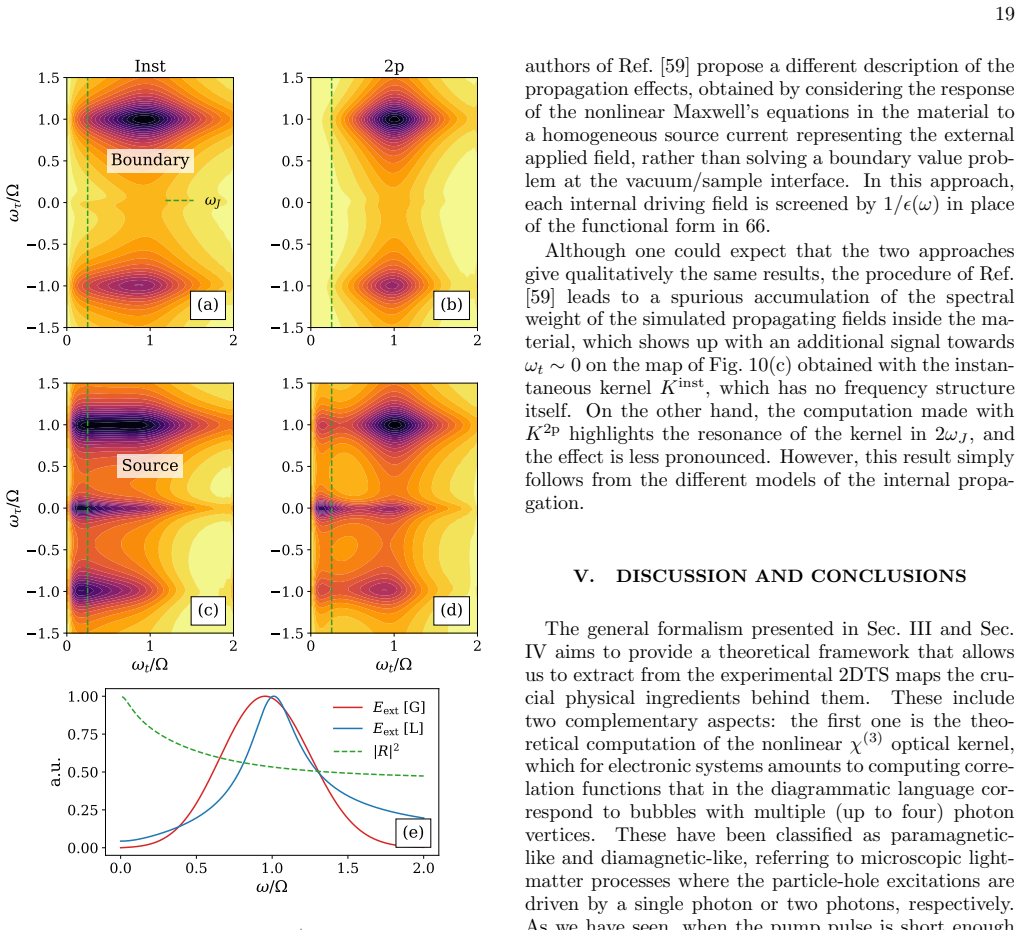
The second half of the paper is a warning. In a bulk sample, the THz pulse is filtered by the frequency-dependent refractive index before it drives the nonlinearity, and the generated nonlinear field is also modified at the sample boundary. For Josephson plasmons in a cuprate superconductor, they show this filtering turns the expected broadband map into a narrow, four-spot pattern. As a result, the measured 2D map is controlled by propagation, and two theoretically different nonlinear kernels become almost impossible to distinguish.
Extended reading notes
Core claim
The paper's central result is the factorization of the 2DTS signal into a detection structure and a material spectrum: 'The set of Eqs. 53-63 represent the central result of the present work: they provide... a general expression for the computation of the 2D maps, where the details of the excitation spectrum of the system is fully encoded in the density of states rho(E).' For bulk systems, Eq. 66 gives the propagation-corrected outgoing nonlinear field, and the authors conclude that for Josephson plasmons in cuprates the measured four-spot 2D map is dominated by linear-response filtering, so that instantaneous and two-plasmon nonlinear kernels cannot be distinguished experimentally.
Load-bearing premise
The bulk propagation treatment of Sec. IV (Eqs. 65-66) assumes Maxwell's equations can be solved iteratively to third order in the nonlinear source while keeping the linear refractive index n(omega) of Eq. 67 fixed, i.e. the internal driving field is simply t(omega) times the external field and the strong THz pulse does not modify the dielectric response. If pump-induced changes of n(omega) or higher-order feedback matter, the conclusion that propagation masks the intrinsic kernel would not hold. This is a distinct premise from the claim itself: it is the model of how the nonlinear signal travels out of the sample.
Editorial analysis
A structured set of objections, weighed in public.
Assumptions & free parameters
free parameters (2)
- eta (analytic-continuation broadening) =
0.05 * 2Delta in Figs. 6-7
- omega_J(T), gamma(T) Josephson parameters for LSCO x=0.17 =
Interpolated from fits to x=0.16 and x=0.18 data in Refs. [85,86]
assumptions (7)
- domain assumption Centrosymmetric systems have no even-order nonlinear response, so the leading 2D signal is third order (Eq. 7).
- standard math Electron-light coupling via the Peierls substitution and expansion in powers of A (Eqs. 28-29), truncated at order A^4 for the current.
- domain assumption The CDW toy model is a static mean-field quadratic Hamiltonian (Eq. 23) with fermions integrated out exactly and no vertex corrections beyond mean field.
- standard math Analytic continuation iOmega -> omega + i eta with eta > 0 after Matsubara summation is valid.
- domain assumption Maxwell equations can be solved iteratively to third order in the nonlinear source with a fixed linear refractive index n(omega) (Eqs. 65-66).
- domain assumption Josephson phase model Eq. 68 and two-fluid dielectric function Eq. 67 describe the linear and nonlinear response of LSCO.
- domain assumption The two-plasmon kernel Eq. 70 and its log form Eq. 71 are valid as derived in prior work [58].
Cite this review
Pith. "Pith review of Two-dimensional THz spectroscopy in electronic systems: a many-body diagrammatic approach." pith.science (2026). https://pith.science/paper/7726GQ56
@misc{pith2026250925060,
  author       = {Pith},
  title        = {Pith review of: Two-dimensional THz spectroscopy in electronic systems: a many-body diagrammatic approach},
  year         = {2026},
  howpublished = {\url{https://pith.science/paper/7726GQ56}},
  note         = {Machine review of arXiv:2509.25060}
}
abstract
The term two-dimensional coherent spectroscopy (2DCS) usually refers to experimental setups where a coherently generated electric field in a sample is recorded over many runs as a function of two time variables: the delay $\tau$ between two consequent excitation pulses and the time $t$ over which the signal is emitted. While its implementation in the femtosecond time domain for studying vibrational molecular states has been developed for over two decades, its experimental application in the THz domain to interacting electronic systems remains in its infancy. This work provides a general theoretical framework for describing and interpreting 2DCS using a many-body language based on a perturbative diagrammatic expansion, as widely applied in linear spectroscopy. Focusing on centrosymmetric systems, we show that interpreting the 2D maps can be recast into two complementary problems. The first is the evaluation of a third-order response function to the gauge field. In the velocity gauge, this leads to semi-analytical expressions that both reduce computational complexity and assist in assigning spectral features to microscopic processes, as shown using a toy model of electrons undergoing a charge-density wave transition. The second is a careful treatment of multi-wave propagation effects, which, in bulk systems, can obscure the intrinsic nonlinear response, demonstrated here for soft superconducting Josephson plasmons. Our results provide a solid foundation for extending 2DCS to complex interacting systems and offer a flexible method to realistically model nonlinear responses across arbitrary spectral widths.
Figures


Figures from the paper (8 more)



Forward citations
Cited by 1 Pith paper
-
Floquet polaritons in optically driven materials
A Green-function framework derives Floquet polariton spectra in pumped quantum materials from their nonlinear optical susceptibilities, predicting flat bands, exceptional points, and parametric instability in graphene...
Reference graph
Works this paper leans on
-
[1]
Hirori, A
H. Hirori, A. Doi, F. Blanchard, and K. Tanaka, Single-cycle terahertz pulses with amplitudes exceeding 1 MV/cm generated by optical rectification in LiNbO3, Applied Physics Letters98, 091106 (2011)
2011
-
[2]
Leitenstorfer, A
A. Leitenstorfer, A. S. Moskalenko, T. Kampfrath, J. Kono, E. Castro-Camus, K. Peng, N. Qureshi, D. Turchinovich, K. Tanaka, A. G. Markelz, M. Havenith, C. Hough, H. J. Joyce, W. J. Padilla, B. Zhou, K.-Y. Kim, X.-C. Zhang, P. U. Jepsen, S. Dhillon, M. Vitiello, E. Linfield, A. G. Davies, M. C. Hoffmann, R. Lewis, M. Tonouchi, P. Klarskov, T. S. Seifert, ...
2023
-
[3]
F¨ orst, C
M. F¨ orst, C. Manzoni, S. Kaiser, Y. Tomioka, Y. Tokura, R. Merlin, and A. Cavalleri, Nonlinear phononics as an ultrafast route to lattice control, Nature Physics7, 854 (2011)
2011
-
[4]
Kampfrath, K
T. Kampfrath, K. Tanaka, and K. A. Nelson, Resonant and nonresonant control over matter and light by intense terahertz transients, Nature Photonics7, 680 (2013)
2013
-
[5]
Giannetti, M
C. Giannetti, M. Capone, D. Fausti, M. Fabrizio, F. Parmigiani, and D. Mihailovic, Ultrafast optical spectroscopy of strongly correlated materials and high- temperature superconductors: A non-equilibrium ap- proach, Advances in Physics65, 58 (2016)
2016
-
[6]
fil- ter
In the upper row, panels (a)-(c), we considered the dispersive limitt≫∆, while in the lower row, panels (d)-(f), we considered the oppositet≪∆ case. The dia- magnetic process is much less effective in selecting spe- cific spots in the 2D map as compared to the paramag- netic ones, as one can observe in panels (c)-(f), where we show the results obtained in...
-
[7]
A. F. Volkov and S. M. Kogan, Collisionless relaxation of the energy gap in superconductors, Soviet Journal of Experimental and Theoretical Physics38, 1018 (1974)
1974
-
[8]
P. B. Littlewood and C. M. Varma, Amplitude collective modes in superconductors and their coupling to charge- density waves, Physical Review B26, 4883 (1982)
1982
Show all 98 references
-
[9]
P. W. Anderson, Random-Phase Approximation in the Theory of Superconductivity, Physical Review112, 1900 (1958)
1900
-
[10]
Matsunaga, Y
R. Matsunaga, Y. I. Hamada, K. Makise, Y. Uzawa, H. Terai, Z. Wang, and R. Shimano, Higgs Amplitude Mode in the BCS Superconductors Nb 1−xTixNInduced by Terahertz Pulse Excitation, Physical Review Letters 111, 057002 (2013)
2013
-
[11]
Matsunaga, N
R. Matsunaga, N. Tsuji, H. Fujita, A. Sugioka, K. Makise, Y. Uzawa, H. Terai, Z. Wang, H. Aoki, and R. Shimano, Light-induced collective pseudospin preces- sion resonating with Higgs mode in a superconductor, Science345, 1145 (2014)
2014
-
[12]
Z. Sun, M. M. Fogler, D. N. Basov, and A. J. Millis, Col- lective modes and terahertz near-field response of super- conductors, Physical Review Research2, 023413 (2020)
2020
-
[13]
Murotani and R
Y. Murotani and R. Shimano, Nonlinear optical response of collective modes in multiband superconductors as- sisted by nonmagnetic impurities, Physical Review B99, 224510 (2019)
2019
-
[14]
Silaev, Nonlinear electromagnetic response and Higgs- mode excitation in BCS superconductors with impurities, Physical Review B99, 224511 (2019)
M. Silaev, Nonlinear electromagnetic response and Higgs- mode excitation in BCS superconductors with impurities, Physical Review B99, 224511 (2019)
2019
-
[15]
T. Cea, C. Castellani, and L. Benfatto, Nonlinear op- tical effects and third-harmonic generation in supercon- 22 ductors: Cooper pairs versus Higgs mode contribution, Physical Review B93, 180507 (2016)
2016
-
[16]
Haenel, P
R. Haenel, P. Froese, D. Manske, and L. Schwarz, Time- resolved optical conductivity and Higgs oscillations in two-band dirty superconductors, Physical Review B104, 134504 (2021)
2021
-
[17]
Seibold, M
G. Seibold, M. Udina, C. Castellani, and L. Benfatto, Third harmonic generation from collective modes in dis- ordered superconductors, Physical Review B103, 014512 (2021)
2021
-
[18]
Tsuji and Y
N. Tsuji and Y. Nomura, Higgs-mode resonance in third harmonic generation in NbN superconductors: Multiband electron-phonon coupling, impurity scatter- ing, and polarization-angle dependence, Physical Review Research2, 043029 (2020)
2020
-
[19]
Chu, M.-J
H. Chu, M.-J. Kim, K. Katsumi, S. Kovalev, R. D. Daw- son, L. Schwarz, N. Yoshikawa, G. Kim, D. Putzky, Z. Z. Li, H. Raffy, S. Germanskiy, J.-C. Deinert, N. Awari, I. Ilyakov, B. Green, M. Chen, M. Bawatna, G. Cristiani, G. Logvenov, Y. Gallais, A. V. Boris, B. Keimer, A. P. S...
2020
-
[20]
Wang, J.-R
Z.-X. Wang, J.-R. Xue, H.-K. Shi, X.-Q. Jia, T. Lin, L.-Y. Shi, T. Dong, F. Wang, and N.-L. Wang, Transient Higgs oscillations and high-order nonlinear light-Higgs coupling in a terahertz wave driven NbN superconductor, Physical Review B105, L100508 (2022)
2022
-
[21]
Udina, J
M. Udina, J. Fiore, T. Cea, C. Castellani, G. Seibold, and L. Benfatto, THz non-linear optical response in cuprates: Predominance of the BCS response over the Higgs mode, Faraday Discussions237, 168 (2022)
2022
-
[22]
J. Lu, X. Li, Y. Zhang, H. Y. Hwang, B. K. Ofori-Okai, and K. A. Nelson, Two-Dimensional Spectroscopy at Ter- ahertz Frequencies, inMultidimensional Time-Resolved Spectroscopy, edited by T. Buckup and J. L´ eonard (Springer International Publishing, Cham, 2019) pp. 275–320
2019
-
[23]
Liu, Multidimensional terahertz probes of quantum materials, npj Quantum Materials10, 18 (2025)
A. Liu, Multidimensional terahertz probes of quantum materials, npj Quantum Materials10, 18 (2025)
2025
-
[24]
Reinhoffer, P
C. Reinhoffer, P. Pilch, A. Reinold, P. Derendorf, S. Ko- valev, J.-C. Deinert, I. Ilyakov, A. Ponomaryov, M. Chen, T.-Q. Xu, Y. Wang, Z.-Z. Gan, D.-S. Wu, J.-L. Luo, S. Germanskiy, E. A. Mashkovich, P. H. M. van Loos- drecht, I. M. Eremin, and Z. Wang, High-order nonlinear te...
2022
-
[25]
Mukamel,Principles of Nonlinear Optical Spectroscopy (Oxford University Press, 1995)
S. Mukamel,Principles of Nonlinear Optical Spectroscopy (Oxford University Press, 1995)
1995
-
[26]
Hamm and M
P. Hamm and M. Zanni,Concepts and Methods of 2D In- frared Spectroscopy(Cambridge University Press, Cam- bridge, 2011)
2011
-
[27]
Huang, M
C. Huang, M. Mootz, L. Luo, I. E. Perakis, and J. Wang, Unlocking Quantum Control and Multi-Order Correla- tions via Terahertz Two-Dimensional Coherent Spec- troscopy (2025), arXiv:2507.02116 [cond-mat]
2025
-
[28]
C. L. Smallwood and S. T. Cundiff, Coherent Spec- troscopy: Multidimensional Coherent Spectroscopy of Semiconductors, Laser & Photonics Reviews12, 1870052 (2018)
2018
-
[29]
L. Luo, M. Mootz, J. H. Kang, C. Huang, K. Eom, J. W. Lee, C. Vaswani, Y. G. Collantes, E. E. Hellstrom, I. E. Perakis, C. B. Eom, and J. Wang, Quantum coherence tomography of light-controlled superconductivity, Nature Physics19, 201 (2023)
2023
-
[30]
S. T. Cundiff and S. Mukamel, Optical multidimensional coherent spectroscopy, Physics Today66, 44 (2013)
2013
-
[31]
Katsumi, J
K. Katsumi, J. Fiore, M. Udina, R. Romero, D. Barbalas, J. Jesudasan, P. Raychaudhuri, G. Seibold, L. Benfatto, and N. P. Armitage, Revealing Novel Aspects of Light- Matter Coupling by Terahertz Two-Dimensional Coher- ent Spectroscopy: The Case of the Amplitude Mode in Superco...
2024
-
[32]
J. Yuan, L. Shi, L. Yue, B. Li, Z. Wang, S. Xu, T. Xu, Y. Wang, Z. Gan, F. Chen, Z. Lin, X. Wang, K. Jin, X. Wang, J. Luo, S. Zhang, Q. Wu, Q. Liu, T. Hu, R. Li, X. Zhou, D. Wu, T. Dong, and N. Wang, Dynamical interplay between superconductivity and pseudogap in cuprates as re...
2024
-
[33]
M.-J. Kim, S. Kovalev, M. Udina, R. Haenel, G. Kim, M. Puviani, G. Cristiani, I. Ilyakov, T. V. A. G. de Oliveira, A. Ponomaryov, J.-C. Deinert, G. Logvenov, B. Keimer, D. Manske, L. Benfatto, and S. Kaiser, Trac- ing the dynamics of superconducting order via transient teraher...
2024
-
[34]
Huang, M
C. Huang, M. Mootz, L. Luo, D. Cheng, A. Khatri, J.- M. Park, R. H. J. Kim, Y. Qiang, V. L. Quito, Y. Yao, P. P. Orth, I. E. Perakis, and J. Wang, Discovery of an unconventional quantum echo by interference of Higgs coherence, Science Advances11, eads8740 (2025)
2025
-
[35]
Cheng, D
B. Cheng, D. Cheng, K. Lee, M. Mootz, C. Huang, L. Luo, Z. Chen, Y. Lee, B. Y. Wang, I. E. Perakis, Z.-X. Shen, H. Y. Hwang, and J. Wang, Observation of cupratelike nonlinear terahertz responses in super- conducting infinite-layer nickelates via two-dimensional coherent spectr...
2025
-
[36]
Katsumi, J
K. Katsumi, J. Liang, R. Romero, K. Chen, X. Xi, and N. P. Armitage, Amplitude Mode in a Multigap Superconductor MgB 2 Investigated by Terahertz Two- Dimensional Coherent Spectroscopy, Physical Review Letters135, 036902 (2025)
2025
-
[37]
Mahmood, D
F. Mahmood, D. Chaudhuri, S. Gopalakrishnan, R. Nandkishore, and N. P. Armitage, Observation of a marginal Fermi glass, Nature Physics17, 627 (2021)
2021
-
[38]
A. Liu, D. Pavi´ cevi´ c, M. H. Michael, A. G. Salvador, P. E. Dolgirev, M. Fechner, A. S. Disa, P. M. Lozano, Q. Li, G. D. Gu, E. Demler, and A. Cavalleri, Probing inhomogeneous cuprate superconductivity by terahertz Josephson echo spectroscopy, Nature Physics , 1 (2024)
2024
-
[39]
Wan and N
Y. Wan and N. P. Armitage, Resolving Continua of Frac- tional Excitations by Spinon Echo in THz 2D Coher- ent Spectroscopy, Physical Review Letters122, 257401 (2019)
2019
-
[40]
Chaudhuri, D
D. Chaudhuri, D. Barbalas, F. Mahmood, J. Liang, R. R. III, A. Legros, X. He, H. Raffy, I. Bozovic, and N. P. Ar- mitage, Planckian dissipation, anomalous high temper- ature THz non-linear response and energy relaxation in the strange metal state of the cuprate superconductors...
2025 arXiv
-
[41]
J. Lu, X. Li, H. Y. Hwang, B. K. Ofori-Okai, T. Kurihara, T. Suemoto, and K. A. Nelson, Coherent Two-Dimensional Terahertz Magnetic Resonance Spec- troscopy of Collective Spin Waves, Physical Review Let- ters118, 207204 (2017)
2017
-
[42]
Barbalas, R
D. Barbalas, R. Romero, D. Chaudhuri, F. Mahmood, H. P. Nair, N. J. Schreiber, D. G. Schlom, K. M. Shen, 23 and N. P. Armitage, Energy Relaxation and Dynam- ics in the Correlated Metal Sr 2 RuO 4 via Terahertz Two-Dimensional Coherent Spectroscopy, Physical Re- view Letters134...
2025
-
[43]
Zhang, F
Z. Zhang, F. Y. Gao, J. B. Curtis, Z.-J. Liu, Y.-C. Chien, A. von Hoegen, M. T. Wong, T. Kurihara, T. Suemoto, P. Narang, E. Baldini, and K. A. Nelson, Terahertz field- induced nonlinear coupling of two magnon modes in an antiferromagnet, Nature Physics20, 801 (2024)
2024
-
[44]
Mootz, L
M. Mootz, L. Luo, J. Wang, and l. E. Perakis, Visu- alization and quantum control of light-accelerated con- densates by terahertz multi-dimensional coherent spec- troscopy, Communications Physics5, 1 (2022)
2022
-
[45]
E. A. Mashkovich, K. A. Grishunin, R. M. Dubrovin, A. K. Zvezdin, R. V. Pisarev, and A. V. Kimel, Tera- hertz light–driven coupling of antiferromagnetic spins to lattice, Science374, 1608 (2021)
2021
-
[46]
Puviani, R
M. Puviani, R. Haenel, and D. Manske, Quench-drive spectroscopy and high-harmonic generation in BCS su- perconductors, Physical Review B107, 094501 (2023)
2023
-
[47]
Mootz, L
M. Mootz, L. Luo, C. Huang, J. Wang, and l. E. Perakis, Multidimensional coherent spectroscopy of light-driven states and their collective modes in multiband supercon- ductors, Physical Review B109, 014515 (2024)
2024
-
[48]
Hart and R
O. Hart and R. Nandkishore, Extracting spinon self- energies from two-dimensional coherent spectroscopy, Physical Review B107, 205143 (2023)
2023
-
[49]
Chen and P
J. Chen and P. Werner, Multidimensional coherent spec- troscopy of correlated lattice systems, npj Computational Materials11, 127 (2025)
2025
-
[50]
Ono, Extracting Nonlinear Dynamical Response Func- tions from Time Evolution, Physical Review Letters135, 026401 (2025)
A. Ono, Extracting Nonlinear Dynamical Response Func- tions from Time Evolution, Physical Review Letters135, 026401 (2025)
2025
-
[51]
In the present manuscript we applied the formal- ism to a toy model for CDW formation, which essen- tially reproduces a semiconducting-like band structure. We worked out several semi-analytical expressions for the optical kernel and for the convolution with gaussian light puls...
-
[52]
A. G. Salvador, I. Morera, M. H. Michael, P. E. Dol- girev, D. Pavicevic, A. Liu, A. Cavalleri, and E. Dem- ler, Two-dimensional spectroscopy of bosonic collective excitations in disordered many-body systems (2025), arXiv:2501.16856 [cond-mat]
2025 arXiv
-
[53]
Kuehn, K
W. Kuehn, K. Reimann, M. Woerner, T. Elsaesser, and R. Hey, Two-Dimensional Terahertz Correlation Spec- tra of Electronic Excitations in Semiconductor Quantum Wells, The Journal of Physical Chemistry B115, 5448 (2011)
2011
-
[54]
J. Chen, N. Tsuji, and P. Werner, Higgs mode in two- dimensional coherent spectroscopy of weak-coupling an- tiferromagnets (2025), arXiv:2504.21351 [cond-mat]
2025 arXiv
-
[55]
Tsuji, Two-dimensional coherent spectroscopy of dis- ordered superconductors in the narrow-band and broad- band limits (2025), arXiv:2509.03936 [cond-mat]
N. Tsuji, Two-dimensional coherent spectroscopy of dis- ordered superconductors in the narrow-band and broad- band limits (2025), arXiv:2509.03936 [cond-mat]
2025 arXiv
-
[56]
Sellati, J
N. Sellati, J. Fiore, S. P. Villani, L. Benfatto, and M. Ud- ina, Theory of terahertz pump optical probe spectroscopy of phonon polaritons in noncentrosymmetric systems, npj Quantum Materials10, 46 (2025)
2025
-
[57]
Huber, S
L. Huber, S. F. Maehrlein, F. Wang, Y. Liu, and X.-Y. Zhu, The ultrafast Kerr effect in anisotropic and disper- sive media, The Journal of Chemical Physics154, 094202 (2021)
2021
-
[58]
Frenzel, M
M. Frenzel, M. Cherasse, J. M. Urban, F. Wang, B. Xiang, L. Nest, L. Huber, L. Perfetti, M. Wolf, T. Kampfrath, X.-Y. Zhu, and S. F. Maehrlein, Nonlin- ear terahertz control of the lead halide perovskite lattice, Science Advances9, eadg3856 (2023)
2023
-
[59]
10(c) obtained with the instan- taneous kernelK inst, which has no frequency structure itself
leads to a spurious accumulation of the spectral weight of the simulated propagating fields inside the ma- terial, which shows up with an additional signal towards ωt ∼0 on the map of Fig. 10(c) obtained with the instan- taneous kernelK inst, which has no frequency structure i...
-
[60]
Zhang, Z
S. Zhang, Z. Sun, Q. Liu, Z. Wang, Q. Wu, L. Yue, S. Xu, T. Hu, R. Li, X. Zhou, J. Yuan, G. Gu, T. Dong, and N. Wang, Revealing the frequency-dependent oscillations in nonlinear Terahertz response induced by Josephson current, National Science Review , nwad163 (2023)
2023
-
[61]
Fiore, N
J. Fiore, N. Sellati, F. Gabriele, C. Castellani, G. Sei- bold, M. Udina, and L. Benfatto, Investigating Joseph- son plasmons in layered cuprates via nonlinear terahertz spectroscopy, Physical Review B110, L060504 (2024)
2024
-
[62]
G´ omez Salvador, P
A. G´ omez Salvador, P. E. Dolgirev, M. H. Michael, A. Liu, D. Pavicevic, M. Fechner, A. Cavalleri, and E. Demler, Principles of two-dimensional terahertz spec- troscopy of collective excitations: The case of Josephson plasmons in layered superconductors, Physical Review B 110...
2024
-
[63]
L. N. Bulaevskii, M. Zamora, D. Baeriswyl, H. Beck, and J. R. Clem, Time-dependent equations for phase differ- ences and a collective mode in Josephson-coupled layered superconductors, Physical Review B50, 12831 (1994)
1994
-
[64]
Machida, T
M. Machida, T. Koyama, A. Tanaka, and M. Tachiki, Theory of the superconducting phase and charge dynam- ics in intrinsic Josephson-junction systems: Microscopic foundation for longitudinal Josephson plasma and phe- nomenological dynamical equations, Physica C: Super- conductiv...
2000
-
[65]
Savel’ev, A
S. Savel’ev, A. L. Rakhmanov, V. A. Yampol’skii, and F. Nori, Analogues of nonlinear optics using terahertz Josephson plasma waves in layered superconductors, Na- ture Physics2, 521 (2006)
2006
-
[66]
Savel’ev, V
S. Savel’ev, V. A. Yampol’skii, A. L. Rakhmanov, and F. Nori, Terahertz Josephson plasma waves in layered superconductors: Spectrum, generation, nonlinear and quantum phenomena, Reports on Progress in Physics73, 026501 (2010)
2010
-
[67]
Laplace and A
Y. Laplace and A. Cavalleri, Josephson plasmonics in layered superconductors, Advances in Physics: X1, 387 (2016)
2016
-
[68]
Taherian, M
N. Taherian, M. F¨ orst, A. Liu, M. Fechner, D. Pavicevic, A. von Hoegen, E. Rowe, Y. Liu, S. Nakata, B. Keimer, E. Demler, M. H. Michael, and A. Cavalleri, Probing am- plified Josephson plasmons in YBa2Cu3O6+x by multi- dimensional spectroscopy, npj Quantum Materials10, 54 (2025)
2025
-
[69]
Gabriele, M
F. Gabriele, M. Udina, and L. Benfatto, Non-linear Tera- hertz driving of plasma waves in layered cuprates, Nature Communications12, 752 (2021)
2021
-
[70]
Fiore, N
J. Fiore, N. Sellati, M. Udina, and L. Benfatto, Supple- mentary Material
-
[71]
Liu, Unifying measurement schemes in 2D terahertz spectroscopy, The Journal of Chemical Physics163, 040901 (2025)
A. Liu, Unifying measurement schemes in 2D terahertz spectroscopy, The Journal of Chemical Physics163, 040901 (2025)
2025
-
[72]
Woerner, W
M. Woerner, W. Kuehn, P. Bowlan, K. Reimann, and T. Elsaesser, Ultrafast two-dimensional terahertz spec- troscopy of elementary excitations in solids, New Journal of Physics15, 025039 (2013). 24
2013
-
[73]
Cea and L
T. Cea and L. Benfatto, Nature and Raman signatures of the Higgs amplitude mode in the coexisting supercon- ducting and charge-density-wave state, Physical Review B90, 224515 (2014)
2014
-
[74]
Aversa and J
C. Aversa and J. E. Sipe, Nonlinear optical susceptibili- ties of semiconductors: Results with a length-gauge anal- ysis, Physical Review B52, 14636 (1995)
1995
-
[75]
G. B. Ventura, D. J. Passos, J. M. B. Lopes Dos Santos, J. M. Viana Parente Lopes, and N. M. R. Peres, Gauge covariances and nonlinear optical responses, Physical Re- view B96, 035431 (2017)
2017
-
[76]
J. E. Sipe and E. Ghahramani, Nonlinear optical response of semiconductors in the independent-particle approxi- mation, Physical Review B48, 11705 (1993)
1993
-
[77]
S. A. Mikhailov, Quantum theory of the third-order non- linear electrodynamic effects of graphene, Physical Re- view B93, 085403 (2016)
2016
-
[78]
D. J. Passos, G. B. Ventura, J. M. V. P. Lopes, J. M. B. L. D. Santos, and N. M. R. Peres, Nonlinear optical responses of crystalline systems: Results from a velocity gauge analysis, Physical Review B97, 235446 (2018)
2018
-
[79]
D. E. Parker, T. Morimoto, J. Orenstein, and J. E. Moore, Diagrammatic approach to nonlinear optical re- sponse with application to Weyl semimetals, Physical Re- view B99, 045121 (2019)
2019
-
[80]
Nagaosa,Quantum Field Theory in Condensed Matter Physics(Springer, Berlin, Heidelberg, 1999)
N. Nagaosa,Quantum Field Theory in Condensed Matter Physics(Springer, Berlin, Heidelberg, 1999)
1999
-
[81]
Tanabe, T
T. Tanabe, T. Kaneko, and Y. Ohta, Third-harmonic generation in excitonic insulators, Physical Review B 104, 245103 (2021)
2021
-
[82]
Udina, T
M. Udina, T. Cea, and L. Benfatto, Theory of coherent- oscillations generation in Terahertz pump-probe spec- troscopy: From phonons to electronic collective modes, Physical Review B100, 165131 (2019)
2019
-
[83]
D. A. B. Lopez, W. Hu, and D. M. Juraschek, Electro- phononic and magneto-phononic frequency conversion (2024), arXiv:2404.19436 [cond-mat, physics:physics]
2024 arXiv
-
[84]
Basini, M
M. Basini, M. Udina, M. Pancaldi, V. Unikandanunni, S. Bonetti, and L. Benfatto, Terahertz ionic Kerr ef- fect: Two-phonon contribution to the nonlinear optical response in insulators, Physical Review B109, 024309 (2024)
2024
-
[85]
Paul, Field theoretic description of nonlinear electro- optical responses in centrosymmetric electronic systems, Journal of Physics: Condensed Matter36, 433001 (2024)
I. Paul, Field theoretic description of nonlinear electro- optical responses in centrosymmetric electronic systems, Journal of Physics: Condensed Matter36, 433001 (2024)
2024
-
[86]
W. A. B. Evans, A general analytic continuation response formalism for large quantum systems, Proceedings of the Physical Society88, 723 (1966)
1966
-
[87]
Rostami, M
H. Rostami, M. I. Katsnelson, G. Vignale, and M. Polini, Gauge invariance and Ward identities in nonlinear re- sponse theory, Annals of Physics431, 168523 (2021)
2021
-
[88]
Tamasaku, Y
K. Tamasaku, Y. Nakamura, and S. Uchida, Charge dy- namics across the CuO 2 planes in La 2−x Srx CuO4, Phys- ical Review Letters69, 1455 (1992)
1992
-
[89]
R. Henn, C. Bernhard, A. Wittlin, M. Cardona, and S. Uchida, Far infrared ellipsometry using synchrotron radiation: The out-of-plane response of La2-xSrxCuO4, Thin Solid Films313–314, 642 (1998)
1998
-
[90]
S. V. Dordevic, S. Komiya, Y. Ando, and D. N. Basov, Josephson Plasmon and Inhomogeneous Superconduct- ing State in La2−xSrxCuO4, Physical Review Letters91, 167401 (2003)
2003
-
[91]
van der Marel and A
D. van der Marel and A. Tsvetkov, Transverse optical plasmons in layered superconductors, Czechoslovak Jour- nal of Physics46, 3165 (1996)
1996
-
[92]
M. H. Michael, A. Von Hoegen, M. Fechner, M. F¨ orst, A. Cavalleri, and E. Demler, Parametric resonance of Josephson plasma waves: A theory for optically ampli- fied interlayer superconductivity in YBa 2 Cu 3 O 6 + x, Physical Review B102, 174505 (2020)
2020
-
[93]
Gabriele, C
F. Gabriele, C. Castellani, and L. Benfatto, Generalized plasma waves in layered superconductors: A unified ap- proach, Physical Review Research4, 023112 (2022)
2022
-
[94]
Sellati, F
N. Sellati, F. Gabriele, C. Castellani, and L. Benfatto, Generalized Josephson plasmons in bilayer superconduc- tors, Physical Review B108, 014503 (2023)
2023
-
[95]
V. N. Valmispild, E. Gorelov, M. Eckstein, A. I. Licht- enstein, H. Aoki, M. I. Katsnelson, M. Y. Ivanov, and O. Smirnova, Sub-cycle multidimensional spectroscopy of strongly correlated materials, Nature Photonics18, 432 (2024)
2024
-
[96]
J. Yuan, L. Shi, T. Xu, Y. Wang, Z. Gan, H. Wang, T. Wu, D. Wu, T. Dong, and N. Wang, Selective exci- tation of collective modes in multiband superconductor MgB2 (2024), arXiv:2412.13830 [cond-mat]
2024 arXiv
-
[97]
M. E. Siemens, G. Moody, H. Li, A. D. Bristow, and S. T. Cundiff, Resonance lineshapes in two-dimensional Fourier transform spectroscopy, Optics Express18, 17699 (2010)
2010
-
[98]
Kryhin, S
S. Kryhin, S. Sachdev, and P. A. Volkov, Strong Nonlin- ear Response of Strange Metals, Physical Review Letters 135, 016503 (2025)
2025
Reviewed August 4, 2026 · model on record in the stance chip above.
Discussion (0). Continue with ORCID to comment.