REVIEW 4 major objections 5 minor 2 cited by
Circuit structure-preserving error mitigation for High-Fidelity Quantum Simulations
T0 review · 4 major / 5 minor · reviewed 2026-08-07 · deepseek-v4-flash
Pith's one-line read This paper claims that for a fixed circuit architecture, noise is approximately independent of the gate parameters, so a single calibration matrix built from an identity-equivalent circuit can correct every parameter setting of that…
desk verdict A useful heuristic error-mitigation scheme for small variational circuits, but the key parameter-independence assumption is under-tested and the hardware evidence is thinner than the claims. read the letter →
The pith
A machine-rendered reading of the paper's core claim, the machinery that carries it, and where it could break.
The reading
What carries the argument
The load-bearing object is the identity-equivalent calibration circuit, which shares the exact gate layout of the target variational circuit but is trained to approximate the identity operation. Running it on all computational-basis input states gives the calibration matrix, and inverting that matrix corrects the noisy outputs of any circuit with the same architecture. The ansatz is a layered circuit of single-qubit rotations and CNOT gates, so parameter changes alter only rotation angles, not the gate sequence.
What would settle it
Estimate the effective noise channel of the same circuit architecture at two very different parameter settings, for example all rotation angles near zero versus near pi, on the same qubits within a short time window; if the inferred channels differ by more than shot noise, the parameter-independence assumption is violated, and a single calibration matrix will not correct both settings.
Extended reading notes
Core claim
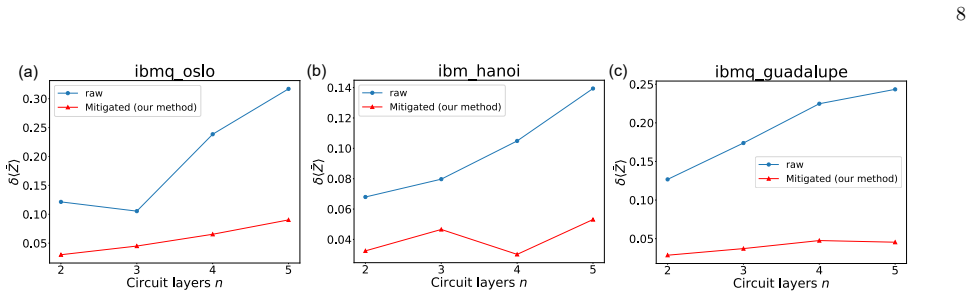
The paper's central claim is that the noisy execution of a parameterized circuit is well approximated by the ideal circuit followed by a noise channel that does not depend on the variational parameters. From this, the paper derives that a calibration matrix, built by running an identity-equivalent circuit with the same architecture on every computational-basis input state, encodes the noise of the whole architecture. The corrected outcome is obtained by applying the inverse of that calibration matrix to the noisy output, and the paper argues this recovers the noiseless result for any parameter setting of that architecture. The demonstration simulates nonunitary dynamics of a non-Hermitian Ising chain using a layered circuit of single-qubit rotations and CNOT gates, and the mitigated magnetization curves closely track exact predictions across different circuit depths and hardware noise levels.
Load-bearing premise
The method rests on the assumption that the noise affecting a circuit depends only on its gate layout, not on the parameter values, so the noise channel measured on an identity-equivalent circuit matches the noise in the target circuit.
Editorial extensions
If this is right
- A single calibration matrix, built once from an identity-equivalent circuit, can be reused for all parameter settings of the same architecture, reducing the quantum cost of repeated small-circuit jobs.
- The method suppresses two-qubit gate errors, not just readout errors; in the benchmarks it visibly outperforms readout-only mitigation.
- The improvement persists across circuit depths from two to five layers (and eight layers in noisy simulation) and across multiple processors with different noise levels.
- Because the method works on the Sampler primitive, it fills a gap left by zero-noise extrapolation and probabilistic error cancellation, which target the Estimator primitive.
- In quantum neural network training, where the circuit layout is fixed across optimization iterations, one calibration could serve the entire training loop.
Reading between the lines
- Editorial inference: The method's reliability could be probed by measuring how the calibration matrix changes as parameters traverse the optimization landscape; if it drifts beyond shot noise, adaptive recalibration would be needed.
- Editorial inference: The same identity-circuit calibration idea could be extended to time-varying hardware noise by interleaving calibration circuits with data circuits and interpolating the calibration matrix, though the paper does not demonstrate this.
- Editorial inference: Because building the full calibration matrix requires running an input state for every computational basis state, the approach is naturally limited to small qubit numbers, which matches the paper's stated niche of small circuits executed at high repetition.
- Editorial inference: The parameter-independence assumption is most likely to break under amplitude-dependent errors, leakage, or crosstalk, so stress-testing the method at extreme rotation angles far outside the training range would be a sharp test.
Editorial analysis
A structured set of objections, weighed in public.
Referee Report
Summary. The paper proposes a 'circuit structure-preserving' error-mitigation method for parameterized quantum circuits. The central claim is Eq. (2): for a parameterized circuit V(θ) with fixed architecture, the noisy implementation is approximately N V(θ) with a parameter-independent noise channel N. Under this assumption, the authors build a calibration matrix M_mit from an identity-equivalent circuit V_mit that shares the same architecture, then correct noisy outputs by applying (M_mit)^{-1} (Eq. (6)). The method is demonstrated on classical noisy simulations and on IBM Quantum hardware for variational simulation of a non-Hermitian transverse-field Ising chain, using the average Z magnetization as the observable. The reported mitigated results agree well with exact evolution across a range of CX error rates and circuit depths.
Significance. If the key assumption Eq. (2) holds, the method provides a practical and reusable error-mitigation strategy for small circuits executed many times, complementing existing techniques such as ZNE and PEC. The paper is clearly written and makes an explicit, immediately falsifiable assumption: that noise is parameter-independent for a fixed circuit architecture. It also demonstrates the method in a nontrivial physics setting (non-Hermitian dynamics) and compares against readout-only mitigation. The main strengths are the transparency of the assumption, the simplicity of the correction formula, and the concrete hardware demonstrations. However, the central assumption is not quantitatively validated; the classical benchmarks appear to test only the special case where noise commutes with the circuit layers, and the hardware results lack error bars and a quantitative treatment of calibration-matrix uncertainty. These gaps leave the central claim only partially supported.
major comments (4)
- [§II A, Eq. (2)] The key assumption that V_noisy(θ) ≈ N V(θ) with parameter-independent N is not justified by the pulse-level argument given. For a layered circuit with per-gate noise channels N_k, the effective noise is dressed by later ideal layers: N_k becomes L_m(θ)...L_{k+1}(θ) N_k L_{k+1}^†(θ)...L_m^†(θ), which depends on θ unless every N_k commutes with all later layers. Depolarizing noise satisfies this, but amplitude damping, dephasing, leakage, and coherent CX errors do not. Since the calibration circuit V_mit is identity-optimized and has different parameters, its dressed noise differs from that of V(θ), so (M_mit)^{-1} need not cancel the noise and can amplify it. The paper should either prove a commutativity condition for the relevant error channels or provide a quantitative test that isolates non-commuting noise.
- [§III B, Fig. 3 and Fig. S3] The classical benchmarks vary CX error rates but do not specify the noise model or include tests designed to violate Eq. (2). If the default Qiskit depolarizing error model is used, these experiments live entirely in the commuting case where Eq. (2) holds by construction, so they constitute a consistency check rather than an independent validation of the parameter-independence assumption. The authors should report the exact noise model used and add benchmarks with non-depolarizing channels (e.g., amplitude damping, coherent Z errors, or leakage) to demonstrate that the method is robust beyond the commuting case.
- [§III C, Eqs. (4)–(6)] The uncertainty in the calibration matrix M_mit is not quantified. The matrix is estimated from a finite number of shots, so its elements have sampling errors that propagate through the inversion in Eq. (6). The hardware plots (Figs. 4 and 5) show no error bars, making it impossible to assess whether the observed agreement with exact results is statistically significant or consistent with large fluctuations. The authors should report the number of shots used for calibration, the condition number of M_mit, and error bars on the mitigated observables.
- [§III C, paragraph on hardware fluctuations] The paper acknowledges that 'fluctuations in noise levels remain unavoidable' and that mitigation is effective only 'as long as noise fluctuations are not excessively large,' but it does not provide a quantitative criterion for this condition. Since the method reuses a single calibration matrix across all parameter settings, the validity of Eq. (2) also depends on temporal noise stability. The authors should measure or bound the drift of the noise channel over the calibration-to-execution timescale, or report the time window in which calibration and simulation were executed.
minor comments (5)
- [§III C, 'mthreepackage'] There is a typo: 'mthreepackage' should read 'mthree package' and the capitalization 'Ibmq oslo' should be 'ibmq Oslo'.
- [§III A, Eq. (12)] The definition of T in Eq. (12) is slightly confusing: the text says T=11 total time steps and δt=2, which gives t up to 20; this should be stated more clearly to avoid the impression that T is the total evolution time.
- [§III C, '2^{4+1}'] The text '2^{4+1} variational identity circuits' is an awkward way to say 2^5; since there are five qubits, the calibration basis has 32 states. Consider simplifying the notation.
- [Appendix B, Fig. S2 caption] The caption of Fig. S2 writes 'e^{-tH}' while the main text uses e^{-itH}; please correct the sign notation for consistency.
- [§IV, Conclusion] The claim that the method 'significantly reduces both computational and quantum resource demands' relative to ZNE is plausible but not quantitatively supported; a cost comparison with ZNE for the same circuits would strengthen the statement.
Circularity Check
No circularity: the central correction is an independent measurement on an identity-equivalent circuit, and the key Eq. (2) is an explicitly stated assumption rather than a derived equivalence.
full rationale
The paper's derivation chain is self-contained in the sense required by this check. The load-bearing relation V_noisy(θ)≈N V(θ), Eq. (2), is introduced explicitly as a 'key assumption' with a physical justification based on pulse amplitude and duration, not derived from the mitigation data. The calibration matrix M_mit is measured on a separately constructed identity-equivalent circuit (Eqs. (3)-(5)), and the corrected output in Eq. (6) is obtained by ordinary matrix inversion; no target observable is used to fit or define M_mit. The classical simulator benchmark may rely on a Qiskit noise model that satisfies Eq. (2) by construction, which weakens its value as independent validation of that assumption, but this is a validation limitation rather than a circular reduction of the claimed method. The IBM Quantum experiments provide external, non-fitted evidence. Self-citations, such as Ref. [45] for the ancilla-based nonunitary embedding and Ref. [81] for the variational treatment of non-Hermitian dynamics, are contextual and not load-bearing for the error-mitigation claim. No uniqueness theorem is imported from the authors' prior work, and no fitted parameter is renamed as a prediction. Therefore no specific circular step can be exhibited.
Assumptions & free parameters
assumptions (4)
- domain assumption Noisy and noiseless output probability distributions are related by a single linear transformation M (Eq. 1).
- domain assumption The noise channel N is independent of the circuit parameters theta (Eq. 2).
- domain assumption The calibration matrix M_mit is invertible and its inverse is stable under sampling noise.
- domain assumption Device noise is temporally stable during the calibration and simulation window.
Cite this review
Pith. "Pith review of Circuit structure-preserving error mitigation for High-Fidelity Quantum Simulations." pith.science (2026). https://pith.science/paper/773TMAG4
@misc{pith2026250517187,
  author       = {Pith},
  title        = {Pith review of: Circuit structure-preserving error mitigation for High-Fidelity Quantum Simulations},
  year         = {2026},
  howpublished = {\url{https://pith.science/paper/773TMAG4}},
  note         = {Machine review of arXiv:2505.17187}
}
read the original abstract
Developing methods to accurately characterize and mitigate the impact of noise is crucial for enhancing the fidelity of quantum simulations on Noisy Intermediate-Scale Quantum (NISQ) devices. In this work, we present a circuit structure-preserving error mitigation framework for parameterized quantum circuits. A key advantage of our approach lies in its ability to retain the original circuit architecture while effectively characterizing and mitigating gate errors, enabling robust and high-fidelity simulations. This makes it particularly well suited for small-scale circuits that require repeated execution at large sampling rates. To demonstrate the effectiveness of our method, we perform variational quantum simulations of a non-Hermitian ferromagnetic transverse-field Ising chain on IBM Quantum processors. The mitigated result shows excellent agreement with exact theoretical predictions across a range of noise levels. Our strategy offers a practical solution for addressing gate-induced errors and significantly broadens the scope of feasible quantum simulations on current quantum hardware.
Figures


Figures from the paper (2 more)

Forward citations
Cited by 2 Pith papers
-
Resolving topological order crossovers on NISQ hardware
On IBM quantum hardware, Wen–plaquette topological crossover signatures remain measurable under disorder, amplified circuit noise, and non-Hermitian quenches — with local stabilizers far more robust than the nonlocal ...
-
Benchmarking Quantum Solvers in Noisy Digital Simulations for Financial Portfolio Optimization
On small synthetic portfolio problems, noiseless QAOA fits the known ground-state energy well, but noisy QAOA fails while QITE, pretrained on noiseless simulators, still identifies the optimal portfolio on IBM hardware.
Reference graph
Works this paper leans on
-
[1]
Steane, Quantum computing, Reports on Progress in Physics61, 117 (1998)
A. Steane, Quantum computing, Reports on Progress in Physics61, 117 (1998)
1998
-
[2]
Knill, Quantum computing, Nature463, 441 (2010)
E. Knill, Quantum computing, Nature463, 441 (2010)
2010
-
[3]
Preskill, Quantum computing in the nisq era and be- yond, Quantum2, 79 (2018)
J. Preskill, Quantum computing in the nisq era and be- yond, Quantum2, 79 (2018)
2018
-
[4]
National Academies of Sciences, Medicine, et al., Quantum computing: progress and prospects, (2019)
E. National Academies of Sciences, Medicine, et al., Quantum computing: progress and prospects, (2019)
2019
-
[5]
Randall, C
J. Randall, C. Bradley, F. van der Gronden, A. Galicia, M. Abobeih, M. Markham, D. Twitchen, F. Machado, N. Yao, and T. Taminiau, Many-body–localized discrete time crystal with a programmable spin-based quantum simulator, Science374, 1474 (2021)
2021
-
[6]
T. Chen, R. Shen, C. H. Lee, B. Yang, and R. W. Bomantara, A robust large-period discrete time crystal and its signature in a digital quantum computer, arXiv preprint arXiv:2309.11560 (2023)
arXiv 2023
-
[7]
Zhou, S.-T
L. Zhou, S.-T. Wang, S. Choi, H. Pichler, and M. D. Lukin, Quantum approximate optimization algorithm: Performance, mechanism, and implementation on near- term devices, Physical Review X10, 021067 (2020)
2020
-
[8]
M. P. Harrigan, K. J. Sung, M. Neeley, K. J. Satzinger, F. Arute, K. Arya, J. Atalaya, J. C. Bardin, R. Barends, S. Boixo, et al., Quantum approximate optimization of non-planar graph problems on a planar superconducting processor, Nature Physics17, 332 (2021)
2021
Show all 104 references
-
[9]
Montanaro and L
A. Montanaro and L. Zhou, Quantum speedups in solv- ing near-symmetric optimization problems by low-depth qaoa, arXiv preprint arXiv:2411.04979 (2024)
2024 arXiv
-
[10]
J. M. Koh, T. Tai, and C. H. Lee, Realization of higher- order topological lattices on a quantum computer, Na- ture Communications15, 5807 (2024)
2024
-
[11]
Chen, H.-T
T. Chen, H.-T. Ding, R. Shen, S.-L. Zhu, and J. Gong, Direct probe of topology and geometry of quantum states on the ibm q quantum processor, Physical Re- view B110, 205402 (2024)
2024
-
[12]
J. M. Koh, T. Tai, and C. H. Lee, Simulation of interaction-induced chiral topological dynamics on a digital quantum computer, Physical Review Letters 129, 140502 (2022)
2022
-
[13]
J. M. Koh, T. Tai, Y. H. Phee, W. E. Ng, and C. H. Lee, Stabilizing multiple topological fermions on a quantum computer, npj Quantum Information8, 16 (2022)
2022
-
[14]
Ippoliti, K
M. Ippoliti, K. Kechedzhi, R. Moessner, S. Sondhi, and V. Khemani, Many-body physics in the nisq era: quan- tum programming a discrete time crystal, PRX Quan- tum2, 030346 (2021)
2021
-
[15]
H. Xu, J. Zhang, J. Han, Z. Li, G. Xue, W. Liu, Y. Jin, and H. Yu, Realizing discrete time crystal in an one-dimensional superconducting qubit chain, arXiv preprint arXiv:2108.00942 (2021)
2021 arXiv
-
[16]
G. K. Brennen and A. Miyake, Measurement-based quantum computer in the gapped ground state of a two- body hamiltonian, Physical review letters101, 010502 (2008)
2008
-
[17]
Poulin and P
D. Poulin and P. Wocjan, Preparing ground states of quantum many-body systems on a quantum computer, Physical review letters102, 130503 (2009)
2009
-
[18]
Wecker, M
D. Wecker, M. B. Hastings, N. Wiebe, B. K. Clark, C. Nayak, and M. Troyer, Solving strongly correlated electron models on a quantum computer, Physical Re- view A92, 062318 (2015)
2015
-
[19]
Nam, J.-S
Y. Nam, J.-S. Chen, N. C. Pisenti, K. Wright, C. De- laney, D. Maslov, K. R. Brown, S. Allen, J. M. Amini, J. Apisdorf, et al., Ground-state energy estimation of the water molecule on a trapped-ion quantum computer, npj Quantum Information6, 33 (2020)
2020
-
[20]
ibmq Oslo
Here, our error-mitigated simulations exhibit consis- tently low deviation across all tested CX gate error rates and circuit layers. In contrast, the unmitigated results show a clear increase in deviation as the circuit depth grows. The result above highlights the effectivenes...
-
[21]
Stanisic, J
S. Stanisic, J. L. Bosse, F. M. Gambetta, R. A. Santos, W. Mruczkiewicz, T. E. O’Brien, E. Ostby, and A. Mon- tanaro, Observing ground-state properties of the fermi- hubbard model using a scalable algorithm on a quantum computer, Nature Communications13, 5743 (2022)
2022
-
[22]
R. Shen, T. Chen, B. Yang, Y. Zhong, and C. H. Lee, Robust simulations of many-body symmetry-protected topological phase transitions on a quantum processor, 9 arXiv preprint arXiv:2503.08776 (2025)
2025 arXiv
-
[23]
Sciorilli, L
M. Sciorilli, L. Borges, T. L. Patti, D. Garc ´ ıa-Mart ´ ın, G. Camilo, A. Anandkumar, and L. Aolita, Towards large-scale quantum optimization solvers with few qubits, Nature Communications16, 476 (2025)
2025
-
[24]
Kirmani, K
A. Kirmani, K. Bull, C.-Y. Hou, V. Saravanan, S. M. Saeed, Z. Papi´ c, A. Rahmani, and P. Ghaemi, Probing geometric excitations of fractional quantum hall states on quantum computers, Physical Review Letters129, 056801 (2022)
2022
-
[25]
Agresti, K
I. Agresti, K. Paul, P. Schiansky, S. Steiner, Z. Yin, C. Pentangelo, S. Piacentini, A. Crespi, Y. Ban, F. Cec- carelli, et al., Demonstration of hardware efficient pho- tonic variational quantum algorithm, arXiv preprint arXiv:2408.10339 (2024)
2024
-
[26]
Y. Wang, Y. Ding, F. A. C´ ardenas-L´ opez, and X. Chen, Pulse-based variational quantum optimization and met- alearning in superconducting circuits, Physical Review Applied22, 024009 (2024)
2024
-
[27]
J. M. Koh, W.-T. Xue, T. Tai, D. E. Koh, and C. H. Lee, Interacting non-hermitian edge and cluster bursts on a digital quantum processor, arXiv preprint arXiv:2503.14595 (2025)
2025 arXiv
-
[28]
R. M. Gingrich and C. P. Williams, Non-unitary prob- abilistic quantum computing, (2004)
2004
-
[29]
C. P. Williams, Probabilistic nonunitary quantum com- puting, in Quantum Information and Computation II, Vol. 5436 (SPIE, 2004) pp. 297–306
2004
-
[30]
Z. Hu, R. Xia, and S. Kais, A quantum algorithm for evolving open quantum dynamics on quantum comput- ing devices, Scientific reports10, 3301 (2020)
2020
-
[31]
Head-Marsden, S
K. Head-Marsden, S. Krastanov, D. A. Mazziotti, and P. Narang, Capturing non-markovian dynamics on near- term quantum computers, Physical Review Research3, 013182 (2021)
2021
-
[32]
Z. Cai, R. Babbush, S. C. Benjamin, S. Endo, W. J. Huggins, Y. Li, J. R. McClean, and T. E. O’Brien, Quantum error mitigation, Rev. Mod. Phys.95, 045005 (2023)
2023
-
[33]
Giurgica-Tiron, Y
T. Giurgica-Tiron, Y. Hindy, R. LaRose, A. Mari, and W. J. Zeng, Digital zero noise extrapolation for quantum error mitigation, in 2020 IEEE International Conference on Quantum Computing and Engineering (QCE) (IEEE, 2020) pp. 306–316
2020
-
[34]
V. R. Pascuzzi, A. He, C. W. Bauer, W. A. De Jong, and B. Nachman, Computationally efficient zero-noise extrapolation for quantum-gate-error mitigation, Phys- ical Review A105, 042406 (2022)
2022
-
[35]
A. He, B. Nachman, W. A. de Jong, and C. W. Bauer, Zero-noise extrapolation for quantum-gate error miti- gation with identity insertions, Physical Review A102, 012426 (2020)
2020
-
[36]
A. Mari, N. Shammah, and W. J. Zeng, Extending quantum probabilistic error cancellation by noise scal- ing, Physical Review A104, 052607 (2021)
2021
-
[37]
Van Den Berg, Z
E. Van Den Berg, Z. K. Minev, A. Kandala, and K. Temme, Probabilistic error cancellation with sparse pauli–lindblad models on noisy quantum processors, Na- ture physics19, 1116 (2023)
2023
-
[38]
R. S. Gupta, E. Van Den Berg, M. Takita, D. Riste, K. Temme, and A. Kandala, Probabilistic error cancel- lation for dynamic quantum circuits, Physical Review A109, 062617 (2024)
2024
-
[39]
Camilo, T
G. Camilo, T. O. Maciel, A. Tosta, A. Alhajri, T. d. L. Silva, D. S. Fran¸ ca, and L. Aolita, Compilation- informed probabilistic quantum error cancellation, arXiv preprint arXiv:2508.20174 (2025)
2025
-
[40]
G. J. Mooney, G. A. White, C. D. Hill, and L. C. Hol- lenberg, Whole-device entanglement in a 65-qubit su- perconducting quantum computer, Advanced Quantum Technologies4, 2100061 (2021)
2021
-
[41]
P. D. Nation, H. Kang, N. Sundaresan, and J. M. Gam- betta, Scalable mitigation of measurement errors on quantum computers, PRX Quantum2, 040326 (2021)
2021
-
[42]
D. Zhu, N. M. Linke, M. Benedetti, K. A. Lands- man, N. H. Nguyen, C. H. Alderete, A. Perdomo-Ortiz, N. Korda, A. Garfoot, C. Brecque, et al., Training of quantum circuits on a hybrid quantum computer, Sci- ence advances5, eaaw9918 (2019)
2019
-
[43]
G. A. Quantum, Collaborators*†, F. Arute, K. Arya, R. Babbush, D. Bacon, J. C. Bardin, R. Barends, S. Boixo, M. Broughton, B. B. Buckley, et al., Hartree- fock on a superconducting qubit quantum computer, Science369, 1084 (2020)
2020
-
[44]
Cerezo, A
M. Cerezo, A. Arrasmith, R. Babbush, S. C. Benjamin, S. Endo, K. Fujii, J. R. McClean, K. Mitarai, X. Yuan, L. Cincio, et al., Variational quantum algorithms, Na- ture Reviews Physics3, 625 (2021)
2021
-
[45]
Ostaszewski, E
M. Ostaszewski, E. Grant, and M. Benedetti, Structure optimization for parameterized quantum circuits, Quan- tum5, 391 (2021)
2021
-
[46]
T. Chen, R. Shen, C. H. Lee, and B. Yang, High-fidelity realization of the aklt state on a nisq-era quantum pro- cessor, SciPost Physics15, 170 (2023)
2023
-
[47]
J. M. Koh, T. Tai, and C. H. Lee, Observation of higher- order topological states on a quantum computer, arXiv preprint arXiv:2303.02179 (2023)
2023 arXiv
-
[48]
Shen and C
R. Shen and C. H. Lee, Non-hermitian skin clusters from strong interactions, Communications Physics5, 1 (2022)
2022
-
[49]
F. Qin, Y. Ma, R. Shen, and C. H. Lee, Universal com- petitive spectral scaling from the critical non-hermitian skin effect, arXiv preprint arXiv:2212.13536 (2022)
2022 arXiv
-
[50]
C. Liu, P. Zhang, and X. Chen, Non-unitary dynamics of sachdev-ye-kitaev chain, SciPost Physics10, 048 (2021)
2021
-
[51]
M. Yang, L. Yuan, and C. H. Lee, Non-hermitian ultra-strong bosonic condensation through interaction- induced caging, arXiv preprint arXiv:2410.01258 (2024)
2024 arXiv
-
[52]
F. Qin, R. Shen, L. Li, and C. H. Lee, Kinked linear response from non-hermitian cold-atom pumping, Phys- ical Review A109, 053311 (2024)
2024
-
[53]
Zhang, C
P. Zhang, C. Liu, S.-K. Jian, and X. Chen, Universal en- tanglement transitions of free fermions with long-range non-unitary dynamics, Quantum6, 723 (2022)
2022
-
[54]
Kawabata, K
K. Kawabata, K. Shiozaki, and S. Ryu, Many-body topology of non-hermitian systems, Physical Review B 105, 165137 (2022)
2022
-
[55]
Jiang and C
H. Jiang and C. H. Lee, Dimensional transmutation from non-hermiticity, arXiv preprint arXiv:2207.08843 (2022)
2022 arXiv
-
[56]
Yoshida and Y
T. Yoshida and Y. Hatsugai, Fate of exceptional points under interactions: Reduction of topological classifica- tions, Physical Review B107, 075118 (2023)
2023
-
[57]
A. N. Poddubny, Interaction-induced analog of a non- hermitian skin effect in a lattice two-body problem, Physical Review B107, 045131 (2023). 10
2023
-
[58]
R. Shen, W. J. Chan, and C. H. Lee, Non-hermitian skin effect along hyperbolic geodesics, Physical Review B111, 045420 (2025)
2025
-
[59]
Fu and Y
Y. Fu and Y. Zhang, Anatomy of open-boundary bulk in multiband non-hermitian systems, Physical Review B107, 115412 (2023)
2023
-
[60]
Q. Li, H. Jiang, and C. H. Lee, Phase-space gener- alized brillouin zone for spatially inhomogeneous non- hermitian systems, arXiv preprint arXiv:2501.09785 (2025)
2025 arXiv
-
[61]
R. Shen, T. Chen, F. Qin, Y. Zhong, and C. H. Lee, Proposal for observing yang-lee criticality in rydberg atomic arrays, arXiv preprint arXiv:2302.06662 (2023)
2023 arXiv
-
[62]
C. H. Lee, Z. Papi´ c, and R. Thomale, Geometric con- struction of quantum hall clustering hamiltonians, Phys. Rev. X5, 041003 (2015)
2015
-
[63]
C. H. Lee, W. W. Ho, B. Yang, J. Gong, and Z. Papi´ c, Floquet mechanism for non-abelian fractional quantum hall states, Phys. Rev. Lett.121, 237401 (2018)
2018
-
[64]
Y. Qin, C. H. Lee, and L. Li, Dynamical suppression of many-body non-hermitian skin effect in anyonic sys- tems, Communications Physics8, 18 (2025)
2025
-
[65]
Lapierre, P
B. Lapierre, P. Pelliconi, S. Ryu, and J. Sonner, Driven non-unitary dynamics of quantum critical sys- tems, arXiv preprint arXiv:2505.01508 (2025)
2025
-
[66]
Schuld, I
M. Schuld, I. Sinayskiy, and F. Petruccione, The quest for a quantum neural network, Quantum Information Processing13, 2567 (2014)
2014
-
[67]
Jeswal and S
S. Jeswal and S. Chakraverty, Recent developments and applications in quantum neural network: A review, Archives of Computational Methods in Engineering26, 793 (2019)
2019
-
[68]
Altaisky, Quantum neural network, arXiv preprint quant-ph/0107012 (2001)
M. Altaisky, Quantum neural network, arXiv preprint quant-ph/0107012 (2001)
2001 arXiv
-
[69]
Ricks and D
B. Ricks and D. Ventura, Training a quantum neural network, Advances in neural information processing sys- tems16(2003)
2003
-
[70]
Rodriguez-Vega, E
M. Rodriguez-Vega, E. Carlander, A. Bahri, Z.-X. Lin, N. A. Sinitsyn, and G. A. Fiete, Real-time simulation of light-driven spin chains on quantum computers, Physi- cal Review Research4, 013196 (2022)
2022
-
[71]
Robertson and S
A. Robertson and S. Song, Mitigating cou- pling map constrained correlated mea- surement errors on quantum devices, Proceedings of the International Conference for High Performance Computing, Networking, Storage and Analysis, , 1 (2023)
2023
-
[72]
Qiskit contributors, Qiskit: An open-source framework for quantum computing (2023)
2023
-
[73]
Z.-C. Yang, A. Rahmani, A. Shabani, H. Neven, and C. Chamon, Optimizing variational quantum algorithms using pontryagin’s minimum principle, Physical Review X7, 021027 (2017)
2017
-
[74]
van Straaten and B
B. van Straaten and B. Koczor, Measurement cost of metric-aware variational quantum algorithms, PRX Quantum2, 030324 (2021)
2021
-
[75]
Y. Zhou, H. He, F. Pang, H. Lyu, Y. Zhang, and X. Chen, Variational quantum compiling for three- qubit-gate design in quantum dots, Phys. Rev. A111, 042616 (2025)
2025
-
[76]
Y. Ji, X. Chen, I. Polian, and Y. Ban, Algorithm- oriented qubit mapping for variational quantum algo- rithms, Physical Review Applied23, 034022 (2025)
2025
-
[77]
Bittel and M
L. Bittel and M. Kliesch, Training variational quantum algorithms is np-hard, Physical Review Letters127, 120502 (2021)
2021
-
[78]
S. Wang, E. Fontana, M. Cerezo, K. Sharma, A. Sone, L. Cincio, and P. J. Coles, Noise-induced barren plateaus in variational quantum algorithms, Nature communications12, 1 (2021)
2021
-
[79]
A. J. Ferreira-Martins, R. Farias, G. Camilo, T. O. Maciel, A. Tosta, R. Lin, A. Alhajri, T. Haug, and L. Aolita, Variational quantum algorithms with ex- act geodesic transport, arXiv preprint arXiv:2506.17395 (2025)
2025
-
[80]
Y. Du, Z. Tu, X. Yuan, and D. Tao, Efficient measure for the expressivity of variational quantum algorithms, Physical Review Letters128, 080506 (2022)
2022
-
[81]
C. Zhu, R. H. Byrd, P. Lu, and J. Nocedal, Algo- rithm 778: L-bfgs-b: Fortran subroutines for large-scale bound-constrained optimization, ACM Transactions on mathematical software (TOMS)23, 550 (1997)
1997
-
[82]
R. Shen, T. Chen, B. Yang, and C. H. Lee, Observa- tion of the non-hermitian skin effect and fermi skin on a digital quantum computer, Nature Communications 16, 1340 (2025)
2025
-
[83]
S.-N. Sun, M. Motta, R. N. Tazhigulov, A. T. Tan, G. K.-L. Chan, and A. J. Minnich, Quantum compu- tation of finite-temperature static and dynamical prop- erties of spin systems using quantum imaginary time evolution, PRX Quantum2, 010317 (2021)
2021
-
[84]
Kamakari, S.-N
H. Kamakari, S.-N. Sun, M. Motta, and A. J. Minnich, Digital quantum simulation of open quantum systems using quantum imaginary–time evolution, PRX Quan- tum3, 010320 (2022)
2022
-
[85]
McArdle, T
S. McArdle, T. Jones, S. Endo, Y. Li, S. C. Benjamin, and X. Yuan, Variational ansatz-based quantum simu- lation of imaginary time evolution, npj Quantum Infor- mation5, 75 (2019)
2019
-
[86]
Motta, C
M. Motta, C. Sun, A. T. Tan, M. J. O’Rourke, E. Ye, A. J. Minnich, F. G. Brand˜ ao, and G. K.-L. Chan, De- termining eigenstates and thermal states on a quantum computer using quantum imaginary time evolution, Na- ture Physics16, 205 (2020)
2020
-
[87]
Shibata and H
N. Shibata and H. Katsura, Dissipative quantum ising chain as a non-hermitian ashkin-teller model, Physical Review B99, 224432 (2019)
2019
-
[88]
R. Shen, F. Qin, J.-Y. Desaules, Z. Papi´ c, and C. H. Lee, Enhanced many-body quantum scars from the non- hermitian fock skin effect, Physical Review Letters133, 216601 (2024)
2024
-
[89]
Xue and C
W.-T. Xue and C. H. Lee, Topologically protected neg- ative entanglement, arXiv preprint arXiv:2403.03259 (2024)
2024
-
[90]
B. Yang, R. Raymond, and S. Uno, Efficient quantum readout-error mitigation for sparse measurement out- comes of near-term quantum devices, Physical Review A106, 012423 (2022)
2022
-
[91]
Nachman, M
B. Nachman, M. Urbanek, W. A. de Jong, and C. W. Bauer, Unfolding quantum computer readout noise, npj Quantum Information6, 84 (2020)
2020
-
[92]
Y.-J. Liu, K. Shtengel, A. Smith, and F. Pollmann, Methods for simulating string-net states and anyons on a digital quantum computer, PRX Quantum3, 040315 (2022)
2022
-
[93]
Xu, Z.-Z
S. Xu, Z.-Z. Sun, K. Wang, H. Li, Z. Zhu, H. Dong, J. Deng, X. Zhang, J. Chen, Y. Wu, et al., Non-abelian braiding of fibonacci anyons with a superconducting processor, Nature Physics20, 1469 (2024). 11
2024
-
[94]
Xu, Z.-Z
S. Xu, Z.-Z. Sun, K. Wang, L. Xiang, Z. Bao, Z. Zhu, F. Shen, Z. Song, P. Zhang, W. Ren, et al., Digital sim- ulation of projective non-abelian anyons with 68 super- conducting qubits, Chinese Physics Letters40, 060301 (2023)
2023
-
[95]
B. P. Lanyon, J. D. Whitfield, G. G. Gillett, M. E. Goggin, M. P. Almeida, I. Kassal, J. D. Biamonte, M. Mohseni, B. J. Powell, M. Barbieri, et al., Towards quantum chemistry on a quantum computer, Nature chemistry2, 106 (2010)
2010
-
[96]
Wecker, B
D. Wecker, B. Bauer, B. K. Clark, M. B. Hastings, and M. Troyer, Gate-count estimates for performing quan- tum chemistry on small quantum computers, Physical Review A90, 022305 (2014)
2014
-
[97]
Kassal, J
I. Kassal, J. D. Whitfield, A. Perdomo-Ortiz, M.-H. Yung, and A. Aspuru-Guzik, Simulating chemistry us- ing quantum computers, Annual review of physical chemistry62, 185 (2011)
2011
-
[98]
T. E. O’Brien, B. Senjean, R. Sagastizabal, X. Bonet- Monroig, A. Dutkiewicz, F. Buda, L. DiCarlo, and L. Visscher, Calculating energy derivatives for quantum chemistry on a quantum computer, npj Quantum Infor- mation5, 113 (2019)
2019
-
[99]
Gaita-Ari˜ no, F
A. Gaita-Ari˜ no, F. Luis, S. Hill, and E. Coronado, Molecular spins for quantum computation, Nature chemistry11, 301 (2019)
2019
-
[100]
H. Ma, M. Govoni, and G. Galli, Quantum simula- tions of materials on near-term quantum computers, npj Computational Materials6, 85 (2020)
2020
-
[101]
Bauer, S
B. Bauer, S. Bravyi, M. Motta, and G. K.-L. Chan, Quantum algorithms for quantum chemistry and quan- tum materials science, Chemical Reviews120, 12685 (2020)
2020
-
[102]
N. P. de Leon, K. M. Itoh, D. Kim, K. K. Mehta, T. E. Northup, H. Paik, B. Palmer, N. Samarth, S. Sangtawesin, and D. W. Steuerman, Materials chal- lenges and opportunities for quantum computing hard- ware, Science372, eabb2823 (2021)
2021
-
[103]
ibmq Hanoi
S.-H. Lin, R. Dilip, A. G. Green, A. Smith, and F. Poll- mann, Real-and imaginary-time evolution with com- pressed quantum circuits, PRX Quantum2, 010342 (2021). S12 FIG. S1. Quantum circuit implementation of nonunitary dynamics.U(t) corresponds to the unitary embedding define...
2021
-
[104]
These simulations on a local simulator are presented in FIG. S6. Under increasing noise levels, raw noisy simulations (red bars) does display the robust GHZ signature: probability weight leaks into incorrect bitstrings, and the two dominant peaks are progressively suppressed. ...
Reviewed August 7, 2026 · model on record in the stance chip above.
Discussion (0). Continue with ORCID to comment.