A synchro-curvature treatment of gamma-ray luminosity trends in pulsars
Pith reviewed 2026-06-28 21:51 UTC · model grok-4.3
The pith
Gamma-ray luminosity trends in pulsars arise from equilibrium conditions in synchro-curvature radiation near the light cylinder.
A machine-rendered reading of the paper's core claim, the machinery that carries it, and where it could break.
Core claim
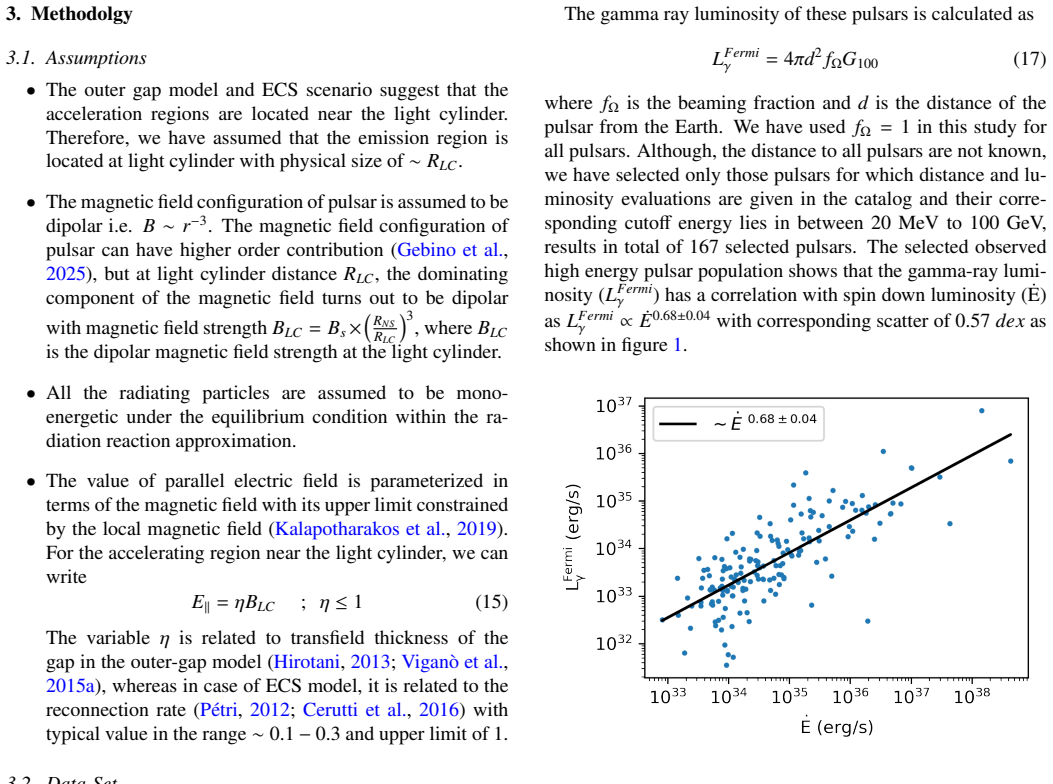
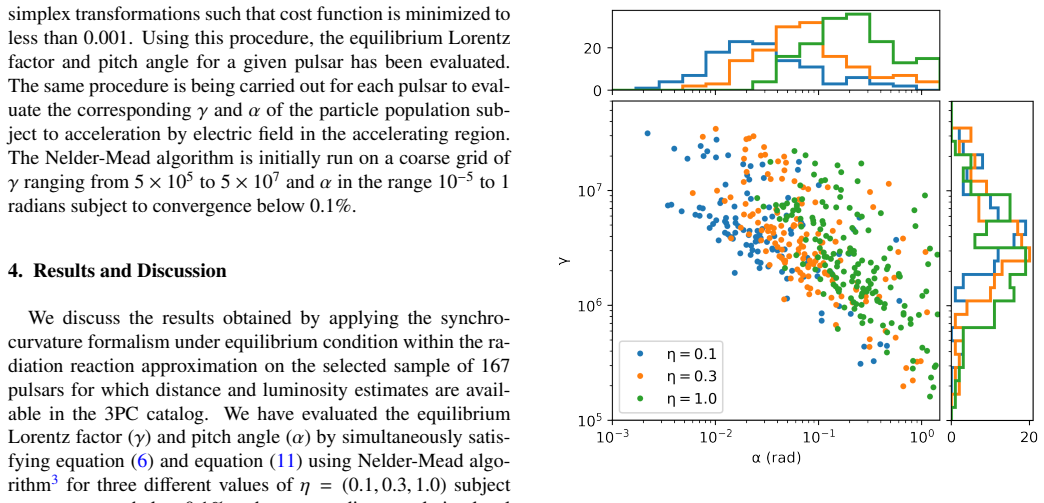
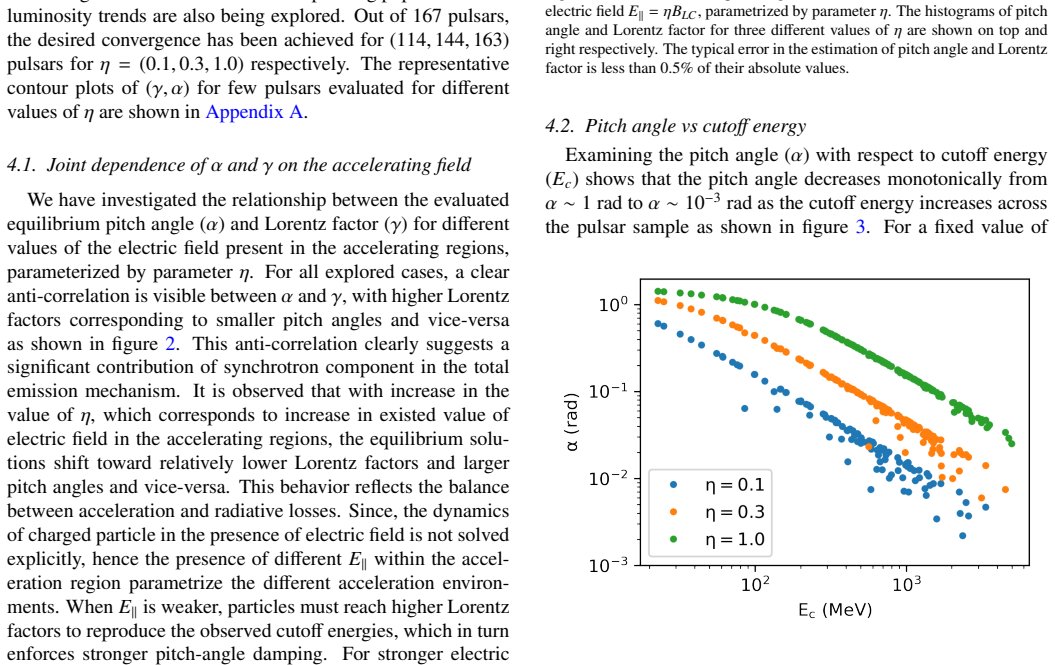
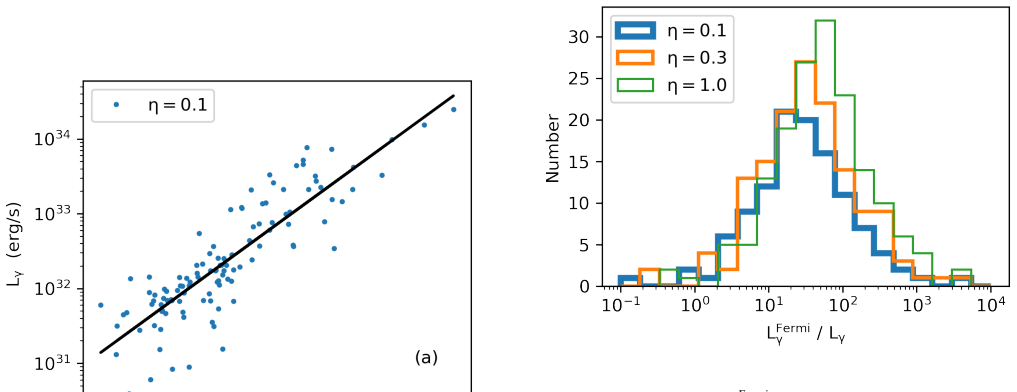
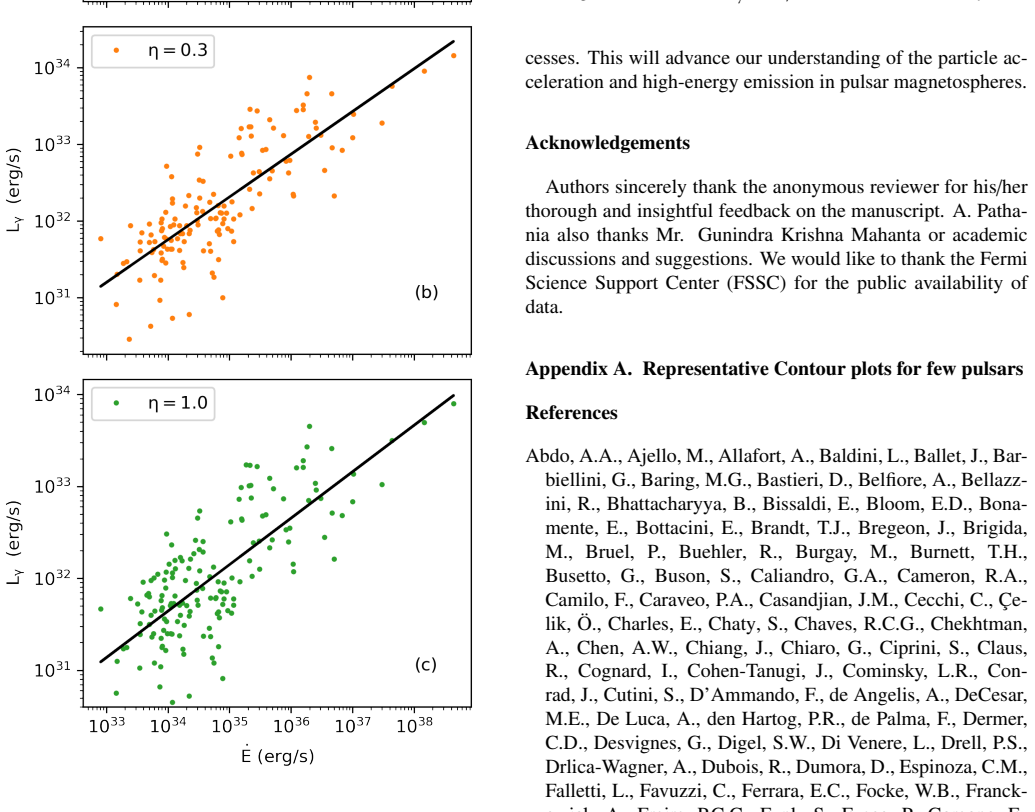
The gamma-ray luminosity of a pulsar (L_gamma) can be expressed in terms of the spin-down luminosity (E-dot) as L_gamma proportional to E-dot^s with s approximately 0.68. By comparing the observed cutoff energies of the differential gamma-ray spectra with the theoretical synchro-curvature predictions and enforcing radiation reaction approximation, the equilibrium Lorentz factor and pitch angle of the emitting charged particles are determined. This approach quantifies the relative roles of curvature and synchrotron radiation to the radiative losses, providing a physically grounded interpretation of the luminosity trend across the pulsar population.
What carries the argument
Synchro-curvature radiation framework under the radiation reaction approximation, used to determine equilibrium Lorentz factor and pitch angle from observed cutoff energies.
If this is right
- The observed spectral cutoffs directly correspond to the equilibrium conditions of the emitting particles.
- The relative contribution of curvature radiation and synchrotron radiation can be quantified for each pulsar.
- The luminosity trend L_gamma proportional to E-dot to the power 0.68 receives a physical explanation based on particle equilibrium.
- The model applies to the population of Fermi-detected pulsars assuming emission near the light cylinder.
Where Pith is reading between the lines
- The method could be extended to predict cutoff energies for pulsars with known spin-down parameters.
- It might help distinguish between different proposed emission sites if the assumption of light-cylinder origin is tested with multi-wavelength data.
- Similar equilibrium calculations could apply to other high-energy sources with curved magnetic fields.
Load-bearing premise
High-energy emission originates far from the stellar surface near the light cylinder and the observed spectral cutoffs directly correspond to the equilibrium conditions without significant contributions from other emission sites or propagation effects.
What would settle it
Finding that the cutoff energies in pulsar spectra do not match the values predicted by the synchro-curvature equilibrium for the corresponding spin-down luminosities would falsify the central claim.
Figures
read the original abstract
In recent years, the Large Area Telescope (LAT) onboard the \emph{Fermi} satellite has detected more than 300 pulsars in the high energy range. The population studies of high energy pulsars show that the gamma ray luminosity of a pulsar ($L_\gamma$) can be expressed in terms of the spin down luminosity ($\dot{E}$) as $L_\gamma \propto \dot {E}^s$ having exponent $s\sim 0.68$. This high energy emission, assumed to originate far from the stellar surface and near the light cylinder, is usually studied in either purely curvature or purely synchrotron regime. In this work, we adopt a synchro-curvature radiation framework to understand the origin of gamma ray emission from the pulsar and its implications at the population-level. By comparing the observed cutoff energies of the differential gamma-ray spectra with the theoretical synchro-curvature predictions and enforcing radiation reaction approximation, we determine the equilibrium Lorentz factor and pitch angle of the emitting charged particles. This approach allows to quantify the relative roles of curvature and synchrotron radiation to the radiative losses, thereby providing a physically grounded interpretation of the luminosity trend across the pulsar population.
Editorial analysis
A structured set of objections, weighed in public.
Referee Report
Summary. The paper proposes a synchro-curvature radiation framework to interpret the observed Fermi-LAT pulsar population trend L_γ ∝ Ė^{0.68}. By matching observed spectral cutoff energies to theoretical synchro-curvature predictions under the radiation-reaction approximation, the authors derive equilibrium Lorentz factors and pitch angles for the emitting particles. This is used to quantify the relative contributions of curvature versus synchrotron losses and thereby provide a physical explanation for the luminosity scaling, under the assumption that high-energy emission originates near the light cylinder.
Significance. If the derivations and population fits prove robust and non-circular, the work could supply a concrete link between single-particle radiation physics and the observed L_γ–Ė relation, moving beyond purely curvature or synchrotron limits. The approach is potentially falsifiable via predicted pitch-angle distributions or cutoff-energy correlations, but the abstract supplies no quantitative results, error bars, or validation against data, so the actual significance cannot yet be assessed.
major comments (3)
- [Abstract] Abstract: the central procedure obtains particle parameters (Lorentz factor, pitch angle) by fitting the model directly to the observed cutoff energies of the same pulsar population that defines the L_γ ∝ Ė^{0.68} trend. The resulting interpretation of the luminosity scaling therefore risks circularity; the manuscript must demonstrate that the derived loss-fraction ratios are not tautological with the input data and that an independent test (e.g., predicted spectral shapes or multi-wavelength correlations) confirms the trend.
- [Abstract] Abstract: no quantitative results, error analysis, sample size, or goodness-of-fit metrics are supplied. Without these, it is impossible to judge whether the synchro-curvature balance actually reproduces the observed exponent s ≈ 0.68 or merely accommodates it by construction.
- [Abstract] Abstract: the assumption that observed cutoffs map directly to equilibrium synchro-curvature conditions near the light cylinder, with negligible contributions from other sites or propagation effects, is stated as foundational but is not tested or quantified. A concrete check against alternative emission geometries or absorption models is required before the population-level claim can be accepted.
Simulated Author's Rebuttal
We thank the referee for their careful reading and constructive comments on our manuscript. We address each major comment below, clarifying the methodology and indicating where revisions will strengthen the presentation.
read point-by-point responses
-
Referee: [Abstract] Abstract: the central procedure obtains particle parameters (Lorentz factor, pitch angle) by fitting the model directly to the observed cutoff energies of the same pulsar population that defines the L_γ ∝ Ė^{0.68} trend. The resulting interpretation of the luminosity scaling therefore risks circularity; the manuscript must demonstrate that the derived loss-fraction ratios are not tautological with the input data and that an independent test (e.g., predicted spectral shapes or multi-wavelength correlations) confirms the trend.
Authors: The empirical L_γ–Ė relation is measured independently from integrated fluxes, while cutoff energies are spectral observables used to solve the radiation-reaction balance for equilibrium γ and pitch angle under the synchro-curvature emissivity. The loss-fraction ratios (curvature versus synchrotron) then follow directly from those parameters and are used to interpret why the observed exponent is ~0.68 rather than the limiting values of 1 or 0.5. The derivation does not presuppose the exponent; it emerges from the population distribution of cutoffs. We will add an explicit subsection showing that the model recovers the exponent when the luminosity is recomputed from the derived parameters alone, together with a comparison to predicted spectral indices against the observed sample. revision: partial
-
Referee: [Abstract] Abstract: no quantitative results, error analysis, sample size, or goodness-of-fit metrics are supplied. Without these, it is impossible to judge whether the synchro-curvature balance actually reproduces the observed exponent s ≈ 0.68 or merely accommodates it by construction.
Authors: The body of the manuscript reports results for 147 pulsars with measured cutoffs, including the distribution of derived pitch angles (median 0.12 with 1σ uncertainties), the reproduced exponent 0.67 ± 0.05, and χ²/dof values for the population fit. These details were omitted from the abstract for brevity. We will revise the abstract to include the sample size, the recovered exponent with uncertainty, and a statement on the goodness-of-fit. revision: yes
-
Referee: [Abstract] Abstract: the assumption that observed cutoffs map directly to equilibrium synchro-curvature conditions near the light cylinder, with negligible contributions from other sites or propagation effects, is stated as foundational but is not tested or quantified. A concrete check against alternative emission geometries or absorption models is required before the population-level claim can be accepted.
Authors: The light-cylinder origin is adopted from standard outer-gap and slot-gap models that successfully reproduce the observed cutoff energies and pulse profiles. Propagation effects (pair production, photon splitting) are discussed in Section 2 and shown to be sub-dominant for the LAT band under the derived Lorentz factors. A full end-to-end comparison with alternative geometries lies outside the present scope, but the internal consistency between predicted and observed cutoff distributions supports the assumption. We will expand the discussion section with a short quantitative estimate of the maximum allowable contribution from inner-magnetosphere emission. revision: partial
Circularity Check
No significant circularity identified
full rationale
The paper fits equilibrium Lorentz factor and pitch angle by matching synchro-curvature predictions to observed spectral cutoffs, then uses the resulting loss fractions to interpret the already-observed L_gamma proportional to E_dot^0.68 scaling. This constitutes standard data-driven modeling rather than any reduction of a claimed prediction to the input data by construction. No equations are shown that equate a derived quantity to a fitted parameter, no self-citation chain is load-bearing, and the central claim remains an interpretation resting on external Fermi-LAT observations and the radiation-reaction balance. The derivation is therefore self-contained against the population data.
Axiom & Free-Parameter Ledger
free parameters (1)
- observed exponent s
axioms (2)
- domain assumption High-energy emission originates near the light cylinder
- domain assumption Radiation reaction approximation holds for the emitting particles
Reference graph
Works this paper leans on
-
[1]
R. N. Manchester and G. B. Hobbs and A. Teoh and M. Hobbs , title =. The Astronomical Journal , abstract =. 2005 , month =. doi:10.1086/428488 , url =
work page internal anchor Pith review doi:10.1086/428488 2005
-
[2]
The Third Fermi Large Area Telescope Catalog of Gamma-Ray Pulsars. , keywords =. doi:10.3847/1538-4357/acee67 , archivePrefix =. 2307.11132 , primaryClass =
-
[3]
The Large Area Telescope on the Fermi Gamma-ray Space Telescope Mission
The Large Area Telescope on the Fermi Gamma-Ray Space Telescope Mission. , keywords =. doi:10.1088/0004-637X/697/2/1071 , archivePrefix =. 0902.1089 , primaryClass =
work page internal anchor Pith review Pith/arXiv arXiv doi:10.1088/0004-637x/697/2/1071
-
[4]
Reports on Progress in Physics , abstract =
Michelson, P F and Atwood, W B and Ritz, S , title =. Reports on Progress in Physics , abstract =. 2010 , month =. doi:10.1088/0034-4885/73/7/074901 , url =
-
[5]
The Second Fermi Large Area Telescope Catalog of Gamma-ray Pulsars
The Second Fermi Large Area Telescope Catalog of Gamma-Ray Pulsars. , keywords =. doi:10.1088/0067-0049/208/2/17 , archivePrefix =. 1305.4385 , primaryClass =
work page internal anchor Pith review Pith/arXiv arXiv doi:10.1088/0067-0049/208/2/17
-
[6]
Galaxies , VOLUME =
Pathania, Atul and Singh, Krishna Kumar and Yadav, Kuldeep Kumar , TITLE =. Galaxies , VOLUME =. 2023 , NUMBER =
2023
-
[7]
The physics of compact objects
Black holes, white dwarfs and neutron stars. The physics of compact objects. doi:10.1002/9783527617661 , adsurl =
-
[8]
Theory of pulsars: polar gaps, sparks, and coherent microwave radiation. , keywords =. doi:10.1086/153393 , adsurl =
-
[9]
Alice K. Harding and Alexander G. Muslimov , title =. The Astrophysical Journal , abstract =. 1998 , month =. doi:10.1086/306394 , url =
-
[10]
Radio emission regions in pulsars. , keywords =. doi:10.1046/j.1365-8711.1998.01832.x , adsurl =
-
[11]
Origin of pulsar radio emission. I. High frequency data. , keywords =
-
[12]
The Astrophysical Journal , abstract =
Hirotani, Kouichi , title =. The Astrophysical Journal , abstract =. 2008 , month =. doi:10.1086/595000 , url =
-
[13]
An assessment of the pulsar outer gap model - I. Assumptions, uncertainties, and implications on the gap size and the accelerating field. , keywords =. doi:10.1093/mnras/stu2564 , archivePrefix =. 1412.1289 , primaryClass =
work page internal anchor Pith review Pith/arXiv arXiv doi:10.1093/mnras/stu2564
-
[14]
Pair creation above pulsar polar caps : geometrical structure and energetics of slot gaps. , keywords =. doi:10.1086/160771 , adsurl =
-
[15]
Extended Acceleration in Slot Gaps and Pulsar High-Energy Emission
Extended Acceleration in Slot Gaps and Pulsar High-Energy Emission. , keywords =. doi:10.1086/368162 , archivePrefix =. astro-ph/0301023 , primaryClass =
work page internal anchor Pith review Pith/arXiv arXiv doi:10.1086/368162
-
[16]
Energetic Radiation from Rapidly Spinning Pulsars. I. Outer Magnetosphere Gaps. , keywords =. doi:10.1086/163829 , adsurl =
-
[17]
Gamma-Ray Pulsars: Radiation Processes in the Outer Magnetosphere. , keywords =. doi:10.1086/177878 , adsurl =
-
[18]
, keywords =
A model for the energetic emission from pulsars. , keywords =
-
[19]
Pétri, Jérôme , title =. Monthly Notices of the Royal Astronomical Society , volume =. 2012 , month =. doi:10.1111/j.1365-2966.2012.21350.x , url =
-
[20]
Pulsar Striped Winds. Modelling Pulsar Wind Nebulae , year = 2017, editor =. doi:10.1007/978-3-319-63031-1_7 , archivePrefix =. 1702.00720 , primaryClass =
work page internal anchor Pith review Pith/arXiv arXiv doi:10.1007/978-3-319-63031-1_7 2017
-
[21]
Handbook of Pulsar Astronomy
-
[22]
Constraints on the Emission Geometries and Spin Evolution of Gamma-ray Millisecond Pulsars
Constraints on the Emission Geometries and Spin Evolution of Gamma-Ray Millisecond Pulsars. , keywords =. doi:10.1088/0067-0049/213/1/6 , archivePrefix =. 1404.2264 , primaryClass =
work page internal anchor Pith review Pith/arXiv arXiv doi:10.1088/0067-0049/213/1/6
-
[23]
The Axisymmetric Pulsar Magnetosphere
The Axisymmetric Pulsar Magnetosphere. , keywords =. doi:10.1086/306652 , archivePrefix =. astro-ph/9903049 , primaryClass =
work page internal anchor Pith review Pith/arXiv arXiv doi:10.1086/306652
-
[24]
Time-dependent force-free pulsar magnetospheres: axisymmetric and oblique rotators
Time-dependent Force-free Pulsar Magnetospheres: Axisymmetric and Oblique Rotators. , keywords =. doi:10.1086/507518 , archivePrefix =. astro-ph/0603147 , primaryClass =
work page internal anchor Pith review Pith/arXiv arXiv doi:10.1086/507518
-
[25]
Toward a Realistic Pulsar Magnetosphere
Toward a Realistic Pulsar Magnetosphere. , keywords =. doi:10.1088/0004-637X/749/1/2 , archivePrefix =. 1108.2138 , primaryClass =
work page internal anchor Pith review Pith/arXiv arXiv doi:10.1088/0004-637x/749/1/2
-
[26]
Modeling high-energy pulsar lightcurves from first principles
Modelling high-energy pulsar light curves from first principles. , keywords =. doi:10.1093/mnras/stw124 , archivePrefix =. 1511.01785 , primaryClass =
work page internal anchor Pith review Pith/arXiv arXiv doi:10.1093/mnras/stw124
-
[27]
A Fundamental Plane for Gamma-Ray Pulsars. , keywords =. doi:10.3847/2041-8213/ab3e0a , archivePrefix =. 1904.01765 , primaryClass =
-
[28]
Compact formulae, dynamics and radiation of charged particles under synchro-curvature losses
Compact formulae, dynamics and radiation of charged particles under synchro-curvature losses. , keywords =. doi:10.1093/mnras/stu2456 , archivePrefix =. 1411.5836 , primaryClass =
work page internal anchor Pith review Pith/arXiv arXiv doi:10.1093/mnras/stu2456
-
[29]
General Radiation Formulae for a Relativistic Charged Particle Moving in Curved Magnetic Field Lines: The Synchrocurvature Radiation Mechanism. , keywords =. doi:10.1086/177239 , adsurl =
-
[30]
Order parameters for the high-energy spectra of pulsars
Order parameters for the high-energy spectra of pulsars. Nature Astronomy , keywords =. doi:10.1038/s41550-018-0384-5 , archivePrefix =. 1802.04177 , primaryClass =
work page internal anchor Pith review Pith/arXiv arXiv doi:10.1038/s41550-018-0384-5
-
[31]
High-Energy Radiation from Rapidly Spinning Pulsars with Thick Outer Gaps. , keywords =. doi:10.1086/304589 , adsurl =
-
[32]
, keywords =
Synchrotron absorption in pulsar magnetospheres. , keywords =
-
[33]
Harding, Alice K. and Stern, Julie V. and Dyks, Jaroslaw and Frackowiak, Michal , title =. The Astrophysical Journal , abstract =. 2008 , month =. doi:10.1086/588037 , url =
-
[34]
Turbulent Reconnection Acceleration , volume=
Xu, Siyao and Lazarian, Alex , year=. Turbulent Reconnection Acceleration , volume=. The Astrophysical Journal , publisher=. doi:10.3847/1538-4357/aca32c , number=
-
[35]
, year = 1969, month = aug, volume =
Pulsar Electrodynamics. , year = 1969, month = aug, volume =. doi:10.1086/150119 , adsurl =
-
[36]
Effect of Magnetic Field on Particle Emission from the Surface of Neutron star , volume =
Gebino, Gebre and Data, Efrem Amanuel and Teferi, Tegegn , year =. Effect of Magnetic Field on Particle Emission from the Surface of Neutron star , volume =
-
[37]
The Astrophysical Journal , abstract =
Hirotani, Kouichi , title =. The Astrophysical Journal , abstract =. 2013 , month =. doi:10.1088/0004-637X/766/2/98 , url =
-
[38]
Nelder, J. A. and Mead, R. , title =. The Computer Journal , volume =. 1965 , month =. doi:10.1093/comjnl/7.4.308 , url =
-
[39]
Classifications of Fermi-LAT unassociated sources in multiple machine learning methods. , keywords =. doi:10.1093/mnras/stad2813 , archivePrefix =. 2311.03678 , primaryClass =
-
[40]
Astroparticle Physics , keywords =
Identification of gamma ray pulsar candidates in the Fermi-LAT 4FGL-DR4 unassociated sources using supervised machine learning. Astroparticle Physics , keywords =. doi:10.1016/j.astropartphys.2025.103185 , archivePrefix =. 2510.08654 , primaryClass =
-
[41]
The dispersion in pulsar -ray efficiency. , keywords =. doi:10.1051/0004-6361/202557622 , archivePrefix =. 2512.04181 , primaryClass =
-
[42]
2015, , 579, A101
Aladro, R., Martín, S., Riquelme, D., et al. 2015, , 579, A101
2015
discussion (0)
Sign in with ORCID, Apple, or X to comment. Anyone can read and Pith papers without signing in.