REVIEW 4 major objections 6 minor 2 cited by
Semantic Steganography: A Framework for Robust and High-Capacity Information Hiding using Large Language Models
T0 review · 4 major / 6 minor · reviewed 2026-08-11 · deepseek-v4-flash
Pith's one-line read The paper claims that secret messages can be embedded in the entities an LLM is prompted to mention, so the stego text is statistically identical to ordinary LLM output and survives paraphrasing and token noise.
desk verdict A concrete semantic-steganography pipeline with a real robustness result, but the indistinguishability claim is contradicted by its own perplexity numbers. read the letter →
The pith
A machine-rendered reading of the paper's core claim, the machinery that carries it, and where it could break.
The reading
What carries the argument
The load-bearing object is the ontology-entity tree: a hand-built hierarchy of basic concepts (person, location, time), fine-grained subconcepts, and a leaf layer of specific entities. Sampling descends the tree with arithmetic coding over the empirical semantic distribution, so the interval of probabilities that lands on a type carries the secret bits; the tree's path labels also serve as disambiguation cues for the generating and extracting agents. The second mechanism is feedback Chain-of-Thought rejection sampling, which iteratively regenerates sentences until a check agent certifies that the entity set is exactly the sampled one.
What would settle it
A direct test: run the framework's embedding on ChatGLM, then measure the KL divergence between the empirical distribution of entity types in the generated stegos and the distribution predicted from the corpus; if it is notably different from zero, the stegos are statistically distinguishable from covers. A second, sharper test: take paraphrased stegos that the paper reports as failures and check whether the failed decodes are exactly those where the extraction agent recovered a different entity set, which would locate the failure in extraction rather than in encoding.
Extended reading notes
Core claim
The central claim is that a covert channel can be built over the semantic content of LLM-generated text rather than its tokens. Concretely, the paper constructs an ontology-entity tree whose leaf nodes are entities like 'Las Vegas' and whose paths disambiguate meaning ('Location/Tourism Location/Washington'), estimates the empirical distribution of sentence 'types' (a multiset of entities) from a large conversation corpus, and uses arithmetic coding to map a uniformly random bit stream to a type sampled from that distribution. A generation agent with a check-agent feedback loop then produces a sentence that contains exactly the sampled entities and no others, so the bits are recoverable by a separate extraction agent. Because the ordinary LLM sampling strategy is not altered, the authors argue the Kullback-Leibler divergence between covers and stegos is zero, giving the same information-theoretic security as symbolic methods.
Load-bearing premise
The framework's security and decodeability rest on the assumption that the entity-type distribution estimated from the LCCC conversation corpus with the UIE extractor is the same distribution that ChatGLM-generated cover sentences actually follow, and that the extraction agent reliably recovers exactly the intended entities from clean and corrupted stegos.
Editorial extensions
If this is right
- Steganography over LLM APIs becomes practical in black-box settings because only prompts are used, no internal token probabilities are needed.
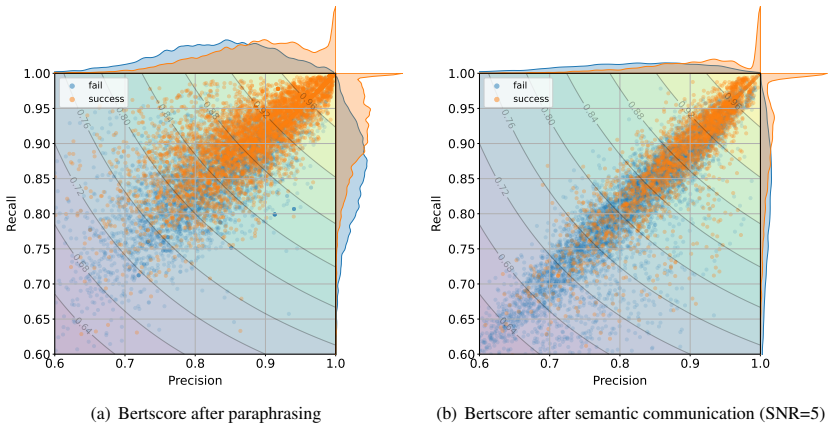
- Text that survives paraphrasing and semantic communication channels at realistic noise levels can still carry the intended message, so the covert channel persists in social-media-like pipelines.
- Because embedding rate tracks the entropy of the semantic distribution rather than token entropy, larger entity trees and richer corpora translate directly into more bits per sentence.
- Stegos generated this way have lower perplexity and higher diversity than token-level steganography on the same models, because the check agent filters awkward regenerations.
- The KL-divergence argument means a statistical warden who compares stego and cover distributions at the token level should not be able to distinguish them, matching the security guarantee of METEOR and DISCOP.
Reading between the lines
- A warden who knows the entity tree could test entity-type frequencies against the empirical distribution, since the hidden bits force entities to appear with exactly those frequencies; this detection angle is not explored in the paper.
- The framework's dependence on a fixed entity vocabulary means it inherits bias from the UIE extractor and the LCCC corpus; deploying on a different domain would require rebuilding the tree and re-estimating frequencies, offering a testable extension.
- The 'DKL = 0' claim implicitly assumes the check agent's rejection loop does not bias the accepted output distribution; a refined analysis would condition on the acceptance probability and measure the divergence empirically.
- The authors note the channel closes when the prompt leaves no semantic freedom (e.g., '1+1='); under such fixed-answer conditions the embedding rate falls to zero, which is consistent with the method's dependence on semantic redundancy.
Signed reviews
Editorial analysis
A structured set of objections, weighed in public.
Referee Report
Summary. The paper proposes a semantic steganography framework in which secret bits are mapped, via arithmetic coding over an ontology-entity tree, onto entity-type classes drawn from an empirical semantic distribution. An LLM generation agent is prompted to produce text containing the sampled entities, a check agent rejects or regenerates outputs that fail the required type, and an extraction agent recovers the entity type at decoding time. The authors claim that the method achieves semantic indistinguishability (DKL = 0), higher embedding capacity than token-level steganography baselines, and robustness against both token-level corruption and semantic-preserving attacks such as paraphrasing and semantic communication.
Significance. If the indistinguishability claim were valid, the framework would be a meaningful step toward high-capacity covert communication over LLM-generated text, because it moves embedding from the token level to the semantic level and explicitly targets robustness in noisy channels. The paper's practical contributions include a concrete entity-tree construction pipeline, a feedback-based rejection-sampling mechanism, and a broad set of robustness experiments covering insert/delete/replace/swap attacks, paraphrasing, and semantic communication. These are useful and worth documenting. However, the central security claim is not established: the DKL = 0 argument in Sec. 2.2 is invalid, the paper's own Table 1 shows a large distribution shift between covers and stegos, and no warden or statistical-indistinguishability experiment is provided. The robustness results are also partially circular because decoding uses the same extractor and ontology tree as encoding. The contribution is therefore better characterized as a practical robust semantic embedding scheme than as a secure steganographic system, and the current claims outrun the evidence.
major comments (4)
- [Sec. 2.2 and Table 1] The claim that DKL(p(cover)||p(stego)) = 0 because 'our method does not alter the sampling strategy of LLM' is not supported. In Secs. 2.3 and 2.4, the generation agent is conditioned on a sampled entity type, and the check agent rejects or regenerates outputs until they satisfy that type, including prohibiting extra entities. The effective output distribution is therefore p(stego) = p(accepted | type) * p(type), not the unconditional cover distribution p(cover). Table 1 confirms a substantial shift: Ours has PPL 869.79 versus 2027.34 for RS covers, and GPT-4 rationality score 7.3624 versus 5.6419. The paper's own explanation attributes this to the check-and-regenerate loop. Since no warden experiment, no DKL estimate, and no comparison of entity-type frequencies between covers and stegos are provided, the central indistinguishability claim is contradicted by the paper's own measurements.
- [Sec. 2.2, Algorithm 1] The empirical semantic distribution p(C(T)) is estimated from LCCC using the UIE extractor, but the cover texts in the experiments are generated by ChatGLM2-6B and ChatGLM2-6B-int4. The manuscript provides no validation that the entity-type distribution of ChatGLM-generated covers matches the LCCC-derived p(C(T)). If this distribution is mismatched, the arithmetic-coding intervals no longer correspond to actual cover frequencies, which breaks both the security argument and the reliability of decoding. The authors should report corpus statistics (number of types, type coverage, smoothing), extraction accuracy on LCCC, and a direct comparison between p(C(T)) and the empirical type distribution of generated covers.
- [Sec. 2.4 and Table 3] The robustness results are partly circular because decoding relies on the same UIE-based extraction agent and the same ontology-entity tree used during encoding. High decoding success under token corruption may reflect the extractor's tendency to output the intended entities even from garbled text, rather than a property of the semantic channel itself. The paper does not report extraction precision/recall on clean or attacked stegos, nor does it compare against an independent extractor or human annotation. Without this, it is unclear whether the reported success rates in Table 3 measure preservation of the embedded semantic signal or artifacts of the decoding pipeline.
- [Sec. 3.1, Tables 1 and 2] The embedding-rate comparison is not apples-to-apples. For Ours, the reported bits are derived from arithmetic coding over entity-type intervals in the semantic tree, whereas AC, METEOR, and DISCOP embed bits at the token level. The manuscript does not specify the message-length distribution, the exact bit-counting convention, or the failure criterion used for each method. Table 2 also reports 'bit/tok' for RS covers without any embedding mechanism. To substantiate the higher-capacity claim, the authors should state precisely how each bit rate is computed, report bit rates conditioned on successful decoding, and use a common message-generation protocol across all methods.
minor comments (6)
- [Sec. 4] The sentence 'Experiments showe that our framework are robust' contains a typo: 'showe' should be 'show', and 'framework are' should be 'framework is'.
- [Sec. 2.1, Eq. (4)] The notation in Eq. (4) uses M without defining it; the entity index should be |E| for consistency with the definition of E and T.
- [Sec. 2.2, Algorithm 1] The pseudocode line 'Assign probabilities to entities' is not specified in the algorithm; the paper should state how p(C(T)) is computed from the LCCC counts, including any smoothing or pruning of rare types.
- [Fig. 2] The label 'Influent?' in the Check Agent box is unclear; it appears to be a typo and should be replaced with a meaningful criterion such as 'Influent?' or 'Fluent?'.
- [References] The references for RNN-Stega (Yang et al., 2019a and 2019b) and VAE-Stega (Yang et al., 2021a and 2021b) are duplicated; the duplicate entries should be removed.
- [Sec. 3.1] Tables 1 and 2 report no variance or number of samples; the authors should add standard deviations or confidence intervals so that the differences between methods can be evaluated statistically.
Circularity Check
Security claim reduces to an assertion that the method does not alter sampling, despite its own rejection-sampling loop; capacity and robustness results are not circular.
-
self definitional
[Section 2.2 ('Sample from the Semantic Distribution'), paragraph 2]
"To ensure the KL divergence is 0, secure sampling methods are often designed. As our method does not alter the sampling strategy of LLM, the stegos remain the same as the covers. Although there is no difference between stegos and covers from a symbolic perspective, there is still a sampling issue from a semantic perspective."
The security claim DKL(p(cover)||p(stego))=0 is made to follow from the assertion that 'our method does not alter the sampling strategy of LLM.' But Algorithms 1-2 sample a type from the empirical LCCC distribution p(C(T)) via arithmetic coding, and Sections 2.3-2.4 prompt the Generation Agent for that type and run a Check Agent that rejects outputs containing unsampled entities. The effective stego distribution is therefore p(stego)=p(accepted|type).p(type), a rejection-filtered conditional distribution, not the LLM's unconditional cover distribution. Equating the two is the very claim being proved, restated as an assumption; no DKL estimate, warden test, or type-frequency comparison is supplied.
full rationale
The paper's encoding/decoding machinery is largely self-consistent rather than circular: sender and receiver share the same hand-built ontology-entity tree and the same empirical distribution p(C(T)), and decoding inverts the same arithmetic-coding intervals the encoder used. That shared context is normal for steganography and does not by itself constitute circularity. The robustness and capacity experiments are also external measurements and retain independent content. The central circularity is in Section 2.2: the security claim DKL(p(cover)||p(stego))=0 is justified by 'our method does not alter the sampling strategy of LLM,' but the method's own type-sampling and rejection loop define a new conditional distribution. The conclusion is therefore the premise restated under a different name. The paper's Table 1 quantifies the resulting distribution shift, contradicting the asserted equality. The self-citation to Zhang et al. 2021 is not load-bearing: it is cited as prior work using classifiers and is explicitly rejected in favor of the entity-tree construction. Overall, the indistinguishability claim—one of the paper's three headline advantages—reduces to an unverified assumption, so the score is 6: partial circularity in a central claim, while other contributions remain independently testable.
Assumptions & free parameters
free parameters (3)
- Empirical semantic distribution p(C(T)) =
Not stated in the paper; a high-dimensional histogram over entity types from LCCC.
- Number of entities in the ontology-entity tree =
Not reported.
- Feedback CoT acceptance criteria and loop cap =
Not specified numerically.
assumptions (5)
- standard math Arithmetic coding with a uniform bitstream preserves the target distribution and yields decodable prefixes.
- domain assumption The entity extraction method (UIE model and LLM extraction agent) correctly identifies all occurrences of all entities in any sentence, including noisy or machine-translated text.
- domain assumption The empirical semantic distribution p(C(T)) estimated from LCCC matches the semantic distribution of cover text produced by the LLM generation agent under the prompt regime.
- ad hoc to paper Conditioning the generation agent on a sampled type and applying check-agent rejection sampling leaves the output distribution identical to the unconditional cover distribution.
- standard math PRF-based cipher bit randomization makes the effective bitstream uniform.
invented entities (1)
-
Ontology-entity tree with semantic classes over entity types
Cite this review
Pith. "Pith review of Semantic Steganography: A Framework for Robust and High-Capacity Information Hiding using Large Language Models." pith.science (2026). https://pith.science/paper/77OQOBSJ
@misc{pith2026241211043,
  author       = {Pith},
  title        = {Pith review of: Semantic Steganography: A Framework for Robust and High-Capacity Information Hiding using Large Language Models},
  year         = {2026},
  howpublished = {\url{https://pith.science/paper/77OQOBSJ}},
  note         = {Machine review of arXiv:2412.11043}
}
read the original abstract
In the era of Large Language Models (LLMs), generative linguistic steganography has become a prevalent technique for hiding information within model-generated texts. However, traditional steganography methods struggle to effectively align steganographic texts with original model-generated texts due to the lower entropy of the predicted probability distribution of LLMs. This results in a decrease in embedding capacity and poses challenges for decoding stegos in real-world communication channels. To address these challenges, we propose a semantic steganography framework based on LLMs, which construct a semantic space and map secret messages onto this space using ontology-entity trees. This framework offers robustness and reliability for transmission in complex channels, as well as resistance to text rendering and word blocking. Additionally, the stegos generated by our framework are indistinguishable from the covers and achieve a higher embedding capacity compared to state-of-the-art steganography methods, while producing higher quality stegos.
Figures


Forward citations
Cited by 2 Pith papers
-
Relatively-Secure LLM-Based Steganography via Constrained Markov Decision Processes
The optimal modification of a two-state LLM-like token distribution for maximum steganographic capacity under a divergence budget is a deterministic, piecewise water-filling policy.
-
Robust Model Reconstruction Based on the Topological Understanding of Point Clouds Using Persistent Homology
The abstract promises persistent homology based separation and reconstruction of multiple closed surfaces in noisy point clouds, but the manuscript body contains a different paper, so the result is unverifiable.
Reference graph
Works this paper leans on
-
[1]
Christian Cachin. 1998. An information-theoretic model for steganography. In Information Hiding, pages 306--318, Berlin, Heidelberg. Springer Berlin Heidelberg
work page 1998
-
[2]
Towards Near-imperceptible Steganographic Text
Falcon Z. Dai and Zheng Cai. 2019. http://arxiv.org/abs/1907.06679 Towards near-imperceptible steganographic text
work page Pith review arXiv 2019
-
[3]
Zico Kolter, Jakob Foerster, and Martin Strohmeier
Christian Schroeder de Witt, Samuel Sokota, J. Zico Kolter, Jakob Foerster, and Martin Strohmeier. 2023. http://arxiv.org/abs/2210.14889 Perfectly secure steganography using minimum entropy coupling
arXiv 2023
-
[4]
Jacob Devlin, Ming-Wei Chang, Kenton Lee, and Kristina Toutanova. 2019. http://arxiv.org/abs/1810.04805 Bert: Pre-training of deep bidirectional transformers for language understanding
arXiv 2019
-
[5]
Jinyang Ding, Kejiang Chen, Yaofei Wang, Na Zhao, Weiming Zhang, and Nenghai Yu. 2023. https://doi.org/10.1109/SP46215.2023.10179287 Discop: Provably secure steganography in practice based on "distribution copies" . In 2023 IEEE Symposium on Security and Privacy (SP), pages 2238--2255
arXiv 2023
-
[6]
Zhengxiao Du, Yujie Qian, Xiao Liu, Ming Ding, Jiezhong Qiu, Zhilin Yang, and Jie Tang. 2022. Glm: General language model pretraining with autoregressive blank infilling. In Proceedings of the 60th Annual Meeting of the Association for Computational Linguistics (Volume 1: Long Papers), pages 320--335
2022
-
[7]
Jois, Matthew Green, and Aviel D
Gabriel Kaptchuk, Tushar M. Jois, Matthew Green, and Aviel D. Rubin. 2021. https://doi.org/10.1145/3460120.3484550 Meteor: Cryptographically secure steganography for realistic distributions . In Proceedings of the 2021 ACM SIGSAC Conference on Computer and Communications Security, CCS '21, page 1529–1548, New York, NY, USA. Association for Computing Machinery
arXiv 2021
-
[8]
PaddleNLP. 2021. Paddlenlp: An easy-to-use and high performance nlp library. https://github.com/PaddlePaddle/PaddleNLP
work page 2021
Show all 23 references
-
[9]
Zhijin Qin, Huiqiang Xie, and Xiaoming Tao. 2023. https://doi.org/10.1109/ICC45041.2023.10279664 Mem-deepsc: A semantic communication system with memory . In ICC 2023 - IEEE International Conference on Communications, pages 3854--3859
2023
-
[10]
Alec Radford, Jeffrey Wu, Rewon Child, David Luan, Dario Amodei, and Ilya Sutskever. 2019. Language models are unsupervised multitask learners
2019
-
[11]
Jiaming Shen, Heng Ji, and Jiawei Han. 2020. Near-imperceptible neural linguistic steganography via self-adjusting arithmetic coding
2020
-
[12]
Hugo Touvron, Louis Martin, Kevin Stone, Peter Albert, Amjad Almahairi, Yasmine Babaei, Nikolay Bashlykov, Soumya Batra, Prajjwal Bhargava, Shruti Bhosale, Dan Bikel, Lukas Blecher, Cristian Canton Ferrer, Moya Chen, Guillem Cucurull, David Esiobu, Jude Fernandes, Jeremy Fu, W...
2023 arXiv
-
[13]
Xilong Wang, Yaofei Wang, Kejiang Chen, Jinyang Ding, Weiming Zhang, and Nenghai Yu. 2023. https://doi.org/10.1109/ICASSP49357.2023.10095722 Icstega: Image captioning-based semantically controllable linguistic steganography . In ICASSP 2023 - 2023 IEEE International Conference...
2023
-
[14]
Yida Wang, Pei Ke, Yinhe Zheng, Kaili Huang, Yong Jiang, Xiaoyan Zhu, and Minlie Huang. 2020. A large-scale chinese short-text conversation dataset. In Natural Language Processing and Chinese Computing, pages 91--103, Cham. Springer International Publishing
2020
-
[15]
Huiqiang Xie, Zhijin Qin, Geoffrey Ye Li, and Biing-Hwang Juang. 2021. https://doi.org/10.1109/TSP.2021.3071210 Deep learning enabled semantic communication systems . IEEE Transactions on Signal Processing, 69:2663--2675
2021
-
[16]
Tianyu Yang, Hanzhou Wu, Biao Yi, Guorui Feng, and Xinpeng Zhang. 2024. https://doi.org/10.1109/TDSC.2023.3247493 Semantic-preserving linguistic steganography by pivot translation and semantic-aware bins coding . IEEE Transactions on Dependable and Secure Computing, 21(1):139--152
2024
-
[18]
Zhong-Liang Yang, Xiao-Qing Guo, Zi-Ming Chen, Yong-Feng Huang, and Yu-Jin Zhang. 2019 b . https://doi.org/10.1109/TIFS.2018.2871746 Rnn-stega: Linguistic steganography based on recurrent neural networks . IEEE Transactions on Information Forensics and Security, 14(5):1280--1295
2019
-
[20]
Zhong-Liang Yang, Si-Yu Zhang, Yu-Ting Hu, Zhi-Wen Hu, and Yong-Feng Huang. 2021 b . https://doi.org/10.1109/TIFS.2020.3023279 Vae-stega: Linguistic steganography based on variational auto-encoder . IEEE Transactions on Information Forensics and Security, 16:880--895
2021
-
[21]
Siyu Zhang, Zhongliang Yang, Jinshuai Yang, and Yongfeng Huang. 2021. https://doi.org/10.1109/LSP.2020.3042413 Linguistic steganography: From symbolic space to semantic space . IEEE Signal Processing Letters, 28:11--15
2021
-
[22]
Weinberger, and Yoav Artzi
Tianyi Zhang, Varsha Kishore, Felix Wu, Kilian Q. Weinberger, and Yoav Artzi. 2020. http://arxiv.org/abs/1904.09675 Bertscore: Evaluating text generation with bert
2020 arXiv
-
[23]
Ziegler, Yuntian Deng, and Alexander M
Zachary M. Ziegler, Yuntian Deng, and Alexander M. Rush. 2019. http://arxiv.org/abs/1909.01496 Neural linguistic steganography
2019 arXiv
-
[24]
URL: " 'urlintro :=
ENTRY address author booktitle chapter edition editor howpublished institution journal key month note number organization pages publisher school series title type volume year eprint doi pubmed url lastchecked label extra.label sort.label short.list INTEGERS output.state before...
-
[25]
write newline
" write newline "" before.all 'output.state := FUNCTION n.dashify 't := "" t empty not t #1 #1 substring "-" = t #1 #2 substring "--" = not "--" * t #2 global.max substring 't := t #1 #1 substring "-" = "-" * t #2 global.max substring 't := while if t #1 #1 substring * t #2 gl...
Reviewed August 11, 2026 · model on record in the stance chip above.
Discussion (0). Continue with ORCID to comment.