REVIEW 3 major objections 4 minor 101 references
Multireference Density Matrix Embedding for Spin-Phonon Relaxation
T0 review · 3 major / 4 minor · reviewed 2026-08-01 · deepseek-v4-flash
Pith's one-line read This paper tries to establish that multireference density matrix embedding (CAS-DMET) reproduces conventional CASSCF spin-phonon relaxation rates for magnetic molecules and a molecular crystal using only the first coordination sphere of the
desk verdict A solid, genuinely new method demonstration: CAS-DMET reproduces CASSCF spin-phonon rates within an order of magnitude across five complexes, with a real but addressable gap in derivative step-size validation for the periodic case. read the letter →
The pith
A machine-rendered reading of the paper's core claim, the machinery that carries it, and where it could break.
The reading
What carries the argument
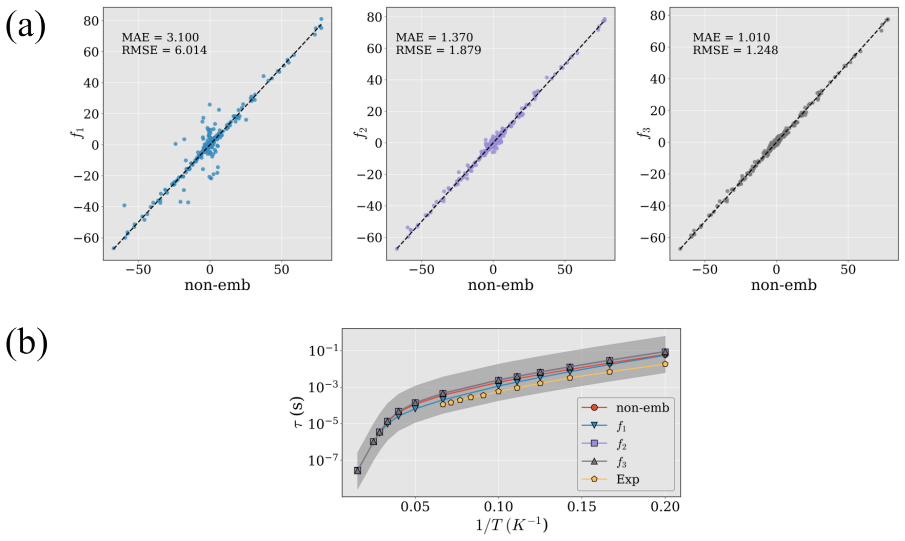
The central object is the CAS-DMET embedding—density matrix embedding theory solved with a CASSCF (complete active space self-consistent field) impurity solver. The full system is Schmidt-decomposed around a chosen fragment, producing a small set of bath orbitals entangled with the fragment, and the resulting impurity Hamiltonian is solved with CASSCF. For all complexes the fragment is defined by coordination shells (f1, f2, f3), and the paper shows the f1 fragment suffices for relaxation rates. The spin-phonon signal itself is carried by derivatives of the crystal-field Hamiltonian H_S = sum_m,l B_l^m O_l^m, where O_l^m are tesseral operators; these derivatives are obtained with finite diff
What would settle it
For any of the five complexes, recompute the f1 crystal-field parameter derivatives at several finite-difference step sizes (e.g., 0.005, 0.01, 0.02, 0.04 Å). If the resulting ∂B_l^m/∂R_i values move by more than the RMSE observed against the non-embedded CASSCF derivatives, or if the relaxation times shift by more than an order of magnitude, the derivative pipeline is not converged. For the crystal, where no non-embedded reference exists, the analogous check is to compare periodic f1 derivatives with f2/f3 periodic derivatives or with a large cluster model.
Extended reading notes
Core claim
The central claim is that the spin-phonon coupling matrix—the derivatives of the crystal-field parameters B_l^m with respect to nuclear displacements—is accurately captured when only the metal ion and its first coordination sphere form the DMET fragment. For the five benchmark systems, the resulting Orbach and Raman relaxation times stay within one order of magnitude of the non-embedded CASSCF reference over the whole temperature range studied, even though the correlated problem shrinks to 26–68% of the full basis. For the molecular crystal, periodic CAS-DMET yields relaxation times that match both the isolated-molecule CASSCF result and experiment, with an impurity of 259 orbitals drawn fro
Load-bearing premise
The whole relaxation signal reduces to numerical derivatives of fitted crystal-field parameters obtained by re-running the DMET embedding at ±0.01/±0.02 Å displaced geometries, and the paper does not test whether that finite-difference derivative is converged or whether the embedding potential remains unbiased under displacement—so a systematic displacement-dependent error in the DMET bath would flow directly into every Orbach and Raman rate without being visible in equilibri
Editorial extensions
If this is right
- Spin-phonon relaxation rates become computable for molecular crystals with multireference accuracy, a regime where conventional periodic CASSCF is impractical.
- For the molecules studied, first-coordination-sphere embedding is a controlled approximation: rates stay within one order of magnitude of full CASSCF while the correlated basis drops to 26–68% of the total.
- Larger fragments systematically improve the agreement, so the embedding offers a tunable accuracy/cost trade-off rather than an all-or-nothing choice.
- The crystal calculation indicates that in this cobalt system the environment beyond the first coordination shell has little influence on relaxation, suggesting spin-phonon relaxation is largely local in such compounds.
- Errors in high-lying Kramers doublets (doubly degenerate spin-orbit levels), which can reach roughly 90 cm^-1 for the smallest fragments, propagate into low-temperature Raman rates, making the whole spin-orbit manifold the quantity to monitor for convergence.
Reading between the lines
- A practical screening pipeline for molecular qubits and magnets could be built on this: computing a candidate's spin-phonon rates inside its real crystalline environment at a small fraction of the cost of full multireference calculations.
- The finite-difference step size and the displacement fidelity of the DMET bath are not tested in the paper; checking convergence with respect to step size, or comparing periodic f1 derivatives with larger fragments, would be the most direct way to harden the protocol.
- The slow KD convergence seen for one dysprosium complex (Complex-V) suggests the 'first shell is enough' rule will not hold universally; systems with significant second-sphere electronic influence will likely need larger fragments.
- Extending the same embedding to higher-level solvers such as NEVPT2 or multiconfiguration pair-density functional theory, which the paper lists as future work, would show whether the derivative quality—and hence rate accuracy—improves beyond CASSCF.
Editorial analysis
A structured set of objections, weighed in public.
Referee Report
Summary. The paper presents an embedded multireference workflow for computing spin–phonon relaxation rates, combining CAS-DMET with state-interaction SO coupling and open quantum system theory. The method is benchmarked on three Co(II) and two Dy(III) single-molecule magnets using fragments of increasing size (f1–f3), and is applied to a Co-based molecular crystal under periodic boundary conditions using only the first coordination shell as the impurity. The central claims are that (i) the smallest fragment f1 reproduces non-embedded CASSCF relaxation times within about an order of magnitude across all molecular complexes, and (ii) periodic CAS-DMET can compute spin–phonon rates for a crystal with a correlated problem of only 259 basis functions out of 2569. The comparison metrics are Kramers-doublet energies, crystal-field parameter derivatives, and relaxation times as a function of temperature.
Significance. If the claims hold, this is a substantial methodological advance: it offers a practical route to multireference spin–phonon calculations for molecular crystals, a regime previously inaccessible to conventional CASSCF. The work benefits from genuine external benchmarks: for the five molecular complexes the embedded results are compared against non-embedded CASSCF, not merely against the embedding itself, and the parity plots of ∂B_l^m/∂R_i with decreasing RMSE as the fragment grows provide a clear convergence signal. The authors are also explicitly honest about the limitations of the study, including the restriction to weakly correlated systems and the known deviations from experiment in the low-temperature Raman regime. The code is made available. The main weakness is that the periodic calculation, which is the most novel component, lacks an independent reference and relies on finite-difference derivatives without step-size convergence or error analysis.
major comments (3)
- [Computational Methods — 'Spin-phonon coupling matrix' (Eqs. 4, 6, 8, 10)] The spin–phonon couplings are obtained by finite differences of fitted B_l^m with ±0.01/0.02 Å for molecules and ±0.01 Å for Crystal-I, but the paper reports no step-size convergence study, no estimate of the fitting noise in B_l^m, and no error propagation into τ. Since Eqs. (6) and (8) make both Orbach and Raman rates quadratic in ∂B_l^m/∂R_i, a systematic bias of the DMET derivative as a function of displacement would directly corrupt the rates while leaving equilibrium KD energies unaffected. For the molecular complexes, the parity plots against non-embedded CASSCF provide an indirect bound on derivative error; for Crystal-I there is no such reference, and the statement that the periodic derivatives are 'smooth' is not a check of accuracy. Please add a step-size convergence test (e.g., 0.005, 0.01, 0.02 Å) and an estimate of the uncertainty in ∂B_l^m/∂R_i from the fit to the SOC Hami
- [Abstract and Results — 'Molecular Crystal'] The abstract states that 'across all systems, treating only the first coordination sphere ... reproduces spin relaxation rates in good agreement with non-embedded CASSCF calculations.' This is not strictly supported for Crystal-I, which has no non-embedded periodic CASSCF reference; the comparison is to the isolated-molecule CASSCF result and to experiment. Moreover, Fig. 10 shows that the crystal environment changes the rates only modestly, so this single periodic demonstration does not test the embedding in a regime where the environment materially affects relaxation. The claim would be appropriately qualified, or the authors should provide a second periodic test where environment effects are significant.
- [Eqs. (6) and (8); Discussion and Conclusions] The paper states that 'errors of more than ≈20 cm−1 in crystal-field parameter derivatives propagate directly into the relaxation times' but does not quantify this propagation. Because the rates are quadratic in the coupling matrix elements, a relative error in ∂B_l^m/∂R_i translates into roughly twice that relative error in Γ and τ. Reporting percentage RMSEs of the derivatives and the resulting uncertainty in τ — at least for the most practical f1 fragmentation — would make the order-of-magnitude claim more quantitative and would also enable a concrete assessment of whether f1 is sufficiently converged for predictive use.
minor comments (4)
- [Figure 7 caption] The caption says 'for Complex II' in panel (b), but the surrounding section concerns Complex-III; the caption should read 'Complex III'.
- [Abstract / Table 1] The abstract's '10–68% of the total basis functions' mixes the molecular f1 fractions (26–68%) with the crystal f1 fraction (10%). Since the crystal is not compared to non-embedded CASSCF, please separate the two statements or clarify the comparison basis.
- [Computational Methods] The sentence 'The CAS-DMET calculations (across 6N, N being the number of atoms in a system, geometries for all five complexes)' is unclear. The meaning of '6N' and how geometries were selected should be spelled out.
- [Discussion and Conclusions] The phrase 'errors of more than ≈20 cm−1 in crystal-field parameter derivatives' is dimensionally inconsistent with the RMSE values given earlier (cm−1 Å−1). Clarify whether the intended quantity is an error in the derivative or an integrated energy error.
Circularity Check
No circular derivation: CAS-DMET spin-phonon rates are benchmarked against non-embedded CASSCF and experiment, not against fitted inputs.
full rationale
The derivation chain is self-contained at the level claimed. Crystal-field parameters B_l^m are fitted to the CAS-DMET/CASSCF spin-orbit Hamiltonian (Eq. 2), not to relaxation rates; rates then follow from the independent spin-phonon master equations (Eqs. 6, 8) and phonon inputs. The central benchmarks are external: parity plots of delfB_l^m/delR_i and tau(T) against non-embedded CASSCF, and experiment. No equation reduces a prediction to its fitted input. The use of prior work by overlapping authors (e.g., Refs. 16, 24, 50) supplies the standard spin-phonon formalism and phonons; it is code-reproduced and externally falsifiable, and the paper's contribution is the embedding extension, not the re-derivation of that formalism. The weaknesses noted—no step-size convergence study for numerical derivatives and no non-embedded reference for Crystal-I—are accuracy/validation limitations, not circularity. The authors themselves limit the claim to weakly correlated systems ('The systems studied here are relatively weakly correlated...'), which is a scope caveat rather than a circular step.
Assumptions & free parameters
free parameters (2)
- Crystal-field parameters B_l^m =
per-system values in cm⁻¹ (not tabulated; hundreds-of-cm⁻¹ scale)
- Finite-difference displacement step for ∂B_l^m/∂R_i =
0.01 Å and 0.02 Å (molecules); 0.01 Å only (crystal)
assumptions (7)
- domain assumption DMET bath from a single Slater determinant is adequate: Schmidt decomposition of a mean-field wave function (Eq. 1) supplies the bath orbitals for the embedded CASSCF problems.
- domain assumption Weak spin-phonon coupling and linear (first-order) truncation of the spin-Hamiltonian Taylor series.
- domain assumption Gamma-point-only phonons suffice for the relaxation rates.
- domain assumption Ground-J-multiplet restriction of the spin Hamiltonian.
- domain assumption Active spaces (7e,5o) for Co(II) and (9e,7o) for Dy(III) with equal-weight state averaging.
- domain assumption PBE+DFT-D3 phonons and optimized geometries from Ref 24 are accurate enough.
- standard math Scalar-relativistic DKH and perturbative mean-field SOC give a faithful spin-orbit manifold.
Cite this review
Pith. "Pith review of Multireference Density Matrix Embedding for Spin-Phonon Relaxation." pith.science (2026). https://pith.science/paper/77WIJ672
@misc{pith2026260717537,
  author       = {Pith},
  title        = {Pith review of: Multireference Density Matrix Embedding for Spin-Phonon Relaxation},
  year         = {2026},
  howpublished = {\url{https://pith.science/paper/77WIJ672}},
  note         = {Machine review of arXiv:2607.17537}
}
read the original abstract
Spin-phonon coupling governs magnetic relaxation in numerous systems including single-molecule magnets and molecular spin qubits. In most cases, the accurate prediction of spin relaxation rates requires multireference electronic structure methods, but their computational cost has largely restricted such calculations to isolated molecules. Here we show that spin-phonon relaxation rates can be computed within a multireference density matrix embedding framework. We apply the approach to three cobalt- and two dysprosium-based single-molecule magnets and to a cobalt-based molecular crystal. Across all systems, treating only the first coordination sphere of the magnetic center at the multireference level reproduces spin relaxation rates in good agreement with non-embedded CASSCF calculations while reducing the correlated problem to 10-68% of the total basis functions. Periodic calculations further demonstrate that spin relaxation rates can be computed for a molecular crystal using an embedded active space of only 259 basis functions out of a total of 2569. These results show that multireference density matrix embedding extends quantitative spin-phonon relaxation calculations from isolated molecules to molecular crystals.
Figures


Figures from the paper (7 more)



Reference graph
Works this paper leans on
-
[1]
Perspective on density functional theory , author=. J. Chem. Phys. , volume=. 2012 , publisher=
2012
-
[2]
Multiconfiguration self-consistent field and multireference configuration interaction methods and applications , author=. Chem. Rev. , volume=. 2012 , publisher=
2012
-
[3]
A general multireference configuration interaction gradient program , author=. J. Chem. Phys. , volume=. 1992 , publisher=
1992
-
[4]
Introduction of n-electron valence states for multireference perturbation theory , author=. J. Chem. Phys. , volume=. 2001 , publisher=
2001
-
[5]
Second-order perturbation theory with a CASSCF reference function , author=. J. Phys. Chem. , volume=. 1990 , publisher=
1990
-
[6]
Individualized configuration selection in CI calculations with subsequent energy extrapolation , author=. Theor. Chim. Acta , volume=. 1974 , publisher=
1974
-
[7]
Applicability of the multi-reference double-excitation CI (MRD-CI) method to the calculation of electronic wavefunctions and comparison with related techniques , author=. Mol. Phys. , volume=. 1978 , publisher=
1978
-
[8]
A complete active space SCF method (CASSCF) using a density matrix formulated super-CI approach , author=. Chem. Phys. , volume=. 1980 , publisher=
1980
Show all 101 references
-
[9]
Npj Comput
Ab initio quantum simulation of strongly correlated materials with quantum embedding , author=. Npj Comput. Mater. , volume=. 2023 , publisher=
2023
-
[10]
Future Gener
Quantum-centric supercomputing for materials science: A perspective on challenges and future directions , author=. Future Gener. Comput. Syst. , volume=. 2024 , publisher=
2024
-
[11]
2017 , publisher=
Fragmentation: toward accurate calculations on complex molecular systems , author=. 2017 , publisher=
2017
-
[12]
Recent developments in the PySCF program package , author=. J. Chem. Phys. , volume=. 2020 , publisher=
2020
-
[13]
Wiley Interdiscip
PySCF: the Python-based simulations of chemistry framework , author=. Wiley Interdiscip. Rev.: Comput. Mol. Sci. , volume=. 2018 , publisher=
2018
-
[14]
Libcint: An efficient general integral library for g aussian basis functions , author=. J. Comput. Chem. , volume=. 2015 , publisher=
2015
-
[15]
Density matrix renormalization group pair-density functional theory (DMRG-PDFT): singlet--triplet gaps in polyacenes and polyacetylenes , author=. Chem. Sci. , volume=. 2019 , publisher=
2019
-
[16]
Quantum embedding theory for strongly correlated states in materials , author=. J. Chem. Theory Comput. , volume=. 2021 , publisher=
2021
-
[17]
Quantum embedding theories to simulate condensed systems on quantum computers , author=. Nat. Comput. Sci. , volume=. 2022 , publisher=
2022
-
[18]
Green’s function formulation of quantum defect embedding theory , author=. J. Chem. Theory Comput. , volume=. 2022 , publisher=
2022
-
[19]
Optical properties of neutral F centers in bulk MgO with density matrix embedding , author=. J. Phys. Chem. Lett. , volume=. 2023 , publisher=
2023
-
[20]
Local excitations of a charged nitrogen vacancy in diamond with multireference density matrix embedding theory , author=. J. Phys. Chem. Lett. , volume=. 2023 , publisher=
2023
-
[21]
Periodic density matrix embedding for co adsorption on the mgo (001) surface , author=. J. Phys. Chem. Lett. , volume=. 2022 , publisher=
2022
-
[22]
Can density matrix embedding theory with the complete activate space self-consistent field solver describe single and double bond breaking in molecular systems? , author=. J. Chem. Theory Comput. , volume=. 2018 , publisher=
2018
-
[23]
Core Binding Energy Calculations: A Scalable Approach with the Quantum Embedding-Based Equation-of-Motion Coupled-Cluster Method , author=. J. Phys. Chem. Lett. , volume=. 2024 , publisher=
2024
-
[24]
Periodic electronic structure calculations with the density matrix embedding theory , author=. J. Chem. Theory Comput. , volume=. 2019 , publisher=
2019
-
[25]
Electronic-structure calculations by first-principles density-based embedding of explicitly correlated systems , author=. J. Chem. Phys. , volume=. 1999 , publisher=
1999
-
[26]
Periodic density functional embedding theory for complete active space self-consistent field and configuration interaction calculations: Ground and excited states , author=. J. Chem. Phys. , volume=. 2002 , publisher=
2002
-
[27]
Projector-based quantum embedding for molecular systems: An investigation of three partitioning approaches , author=. J. Phys. Chem. A , volume=. 2021 , publisher=
2021
-
[28]
Wavefunction embedding for molecular polaritons , author=. J. Chem. Phys. , volume=. 2022 , publisher=
2022
-
[29]
Systematic improvability in quantum embedding for real materials , author=. Phys. Rev. X , volume=. 2022 , publisher=
2022
-
[30]
Effective Reconstruction of Expectation Values from Ab Initio Quantum Embedding , author=. J. Chem. Theory Comput. , volume=. 2023 , publisher=
2023
-
[31]
Dealing with the exponential wall in electronic structure calculations , author=. J. Chem. Phys. , volume=. 2017 , publisher=
2017
-
[32]
Balanced basis sets of split valence, triple zeta valence and quadruple zeta valence quality for H to Rn: Design and assessment of accuracy , author=. Phys. Chem. Chem. Phys. , volume=. 2005 , publisher=
2005
-
[33]
2013 , publisher=
Molecular electronic-structure theory , author=. 2013 , publisher=
2013
-
[34]
Hermes, Matthew R. , note=
-
[35]
Lunghi, Alessandro , note=
-
[36]
Verma, Shreya , note=
-
[37]
Analytic linear vibronic coupling method for first-principles spin-dynamics calculations in single-molecule magnets , author=. J. Chem. Theory Comput. , volume=. 2022 , publisher=
2022
-
[38]
On the theory of relaxation processes , author=. IBM J. Res. Dev. , volume=. 1957 , publisher=
1957
-
[39]
Multiconfiguration pair-density functional theory , author=. J. Chem. Theory Comput. , volume=. 2014 , publisher=
2014
-
[40]
Nobel Lecture: Electronic structure of matter—wave functions and density functionals , author=. Rev. Mod. Phys. , volume=. 1999 , publisher=
1999
-
[41]
Rank-one basis made from matrix-product states for a low-rank approximation of molecular aggregates , author=. J. Chem. Phys. , volume=. 2019 , publisher=
2019
-
[42]
Importance of dynamical electron correlation in diabatic couplings of electron-exchange processes , author=. J. Chem. Phys. , volume=. 2022 , publisher=
2022
-
[43]
Bootstrap embedding for large molecular systems , author=. J. Chem. Theory Comput. , volume=. 2020 , publisher=
2020
-
[44]
and Gagliardi, Laura , doi =
Verma, Shreya and Hermes, Matthew R. and Gagliardi, Laura , doi =. J. Phys. Chem. Lett. , month =
-
[45]
Toward exact predictions of spin-phonon relaxation times: An ab initio implementation of open quantum systems theory , author=. Sci. Adv. , volume=. 2022 , doi=
2022
-
[46]
Computational design of magnetic molecules and their environment using quantum chemistry, machine learning and multiscale simulations , author=. Nat. Rev. Chem. , volume=. 2022 , doi=
2022
-
[47]
Multireference embedding and fragmentation methods for classical and quantum computers: From model systems to realistic applications , author=. Chem. Rev. , year=. doi:10.1021/acs.chemrev.5c00486 , publisher=
-
[48]
Quantum embedding theories , author=. Acc. Chem. Res. , volume=. 2016 , publisher=
2016
-
[49]
Fragmentation: toward accurate calculations on complex molecular systems , pages=
Five years of density matrix embedding theory , author=. Fragmentation: toward accurate calculations on complex molecular systems , pages=. 2017 , doi=
2017
-
[50]
A practical guide to density matrix embedding theory in quantum chemistry , author=. J. Chem. Theory Comput. , volume=. 2016 , publisher=
2016
-
[51]
Strongly correlated states of transition metal spin defects: the case of an iron impurity in aluminum nitride , author=. J. Phys. Chem. Lett. , volume=. 2025 , publisher=
2025
-
[52]
Density Matrix Embedding Theory-Based Multiconfigurational Quantum Chemistry Approach to Lanthanide Single-Ion Magnets , author=. J. Chem. Theory Comput. , volume=. 2025 , publisher=
2025
-
[53]
Linearized Pair-Density Functional Theory with Spin-Orbit Coupling , author=. J. Chem. Theory Comput. , volume=. 2026 , publisher=
2026
-
[54]
Computational Modelling of Molecular Nanomagnets , pages=
Spin-phonon relaxation in magnetic molecules: Theory, predictions and insights , author=. Computational Modelling of Molecular Nanomagnets , pages=. 2023 , publisher=
2023
-
[55]
Unraveling the contributions to spin--lattice relaxation in kramers single-molecule magnets , author=. J. Am. Chem. Soc. , volume=. 2022 , publisher=
2022
-
[56]
A mononuclear transition metal single-molecule magnet in a nuclear spin-free ligand environment , author=. Inorg. Chem. , volume=. 2014 , publisher=
2014
-
[57]
Polymorphism in a cobalt-based single-ion magnet tuning its barrier to magnetization relaxation , author=. J. Phys. Chem. Lett. , volume=. 2016 , publisher=
2016
-
[58]
A four-coordinate cobalt (II) single-ion magnet with coercivity and a very high energy barrier , author=. Nat. Commun. , volume=. 2016 , publisher=
2016
-
[59]
An air-stable Dy (III) single-ion magnet with high anisotropy barrier and blocking temperature , author=. Chem. Sci. , volume=. 2016 , publisher=
2016
-
[60]
A stable pentagonal bipyramidal Dy (III) single-ion magnet with a record magnetization reversal barrier over 1000 K , author=. J. Am. Chem. Soc. , volume=. 2016 , publisher=
2016
-
[61]
Accurate and efficient spin--phonon coupling and spin dynamics calculations for molecular solids , author=. J. Am. Chem. Soc. , volume=. 2023 , publisher=
2023
-
[62]
Spin--phonon coupling and magnetic relaxation in single-molecule magnets , author=. Chem. Soc. Rev. , volume=. 2023 , publisher=
2023
-
[63]
Role of Electron Correlation beyond the Active Space in Achieving Quantitative Predictions of Spin-Phonon Relaxation , author=. J. Chem. Theory Comput. , volume=. 2025 , publisher=
2025
-
[64]
JACS Au , volume=
Generating New Coordination Compounds via Multireference Simulations, Genetic Algorithms, and Machine Learning: The Case of Co (II) and Dy (III) Molecular Magnets , author=. JACS Au , volume=. 2025 , publisher=
2025
-
[65]
Multiple spin--phonon relaxation pathways in a Kramer single-ion magnet , author=. J. Chem. Phys. , volume=. 2020 , publisher=
2020
-
[66]
How do phonons relax molecular spins? , author=. Sci. Adv. , volume=. 2019 , publisher=
2019
-
[67]
Quantum guidelines for solid-state spin defects , author=. Nat. Rev. Mater. , volume=. 2021 , publisher=
2021
-
[68]
Nature , volume=
Magnetic bistability in a metal-ion cluster , author=. Nature , volume=. 1993 , publisher=
1993
-
[69]
Spin and molecular electronics in atomically generated orbital landscapes , author=. Phys. Rev. B - Condens. Matter Mater. Phys. , volume=. 2006 , publisher=
2006
-
[70]
The second quantum revolution: role and challenges of molecular chemistry , author=. J. Am. Chem. Soc. , volume=. 2019 , publisher=
2019
-
[71]
Molecular spins for quantum computation , author=. Nat. Chem. , volume=. 2019 , publisher=
2019
-
[72]
Exploiting chemistry and molecular systems for quantum information science , author=. Nat. Rev. Chem. , volume=. 2020 , publisher=
2020
-
[73]
Chemical tuning of quantum spin--electric coupling in molecular magnets , author=. Nat. Chem. , volume=. 2025 , publisher=
2025
-
[74]
Spin-lattice relaxation of magnetic centers in molecular crystals at low temperature , author=. Phys. Rev. B , volume=. 2018 , publisher=
2018
-
[75]
Density matrix embedding using multiconfiguration pair-density functional theory , author=. J. Chem. Theory Comput. , volume=. 2023 , publisher=
2023
-
[76]
Interfacing relativistic and nonrelativistic methods. IV. One-and two-electron scalar approximations , author=. J. Chem. Phys. , volume=. 2001 , publisher=
2001
-
[77]
The restricted active space (RAS) state interaction approach with spin--orbit coupling , author=. Chem. Phys. Lett. , volume=. 2002 , publisher=
2002
-
[78]
A mean-field spin-orbit method applicable to correlated wavefunctions , author=. Chem. Phys. Lett. , volume=. 1996 , publisher=
1996
-
[79]
Spin-phonon relaxation from a universal ab initio density-matrix approach , author=. Nat. Commun. , volume=. 2020 , publisher=
2020
-
[80]
Accurate crystal field Hamiltonians of single-ion magnets at mean-field cost , author=. J. Phys. Chem. Lett. , volume=. 2025 , publisher=
2025
-
[81]
Parallel Douglas--Kroll energy and gradients in NWChem: Estimating scalar relativistic effects using Douglas--Kroll contracted basis sets , author=. J. Chem. Phys. , volume=. 2001 , publisher=
2001
-
[82]
Efficient evaluation of spin--orbit couplings in single-molecule magnets using DMRG within the DMET framework , author=. J. Chem. Phys. , volume=. 2025 , publisher=
2025
-
[83]
Density-matrix embedding based multi-reference perturbation theory approach to single-ion magnets , author=. J. Chem. Phys. , volume=. 2025 , publisher=
2025
-
[84]
Spin Decoherence Dynamics of Er 3+ in CeO 2 Films , author=. Phys. Rev. Lett. , volume=. 2025 , publisher=
2025
-
[85]
npj Comput
Spin-phonon decoherence in solid-state paramagnetic defects from first principles , author=. npj Comput. Mater. , volume=. 2023 , publisher=
2023
-
[86]
A complete ab initio view of Orbach and Raman spin--lattice relaxation in a dysprosium coordination compound , author=. J. Am. Chem. Soc. , volume=. 2021 , publisher=
2021
-
[87]
Multiconfigurational perturbation theory with level shift—the Cr2 potential revisited , author=. Chem. Phys. Lett. , volume=. 1995 , publisher=
1995
-
[88]
New material platform for superconducting transmon qubits with coherence times exceeding 0.3 milliseconds , author=. Nat. Commun. , volume=. 2021 , publisher=
2021
-
[89]
arXiv preprint arXiv:2605.04294 , year=
Spin Dynamics from Atomistic Quantum Simulations , author=. arXiv preprint arXiv:2605.04294 , year=
-
[90]
Chemical Reviews , volume=
Multireference methods for chemistry and materials science: automated active spaces, efficient dynamic correlation, and extended systems , author=. Chemical Reviews , volume=. 2026 , publisher=
2026
-
[91]
CP2K: An electronic structure and molecular dynamics software package-Quickstep: Efficient and accurate electronic structure calculations , author=. J. Chem. Phys. , volume=. 2020 , publisher=
2020
-
[92]
Gaussian basis sets for accurate calculations on molecular systems in gas and condensed phases , author=. J. Chem. Phys. , volume=. 2007 , publisher=
2007
-
[93]
Efficient and accurate approximations to the molecular spin-orbit coupling operator and their use in molecular g-tensor calculations , author=. J. Chem. Phys. , volume=. 2005 , publisher=
2005
-
[94]
Separable dual-space Gaussian pseudopotentials , author=. Phys. Rev. B , volume=. 1996 , publisher=
1996
-
[95]
Spin-vibronic dynamics in open-shell systems beyond the spin hamiltonian formalism , author=. J. Chem. Theory Comput. , volume=. 2023 , publisher=
2023
-
[96]
Molecular spintronics , author=. Chem. Soc. Rev. , volume=. 2011 , publisher=
2011
-
[97]
2012 , publisher=
Electron paramagnetic resonance of transition ions , author=. 2012 , publisher=
2012
-
[98]
Efficient multiconfigurational quantum chemistry approach to single-ion magnets based on density matrix embedding theory , author=. J. Phys. Chem. Lett. , volume=. 2022 , publisher=
2022
-
[99]
2009 , publisher=
Relativistic quantum chemistry: the fundamental theory of molecular science , author=. 2009 , publisher=
2009
-
[100]
Describing excited states of covalently connected crystals with cluster and embedded cluster approaches: Challenges and solutions , author=. J. Chem. Theory Comput. , volume=. 2025 , publisher=
2025
-
[101]
Nature communications , volume=
The role of anharmonic phonons in under-barrier spin relaxation of single molecule magnets , author=. Nature communications , volume=. 2017 , publisher=
2017
Reviewed August 1, 2026 · model on record in the stance chip above.
Discussion (0). Continue with ORCID to comment.