REVIEW 4 major objections 5 minor 25 references
Quest for detection of a cosmological signal from neutral hydrogen with a digital radio array developed for air-shower measurements
T0 review · 4 major / 5 minor · reviewed 2026-08-14 · deepseek-v4-flash
Pith's one-line read The Tunka-21cm array claims that air-shower radio hardware, with screened antennas and redundant time-domain data, can reach the systematics control needed to search for the cosmological 21-cm signal.
desk verdict An honest status report for a small engineering testbed; no results yet, and the claim that data redundancy tames common-mode systematics is asserted, not demonstrated. read the letter →
The pith
A machine-rendered reading of the paper's core claim, the machinery that carries it, and where it could break.
The reading
What carries the argument
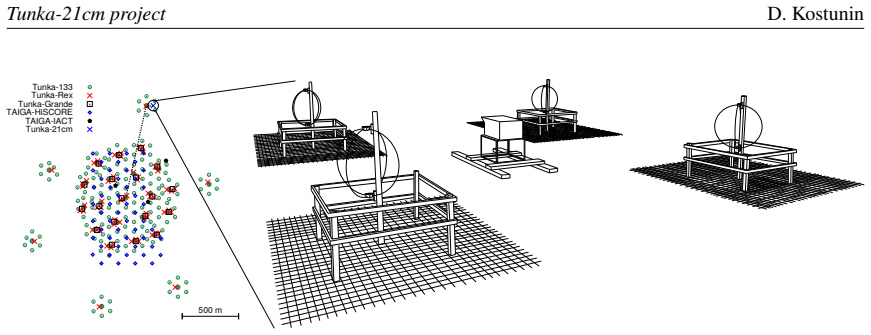
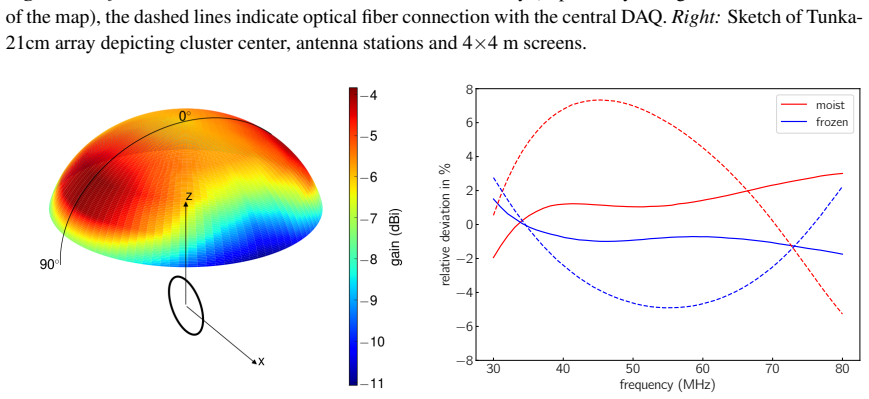
The central object is the four-station Tunka-21cm array, each station holding two perpendicular short aperiodic loaded loop antennas (SALLA) screened below by 4x4 m grounded metal nets. The screening is the main design change relative to the standard air-shower configuration: numerical simulation shows it reduces ground-induced gain uncertainty to a maximum of 3 percent, down from several percent for an unscreened identical antenna. The second carrying mechanism is the acquisition mode: 12-bit digitization at 200 MS/s in 50-microsecond records gives a spectral resolution of 20 kHz, and the resulting roughly 10 GB/day of redundant multi-antenna data is what the planned beamforming, matched filtering, and RFI suppression exploit to drive systematics down.
What would settle it
Take simultaneous time-domain records from the four stations, apply the calibrated response and the planned redundant analysis, and subtract a smooth foreground model; if residual spectral structure remains above roughly $10^{-4}$ of the foreground (tens of mK) in the 30-80 MHz band, the feasibility claim fails. The paper reports no such end-to-end residual spectrum yet.
Extended reading notes
Core claim
The central claim, stated on the paper's own terms, is that the Tunka-21cm engineering array can demonstrate whether an air-shower radio detector can be upgraded to the precision needed for global 21-cm cosmology. Concretely, it claims that the largest hardware systematics — antenna production and alignment, temperature drift of the low-noise amplifiers, crosstalk between channels, and ground effects — are each controllable at the level of a few percent, and that installation of grounded screens under the stations plus redundant data acquisition (digital beamforming, matched filtering, and neural-network RFI tagging) can push the combined residual down toward the required foreground accuracy. The paper also claims that the 20 kHz spectral resolution over 50-microsecond traces is well suited to separating the smooth Galactic foreground from the spectrally structured cosmological signal. It stops short of claiming the signal has been or can be detected with this array alone; the stated goal is to evaluate the gained accuracy and feasibility.
Load-bearing premise
The plan assumes that laboratory calibration plus redundant multi-antenna analysis will reduce combined hardware systematics from 2 to 4 percent per effect down to the $10^{-4}$ to $10^{-5}$ of foreground that 21-cm extraction requires, but the paper does not yet demonstrate that suppression end-to-end.
Editorial extensions
If this is right
- The paper's argument implies that existing and future air-shower radio arrays in the 30-80 MHz band could double as global 21-cm monitors.
- The same data can be processed in single-antenna, uncorrelated-array, and phased-array modes, enabling direct cross-checks of systematic effects on one dataset.
- The 50-microsecond traces and 20 kHz spectral resolution create a testbed for matched filtering and neural-network RFI suppression that can be benchmarked against existing air-shower data before being used for cosmology.
- A controlled reference-source calibration connects the absolute scale of the array to the same standard used by other low-frequency experiments, making future spectra comparable.
Reading between the lines
- If the redundancy argument holds, the limiting factor for this approach may shift from hardware systematics to the unmodeled spectral structure of the foreground itself, which the paper explicitly sets aside.
- A natural next step would be to use the 20 kHz spectral resolution to track the spectral index of the Galactic foreground across time and across stations; excess ripple in that track would reveal residual calibration systematics before any cosmological interpretation.
- The same screened-antenna, long-trace acquisition could be reproduced at a fraction of the cost of a dedicated radiometer, so a network of such engineering arrays could cross-check a claimed global 21-cm detection with independent instruments.
Signed reviews
Editorial analysis
A structured set of objections, weighed in public.
Referee Report
Summary. This paper describes the Tunka-21cm engineering array, a four-station radio array built from Tunka-Rex hardware, with two perpendicular SALLA loop antennas per station, screened ground planes, and 30–80 MHz band operation. The stated goal is to serve as a proof-of-feasibility platform for detecting the global 21-cm signal from the Cosmic Dawn and Epoch of Reionization using hardware originally developed for air-shower detection. The manuscript presents the hardware design, laboratory calibration of the signal chain, NEC2 antenna simulations, the expected systematic uncertainties from Tunka-Rex experience, the data acquisition system with 200 MS/s sampling and 56-microsecond traces, and planned data-analysis strategies including single-antenna, uncorrelated-array, and phased-array modes, matched filtering, RFI suppression, and benchmarking against published Tunka-Rex data. No measurement data, end-to-end calibration results, or quantitative analysis of the full pipeline are presented; the paper is a design and status report.
Significance. If the Tunka-21cm array achieves its stated goal, it would demonstrate that existing air-shower radio-detection infrastructure can be adapted for 21-cm cosmology, which would have practical value for the field. The paper is clearly written and honestly describes planned work, and the hardware choices are sensible for a first engineering test. In particular, the reuse of the Tunka-Rex hardware and the planned VSQ 1000 in-field calibration are concrete strengths, and the paper acknowledges several limitations, including the few-percent numerical uncertainty in the NEC2 antenna simulation. However, the central feasibility claim — that redundancy of the data can reduce systematic uncertainties from the few-percent level to the 10^-4 to 10^-5 of foreground required for global 21-cm signal extraction — is not supported by any quantitative mechanism, simulation, or measurement. The paper therefore does not yet establish the proof-of-feasibility it announces; it establishes a credible experimental program toward that goal.
major comments (4)
- [Section 3 and Section 2.1] The central feasibility argument is unsupported. Section 1 states that foreground estimation must be accurate to 10^-4 to 10^-5, while Section 2.1 lists systematic uncertainties of 2% (antenna production and alignment), 4% (environmental temperature), 2% (crosstalk), and up to 3% (ground/screen effects). Section 3 claims that redundancy of the data, digital beam-forming, and matched filtering will decrease these systematic uncertainties, but no quantitative mechanism is given for how these techniques reduce common-mode multiplicative errors in the absolute antenna-plus-receiver response. All four stations use identical hardware, share the same environment, and observe the same sky, so averaging or beamforming cannot remove a common spectral response error. The planned VSQ 1000 in-field calibration is exactly the measurement needed, but no calibration results are presented. Thus the paper does not demonstrate that the gap between the few-percent per-effect systematics and the required 10^-4 to 10^-5 can be bridged.
- [Section 2.1] The numerical uncertainty of the NEC2 antenna simulation, acknowledged as "of order few percent" and currently under investigation, directly affects the absolute gain calibration and is a load-bearing contributor to the systematics budget. The paper also does not provide an end-to-end systematic budget that combines the laboratory calibration of the signal circuit, the antenna simulation uncertainty, the in-field VSQ 1000 calibration, and the environmental corrections. Without such a budget, the claim of "improved control of systematic uncertainties" is not quantitatively established.
- [Section 4 and Abstract] The abstract and conclusion state that the setup will "decrease systematic uncertainty" and that the project is "aimed at the proof-of-feasibility," but the manuscript contains no data from the deployed array, no commissioning results, and no validation of the analysis pipeline. The conclusion's language that the improvements will be "directly evaluate[d]" is appropriate only as a statement of future work. To make the feasibility claim defensible, the paper should either present the missing calibration and simulation results or explicitly reframe the conclusion as a project plan rather than an achieved demonstration.
- [Section 1] The paper relies on the statement that polynomial foreground subtraction "allows to extract the signal" (citing Ref. [12]), but this statement assumes a well-known instrument response. Since the present work is specifically concerned with instrument systematics, the relevance of that argument to the Tunka-21cm hardware is not established without a quantitative error propagation study linking the per-effect systematics to the residual foreground after polynomial subtraction.
minor comments (5)
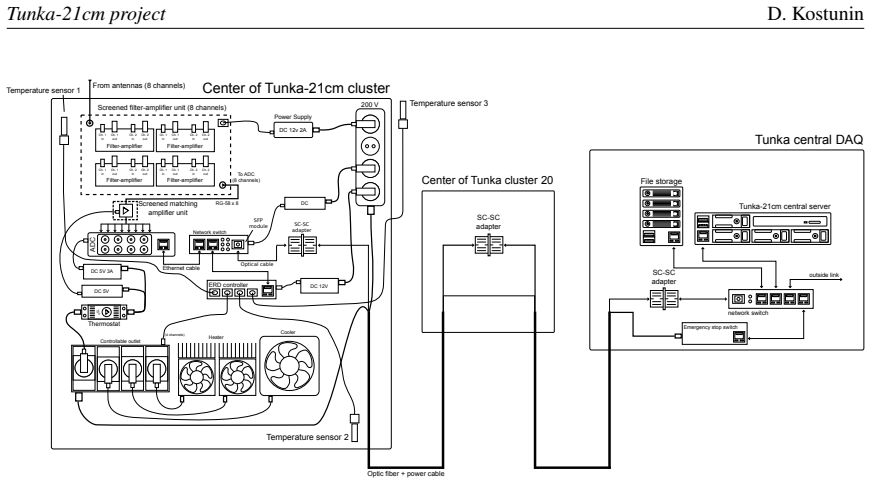
- [Section 2.2] The data-rate estimates are inconsistent: the abstract states an expected data flow of about 10 GB/day, while Section 2.2 states a maximal trigger rate of about 15 Hz, which at 200 MS/s, 12-bit sampling, 8 channels, and 50-microsecond traces corresponds to roughly 2.4 MB/s, i.e., about 200 GB/day, and the section itself quotes about 10 GiB/h. Please reconcile these numbers.
- [Section 2.1] There is a typo: "Let us not, that in the present work" should read "Let us note that in the present work." Also, in Section 1, "artificial radio frequency inference" should read "artificial radio frequency interference."
- [Section 2.2] The text says "the order is equipped with the modern Ethernet interface"; this should presumably be "the board is equipped...".
- [Figure 2] The caption of Figure 2 states "One can see that the screening significantly decreases the systematic uncertainty from the ground" in the first sentence, but the figure only shows the simulated gain difference; please make the caption explicitly state that this is a simulation result and not a measurement.
- [Section 3.1] The proposal to benchmark Tunka-21cm analysis methods against Tunka-Rex data is reasonable, but since both instruments use the same antenna and electronics family and the same site, this benchmarking is not an independent cross-check of the absolute calibration; this limitation should be stated.
Circularity Check
No significant circularity: the paper describes an engineering prototype and prospective analysis plans; its feasibility argument is self-referential but not derivational circularity.
full rationale
The paper's central claim is a proof-of-feasibility goal for Tunka-21cm, not a derived prediction. It reports hardware design, laboratory calibration, NEC2 antenna simulations, and a planned in-field cross-check with the external VSQ 1000 reference source. The systematic uncertainty estimates are taken from Tunka-Rex operational experience (Section 2.1), but these are empirical inputs to the design and planning, not outputs being relabeled as predictions. The proposed reduction of systematics through redundancy, digital beamforming, matched filtering, and RFI suppression (Section 3) is explicitly framed as a future test ('we will try the following strategies', 'plan to exploit this redundancy'), not as a demonstrated result. No equation in the paper reduces a claimed outcome to its own inputs; no fitted parameter is renamed as a prediction; no uniqueness theorem is imported from self-citations. The self-citations to Tunka-Rex and TAIGA concern hardware heritage and data availability, which are appropriate references and are not load-bearing substitutes for the measurement that the paper itself defers: the in-field calibration 'will be performed' and the comparison with published Tunka-Rex data 'is going to' be done. These are limitations of a proposal paper, not circularity. The strongest skeptical concern, that the planned redundancy cannot remove common-mode systematics, is a correctness or completeness issue about the stated suppression mechanism, not a circularity of the argument. Overall, the derivation chain is self-contained as a design and feasibility-study proposal, with no circular step identified.
Assumptions & free parameters
assumptions (4)
- domain assumption The global 21 cm signal from the Epoch of Reionization exists at the expected brightness temperature level and can be extracted by high-order polynomial foreground subtraction.
- domain assumption Systematic uncertainties must be controlled to 10^-4 to 10^-5 of the foreground for signal extraction.
- domain assumption The NEC2 simulations accurately predict the SALLA antenna response in the deployed configuration, including ground effects.
- ad hoc to paper Redundant time-domain data combined with digital processing can reduce systematic uncertainties below individual hardware contributions.
Cite this review
Pith. "Pith review of Quest for detection of a cosmological signal from neutral hydrogen with a digital radio array developed for air-shower measurements." pith.science (2026). https://pith.science/paper/7AFQ7Z63
@misc{pith2026190806975,
  author       = {Pith},
  title        = {Pith review of: Quest for detection of a cosmological signal from neutral hydrogen with a digital radio array developed for air-shower measurements},
  year         = {2026},
  howpublished = {\url{https://pith.science/paper/7AFQ7Z63}},
  note         = {Machine review of arXiv:1908.06975}
}
abstract
Digital radio arrays are widely used for the low-frequency radio astronomy as well as for detection of air-showers induced by high-energy cosmic rays and neutrinos. Since the radio emission from air-showers forms short broadband pulses with duration of tens nanoseconds, the data acquisition strategies of cosmic-ray and astronomical arrays have significant differences. To perform precise measurement of cosmic rays, the radio array should have absolute amplitude calibration and record the entire electric field on the antenna in the broad frequency range. These requirements are similar to ones defined for the experiments aimed at the detection of weak signal from neutral hydrogen at redshifts of $z$>10, what led us to the application of our experience with Tunka-Rex to this problem. We are developing new experimental setup comprising of four antenna stations, placed on the area of 100 sq.m. Each antenna station consists of two perpendicular loop antennas measuring electric field in the frequency band of 30-80 MHz. The setup records electric fields from all antennas in portions of 50 $\mu$s reaching the spectral resolution of 20 kHz. We expect a flow of redundant data of about 10 GB/day, and plan to exploit this redundancy in order to decrease systematic uncertainty of the measurements by application of digital beam-forming, matched filtering and RFI suppression with neural networks. In the present contribution we describe the design and calibration of the setup, expected performance and data analysis techniques.
Figures
Reference graph
Works this paper leans on
-
[12]
J. R. Pritchard and A. Loeb, “Constraining the unexplored period between the dark ages and reionization with observations of the global 21 cm signal,”Phys. Rev. D, vol. 82, p. 023006, Jul 2010
work page 2010
-
[1]
Cosmology at low frequencies: The 21 cm transition and the high-redshift Universe,
S. R. Furlanetto, S. P. Oh, and F. H. Briggs, “Cosmology at low frequencies: The 21 cm transition and the high-redshift Universe,”Phys. Rep., vol. 433, pp. 181–301, Oct 2006
work page 2006
-
[2]
Reionization and Cosmology with 21-cm Fluctuations,
M. F. Morales and J. S. B. Wyithe, “Reionization and Cosmology with 21-cm Fluctuations,” ARA&A, vol. 48, pp. 127–171, Sep 2010
work page 2010
-
[3]
Can the reionization epoch be detected as a global signature in the cosmic background?,
P. A. Shaver, R. A. Windhorst, P. Madau, and A. G. de Bruyn, “Can the reionization epoch be detected as a global signature in the cosmic background?,”A&A, vol. 345, pp. 380–390, May 1999
work page 1999
-
[4]
J. D. Bowman, A. E. E. Rogers, and J. N. Hewitt, “Toward Empirical Constraints on the Global Redshifted 21 cm Brightness Temperature During the Epoch of Reionization,”ApJ, vol. 676, pp. 1–9, Mar 2008
work page 2008
-
[5]
First Results on the Epoch of Reionization from First Light with SARAS 2,
S. Singh et al., “First Results on the Epoch of Reionization from First Light with SARAS 2,”ApJ, vol. 845, p. L12, Aug 2017
work page 2017
-
[6]
Probing the Dark Ages at z ~20: The SCI-HI 21 cm All-sky Spectrum Experiment,
T. C. V oyteket al., “Probing the Dark Ages at z ~20: The SCI-HI 21 cm All-sky Spectrum Experiment,”ApJ, vol. 782, p. L9, Feb 2014
work page 2014
-
[7]
BIGHORNS - Broadband Instrument for Global HydrOgen ReioNisation Signal,
M. Sokolowski et al., “BIGHORNS - Broadband Instrument for Global HydrOgen ReioNisation Signal,”PASA, vol. 32, p. e004, Feb 2015
work page 2015
Show all 25 references
-
[8]
Design and characterization of the Large-aperture Experiment to Detect the Dark Age (LEDA) radiometer systems,
D. C. Price et al., “Design and characterization of the Large-aperture Experiment to Detect the Dark Age (LEDA) radiometer systems,”MNRAS, vol. 478, pp. 4193–4213, Aug 2018
2018
-
[9]
The Precision Array for Probing the Epoch of Re-ionization: Eight Station Results,
A. R. Parsons et al., “The Precision Array for Probing the Epoch of Re-ionization: Eight Station Results,”AJ, vol. 139, pp. 1468–1480, Apr 2010
2010
-
[10]
Hydrogen Epoch of Reionization Array (HERA),
D. R. DeBoer et al., “Hydrogen Epoch of Reionization Array (HERA),”PASP, vol. 129, p. 045001, Apr 2017. 6 Tunka-21cm project D. Kostunin
2017
-
[11]
A model of diffuse Galactic radio emission from 10 MHz to 100 GHz,
A. de Oliveira-Costa, M. Tegmark, B. M. Gaensler, J. Jonas, T. L. Landecker, and P. Reich, “A model of diffuse Galactic radio emission from 10 MHz to 100 GHz,”MNRAS, vol. 388, pp. 247–260, Jul 2008
2008
-
[13]
An absorption profile centred at 78 megahertz in the sky-averaged spectrum,
J. D. Bowman, A. E. E. Rogers, R. A. Monsalve, T. J. Mozdzen, and N. Mahesh, “An absorption profile centred at 78 megahertz in the sky-averaged spectrum,”Nature, vol. 555, pp. 67–70, Mar 2018
2018
-
[14]
Possible interaction between baryons and dark-matter particles revealed by the first stars,
R. Barkana, “Possible interaction between baryons and dark-matter particles revealed by the first stars,”Nature, vol. 555, pp. 71–74, Mar 2018
2018
-
[15]
Radio detection of Cosmic-Ray Air Showers and High-Energy Neutrinos,
Schröder, Frank G., “Radio detection of Cosmic-Ray Air Showers and High-Energy Neutrinos,” Prog. Part. Nucl. Phys., vol. 93, pp. 1–68, 2017
2017
-
[16]
The Giant Radio Array for Neutrino Detection (GRAND): Science and Design,
J. Alvarez-Muñiz et al., “The Giant Radio Array for Neutrino Detection (GRAND): Science and Design,” 2018
2018
-
[17]
The TAIGA experiment: From cosmic-ray to gamma-ray astronomy in the Tunka valley,
N. Budnev et al., “The TAIGA experiment: From cosmic-ray to gamma-ray astronomy in the Tunka valley,”Nucl. Instrum. Meth., vol. A845, pp. 330–333, 2017
2017
-
[18]
Tunka Advanced Instrument for cosmic rays and Gamma Astronomy,
D. Kostunin et al., “Tunka Advanced Instrument for cosmic rays and Gamma Astronomy,”J. Phys. Conf. Ser., vol. 1263, no. 1, p. 012006, 2019
2019
-
[19]
Measurement of cosmic-ray air showers with the Tunka Radio Extension (Tunka-Rex),
P. A. Bezyazeekov et al., “Measurement of cosmic-ray air showers with the Tunka Radio Extension (Tunka-Rex),”Nucl. Instrum. Meth., vol. A802, pp. 89–96, 2015
2015
-
[20]
New Antenna for Radio Detection of UHECR,
O. Krömer et al. (LOPES Collaboration), “New Antenna for Radio Detection of UHECR,” Proc. of the 31st ICRC, Łód´ z, Poland, no. 1232, 2009. http://icrc2009.uni.lodz.pl/proc/html/
2009
-
[21]
Antennas for the Detection of Radio Emission Pulses from Cosmic-Ray,
P. Abreu et al., “Antennas for the Detection of Radio Emission Pulses from Cosmic-Ray,”JINST, vol. 7, p. P10011, 2012
2012
-
[22]
NEC - numerical electromagnetics code for antennas and scattering,
G. Burke and A. Poggio, “NEC - numerical electromagnetics code for antennas and scattering,” tech. rep., Lawrence Livermore National Laboratory, USA, 1977
1977
-
[23]
Advanced Signal Reconstruction in Tunka-Rex with Matched Filtering and Deep Learning,
P. Bezyazeekov et al., “Advanced Signal Reconstruction in Tunka-Rex with Matched Filtering and Deep Learning,” in3rd International Workshop on Data Life Cycle in Physics (DLC-2019) Irkutsk, Russia, April 2-7, 2019, 2019
2019
-
[24]
Towards the Tunka-Rex Virtual Observatory,
P. Bezyazeekov et al., “Towards the Tunka-Rex Virtual Observatory,” in3rd International Workshop on Data Life Cycle in Physics (DLC-2019) Irkutsk, Russia, April 2-7, 2019, 2019
2019
-
[25]
Seven years of Tunka-Rex operation,
D. Kostunin et al., “Seven years of Tunka-Rex operation,” inProceedings of the 36th International Cosmic Ray Conference 2019, Madison, WI, USA, p. PoS (ICRC2019) 319, 2019. 7
2019
Reviewed August 14, 2026 · model on record in the stance chip above.
Discussion (0). Continue with ORCID to comment.