REVIEW 4 major objections 5 minor 51 references
MultiCompose: Multi-Concept Personalized Composition with Per-Subject Attribute Binding
T0 review · 4 major / 5 minor · reviewed 2026-08-05 · deepseek-v4-flash
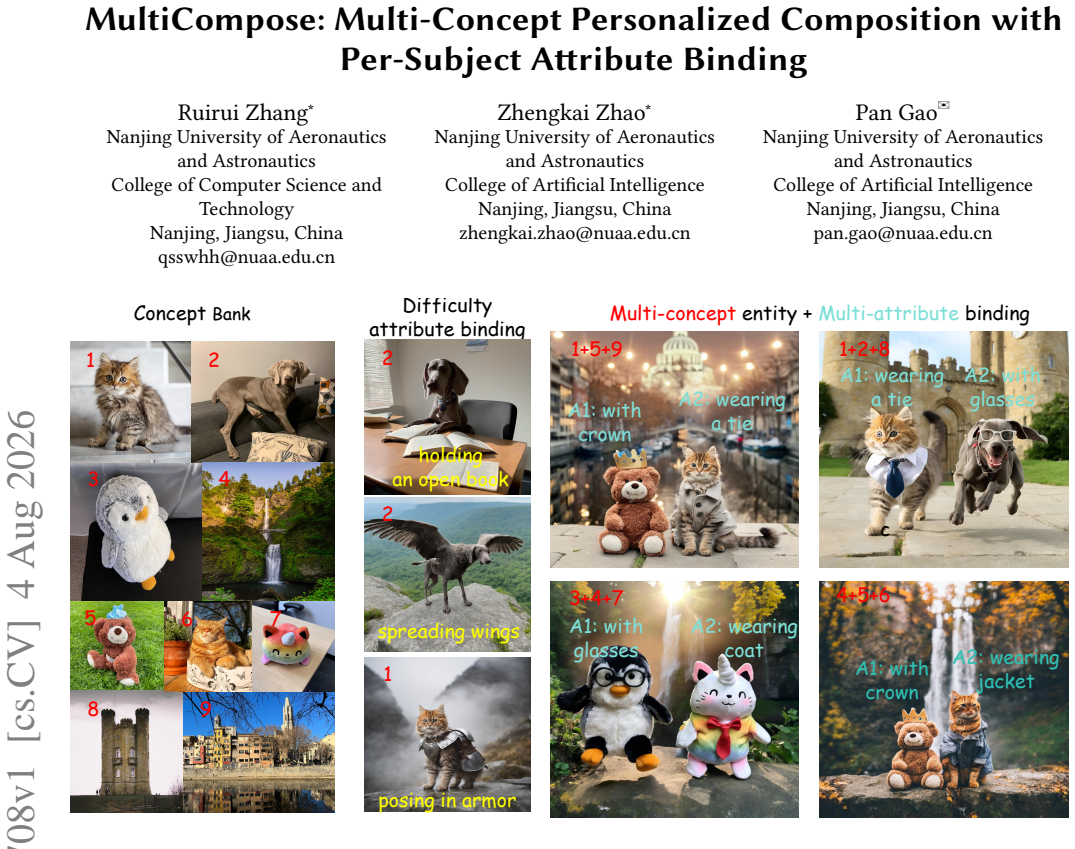
Pith's one-line read MultiCompose composes separately fine-tuned personalized subjects into one image with per-subject attribute binding, via a regularizer and two-phase mask-routed inference, and adds MSP-Bench to score identity, binding, and misalignment join
desk verdict A genuinely useful method for multi-concept personalization, but the empirical claims rest on an unvalidated self-built benchmark and missing reproducibility details. read the letter →
The pith
A machine-rendered reading of the paper's core claim, the machinery that carries it, and where it could break.
The reading
What carries the argument
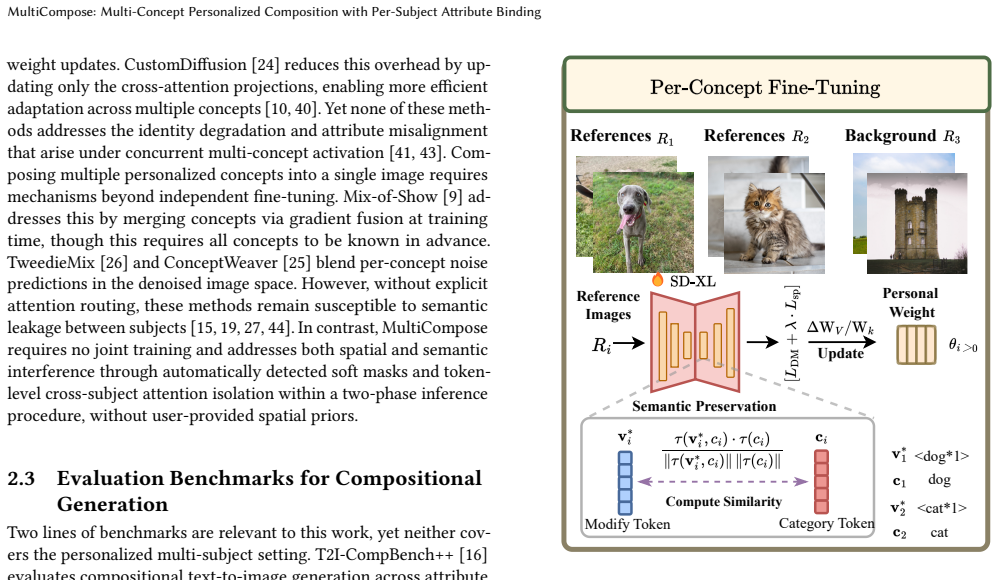
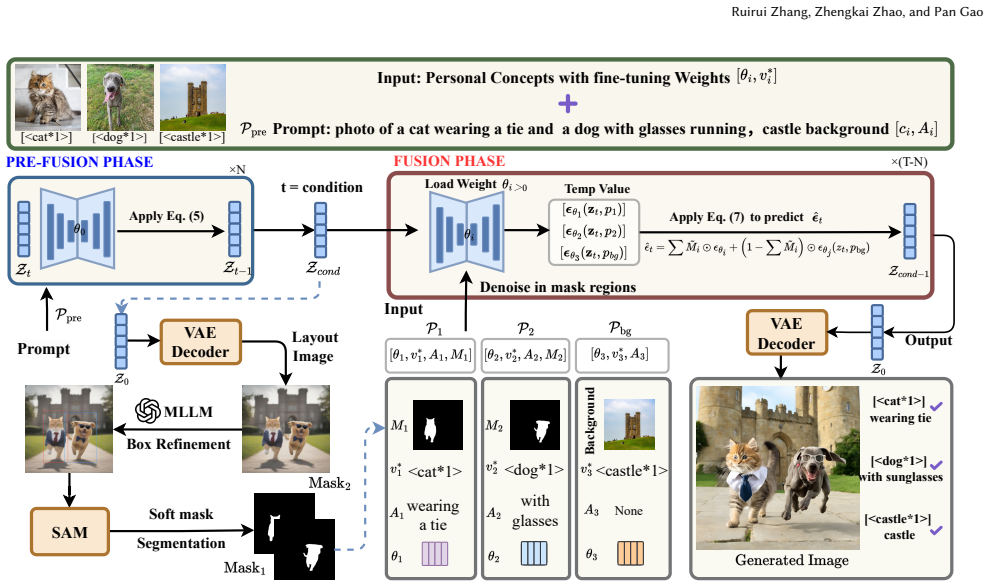
Decoupling plus spatial routing. Fine-tuning adds a semantic-preservation loss L_sp that keeps the 'modifier token + category word' phrase close to the category word alone, keeping the personalized token compositional. Inference is two-phase. Pre-fusion, under a global prompt with no personalized weights, builds an ownership map O_i(s) — each position's share of category-token attention belonging to subject i — and penalizes attribute tokens at positions the subject does not own (Eq. 5), stopping leakage early. At the phase boundary, the latent is decoded, an MLLM detects boxes, and SAM cuts mutually exclusive soft masks (Eq. 6). Fusion activates each concept's own weight offsets under a sin
What would settle it
Run the pipeline on two personalized subjects that share one category word (two different cats): the ownership map of Eq. (4) divides by category-token attention, which cannot separate same-class subjects, so the masks should collapse or swap — inspect masks and final images. Second, re-score MSP-Bench (which judges a 5,000-image sample of 10,080) with a different multimodal judge, e.g., GPT-4o instead of Qwen3.5-Plus; if the MIS/BIND ranking of methods flips, the benchmark's reported failure modes belong to the judge, not the methods.
Extended reading notes
Core claim
MultiCompose's claim: per-concept personalization and multi-subject composition can be decoupled — identity lives in independently trained weight offsets, and attribute binding is handled at inference by spatial routing. It identifies two failure points: modifier tokens drift from their category word during fine-tuning (fixed by regularization L_sp), and concurrent concepts overlap in cross-attention (fixed by a layout phase that suppresses attribute attention outside each subject's ownership region, followed by a mask-guided fusion phase using each subject's own weights). The paper also introduces MSP-Bench, a joint protocol for identity fidelity, binding accuracy, and misalignment, and sho
Load-bearing premise
Everything rests on one bet: that the layout image produced after only the first ten denoising steps already shows where each subject is, accurately enough that the masks cut from it can guide all remaining generation — if those early masks are misplaced, attributes get routed to the wrong subject.
Editorial extensions
If this is right
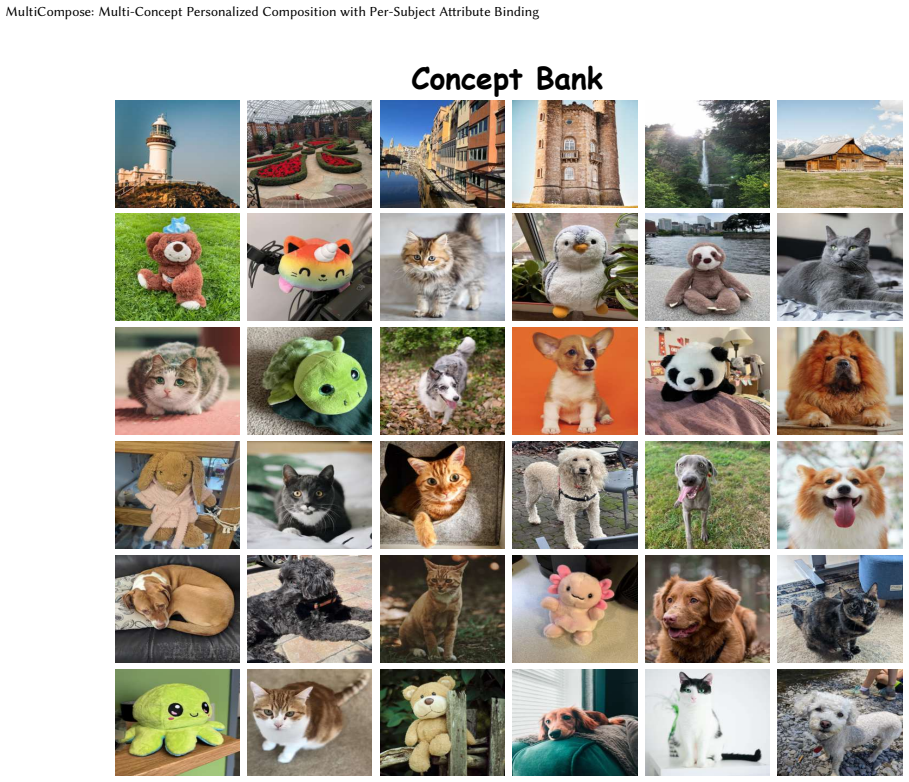
- Users can build a library of independently fine-tuned concepts and compose any subset at inference time; adding a new concept never requires retraining existing combinations.
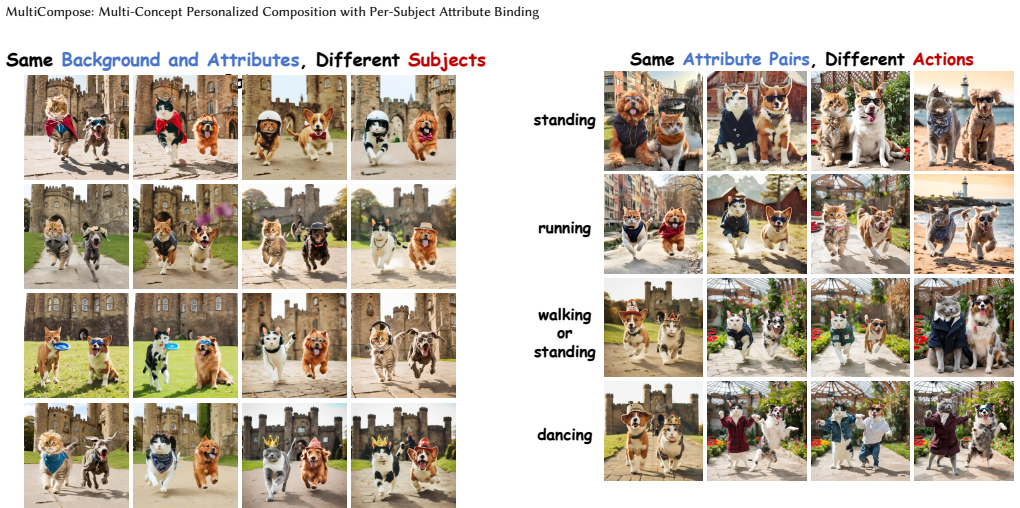
- No spatial priors are needed from the user: subject positions emerge from the prompt during the layout phase, and swapping the prompt's subject order swaps positions and attribute bindings correctly.
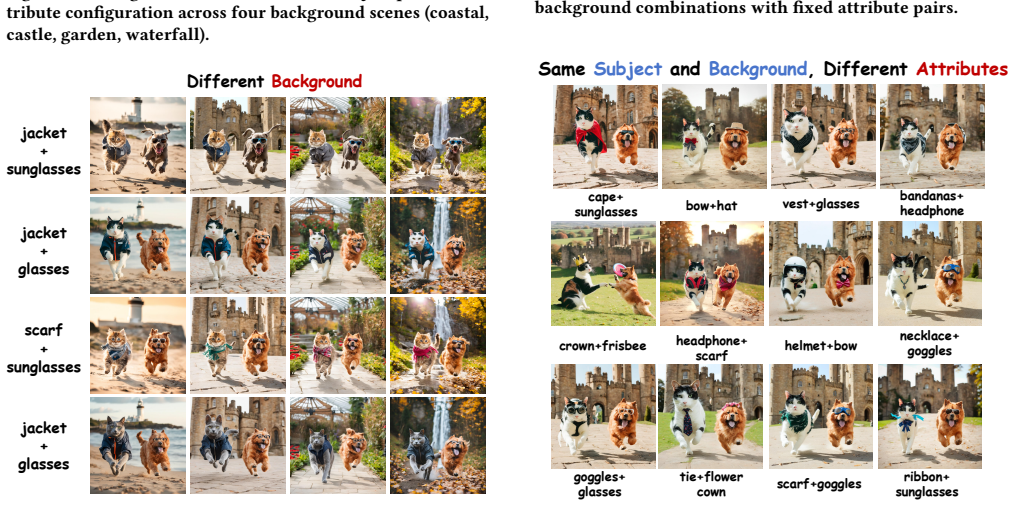
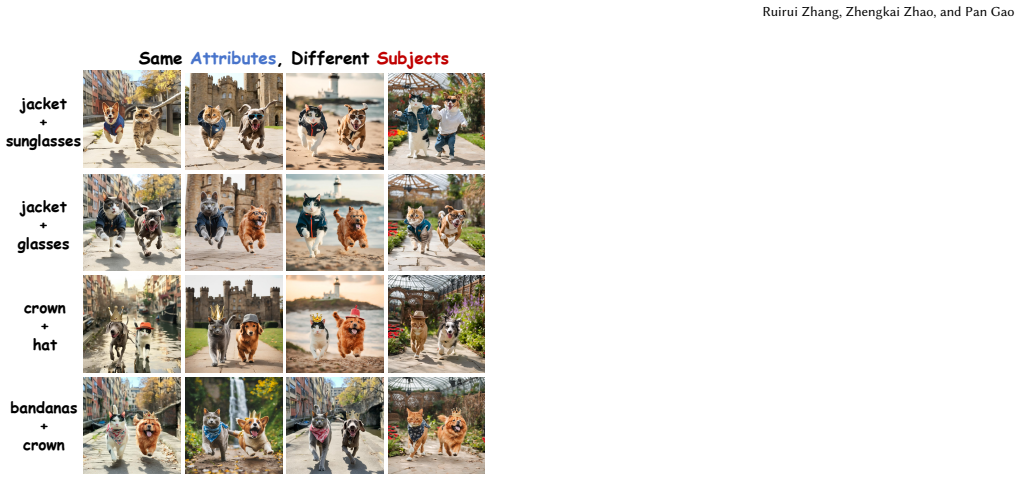
- Per-subject attributes stay bound across changes of background, action, and partner subject, because the fusion phase confines each concept's noise prediction to its own mask.
- MSP-Bench gives automatic, annotation-free joint scores for identity fidelity, binding, and misalignment, so future multi-subject methods can be compared on the failure modes that matter here.
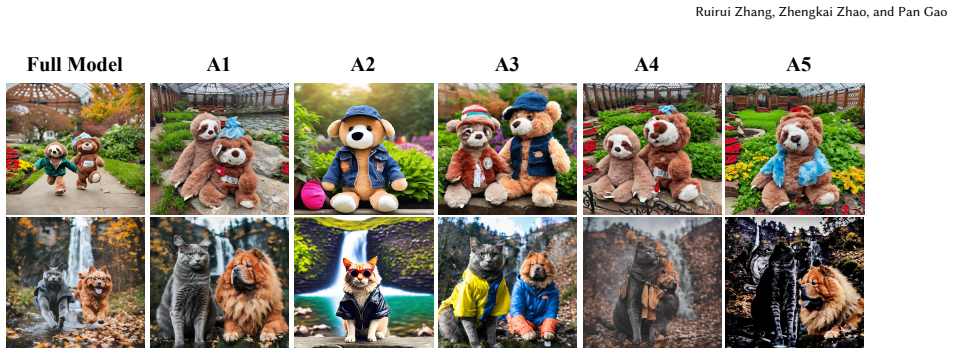
- High CLIP-I, CLIP-T, and DINO scores do not guarantee correct attribute binding; the paper's ablations show conventional metrics rating the ablated (worse) model higher, with MSP-Bench catching the drop.
Reading between the lines
- Because identity is carried entirely by per-concept weight offsets, the fusion phase should accept concepts fine-tuned by any compatible means (e.g., LoRA-style checkpoints) with no change — the paper only demonstrates its own fine-tuning, but the inference design is agnostic.
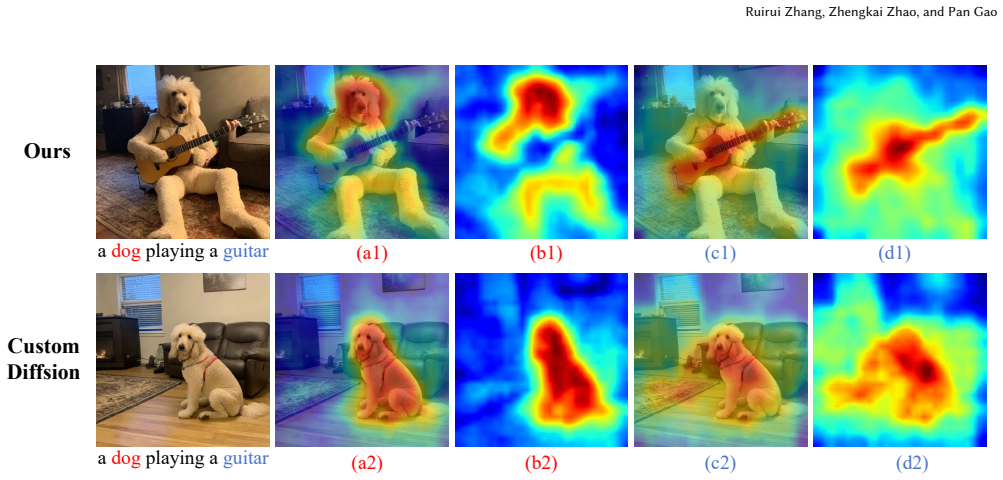
- The ownership map in Eq. (4) divides by category-token attention, so two subjects sharing one category word (two different cats) should defeat the pre-fusion layout — a boundary the paper does not test, and a likely place for extension work.
- The fixed split at 20% of steps commits to subjects being localizable that early; crowded or small-subject scenes may need an adaptive split, and a direct test would vary t_cond and measure mask accuracy against the final image.
- MSP-Bench's reliability rests partly on its chosen MLLM judge and on the 5,000-image evaluation sample; re-running the protocol with a different judge or a small human-rated subset would reveal whether the reported ID/BIND/MIS gaps belong to the methods or to the evaluator.
Editorial analysis
A structured set of objections, weighed in public.
Referee Report
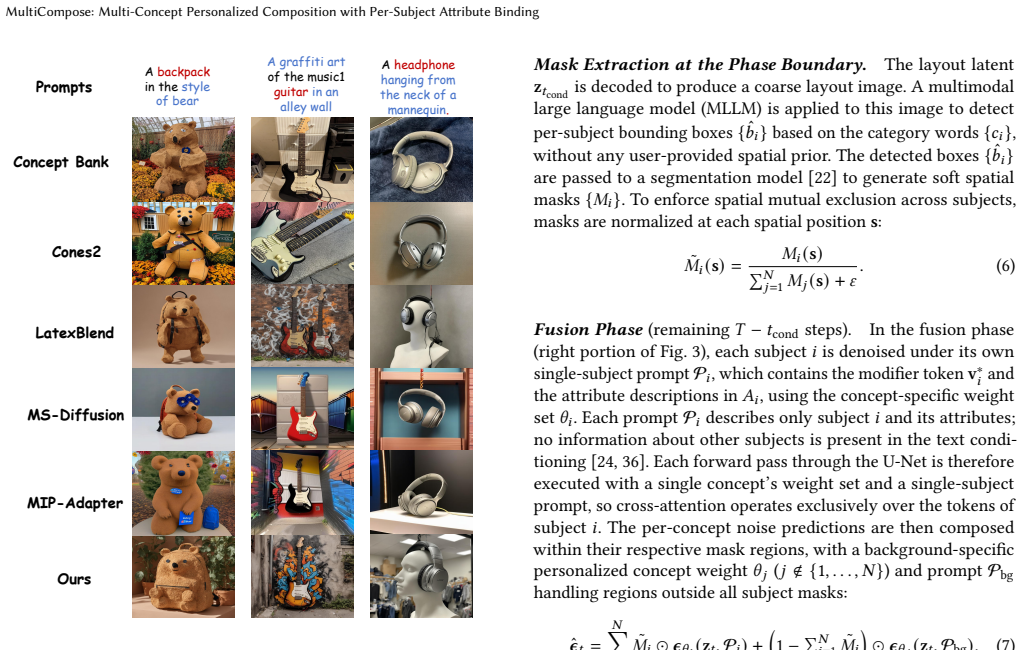
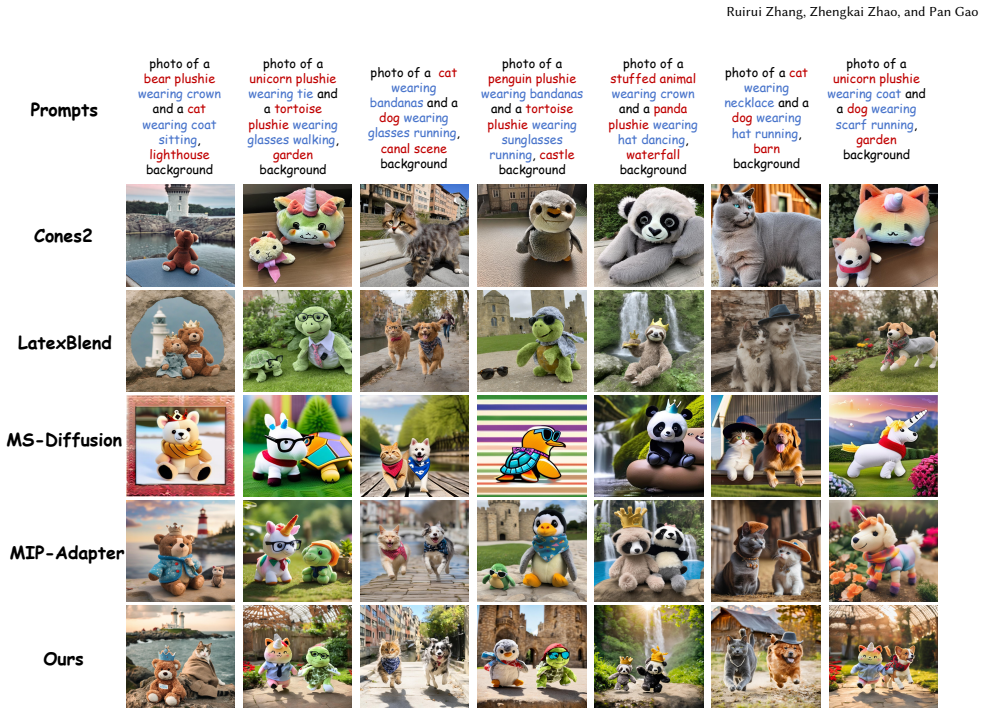
Summary. The paper proposes MultiCompose, a framework for composing multiple independently fine-tuned personalized subjects into one image while binding user-specified attributes (e.g., clothing, accessories, held objects) exclusively to each subject. It introduces a semantic-preservation regularization term on modifier-token embeddings (Eq. 2), a two-phase inference procedure that establishes layout in a pre-fusion phase and routes per-concept noise predictions through mutually exclusive soft masks in a fusion phase (Eqs. 4-7), and a new benchmark, MSP-Bench, which jointly scores identity fidelity (ID), attribute binding (BIND), and attribute misalignment (MIS) via dual traditional/MLLM pathways (Eqs. 8-11). The authors report superior performance over Cones 2, MS-Diffusion, LatentBlend, and MIP-Adapter on MSP-Bench, plus competitive results on Concept101, and use MSP-Bench ablations to argue that conventional metrics miss important failure modes.
Significance. If the claims are fully supported, the paper would address a real and under-studied gap: composing multiple independently personalized concepts without joint training or user-provided spatial priors, while maintaining exclusive per-subject attribute binding. The conceptual decomposition—personalization at fine-tuning time and composition at inference time—is clean and the qualitative results are often compelling. The authors also provide extensive appendix material on token embedding geometry and cross-attention behavior, and their component ablations are useful. However, the central empirical claim rests on an author-constructed benchmark whose automatic judge is not validated against humans, mask acquisition for baselines is unspecified, and all numeric comparisons lack error bars. As a result, the benchmark evidence for superiority and for diagnostic power is not yet conclusive.
major comments (4)
- [§3.2.2, §3.3, Table 3] The mask acquisition protocol for baselines is unspecified. For MultiCompose, masks \(\tilde{M}_i\) are obtained from the method's own pre-fusion layout, MLLM box detection, and SAM segmentation. If the same masks are used for Cones 2, MS-Diffusion, LatentBlend, and MIP-Adapter, methods with different but valid spatial layouts are systematically penalized; if masks are re-detected per method, the comparison is mediated by an unvalidated MLLM detector. Since ID, BIND, and MIS all crop subject regions using \(\tilde{M}_i\) (Eqs. 8-10), the reported 0.105 MSP advantage over MIP-Adapter in Table 3 could be an evaluation artifact. Please specify the exact protocol per baseline and, ideally, validate masks against human-annotated regions.
- [§3.3, Eqs. (8)-(11), §4.1] The dual-pathway weights \(w_h\) and \(w_m\) are never given; Eq. (11) fixes only the relative weights of ID, BIND, and 1-MIS. Moreover, the 'traditional pathway' for BIND in Eq. (9) is described as CLIP-based feature matching, but no threshold or calibration is provided to convert CLIP scores into the binary \(\phi(\cdot)=1\) judgment. Without these details, Tables 3 and 4 are not reproducible. In addition, all tables report point estimates without standard deviations, confidence intervals, or significance tests; the differences of 0.02-0.10 could be within run-to-run noise. Please report multi-seed means and variances and specify all metric weights and thresholds.
- [§A.3, §A.4, Sec. 4.5] The MLLM judge Qwen3.5-Plus is not validated. Appendix A.4 justifies its use by asserting that it has 'strong spatial relationship reasoning' and 'fine-grained visual-textual alignment,' but no human agreement study, no comparison with human preference judgments, and no calibration of the three MIS error types (leakage, confusion, missing) is provided. Since the claim in Sec. 4.5 that MSP-Bench 'captures failures overlooked by conventional metrics' is based entirely on this judge, the argument is circular unless the judge's decisions are validated against human annotations. Please add an inter-annotator or human-preference study and report agreement rates for each MSP-Bench subscore.
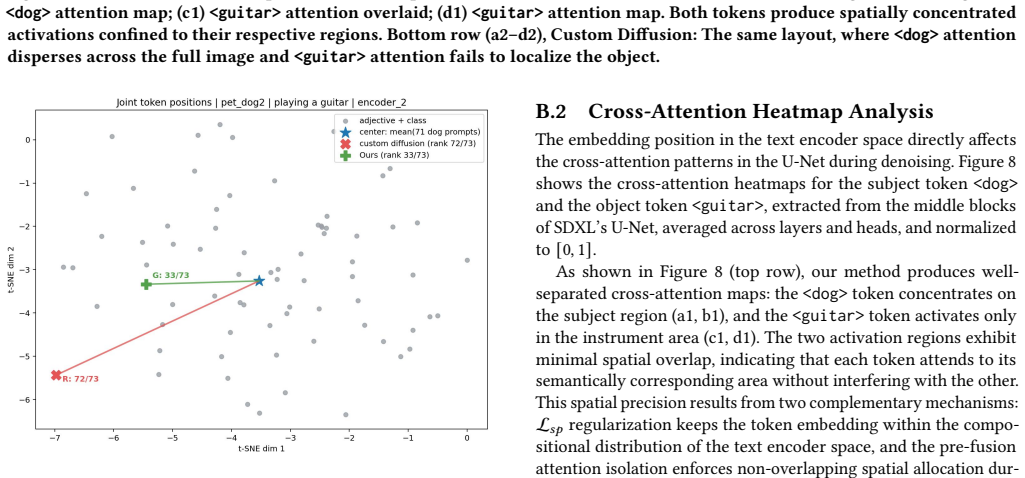
- [§3.2.2, Eqs. (4)-(5), §4.1] The two-phase inference procedure depends on the ownership map \(O_i(s)\) computed from category-token cross-attention and on the fixed phase split \(t_{\text{cond}}=10\) / 50 steps. No sensitivity analysis is reported for \(t_{\text{cond}}\) or the suppression strength \(\alpha\). If attribute tokens distort the category-token ownership map, or if the layout decoded at \(t_{\text{cond}}\) is noisy, the masks mislocate subjects and Eq. (5) suppresses attributes in incorrect regions. This is a structural modeling premise of the method. Please report performance across a range of \(t_{\text{cond}}\) and \(\alpha\) values, and show representative layout-failure cases.
minor comments (5)
- [Abstract and Tables 1-2] The abstract states that MultiCompose 'outperforms existing methods on both conventional metrics,' but Tables 1 and 2 show MultiCompose is not the best on CLIP-I or DINO. Please soften this claim.
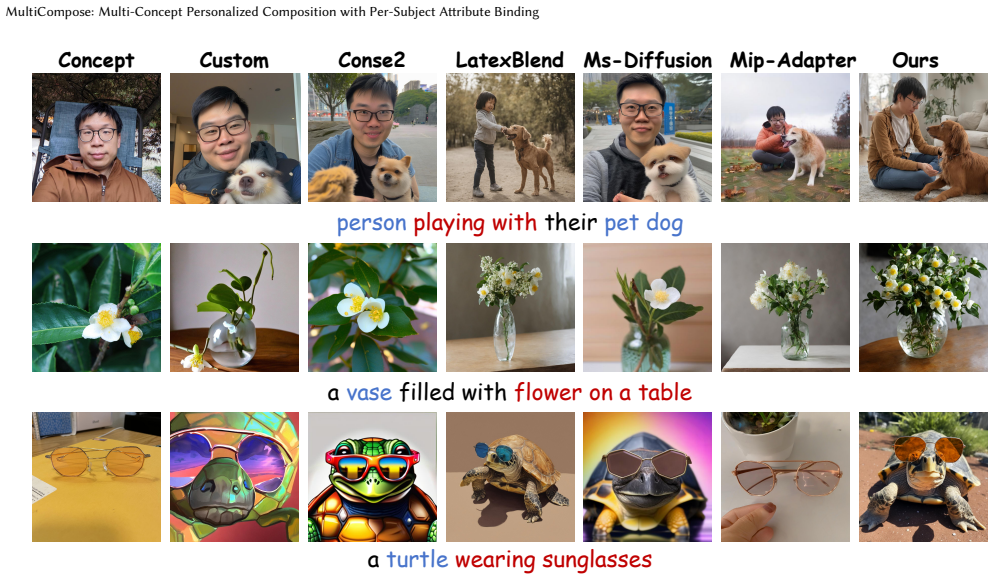
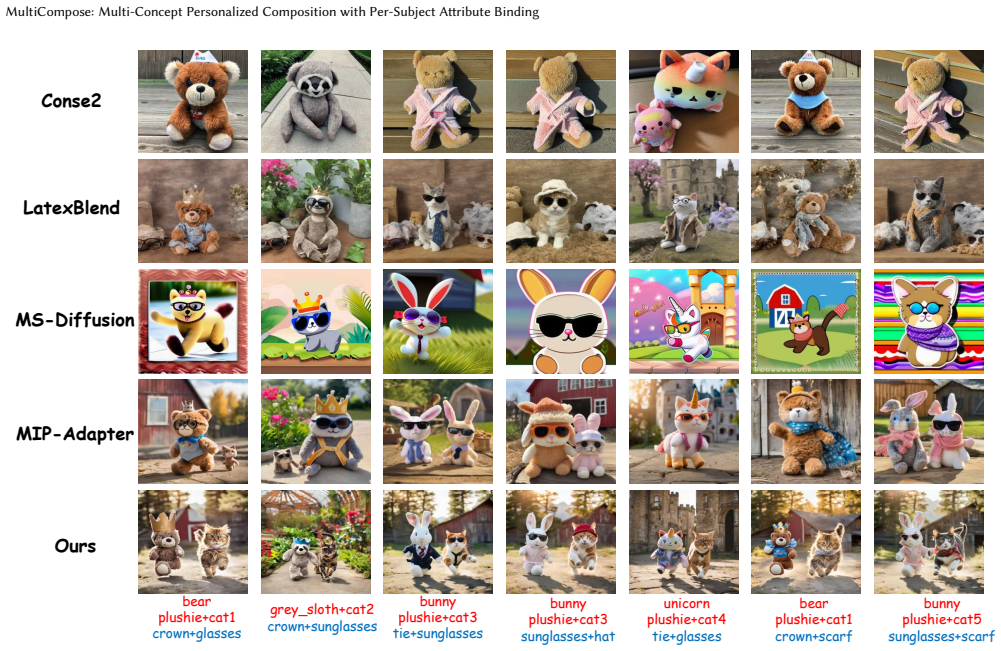
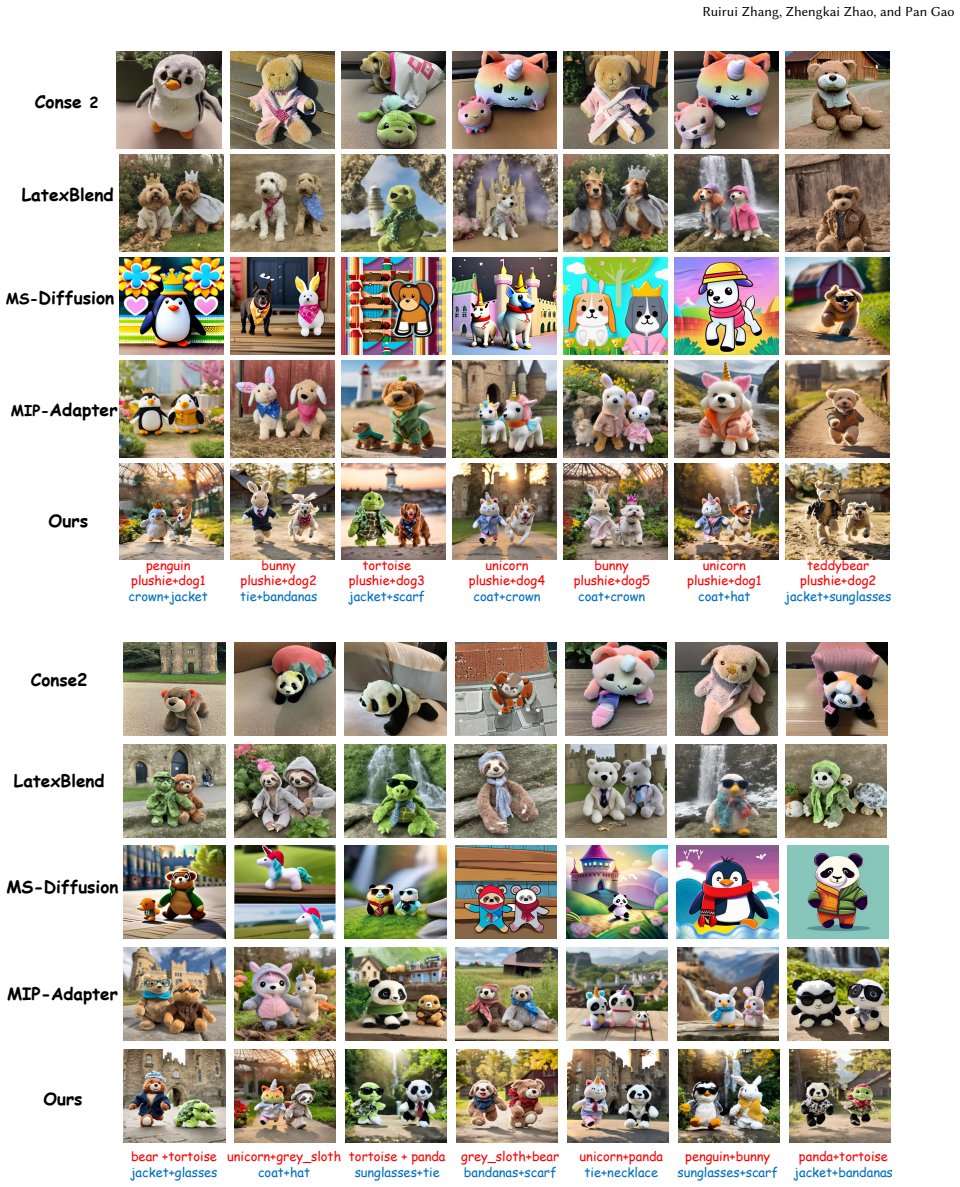
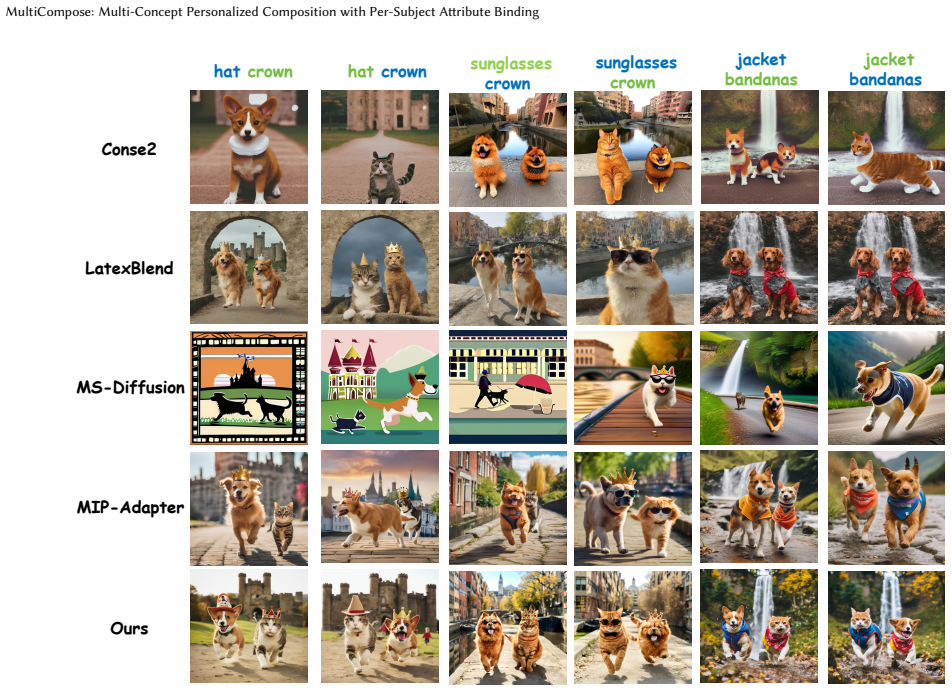
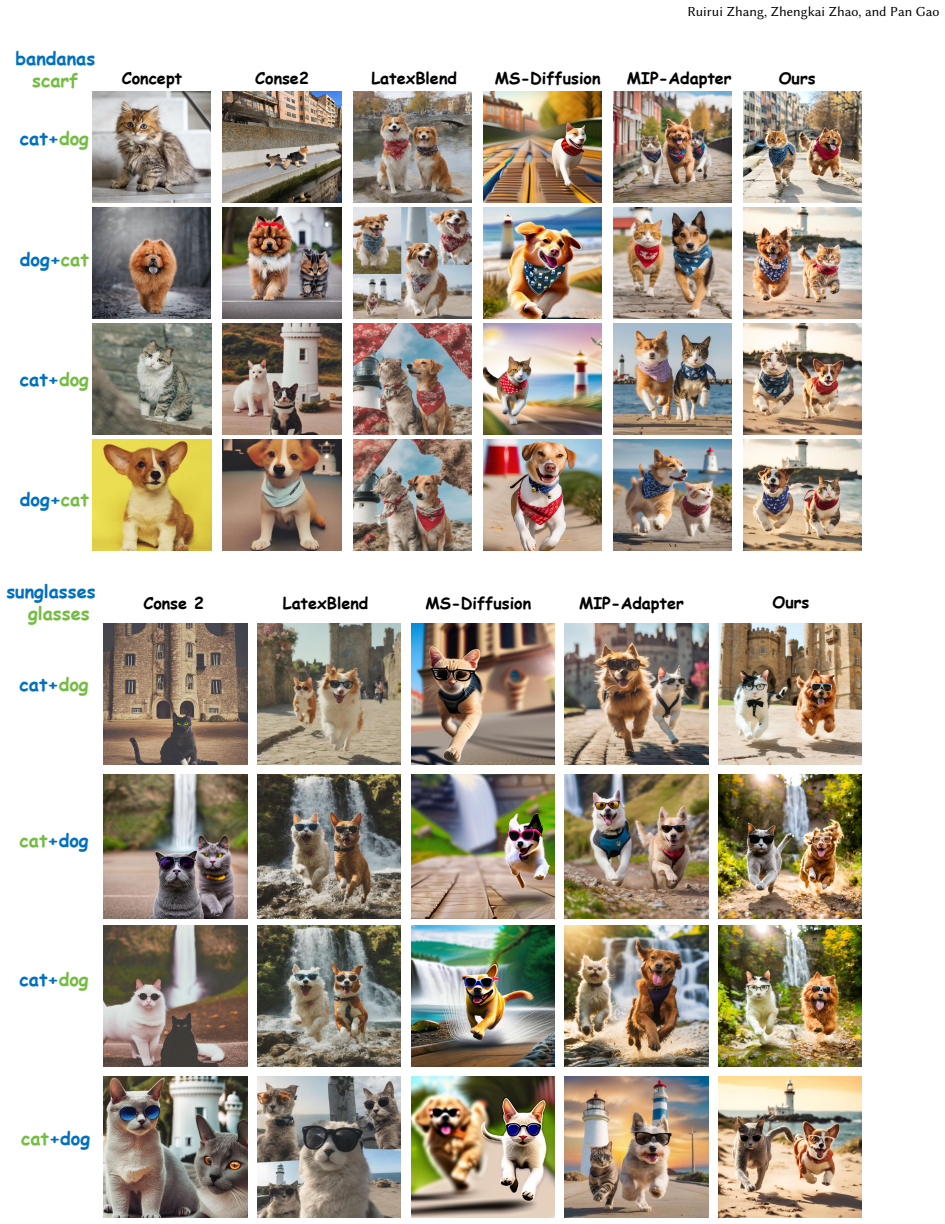
- [Figures 4, 12-15] The figure labels use 'LatexBlend' while the text and reference list use 'LatentBlend'. Please correct for consistency.
- [Eq. (8)] The background identity term \(\text{ID}_{\text{bg}}\) is not explicitly defined. Please provide its formula and state how background reference images are selected.
- [Eq. (5)] The equation subtracts a bias from the attention logit, not from the normalized attention score. The surrounding text says 'attention logit' once but 'attention score' elsewhere; please align the terminology.
- [§4.2, Table 3] For the baselines (Cones 2, MS-Diffusion, LatentBlend, MIP-Adapter), please report the exact configuration used (e.g., prompts, seeds, guidance scale, number of steps) and whether their masks are obtained with the same pipeline as MultiCompose.
Circularity Check
No significant circularity: the method is not fitted to MSP-Bench, and the only same-author citation is not load-bearing.
full rationale
The derivation chain is self-contained. The per-concept regularizer L_sp (Eq. 2) is a fixed cosine-similarity penalty with λ = 1.0, not fitted to any evaluation score. The two-phase inference procedure (Eqs. 4-7) is an algorithmic composition rule with fixed hyperparameters (t_cond = 10, α = 0.1); the masks and noise predictions are produced by the method rather than taken from the benchmark. The main conventional-metric results on Concept101 (Tables 1-2) use standard external metrics and an established dataset, providing independent grounding for the core claim. The only same-author citation is [47] (Magnet, with author Pan Gao), used to motivate the attention-suppression design in Eq. 5; however, the paper also provides an independent ablation (A3) showing the component's effect, so the self-citation is not load-bearing. The MSP-Bench evaluation raises validity concerns: Appendix A.4 justifies the Qwen3.5-Plus judge by assertion rather than human agreement, and the paper does not specify how subject masks are obtained for baseline methods. These are evaluation-validity and reproducibility risks, not circular reductions by construction. No equation in the paper is equivalent to its input by definition, and no fitted parameter is renamed as a prediction.
Assumptions & free parameters
free parameters (5)
- lambda (semantic preservation weight) =
1.0
- alpha (attention suppression strength) =
0.1
- t_cond (phase split) =
10 of 50 steps (0.2T)
- MSP-Bench aggregation weights =
MSP: 0.50 ID + 0.35 BIND + 0.15(1-MIS); MIS: 0.5 Leak + 0.35 Conf + 0.15 Miss; w_bg = 0.5
- Dual-pathway weights w_h, w_m =
unspecified
assumptions (5)
- domain assumption EOS-token embedding of a prompt captures compositional semantics, so minimizing cosine distance to the category word preserves attribute binding capacity.
- domain assumption Category-token cross-attention O_i(s) in Eq. (4) reliably indicates spatial ownership of each subject in the global prompt.
- domain assumption The layout latent decoded at t_cond=10 steps yields accurate per-subject boxes and masks via MLLM + SAM.
- domain assumption Qwen3.5-Plus MLLM judgments are reliable ground truth for ID, BIND, and MIS without human calibration.
- ad hoc to paper The MSP-Bench score formulas (Eqs. 10-11) and their weights are an accepted evaluation standard.
Cite this review
Pith. "Pith review of MultiCompose: Multi-Concept Personalized Composition with Per-Subject Attribute Binding." pith.science (2026). https://pith.science/paper/7ANM7476
@misc{pith2026260803708,
  author       = {Pith},
  title        = {Pith review of: MultiCompose: Multi-Concept Personalized Composition with Per-Subject Attribute Binding},
  year         = {2026},
  howpublished = {\url{https://pith.science/paper/7ANM7476}},
  note         = {Machine review of arXiv:2608.03708}
}
read the original abstract
Text-to-image diffusion models enable personalization of specific visual concepts from a small number of reference images. However, generating a single image that contains multiple personalized subjects, each bound to user-specified attributes such as clothing, accessories, and held objects, remains largely unaddressed. Without explicit spatial constraints, concurrently activated concept checkpoints produce overlapping cross-attention responses, causing per-subject identity degradation and attribute misalignment. Moreover, no established benchmark jointly evaluates these two failure modes in the personalized multi-subject setting. We present MultiCompose, a composition framework that decouples per-concept personalization from multi-subject inference. A semantic preservation regularization maintains attribute binding capacity during fine-tuning, while a two-phase inference procedure automatically establishes subject layout and composes per-concept predictions through spatially exclusive masks. We further introduce MSP-Bench, a benchmark that jointly evaluates identity fidelity (ID), attribute binding accuracy (BIND), and attribute misalignment (MIS) through a dual-pathway protocol. Experiments show that MultiCompose outperforms existing methods on both conventional metrics and MSP-Bench, confirming the benchmark's ability to reveal failure modes that conventional metrics overlook. Code is available at https://github.com/I2-Multimedia-Lab/MultiCompose
Figures
Figures from the paper (15 more)
Reference graph
Works this paper leans on
-
[47]
Chenyi Zhuang, Ying Hu, and Pan Gao. 2024. Magnet: We Never Know How Text-to-Image Diffusion Models Work, Until We Learn How Vision-Language Models Function. InAdvances in Neural Information Processing Systems (NeurIPS). 9 Ruirui Zhang, Zhengkai Zhao, and Pan Gao A Dataset Construction and Evaluation Details A.1 Dataset Composition and Prompt Design The e...
work page 2024
-
[1]
Aishwarya Agarwal, Srikrishna Karanam, KJ Joseph, Apoorv Saxena, Koustava Goswami, and Balaji Vasan Srinivasan. 2023. A-star: Test-time attention segre- gation and retention for text-to-image synthesis. InProceedings of the IEEE/CVF International Conference on Computer Vision. 2283–2293
work page 2023
-
[2]
Omri Avrahami, Thomas Hayes, Oran Gafni, Sonal Gupta, Yaniv Taigman, Devi Parikh, Dani Lischinski, Ohad Fried, and Xi Yin. 2023. SpaText: Spatio-Textual Representation for Controllable Image Generation. InProceedings of the IEEE/CVF Conference on Computer Vision and Pattern Recognition (CVPR). 18370–18380
work page 2023
-
[3]
Omer Bar-Tal, Lior Yariv, Yaron Lipman, and Tali Dekel. 2023. MultiDiffusion: Fusing Diffusion Paths for Controlled Image Generation. InProceedings of the 40th International Conference on Machine Learning (ICML). 1737–1752
work page 2023
-
[4]
Mathilde Caron, Hugo Touvron, Ishan Misra, Hervé Jégou, Julien Mairal, Piotr Bojanowski, and Armand Joulin. 2021. Emerging Properties in Self-Supervised Vision Transformers. InProceedings of the IEEE/CVF International Conference on Computer Vision (ICCV). 9650–9660
work page 2021
-
[5]
Hila Chefer, Yuval Alaluf, Yael Vinker, Lior Wolf, and Daniel Cohen-Or. 2023. Attend-and-Excite: Attention-Based Semantic Guidance for Text-to-Image Diffu- sion Models.ACM Transactions on Graphics42, 4 (2023), 148
work page 2023
-
[6]
Weixi Feng, Xuehai He, Tsu-Jui Fu, Varun Jampani, Arjun Reddy Akula, Pradyumna Narayana, Sugato Basu, Xin Eric Wang, and William Yang Wang
-
[7]
Rinon Gal, Yuval Alaluf, Yuval Atzmon, Or Patashnik, Amit Haim Bermano, Gal Chechik, and Daniel Cohen-Or. 2023. An Image is Worth One Word: Personalizing Text-to-Image Generation using Textual Inversion. InInternational Conference on Learning Representations (ICLR)
work page 2023
Show all 51 references
-
[8]
Songwei Ge, Taesung Park, Jun-Yan Zhu, and Jia-Bin Huang. 2023. Expressive text-to-image generation with rich text. InProceedings of the IEEE/CVF interna- tional conference on computer vision. 7545–7556. 8 MultiCompose: Multi-Concept Personalized Composition with Per-Subject A...
2023
-
[9]
Yuchao Gu, Xintao Wang, Jay Zhangjie Wu, Yujun Shi, Yunpeng Chen, Zihan Fan, Wuyou Xiao, Rui Zhao, Shuning Chang, Weijia Wu, Yixiao Ge, Ying Shan, and Mike Zheng Shou. 2024. Mix-of-Show: Decentralized Low-Rank Adaptation for Multi-Concept Customization of Diffusion Models. InA...
2024
-
[10]
Ligong Han, Yinxiao Li, Han Zhang, Peyman Milanfar, Dimitris Metaxas, and Feng Yang. 2023. Svdiff: Compact parameter space for diffusion fine-tuning. In Proceedings of the IEEE/CVF international conference on computer vision. 7323– 7334
2023
-
[11]
Amir Hertz, Ron Mokady, Jay Tenenbaum, Kfir Aberman, Yael Pritch, and Daniel Cohen-Or. 2023. Prompt-to-Prompt Image Editing with Cross Attention Control. InInternational Conference on Learning Representations (ICLR)
2023
-
[12]
Jack Hessel, Ari Holtzman, Maxwell Forbes, Ronan Le Bras, and Yejin Choi
-
[13]
Jonathan Ho, Ajay Jain, and Pieter Abbeel. 2020. Denoising Diffusion Probabilistic Models. InAdvances in Neural Information Processing Systems (NeurIPS), Vol. 33. 6840–6851
2020
-
[14]
Hu, Yelong Shen, Phillip Wallis, Zeyuan Allen-Zhu, Yuanzhi Li, Shean Wang, Lu Wang, and Weizhu Chen
Edward J. Hu, Yelong Shen, Phillip Wallis, Zeyuan Allen-Zhu, Yuanzhi Li, Shean Wang, Lu Wang, and Weizhu Chen. 2022. LoRA: Low-Rank Adaptation of Large Language Models. InInternational Conference on Learning Representations (ICLR)
2022
-
[15]
Xiwei Hu, Rui Wang, Yixiao Fang, Bin Fu, Pei Cheng, and Gang Yu. 2024. Ella: Equip diffusion models with llm for enhanced semantic alignment.arXiv preprint arXiv:2403.05135(2024)
2024 arXiv
-
[16]
Kaiyi Huang, Kaiyue Sun, Enze Xie, Zhenguo Li, and Xihui Liu. 2023. T2I- CompBench++: An Enhanced and Comprehensive Benchmark for Compositional Text-to-Image Generation.arXiv preprint arXiv:2307.06350(2023)
2023 arXiv
-
[17]
Qihan Huang, Siming Fu, Jinlong Liu, Hao Jiang, Yipeng Yu, and Jie Song. 2025. Resolving multi-condition confusion for finetuning-free personalized image generation. InProceedings of the AAAI conference on Artificial Intelligence, Vol. 39. 3707–3714
2025
-
[18]
Aaron Hurst, Adam Lerer, Adam P Goucher, Adam Perelman, Aditya Ramesh, Aidan Clark, AJ Ostrow, Akila Welihinda, Alan Hayes, Alec Radford, et al. 2024. Gpt-4o system card.arXiv preprint arXiv:2410.21276(2024)
2024 arXiv
-
[19]
Dongzhi Jiang, Guanglu Song, Xiaoshi Wu, Renrui Zhang, Dazhong Shen, Zhuofan Zong, Yu Liu, and Hongsheng Li. 2024. CoMat: Aligning Text-to- Image Diffusion Model with Image-to-Text Concept Matching.arXiv preprint arXiv:2404.03653(2024)
2024 arXiv
-
[20]
Jiaxiu Jiang, Yabo Gao, Qingxu Ye, Xiao Liu, Jincheng Wang, Xian Zheng, and Ying Tai. 2024. MC2: Multi-Concept Guidance for Customized Multi-Concept Generation.arXiv preprint arXiv:2404.05268(2024)
2024 arXiv
-
[21]
Jian Jin, Yu Zhenbo, Shen Yang, Zhenyong Fu, and Jian Yang. 2025. LatexBlend: Scaling Multi-concept Customized Generation with Latent Textual Blending. In Proceedings of the IEEE/CVF conference on computer vision and pattern recognition
2025
-
[22]
Berg, Wan-Yen Lo, Piotr Dollár, and Ross Girshick
Alexander Kirillov, Eric Mintun, Nikhila Ravi, Hanzi Mao, Chloe Rolland, Laura Gustafson, Tete Xiao, Spencer Whitehead, Alexander C. Berg, Wan-Yen Lo, Piotr Dollár, and Ross Girshick. 2023. Segment Anything. InProceedings of the IEEE/CVF International Conference on Computer Vi...
2023
-
[23]
Max Ku, Dongfu Jiang, Cong Wei, Xiang Yue, and Wenhu Chen. 2024. Vi- escore: Towards explainable metrics for conditional image synthesis evaluation. InProceedings of the 62nd Annual Meeting of the Association for Computational Linguistics (Volume 1: Long Papers). 12268–12290
2024
-
[24]
Nupur Kumari, Bingliang Zhang, Richard Zhang, Eli Shechtman, and Jun-Yan Zhu
-
[25]
Gihyun Kwon, Simon Jenni, Dingzeyu Li, Joon-Young Lee, Jong Chul Ye, and Fabian Caba Heilbron. 2024. Concept weaver: Enabling multi-concept fusion in text-to-image models. InProceedings of the IEEE/CVF Conference on Computer Vision and Pattern Recognition. 8880–8889
2024
-
[26]
Gihyun Kwon and Jong Chul Ye. 2025. TweedieMix: Improving Multi-Concept Fusion for Diffusion-based Image/Video Generation. InInternational Conference on Learning Representations (ICLR)
2025
-
[27]
InProceedings of the IEEE/CVF Conference on Computer Vision and Pattern Recognition (CVPR)
Multi-Concept Customization of Text-to-Image Diffusion. InProceedings of the IEEE/CVF Conference on Computer Vision and Pattern Recognition (CVPR). 1931–1941
1931
-
[28]
Yumeng Li, Margret Keuper, Dan Zhang, and Anna Khoreva. 2023. Divide & bind your attention for improved generative semantic nursing. In34th British Machine Vision Conference 2023, BMVC 2023
2023
-
[29]
Yuheng Li, Haotian Liu, Qingyang Wu, Fangzhou Mu, Jianwei Yang, Jianfeng Gao, Chunyuan Li, and Yong Jae Lee. 2023. GLIGEN: Open-Set Grounded Text- to-Image Generation.CVPR(2023)
2023
-
[30]
Sen Li, Ruochen Wang, Cho-Jui Hsieh, Minhao Cheng, and Tianyi Zhou. 2024. Mulan: Multimodal-llm agent for progressive and interactive multi-object diffu- sion.arXiv preprint arXiv:2402.12741(2024)
2024 arXiv
-
[31]
Yuang Peng, Yuxin Zhao, Haoxin Wei, Zhangye Chen, Wenzhao Xiao, Jiwen Yao, Zhiyuan Li, Yichen Liu, Weiming Chen, Quanlong Zhao, Jing Zhang, Hu Han, and Hao Dong. 2024. DreamBench++: A Human-Aligned Benchmark for Personalized Image Generation.arXiv preprint arXiv:2406.16855(2024)
2024 arXiv
-
[32]
Dustin Podell, Zion English, Kyle Lacey, Andreas Blattmann, Tim Dockhorn, Jonas Müller, Joe Penna, and Robin Rombach. 2023. SDXL: Improving La- tent Diffusion Models for High-Resolution Image Synthesis.arXiv preprint arXiv:2307.01952(2023)
2023 arXiv
-
[33]
Zhiheng Liu, Yifei Zhang, Yujun Shen, Kecheng Zheng, Kai Zhu, Ruili Feng, Yu Liu, Deli Zhao, Jingren Zhou, and Yang Cao. 2023. Cones 2: Customizable Image Synthesis with Multiple Subjects. InAdvances in Neural Information Processing Systems (NeurIPS). 57500–57519
2023
-
[34]
Royi Rassin, Eran Hirsch, Daniel Glickman, Shauli Ravfogel, Yoav Goldberg, and Gal Chechik. 2024. Linguistic binding in diffusion models: Enhancing at- tribute correspondence through attention map alignment.Advances in Neural Information Processing Systems36 (2024)
2024
-
[35]
Robin Rombach, Andreas Blattmann, Dominik Lorenz, Patrick Esser, and Björn Ommer. 2022. High-Resolution Image Synthesis with Latent Diffusion Mod- els. InProceedings of the IEEE/CVF Conference on Computer Vision and Pattern Recognition (CVPR). 10684–10695
2022
-
[36]
Alec Radford, Jong Wook Kim, Chris Hallacy, Aditya Ramesh, Gabriel Goh, Sand- hini Agarwal, Girish Sastry, Amanda Askell, Pamela Mishkin, Jack Clark, et al
-
[37]
In International conference on machine learning
Learning transferable visual models from natural language supervision. In International conference on machine learning. PmLR, 8748–8763
-
[38]
Jiaming Song, Chenlin Meng, and Stefano Ermon. 2020. Denoising Diffusion Implicit Models.arXiv:2010.02502(October 2020). https://arxiv.org/abs/2010. 02502
2020 arXiv
-
[39]
Raphael Tang, Linqing Liu, Akshat Pandey, Zhiying Jiang, Gefei Yang, Karun Kumar, Pontus Stenetorp, Jimmy Lin, and Ferhan Türe. 2023. What the daam: Interpreting stable diffusion using cross attention. InProceedings of the 61st Annual Meeting of the Association for Computation...
2023
-
[40]
Nataniel Ruiz, Yuanzhen Li, Varun Jampani, Yael Pritch, Michael Rubinstein, and Kfir Aberman. 2023. DreamBooth: Fine Tuning Text-to-Image Diffusion Models for Subject-Driven Generation. InProceedings of the IEEE/CVF Conference on Computer Vision and Pattern Recognition (CVPR)....
2023
-
[41]
Chitwan Saharia, William Chan, Saurabh Saxena, Lala Li, Jay Whang, Emily L Denton, Kamyar Ghasemipour, Raphael Gontijo Lopes, Burcu Karagol Ayan, Tim Salimans, et al. 2022. Photorealistic text-to-image diffusion models with deep language understanding.Advances in neural inform...
2022
-
[42]
Xierui Wang, Siming Fu, Qihan Huang, Wanggui He, and Hao Jiang. 2025. MS- Diffusion: Multi-subject Zero-shot Image Personalization with Layout Guidance. InThe Thirteenth International Conference on Learning Representations. https: //openreview.net/forum?id=PJqP0wyQek
2025
-
[43]
Jinheng Xie, Yuexiang Li, Yawen Huang, Haozhe Liu, Wentian Zhang, Yefeng Zheng, and Mike Zheng Shou. 2023. BoxDiff: Text-to-Image Synthesis with Training-Free Box-Constrained Diffusion. InProceedings of the IEEE/CVF Inter- national Conference on Computer Vision (ICCV). 7452–7461
2023
-
[44]
Yoad Tewel, Rinon Gal, Gal Chechik, and Yuval Atzmon. 2023. Key-Locked Rank One Editing for Text-to-Image Personalization.ACM SIGGRAPH 2023 Conference Proceedings(2023). https://api.semanticscholar.org/CorpusID:258436985
2023
-
[45]
Ruichen Wang, Zekang Chen, Chen Chen, Jian Ma, Haonan Lu, and Xiaodong Lin. 2024. Compositional text-to-image synthesis with attention map control of diffusion models. InProceedings of the AAAI Conference on Artificial Intelligence, Vol. 38. 5544–5552
2024
-
[46]
Xinlu Zhang, Yujie Lu, Weizhi Wang, An Yan, Jun Yan, Lianke Qin, Heng Wang, Xifeng Yan, William Yang Wang, and Linda Ruth Petzold. 2023. Gpt-4v (ision) as a generalist evaluator for vision-language tasks.arXiv preprint arXiv:2311.01361 (2023)
2023 arXiv
-
[48]
Ling Yang, Zhaochen Yu, Chenlin Meng, Minkai Xu, Stefano Ermon, and Bin Cui. 2024. Mastering Text-to-Image Diffusion: Recaptioning, Planning, and Generating with Multimodal LLMs.. InIcml, Vol. 3. 7
2024
-
[49]
Lvmin Zhang, Anyi Rao, and Maneesh Agrawala. 2023. Adding Conditional Control to Text-to-Image Diffusion Models
2023
-
[2021]
In Proceedings of the 2021 conference on empirical methods in natural language processing
Clipscore: A reference-free evaluation metric for image captioning. In Proceedings of the 2021 conference on empirical methods in natural language processing. 7514–7528
2021
-
[2023]
InThe Eleventh International Conference on Learning Represen- tations
Training-Free Structured Diffusion Guidance for Compositional Text-to- Image Synthesis. InThe Eleventh International Conference on Learning Represen- tations. https://openreview.net/forum?id=PUIqjT4rzq7
Reviewed August 5, 2026 · model on record in the stance chip above.
Discussion (0). Sign in to comment.