REVIEW 4 major objections 4 minor 68 references
Quantum Dynamical Signatures of Topological Flow Transitions in Limit Cycle Phases
T0 review · 4 major / 4 minor · reviewed 2026-08-03 · deepseek-v4-flash
Pith's one-line read A graph invariant built from the phase-space flow of fixed points and limit cycles classifies self-oscillating quantum phases, including transitions that leave the Liouvillian spectrum unchanged.
desk verdict A useful topological invariant for limit-cycle flows in driven-dissipative systems, with a clean analytic core; the claim that it goes 'beyond the Liouvillian spectrum' is overstated, but the paper deserves serious refereeing. read the letter →
The pith
A machine-rendered reading of the paper's core claim, the machinery that carries it, and where it could break.
The reading
What carries the argument
The molecule invariant: atoms A• (point attractor), A∘ (point repellor), S/S̄ (attracting/repelling limit cycle), and V(n) (saddle region), connected by directed edges s, t, u along separatrices, with each atom carrying a chirality label (+/−/undefined). It is built by compactifying the plane flow onto a sphere and cutting out discs, annuli, and neighborhoods around each recurrent set. The molecule's adjacency structure encodes which bifurcations are topologically allowed, making repelling limit cycles act as dynamical barriers that protect non-adjacent attractors from instability.
What would settle it
Record transient Wigner functions or quadrature distributions after a vacuum quench across one of the global bifurcations (e.g., the fold or limit-cycle annihilation) in a regime where the steady state and Liouvillian gap are unchanged. If the relaxation pathway does not show the barrier or rewiring predicted by the molecule—or if it persists in parameter regions where the mean-field flow is not structurally stable—the central claim fails. A low-photon experiment where quantum jumps dominate would similarly test the robustness of the signatures.
Extended reading notes
Core claim
The central claim is that the molecule—a decorated graph whose vertices are attractors, repellors, saddle regions, and attracting or repelling limit cycles, with edges given by separatrices and labels by local chirality—is a complete topological invariant of the structurally stable mean-field flow. Each phase corresponds to an equivalence class of molecules, and every local or global bifurcation changes the molecule. Because the flow scaffolds the quantum dynamics, these molecule transitions show up in transient Wigner-function evolution and in the ordering of low-lying Liouvillian modes, even when the real Liouvillian gap remains open. In particular, the paper identifies a quantitative Hopf
Load-bearing premise
The entire mapping from classical flow to quantum dynamics rests on the mean-field factorization that neglects quantum correlations; in strongly fluctuating or low-photon regimes the classical scaffold can wash out, so the molecule's predicted quantum signatures may disappear.
Editorial extensions
If this is right
- Flow topology can classify self-oscillatory phases in driven-dissipative systems even when Liouvillian spectra look identical.
- Transient relaxation after a quench becomes predictable from the molecule: which basins are reached, which barriers appear, and when the slowest pathway switches at G_H.
- Global bifurcations such as saddle-loops and limit-cycle annihilation are genuine dynamical phase transitions despite leaving the spectral gap open.
- The framework extends beyond the specific model to any two-dimensional Morse-Smale flow of a driven-dissipative resonator, suggesting universal signatures across experimental platforms.
Reading between the lines
- One could test the molecule's predictive power by engineering two parameter settings with identical steady states and Liouvillian gaps but different molecules, and observing the transient route to steady state in an experiment (e.g., heterodyne detection of quadratures after a quench).
- The same invariant may organize rare activation paths between metastable states, linking molecule topology to transition rates and escape times—a direction the paper hints at but does not compute.
- Extending the construction to toroidal or Brillouin-zone phase spaces would couple flow topology to band topology in nonlinear photonics, an avenue the paper flags as future work.
- The semiclassical assumption could be stress-tested by comparing molecule-predicted barrier effects with exact quantum trajectories at low photon numbers, where noise may erase the signatures.
Editorial analysis
A structured set of objections, weighed in public.
Referee Report
Summary. The paper introduces a topological graph invariant, the 'molecule,' intended to classify structurally stable planar flows with fixed points and limit cycles in driven-dissipative systems. The invariant is built from the mean-field flow of a driven nonlinear Kerr resonator with gain and nonlinear loss, and is used to map phases in the (U, G) plane, identify local and global bifurcations (pitchfork, Hopf, saddle-loop, LC fold), and correlate these with transient quantum dynamics. The central claim is that flow-topology transitions can reorganize quantum relaxation pathways even when the low-lying Liouvillian spectrum shows no gap closing, so that the molecule reveals structure 'beyond what Liouvillian spectra alone reveal.' Supporting material includes analytic expressions for critical drives (G_min, G_*, G_H, G_F), an exceptional-point condition for chirality loss, and numerical Wigner-function snapshots.
Significance. If established, the molecule would provide a unified combinatorial classification of dynamical phases in driven-dissipative systems with coexisting fixed points and limit cycles, extending prior FP-only graph invariants. The analytic parts are a genuine strength: the FP count and critical lines in SM II.A are clean and internally consistent, the Hopf and node-focus thresholds are explicit, and the EP condition in SM II.D is concrete and falsifiable. The phase diagram and bifurcation sequences are clearly presented. However, the paper's strongest claim—that global flow-topology transitions are spectrally invisible and yet produce distinct quantum dynamical patterns—is not yet supported by the evidence shown. The main text provides only low-lying Liouvillian eigenvalues and representative Wigner snapshots, without a full eigenmode analysis or a quantitative measure of the quantum relaxation pathway. The semiclassical correspondence underlying the molecule is also explicitly acknowledged to break down in strongly fluctuating regimes, and no quantitative validity check is given for the parameters used. These gaps are load-bearing for the central message, though they appear addressable
major comments (4)
- [Sec. 'Transient signatures of flow-topology transitions'; Fig. 4; SM II.C] The claim that 'the molecule detects transitions that the Liouvillian spectrum misses' is not established by Fig. 4, which plots only low-lying Re λ_i. Any abrupt change in the transient relaxation of ρ(t) must appear in the decomposition ρ(t)=ρ_ss+Σ_{j≠0} c_j e^{λ_j t} R_j: either in a high-lying eigenvalue λ_j, in an eigenmode R_j, or in an initial-state overlap c_j. Showing that the Liouvillian gap (and Δ_OM) remain open demonstrates only that the slowest decay channel is insensitive. The sentence 'because global reorganizations ... leave the Liouvillian gap unchanged and therefore remain invisible at the spectral level' is a non sequitur unless the full spectrum and eigenmodes are examined. Please provide a full spectral/eigenmode analysis or explicitly restrict the conclusion to the Liouvillian gap rather than to 'Liouvillian spectra'.
- [Eq. (4) and Sec. 'Flow-topology classification'] The molecule is constructed entirely from the mean-field flow obtained by the factorization ⟨□△⟩≃⟨□⟩⟨△⟩. The authors themselves state that 'in the strongly fluctuating regime this correspondence can break down.' Yet the quantum-signature claims in Fig. 3 are presented without quantifying the regime: no mean photon number, no measure of neglected correlations, and no comparison between exact Liouvillian dynamics and mean-field trajectories at the same parameters. To support 'quantum dynamical signatures' of flow-topology transitions, the manuscript should specify the validity window (e.g., mean photon number, κ2/γ) and show that the same molecule transitions are visible in exact quantum observables within that window.
- [Fig. 3 and Sec. 'Transient signatures of flow-topology transitions'] The evidence that each molecule phase has a distinct quantum relaxation pathway is currently qualitative: selected Wigner-function snapshots at intermediate times. Differences in these snapshots might be accounted for by local linearized decay rates (which are already encoded in low-lying Liouvillian modes) rather than by the global connectivity of the molecule. Please define a quantitative signature—for example, the time-dependent overlap with specific Liouvillian eigenmodes, a quadrature variance, or a fidelity—and demonstrate that this quantity changes at the global bifurcations g while the low-lying spectral data do not. Without such a metric, the claim of 'distinct quantum dynamical patterns' remains illustrative.
- [SM I.B and Sec. 'Flow-topology classification'] The paper asserts that two molecules are equivalent when their separatrix graphs and chiralities match, and that this equivalence means they describe the same phase. For FP-only flows this is grounded in Ref. [33], but for flows with limit cycles no proof or reference is given that this graph-plus-chirality data is a complete invariant of Morse-Smale flows with cycles. Since the central conceptual contribution is a topological invariant, the equivalence relation needs to be stated precisely, including which features are forgotten, and the molecule should be shown to distinguish all phases appearing in Fig. 2(e,f). Without this, 'topological invariant' is being used in an informal sense.
minor comments (4)
- [Abstract and Outlook] The wording 'hidden in the steady-state spectrum' and 'beyond what Liouvillian spectra alone reveal' is too sharp: the paper itself identifies a level crossing of λ1 and λ2 at G_H (Fig. 4 and SM II.E), which is a spectral signature. Please rephrase to refer to the low-lying gap and steady-state spectrum specifically, rather than to all Liouvillian spectral data.
- [Fig. 2(a) and SM I.B] The 'virtual source at infinity' is introduced in the main text but its role in the molecule construction and its chirality assignment are only explained in the SM. A sentence in the main text defining why A◦ at infinity is needed would improve readability.
- [References] Reference [38] is listed twice with the same content ('Supplemental Material'). Please disambiguate the main-text citation from the SM citation and ensure the SM is accessible with the manuscript.
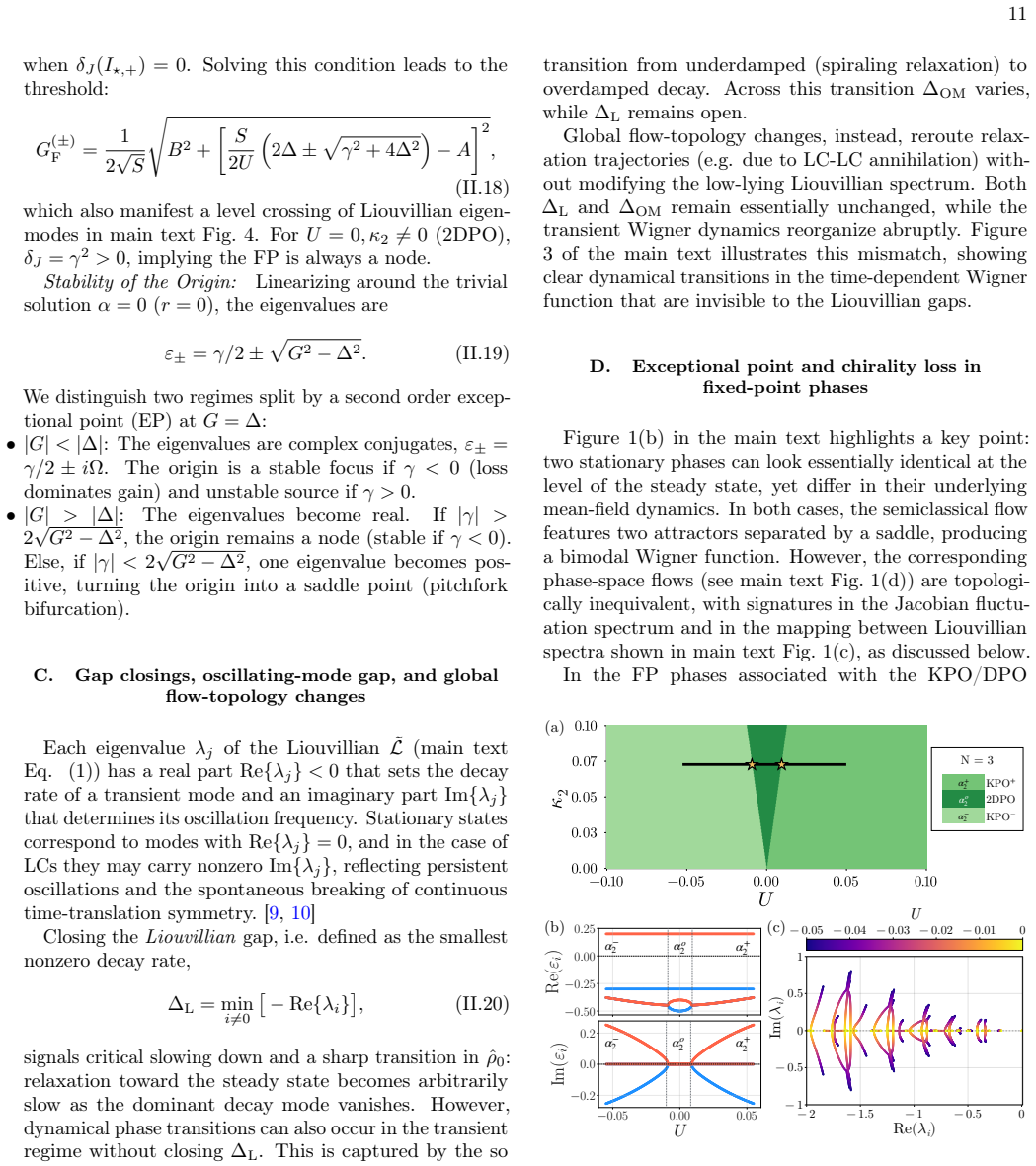
- [SM II.C, Eq. (II.20)-(II.21)] The definitions of Δ_L and Δ_OM are clear, but the text immediately concludes that 'global flow-topology changes ... leave the Liouvillian gaps unchanged' without citing the numerical data for Δ_OM. Fig. 4 only shows Δ_L, not Δ_OM. Please either show Δ_OM explicitly for the g transitions or state that Δ_OM is computed but not plotted.
Circularity Check
No significant circularity: the molecule is constructed from the mean-field flow, and the spectral/transient signatures are checked against independently computed Liouvillian data.
full rationale
The derivation chain is self-contained rather than circular. The molecule invariant is constructed from the mean-field flow Eq. (4), not from the Liouvillian spectrum or the transient Wigner functions it is used to interpret. The critical drive values G_min, G_star, G_H, and G_F are derived analytically from the mean-field Jacobian in the Supplemental Material (Eqs. II.10, II.17, II.18), with no parameters fitted to the quantum data. The claim that the real Liouvillian gap remains open across the global transitions is supported by the independently computed spectra in Fig. 4, and the level crossing of the low-lying Liouvillian modes at G_H is checked numerically against the analytic Jacobian prediction in SM Fig. 7. The global bifurcation sequence is obtained by numerical integration of the semiclassical flow (SM Sec. III) and by standard bifurcation analysis, not by assuming the molecule. Self-citations to Ref. [33] provide the earlier fixed-point graph invariant and chirality marker, and Ref. [35] is cited as a caveat on the semiclassical correspondence; these are background and limitation statements rather than the load-bearing derivation of the paper's new LC extension. The skeptic's concern that only low-lying eigenvalues were examined, without a full eigenmode-overlap analysis, is a question about the strength of the evidence for the 'spectrum misses transitions' claim, not a demonstration that any prediction reduces by construction to its inputs. No fitted input is renamed as a prediction, and no result is forced by a self-citation chain. The paper's central comparison between flow topology and Liouvillian spectra is an observational/falsifiable check, so the appropriate circularity score is low.
Assumptions & free parameters
assumptions (6)
- domain assumption Mean-field factorization <aba> ≈ <a><b><a> (neglect of quantum correlations)
- domain assumption Rotating-wave approximation and rotating frame at frequency ω
- domain assumption Morse-Smale structural stability of flow (4) for generic parameters
- standard math Poincare-Hopf index theorem on the compactified sphere
- domain assumption Compactification of the open plane to a sphere with a single virtual source at infinity
- standard math Completeness of the Oshemkov-Sharko classification of Morse-Smale flows with periodic orbits
invented entities (2)
-
molecule invariant
independent evidence
-
virtual source at infinity
Cite this review
Pith. "Pith review of Quantum Dynamical Signatures of Topological Flow Transitions in Limit Cycle Phases." pith.science (2026). https://pith.science/paper/7AO5V5BZ
@misc{pith2026251211747,
  author       = {Pith},
  title        = {Pith review of: Quantum Dynamical Signatures of Topological Flow Transitions in Limit Cycle Phases},
  year         = {2026},
  howpublished = {\url{https://pith.science/paper/7AO5V5BZ}},
  note         = {Machine review of arXiv:2512.11747}
}
read the original abstract
Quantum self-oscillatory phases are ubiquitous in driven-dissipative systems. Classically, each phase is defined by its flow pattern and how stationary sets organize phase space (e.g. fixed points and limit cycles), with transitions triggered by local bifurcations or global basin rearrangements. In the quantum regime, these reorganizations are often blurred by density-matrix averaging, and spectral indicators such as the Liouvillian gap can miss changes that unfold mainly in the transients. Here we introduce a topological graph invariant, the molecule, which captures the phase-space connectivity of fixed points and limit cycles. Transitions show up as discrete changes of this invariant, with each form marking a distinct quantum dynamical pattern (e.g. relaxation pathway). The molecule encodes the global topological constraints that govern how stationary sets and their basins can rearrange, clarifies when such rearrangements can affect the Liouvillian modes, and reveals additional transitions that remain hidden in the steady-state spectrum but stem from global changes of the flow topology. Our findings show that flow topology offers a clear and unified way to identify and classify dynamical phases beyond what Liouvillian spectra alone reveal.
Figures


Figures from the paper (5 more)




Reference graph
Works this paper leans on
-
[1]
Leuch, L
A. Leuch, L. Papariello, O. Zilberberg, C. L. Degen, R. Chitra, and A. Eichler, Physical Review Letters117, 214101 (2016)
2016
-
[2]
Kovacic, R
I. Kovacic, R. Rand, and S. Mohamed Sah, Applied Me- chanics Reviews70, 020802 (2018)
2018
-
[3]
Grimm, N
A. Grimm, N. E. Frattini, S. Puri, S. O. Mundhada, S. Touzard, M. Mirrahimi, S. M. Girvin, S. Shankar, and M. H. Devoret, Nature584, 205 (2020)
2020
-
[4]
Eichler and O
A. Eichler and O. Zilberberg,Classical and Quantum Parametric Phenomena(Oxford University Press, 2023)
2023
-
[5]
Keeling, M
J. Keeling, M. J. Bhaseen, and B. D. Simons, Phys. Rev. Lett.105, 043001 (2010)
2010
-
[6]
T. E. Lee and H. R. Sadeghpour, Phys. Rev. Lett.111, 234101 (2013)
2013
-
[7]
Lörch, J
N. Lörch, J. Qian, A. Clerk, F. Marquardt, and K. Ham- merer, Physical Review X4, 011015 (2014)
2014
-
[8]
Ben Arosh, M
L. Ben Arosh, M. C. Cross, and R. Lifshitz, Physical Review Research3, 013130 (2021)
2021
Show all 68 references
-
[9]
Kongkhambut, J
P. Kongkhambut, J. Skulte, L. Mathey, J. G. Cosme, A. Hemmerich, and H. Keßler, Science377, 670 (2022)
2022
-
[10]
Kehrer, C
T. Kehrer, C. Bruder, and P. Solanki, Phys. Rev. Lett. 135, 063601 (2025)
2025
-
[11]
J. Liu, Q. Wu, J. E. Moore, H. Haeffner, and C. W. Wächtler, arXiv:2509.18423 (2025), arXiv:2509.18423 [quant-ph]
2025 arXiv
-
[12]
J. J. G. Ripoll,Quantum information and quantum op- tics with superconducting circuits(Cambridge University Press, 2022)
2022
-
[13]
Ritsch, P
H. Ritsch, P. Domokos, F. Brennecke, and T. Esslinger, Reviews of Modern Physics85, 553 (2013)
2013
-
[14]
Leibfried, R
D. Leibfried, R. Blatt, C. Monroe, and D. Wineland, Reviews of Modern Physics75, 281 (2003)
2003
-
[15]
Poot and H
M. Poot and H. S. J. van der Zant, Physics Reports511, 273 (2012), arXiv: 1106.2060
2012 arXiv
-
[16]
C. Brif, R. Chakrabarti, and H. Rabitz, New Journal of Physics12, 075008 (2010)
2010
-
[17]
S. T. Cundiff and J. Ye, Rev. Mod. Phys.75, 325 (2003)
2003
-
[18]
W. Cai, Y. Ma, W. Wang, C.-L. Zou, and L. Sun, Funda- mental Research1, 50 (2021)
2021
-
[19]
M. J. Hartmann, F. G. S. L. Brandao, and M. B. Plenio, Laser & Photonics Reviews2, 527 (2008), arXiv:0808.2557 [quant-ph]
2008 arXiv
-
[20]
Eisert, M
J. Eisert, M. Friesdorf, and C. Gogolin, Nature Physics 11, 124 (2015)
2015
-
[21]
D. A. Abanin, E. Altman, I. Bloch, and M. Serbyn, Rev. Mod. Phys.91, 021001 (2019)
2019
-
[23]
Oka and S
T. Oka and S. Kitamura, Annual Review of Condensed Matter Physics10, 387 (2019)
2019
-
[26]
E. I. R. Chiacchio, A. Nunnenkamp, and M. Brunelli, Phys. Rev. Lett.131, 113602 (2023)
2023
-
[27]
del Pino, J
J. del Pino, J. Košata, and O. Zilberberg, Phys. Rev. Res. 6, 033180 (2024)
2024
-
[28]
M. Fu, O. Ameye, F. Yang, J. Košata, J. Del Pino, O. Zil- berberg, and E. Scheer, Physical Review Research7, 033127 (2025)
2025
-
[30]
Blaizot and G
J.-P. Blaizot and G. Ripka,Quantum theory of finite systems(MIT Press, Cambridge, Mass, 1986)
1986
-
[31]
Rossignoli and A
R. Rossignoli and A. M. Kowalski, Phys. Rev. A72, 032101 (2005)
2005
-
[32]
V. P. Flynn, E. Cobanera, and L. Viola, New Journal of Physics22, 083004 (2020), arXiv:2003.03405 [quant-ph]
2020 arXiv
-
[34]
Dumont, M
V. Dumont, M. Bestler, L. Catalini, G. Margiani, O. Zil- berberg, and A. Eichler, Phys. Rev. Res.6, 043012 (2024)
2024
-
[35]
Seibold, G
K. Seibold, G. Villa, J. del Pino, and O. Zilberberg, arXiv:2508.16486 (2025), arXiv:2508.16486 [quant-ph]
2025 arXiv
-
[36]
Glendinning,Stability, instability and chaos: an intro- duction to the theory of nonlinear differential equations (Cambridge university press, 1994)
P. Glendinning,Stability, instability and chaos: an intro- duction to the theory of nonlinear differential equations (Cambridge university press, 1994)
1994
-
[37]
Guckenheimer and P
J. Guckenheimer and P. Holmes,Nonlinear oscillations, dynamical systems, and bifurcations of vector fields, Vol. 42 (Springer Science & Business Media, 2013)
2013
-
[38]
Supplemental Material, Supplemental material (2025), see Supplemental Material for the construction of the invariant, the semiclassical stability analysis, and the bifurcation sequence in the region where five fixed points coexist with limit cycles
2025
-
[39]
Pandey, R
M. Pandey, R. H. Rand, and A. T. Zehnder, Nonlinear Dynamics54, 3 (2008)
2008
-
[40]
Wielinga and G
B. Wielinga and G. J. Milburn, Physical Review A48, 2494 (1993)
1993
-
[41]
Mirrahimi, Z
M. Mirrahimi, Z. Leghtas, V. V. Albert, S. Touzard, R. J. Schoelkopf, L. Jiang, and M. H. Devoret, New Journal of Physics16, 045014 (2014)
2014
-
[43]
Reisenbauer, H
M. Reisenbauer, H. Rudolph, L. Egyed, K. Hornberger, A. V. Zasedatelev, M. Abuzarli, B. A. Stickler, and U. Delić, Nature Physics20, 1629 (2024)
2024
-
[44]
Liška, T
V. Liška, T. Zemánková, P. Jákl, M. Šiler, S. H. Simpson, P. Zemánek, and O. Brzobohatý, Nature Physics20, 1622 (2024)
2024
-
[45]
Carlon Zambon, S
N. Carlon Zambon, S. R. K. Rodriguez, A. Lemaître, A. Harouri, L. Le Gratiet, I. Sagnes, P. St-Jean, S. Ravets, A. Amo, and J. Bloch, Physical Review A102, 023526 (2020)
2020
-
[46]
J. G. Bohnet, Z. Chen, J. M. Weiner, D. Meiser, M. J. Holland, and J. K. Thompson, Nature484, 78 (2012)
2012
-
[47]
Donner, Nature608, 494 (2022)
D.Dreon, A.Baumgärtner, X.Li, S.Hertlein, T.Esslinger, and T. Donner, Nature608, 494 (2022)
2022
-
[48]
Astafiev, K
O. Astafiev, K. Inomata, A. O. Niskanen, T. Yamamoto, Y. A. Pashkin, Y. Nakamura, and J. S. Tsai, Nature449, 588 (2007)
2007
-
[49]
B. Du, Q. Guo, S. López, and R. Ma, Phys. Rev. Res.7, L022038 (2025)
2025
-
[50]
Adinolfi, D
F. Adinolfi, D. Z. Haxell, A. Bruno, L. Michaud, V. H. Kamrul, P. Pandey, and A. Grimm, arXiv e-prints (2025), arXiv:2511.01027 [quant-ph]
2025
-
[51]
Y. Chu, P. Kharel, W. H. Renninger, L. D. Burkhart, L. Frunzio, P. T. Rakich, and R. J. Schoelkopf, Science 358, 199 (2017)
2017
-
[52]
Marthaler and M
M. Marthaler and M. I. Dykman, Physical Review A73, 042108 (2006)
2006
-
[53]
Macieszczak, M
K. Macieszczak, M. u. u. u. u. Guţă, I. Lesanovsky, and J. P. Garrahan, Phys. Rev. Lett.116, 240404 (2016)
2016
-
[54]
Smirnova, D
D. Smirnova, D. Leykam, Y. Chong, and Y. Kivshar, 7 Applied Physics Reviews7, 021306 (2020)
2020
-
[55]
Szameit and M
A. Szameit and M. C. Rechtsman, Nature Physics20, 905 (2024)
2024
-
[56]
Vijay, M
R. Vijay, M. H. Devoret, and I. Siddiqi, Review of Scien- tific Instruments80, 111101 (2009)
2009
-
[57]
Gravina, F
L. Gravina, F. Minganti, and V. Savona, PRX Quantum 4, 020337 (2023)
2023
-
[58]
Beato, P
N. Beato, P. Patil, and M. Bukov, Phys. Rev. X15, 041014 (2025), publisher: American Physical Society. 8 Supplemental Material: Quantum Dynamical Signatures of Topological Flow Transitions in Limit Cycle Phases Alejandro S. Gómez Javier del Pino Departamento de Física Teórica ...
2025
-
[59]
Single T rivial Attractor (1 FP):For |G|< Gmin, no real nontrivial solution exists; only the trivial fixed point remains
-
[60]
For A >0and Gmin <|G|< G ⋆, the system supports five FPs: the origin and two nontrivial pairs
Five-Solution Region (5 FPs):This phase re- quires two distinct positive rootsI⋆,± > 0, which occurs when A >0and C >0(i.e., |G|< G⋆). For A >0and Gmin <|G|< G ⋆, the system supports five FPs: the origin and two nontrivial pairs
-
[61]
−” branch (when it exists physically) contains only saddle points. The “+
Three-Solution Region (3 FPs):This phase occurs when exactly one rootI⋆ > 0. For A >0, this requires a negative product of roots (|G| ≥G⋆). For A <0, a real discriminant and a positive root likewise require a negative product, again giving |G| ≥G⋆. Thus, for any A, the conditi...
-
[62]
In this context, hyperbolicity ensures the dynamics are decisive: at any equilibrium or closed loop, the system strictly attracts or repels nearby trajectories, with no neutral directions where behavior is ambiguous
-
[63]
Peixoto, Topology1, 101 (1962)
M. Peixoto, Topology1, 101 (1962)
1962
-
[64]
Villa, J
G. Villa, J. del Pino, V. Dumont, G. Rastelli, M. Michałek, A. Eichler, and O. Zilberberg, Science Advances11, eadt9311 (2025)
2025
-
[65]
The stable (unstable) manifold is the set of all trajectories winding into (out of) a FP or cycle. Transversality requires that if these manifolds intersect, their tangent vectors at the intersection point must span the entire phase space; visually, they must cross at a non-ze...
-
[66]
Soriente, T
M. Soriente, T. L. Heugel, K. Omiya, R. Chitra, and O. Zilberberg, Physical Review Research3, 023100 (2021)
2021
-
[67]
A. A. Oshemkov and V. V. Sharko, Sbornik: Mathematics 189, 1205 (1998)
1998
-
[68]
Nakahara,Geometry, topology and physics(CRC press, 2018)
M. Nakahara,Geometry, topology and physics(CRC press, 2018)
2018
-
[69]
R. H. Rand, Lecture notes on nonlinear vibrations (2012)
2012
-
[70]
Minganti, A
F. Minganti, A. Biella, N. Bartolo, and C. Ciuti, Physical Review A98, 042118 (2018)
2018
-
[71]
Dutta, S
S. Dutta, S. Zhang, and M. Haque, Phys. Rev. Lett.134, 050407 (2025)
2025
-
[72]
Haga, Physical Review B110, 104303 (2024)
T. Haga, Physical Review B110, 104303 (2024)
2024
-
[73]
Minganti, A
F. Minganti, A. Miranowicz, R. W. Chhajlany, and F. Nori, Physical Review A100, 062131 (2019)
2019
-
[74]
Rackauckas and Q
C. Rackauckas and Q. Nie, Journal of Open Research Software5(2017)
2017
Reviewed August 3, 2026 · model on record in the stance chip above.
Discussion (0). Sign in to comment.