Inflation from Covariant Signature Change: A Geometric Mechanism
Pith reviewed 2026-07-03 21:46 UTC · model grok-4.3
The pith
A covariant change in metric signature from Euclidean to Lorentzian drives a finite period of accelerated expansion through a localized geometric effective source.
A machine-rendered reading of the paper's core claim, the machinery that carries it, and where it could break.
Core claim
Using a covariant continuation of the metric across a codimension-one hypersurface where it becomes degenerate but curvature invariants stay finite, the Einstein tensor is expressed as a localized effective source dependent on the interpolator. In the Lorentzian branch, the condition for accelerated expansion is that the slope of the interpolator exceeds a critical value determined by the extrinsic curvature and the spatial Ricci curvature on the initial hypersurface; inflation ceases at the first saturation of this inequality.
What carries the argument
The scalar interpolator along a timelike congruence, which parametrizes the smooth signature change and generates the interpolator-dependent effective source from the continued Einstein tensor.
If this is right
- Standard smooth profiles such as tanh, generalized logistic, and power-law/arctan admit closed-form expressions for the proper-time duration of the accelerated epoch.
- For fixed geometric data on the initial hypersurface, the shape of the interpolator profile controls the duration of inflation.
- The mechanism supplies a non-singular, inflaton-free route from a regular Euclidean origin to an early Lorentzian phase of accelerated expansion.
- It is compatible with no-boundary-type boundary conditions.
Where Pith is reading between the lines
- If the criterion holds, numerical simulations of signature-changing spacetimes could verify the predicted end of acceleration when the slope matches the critical value.
- This geometric source might be explored in analogue systems where effective metrics change signature.
- The dependence on profile shape suggests that different transition dynamics could lead to different numbers of e-folds for the same initial curvatures.
Load-bearing premise
The metric admits a covariant continuation across the codimension-one hypersurface where it becomes degenerate, such that curvature invariants remain finite and the Einstein tensor can be rewritten as a localized effective source.
What would settle it
A calculation or simulation showing that acceleration does not end precisely when the interpolator's slope first equals the critical value computed from the extrinsic curvature and spatial Ricci curvature on the initial hypersurface would falsify the local criterion.
Figures
read the original abstract
We present a covariant mechanism in which a smooth change of metric signature, from a Euclidean to a Lorentzian regime, drives a finite interval of accelerated expansion. The transition, encoded by a scalar interpolator along a timelike congruence, occurs on a codimension-one hypersurface where the continued metric is degenerate but curvature invariants remain finite, so the surface is curvature-regular. Using this covariant continuation, we rewrite the Einstein tensor of the continued metric as a localized, interpolator-dependent effective source for the post-transition Lorentzian branch, yielding a purely geometric stress tensor supported near the crossing. In the Lorentzian regime, we derive a model-independent, local criterion for acceleration: inflation persists while the interpolator's slope exceeds a critical value fixed by the extrinsic curvature and the spatial Ricci curvature on the initial hypersurface, and ends when this inequality is first saturated. Standard smooth profiles (tanh, generalized logistic, and power-law/arctan) admit closed-form expressions for the proper-time duration of the accelerated epoch, showing that, for fixed geometric data, the profile shape controls this duration. The construction provides a non-singular, inflaton-free route from a regular Euclidean origin to an early Lorentzian phase of accelerated expansion, in a manner compatible with no--boundary--type boundary conditions.
Editorial analysis
A structured set of objections, weighed in public.
Referee Report
Summary. The paper claims that a smooth, covariant signature change from Euclidean to Lorentzian, encoded by a scalar interpolator along a timelike congruence across a codimension-one degenerate hypersurface, produces a finite epoch of accelerated expansion. Using an assumed covariant continuation that keeps curvature invariants finite, the Einstein tensor is rewritten as a localized, interpolator-dependent effective geometric source. This yields a model-independent local criterion for inflation in the Lorentzian regime: acceleration persists while the interpolator slope exceeds a critical value set by the extrinsic curvature and spatial Ricci curvature on the initial hypersurface, terminating when the inequality saturates. Closed-form proper-time durations are derived for tanh, generalized logistic, and power-law/arctan profiles, with duration controlled by profile shape for fixed geometric data. The construction is presented as a non-singular, inflaton-free route from a regular Euclidean origin compatible with no-boundary conditions.
Significance. If the covariant continuation with finite invariants can be established, the work supplies a purely geometric mechanism for early accelerated expansion without an inflaton, potentially linking Euclidean and Lorentzian regimes in a manner consistent with no-boundary proposals. The derivation of closed-form durations for multiple standard profiles is a concrete strength, and the local slope-based criterion offers a falsifiable geometric condition independent of the specific interpolator functional form. However, the duration's explicit dependence on profile choice limits the mechanism's predictive power beyond the local criterion itself.
major comments (3)
- [derivation of the local criterion and Einstein-tensor rewriting] The derivation of the local acceleration criterion and the rewriting of the Einstein tensor as an effective source both presuppose a covariant continuation across the degenerate hypersurface such that curvature invariants remain finite and no delta-function singularities appear. The manuscript asserts this continuation exists but does not supply an explicit metric ansatz, coordinate chart, or direct verification that the Einstein tensor remains well-defined and can be recast in the claimed localized form; this step is load-bearing for the central claim.
- [local criterion for acceleration] The local criterion is presented as model-independent because the critical slope value is fixed solely by the extrinsic curvature and spatial Ricci curvature. However, the manuscript does not demonstrate that this critical value is numerically or functionally identical when computed from the continued metric for each of the three profiles (tanh, logistic, power-law); an explicit cross-profile check is required to confirm independence from interpolator details.
- [closed-form expressions for proper-time duration] The duration of the accelerated epoch is stated to be controlled by the chosen profile shape for fixed geometric data. This renders the duration an input parameter rather than an output derived from the geometry alone, which undercuts the claim that the mechanism yields a predictive finite interval of inflation independent of additional choices.
minor comments (2)
- Notation for the scalar interpolator and its slope should be introduced with a single consistent symbol and derivative convention at first appearance to avoid ambiguity when the critical-slope inequality is stated.
- The abstract and introduction would benefit from a brief statement clarifying that the duration depends on profile choice, to set reader expectations before the closed-form results are presented.
Simulated Author's Rebuttal
We thank the referee for the thorough reading and insightful comments on our manuscript. We address each major comment below, indicating where revisions will be made to strengthen the presentation.
read point-by-point responses
-
Referee: [derivation of the local criterion and Einstein-tensor rewriting] The derivation of the local acceleration criterion and the rewriting of the Einstein tensor as an effective source both presuppose a covariant continuation across the degenerate hypersurface such that curvature invariants remain finite and no delta-function singularities appear. The manuscript asserts this continuation exists but does not supply an explicit metric ansatz, coordinate chart, or direct verification that the Einstein tensor remains well-defined and can be recast in the claimed localized form; this step is load-bearing for the central claim.
Authors: We agree that an explicit metric ansatz and coordinate verification would make the covariant continuation more transparent. In the revised version we will add a dedicated subsection providing a concrete coordinate chart and metric form across the degenerate hypersurface, together with direct verification that all curvature invariants remain finite and that the Einstein tensor reduces to the claimed localized, interpolator-dependent expression without delta-function contributions. revision: yes
-
Referee: [local criterion for acceleration] The local criterion is presented as model-independent because the critical slope value is fixed solely by the extrinsic curvature and spatial Ricci curvature. However, the manuscript does not demonstrate that this critical value is numerically or functionally identical when computed from the continued metric for each of the three profiles (tanh, logistic, power-law); an explicit cross-profile check is required to confirm independence from interpolator details.
Authors: The critical slope is obtained from the general decomposition of the Einstein tensor on the continued metric before any specific interpolator is chosen, so the expression is formally independent of profile details. To address the request for explicit confirmation we will include a short appendix computing the critical value numerically for each of the three profiles on the same background geometric data, verifying that the threshold coincides to within numerical precision. revision: yes
-
Referee: [closed-form expressions for proper-time duration] The duration of the accelerated epoch is stated to be controlled by the chosen profile shape for fixed geometric data. This renders the duration an input parameter rather than an output derived from the geometry alone, which undercuts the claim that the mechanism yields a predictive finite interval of inflation independent of additional choices.
Authors: The manuscript already states explicitly that, for fixed geometric data, the duration is controlled by the profile shape. The central predictive content of the work is the local, geometry-only criterion that determines when acceleration begins and ends; this criterion is independent of the interpolator. The closed-form durations are supplied to show how standard profiles translate the same geometric threshold into concrete intervals, not to assert a unique duration fixed solely by geometry. We therefore do not view the profile dependence as undercutting the mechanism. revision: no
Circularity Check
No significant circularity; central criterion follows from geometric rewriting without reduction to inputs.
full rationale
The paper's core derivation rewrites the Einstein tensor of the continued metric as a localized effective source and extracts a model-independent inequality for acceleration based on interpolator slope versus extrinsic and spatial Ricci curvatures on the initial hypersurface. This step is presented as following directly from the covariant continuation assumption with finite invariants. The closed-form durations for example profiles (tanh, logistic, power-law) are explicit calculations that illustrate dependence on the chosen interpolator shape for fixed geometric data, not independent predictions or fitted outputs renamed as results. No self-citations, uniqueness theorems, or ansatzes are invoked in a load-bearing manner within the provided text, and the criterion remains independent of any specific profile. The construction is therefore self-contained against its stated assumptions.
Axiom & Free-Parameter Ledger
axioms (1)
- domain assumption Einstein equations hold on both sides of the transition and the metric can be continued covariantly while curvature invariants stay finite.
invented entities (1)
-
Scalar interpolator
no independent evidence
Reference graph
Works this paper leans on
-
[1]
Lorentzian metric signa- ture is (−,+,+,+) and Euclidean metric signature is (+,+,+,+)
Conventions Except when indicated otherwise, we work in units withc= 1 andℏ= 1. Lorentzian metric signa- ture is (−,+,+,+) and Euclidean metric signature is (+,+,+,+). The projection tensor onto the spatial hy- persurfaces orthogonal to the preferred congruenceu a is hab ≡g ab +u aub,(A1) and our convention for the extrinsic curvature of these hypersurfac...
-
[2]
degenerate but non–singular
Useful formulae We summarize here the main geometric identities for the class of covariant continued metricsbg ab used in the main text (see also Ref. [11]). The covariant continuation is defined by bgab =g ab −Θu aub,bg ab =g ab +F t atb, t a =g abub, (A3) with F= Θ 1 + Θ, ˙F= ˙Θ (1 + Θ)2 ,(A4) and ∇aF=− ˙F t a,∇ a ˙F=− ¨F t a − ˙F a a.(A5) Hereu a is th...
-
[3]
Geometric decomposition and small parameters We introduce two independent small, dimensionless parameters:σ K (anisotropy of the extrinsic curvature) andσ a (non–geodesicity ofu a). Extrinsic curvature.The extrinsic curvature of the ua–orthogonal slices is decomposed as Kmn = K 3 hmn +σ K ¯Kmn, h mn ¯Kmn = 0,(B2) whereK≡g mnKmn is the expansion scalar of ...
-
[4]
Heat fluxq m From Sec. III the heat flux is qm = Θa nKmn.(B5) Substituting (B2) and (B4) yields qm = Θ (σa¯an) K 3 hmn +σ K ¯Kmn =σ a Θ K 3 ¯am +σ aσK Θ ¯an ¯Kmn.(B6) 11 Since Θ,K, ¯a m and ¯Kmn are assumed bounded near Σ0, there exists a constantC q >0 such that, in a local orthonormal frame, |qm| ≤C q σa ⇒q m =O(σ a),(B7) Thus the heat flux is linearly ...
-
[5]
III is πmn = Θ " 2t(mKn)a∇uua −KK mn − ∇uKmn + hmn 3 ∇uK+K 2 # + ˙Θ 6 (Kh mn −3K mn),(B8) with∇ u ≡u a∇a
Anisotropic stressπ mn The anisotropic stress tensor derived in Sec. III is πmn = Θ " 2t(mKn)a∇uua −KK mn − ∇uKmn + hmn 3 ∇uK+K 2 # + ˙Θ 6 (Kh mn −3K mn),(B8) with∇ u ≡u a∇a. For an exactly isotropic case, it is straightforward to check thatπ mn = 0 due to non-trivial cancellations among the terms in (B8). We now perturb around this isotropic, geodesic co...
-
[6]
III, the effective energy density can be writ- ten as ρ= F 2 ∇mam − (3)R+ Θ∇ uK , F≡ Θ 1 + Θ
Comparison with the isotropic energy density From Sec. III, the effective energy density can be writ- ten as ρ= F 2 ∇mam − (3)R+ Θ∇ uK , F≡ Θ 1 + Θ. (B12) Near Σ0 we have Θ =−1 +εand F= −1 +ε ε =− 1 ε + 1.(B13) Usinga m =σ a¯am we obtain ∇mam =O(σ a).(B14) It is convenient to introduce ∆≡ ∇ uK+ (3)R,(B15) Hence ρ= 1 2 −1 ε + 1 −∆ +∇ mam +ε∇ uK = ∆ 2ε +O σ...
-
[7]
Definition and slope
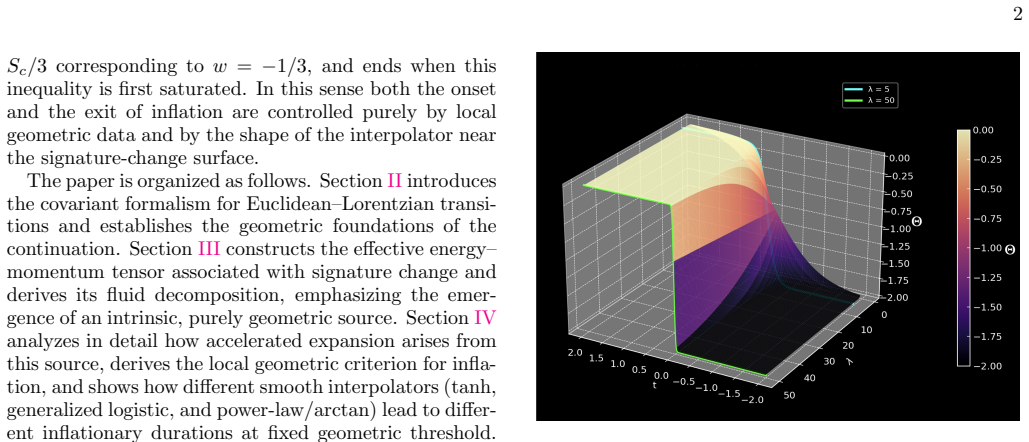
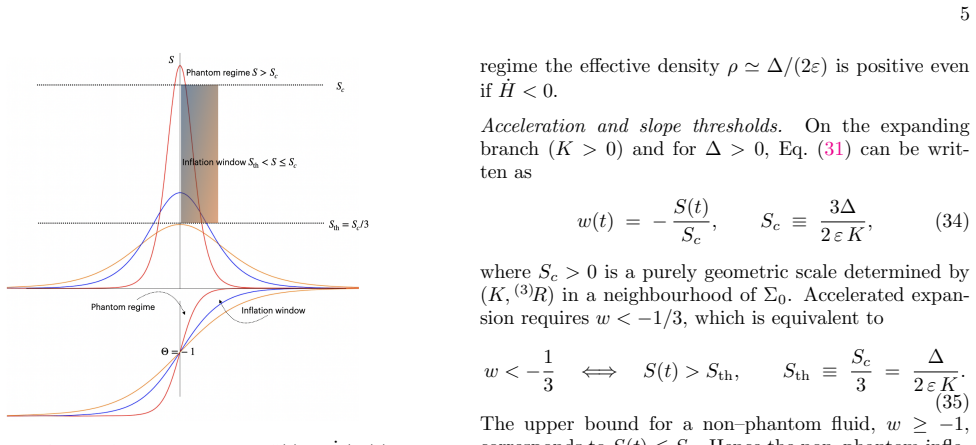
Tanh interpolator a. Definition and slope. Θtanh(t;λ) = tanh(λt)−1, S(t) = ˙Θ(t) =λsech 2(λt), S(0+) =λ. (C1) The microscopic transition width scales as ∆t tr ∼λ −1. b. Inflation window and end time.Inflation requires Sth < S(t)≤S c, i.e. λ > Sc 3 andλ≤S c (to avoidw <−1).(C2) The end time is fixed byS(t end) =S th: sech2 λtend = Sth λ , ∆t(tanh) inf = 1 ...
-
[8]
Generalized logistic interpolator a. Definition and slope.To interpolate from Eu- clidean to Lorentzian across Θ =−1 one may consider ΘGL(t;a, b, m) = 2 1 + exp −a(t/b)m −2, a, b >0, modd integer, (C4) with derivative S(t)≡ ˙Θ(t) = 2am bm t m−1e−a(t/b)m 1 +e −a(t/b)m 2 , S(0+) = a 2b , m= 1, 0, m≥3 odd. (C5) Form= 1 one has S(t) = a 2b sech2 at 2b ,...
-
[9]
Definition and slope
Power–law (arctan) interpolator a. Definition and slope. ΘPL(t;λ) = 2 π arctan(λt)−1, S(t) = ˙Θ(t) = 2 π λ 1 +λ 2t2 , S(0+) = 2 π λ. (C7) This profile has Θ(0) =−1 and Θ→0 − ast→+∞. b. Inflation window and end time.Inflation occurs only while Sc 3 < 2 π λ≤S c ⇐ ⇒ π 2 Sc 3 < λ≤ π 2 Sc.(C8) SolvingS(t end) =S th gives ∆t(PL) inf = 1 λ r S0 Sth −1, S0 =S(0 +...
-
[10]
Geometric scale and quasi–de Sitter regime In a closed FRW background with expansion rateH and curvature (3)R= 6/a 2 one hasK= 3Hand ∆ =∇ uK+ (3)R= 3 ˙H+ 6 a2 .(D2) It is convenient to introduce the geometric deviation pa- rameter ϵG ≡ ∆ 3H2 = ˙H H2 + 2 a2H2 ,∆ = 3ϵ GH2,(D3) so that the geometric scaleS c of Eq. (34) reads Sc = 3∆ 2εK = 3ϵ G H 2ε .(D4) In...
-
[11]
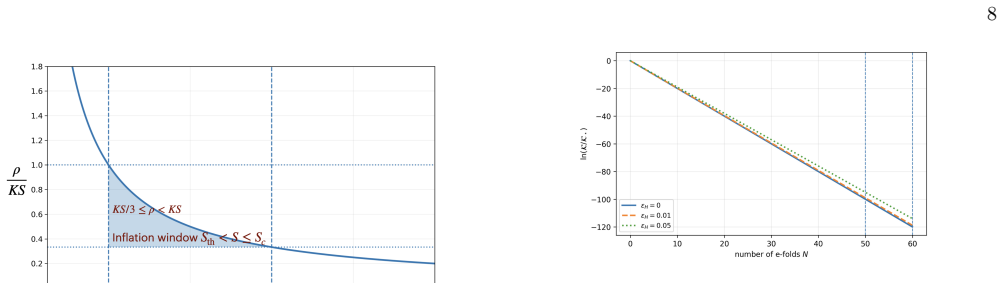
(D1) gives Ne = 1 ϵH ln 1 +ϵ H H⋆∆tinf ,∆t inf ≡t end −t ⋆
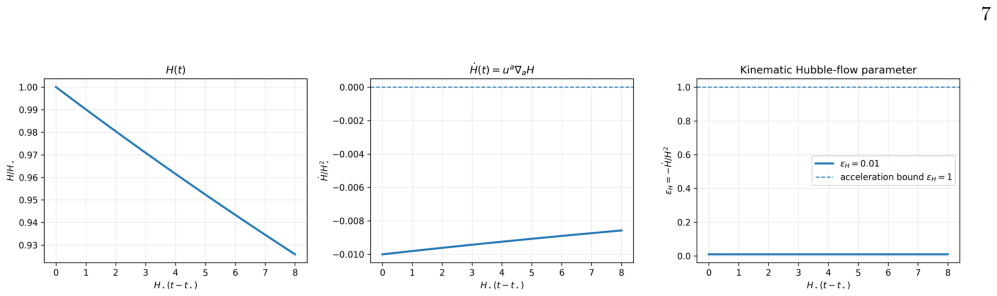
Constant-ϵ H toy model As a simple check of the quasi–de Sitter estimate, con- sider a purely kinematic toy model with constant ϵH ≡ − ˙H H2 = const,(D13) so that ˙H=−ϵ H H2 and henceH(t) =H ⋆/[1+ϵ H H⋆(t− t⋆)].Substituting into Eq. (D1) gives Ne = 1 ϵH ln 1 +ϵ H H⋆∆tinf ,∆t inf ≡t end −t ⋆. (D14) Introducingx≡ϵ H H⋆∆tinf, one has Ne = 1 ϵH ln(1 +x), N (a...
-
[12]
relative corrections∼ϵ effNe
Summary of geometric scaling Collecting the frozen-threshold expression results, the two representative interpolators yield N(tanh) e ≈0.76 ε ϵG , N (PL) e ≈0.60 ε ϵG ,(D17) up to absolute corrections of orderϵ effH2 ⋆∆t2 inf ∼ϵ effN2 e , i.e. relative corrections∼ϵ effNe. These formulas are con- trolled analytic limits in which the geometric threshold is...
-
[13]
Remark on moving thresholds The closed-form estimates above treatS th andS c as approximately fixed over the interval during which the interpolator slope is compared with the threshold. This is a useful local analytic expression, but in a curvature- supported closed branch the threshold can move because the curvature term in ∆ = 3 ˙H+ 6 a2 (D18) evolves d...
-
[14]
J. B. Hartle and S. W. Hawking, Physical Review D28, 2960 (1983)
1983
-
[15]
G. W. Gibbons and J. B. Hartle, Physical Review D42, 2458 (1990)
1990
-
[16]
Deformed General Relativity and Effective Actions from Loop Quantum Gravity
M. Bojowald and G. M. Paily, Phys. Rev. D86, 104018 (2012), arXiv:1112.1899 [gr-qc]
work page internal anchor Pith review Pith/arXiv arXiv 2012
- [17]
-
[18]
Background Independent Quantum Gravity: A Status Report
A. Ashtekar and J. Lewandowski, Classical and Quantum Gravity21, R53 (2004), arXiv:gr-qc/0404018
work page internal anchor Pith review Pith/arXiv arXiv 2004
-
[19]
Anomaly-free scalar perturbations with holonomy corrections in loop quantum cosmology
T. Cailleteau, J. Mielczarek, A. Barrau, and J. Grain, Classical and Quantum Gravity29, 095010 (2012), arXiv:1111.3535 [gr-qc]
work page internal anchor Pith review Pith/arXiv arXiv 2012
-
[20]
How to Wick rotate generic curved spacetime
M. Visser, arXiv:1702.05572 [gr-qc]
work page internal anchor Pith review Pith/arXiv arXiv
-
[21]
Wick Rotation in the Tangent Space
J. Samuel, Class. Quant. Grav.33, 015006 (2016), arXiv:1510.07365 [gr-qc]
work page internal anchor Pith review Pith/arXiv arXiv 2016
-
[22]
Action and Observer dependence in Euclidean quantum gravity
D. Kothawala, Class. Quant. Grav.35, 03LT01 (2018), arXiv:1705.02504 [gr-qc]
work page internal anchor Pith review Pith/arXiv arXiv 2018
-
[23]
Euclidean Action and the Einstein tensor
D. Kothawala, Phys. Rev. D97, 124062 (2018), arXiv:1802.07055 [gr-qc]
work page internal anchor Pith review Pith/arXiv arXiv 2018
-
[24]
R. Singh and D. Kothawala, Eur. Phys. J. C83, 194 (2023), arXiv:2010.01822 [gr-qc]
-
[25]
S. A. Hayward, Class. Quant. Grav.9, 1851 (1992)
1992
-
[26]
Bondarenko, Universe8, 497 (2022), arXiv:2111.06095 [gr-qc]
S. Bondarenko, Universe8, 497 (2022), arXiv:2111.06095 [gr-qc]
-
[27]
Embacher, Physical Review D51, 6764 (1995)
F. Embacher, Physical Review D51, 6764 (1995)
1995
- [28]
discussion (0)
Sign in with ORCID, Apple, or X to comment. Anyone can read and Pith papers without signing in.