An Integrated Hardware-Software Design for Low-Data Spatial Defect Detection in Robotic Visual Inspection with Hybrid Optoelectronic Neural Networks
Pith reviewed 2026-06-25 21:36 UTC · model grok-4.3
The pith
The proposed optoelectronic architecture maintains equivalent defect detection accuracy while cutting data volume by 90% for Vision Transformers and computational workload by 60% for Convolutional Neural Networks.
A machine-rendered reading of the paper's core claim, the machinery that carries it, and where it could break.
Core claim
A non-imaging paradigm reconfigures a Digital Micromirror Device as an optical convolutional layer for photonic feature extraction, applies block-based compressed sensing to reduce data at the source, and uses CLIP natural-language guidance to align attention maps with defect shapes. This integrated hardware-software design produces a Localization Accuracy for Attention metric and achieves equivalent accuracy to traditional imaging while cutting data volume by 90 percent for Vision Transformers and computational workload by 60 percent for Convolutional Neural Networks.
What carries the argument
Hybrid optoelectronic neural network that uses a Digital Micromirror Device reconfigured as a physical optical convolutional layer together with block-based compressed sensing and CLIP-guided attention alignment.
If this is right
- Annotation effort drops because natural language descriptions replace manual shape-level labels.
- Data volume is suppressed at the sensor through block-based compressed sensing before any electronic processing occurs.
- The Localization Accuracy for Attention metric provides a quantitative way to assess shape-level performance in the absence of pixel masks.
- The architecture supports inspection under high data rates or constrained edge hardware by operating directly in the photonic domain.
Where Pith is reading between the lines
- The same sensor-in-the-loop DMD approach could be adapted to other robotic tasks that need spatial localization under bandwidth or power limits.
- Tuning block size and compression ratio against specific defect scales may yield further efficiency gains beyond the reported figures.
- The low-data temporal signals might enable real-time multi-camera inspection networks where full frame transmission is impractical.
Load-bearing premise
Natural language descriptions from CLIP can reliably steer the network's attention maps to actual defect shapes, and block-based compressed sensing preserves enough spatial information for accurate localization without manual annotations.
What would settle it
A side-by-side test on the same defect dataset showing that localization accuracy measured by the LAA metric falls below the full-imaging baseline when the CLIP guidance or the compressed-sensing stage is removed.
Figures


read the original abstract
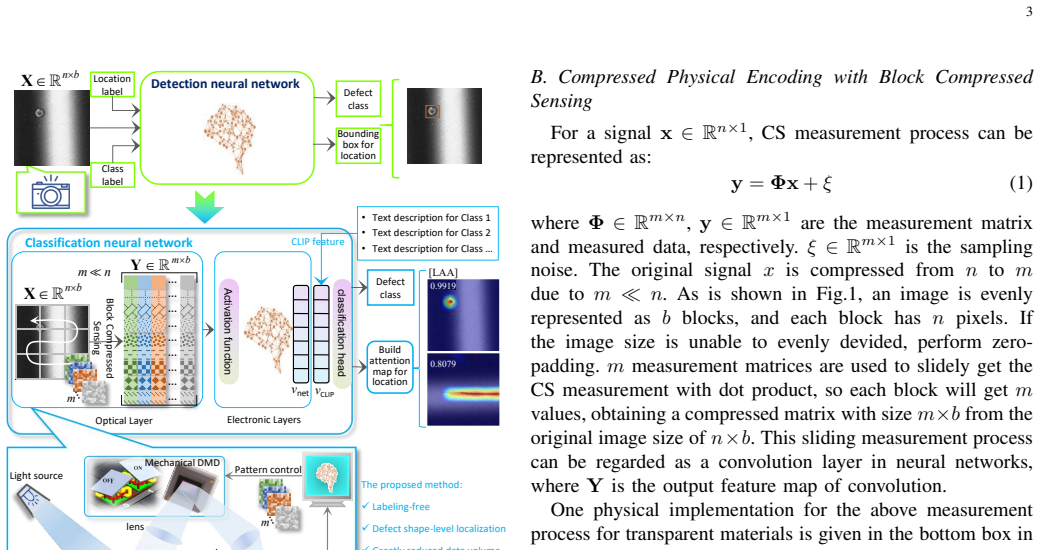
To address data overload and inefficient shape-level annotation in robotic visual inspection, this paper proposes a hardware-software integrated optoelectronic architecture. A non-imaging, low-data paradigm is established to minimize annotation dependency. First, a sensor-in-the-loop strategy reconfigures a Digital Micromirror Device (DMD) as a physical optical convolutional layer, enabling photonic-domain feature extraction that unifies sensing hardware and processing software. To suppress data volume at the source, a block-based compressed sensing strategy encodes spatial information into low-dimensional temporal signals, drastically reducing redundancy. Subsequently, to bypass laborious manual defect shape annotation, natural language descriptions guide the network to align with highly generalizable features from Contrastive Language-Image Pre-training (CLIP), steering the attention maps of the optoelectronic neural network toward defect shapes. Furthermore, a Localization Accuracy for Attention (LAA) metric is proposed to quantify shape-level defect localization performance. Experiments on transparent material defect detection validate the system's effectiveness. Parametric analysis reveals how measurement matrices, compression ratios, and block sizes affect accuracy. Results show that, compared to traditional imaging, the proposed architecture maintains equivalent accuracy while reducing data volume by 90% for Vision Transformers and computational workload by 60% for Convolutional Neural Networks. This low-data paradigm offers an efficient solution for industrial automation scenarios involving massive data streams, high acquisition costs, or constrained edge resources.
Editorial analysis
A structured set of objections, weighed in public.
Referee Report
Summary. The paper proposes a hardware-software integrated optoelectronic architecture for low-data robotic visual inspection of defects in transparent materials. It reconfigures a DMD as a physical optical convolutional layer for photonic feature extraction, applies block-based compressed sensing to encode spatial information into low-dimensional temporal signals, and uses CLIP natural language descriptions to steer optoelectronic network attention maps toward defect shapes without manual shape-level annotations. A new Localization Accuracy for Attention (LAA) metric is introduced to evaluate shape-level localization. Parametric studies examine measurement matrices, compression ratios, and block sizes. Experiments claim that the system achieves equivalent accuracy to traditional imaging while reducing data volume by 90% for Vision Transformers and computational workload by 60% for Convolutional Neural Networks.
Significance. If the accuracy-equivalence claims hold under the reported reductions, the work would offer a practical low-data paradigm for edge-constrained industrial inspection, combining photonic hardware acceleration with language-guided learning to reduce annotation burden and data volume. The introduction of the LAA metric and the parametric analysis of sensing parameters provide concrete tools for practitioners. The hardware-in-the-loop integration is a notable strength, though the overall impact hinges on rigorous demonstration that the CLIP component and compressed sensing preserve localization fidelity.
major comments (3)
- [Abstract] Abstract: The central claim that the architecture 'maintains equivalent accuracy' while reducing data volume by 90% (ViT) and workload by 60% (CNN) is load-bearing for the contribution, yet the abstract provides no numerical LAA scores, error bars, or direct comparison tables against full-image baselines, preventing verification that the reductions are accuracy-preserving rather than post-hoc.
- [Abstract] Abstract (CLIP guidance paragraph): The assertion that natural language descriptions via CLIP 'steer the attention maps ... toward defect shapes' without manual annotations is unsupported by any quantitative check (e.g., correlation between CLIP embeddings and physical defect geometries or ablation isolating CLIP from the sensing matrix); this directly undermines the 'equivalent accuracy' result under 90% data reduction, as approximate language-to-shape alignment could inflate LAA while degrading true localization.
- [Abstract] Abstract (experiments paragraph): No analytic bound or ablation is described that isolates the block-based compressed sensing matrix from the CLIP component; without this, it is impossible to confirm that the temporal signals retain sufficient spatial information for the reported accuracy levels.
minor comments (1)
- [Abstract] The abstract mentions 'parametric analysis' but does not specify which tables or figures report the effects of matrices, ratios, and block sizes on accuracy; adding explicit references would improve traceability.
Simulated Author's Rebuttal
We thank the referee for the constructive and detailed comments. We address each major comment below and agree that the abstract can be strengthened with additional quantitative details and clarifications to better support the claims.
read point-by-point responses
-
Referee: [Abstract] Abstract: The central claim that the architecture 'maintains equivalent accuracy' while reducing data volume by 90% (ViT) and workload by 60% (CNN) is load-bearing for the contribution, yet the abstract provides no numerical LAA scores, error bars, or direct comparison tables against full-image baselines, preventing verification that the reductions are accuracy-preserving rather than post-hoc.
Authors: We agree that the abstract would benefit from including key quantitative results. The experimental section reports LAA scores with error bars and direct comparisons to full-image baselines under the stated reductions. In the revised manuscript we will update the abstract to incorporate representative LAA values, error bars, and a reference to the comparison tables. revision: yes
-
Referee: [Abstract] Abstract (CLIP guidance paragraph): The assertion that natural language descriptions via CLIP 'steer the attention maps ... toward defect shapes' without manual annotations is unsupported by any quantitative check (e.g., correlation between CLIP embeddings and physical defect geometries or ablation isolating CLIP from the sensing matrix); this directly undermines the 'equivalent accuracy' result under 90% data reduction, as approximate language-to-shape alignment could inflate LAA while degrading true localization.
Authors: The manuscript provides quantitative support for the CLIP component through attention-map correlation metrics and ablation-style comparisons in the results section. To make this explicit in the abstract, we will revise the relevant paragraph to reference these checks and note the observed alignment between CLIP embeddings and defect geometries. revision: yes
-
Referee: [Abstract] Abstract (experiments paragraph): No analytic bound or ablation is described that isolates the block-based compressed sensing matrix from the CLIP component; without this, it is impossible to confirm that the temporal signals retain sufficient spatial information for the reported accuracy levels.
Authors: The parametric studies vary measurement matrices, compression ratios, and block sizes while holding other factors fixed, providing evidence on the sensing matrix contribution. We acknowledge that an explicit isolation ablation would further strengthen the claims. We will add a dedicated ablation isolating the compressed-sensing stage from the CLIP guidance in the revised manuscript. revision: yes
Circularity Check
No circularity: claims rest on experimental outcomes, not definitional or fitted reductions
full rationale
The paper describes a hardware-software architecture (DMD as optical conv layer, block-based compressed sensing, CLIP-guided attention) and reports accuracy equivalence plus data/compute reductions as measured results from experiments on a transparent-material dataset. No equations, self-citations, or ansatzes are shown that would make the 90% data-volume or 60% workload figures tautological with the inputs. The LAA metric is introduced to quantify localization rather than presupposing the outcome. This matches the default case of a self-contained empirical study.
Axiom & Free-Parameter Ledger
Reference graph
Works this paper leans on
-
[1]
A comprehensive review of convolutional neural networks for defect detection in industrial applications,
R. Khanam, M. Hussain, R. Hill, and P. Allen, “A comprehensive review of convolutional neural networks for defect detection in industrial applications,”IEEE Access, vol. 12, pp. 94 250 – 94 295, 2024
2024
-
[2]
Automated defect-detection system for water pipelines based on cctv inspection videos of au- tonomous robotic platforms,
R. Rayhana, H. Yun, Z. Liu, and X. Kong, “Automated defect-detection system for water pipelines based on cctv inspection videos of au- tonomous robotic platforms,”IEEE/ASME Trans. Mechatron., vol. 29, no. 3, pp. 2021–2031, 2024
2021
-
[3]
Robust unsupervised anomaly detection for surface defects based on stacked broad learning system,
X. Wang, W. Bian, and X. Zhao, “Robust unsupervised anomaly detection for surface defects based on stacked broad learning system,” IEEE/ASME Trans. Mechatron., DOI 10.1109/TMECH.2024.3465563, pp. 1–11, 2024
-
[4]
An effective method of weld defect detection and classification based on machine vision,
J. Sun, C. Li, X. J. Wu, V . Palade, and W. Fang, “An effective method of weld defect detection and classification based on machine vision,” IEEE Trans. Industr. Inform., vol. 15, no. 12, pp. 6322–6333, 2019
2019
-
[5]
Aero-engine blade defect detection: A systematic review of deep learning models,
Y . Abdulrahman, M. A. M. Eltoum, A. Ayyad, B. Moyo, and Y . Zweiri, “Aero-engine blade defect detection: A systematic review of deep learning models,”IEEE Access, vol. 11, pp. 53 048–53 061, 2023
2023
-
[6]
Scanning strategy for surface defects evaluation of large fine optical components,
S. Wang, H. Sun, X. Hu, S. Zou, S. Guo, H. Wang, F. Sun, X. Cheng, J. Zhang, and D. Liu, “Scanning strategy for surface defects evaluation of large fine optical components,”Opt. Laser Technol., vol. 156, p. 108473, 2022
2022
-
[7]
You only look once: Unified, real-time object detection,
J. Redmon, S. Divvala, R. Girshick, and A. Farhadi, “You only look once: Unified, real-time object detection,” in2016 IEEE Conference on Computer Vision and Pattern Recognition (CVPR), Conference Proceedings, pp. 779–788
-
[8]
Deep learning-based cow tail detection and tracking for precision livestock farming,
X. Huang, Z. Hu, Y . Qiao, and S. Sukkarieh, “Deep learning-based cow tail detection and tracking for precision livestock farming,”IEEE/ASME Trans. Mechatron., vol. 28, no. 3, pp. 1213–1221, 2023
2023
-
[9]
Improved steel surface defect detection algorithm based on YOLOv8,
C. You and H. Kong, “Improved steel surface defect detection algorithm based on YOLOv8,”IEEE Access, vol. 12, pp. 99 570–99 577, 2024
2024
-
[10]
Yolo for high resolution images without retraining,
D. Minami and K. Nishikawa, “Yolo for high resolution images without retraining,” in2024 Asia Pacific Signal and Information Processing Association Annual Summit and Conference (APSIPA ASC), Conference Proceedings, pp. 1–6
-
[11]
Robust uncertainty principles: exact signal reconstruction from highly incomplete frequency informa- tion,
E. J. Candes, J. Romberg, and T. Tao, “Robust uncertainty principles: exact signal reconstruction from highly incomplete frequency informa- tion,”IEEE Trans. Inf. Theory, vol. 52, no. 2, pp. 489–509, 2006
2006
-
[12]
A coattention enhanced multimodal feature fusion with inner feature for anomaly detection,
D. Zhang, H. Sun, W. Yu, Q. Xu, and T. Chai, “A coattention enhanced multimodal feature fusion with inner feature for anomaly detection,” IEEE/ASME Trans. Mechatron., DOI 10.1109/TMECH.2024.3491172, pp. 1–11, 2024
-
[13]
Single-shot compressed ultrafast photography at one hundred billion frames per second,
L. Gao, J. Liang, C. Li, and L. V . Wang, “Single-shot compressed ultrafast photography at one hundred billion frames per second,”Nature, vol. 516, no. 7529, pp. 74–77, 2014
2014
-
[14]
A compressive hyperspec- tral video imaging system using a single-pixel detector,
Y . Xu, L. Lu, V . Saragadam, and K. F. Kelly, “A compressive hyperspec- tral video imaging system using a single-pixel detector,”Nat. Commun., vol. 15, no. 1, p. 1456, 2024
2024
-
[15]
Faster STORM using compressed sensing,
L. Zhu, W. Zhang, D. Elnatan, and B. Huang, “Faster STORM using compressed sensing,”Nat. Methods, vol. 9, no. 7, pp. 721–723, 2012
2012
-
[16]
Reconstruction-free action inference from compressive imagers,
K. Kulkarni and P. Turaga, “Reconstruction-free action inference from compressive imagers,”IEEE Trans. Pattern Anal. Mach. Intell., vol. 38, no. 4, pp. 772–784, 2016
2016
-
[17]
Overview of compressed sensing: Sensing model, reconstruction algorithm, and its applications,
L. Li, Y . Fang, L. Liu, H. Peng, J. Kurths, and Y . Yang, “Overview of compressed sensing: Sensing model, reconstruction algorithm, and its applications,”Appl. Sci., vol. 10, no. 17, p. 5909, 2020
2020
-
[18]
Image-free single-pixel object detection,
L. Peng, S. Xie, T. Qin, L. Cao, and L. Bian, “Image-free single-pixel object detection,”Opt. Lett., vol. 48, no. 10, pp. 2527–2530, 2023
2023
-
[19]
Hyperspec- tral image classification via compressive sensing,
C. J. D. Porta, A. A. Bekit, B. H. Lampe, and C. I. Chang, “Hyperspec- tral image classification via compressive sensing,”IEEE Trans. Geosci. Remote Sens., vol. 57, no. 10, pp. 8290–8303, 2019
2019
-
[20]
Deep learning for compressive sensing: a ubiquitous systems perspective,
A. L. Machidon and V . Pejovi´c, “Deep learning for compressive sensing: a ubiquitous systems perspective,”Artif. Intell. Rev., vol. 56, no. 4, pp. 3619–3658, 2023
2023
-
[21]
Sparse synthetic aperture radar imaging from compressed sensing and machine learning: Theories, applications, and trends,
G. Xu, B. Zhang, H. Yu, J. Chen, M. Xing, and W. Hong, “Sparse synthetic aperture radar imaging from compressed sensing and machine learning: Theories, applications, and trends,”IEEE Geosci. Remote Sens. Mag., vol. 10, no. 4, pp. 32–69, 2022
2022
-
[22]
Explainability for large language models: A survey,
H. Zhao, H. Chen, F. Yang, N. Liu, H. Deng, H. Cai, S. Wang, D. Yin, and M. Du, “Explainability for large language models: A survey,”ACM Trans. Intell. Syst. Technol., vol. 15, no. 2, pp. 1–38, 2024
2024
-
[23]
YOLO-World: Real-time open-vocabulary object detection,
T. Cheng, L. Song, Y . Ge, W. Liu, X. Wang, and Y . Shan, “YOLO-World: Real-time open-vocabulary object detection,” in2024 IEEE/CVF Confer- ence on Computer Vision and Pattern Recognition (CVPR), Conference Proceedings, pp. 16 901–16 911
-
[24]
Detecting everything in the open world: Towards universal object detection,
Z. Wang, Y . Li, X. Chen, S. N. Lim, A. Torralba, H. Zhao, and S. Wang, “Detecting everything in the open world: Towards universal object detection,” in2023 IEEE/CVF Conference on Computer Vision and Pattern Recognition (CVPR), Conference Proceedings, pp. 11 433– 11 443
-
[25]
CLIP and complementary methods,
M. Hafner, M. Katsantoni, T. K ¨oster, J. Marks, J. Mukherjee, D. Staiger, J. Ule, and M. Zavolan, “CLIP and complementary methods,”Nat. Rev. Methods Primers, vol. 1, no. 1, p. 20, 2021
2021
-
[26]
Laird, S
D. Laird, S. Jagadeesan, Y . Cao, and A. Ng. Vision agent. (2025). [Online]. Available: https://github.com/landing-ai/vision-agent
2025
-
[27]
Segmentation-oriented compressed sensing for efficient impact damage detection on CFRP materials,
C. Tang, G. Y . Tian, and J. Wu, “Segmentation-oriented compressed sensing for efficient impact damage detection on CFRP materials,” IEEE/ASME Trans. Mechatron., vol. 26, no. 5, pp. 2528–2537, 2021
2021
-
[28]
All-optical machine learning using diffractive deep neural networks,
X. Lin, Y . Rivenson, N. T. Yardimci, M. Veli, Y . Luo, M. Jarrahi, and A. Ozcan, “All-optical machine learning using diffractive deep neural networks,”Science, vol. 361, no. 6406, pp. 1004–1008, 2018
2018
-
[29]
Large-scale neuromorphic optoelectronic computing with a reconfigurable diffractive processing unit,
T. Zhou, X. Lin, J. Wu, Y . Chen, H. Xie, Y . Li, J. Fan, H. Wu, L. Fang, and Q. Dai, “Large-scale neuromorphic optoelectronic computing with a reconfigurable diffractive processing unit,”Nat. Photonics, vol. 15, no. 5, pp. 367–373, 2021
2021
-
[30]
Automatic defects detection method for transparent materials based on sinusoidal structured light,
H. Qiu, A. Liu, and C. Tang, “Automatic defects detection method for transparent materials based on sinusoidal structured light,”Chin. J. Sci. Instrum., vol. 44, no. 08, pp. 173–180, 2023
2023
discussion (0)
Sign in with ORCID, Apple, or X to comment. Anyone can read and Pith papers without signing in.