REVIEW 3 major objections 6 minor 1 cited by
Coordinated Spatial Reuse Scheduling With Machine Learning in IEEE 802.11 MAPC Networks
T0 review · 3 major / 6 minor · reviewed 2026-08-15 · deepseek-v4-flash
Pith's one-line read The paper claims that hierarchical multi-armed bandits can schedule coordinated spatial reuse in IEEE 802.11bn networks, lifting aggregate throughput by about 80% over legacy Wi-Fi while keeping per-station transmission opportunities…
desk verdict A credible, openly-coded C-SR scheduler with a genuinely useful MILP upper bound; the 80% headline is simulation-bounded, and the paper's own footnote marks its biggest soft spot. read the letter →
The pith
A machine-rendered reading of the paper's core claim, the machinery that carries it, and where it could break.
The reading
What carries the argument
The central object is a three-level hierarchical multi-armed bandit: a first-level agent selects the set of simultaneously transmitting access points, second-level agents select each access point's recipient station, and third-level agents select transmit power levels, with the throughput reward propagating back through all three levels. The hierarchy shrinks the effective action space from all joint configurations to a sequence of smaller choices, which is what lets the learner converge quickly. The upper-bound model is a MILP built on column generation: a main linear program allocates time shares to transmission sets, and a pricing problem iteratively generates new transmission sets with positive reduced cost until no improving set remains.
What would settle it
Run the H-MAB in a two-access-point topology where successful simultaneous transmission requires a specific transmit-power balance, and compare the learned power pair against the power assignment found by the MILP upper bound; if the learned pair consistently misses the joint configuration and throughput stays below the bound, the independent-power-learning assumption is falsified.
Extended reading notes
Core claim
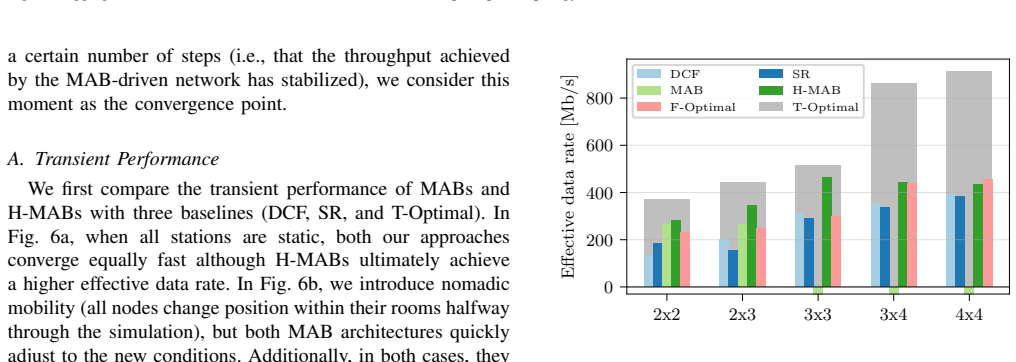
The paper's central claim is that C-SR scheduling does not need RSS or CSI measurements: a probing hierarchy of multi-armed bandit agents, rewarded by the aggregate throughput of each attempted transmission configuration, can approach the performance of an optimal schedule computed offline by MILP. In random open-space simulations, the H-MAB improves aggregate throughput over legacy 802.11 by 80% on average, without cutting any station's transmission opportunities; in the testbed, it learns to run three concurrent downlink transmissions and adapts to uneven radio conditions. The flat MAB works in small topologies but its action space explodes as the network grows, while the hierarchical decomposition plus clustering restores scalability for denser deployments.
Load-bearing premise
The argument hinges on assuming that learning each transmitter's power level independently from the same aggregate reward is accurate enough, even though the power choices of all simultaneous transmitters jointly decide whether a transmission succeeds.
Editorial extensions
If this is right
- A central controller can run H-MABs with only wired signaling, avoiding the inter-BSS over-the-air sounding that measurement-based C-SR solutions require.
- Dense random Wi-Fi deployments can expect roughly 80% higher aggregate throughput than legacy DCF while no station receives fewer transmission opportunities than it would under DCF.
- When the topology changes abruptly, the learner re-converges without resetting its state, so nomadic environments do not require manual reconfiguration.
- For larger multi-room deployments, splitting the network into independent clusters restores fast convergence and near-optimal throughput, pointing to a practical deployment recipe.
- The MILP model gives the field a quantitative upper bound against which future C-SR schedulers can be measured, for either throughput or fairness objectives.
Reading between the lines
- Editorial inference: the same probing hierarchy could also learn modulation-and-coding-scheme selection jointly with power and concurrency, an extension the paper leaves mostly idealized.
- Editorial inference: the 80% average is measured under full-buffer downlink-only, single-channel conditions; the gain may be smaller under uplink traffic or bursty arrivals, which the paper does not test.
- Editorial inference: the clustering results suggest dynamic cluster creation as the natural deployment path for very dense networks, a step the paper explicitly leaves for future work.
Signed reviews
Editorial analysis
A structured set of objections, weighed in public.
Referee Report
Summary. The paper addresses coordinated spatial reuse (C-SR) scheduling for IEEE 802.11bn multi-AP coordination. It contributes a mixed-integer linear programming model based on column generation that yields an upper bound on achievable throughput or fairness, and a practical probing-based scheduler using flat and hierarchical multi-armed bandits (MAB/H-MAB). The H-MAB selects transmitting APs, recipient stations, and transmit power levels in a three-level hierarchy and is updated with the aggregate throughput reward. The proposal is evaluated in simulations across multi-room, open-space, clustered, and legacy-device scenarios, and in an openwifi testbed with three APs. The headline claim is that H-MAB-based C-SR improves aggregate throughput over legacy 802.11 by on average 80% in random open-space scenarios without reducing per-station transmission opportunities, while approaching the MILP-derived upper bound.
Significance. If the claims hold, the paper provides a lightweight, implementable learning-based alternative to measurement-heavy C-SR scheduling, which is directly relevant to the ongoing 802.11bn standardization. The MILP upper-bound model is a solid methodological contribution and the open-source release of code is a strength that supports reproducibility. The testbed validation with openwifi demonstrates real-world feasibility, which is rare in this literature. The central risk is that the 80% gain and the closeness to the upper bound rest on an independent-learning assumption for transmit power selection that the authors themselves concede is not generally precise; the evidence presented does not stress the strongly coupled regimes where that assumption could fail.
major comments (3)
- [Section V, footnote 4 and Algorithm 1] The third-level agents select transmit powers independently (Algorithm 1, lines 12-15) while the same aggregate reward r is back-propagated to all selected agents (lines 18-19). As the authors concede in footnote 4, this independent cooperative learning framework 'may not be precise' for power selection, which formally requires a joint action. This assumption is load-bearing for the paper's central claim that H-MABs approach the MILP upper bound, because transmit powers jointly determine the SINR and hence the reward. The current evaluation does not include a strongly coupled topology in which power choices interact adversarially; the multi-room walls and the open-space 2-5 AP deployments weaken or randomize this coupling. Please add an experiment designed to stress this point, e.g., two or three APs with symmetric cross-interference and a small discrete power set, comparing H-MAB against T-Optimal and against a joint-action learner, or alternatively restrict the general claim to topologies where power coupling is weak.
- [Section VI-C and Section VII-C] The abstract's 80% average throughput improvement is a simulation result from the random open-space scenarios of Section VI-C, not from the testbed. The testbed evaluation in Section VII-C reports the number of concurrent transmissions and the frequency of selected actions, but it does not measure aggregate throughput relative to DCF or SR. The testbed therefore validates feasibility and learning behavior, but it does not corroborate the 80% gain or the no-TXOP-reduction claim in a real system. Please report a testbed throughput comparison against a legacy baseline, or rephrase the abstract and conclusion to state explicitly that the 80% figure is simulation-only.
- [Section VI-B and Table II] The convergence results in Table II show that H-MABs do not converge within 200,000 steps in the 4x4 multi-room topology (inf), and the 3x4 case requires 120,000 steps. The clustered approach of Section VI-D restores convergence, but the paper's broad statements that H-MABs 'approach the T-Optimal value' are qualified by these scalability limits. Please state the applicability envelope more precisely: the near-optimal behavior is demonstrated for small and medium topologies (up to about 12 APs with clustering), and clusterless H-MABs are not a general solution for large deployments without the clusterization mechanism.
minor comments (6)
- [Section V] The sentence 'APs can transmit data at any power lever from the set P' contains a typo; 'lever' should be 'level'.
- [Section IV, constraints (4h)] The text says 'constraints (4h) are the SINR constrains' — 'constrains' should be 'constraints'.
- [Figure 10] The caption of Figure 10 labels the left panel '(a) 3x3 topology', but the text and the clustering scheme refer to the 3x4 topology; please correct the label.
- [Table III] Table III uses the header 'Large TXOP' while the text and Table II use 'Long TXOP'; please use consistent terminology.
- [References] Reference [27] lists the author as 'J. C. et al.' with no full name; please provide the complete author list.
- [Section IV, Eq. (4h)] The constant M(e,m) is introduced only after the constraint is presented; defining it before the constraint would improve readability.
Circularity Check
No circularity found; the 80% gain is an empirical simulation/testbed result and the MILP upper bound is an independent optimization baseline.
full rationale
The paper's central claims are empirical and benchmarked against external baselines rather than derived from fitted constants or self-referential definitions. The abstract's 80% average throughput improvement of H-MAB-based C-SR over legacy IEEE 802.11 is presented as a measured outcome of simulations over random topologies and of a testbed deployment, with DCF and 802.11ax SR as lower-bound references and the MILP model as an upper-bound reference. The MILP model in Section IV is an optimization formulation built on standard column generation and SINR feasibility constraints adapted from [19,20]; it is not a prediction derived from the MAB results, and it does not define the MAB reward or the reported gains by construction. The MAB/H-MAB learning loop in Section V uses the measured aggregate throughput r as a reward signal, and no fitted parameter is renamed as a prediction: hyperparameter tuning via Optuna is a standard engineering step and does not force the reported 80% figure. Self-citations such as [7] (earlier two-level H-MAB), [24] (Reinforced-lib), and [14,15] (testbed infrastructure) are present but are not load-bearing for the paper's main empirical claim; reusing a testbed from prior work is independent hardware context, not circular reasoning. The paper's own footnote 4 concedes that the third-level power-selection agents are independent learners even though transmit powers jointly determine the observed reward, and states that this is 'often used in practice and yields satisfactory results'; this is an explicitly acknowledged limitation of the learning model and a generalizability caveat, not a circular step. The concession does not make the 80% throughput measurement equivalent to an input of the derivation. No uniqueness theorem is imported from the authors' prior work, no ansatz is smuggled in via self-citation, and no known empirical pattern is merely renamed as a new result. Because the central claims reduce neither to self-definition nor to fitted inputs, the circularity score is 0.
Assumptions & free parameters
free parameters (3)
- MAB algorithm hyperparameters (theta1, theta2, theta3) =
Not reported; tuned with Optuna; selected types Softmax for flat MAB, UCB for H-MAB
- Convergence detection threshold (Holt's exponential smoothing) =
Scenario-dependent, not reported
- Testbed transmit power levels =
{0, -6, -12} dB attenuation
assumptions (5)
- standard math LP duality and reduced-cost conditions justify column generation
- domain assumption Full-buffer downlink traffic and fully coordinated network with only C-SR transmissions
- domain assumption Multi-user block ACK via OFDMA prevents ACK collisions
- domain assumption SINR-based MCS assignment with TGax path loss and AWGN
- ad hoc to paper Independent cooperative learning assumption for H-MAB
Cite this review
Pith. "Pith review of Coordinated Spatial Reuse Scheduling With Machine Learning in IEEE 802.11 MAPC Networks." pith.science (2026). https://pith.science/paper/7BIUOLUM
@misc{pith2026250507278,
  author       = {Pith},
  title        = {Pith review of: Coordinated Spatial Reuse Scheduling With Machine Learning in IEEE 802.11 MAPC Networks},
  year         = {2026},
  howpublished = {\url{https://pith.science/paper/7BIUOLUM}},
  note         = {Machine review of arXiv:2505.07278}
}
read the original abstract
The densification of Wi-Fi deployments means that fully distributed random channel access is no longer sufficient for high and predictable performance. Therefore, the upcoming IEEE 802.11bn amendment introduces multi-access point coordination (MAPC) methods. This paper addresses a variant of MAPC called coordinated spatial reuse (C-SR), where devices transmit simultaneously on the same channel, with the power adjusted to minimize interference. The C-SR scheduling problem is selecting which devices transmit concurrently and with what settings. We provide a theoretical upper bound model, optimized for either throughput or fairness, which finds the best possible transmission schedule using mixed-integer linear programming. Then, a practical, probing-based approach is proposed which uses multi-armed bandits (MABs), a type of reinforcement learning, to solve the C-SR scheduling problem. We validate both classical (flat) MAB and hierarchical MAB (H-MAB) schemes with simulations and in a testbed. Using H-MABs for C-SR improves aggregate throughput over legacy IEEE 802.11 (on average by 80% in random scenarios), without reducing the number of transmission opportunities per station. Finally, our framework is lightweight and ready for implementation in Wi-Fi devices.
Figures


Figures from the paper (14 more)




Forward citations
Cited by 1 Pith paper
-
Hierarchical Multi-Agent Reinforcement Learning-based Coordinated Spatial Reuse for Next Generation WLANs
A decentralized hierarchical multi-agent reinforcement learning algorithm for Wi-Fi coordinated spatial reuse, selecting target stations and transmit powers through high- and low-level policies, improves simulated thr...
Reference graph
Works this paper leans on
-
[1]
Beyond Wi-Fi 7: Spatial reuse through multi-AP coordination,
P. Imputato et al., “Beyond Wi-Fi 7: Spatial reuse through multi-AP coordination,” Computer Networks, vol. 239, p. 110 160, 2024
work page 2024
-
[2]
What Will Wi-Fi 8 Be? A Primer on IEEE 802.11bn Ultra High Reliability,
L. G. Giordano et al., “What Will Wi-Fi 8 Be? A Primer on IEEE 802.11bn Ultra High Reliability,” preprint arXiv:2303.10442, 2023
arXiv 2023
-
[3]
R. J. Yu, Specification Framework for TGbn, Accessed on Oct 10, 2024. [Online]. Available: https://mentor.ieee.org/802.11/dcn/24/11-24-0209- 05-00bn-specification-framework-for-tgbn.docx
work page 2024
-
[4]
MAC-layer rate control for 802.11 networks: A survey,
W. Yin et al., “MAC-layer rate control for 802.11 networks: A survey,” Wireless Networks, vol. 26, pp. 3793–3830, 2020
work page 2020
-
[5]
Simulation and performance evaluation of the Intel rate adaptation algorithm,
R. Grünblatt, I. Guérin-Lassous, and O. Simonin, “Simulation and performance evaluation of the Intel rate adaptation algorithm,” in Proc. of ACM MSWiM, 2019, pp. 27–34
work page 2019
-
[6]
Introduction to multi-armed bandits,
A. Slivkins et al., “Introduction to multi-armed bandits,” Foundations and Trends® in Machine Learning , vol. 12, no. 1-2, pp. 1–286, 2019
work page 2019
-
[7]
IEEE 802.11bn Multi-AP Coordinated Spatial Reuse with Hierarchical Multi-Armed Bandits,
M. Wojnar et al., “IEEE 802.11bn Multi-AP Coordinated Spatial Reuse with Hierarchical Multi-Armed Bandits,”IEEE Communications Letters, vol. 29, no. 3, pp. 428–432, 2025
work page 2025
-
[8]
Coordinated multipoint transmission and reception in LTE-advanced systems,
J. Lee et al., “Coordinated multipoint transmission and reception in LTE-advanced systems,” IEEE Comm. Mag. , vol. 50, no. 11, 2012
work page 2012
Show all 34 references
-
[9]
A Survey on Multi-AP Coordination Approaches Over Emerging WLANs: Future Directions and Open Challenges,
S. Verma et al., “A Survey on Multi-AP Coordination Approaches Over Emerging WLANs: Future Directions and Open Challenges,”IEEE Communications Surveys & Tutorials, vol. 26, no. 2, pp. 858–889, 2024
2024
-
[10]
TXOP sharing with coordinated spatial reuse in multi- AP cooperative IEEE 802.11be WLANs,
D. Nunez et al., “TXOP sharing with coordinated spatial reuse in multi- AP cooperative IEEE 802.11be WLANs,” in Proc. of IEEE CCNC , 2022
2022
-
[11]
Multi-AP Coordinated Spa- tial Reuse for Wi-Fi 8: Group Creation and Scheduling,
D. Nunez, M. Smith, and B. Bellalta, “Multi-AP Coordinated Spa- tial Reuse for Wi-Fi 8: Group Creation and Scheduling,” preprint arXiv:2305.04846, 2023
2023 arXiv
-
[12]
Research on Next-Generation Wi-Fi Spatial Reuse Power Control Based on Federated Reinforcement Learning,
J. Wang and X. Fang, “Research on Next-Generation Wi-Fi Spatial Reuse Power Control Based on Federated Reinforcement Learning,” in 2024 IEEE VTC2024-Spring , IEEE, 2024
2024
-
[13]
Enhanced Coordinated Spatial Reuse: Bidi- rectional Multiple AP Coordination for IEEE 802.11be,
M. Talukder and J. Xie, “Enhanced Coordinated Spatial Reuse: Bidi- rectional Multiple AP Coordination for IEEE 802.11be,” in IEEE ICC 2023, IEEE, 2023, pp. 660–665
2023
-
[14]
Coordinated Spatial Reuse for WiFi Networks: A Centralized Approach,
J. Haxhibeqiri et al., “Coordinated Spatial Reuse for WiFi Networks: A Centralized Approach,” in 2024 IEEE 20th International Conference on Factory Communication Systems (WFCS) , 2024
2024
-
[15]
Coordinated SR and Restricted TWT for Time Sensitive Applications in WiFi 7 Networks,
J. Haxhibeqiri et al., “Coordinated SR and Restricted TWT for Time Sensitive Applications in WiFi 7 Networks,” IEEE Communications Magazine, vol. 62, no. 8, pp. 118–124, 2024
2024
-
[16]
Throughput Analysis of IEEE 802.11bn Coordinated Spatial Reuse,
F. Wilhelmi et al., “Throughput Analysis of IEEE 802.11bn Coordinated Spatial Reuse,” preprint arXiv:2309.09169, 2023
2023 arXiv
-
[17]
Lu et al., Multi-AP Coordination Setup Scheme , doc.: IEEE 802.11- 24/1217r02, Aug
K. Lu et al., Multi-AP Coordination Setup Scheme , doc.: IEEE 802.11- 24/1217r02, Aug. 2024
2024
-
[18]
Using ranging for collision-immune IEEE 802.11 rate selection with statistical learning,
W. Ciezobka et al., “Using ranging for collision-immune IEEE 802.11 rate selection with statistical learning,” Computer Communications , vol. 225, pp. 10–26, 2024
2024
-
[19]
Rout- ing, scheduling and channel assignment in wireless mesh networks: Optimization models and algorithms,
A. Capone, G. Carello, I. Filippini, S. Gualandi, and F. Malucelli, “Rout- ing, scheduling and channel assignment in wireless mesh networks: Optimization models and algorithms,” Ad Hoc Networks , vol. 8, no. 6, pp. 545–563, 2010
2010
-
[20]
On max–min fair flow optimization in wireless mesh networks,
M. Pióro et al., “On max–min fair flow optimization in wireless mesh networks,” Ad Hoc Networks , vol. 13, pp. 134–152, 2014
2014
-
[21]
A simple perspective on simultaneous column and row generation,
R. Spliet, “A simple perspective on simultaneous column and row generation,” Operations Research Forum, vol. 5, no. 69, Aug. 2024
2024
-
[22]
A primer in column generation,
J. Desrosiers and M. E. Lübbecke, “A primer in column generation,” in Column Generation, G. Desaulniers, J. Desrosiers, and M. M. Solomon, Eds. Boston, MA: Springer US, 2005, pp. 1–32
2005
-
[23]
Bench- marking multi-agent deep reinforcement learning algorithms in cooper- ative tasks,
G. Papoudakis, F. Christianos, L. Schäfer, and S. V . Albrecht, “Bench- marking multi-agent deep reinforcement learning algorithms in cooper- ative tasks,” in NeurIPS Datasets and Benchmarks , 2020
2020
-
[24]
Reinforced-lib: Rapid prototyping of reinforcement learning solutions,
M. Wojnar et al., “Reinforced-lib: Rapid prototyping of reinforcement learning solutions,” SoftwareX, vol. 26, 2024
2024
-
[25]
Merlin et al., TGax Simulation Scenarios , doc.: IEEE 802.11- 14/0980r16, Nov
S. Merlin et al., TGax Simulation Scenarios , doc.: IEEE 802.11- 14/0980r16, Nov. 2015
2015
-
[26]
Forecasting seasonals and trends by exponentially weighted moving averages,
C. C. Holt, “Forecasting seasonals and trends by exponentially weighted moving averages,” International Journal of Forecasting, vol. 20, no. 1, pp. 5–10, 2004
2004
-
[27]
An Analysis of the Mixed IEEE 802.11ax Wireless Networks in the 5 GHz Band,
M. Natkaniec and N. Bieryt, “An Analysis of the Mixed IEEE 802.11ax Wireless Networks in the 5 GHz Band,” Sensors, vol. 23, no. 10, 2023
2023
-
[28]
J. C. et al., Details on the unified MAPC framework , Accessed on April 2, 2025. [Online]. Available: https://mentor.ieee.org/802.11/dcn/25/11- 25-0502-00-00bn-details-on-the-unified-mapc-framework.pptx
2025
-
[29]
openwifi: a free and open-source IEEE802.11 SDR implementation on SoC,
X. Jiao, W. Liu, M. Mehari, M. Aslam, and I. Moerman, “openwifi: a free and open-source IEEE802.11 SDR implementation on SoC,” in 2020 IEEE 91st Vehicular Technology Conference (VTC2020-Spring) , IEEE, 2020, pp. 1–2
2020
-
[30]
Bringing time-sensitive networking to wireless professional private networks: Filling gaps and bridging the innovation,
J. Haxhibeqiri et al., “Bringing time-sensitive networking to wireless professional private networks: Filling gaps and bridging the innovation,” Wireless Personal Communications, vol. 121, pp. 1255–1271, 2021
2021
-
[31]
Forrest et al., Coin-or/cbc: Release releases/2.10.12 , version re- leases/2.10.12, Aug
J. Forrest et al., Coin-or/cbc: Release releases/2.10.12 , version re- leases/2.10.12, Aug. 2024
2024
-
[32]
IBM, IBM ILOG CPLEX Optimization Studio CPLEX user’s manual ,
-
[33]
Theil-sen estimators in a multiple linear regression model,
X. Dang, H. Peng, X. Wang, and H. Zhang, “Theil-sen estimators in a multiple linear regression model,” Olemiss Edu, vol. 2, 2008. Maksymilian Wojnar is a PhD candidate and re- searcher in machine learning and wireless networks, with an MSc degree in computer science from the A...
2024
-
[2023]
Available: https://www.ibm.com/docs/en/icos/20.1.0? topic=cplex-users-manual
[Online]. Available: https://www.ibm.com/docs/en/icos/20.1.0? topic=cplex-users-manual
Reviewed August 15, 2026 · model on record in the stance chip above.
Discussion (0). Continue with ORCID to comment.