Generating Physically Consistent Molecules with Energy-Based Models
Pith reviewed 2026-05-20 13:12 UTC · model grok-4.3
The pith
Energy-based models can generate physically consistent 3D molecules by learning an atom-additive scalar potential from data.
A machine-rendered reading of the paper's core claim, the machinery that carries it, and where it could break.
Core claim
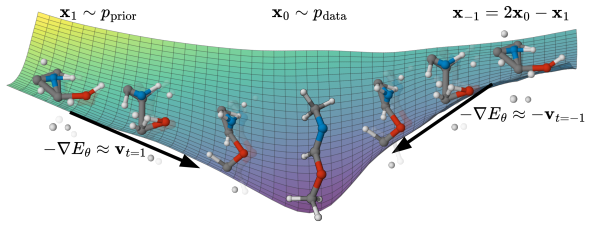
EBMol learns an atom-additive scalar potential to approximate the energy landscape of molecules using a flow-inspired Restoring Field Matching objective without explicit simulation during training. Sampling is performed with the Mirror-Langevin algorithm that enables unified updates of atomic positions and types, together with parallel tempering for inference-time scaling. The resulting model achieves state-of-the-art performance on QM9 and GEOM-Drugs, uses the learned energy landscape as a principled quality metric for ranking and filtering, and supports controllable generation without retraining through shape-steered sampling via potential composition as well as zero-shot linker design.
What carries the argument
The Restoring Field Matching objective that trains an atom-additive scalar potential to approximate the molecular energy landscape for later sampling.
If this is right
- The learned energy landscape directly serves as a quality metric for ranking and filtering candidate molecules.
- Controllable generation is possible without any retraining by composing potentials for shape-steered sampling.
- Zero-shot linker design can be performed by the same sampling procedure.
- Parallel tempering provides a way to trade extra compute at inference time for better sampling quality.
Where Pith is reading between the lines
- The energy-based framing may extend naturally to other physical systems where equilibrium distributions matter, such as protein conformations.
- Because the model separates learning the landscape from sampling, it could be combined with faster sampling methods developed for other energy-based models.
- The approach offers a route to interpret generated molecules by inspecting the contributions of the learned scalar potential.
Load-bearing premise
The Restoring Field Matching objective, without any explicit simulation during training, produces an energy landscape whose Boltzmann distribution can be accurately sampled by the Mirror-Langevin algorithm to yield physically consistent molecules.
What would settle it
If molecules generated by running Mirror-Langevin sampling on the learned energy landscape show high rates of physical inconsistency or fail to match the distribution of valid structures on QM9 or GEOM-Drugs, the central claim would not hold.
Figures




read the original abstract
Molecules in equilibrium follow a Boltzmann distribution, making the underlying energy landscape a physically grounded modeling objective. However, such landscapes are difficult to learn from data and, once learned, hard to sample from. Diffusion and flow-matching models sidestep these difficulties by learning a time-conditional score or transport field between noise and data, losing the energy inductive bias in exchange for a more tractable training objective. We introduce EBMol, an energy-based model (EBM) that restores this inductive bias by learning an atom-additive scalar potential without explicit simulation during training. Our method employs a flow-inspired Restoring Field Matching objective to approximate the energy landscape. We adopt the Mirror-Langevin algorithm for sampling, enabling unified updates of atomic positions and types, and incorporate parallel tempering for inference-time compute scaling. EBMol is the first EBM for 3D molecular generation to achieve state-of-the-art performance on QM9 and GEOM-Drugs. Moreover, we show that the learned energy landscape serves as a principled quality metric for ranking and filtering configurations, and demonstrate controllable generation without retraining through shape-steered sampling via potential composition and zero-shot linker design.
Editorial analysis
A structured set of objections, weighed in public.
Referee Report
Summary. The manuscript introduces EBMol, an energy-based model for 3D molecular generation that learns an atom-additive scalar potential via a flow-inspired Restoring Field Matching objective without explicit simulation during training. Sampling employs the Mirror-Langevin algorithm with parallel tempering to produce molecules from the learned energy landscape. The central claims are that EBMol is the first such EBM to reach state-of-the-art performance on QM9 and GEOM-Drugs, that the learned energy serves as a principled quality metric for ranking and filtering, and that controllable generation is possible without retraining through potential composition and zero-shot linker design.
Significance. If the empirical results hold and the sampled molecules are verifiably consistent with the Boltzmann distribution of valid structures, the work would meaningfully advance molecular generation by restoring an explicit energy inductive bias that diffusion and flow models largely forgo. This could improve interpretability, enable direct use of the energy for filtering, and support controllable sampling, representing a useful alternative paradigm in the field.
major comments (2)
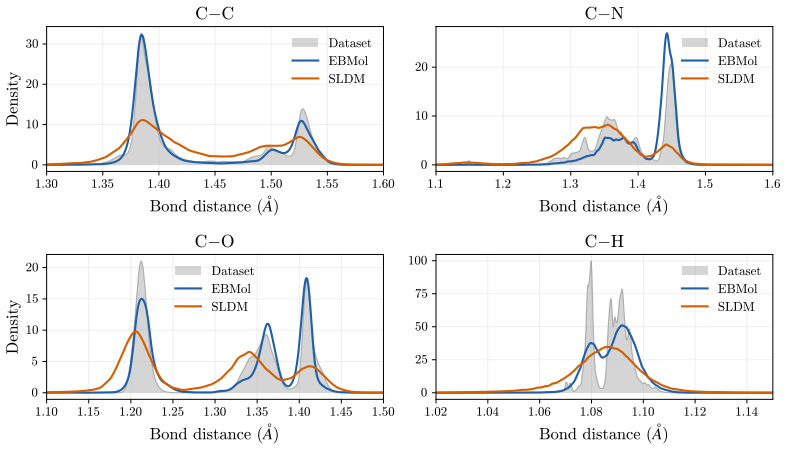
- [Abstract and §3 (Restoring Field Matching)] Abstract and methods description of Restoring Field Matching: the claim that this objective produces an energy landscape whose Boltzmann distribution is accurately sampled by Mirror-Langevin (with parallel tempering) to yield chemically valid and statistically consistent molecules is load-bearing for the physical-consistency and SOTA claims, yet no direct diagnostic (energy histograms vs. reference DFT, fraction of valid valences post-sampling, or comparison of sampled vs. data manifold statistics) is provided to confirm the sampler recovers the intended distribution rather than non-physical low-energy modes.
- [Experiments] Experiments section reporting QM9 and GEOM-Drugs results: the SOTA performance assertions lack error bars, ablation studies isolating the contribution of the Restoring Field Matching objective versus the sampler or parallel tempering, and explicit verification that metrics are not reducible to self-defined quantities, weakening support for the central empirical claim.
minor comments (2)
- [Methods] Clarify notation for the atom-additive scalar potential and its exact relation to the full molecular energy function used in sampling.
- [Experiments] Ensure all baseline comparisons in the results tables include the same evaluation protocol (e.g., identical validity checks and conformer generation settings) for fair assessment.
Simulated Author's Rebuttal
We thank the referee for their constructive comments on our manuscript introducing EBMol. We address each of the major comments below, providing clarifications and indicating planned revisions where appropriate.
read point-by-point responses
-
Referee: Abstract and §3 (Restoring Field Matching): the claim that this objective produces an energy landscape whose Boltzmann distribution is accurately sampled by Mirror-Langevin (with parallel tempering) to yield chemically valid and statistically consistent molecules is load-bearing for the physical-consistency and SOTA claims, yet no direct diagnostic (energy histograms vs. reference DFT, fraction of valid valences post-sampling, or comparison of sampled vs. data manifold statistics) is provided to confirm the sampler recovers the intended distribution rather than non-physical low-energy modes.
Authors: We agree that additional diagnostics would strengthen the claims regarding the fidelity of the sampling process to the learned Boltzmann distribution. While the manuscript demonstrates high rates of chemical validity and state-of-the-art performance on QM9 and GEOM-Drugs, which serve as indirect evidence, we did not include direct comparisons such as energy histograms against DFT or explicit manifold statistics. In the revised manuscript, we will add these analyses, including valence validity fractions post-sampling and comparisons of sampled distributions to the training data manifold. revision: yes
-
Referee: Experiments section reporting QM9 and GEOM-Drugs results: the SOTA performance assertions lack error bars, ablation studies isolating the contribution of the Restoring Field Matching objective versus the sampler or parallel tempering, and explicit verification that metrics are not reducible to self-defined quantities, weakening support for the central empirical claim.
Authors: We appreciate this point. Error bars from multiple runs will be included in the revised experiments section to provide statistical robustness. We will also add ablation studies isolating the contribution of the Restoring Field Matching objective versus the sampler and parallel tempering. The metrics used are standard in the molecular generation literature (e.g., validity, uniqueness, novelty as defined in prior works like EDM and GeoLDM), and we will explicitly reference their definitions to confirm they are not self-defined. revision: yes
Circularity Check
No significant circularity; derivation approximates external physical target
full rationale
The paper's core chain learns an atom-additive scalar potential via a flow-inspired Restoring Field Matching objective that targets an external Boltzmann distribution, then samples it with Mirror-Langevin plus parallel tempering. This is not self-definitional, does not rename a fitted parameter as a prediction, and contains no load-bearing self-citation or uniqueness theorem that reduces the central claim to prior author work. Performance claims on QM9/GEOM-Drugs and controllable generation via potential composition are evaluated against independent external benchmarks rather than by construction from the training objective itself. The derivation remains self-contained against verifiable physical and statistical targets.
Axiom & Free-Parameter Ledger
axioms (1)
- domain assumption Molecules in equilibrium follow a Boltzmann distribution
Lean theorems connected to this paper
-
IndisputableMonolith/Cost/FunctionalEquation.leanwashburn_uniqueness_aczel unclear?
unclearRelation between the paper passage and the cited Recognition theorem.
We introduce EBMol, an energy-based model (EBM) that restores this inductive bias by learning an atom-additive scalar potential without explicit simulation during training. Our method employs a flow-inspired Restoring Field Matching objective to approximate the energy landscape.
What do these tags mean?
- matches
- The paper's claim is directly supported by a theorem in the formal canon.
- supports
- The theorem supports part of the paper's argument, but the paper may add assumptions or extra steps.
- extends
- The paper goes beyond the formal theorem; the theorem is a base layer rather than the whole result.
- uses
- The paper appears to rely on the theorem as machinery.
- contradicts
- The paper's claim conflicts with a theorem or certificate in the canon.
- unclear
- Pith found a possible connection, but the passage is too broad, indirect, or ambiguous to say the theorem truly supports the claim.
Reference graph
Works this paper leans on
-
[1]
Raghunathan Ramakrishnan, Pavlo O. Dral, Matthias Rupp, and O. Anatole von Lilienfeld. Quantum chemistry structures and properties of 134 kilo molecules.Scientific Data, 1(1):140022, August 2014
work page 2014
-
[2]
Simon Axelrod and Rafael Gómez-Bombarelli. GEOM, energy-annotated molecular conformations for property prediction and molecular generation.Scientific Data, 9(1):185, April 2022
work page 2022
-
[3]
The enumeration of chemical space.WIREs Computational Molecular Science, 2(5):717–733, 2012
Jean-Louis Reymond, Lars Ruddigkeit, Lorenz Blum, and Ruud van Deursen. The enumeration of chemical space.WIREs Computational Molecular Science, 2(5):717–733, 2012
work page 2012
-
[4]
Unke, Stefan Chmiela, Huziel E
Oliver T. Unke, Stefan Chmiela, Huziel E. Sauceda, Michael Gastegger, Igor Poltavsky, Kristof T. Schütt, Alexandre Tkatchenko, and Klaus-Robert Müller. Machine Learning Force Fields.Chemical Reviews, 121(16):10142–10186, August 2021
work page 2021
-
[5]
Dotson, Raimondas Galvelis, John E
Peter Eastman, Pavan Kumar Behara, David L. Dotson, Raimondas Galvelis, John E. Herr, Josh T. Horton, Yuezhi Mao, John D. Chodera, Benjamin P. Pritchard, Yuanqing Wang, Gianni De Fabritiis, and Thomas E. Markland. SPICE, A Dataset of Drug-like Molecules and Peptides for Training Machine Learning Potentials.Scientific Data, 10(1):11, January 2023
work page 2023
-
[6]
Sauceda, Igor Poltavsky, Kristof T
Stefan Chmiela, Alexandre Tkatchenko, Huziel E. Sauceda, Igor Poltavsky, Kristof T. Schütt, and Klaus- Robert Müller. Machine learning of accurate energy-conserving molecular force fields.Science Advances, 3(5):e1603015, May 2017
work page 2017
-
[7]
Zero shot molecular generation via similarity kernels.Nature Communications, 16(1):5991, July 2025
Rokas Elijošius, Fabian Zills, Ilyes Batatia, Sam Walton Norwood, Dávid Péter Kovács, Christian Holm, and Gábor Csányi. Zero shot molecular generation via similarity kernels.Nature Communications, 16(1):5991, July 2025
work page 2025
-
[8]
Denoising diffusion probabilistic models
Jonathan Ho, Ajay Jain, and Pieter Abbeel. Denoising diffusion probabilistic models. InConference on Neural Information Processing Systems, 2020
work page 2020
-
[9]
Score-based generative modeling through stochastic differential equations
Yang Song, Jascha Sohl-Dickstein, Diederik P Kingma, Abhishek Kumar, Stefano Ermon, and Ben Poole. Score-based generative modeling through stochastic differential equations. InInternational Conference on Learning Representations, 2021
work page 2021
-
[10]
Flow matching for generative modeling
Yaron Lipman, Ricky TQ Chen, Heli Ben-Hamu, Maximilian Nickel, and Matthew Le. Flow matching for generative modeling. InInternational Conference on Learning Representations, 2023
work page 2023
-
[11]
Flow straight and fast: Learning to generate and transfer data with rectified flow
Xingchao Liu, Chengyue Gong, et al. Flow straight and fast: Learning to generate and transfer data with rectified flow. InInternational Conference on Learning Representations, 2023
work page 2023
-
[12]
Wasserstein control of mirror langevin monte carlo
Kelvin Shuangjian Zhang, Gabriel Peyré, Jalal Fadili, and Marcelo Pereyra. Wasserstein control of mirror langevin monte carlo. InConference on learning theory, pages 3814–3841. PMLR, 2020
work page 2020
-
[13]
A Tutorial on Energy-Based Learning.Predicting structured data, 2006
Yann LeCun, Sumit Chopra, Raia Hadsell, Marc’Aurelio Ranzato, and Fu Jie Huang. A Tutorial on Energy-Based Learning.Predicting structured data, 2006
work page 2006
-
[14]
Geoffrey E Hinton. Training products of experts by minimizing contrastive divergence.Neural computation, 14(8):1771–1800, 2002
work page 2002
-
[15]
Generative modeling by estimating gradients of the data distribution
Yang Song and Stefano Ermon. Generative modeling by estimating gradients of the data distribution. In Conference on Neural Information Processing Systems, 2019
work page 2019
-
[16]
Improved contrastive divergence training of energy-based models
Yilun Du, Shuang Li, Joshua Tenenbaum, and Igor Mordatch. Improved contrastive divergence training of energy-based models. In Marina Meila and Tong Zhang, editors,Proceedings of the 38th International Conference on Machine Learning, volume 139 ofProceedings of Machine Learning Research, pages 2837–2848. PMLR, 18–24 Jul 2021. 10
work page 2021
-
[17]
Energy Matching: Unifying Flow Matching and Energy-Based Models for Generative Modeling
Michal Balcerak, Tamaz Amiranashvili, Antonio Terpin, Suprosanna Shit, Lea Bogensperger, Sebastian Kaltenbach, Petros Koumoutsakos, and Bjoern Menze. Energy Matching: Unifying Flow Matching and Energy-Based Models for Generative Modeling. InConference on Neural Information Processing Systems, October 2025
work page 2025
-
[18]
Equilibrium Matching: Generative Modeling with Implicit Energy-Based Models, October 2025
Runqian Wang and Yilun Du. Equilibrium Matching: Generative Modeling with Implicit Energy-Based Models, October 2025
work page 2025
-
[19]
Learning Equivariant Energy Based Models with Equivariant Stein Variational Gradient Descent
Priyank Jaini, Lars Holdijk, and Max Welling. Learning Equivariant Energy Based Models with Equivariant Stein Variational Gradient Descent. InConference on Neural Information Processing Systems, November 2021
work page 2021
-
[20]
Symphony: Symmetry-Equivariant Point- Centered Spherical Harmonics for 3D Molecule Generation
Ameya Daigavane, Song Eun Kim, Mario Geiger, and Tess Smidt. Symphony: Symmetry-Equivariant Point- Centered Spherical Harmonics for 3D Molecule Generation. InInternational Conference on Representation Learning, October 2024
work page 2024
-
[21]
Cheng, Chong Sun, and Alán Aspuru-Guzik
Austin H. Cheng, Chong Sun, and Alán Aspuru-Guzik. Scalable Autoregressive 3D Molecule Generation, May 2025
work page 2025
-
[22]
Niklas W. A. Gebauer, Michael Gastegger, Stefaan S. P. Hessmann, Klaus-Robert Müller, and Kristof T. Schütt. Inverse design of 3d molecular structures with conditional generative neural networks.Nature Communications, 13(1):973, February 2022
work page 2022
-
[23]
Matthieu Kirchmeyer, Pedro O. Pinheiro, and Saeed Saremi. Score-based 3D molecule generation with neural fields. InConference on Neural Information Processing Systems, November 2024
work page 2024
-
[24]
Pinheiro, Emma Willett, Karolis Martinkus, Joseph Kleinhenz, Emily K
Matthieu Kirchmeyer, Pedro O. Pinheiro, Emma Willett, Karolis Martinkus, Joseph Kleinhenz, Emily K. Makowski, Andrew Martin Watkins, Vladimir Gligorijevic, Richard Bonneau, and Saeed Saremi. Unified all-atom molecule generation with neural fields. InConference on Neural Information Processing Systems, October 2025
work page 2025
-
[25]
MolDiff: Addressing the Atom-Bond Inconsistency Problem in 3D Molecule Diffusion Generation
Xingang Peng, Jiaqi Guan, Qiang Liu, and Jianzhu Ma. MolDiff: Addressing the Atom-Bond Inconsistency Problem in 3D Molecule Diffusion Generation. InInternational Conference on Machine Learning, pages 27611–27629. PMLR, July 2023
work page 2023
-
[26]
MiDi: Mixed Graph and 3D Denoising Diffusion for Molecule Generation
Clement Vignac, Nagham Osman, Laura Toni, and Pascal Frossard. MiDi: Mixed Graph and 3D Denoising Diffusion for Molecule Generation. InJoint European Conference on Machine Learning and Knowledge Discovery in Databases, May 2023
work page 2023
-
[27]
Learning Joint 2D & 3D Diffusion Models for Complete Molecule Generation, June 2023
Han Huang, Leilei Sun, Bowen Du, and Weifeng Lv. Learning Joint 2D & 3D Diffusion Models for Complete Molecule Generation, June 2023
work page 2023
-
[28]
SemlaFlow – Efficient 3D Molecular Generation with Latent Attention and Equivariant Flow Matching
Ross Irwin, Alessandro Tibo, Jon Paul Janet, and Simon Olsson. SemlaFlow – Efficient 3D Molecular Generation with Latent Attention and Equivariant Flow Matching. InInternational Conference on Artificial Intelligence and Statistics. arXiv, 2025
work page 2025
-
[29]
Mixed Continuous and Categorical Flow Matching for 3D De Novo Molecule Generation, April 2024
Ian Dunn and David Ryan Koes. Mixed Continuous and Categorical Flow Matching for 3D De Novo Molecule Generation, April 2024
work page 2024
-
[30]
Applications of Modular Co-Design for De Novo 3D Molecule Generation, 2025
Danny Reidenbach, Filipp Nikitin, Olexandr Isayev, and Saee Paliwal. Applications of Modular Co-Design for De Novo 3D Molecule Generation, 2025. Version Number: 1
work page 2025
-
[31]
O’Boyle, Michael Banck, Craig A
Noel M. O’Boyle, Michael Banck, Craig A. James, Chris Morley, Tim Vandermeersch, and Geoffrey R. Hutchison. Open Babel: An open chemical toolbox.Journal of Cheminformatics, 3(1):33, October 2011
work page 2011
-
[32]
Equivariant Diffusion for Molecule Generation in 3D
Emiel Hoogeboom, Victor Garcia Satorras, Clément Vignac, and Max Welling. Equivariant Diffusion for Molecule Generation in 3D. InConference on Neural Information Processing Systems. arXiv, June 2022
work page 2022
-
[33]
E (n) equivariant graph neural networks
Vıctor Garcia Satorras, Emiel Hoogeboom, and Max Welling. E (n) equivariant graph neural networks. In International Conference on Machine Learning, pages 9323–9332. PMLR, 2021
work page 2021
-
[34]
Minkai Xu, Alexander S. Powers, Ron O. Dror, Stefano Ermon, and Jure Leskovec. Geometric Latent Diffusion Models for 3D Molecule Generation. InInternational Conference on Machine Learning, pages 38592–38610. PMLR, July 2023
work page 2023
-
[35]
Straight-Line Diffusion Model for Efficient 3D Molecular Generation
Yuyan Ni, Shikun Feng, Haohan Chi, Bowen Zheng, Huan-ang Gao, Wei-Ying Ma, Zhi-Ming Ma, and Yanyan Lan. Straight-Line Diffusion Model for Efficient 3D Molecular Generation. InConference on Neural Information Processing Systems, October 2025. 11
work page 2025
-
[36]
Equivariant Flow Matching with Hybrid Probability Transport for 3D Molecule Generation
Yuxuan Song, Jingjing Gong, Minkai Xu, Ziyao Cao, Yanyan Lan, Stefano Ermon, Hao Zhou, and Wei- Ying Ma. Equivariant Flow Matching with Hybrid Probability Transport for 3D Molecule Generation. In Conference on Neural Information Processing Systems, 2023
work page 2023
-
[37]
Leon Klein, Andreas Krämer, and Frank Noé. Equivariant flow matching. InConference on Neural Information Processing Systems, 2023
work page 2023
-
[38]
Accelerating 3D Molecule Generation via Jointly Geometric Optimal Transport, March 2025
Haokai Hong, Wanyu Lin, and Kay Chen Tan. Accelerating 3D Molecule Generation via Jointly Geometric Optimal Transport, March 2025
work page 2025
-
[39]
Unified Generative Modeling of 3D Molecules with Bayesian Flow Networks
Yuxuan Song, Jingjing Gong, Hao Zhou, Mingyue Zheng, Jingjing Liu, and Wei-Ying Ma. Unified Generative Modeling of 3D Molecules with Bayesian Flow Networks. InInternational Conference on Learning Representations, October 2023
work page 2023
-
[40]
Diffusion-based Molecule Generation with Informative Prior Bridges
Lemeng Wu, Chengyue Gong, Xingchao Liu, Mao Ye, and Qiang Liu. Diffusion-based Molecule Generation with Informative Prior Bridges. InConference on Neural Information Processing Systems, October 2022
work page 2022
-
[41]
Energy-Based Flow Matching for Generating 3D Molecular Structure
Wenyin Zhou, Christopher Iliffe Sprague, Vsevolod Viliuga, Matteo Tadiello, Arne Elofsson, and Hossein Azizpour. Energy-Based Flow Matching for Generating 3D Molecular Structure. InInternational Conference on Machine Learning, June 2025
work page 2025
-
[42]
Guikun Xu, Xiaohan Yi, Peilin Zhao, and Yatao Bian. Energy-Guided Flow Matching Enables Few-Step Conformer Generation and Ground-State Identification, December 2025
work page 2025
-
[43]
Amir Beck and Marc Teboulle. Mirror descent and nonlinear projected subgradient methods for convex optimization.Operations Research Letters, 31(3):167–175, May 2003
work page 2003
-
[44]
Aharon Ben-Tal, Tamar Margalit, and Arkadi Nemirovski. The Ordered Subsets Mirror Descent Optimiza- tion Method with Applications to Tomography.SIAM Journal on Optimization, 12(1):79–108, January 2001
work page 2001
-
[45]
Ruilin Li, Molei Tao, Santosh S. Vempala, and Andre Wibisono. The Mirror Langevin Algorithm Converges with Vanishing Bias. InInternational Conference on Algorithmic Learning Theory, pages 718–742. PMLR, March 2022
work page 2022
-
[46]
Efficient constrained sampling via the mirror-Langevin algorithm
Kwangjun Ahn and Sinho Chewi. Efficient constrained sampling via the mirror-Langevin algorithm. In Conference on Neural Information Processing Systems, 2021
work page 2021
-
[47]
Fast sampling from constrained spaces using the metropolis-adjusted mirror langevin algorithm
Vishwak Srinivasan, Andre Wibisono, and Ashia Wilson. Fast sampling from constrained spaces using the metropolis-adjusted mirror langevin algorithm. InThe Thirty Seventh Annual Conference on Learning Theory, pages 4593–4635. PMLR, 2024
work page 2024
-
[48]
Mirror Diffusion Models for Constrained and Watermarked Generation
Guan-Horng Liu, Tianrong Chen, Evangelos Theodorou, and Molei Tao. Mirror Diffusion Models for Constrained and Watermarked Generation. InConference on Neural Information Processing Systems, November 2023
work page 2023
-
[49]
Estimation of non-normalized statistical models by score matching
Aapo Hyvärinen and Peter Dayan. Estimation of non-normalized statistical models by score matching. Journal of Machine Learning Research, 6(4), 2005
work page 2005
-
[50]
François R. J. Cornet, Grigory Bartosh, Mikkel N. Schmidt, and Christian A. Naesseth. Equivariant Neural Diffusion for Molecule Generation. InConference on Neural Information Processing Systems, June 2024
work page 2024
-
[51]
UniGEM: A Unified Approach to Generation and Property Prediction for Molecules
Shikun Feng, Yuyan Ni, Lu Yan, Zhi-Ming Ma, Wei-Ying Ma, and Yanyan Lan. UniGEM: A Unified Approach to Generation and Property Prediction for Molecules. InInternational Conference on Learning Representations, October 2024
work page 2024
-
[52]
Filipp Nikitin, Ian Dunn, David Ryan Koes, and Olexandr Isayev. GEOM-drugs revisited: toward more chemically accurate benchmarks for 3D molecule generation.Digital Discovery, 4(11):3282–3291, 2025
work page 2025
-
[53]
The vendi score: A diversity evaluation metric for machine learning
Dan Friedman and Adji Bousso Dieng. The vendi score: A diversity evaluation metric for machine learning. Transactions on Machine Learning Research, 2022
work page 2022
-
[54]
Christoph Bannwarth, Sebastian Ehlert, and Stefan Grimme. GFN2-xTB—An Accurate and Broadly Parametrized Self-Consistent Tight-Binding Quantum Chemical Method with Multipole Electrostatics and Density-Dependent Dispersion Contributions.Journal of Chemical Theory and Computation, 15(3):1652– 1671, March 2019. 12
work page 2019
-
[55]
Thomas A Halgren. Merck molecular force field. i. basis, form, scope, parameterization, and performance of mmff94.Journal of computational chemistry, 17(5-6):490–519, 1996
work page 1996
-
[56]
Ilia Igashov, Hannes Stärk, Clément Vignac, Arne Schneuing, Victor Garcia Satorras, Pascal Frossard, Max Welling, Michael Bronstein, and Bruno Correia. Equivariant 3D-conditional diffusion model for molecular linker design.Nature Machine Intelligence, 6(4):417–427, April 2024
work page 2024
-
[57]
An Inertial Langevin Algorithm, October 2025
Alexander Falk, Andreas Habring, Christoph Griesbacher, and Thomas Pock. An Inertial Langevin Algorithm, October 2025
work page 2025
-
[58]
Leimkuhler, Daniel Paulin, and Peter A
Benedict J. Leimkuhler, Daniel Paulin, and Peter A. Whalley. Contraction and Convergence Rates for Discretized Kinetic Langevin Dynamics.SIAM Journal on Numerical Analysis, 62(3):1226–1258, June 2024
work page 2024
-
[59]
Santosh Vempala and Andre Wibisono. Rapid convergence of the unadjusted langevin algorithm: Isoperime- try suffices.Advances in neural information processing systems, 32, 2019
work page 2019
-
[60]
A simple proof of the poincaré inequality for a large class of probability measures
Dominique Bakry, Franck Barthe, Patrick Cattiaux, and Arnaud Guillin. A simple proof of the poincaré inequality for a large class of probability measures. 2008
work page 2008
-
[61]
PyG 2.0: Scalable Learning on Real World Graphs
Matthias Fey, Jinu Sunil, Akihiro Nitta, Rishi Puri, Manan Shah, Blaž Stojanovi ˇc, Ramona Bendias, Alexandria Barghi, Vid Kocijan, Zecheng Zhang, Xinwei He, Jan Eric Lenssen, and Jure Leskovec. PyG 2.0: Scalable Learning on Real World Graphs. InTemporal Graph Learning Workshop @ KDD 2025, August 2025. A Proofs In this section we provide rigorous formulat...
work page 2025
-
[62]
The domain dom(px) is connected, px is continuous, bounded above and strictly positive onΩ. Moreover,p x satisfies a Poincaré inequality, that is, there existsC >0such that ∥f− ¯f∥ L2(px)dx≤C∥∇f∥ L2(px), f∈ W 1,2(Ω)(PI) where ¯f= R f(x)p x(x)dx
-
[63]
Moreover, there exists A⊂R d such that for x∈A,p 0(x) = 0impliesp x(x) = 0and R A px(x)dx>0
It holds p0 ≪p x with p0 px locally bounded. Moreover, there exists A⊂R d such that for x∈A,p 0(x) = 0impliesp x(x) = 0and R A px(x)dx>0. Remark 1.Let us briefly comment on assumption 1
-
[64]
In the first assumption the most interesting part is the Poincaré inequality. This assumptions appears frequently in the context of diffusion processes and Langevin sampling [ 59]. A Poincaré inequality is, in particular, satisfied for a densityp, if ⟨∇logp(x),x⟩ ≤ −a∥x∥+b for some a >0 , b∈R [60]. That is, the Poincaré inequality imposes in some sense su...
-
[65]
Regarding the second assumption,p0 ≪p x is to be expected, as px is effectively a perturbed version of p0. The converse absolute continuity on the set A is, for instance, satisfied if there exists a setAof positive measurep x withp 0 >0onA. 13 Before considering the main results, we prove the following equivalence of norms inW 1,2(Ω). Lemma 1.Under assump...
work page 1960
discussion (0)
Sign in with ORCID, Apple, or X to comment. Anyone can read and Pith papers without signing in.