REVIEW 2 major objections 4 minor 61 references
Entropic limitations on fixed causal order
T0 review · 2 major / 4 minor · reviewed 2026-08-15 · deepseek-v4-flash
Pith's one-line read Every fixed-causal-order process obeys an entropy inequality; violating it certifies the process is not fixed causal order.
desk verdict New entropic certificate for non-fixed causal order with a clean proof for trivial-global-past processes, but the advertised scope overreaches and the marginal I2 witness needs a complete proof. read the letter →
The pith
A machine-rendered reading of the paper's core claim, the machinery that carries it, and where it could break.
The reading
What carries the argument
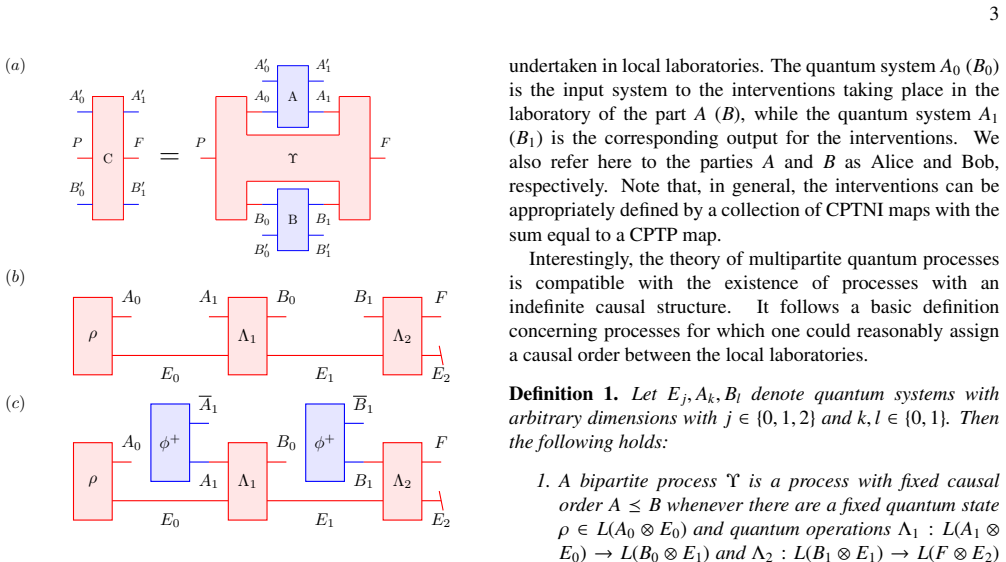
The mechanism is an interventional construction combined with monotonicity of quantum relative entropy. Feeding the $A_1$ and $B_1$ systems with halves of maximally entangled states makes the reduced channel on the environment a completely factorizable channel that sends maximally mixed states to maximally mixed states; Lemma 1 then bounds the entropy increase of any state through such a channel by $\log_2(\dim(\text{output})/\dim(\text{input}))$. Because the post-intervention global state is pure, the entropy of any complementary bipartition equals the entropy of its complement, which carries the environment dimension bound into the accessible-system inequality. A purification lemma shows every non-Markovian process can be represented by pure state preparation followed by unitaries, completing the proof.
What would settle it
Construct a concrete fixed-order process with a non-trivial global past system $P$, for example by starting with a correlated state between $P$ and the environment, apply the same maximally-entangled interventions, and compute the entropy difference in Eq. (9); if it drops below $\log_2(\dim(B_1)/\dim(F))$, the inequality is not necessary for fixed causal order and the 'without loss of generality' reduction is false.
Extended reading notes
Core claim
The central result is Theorem 1: for any bipartite process with fixed causal order $A\preceq B$ and global future $F$, the state $\tau$ obtained by feeding halves of maximally entangled states at $A_1$ and $B_1$ satisfies $H(A_0A_1B_0B_1F)_\tau - H(A_0A_1B_0)_\tau \ge \log_2(\dim(B_1)/\dim(F))$. The symmetric bound, with $A$ and $B$ interchanged, applies to processes of the form $B\preceq A$. A process that violates both bounds cannot be represented as a fixed-order quantum comb; it is either causally separable or indefinite causal ordered. The proof forces the environment to evolve through a channel that preserves maximally mixed states, so monotonicity of quantum relative entropy gives a dimension-dependent entropy increase; purity of the post-intervention state then converts environment entropies into entropies of the accessible output systems. The same reasoning extends to Rényi entropies with $\alpha\in[1/2,1)\cup(1,\infty)$ and to max- and min-entropies.
Load-bearing premise
The load-bearing premise is that a fixed-causal-order process can be assumed to have no non-trivial global past system; the proof asserts this 'without loss of generality' but does not reduce away a genuine past system, so a fixed-order process with such a past could evade the entropy bound and be misclassified.
Editorial extensions
If this is right
- Violating both the $A\preceq B$ and $B\preceq A$ bounds for the same interventional state is a sufficient certificate that the process is not fixed causal order, and it requires only entropies of the accessible systems rather than full process tomography.
- The quantum switch violates the inequalities, and for the switch and its causally separable mixture $\Upsilon_1$ the certification succeeds for every non-extreme control parameter $0<\lambda<1$; for the variant with the target output discarded, certification succeeds on an intermediate range of $\lambda$.
- Combining the main inequality with strong subadditivity of quantum entropy yields marginal witnesses $I_1$ and $I_2$ that are computable from subsystem states alone, although they are never stronger than the full witness.
- For Rényi parameters $\alpha\in[1/2,1)$, the inequalities are more sensitive for the $\Upsilon_2$ process than the von Neumann entropy version, while parameters $\alpha>1$ and the max- and min-entropies are less sensitive.
- When $\dim(B_1)\ge\dim(F)$, the inequality simplifies to $H(A_0A_1B_0B_1F)_\tau \ge H(A_0A_1B_0)_\tau$, an immediate necessary condition for fixed causal order.
Reading between the lines
- If the global-past reduction can be completed by absorbing the past system $P$ into the environment preparation, the same entropic bound should apply to processes with a non-trivial global past; the paper's 'without loss of generality' leaves that step open.
- Because the Rényi parameter can be tuned continuously in $\alpha\in[1/2,1)$, the inequalities could be used as a family of witnesses rather than a single fixed one; the paper does not report an exhaustive optimisation over $\alpha$.
- The marginal witnesses are computable from reduced states alone, which suggests that suitably modified versions could lead toward the semi-device-dependent or device-independent entropic causal inequalities the paper flags as a future direction.
Signed reviews
Editorial analysis
A structured set of objections, weighed in public.
Referee Report
Summary. The paper proposes entropic inequalities that are claimed to hold for every bipartite quantum process with fixed causal order (non-Markovian process), and whose violation certifies that the process is not fixed causal order, i.e., it is causally separable or has indefinite causal order. The main inequality, Theorem 1, states that after feeding halves of maximally entangled states at the local output systems A1 and B1, the resulting state τ obeys H(A0A1B0B1F) − H(A0A1B0) ≥ log2(dim B1 / dim F) for a process of the form A⪯B. The proof in Appendix A proceeds through three lemmas: relative entropy monotonicity for channels preserving maximally mixed states, an intervention argument using a pure-state unitary dilation, and a purification result converting the general non-Markovian form into a unitary circuit. The authors apply the inequality to the quantum switch, discuss marginal witnesses derived from strong subadditivity, and generalize the inequality to Rényi, max-, and min-entropies.
Significance. The proposed inequalities are attractive and potentially useful witnesses: they are simple, entropic, device-dependent tests that require only marginal information, and the proof is self-contained using standard tools (relative entropy monotonicity, Stinespring dilation, strong subadditivity). The Rényi extension, with the demonstrated advantage for parameters in [1/2,1), is a useful addition. However, the significance is currently limited by a scope mismatch: the proof in Appendix A and Definition 1 concern processes with a trivial global past, while the abstract, the theorem statement, and the main application (the quantum switch) involve processes with a non-trivial global past system. If this scope issue is resolved by either restricting the claims or supplying the missing reduction, the result would be a clean and useful contribution to the information-theoretic certification of indefinite causal order.
major comments (2)
- [Section III A and Appendix A (Lemma 2, Lemma 3)] The proof of Theorem 1 assumes, via the opening phrase 'without loss of generality' in Section III A, that the process has no non-trivial global past system P. This is not justified. Definition 1 defines fixed causal order A⪯B only through an initial state in L(A0⊗E0) and operations Λ1, Λ2, with no P; Lemma 3 is a purification of exactly that form. For a fixed-order process with a non-trivial global past P, the interventional state after feeding the maximally entangled states is not a pure state on A0⊗A1⊗B0⊗B1⊗F⊗Q2 alone: the system P (or a preparation-dependent marginal of it) enters the entropy equalities, and the identities H(Q2)=H(A0A1B0B1F) and H(Q1)=H(A0A1B0) used in Lemma 2 fail unless P is traced out in a way that changes the process. No reduction is given that absorbs P into A0, B0, or the initial preparation without altering the local operations or the dimensions in Eq. (9). Thus Eq. (9) is unproven for exactly the class of processes—such as the quantum switch, whose global past is T0⊗C0—that the paper aims to certify. Please either restrict the theorem to trivial-P processes and state the switch application as a derived process with fixed input states on P, or extend the proof to include non-trivial P.
- [Section II A (Definition 1)] Definition 1 and the surrounding text restrict the notion of fixed causal order to processes with a trivial global past: the initial state is on A0⊗E0 and the output is a state on F. The sentence 'the most general fixed causal order processes ... are quantum processes with a trivial global past system' is in tension with the process matrix formalism introduced in Eq. (6), where the process matrix is an operator on P⊗A0⊗A1⊗B0⊗B1⊗F, and also with the quantum switch used later, which has a non-trivial global past. If the authors intend to work only with trivial-P processes, the theorem and abstract should say so explicitly; if they intend the general fixed-order class, the proof and the reduction from P to the trivial-P case must be supplied. This is not a cosmetic point, because the witness inequality (9) and its violation depend on the dimensions and on whether P is retained.
minor comments (4)
- [Section III D] The parameter range for which the Rényi properties are claimed is written as 1/2<α<1, while the abstract and the theorem use α∈[1/2,1). Since the cited Frank–Lieb monotonicity holds at α=1/2, please make the text consistent.
- [Section III D] In the sentence 'Now, we focus on quantum processes A⪯B for which the global future is such that dim(F) is not larger than dim B1. Similar reasoning holds for processes of the form A⪯B, interchanging A and B', the second 'A⪯B' should be 'B⪯A'.
- [Lemma 2 and Fig. 1(c)] The systems called A1 and B1 in the entropy expressions are actually the reference halves \bar A1 and \bar B1 of the maximally entangled states; the notation is suppressed via the statement X≃X, but this should be stated in the main text of Theorem 1 as well, to avoid confusion.
- [Figures 2–4] The figure captions refer to DP1, DP_A⪯B;α, and similar quantities without explicitly defining the plotted expressions; please add equations or refer consistently to Eqs. (11)–(15) so the reader can reproduce the plots.
Circularity Check
The derivation is self-contained; the flagged global-past scope gap is a correctness concern, not circularity.
full rationale
I walked the paper's derivation chain through Lemmas 1–3. Lemma 1 is the standard relative-entropy monotonicity for channels that preserve the maximally mixed state; Lemma 2 applies it to the completely factorizable channel produced by the maximally-entangled interventions, using only purity identities and dimension counting; Lemma 3 is the standard purification/dilation decomposition of Definition 1. None of these steps assumes the target inequality, fits a parameter, or defines the witness in terms of the outcome. The self-citations to Refs. [24,25] are background motivation for data-processing witnesses and are not load-bearing in the proof; the Rényi extension relies on external results [55,56]. The only flagged issue is Section III A's 'without loss of generality' restriction to a global future while Definition 1 and Lemma 3 realize fixed-order processes only with trivial global past: processes with non-trivial global past P are not covered by Eq. (9), so the abstract may overstate the theorem's scope. That is a correctness risk, not a circular reduction, because Eq. (9) is not assumed as an input anywhere and the proof is anchored in standard external information-theoretic facts.
Assumptions & free parameters
assumptions (5)
- standard math Monotonicity of quantum relative entropy under CPTP maps
- standard math Strong subadditivity of von Neumann entropy
- domain assumption Every non-Markovian process with fixed causal order can be purified to a pure state preparation and unitary operations
- domain assumption The bipartite process has no non-trivial global past
- domain assumption Rényi entropy monotonicity for unital channels holds for α in [1/2,1) ∪ (1,∞)
Cite this review
Pith. "Pith review of Entropic limitations on fixed causal order." pith.science (2026). https://pith.science/paper/7CGYEFL4
@misc{pith2026250513681,
  author       = {Pith},
  title        = {Pith review of: Entropic limitations on fixed causal order},
  year         = {2026},
  howpublished = {\url{https://pith.science/paper/7CGYEFL4}},
  note         = {Machine review of arXiv:2505.13681}
}
abstract
Quantum processes can exhibit scenarios beyond a fixed order of events. We propose information inequalities that, when violated, constitute sufficient conditions to certify quantum processes without a fixed causal order -- causally separable or indefinite causal ordered processes. The inequalities hold valid for a vast class of information measures. Nevertheless, we take under scrutiny the von Neumann, $\alpha-$R\'enyi entropies with parameter $\alpha \in [1/2,1) \cup (1,\infty)$, and max- and min-entropies. We also discuss how the strong subadditivity of quantum (von Neumann) entropy, used along with the information inequality developed here, implies relevant witnesses of causally separable and indefinite causal ordered processes in marginal scenarios. Importantly, we show the violation of these inequalities for the quantum switch, a paradigmatic example of a process with indefinite causal order. Our approach contributes to the important research direction of information-theoretic characterization of quantum processes beyond fixed causal orders.
Figures


Figures from the paper (2 more)


Reference graph
Works this paper leans on
-
[1]
The set of linear transformations with input system A and output system B is denoted with L(A, B)
The quantum state ρ ∈ L(A) is a positive semidefinite operator with a unit trace. The set of linear transformations with input system A and output system B is denoted with L(A, B). Any linear transformation T ∈ L(A, B) can be equivalently represented via its Choi-Jamiołkowski (CJ) vector in L(A⊗B) [32–34]: |T⟩⟩= X i |i⟩⊗T |i⟩, (1) where{|i⟩} is an orthono...
-
[2]
to L(A′ 1⊗ F⊗ B′ 1), as defined in Eq. (3). The action of the quantum process Υ on the auxiliary systems A′ 0, A′ 1, B′ 0, B′ 1 is trivial, in other words on those systems the identity supermap is being applied. Fig. (b) is a pictorial representation of an arbitrary non-Markovian process: it consists of an initial bipartite system-environment quantum stat...
-
[3]
1(a), we show the diagrammatic representation of Eq
In Fig. 1(a), we show the diagrammatic representation of Eq. (3). The spots for the intervention (shown in the blue shaded regions in Fig. 1) performed by quantum operations on quantum processes are interpreted as the possible experiments undertaken in local laboratories. The quantum system A0 (B0) is the input system to the interventions taking place in ...
-
[4]
A bipartite process Υ is a process with fixed causal order A⪯ B whenever there are a fixed quantum state ρ∈ L(A0⊗ E0) and quantum operations Λ1 : L(A1⊗ E0)→ L(B0⊗ E1) and Λ2 : L(B1⊗ E1)→ L(F⊗ E2) for which holds Υ(ΦA, ΦB) = TrE2[(Λ2)(ΦB⊗idE1)(Λ1)(ΦA⊗idE0)(ρ)], (4) for arbitrary quantum channels ΦA : L(A0)→ L(A1) and ΦB : L(B0)→ L(B1)
-
[5]
The Quantum Information Structure of Spacetime
A process is called causally separable if it is a probabilistic combination of processes with distinct fixed causal orders. Precisely, a process is causally separable and denoted as Υsep if there are processes ΥA⪯B and ΥB⪯A for which Υsep = qΥA⪯B + (1− q)ΥB⪯A, (5) with probability 0≤ q≤ 1. Fig. 1(b) provides an illustration of a fixed causal order in agre...
work page 2024
-
[6]
Pearl, Causality (Cambridge University Press, Cambridge, England, 2009)
J. Pearl, Causality (Cambridge University Press, Cambridge, England, 2009)
work page 2009
-
[7]
P. Spirtes, C. Glymour, and R. Scheines,Causation, Prediction, and Search (The MIT Press, 2001)
work page 2001
-
[8]
L. Lamport, Time, clocks, and the ordering of events in a distributed system, Communications of the ACM 21, 558–565 (1978)
work page 1978
Show all 61 references
-
[9]
Oreshkov, F
O. Oreshkov, F. Costa, and ˇC. Brukner, Quantum correlations with no causal order, Nature communications 3, 1092 (2012)
2012
-
[10]
Chiribella, G
G. Chiribella, G. M. D’Ariano, P. Perinotti, and B. Valiron, Quantum computations without definite causal structure, Physical Review A 88, 022318 (2013)
2013
-
[11]
Hardy, Towards quantum gravity: a framework for probabilistic theories with non-fixed causal structure, Journal of Physics A: Mathematical and Theoretical 40, 3081–3099 (2007)
L. Hardy, Towards quantum gravity: a framework for probabilistic theories with non-fixed causal structure, Journal of Physics A: Mathematical and Theoretical 40, 3081–3099 (2007)
2007
-
[12]
L. Hardy, Quantum gravity computers: On the theory of computation with indefinite causal structure, in Quantum Reality, Relativistic Causality, and Closing the Epistemic Circle (Springer Netherlands, 2009) p. 379–401
2009
-
[13]
M. Zych, F. Costa, I. Pikovski, and ˇC. Brukner, Bell’s theorem for temporal order, Nature Communications 10, 10.1038/s41467-019-11579-x (2019)
2019 doi
-
[14]
Araújo, F
M. Araújo, F. Costa, and ˇC. Brukner, Computational advantage from quantum-controlled ordering of gates, Physical Review Letters 113, 10.1103/physrevlett.113.250402 (2014)
2014 doi
-
[15]
P. A. Guérin, A. Feix, M. Araújo, and ˇC. Brukner, Exponential communication complexity advantage from quantum superposition of the direction of communication, Physical Review Letters 117, 10.1103/physrevlett.117.100502 (2016)
2016 doi
-
[16]
Araújo, P
M. Araújo, P. A. Guérin, and Ä. Baumeler, Quantum computation with indefinite causal structures, Physical Review A 96, 10.1103/physreva.96.052315 (2017)
2017 doi
-
[17]
Ebler, S
D. Ebler, S. Salek, and G. Chiribella, Enhanced communication with the assistance of indefinite causal order, Physical Review Letters 120, 120502 (2018)
2018
-
[18]
Chiribella, M
G. Chiribella, M. Banik, S. S. Bhattacharya, T. Guha, M. Alimuddin, A. Roy, S. Saha, S. Agrawal, and G. Kar, Indefinite causal order enables perfect quantum communication with zero capacity channels, New Journal of Physics 23, 033039 (2021)
2021
-
[19]
Chiribella, G
G. Chiribella, G. M. D’Ariano, and P. Perinotti, Transforming quantum operations: Quantum supermaps, Europhysics Letters 83, 30004 (2008)
2008
-
[20]
Chiribella, G
G. Chiribella, G. M. D’Ariano, and P. Perinotti, Theoretical framework for quantum networks, Physical Review A—Atomic, Molecular, and Optical Physics 80, 022339 (2009)
2009
-
[21]
F. A. Pollock, C. Rodríguez-Rosario, T. Frauenheim, M. Paternostro, and K. Modi, Non-markovian quantum processes: Complete framework and e fficient characterization, Physical Review A 97, 012127 (2018)
2018
-
[22]
M. M. Wilde, From classical to quantum shannon theory, arXiv preprint arXiv:1106.1445 (2011)
2011
-
[23]
Renner, N
R. Renner, N. Gisin, and B. Kraus, Information-theoretic security proof for quantum-key-distribution protocols, Physical Review A 72, 10.1103/physreva.72.012332 (2005)
2005 doi
-
[24]
A. E. Gamal and Y .-H. Kim, Lecture notes on network information theory (2011), arXiv:1001.3404 [cs.IT]
2011 arXiv
-
[25]
J. D. Bekenstein, Black holes and information theory, Contemporary Physics 45, 31–43 (2004)
2004
-
[26]
Goold, M
J. Goold, M. Huber, A. Riera, L. d. Rio, and P. Skrzypczyk, The role of quantum information in thermodynamics—a topical review, Journal of Physics A: Mathematical and Theoretical49, 143001 (2016)
2016
-
[27]
E. H. Lieb and M. B. Ruskai, Proof of the strong subadditivity of quantum-mechanical entropy, Journal of Mathematical Physics 14, 1938–1941 (1973)
1973
-
[28]
Schumacher and M
B. Schumacher and M. A. Nielsen, Quantum data processing and error correction, Physical Review A54, 2629–2635 (1996)
1996
-
[29]
Capela, L
M. Capela, L. C. Céleri, K. Modi, and R. Chaves, Monogamy of temporal correlations: Witnessing non-markovianity beyond data processing, Physical Review Research 2, 013350 (2020)
2020
-
[30]
Capela, L
M. Capela, L. C. Céleri, R. Chaves, and K. Modi, Quantum markov monogamy inequalities, Physical Review A 106, 022218 (2022)
2022
-
[31]
Branciard, M
C. Branciard, M. Araújo, A. Feix, F. Costa, and ˇC. Brukner, The simplest causal inequalities and their violation, New Journal of Physics 18, 013008 (2015)
2015
-
[32]
Dourdent, A
H. Dourdent, A. A. Abbott, N. Brunner, I. Šupi ´c, and C. Branciard, Semi-device-independent certification of causal nonseparability with trusted quantum inputs, Physical Review Letters 129, 090402 (2022)
2022
-
[33]
van der Lugt, J
T. van der Lugt, J. Barrett, and G. Chiribella, Device- independent certification of indefinite causal order in the quantum switch, Nature Communications 14, 5811 (2023)
2023
-
[34]
D. Jia, F. Costa, et al., Causal order as a resource for quantum communication, Physical Review A 100, 052319 (2019)
2019
-
[35]
P. J. Coles, M. Berta, M. Tomamichel, and S. Wehner, Entropic uncertainty relations and their applications, Reviews of Modern Physics 89, 10.1103/revmodphys.89.015002 (2017)
2017 doi
-
[36]
Dourdent, A
H. Dourdent, A. A. Abbott, I. Šupi ´c, and C. Branciard, Network-device-independent certification of causal nonseparability, Quantum 8, 1514 (2024)
2024
-
[37]
Jamiołkowski, Linear transformations which preserve trace and positive semidefiniteness of operators, 3, 275 (1972)
A. Jamiołkowski, Linear transformations which preserve trace and positive semidefiniteness of operators, 3, 275 (1972)
1972
-
[38]
Choi, Positive semidefinite biquadratic forms, 12, 95 (1975)
M.-D. Choi, Positive semidefinite biquadratic forms, 12, 95 (1975)
1975
-
[39]
Choi, Completely positive linear maps on complex matrices, Linear algebra and its applications 10, 285 (1975)
M.-D. Choi, Completely positive linear maps on complex matrices, Linear algebra and its applications 10, 285 (1975)
1975
-
[40]
Milz and K
S. Milz and K. Modi, Quantum stochastic processes and quantum non-markovian phenomena, PRX Quantum2, 030201 12 (2021)
2021
-
[42]
M. Nery, M. T. Quintino, P. A. Guérin, T. O. Maciel, and R. O. Vianna, Simple and maximally robust processes with no classical common-cause or direct-cause explanation, Quantum 5, 538 (2021)
2021
-
[43]
Taranto, M
P. Taranto, M. T. Quintino, M. Murao, and S. Milz, Characterising the hierarchy of multi-time quantum processes with classical memory, Quantum 8, 1328 (2024)
2024
-
[44]
Goswami, A
K. Goswami, A. K. Roy, V . Srivastava, B. Perez, C. Giarmatzi, A. Gilchrist, and F. Costa, Hamiltonian characterisation of multi-time processes with classical memory (2024), arXiv:2412.01998 [quant-ph]
2024
-
[45]
Branciard, Witnesses of causal nonseparability: an introduction and a few case studies, Scientific reports 6, 26018 (2016)
C. Branciard, Witnesses of causal nonseparability: an introduction and a few case studies, Scientific reports 6, 26018 (2016)
2016
-
[46]
Giarmatzi and F
C. Giarmatzi and F. Costa, Witnessing quantum memory in non-markovian processes, Quantum 5, 440 (2021)
2021
-
[47]
C. E. Shannon, A mathematical theory of communication, The Bell system technical journal 27, 379 (1948)
1948
-
[48]
R. W. Yeung, Information theory and network coding (Springer Science & Business Media, 2008)
2008
-
[49]
Watrous, The theory of quantum information (Cambridge university press, 2018)
J. Watrous, The theory of quantum information (Cambridge university press, 2018)
2018
-
[50]
Schumacher and M
B. Schumacher and M. A. Nielsen, Quantum data processing and error correction, Physical Review A 54, 2629 (1996)
1996
-
[51]
F. Buscemi, Complete positivity, Markovianity, and the quantum data-processing inequality, in the presence of initial system-environment correlations, Physical review letters 113, 140502 (2014)
2014
-
[52]
Hayden, R
P. Hayden, R. Jozsa, D. Petz, and A. Winter, Structure of states which satisfy strong subadditivity of quantum entropy with equality, Communications in mathematical physics 246, 359 (2004)
2004
-
[53]
Taranto, F
P. Taranto, F. Bakhshinezhad, P. Schüttelkopf, F. Clivaz, and M. Huber, Exponential improvement for quantum cooling through finite-memory e ffects, Physical Review Applied 14, 054005 (2020)
2020
-
[54]
Taranto, F
P. Taranto, F. A. Pollock, and K. Modi, Non-markovian memory strength bounds quantum process recoverability, npj Quantum Information 7, 149 (2021)
2021
-
[55]
Araújo, C
M. Araújo, C. Branciard, F. Costa, A. Feix, C. Giarmatzi, and ˇC. Brukner, Witnessing causal nonseparability, New Journal of Physics 17, 102001 (2015)
2015
-
[56]
S. Milz, M. Kim, F. A. Pollock, and K. Modi, Completely positive divisibility does not mean markovianity, Physical review letters 123, 040401 (2019)
2019
-
[57]
S. Milz, F. Sakuldee, F. A. Pollock, and K. Modi, Kolmogorov extension theorem for (quantum) causal modelling and general probabilistic theories, Quantum 4, 255 (2020)
2020
-
[58]
Taranto, F
P. Taranto, F. A. Pollock, S. Milz, M. Tomamichel, and K. Modi, Quantum markov order, Physical Review Letters122, 140401 (2019)
2019
-
[59]
Schumacher, Quantum coding, Physical Review A 51, 2738 (1995)
B. Schumacher, Quantum coding, Physical Review A 51, 2738 (1995)
1995
-
[60]
R. L. Frank and E. H. Lieb, Monotonicity of a relative Rényi entropy, Journal of Mathematical Physics 54, https://doi.org/10.1063/1.4838835 (2013)
2013 doi
-
[61]
Datta, Min-and max-relative entropies and a new entanglement monotone, IEEE Transactions on Information Theory 55, 2816 (2009)
N. Datta, Min-and max-relative entropies and a new entanglement monotone, IEEE Transactions on Information Theory 55, 2816 (2009)
2009
-
[62]
Gour, Resources of the quantum world (2024), arXiv:2402.05474 [quant-ph]
G. Gour, Resources of the quantum world (2024), arXiv:2402.05474 [quant-ph]
2024
Reviewed August 15, 2026 · model on record in the stance chip above.
Discussion (0). Continue with ORCID to comment.