REVIEW 3 major objections 5 minor 32 references
First-principles calculations of transport coefficients in Weyl semimetal TaAs
T0 review · 3 major / 5 minor · reviewed 2026-08-07 · deepseek-v4-flash
Pith's one-line read A first-principles electron-phonon calculation reproduces the measured in-plane conductivity of the Weyl semimetal TaAs and predicts a strong breakdown of the Wiedemann–Franz law between 150 K and 350 K.
desk verdict First full e-ph BTE transport coefficients for TaAs, with a genuine Wiedemann-Franz violation that is consistent across RTA and IBTE; the unquantified Onsager residual is a real but secondary issue. read the letter →
The pith
A machine-rendered reading of the paper's core claim, the machinery that carries it, and where it could break.
The reading
What carries the argument
The central object is a pair of iterative Boltzmann transport equations, one for the electric-field response function $F^E$ and one for the thermal-gradient response function $F^T$, coupled through the same electron-phonon scattering kernel built from matrix elements $g_{mn\nu}(\mathbf{k}, \mathbf{q})$. The iterative scheme supplies the Onsager coefficients $L_{11}$, $L_{12}$, $L_{21}$, and $L_{22}$ independently, so the Seebeck coefficient $S = L_{12}/(T L_{11})$ and the Peltier coefficient $\Pi = L_{21}/L_{11}$ need not satisfy $\Pi = T S$. This structure is what lets the electrical and thermal responses be solved on the same footing, and it is what makes the calculation applicable to magnetic systems.
What would settle it
A direct measurement of the in-plane electronic thermal conductivity of TaAs between 150 and 350 K, not inferred through the Wiedemann–Franz law, would settle the central claim: the paper predicts the Lorenz ratio rises to about 1.7 times the Sommerfeld value along $x$, so a measured value near the Sommerfeld value would refute it.
Extended reading notes
Core claim
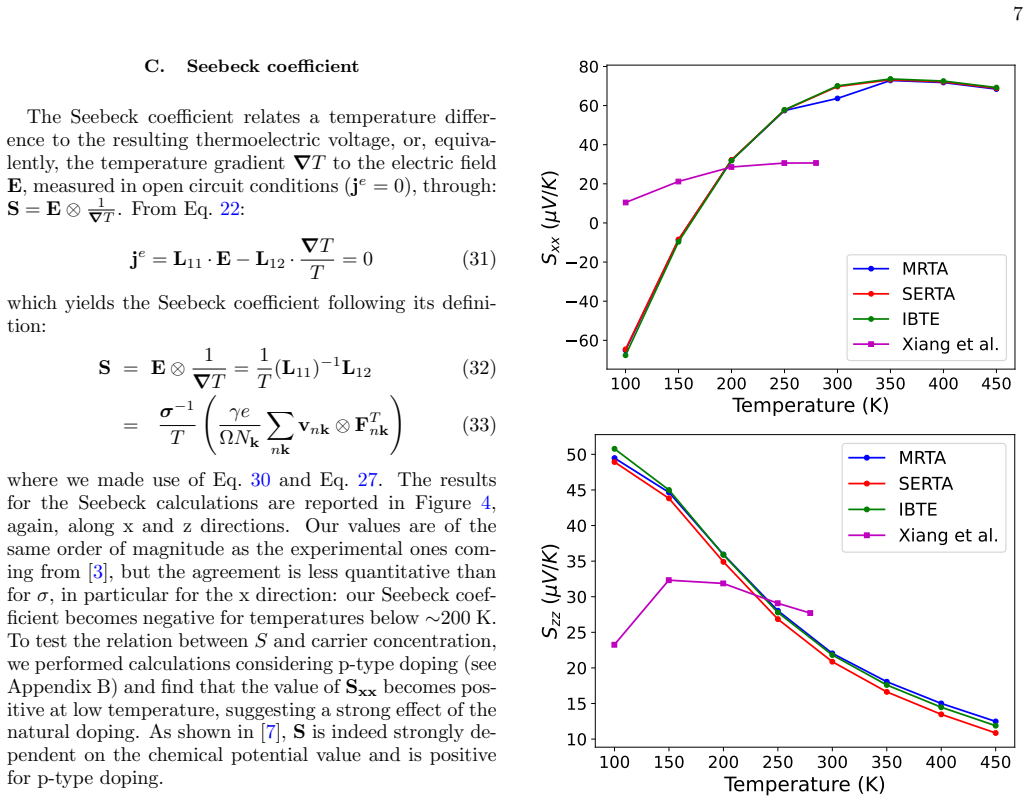
The authors' central claim is that solving the linearized Boltzmann transport equation with electron-phonon scattering computed from density functional perturbation theory gives the full thermoelectric response of TaAs: electrical conductivity, Seebeck coefficient, electronic thermal conductivity, and Peltier coefficient. The computed in-plane conductivity $\sigma_{xx}$ agrees with experiment over the measured range, while $\sigma_{zz}$ is overestimated, a discrepancy attributed to differences in carrier concentration. The Seebeck coefficient has the right order of magnitude and its low-temperature sign is controlled by doping. The paper also reports Lorenz numbers $L_{xx}/L_0$ reaching about 1.7 between 150 K and 350 K, so the Wiedemann–Franz law is strongly violated in-plane; along $z$ the ratio sits below 1. For the method, the authors derive a second iterative equation for the thermal-gradient response, so $L_{12}$ and $L_{21}$ are computed independently and Onsager reciprocity is not imposed.
Load-bearing premise
The load-bearing premise is that natural doping in real TaAs crystals only shifts the Fermi level, leaving the band structure and scattering unchanged; if the actual carrier concentrations or band renormalization are different, the model cannot fix the two main disagreements with experiment.
Editorial extensions
If this is right
- Because the calculation includes the full electron-phonon scattering kernel, the constant relaxation time approximation is not needed for semimetals; the in-plane conductivity of TaAs is reproduced without adjustable parameters.
- Experimental estimates of the electronic thermal conductivity of TaAs that use the Sommerfeld Lorenz number will be off by up to roughly 70% in-plane between 150 and 350 K, since the computed Lorenz number deviates from $L_0$.
- The double iterative Boltzmann scheme, which does not enforce Onsager reciprocity, extends the same first-principles transport calculation to magnetic materials that break time-reversal symmetry.
- The sign and low-temperature magnitude of the Seebeck coefficient are controlled by doping, so measurements on samples with known carrier concentration should track the computed rigid-band trends.
Reading between the lines
- A natural next test would be computing the same transport coefficients with a self-consistent treatment of doping, including band renormalization, rather than rigid-band shifts; this could close the remaining $\sigma_{zz}$ and Seebeck-sign discrepancies.
- Applying the double-IBTE method to a magnetic Weyl semimetal with broken time-reversal symmetry would directly demonstrate the claimed difference between $L_{12}$ and $L_{21}$, a calculation the paper does not perform.
- The predicted in-plane Lorenz-number enhancement suggests a clean experimental probe: direct thermal-conductivity measurements that separate phonon and electron contributions could test the topological origin of the Wiedemann–Franz violation.
Signed reviews
Editorial analysis
A structured set of objections, weighed in public.
Referee Report
Summary. The paper computes the thermoelectric transport coefficients of the Weyl semimetal TaAs from first principles, using DFT and DFPT to obtain electron-phonon coupling matrix elements and then solving the linearized Boltzmann transport equation with three approaches: SERTA, MRTA, and an iterative BTE (IBTE). A methodological extension is presented in which the IBTE is solved separately for the response to an electric field and to a temperature gradient (Eqs. 20-21), yielding the Onsager coefficients L11, L12, L21, and L22 without imposing Onsager reciprocity (Eqs. 26-29). From these coefficients the authors obtain the electrical conductivity, Seebeck coefficient, electronic thermal conductivity, Peltier coefficient, and Lorenz number. Comparing with experiment, they find good agreement for sigma_xx, an overestimation of sigma_zz, and a Seebeck coefficient of the correct magnitude whose low-temperature sign depends on doping. They report a finite deviation between Pi_zz and T S_zz within the IBTE, and they conclude that the Wiedemann-Franz law is strongly violated, especially along the x direction. The paper includes rigid-band doping calculations in Appendix B and a discussion of the scattering operator in Appendix A.
Significance. If the central claim is established, the paper would be a valuable methodological contribution: it would show that a fully ab initio electron-phonon calculation can determine charge and heat transport in a topological semimetal, and it would provide a concrete test of Onsager reciprocity in an iterative Boltzmann solver. The double-IBTE formulation that allows L12 and L21 to differ is a potentially useful extension for systems without time-reversal symmetry, and the authors are careful to compare SERTA, MRTA, and IBTE results. The paper is also honest in reporting limitations of the rigid-band doping model. However, the headline quantitative claim of a 70% Wiedemann-Franz violation is not yet convincing because Onsager reciprocity is violated in the numerical results without any quantification of the residual or of convergence, and because key numerical details of the delta-function broadening and iterative convergence are missing. These gaps affect the central conclusion and must be addressed before the result can be regarded as a physical prediction.
major comments (3)
- [IV.E] The statement that 'Pi_zz shows finite deviation from T S_zz' is not quantified. The magnitude and temperature dependence of the deviation are not reported, nor is the convergence of the FE/FT iterative solution. Since S is computed from L12 (Eqs. 32-33) and kappa_el from L21*S (Eq. 36), any numerical asymmetry between L12 and L21 shifts both S and kappa_el, and therefore the Lorenz numbers in Tables I and II. Without a quantitative Onsager-residual check (e.g., |L12-L21|/|L12| as a function of iteration number and grid density), the claimed up-to-70% violation of the Wiedemann-Franz law is not established as a physical result. This is a load-bearing point for the paper's central conclusion.
- [III.C and IV.A] The iterative scheme in Eqs. 20-21 omits essential numerical details: the broadening width used for the energy-conserving delta functions delta_plus and delta_minus is not specified, and the convergence of the FE and FT iterations (number of iterations, stopping criterion) is not reported. The paper only states that room-temperature conductivities differ by 5% (x direction) and 20% (z direction) between 56^3 and 64^3 q-grids (Sec. IV.A), but does not report the sensitivity of S, kappa_el, or the individual Onsager coefficients to these parameters. Given that the claimed Wiedemann-Franz violation is a quantitative statement about Lxx/L0, these missing convergence checks are essential.
- [Appendix A] The linearized scattering integral (Eq. A10) is the central operator of the IBTE, but its derivation is deferred: Appendix A states 'The derivation is quite lengthy and is not reported here, but more details can be found in [23].' For a paper that claims to derive an additional equation needed to fully solve transport under both electrical and thermal gradients, this is a significant gap. In particular, the linearization of the emission and absorption terms (Eqs. A8-A9) and the appearance of band indices m and n in delta f_{mk+q} in Eq. A10 need to be shown explicitly. The statement in Sec. III.C that the FT ansatz is 'not exact' due to a band mismatch raises the question of whether Eqs. 20-21 are exact solutions or an additional approximation, and the appendix does not resolve this.
minor comments (5)
- [III.B] There is a typo in the sentence beginning 'In should be noted' in the paragraph after Eq. 14; it should read 'It should be noted'.
- [Figures 3-9] The figure captions contain 'T emperature' instead of 'Temperature' in several places; please correct this throughout.
- [IV.E, Figure 6] In the legend, 'IBTE = TS' is used, while the text uses 'Pi = T S'; please make the notation consistent so the reader knows which quantity is plotted.
- [I.B] The relation between the 8x8x8 q-point grid used for phonons and the 64x64x64 q-point grid used for scattering potentials should be clarified; the former is presumably the DFPT grid, while the latter is the interpolation grid for the EPC matrix elements.
- [References] References [31] and [32] are the same publication (Madsen, Carrete, and Verstraete, Comput. Phys. Commun. 231, 140 (2018)); please cite it only once.
Circularity Check
No significant circularity: transport coefficients are computed ab initio with no fitted parameters; self-citations are methodological and not load-bearing.
full rationale
Walking the derivation chain: the paper computes electron-phonon matrix elements from DFPT, solves the linearized BTE in SERTA, MRTA, and IBTE, and forms the Onsager coefficients via Eqs. 26-29. The transport coefficients S, kappa_el, and Pi are then obtained from the defining relations in Eqs. 30-38. Nothing in this chain is fitted to the experimental sigma, S, or kappa_el values used for comparison; experimental data enter only after the calculations as benchmarks. The rigid-band doping shifts in Appendix B are exploratory: the paper chooses two concentrations and explicitly concludes that rigid-band doping cannot simultaneously explain S and sigma, so the doping study is not a fitted input renamed as a prediction. Self-citations to the ABINIT EPH module (Refs. 21, 22) and to prior work on cRTA failure (Ref. 8) support the numerical methodology but are not used to justify the central physical claim; the implementation is open-source and the electronic and phonon band structures are checked against independent calculations and experiments. The paper also discloses the two limitations that a circularity critique would target: the IBTE Onsager residual in Sec. IV.E, where it states that differences 'could be caused by numerical effects,' and the fact that the experimental kappa_el of Ref. 3 assumes the Wiedemann-Franz law. These are accuracy caveats, not circular reasoning. No step reduces, by construction, to its own input.
Assumptions & free parameters
free parameters (3)
- Rigid-band p-type doping concentration =
0, +1e19, +5e19 cm^-3
- Energy window around the Fermi level =
0.25 eV
- Delta-function broadening width =
not reported
assumptions (7)
- domain assumption Phonons stay in thermal equilibrium and follow the Bose-Einstein distribution n0(omega).
- domain assumption Electron-phonon scattering is the only operative scattering mechanism.
- domain assumption Quasiparticles are well defined: the spectral function is strongly peaked around epsilon_nk.
- domain assumption GGA-PBE with spin-orbit coupling gives an accurate band structure and Fermi surface for TaAs.
- ad hoc to paper Doping only shifts the chemical potential and does not modify the band structure (rigid-band approximation).
- domain assumption The iterative IBTE scheme converges to the solution of the linearized BTE.
- standard math Fermi's golden rule applies to electron-phonon scattering.
Cite this review
Pith. "Pith review of First-principles calculations of transport coefficients in Weyl semimetal TaAs." pith.science (2026). https://pith.science/paper/7D7Z4LXK
@misc{pith2026250515522,
  author       = {Pith},
  title        = {Pith review of: First-principles calculations of transport coefficients in Weyl semimetal TaAs},
  year         = {2026},
  howpublished = {\url{https://pith.science/paper/7D7Z4LXK}},
  note         = {Machine review of arXiv:2505.15522}
}
abstract
We study charge and heat transport from first-principles in the topological Weyl semimetal TaAs. Electron-phonon coupling matrix elements are calculated using density functional perturbation theory and used to derive the thermo-electric transport coefficients, including the electrical conductivity, Seebeck coefficient, electronic thermal conductivity and the Peltier coefficient. We compare the self-energy and momentum relaxation time approximations to the iterative solution of the Boltzmann Transport Equation, finding they give similar results for TaAs provided the chemical potential is treated accurately. For the iterative method, we derive an additional equation, which is needed to fully solve for transport under both thermal and an electrical potential gradients. Interestingly, the Onsager reciprocity between $S$ and $\Pi$ is no longer imposed, and we can deal with systems breaking time-reversal symmetry, in particular magnetic materials. We compare our results with the available experimental data for TaAs: the agreement is excellent for $\sigma_{xx}$, while $\sigma_{zz}$ is overestimated, probably due to differences in experimental carrier concentrations. The Seebeck coefficient is of the same order of magnitude in theory and experiments, and we find that its low-T behavior also strongly depends on the doping level.
Figures


Figures from the paper (5 more)


Reference graph
Works this paper leans on
-
[23]
S. Ponc´ e, W. Li, S. Reichardt, and F. Giustino, First- principles calculations of charge carrier mobility and con- ductivity in bulk semiconductors and two-dimensional materials, Reports on Progress in Physics 83, 036501 (2020)
work page 2020
- [1]
-
[2]
B. Lv, H. Weng, B. Fu, X. P. Wang, H. Miao, J. Ma, P. Richard, X. Huang, L. Zhao, G. Chen, et al. , Experi- mental discovery of weyl semimetal taas, Physical Review X 5, 031013 (2015)
work page 2015
- [3]
-
[4]
X. Xu, Y. Liu, G. Seyfarth, A. Pourret, W. Ma, H. Zhou, G. Wang, Z. Qu, and S. Jia, Thermoelectric transport and phonon drag in weyl semimetal monochalcogenides, Physical Review B 104, 115164 (2021)
work page 2021
-
[5]
C. A. Garcia, J. Coulter, and P. Narang, Optoelectronic 12 100 150 200 250 300 350 400 450 T emperature (K) 40 20 0 20 40 60 80 Sxx ( V/K) MRTA SERTA IBTE Xiang et al. Figure 8: Temperature dependence of the x component of the Seebeck coefficient, using RTA and IBTE and considering a rigid band doping of +1 10 19 carriers per cm3 (p-type). Experimental da...
work page 2020
-
[6]
J. Coulter, G. B. Osterhoudt, C. A. Garcia, Y. Wang, V. M. Plisson, B. Shen, N. Ni, K. S. Burch, and P. Narang, Uncovering electron-phonon scattering and phonon dynamics in type-i weyl semimetals, Physical Re- view B 100, 220301 (2019)
work page 2019
-
[7]
B. Peng, H. Zhang, H. Shao, H. Lu, D. W. Zhang, and H. Zhu, High thermoelectric performance of weyl semimetal taas, Nano Energy 30, 225 (2016)
work page 2016
Show all 32 references
-
[8]
B. Xu, M. Di Gennaro, and M. J. Verstraete, Ther- moelectric properties of elemental metals from first- principles electron-phonon coupling, Physical Review B 102, 155128 (2020)
2020
-
[9]
Gonze, B
X. Gonze, B. Amadon, G. Antonius, F. Arnardi, L. Baguet, J.-M. Beuken, J. Bieder, F. Bottin, J. Bouchet, E. Bousquet, N. Brouwer, F. Bruneval, G. Brunin, T. Cavignac, J.-B. Charraud, W. Chen, M. Cˆ ot´ e, S. Cottenier, J. Denier, G. Geneste, P. Ghosez, M. Giantomassi, Y. Gille...
2020
-
[10]
Hohenberg and W
P. Hohenberg and W. Kohn, Inhomogeneous electron gas, Phys. Rev. 136, B864 (1964)
1964
-
[11]
Kohn and L
W. Kohn and L. J. Sham, Self-consistent equations in- cluding exchange and correlation effects, Phys. Rev. 140, A1133 (1965)
1965
-
[12]
Gonze, First-principles responses of solids to atomic displacements and homogeneous electric fields: Imple- mentation of a conjugate-gradient algorithm, Phys
X. Gonze, First-principles responses of solids to atomic displacements and homogeneous electric fields: Imple- mentation of a conjugate-gradient algorithm, Phys. Rev. B 55, 10337 (1997)
1997
-
[13]
Baroni, S
S. Baroni, S. de Gironcoli, A. Dal Corso, and P. Gi- annozzi, Phonons and related crystal properties from density-functional perturbation theory, Rev. Mod. Phys. 73, 515 (2001)
2001
-
[14]
J. P. Perdew, K. Burke, and M. Ernzerhof, Generalized gradient approximation made simple, Phys. Rev. Lett. 77, 3865 (1996)
1996
-
[15]
D. R. Hamann, Optimized norm-conserving vanderbilt pseudopotentials, Phys. Rev. B 88, 085117 (2013)
2013
-
[16]
van Setten, M
M. van Setten, M. Giantomassi, E. Bousquet, M. Ver- straete, D. Hamann, X. Gonze, and G.-M. Rignanese, The pseudodojo: Training and grading a 85 element opti- mized norm-conserving pseudopotential table, Computer Physics Communications 226, 39 (2018)
2018
-
[17]
Chang, Y
D. Chang, Y. Liu, F. Rao, F. Wang, Q. Sun, and Y. Jia, Phonon and thermal expansion properties in weyl semimetals mx (m= nb, ta; x= p, as): ab initio studies, Physical Chemistry Chemical Physics 18, 14503 (2016)
2016
-
[18]
Lee, S.-Y
C.-C. Lee, S.-Y. Xu, S.-M. Huang, D. S. Sanchez, I. Be- lopolski, G. Chang, G. Bian, N. Alidoust, H. Zheng, M. Neupane, et al. , Fermi surface interconnectivity and topology in weyl fermion semimetals taas, tap, nbas, and nbp, Physical Review B 92, 235104 (2015)
2015
-
[19]
Setyawan and S
W. Setyawan and S. Curtarolo, High-throughput elec- tronic band structure calculations: Challenges and tools, Computational Materials Science 49, 299 (2010)
2010
-
[20]
Giustino, Electron-phonon interactions from first prin- ciples, Rev
F. Giustino, Electron-phonon interactions from first prin- ciples, Rev. Mod. Phys. 89, 015003 (2017)
2017
-
[21]
Brunin, H
G. Brunin, H. P. C. Miranda, M. Giantomassi, M. Royo, M. Stengel, M. J. Verstraete, X. Gonze, G.-M. Rig- nanese, and G. Hautier, Phonon-limited electron mobility in si, gaas, and gap with exact treatment of dynamical quadrupoles, Phys. Rev. B 102, 094308 (2020)
2020
-
[22]
Claes, G
R. Claes, G. Brunin, M. Giantomassi, G.-M. Rignanese, and G. Hautier, Assessing the quality of relaxation-time approximations with fully automated computations of phonon-limited mobilities, Phys. Rev. B 106, 094302 13 (2022)
2022
-
[24]
Behnia, Fundamentals of thermoelectricity (OUP Ox- ford, 2015)
K. Behnia, Fundamentals of thermoelectricity (OUP Ox- ford, 2015)
2015
-
[25]
Li, Electrical transport limited by electron-phonon coupling from boltzmann transport equation: An ab ini- tio study of si, al, and mos 2, Physical Review B 92, 075405 (2015)
W. Li, Electrical transport limited by electron-phonon coupling from boltzmann transport equation: An ab ini- tio study of si, al, and mos 2, Physical Review B 92, 075405 (2015)
2015
-
[26]
Fiorentini and N
M. Fiorentini and N. Bonini, Thermoelectric coefficients of n-doped silicon from first principles via the solution of the boltzmann transport equation, Phys. Rev. B 94, 085204 (2016)
2016
-
[27]
Eiguren and C
A. Eiguren and C. Ambrosch-Draxl, Wannier interpola- tion scheme for phonon-induced potentials: Application to bulk mgb2, w, and the (1×1) h-covered w(110) surface, Phys. Rev. B 78, 045124 (2008)
2008
-
[28]
D. G. Shankland, Fourier transformation by smooth in- terpolation, International Journal of Quantum Chem- istry 5, 497 (1971)
1971
-
[29]
Koelling and J
D. Koelling and J. Wood, On the interpolation of eigen- values and a resultant integration scheme, Journal of Computational Physics 67, 253 (1986)
1986
-
[30]
G. K. Madsen and D. J. Singh, BoltzTraP. a code for cal- culating band-structure dependent quantities, Computer Physics Communications 175, 67 (2006)
2006
-
[32]
G. K. H. Madsen, J. Carrete, and M. J. Verstraete, Boltz- TraP2, a program for interpolating band structures and calculating semi-classical transport coefficients, Comput. Phys. Commun. 231, 140 (2018)
2018
-
[50]
2.5020.11), as well as the Lucia Tier-1 of the F´ ed´ eration Wallonie-Bruxelles (Walloon Region grant agreement No
on Marenostrum5 at BSC, Spain, by the CECI (FRS-FNRS Belgium Grant No. 2.5020.11), as well as the Lucia Tier-1 of the F´ ed´ eration Wallonie-Bruxelles (Walloon Region grant agreement No. 1910247). Appendix A: Scattering operator The scattering integral Ink[f ] includes all po...
Reviewed August 7, 2026 · model on record in the stance chip above.
Discussion (0). Continue with ORCID to comment.