REVIEW 4 major objections 5 minor 1 cited by
Feature Gradients: Scalable Feature Selection via Discrete Relaxation
T0 review · 4 major / 5 minor · reviewed 2026-08-14 · deepseek-v4-flash
Pith's one-line read Feature Gradients makes feature selection a continuous optimization problem, scaling to millions of features while capturing higher-order feature-target interactions.
desk verdict A genuinely useful, efficient feature-selection method built on a sound linear-time trick, with honest caveats; a few experimental reporting issues to fix. read the letter →
The pith
A machine-rendered reading of the paper's core claim, the machinery that carries it, and where it could break.
The reading
What carries the argument
The load-bearing object is the estimator f(s) from Kong and Valiant, Eq. (1): f(s) = yᵀy/N − Σ_{i=0}^{k−1} aᵢ (N choose i+2) yᵀ triud(X diag(s) Xᵀ)^{i+1} y. The triud operator zeros out the lower triangle and diagonal, and Proposition 2.1 shows triud(zzᵀ)y is computable by one reverse cumulative sum; expanding X diag(s)Xᵀ as Σ_d s_d G_d allows repeated application in O(ND). The paper then relaxes s ∈ {0,1}^D to s = σ(v) ∈ [0,1]^D and runs Adam on f(σ(v)) plus an L1 penalty. The estimator order k is the dial controlling how many feature interactions enter the objective.
What would settle it
Construct a synthetic N<D classification dataset in which the label is determined by a known three-way interaction among three specific features and all other features are pure noise. Run Feature Gradients at order 3; if the three interaction features are not among the selected features, or if order 3 fails to beat order 1 on held-out AUC, the central claim that the method discovers higher-order correlations is contradicted.
Extended reading notes
Core claim
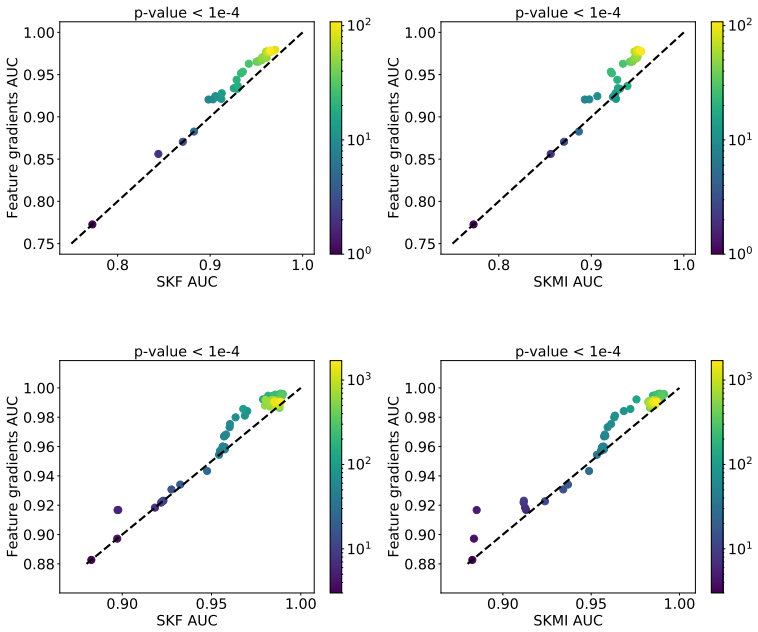
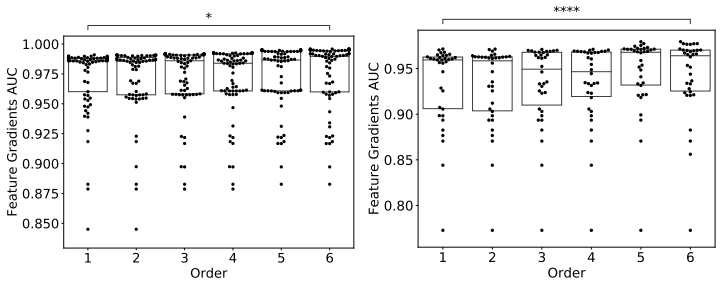
The paper's discovery is that subset quality, as measured by the Kong-Valiant residual-variance estimator f(s), has a gradient that can be followed. Writing s = σ(v) turns the NP-hard binary selection into unconstrained minimization of f(σ(v)) + (λ/D)‖σ(v)‖₁; Lemma 2.1 shows each step costs O(ND) time and O(N) space. Higher estimator order k incorporates kth-order feature interactions with a constant per-order increase, so the search can move beyond pairwise or main-effect filters. The experimental section reports that FG order 6 significantly beats single-feature filters on mnist35 and gisette, and FG order 4 beats MISSION on rcv1, webspam, and criteo, including maintaining 0.92 test AUC with 22 selected features out of 16.6 million. This is the paper's evidence for the combination of scalability and higher-order interaction detection.
Load-bearing premise
The load-bearing premise is that the Kong-Valiant estimator f(s), after centering and scaling, faithfully measures which feature subsets will help a downstream classifier; if the estimator's assumptions (i.i.d. data, bounded moments, and Gaussianity for classification) are violated too severely, the gradient signal will not point toward useful features.
Editorial extensions
If this is right
- Feature selection becomes feasible on datasets with tens of millions of samples and millions of features, as demonstrated on webspam and criteo.
- Increasing the estimator order lets users trade computational cost against the depth of feature interactions being searched, at constant complexity per order.
- Feature Gradients can act as a drop-in filter ahead of any downstream model, since it evaluates subset quality rather than training a predictor.
- The mini-batch formulation makes the method online-capable, so feature subsets can be updated as new data arrive.
- In N<<D regimes, selection is guided by sublinear learnability estimates rather than by training a model, reducing overfitting risk.
Reading between the lines
- The same differentiable-relaxation template could be applied to other subset-quality estimators, not just the Kong-Valiant criterion, yielding a family of differentiable filters.
- Because the objective is non-convex and initialization-dependent, annealing the squashing temperature or running multiple restarts would likely improve selection stability; the paper does not investigate this.
- The online extension mentioned in the discussion could be developed into a streaming monitor that tracks which feature subsets matter as a distribution drifts over time.
- On datasets where FG order 1 and order 6 agree closely, higher-order feature interactions are probably not needed, giving practitioners a cheap diagnostic.
Signed reviews
Editorial analysis
A structured set of objections, weighed in public.
Referee Report
Summary. The paper proposes Feature Gradients (FG), a filter-style feature selection algorithm that uses the Kong–Valiant learnability estimator as an objective, relaxes the discrete feature subset indicator to a sigmoidal continuous variable, and optimizes the relaxed objective with Adam over mini-batches. The authors prove that the estimator can be evaluated in O(ND) time and O(N) space, and they argue that increasing the estimator order accounts for higher-order feature interactions. The method is evaluated on small datasets (mnist35, gisette) against ANOVA and mutual-information filters, and on larger datasets (rcv1, webspam, criteo) against MISSION, with logistic-regression AUC as the performance metric. The central claims are scalability to large N and D, applicability in both N > D and N < D regimes, and the ability to exploit higher-order correlations.
Significance. If the claims hold, FG would be a practically valuable filter: it is the first method to combine the sublinear-dimension statistical guarantees of the Kong–Valiant estimator with a gradient-based subset search that can capture feature interactions. The paper has concrete strengths: Lemma 2.1 gives an explicit and checkable linear-time, linear-space computation; the small-data experiments show large and mostly statistically significant AUC improvements over standard filters; and the use of held-out logistic-regression AUC is a reasonable evaluation protocol. The computational complexity result is the kind of verifiable contribution that is useful beyond the specific application. However, the supporting analysis is incomplete in several load-bearing places, and one reported significance claim is internally inconsistent, so the current version needs substantial revision.
major comments (4)
- [Section 4, webspam results] The text states that FG 'is able to locate feature subsets resulting in test set performance significantly better than MISSION (significance level 0.01, with p-values of 0.0064 and 0.0201 for rcv1 and webspam, respectively).' Since 0.0201 > 0.01, the webspam comparison is not significant at the stated level, so the claim as written is contradicted by the reported p-value. Please either correct the significance statement or use a level of 0.05 for that comparison.
- [Section 2 and Section 4] The optimization objective f(s) is the Kong–Valiant residual-variance estimator, whose classification bound assumes Gaussian examples, yet the experiments apply the method to binary labels and non-Gaussian features and evaluate with logistic-regression AUC. The manuscript acknowledges this limitation in Section 2 but offers no diagnostic of proxy fidelity, such as the correlation between f(s) and held-out AUC over a range of subsets. Without such a diagnostic, the reported gains could be dataset-specific, and the abstract's claim that the algorithm is 'capable of finding higher-order correlations' is broader than what is demonstrated.
- [Section 2, mini-batch optimization] The paper claims that the calculation can be performed iteratively in mini-batches, but it gives no analysis of the mini-batch gradient estimates (bias, variance, consistency) and no convergence analysis for the non-convex relaxed objective. The authors themselves note that 'the objective (plus penalty) is non-convex and likely has many local optima,' yet the sensitivity of the results to initialization, learning rate, and mini-batch size is not reported. This is load-bearing because the entire method rests on the ability of Adam to reliably optimize the relaxed objective.
- [Section 4, higher-order interaction evidence] The evidence for higher-order interaction detection consists of paired comparisons of FG order 6 versus order 1 on two small datasets. There is no synthetic experiment with known ground-truth interaction structure, so the observed improvements could come from better polynomial approximation of a linear or low-order signal rather than from genuine recovery of higher-order correlations. A controlled experiment with known pairwise or higher-order terms would substantially strengthen the central claim.
minor comments (5)
- [Section 2, Proposition 2.1] The description of the vector (sum_{i=2}^N u_i, ..., u_N, 0) as a reverse cumulative sum is slightly imprecise; it is a shifted reverse prefix sum of u. Clarifying the indexing would make the O(N) claim easier to verify.
- [Section 1] There is a typo: 'constant increase in time and space complexity with with each additional order' contains a duplicated 'with'.
- [Section 4] The order parameter k is used in the definition of the estimator, but the experiments do not specify exactly how 'FG order 4' and 'FG order 6' correspond to the coefficients {a_i} and the summation limit in Eq. (1). Please state this explicitly.
- [Section 4, figures] In Figures 2 and 5 the point colors encode feature subset size, but the color scale is not shown in the reproduced figures; adding a colorbar or equivalent legend would improve interpretability.
- [General] No statement of code or data availability is included; since the algorithm is presented as a practical scalable method, a reproducibility statement would be helpful.
Circularity Check
No significant circularity: Feature Gradients uses an external learnability estimator and is validated against external benchmarks.
full rationale
The paper's optimization objective, Eq. (1), is taken directly from Kong and Valiant [2018] and is not fitted to the evaluation metric; the residual-variance estimator is an external, stated input rather than a derived prediction of the paper. The algorithmic contributions, including the discrete-to-continuous relaxation s = sigma(v), mini-batching, and the linear-time/space lemmas, are self-contained extensions with proofs that do not assume the experimental conclusions. The regularization parameter lambda is selected via validation-set grid search, which is standard model selection and not a fitted input renamed as a prediction. The paper contains no self-citations, so no load-bearing argument reduces to a self-citation chain. The main caveat, acknowledged in Section 2, is that the Kong-Valiant classification bound assumes Gaussianity and that the objective is non-convex; this is an applicability limitation, not a circular step. The empirical claims are supported by measured AUC comparisons against external baselines such as ANOVA filters, mutual-information filters, and MISSION, so the reported gains are not forced by construction.
Assumptions & free parameters
free parameters (4)
- regularization strength lambda =
grid-searched on validation sets
- estimator order k =
6 for small datasets, 4 for large datasets
- mini-batch size =
1000 (rcv1), 8 (webspam), 100 (criteo)
- Adam learning rate =
0.1
assumptions (4)
- domain assumption The Kong-Valiant estimator requires i.i.d. examples/labels and bounded 2nd/4th order moments and bounded noise variance.
- domain assumption The classification bound of Kong and Valiant assumes Gaussianity of the examples.
- ad hoc to paper The relaxed non-convex objective can be optimized effectively by Adam gradient descent.
- domain assumption A single set of degree-k polynomial coefficients is valid for all input data matrices after scaling by the square root of the largest singular value.
Cite this review
Pith. "Pith review of Feature Gradients: Scalable Feature Selection via Discrete Relaxation." pith.science (2026). https://pith.science/paper/7DE4Y3KG
@misc{pith2026190810382,
  author       = {Pith},
  title        = {Pith review of: Feature Gradients: Scalable Feature Selection via Discrete Relaxation},
  year         = {2026},
  howpublished = {\url{https://pith.science/paper/7DE4Y3KG}},
  note         = {Machine review of arXiv:1908.10382}
}
read the original abstract
In this paper we introduce Feature Gradients, a gradient-based search algorithm for feature selection. Our approach extends a recent result on the estimation of learnability in the sublinear data regime by showing that the calculation can be performed iteratively (i.e., in mini-batches) and in linear time and space with respect to both the number of features D and the sample size N . This, along with a discrete-to-continuous relaxation of the search domain, allows for an efficient, gradient-based search algorithm among feature subsets for very large datasets. Crucially, our algorithm is capable of finding higher-order correlations between features and targets for both the N > D and N < D regimes, as opposed to approaches that do not consider such interactions and/or only consider one regime. We provide experimental demonstration of the algorithm in small and large sample-and feature-size settings.
Figures


Figures from the paper (2 more)

Forward citations
Cited by 1 Pith paper
-
Make Both Ends Meet: A Synergistic Optimization Infrared Small Target Detection with Streamlined Computational Overhead
LE-IRSTD, a YOLOv8-n variant using MBConv, partial convolution, variable-kernel convolution, and GSConv, reports a 2.6M-parameter model with mAP 95.4 on IRSTD-1K, outperforming listed SOTA methods.
Reference graph
Works this paper leans on
-
[1]
A. Abid, M. F. Balin, and J. Zou. Concrete autoencoders for differentiable feature selection and reconstruction. arXiv preprint arXiv:1901.09346, 2019
work page Pith review arXiv 1901
-
[2]
MISSION: Ultra Large-Scale Feature Selection using Count-Sketches
A. Aghazadeh, R. Spring, D. LeJeune, G. Dasarathy, A. Shrivastava, and R. G. Baraniuk. MISSION : Ultra large-scale feature selection using count-sketches. arXiv preprint arXiv:1806.04310, 2018
work page Pith review arXiv 2018
-
[3]
G. Forman. An extensive empirical study of feature selection metrics for text classification. JMLR , pages 1289--1305, 2003
work page 2003
-
[4]
I. Guyon and A. Elisseeff. An introduction to variable and feature selection. JMLR , pages 1157--1182, 2003
work page 2003
-
[5]
E. Jang, S. Gu, and B. Poole. Categorical reparameterization with G umbel-softmax. arXiv preprint arXiv:1611.01144, 2016
arXiv 2016
-
[6]
D. P. Kingma and J. Ba. Adam: A method for stochastic optimization. arXiv preprint arXiv:1412.6980, 2014
arXiv 2014
-
[7]
R. Kohavi and G. H. John. Wrappers for feature subset selection. Artificial intelligence, pages 273--324, 1997
work page 1997
-
[8]
W. Kong and G. Valiant. Estimating learnability in the sublinear data regime. CoRR, abs/1805.01626, 2018. URL http://arxiv.org/abs/1805.01626
arXiv 2018
Show all 17 references
-
[9]
H. Liu, K. Simonyan, and Y. Yang. DARTS: D ifferentiable architecture search. CoRR, abs/1806.09055, 2018. URL http://arxiv.org/abs/1806.09055
2018 arXiv
-
[10]
C. J. Maddison, A. Mnih, and Y. W. Teh. The C oncrete distribution: A continuous relaxation of discrete random variables. arXiv preprint arXiv:1611.00712, 2016
2016 arXiv
-
[11]
B. K. Natarajan. Sparse approximate solutions to linear systems. SIAM journal on computing , pages 227--234, 1995
1995
-
[12]
Saeys, I
Y. Saeys, I. Inza, and P. Larra \ n aga. A review of feature selection techniques in bioinformatics. Bioinformatics, pages 2507--2517, 2007
2007
-
[13]
Y. Sun, S. Todorovic, and S. Goodison. Local-learning-based feature selection for high-dimensional data analysis. IEEE transactions on pattern analysis and machine intelligence , pages 1610--1626, 2009
2009
-
[14]
Tibshirani
R. Tibshirani. Regression shrinkage and selection via the lasso. Journal of the Royal Statistical Society: Series B (Methodological), pages 267--288, 1996
1996
-
[15]
K. Yu, X. Wu, W. Ding, and J. Pei. Towards scalable and accurate online feature selection for big data. In ICDM , pages 660--669, 2014
2014
-
[16]
Yu and H
L. Yu and H. Liu. Feature selection for high-dimensional data: A fast correlation-based filter solution. In ICML , pages 856--863, 2003
2003
-
[17]
Yu and H
L. Yu and H. Liu. Efficient feature selection via analysis of relevance and redundancy. JMLR , pages 1205--1224, 2004
2004
Reviewed August 14, 2026 · model on record in the stance chip above.
Discussion (0). Continue with ORCID to comment.