A Multi-Fidelity Convolutional Autoencoder-Transfer Learning Framework for Guided-Wave-Based Damage Diagnosis Using Large Simulated and Limited Experimental Datasets
Pith reviewed 2026-06-26 05:05 UTC · model grok-4.3
The pith
Convolutional autoencoder transfer learning from large synthetic guided-wave datasets to limited experimental measurements achieves R² scores above 0.93 for damage localization.
A machine-rendered reading of the paper's core claim, the machinery that carries it, and where it could break.
Core claim
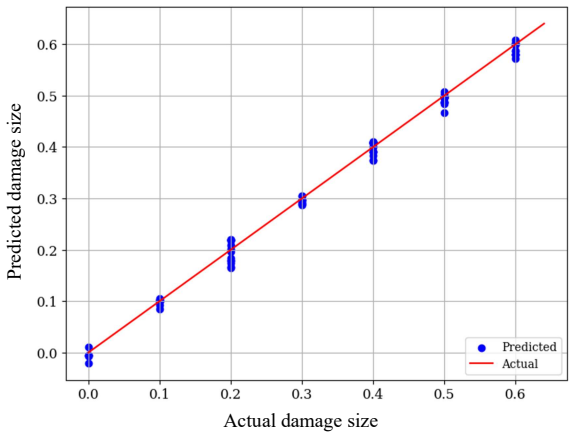
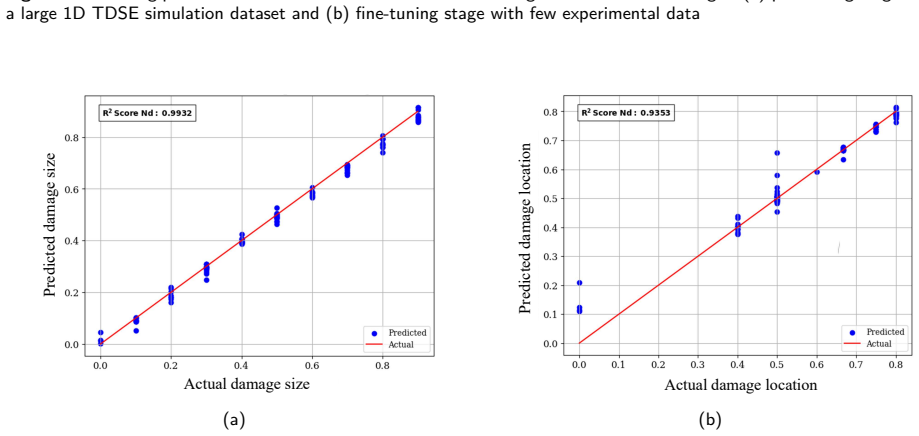
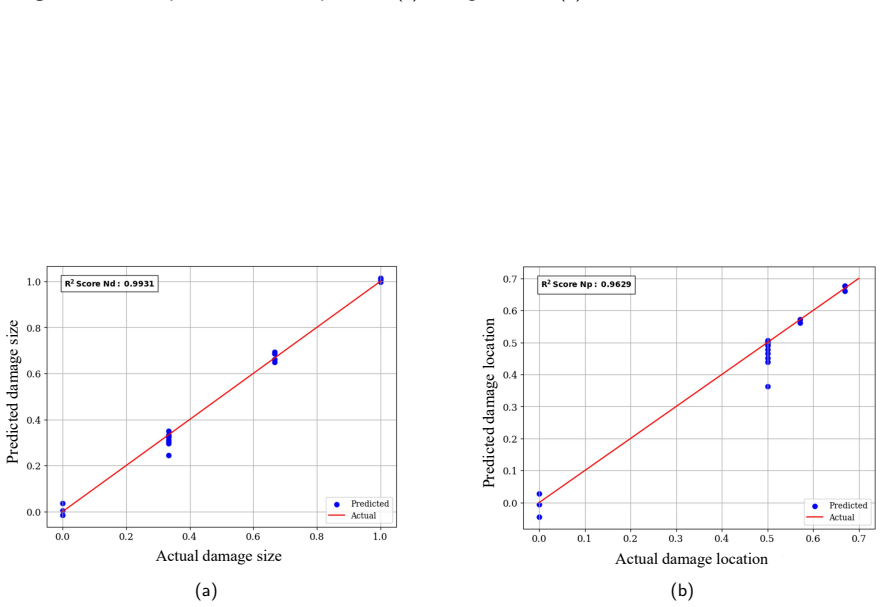
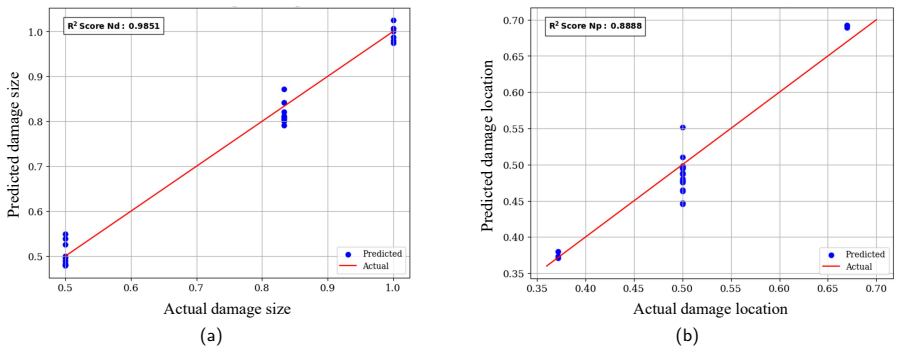
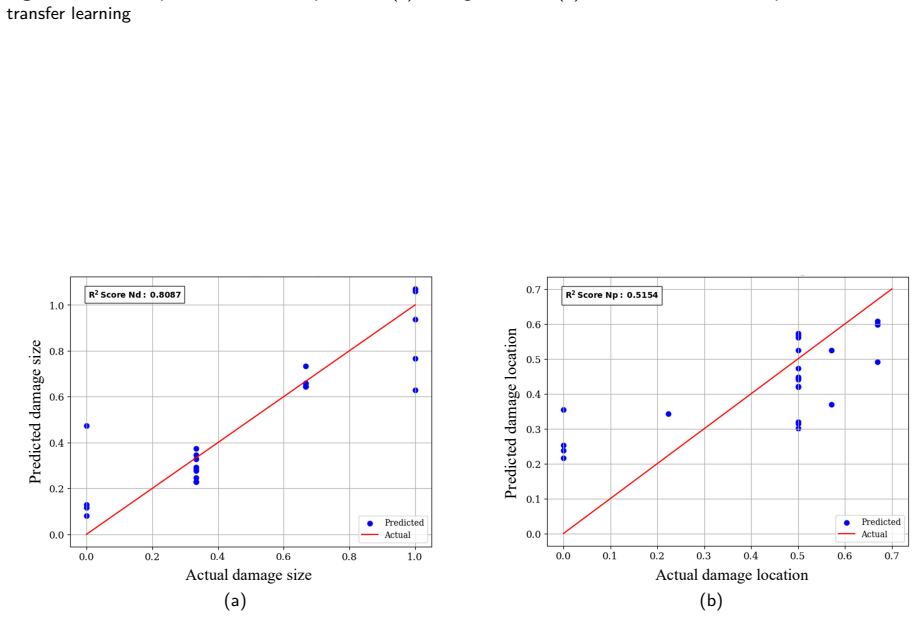
The CAE-based transfer learning framework significantly outperforms its CNN-based counterpart in damage localisation accuracy. The model achieves excellent predictive performance with R² scores exceeding 0.93 for damage localisation and 0.99 for damage sizing. Its generalisation capability is demonstrated on previously unseen data, showing high prediction accuracy for damage scenarios not represented during pretraining or fine-tuning. The results establish the proposed framework as an accurate, computationally efficient, and practically viable solution for real-world GWSHM applications.
What carries the argument
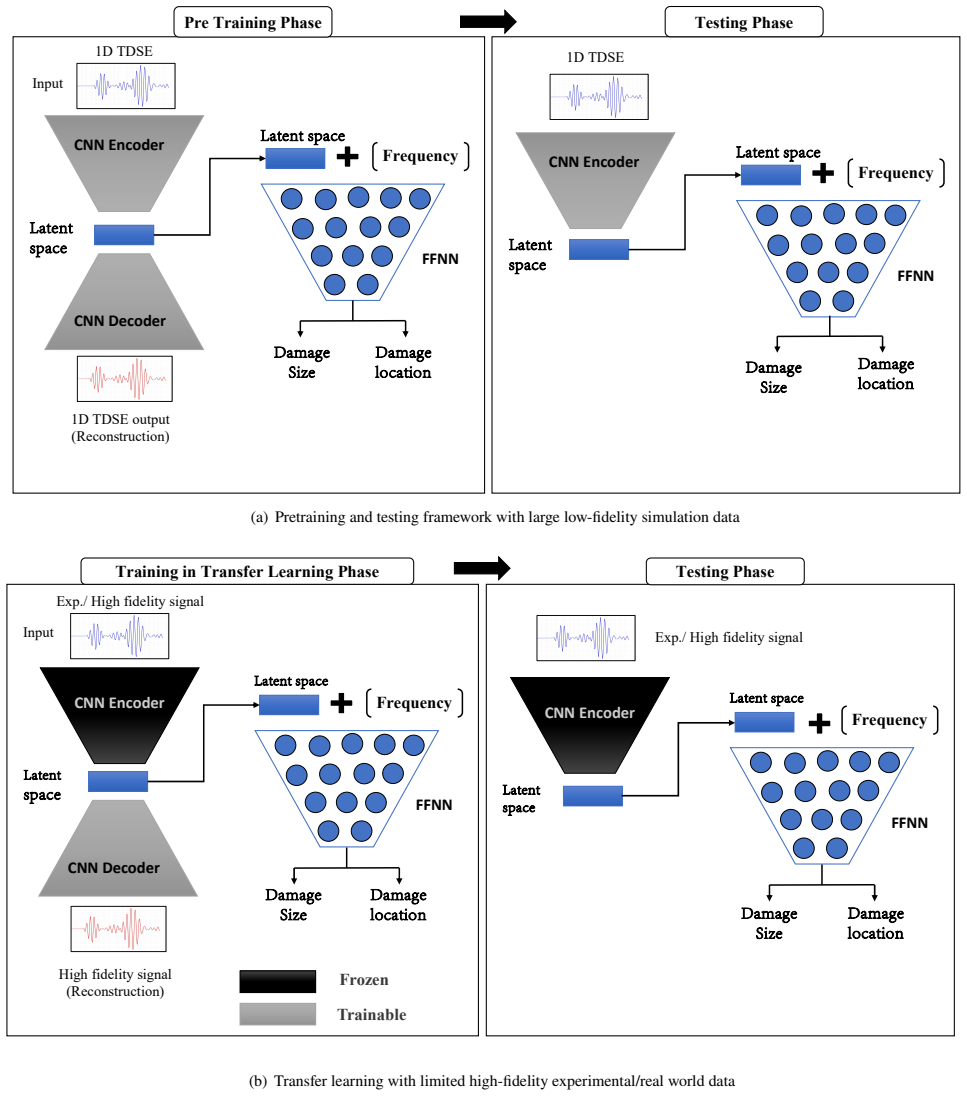
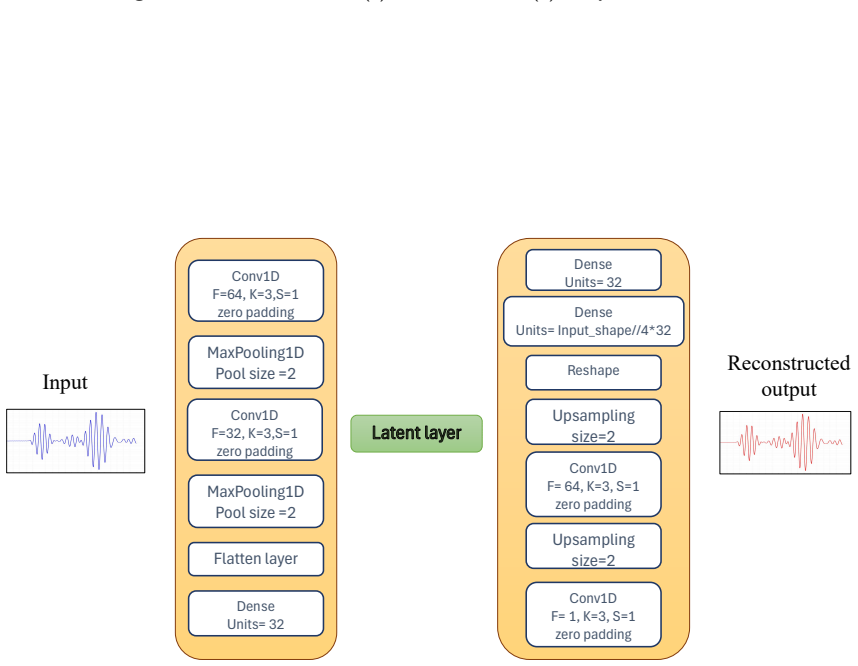
Convolutional autoencoder pretrained on synthetic data from a one-dimensional time-domain spectral element model, followed by transfer learning with a feed-forward network and limited experimental data to diagnose damage.
If this is right
- The framework supplies accurate damage localization and sizing even when only a small quantity of experimental data is available.
- It outperforms CNN-based methods specifically in localization accuracy.
- The trained model maintains high prediction accuracy on damage scenarios absent from both the synthetic pretraining and the experimental fine-tuning sets.
- The overall approach reduces computational cost relative to full high-fidelity simulation while remaining suitable for practical onboard monitoring.
Where Pith is reading between the lines
- If the synthetic-to-experimental feature transfer proves robust, the same pretraining strategy could be tested on other wave-based sensing problems that face similar data scarcity.
- Systematic variation of the number of fine-tuning samples would reveal the minimum experimental data volume required for acceptable performance.
- Extending the underlying simulation model beyond one dimension could address potential limits when structures have more complex geometries.
Load-bearing premise
Features learned from the one-dimensional spectral element simulations transfer effectively to real experimental guided-wave signals when the network is fine-tuned on a small set of labeled measurements.
What would settle it
If R² scores on a held-out experimental test set with new damage locations and sizes fall below 0.8 or if the CAE framework fails to exceed the CNN baseline on the same data, the transfer-learning claim would be disproven.
Figures

read the original abstract
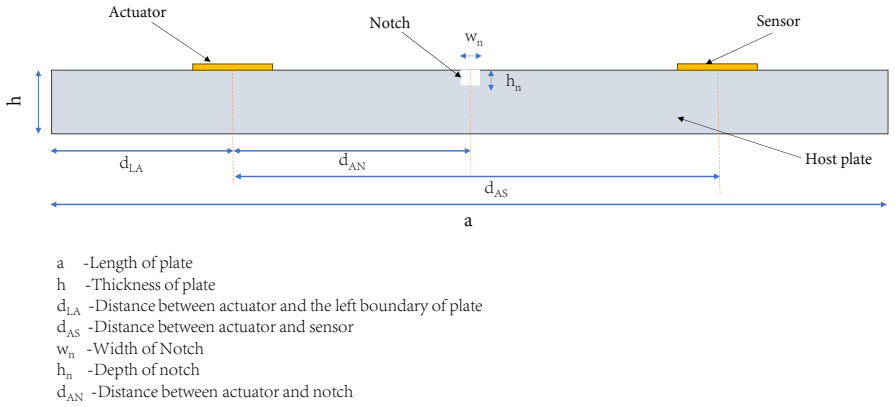
Guided wave-based structural health monitoring (GWSHM) with onboard transducers offers significant potential for the early diagnosis of damage in engineering structures. However, the practical deployment of deep learning models is often hindered by the limited availability of labelled experimental data and the high computational cost of generating large-scale high-fidelity simulation datasets. This study presents a multifidelity transfer learning framework that integrates lightweight physics-based simulations, convolutional autoencoder (CAE)-based deep feature learning, a feed-forward neural network, and limited experimental measurements for accurate damage localisation and sizing in plate-like structures instrumented with piezoelectric transducers. A computationally efficient one-dimensional time-domain spectral element model is employed to generate a large synthetic dataset for pretraining, while transfer learning adapts the model to experimental domains using only a small amount of labelled data. The CAE-based transfer learning framework significantly outperforms its CNN-based counterpart in damage localisation accuracy. The model achieves excellent predictive performance with $R^2$ scores exceeding 0.93 for damage localisation and 0.99 for damage sizing. Its generalisation capability is demonstrated on previously unseen data, showing high prediction accuracy for damage scenarios not represented during pretraining or fine-tuning. The results establish the proposed framework as an accurate, computationally efficient, and practically viable solution for real-world GWSHM applications.
Editorial analysis
A structured set of objections, weighed in public.
Referee Report
Summary. The manuscript proposes a multi-fidelity convolutional autoencoder-transfer learning (CAE-TL) framework for guided-wave structural health monitoring. A lightweight 1D time-domain spectral element model generates a large synthetic dataset for CAE pretraining; the learned features are then transferred via fine-tuning on a small set of labeled experimental measurements to predict damage location and size. The authors report that CAE-TL significantly outperforms a CNN baseline, with R² exceeding 0.93 for localization and 0.99 for sizing, and that the model generalizes to previously unseen damage scenarios.
Significance. If the reported transfer performance holds under rigorous cross-validation, the framework would offer a practical route to leverage inexpensive low-fidelity simulations when experimental labels are scarce. The multi-fidelity strategy itself is a constructive response to data limitations in GWSHM; however, the central empirical claims rest on an unexamined 1D-to-2D domain gap whose resolution is not demonstrated in the available description.
major comments (2)
- [Abstract] Abstract: the performance claims (R² > 0.93 localization, R² > 0.99 sizing, outperformance over CNN) are presented without any indication of synthetic or experimental dataset cardinalities, the number of labeled experimental samples used for fine-tuning, train/validation/test splits, or uncertainty quantification. These omissions render the numerical results impossible to interpret or reproduce from the given information.
- [Abstract / Method] The transfer-learning pipeline (implied in the abstract and method description): the central claim that CAE features pretrained on 1D spectral-element signals transfer effectively to 2D experimental Lamb-wave data after limited fine-tuning is load-bearing, yet the manuscript supplies no analysis of the domain gap. The 1D model necessarily omits lateral spreading, 2D scattering from finite damage, boundary reflections in both in-plane directions, and accurate dispersion surfaces; without explicit evidence (e.g., feature-space alignment metrics or ablation on 2D synthetic data) that these omissions do not prevent useful transfer, the reported generalization cannot be taken as support for the framework.
minor comments (1)
- [Abstract] Abstract: the phrase 'previously unseen data' is ambiguous; it should be clarified whether these cases are new experimental measurements or merely held-out synthetic realizations.
Simulated Author's Rebuttal
We thank the referee for their constructive comments on our manuscript. We address each major comment below and will revise the manuscript to improve clarity and address the identified gaps where possible.
read point-by-point responses
-
Referee: [Abstract] Abstract: the performance claims (R² > 0.93 localization, R² > 0.99 sizing, outperformance over CNN) are presented without any indication of synthetic or experimental dataset cardinalities, the number of labeled experimental samples used for fine-tuning, train/validation/test splits, or uncertainty quantification. These omissions render the numerical results impossible to interpret or reproduce from the given information.
Authors: We agree that the abstract should include these details to ensure the results are interpretable and reproducible. In the revised manuscript, we will expand the abstract to report the cardinalities of the synthetic dataset (generated via the 1D spectral element model) and experimental dataset, the number of labeled experimental samples used for fine-tuning, the train/validation/test splits, and any uncertainty quantification associated with the R² scores. revision: yes
-
Referee: [Abstract / Method] The transfer-learning pipeline (implied in the abstract and method description): the central claim that CAE features pretrained on 1D spectral-element signals transfer effectively to 2D experimental Lamb-wave data after limited fine-tuning is load-bearing, yet the manuscript supplies no analysis of the domain gap. The 1D model necessarily omits lateral spreading, 2D scattering from finite damage, boundary reflections in both in-plane directions, and accurate dispersion surfaces; without explicit evidence (e.g., feature-space alignment metrics or ablation on 2D synthetic data) that these omissions do not prevent useful transfer, the reported generalization cannot be taken as support for the framework.
Authors: We acknowledge that the manuscript does not include explicit analyses of the 1D-to-2D domain gap, such as feature-space alignment metrics or ablations using 2D synthetic data. The reported transfer performance on experimental data provides empirical support for the framework, but we agree that additional discussion would strengthen the claims. In the revision, we will add a dedicated discussion of the domain gap, its potential effects, and any supporting evidence derivable from the existing experiments and feature visualizations. revision: partial
Circularity Check
No significant circularity; empirical results on held-out data
full rationale
The paper's central claims rest on training a CAE on large synthetic 1D spectral-element data, fine-tuning with limited experimental labels, and reporting R² scores plus generalization on previously unseen experimental test cases. No quoted equations, fitted parameters, or self-citations reduce any reported prediction to a quantity defined by the inputs themselves; the evaluation metrics are standard held-out empirical performance measures. The derivation chain therefore remains self-contained against external benchmarks and receives the default non-circularity finding.
Axiom & Free-Parameter Ledger
free parameters (1)
- CAE and network training hyperparameters
axioms (1)
- domain assumption The computationally efficient 1D spectral element model generates data sufficiently representative for feature learning that transfers to experimental conditions
Reference graph
Works this paper leans on
-
[1]
Structural Control and Health Monitoring , volume=
A Deep Transfer Learning Network for Structural Condition Identification with Limited Real-World Training Data , author=. Structural Control and Health Monitoring , volume=. 2023 , publisher=
2023
-
[2]
Kingma, D. P. and Ba, J. , title =. 2014 , eprint =
2014
-
[3]
Smart Materials and Structures , volume=
Active vibration control of piezoelectric laminated beams with electroded actuators and sensors using an efficient finite element involving an electric node , author=. Smart Materials and Structures , volume=. 2010 , publisher=
2010
-
[4]
Unified efficient layerwise theory for smart beams with segmented extension/shear mode, piezoelectric actuators and sensors , volume =
Kapuria, Santosh and Hagedorn, Peter , year =. Unified efficient layerwise theory for smart beams with segmented extension/shear mode, piezoelectric actuators and sensors , volume =
-
[5]
Boca Raton , volume=
Introduction to Finite and Spectral Element Methods using MATLAB , author=. Boca Raton , volume=
-
[6]
Kapuria, Santosh and Jain, Mayank , journal=. A. 2021 , publisher=
2021
-
[7]
International Journal of Mechanical Sciences , volume=
Efficient time-domain spectral element with zigzag kinematics for multilayered strips , author=. International Journal of Mechanical Sciences , volume=. 2022 , publisher=
2022
-
[8]
Role of transducer inertia in generation, sensing, and time-reversal process of
Kapuria, Santosh and Sharma, Bhabagrahi Natha and Arockiarajan, A , journal=. Role of transducer inertia in generation, sensing, and time-reversal process of. 2022 , publisher=
2022
-
[9]
Available at: https://www.sparklerceramics.com/piezoelectricproperties.html , YEAR=
Sparkler , TITLE=. Available at: https://www.sparklerceramics.com/piezoelectricproperties.html , YEAR=
-
[10]
Composite Structures , volume=
Efficient zigzag theory-based spectral element model for guided waves in composite structures containing delaminations , author=. Composite Structures , volume=. 2023 , publisher=
2023
-
[11]
Deep Learning , author=
-
[12]
Journal of Sound and Vibration , volume =
Efficient electromechanical spectral element model using zigzag kinematics for. Journal of Sound and Vibration , volume =. 2024 , issn =
2024
-
[13]
2014 , publisher=
Ultrasonic Guided Waves in Solid Media , author=. 2014 , publisher=
2014
-
[14]
Identification of damage using
Su, Zhongqing and Ye, Lin , journal=. Identification of damage using
-
[15]
Giurgiutiu, Victor , journal=. Tuned
-
[16]
, journal=
Su, Zhongqing and Ye, Lin and Lu, Y. , journal=. Guided
-
[17]
The use of
Cawley, Peter , journal=. The use of
-
[18]
Philosophical Transactions of the Royal Society A , volume=
An introduction to structural health monitoring , author=. Philosophical Transactions of the Royal Society A , volume=
-
[19]
Philosophical Transactions of the Royal Society A , volume=
The application of machine learning to structural health monitoring , author=. Philosophical Transactions of the Royal Society A , volume=
-
[20]
Computer-Aided Civil and Infrastructure Engineering , volume=
Structural health monitoring using extremely compressed data through deep learning , author=. Computer-Aided Civil and Infrastructure Engineering , volume=
-
[21]
Journal of Manufacturing Systems , volume=
Deep learning for smart manufacturing: methods and applications , author=. Journal of Manufacturing Systems , volume=
-
[22]
Microfabricated
Luginbuhl, Philippe and Collins, Scott D and Racine, G-A and Gretillat, M-A and De Rooij, Nicolaas F and Brooks, Keith G and Setter, Nava , journal=. Microfabricated. 1997 , publisher=
1997
-
[23]
Journal of Intelligent Material Systems and Structures , volume =
Jitendra Kumar Agrahari and Santosh Kapuria , title =. Journal of Intelligent Material Systems and Structures , volume =
-
[24]
2020 , month =
Kannusamy, M and Kapuria, S and Sasmal, S , title =. 2020 , month =
2020
-
[25]
Self-focusing and time recompression of
Ing, RK and Fink, M , journal=. Self-focusing and time recompression of. 1998 , publisher=
1998
-
[26]
Smart Materials and Structures , volume=
Lamb wave damage severity estimation using ensemble-based machine learning method with separate model network , author=. Smart Materials and Structures , volume=. 2021 , publisher=
2021
-
[27]
Mechanical Systems and Signal Processing , volume=
Sparse ultrasonic guided wave imaging with compressive sensing and deep learning , author=. Mechanical Systems and Signal Processing , volume=. 2022 , publisher=
2022
-
[28]
Structural Health Monitoring , volume =
Tong Zhang and Suryakanta Biswal and Ying Wang , title =. Structural Health Monitoring , volume =
-
[29]
NDT & E International , volume=
Defect sizing in guided wave imaging structural health monitoring using convolutional neural networks , author=. NDT & E International , volume=. 2021 , publisher=
2021
-
[30]
Journal of Intelligent Material Systems and Structures , YEAR=
V Giurgiutiu and B Lin and G Santoni-Bottai and A Cuc , TITLE=. Journal of Intelligent Material Systems and Structures , YEAR=
-
[31]
Structural Control and Health Monitoring , year=
Wang, Peng and Zhou, Wensong and Bao, Yuequan and Li, Hui , title=. Structural Control and Health Monitoring , year=
-
[32]
Sensors , year=
Hu, Chaojie and Yang, Bin and Xuan, Fu-Zhen and Yan, Jianjun and Xiang, Yanxun , title=. Sensors , year=
-
[33]
Ultrasonics , year=
Huan, Qiang and Chen, Mingtong and Li, Faxin , title=. Ultrasonics , year=
-
[34]
Identification of Damage using Lamb Waves
Z Su and Lin Ye. Identification of Damage using Lamb Waves. 2009
2009
-
[35]
Smart Materials and Structures , volume=
Lamb wave-based baseline-free damage localization in pipes with surface-mounted piezo patches , author=. Smart Materials and Structures , volume=. 2025 , publisher=
2025
-
[36]
Composite Structures , pages=
Autonomous structural health monitoring of composite wind turbine blades using guided waves and machine learning , author=. Composite Structures , pages=. 2025 , publisher=
2025
-
[37]
Journal of Nondestructive Evaluation , YEAR=
R P Dalton and P Cawley and M J S Lowe , TITLE=. Journal of Nondestructive Evaluation , YEAR=
-
[38]
Mechanical Systems and Signal Processing , volume=
Isolation of ultrasonic scattering by wavefield baseline subtraction , author=. Mechanical Systems and Signal Processing , volume=. 2016 , publisher=
2016
-
[39]
Structural Health Monitoring system based on a concept of
Kudela, Pawel and Radzienski, Maciej and Ostachowicz, Wieslaw and Yang, Zhibo , journal=. Structural Health Monitoring system based on a concept of. 2018 , publisher=
2018
-
[40]
Wave motion , volume=
Guided wave signal processing and image fusion for in situ damage localization in plates , author=. Wave motion , volume=. 2007 , publisher=
2007
-
[41]
Mechanical Systems and Signal Processing , volume=
Effective combination of modeling and experimental data with deep metric learning for guided wave-based damage localization in plates , author=. Mechanical Systems and Signal Processing , volume=. 2022 , publisher=
2022
-
[42]
Composite Structures , volume=
An integrated multi-task transfer learning for damage detection, localization, and severity assessment of laminated composite plate , author=. Composite Structures , volume=. 2025 , publisher=
2025
-
[43]
Best reconstruction frequency for time-reversal process of
Kapuria, Santosh , journal=. Best reconstruction frequency for time-reversal process of. 2025 , publisher=
2025
-
[44]
Physics-guided neural network for structural health monitoring with
Song, Yang and Shan, Shengbo and Zhang, Yuanman and Cheng, Li , journal=. Physics-guided neural network for structural health monitoring with. 2026 , publisher=
2026
-
[45]
Thermal sensitivity of
Dodson, JC and Inman, DJ , journal=. Thermal sensitivity of. 2013 , publisher=
2013
-
[46]
Baseline-free damage detection and sizing under varying temperatures using
Sharma, Bhabagrahi Natha and Kapuria, Santosh and Arockiarajan, A and Kannusamy, M , journal=. Baseline-free damage detection and sizing under varying temperatures using. 2023 , publisher=
2023
-
[47]
Time reversibility of
Sharma, Bhabagrahi Natha and Kapuria, Santosh and Arockiarajan, A , journal=. Time reversibility of. 2021 , publisher=
2021
-
[48]
NDT & E International , volume=
Guided waves in long range nondestructive testing and structural health monitoring: Principles, history of applications and prospects , author=. NDT & E International , volume=. 2024 , publisher=
2024
-
[49]
Ultrasonics , volume=
Appraisal of linear baseline-free techniques for guided wave based structural health monitoring , author=. Ultrasonics , volume=. 2024 , publisher=
2024
-
[50]
Smart Materials and Structures , volume=
Systematic critical review of structural health monitoring under environmental and operational variability: approaches for baseline compensation, adaptation, and reference-free techniques , author=. Smart Materials and Structures , volume=. 2025 , publisher=
2025
-
[51]
Mechanical Systems and Signal Processing , volume =
Fast and accurate decomposition of overlapping. Mechanical Systems and Signal Processing , volume =. 2026 , author =
2026
-
[52]
Ultrasonics , volume=
A review on guided-ultrasonic-wave-based structural health monitoring: From fundamental theory to machine learning techniques , author=. Ultrasonics , volume=. 2023 , publisher=
2023
-
[53]
Deep learning based crack damage detection technique for thin plate structures using guided
Liu, Heng and Zhang, Yunfeng , journal=. Deep learning based crack damage detection technique for thin plate structures using guided. 2020 , publisher=
2020
-
[54]
DeepSHM: A deep learning approach for structural health monitoring based on guided
Ewald, Vincentius and Groves, Roger M and Benedictus, Rinze , booktitle=. DeepSHM: A deep learning approach for structural health monitoring based on guided. 2019 , organization=
2019
-
[55]
Composite Structures , volume=
Lamb wave-based damage detection of composite structures using deep convolutional neural network and continuous wavelet transform , author=. Composite Structures , volume=. 2021 , publisher=
2021
-
[56]
Smart Materials and Structures , volume=
Lamb wave based damage detection in metallic plates using multi-headed 1-dimensional convolutional neural network , author=. Smart Materials and Structures , volume=. 2021 , publisher=
2021
-
[57]
Mechanical Systems and Signal Processing , volume=
Damage localization in plate-like structures using time-varying feature and one-dimensional convolutional neural network , author=. Mechanical Systems and Signal Processing , volume=. 2021 , publisher=
2021
-
[58]
Mechanical Systems and Signal Processing , volume=
On the explainability of convolutional neural networks processing ultrasonic guided waves for damage diagnosis , author=. Mechanical Systems and Signal Processing , volume=. 2023 , publisher=
2023
-
[59]
Explainable
Pandey, Pushpa and Rai, Akshay and Mitra, Mira , journal=. Explainable. 2022 , publisher=
2022
-
[60]
IEEE transactions on neural networks , volume=
An overview of statistical learning theory , author=. IEEE transactions on neural networks , volume=. 1999 , publisher=
1999
-
[61]
A numerically-enhanced machine learning approach to damage diagnosis using a
Sbarufatti, Claudio and Manson, G and Worden, K , journal=. A numerically-enhanced machine learning approach to damage diagnosis using a. 2014 , publisher=
2014
-
[62]
Application of Artificial Neural Networks and Probability Ellipse methods for damage detection using
De Fenza, Angelo and Sorrentino, Assunta and Vitiello, Pasquale , journal=. Application of Artificial Neural Networks and Probability Ellipse methods for damage detection using. 2015 , publisher=
2015
-
[63]
Computers & Structures , volume=
Crack detection in Mindlin-Reissner plates under dynamic loads based on fusion of data and models , author=. Computers & Structures , volume=. 2021 , publisher=
2021
-
[64]
Journal of Mechanical Design , volume=
Calibration and validation framework for selective laser melting process based on multi-fidelity models and limited experiment data , author=. Journal of Mechanical Design , volume=. 2020 , publisher=
2020
-
[65]
Ultrasonics , volume=
A physics-embedded deep-learning framework for efficient multi-fidelity modeling applied to guided wave based structural health monitoring , author=. Ultrasonics , volume=. 2024 , publisher=
2024
-
[66]
Journal of Big data , volume=
A survey of transfer learning , author=. Journal of Big data , volume=. 2016 , publisher=
2016
-
[67]
Proceedings of the IEEE , volume=
A comprehensive survey on transfer learning , author=. Proceedings of the IEEE , volume=. 2020 , publisher=
2020
-
[68]
Computer-aided civil and Infrastructure Engineering , volume=
Dynamics-based cross-domain structural damage detection through deep transfer learning , author=. Computer-aided civil and Infrastructure Engineering , volume=. 2022 , publisher=
2022
-
[69]
Computer Methods in Applied Mechanics and Engineering , volume=
Sustainable computational mechanics assisted by deep learning , author=. Computer Methods in Applied Mechanics and Engineering , volume=. 2022 , publisher=
2022
-
[70]
A variable kinematic multi-field model for
Najd, Jamal and Zappino, Enrico and Carrera, Erasmo and Harizi, Walid and Aboura, Zoheir , journal=. A variable kinematic multi-field model for. 2025 , publisher=
2025
-
[71]
Mechanics of Advanced Materials and Structures , volume=
Finite element modeling and analysis of adhesive layer effects in surface-bonded piezoelectric sensors and actuators including non-uniform thickness , author=. Mechanics of Advanced Materials and Structures , volume=. 2022 , publisher=
2022
-
[72]
International Journal of Mechanical Sciences , volume=
A coupled efficient layerwise finite element model for free vibration analysis of smart piezo-bonded laminated shells featuring delaminations and transducer debonding , author=. International Journal of Mechanical Sciences , volume=. 2021 , publisher=
2021
-
[73]
Efficient layerwise multiphysics spectral element model for delaminated composite strips with
Jain, Mayank and Kapuria, Santosh , journal=. Efficient layerwise multiphysics spectral element model for delaminated composite strips with. 2025 , publisher=
2025
-
[74]
Journal of Sound and Vibration , volume=
Spectral finite element based on an efficient layerwise theory for wave propagation analysis of composite and sandwich beams , author=. Journal of Sound and Vibration , volume=. 2014 , publisher=
2014
-
[75]
Journal of Intelligent Material Systems and Structures , volume=
A time domain spectral layerwise finite element for wave structural health monitoring in composite strips with physically modeled active piezoelectric actuators and sensors , author=. Journal of Intelligent Material Systems and Structures , volume=. 2017 , publisher=
2017
-
[76]
Aircraft Engineering and Aerospace Technology , volume=
Spectral finite element method for wave propagation analysis in smart composite beams containing delamination , author=. Aircraft Engineering and Aerospace Technology , volume=. 2020 , publisher=
2020
-
[77]
International Journal of Mechanical Sciences , volume=
A wave packet enriched finite element for electroelastic wave propagation problems , author=. International Journal of Mechanical Sciences , volume=. 2020 , publisher=
2020
-
[78]
2014 , publisher=
Structural health monitoring with piezoelectric wafer active sensors , author=. 2014 , publisher=
2014
discussion (0)
Sign in with ORCID, Apple, or X to comment. Anyone can read and Pith papers without signing in.