Distinguishing quantum processes with bounded coherent memory
Pith reviewed 2026-06-26 20:27 UTC · model grok-4.3
The pith
Any adaptive strategy for distinguishing multi-time quantum processes can be compiled into a single MAD with bounded coherent memory and an internal counter.
A machine-rendered reading of the paper's core claim, the machinery that carries it, and where it could break.
Core claim
The central claim is that the MAD hierarchy saturates the strategy-norm benchmark because any N-step adaptive probing strategy can be compiled into a single MAD that uses an internal counter and sufficiently large coherent memory; the resulting memory-parametrized measure d^(N)_MAD therefore equals the optimal strategy-norm distance once d_A is large enough.
What carries the argument
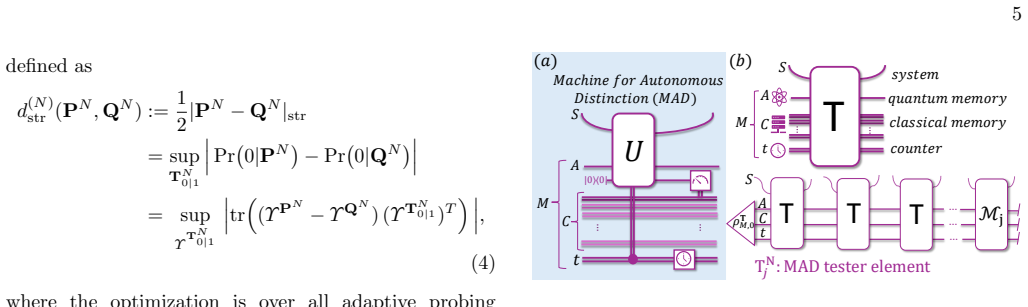
MAD (machine for autonomous distinction): a probing strategy that applies the same quantum instrument at each time step, stores the full classical outcome record, and maintains coherent memory of dimension d_A.
If this is right
- The distinguishability measure rises monotonically as coherent memory dimension increases.
- At any fixed finite N the measure equals the strategy-norm distance once memory is large enough.
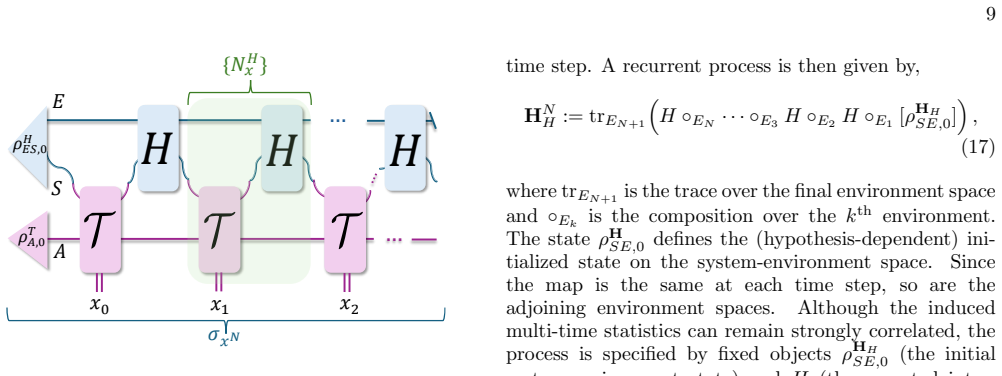
- Recurrent processes admit a single-step description separating generation of new distinguishing information from its propagation and decay.
- Numerical evaluation of MAD success probabilities is substantially more tractable than optimizing over arbitrary adaptive strategies.
Where Pith is reading between the lines
- Devices with limited quantum memory could still achieve optimal distinction by fixing one instrument and adding a simple counter.
- The single-step reduction for recurrent processes may simplify the analysis of continuous-time or infinite-horizon discrimination tasks.
- Choosing the optimal fixed instrument for a given process class becomes a practical design problem once the completeness result is accepted.
Load-bearing premise
That every adaptive N-step strategy can be exactly reproduced by a MAD that uses only one fixed instrument, an internal counter, and finite coherent memory.
What would settle it
An explicit N-step adaptive strategy whose distinguishing power cannot be matched by any MAD with finite coherent memory and an internal counter, or a concrete process pair where the MAD distance remains strictly below the strategy norm for all finite d_A.
Figures
read the original abstract
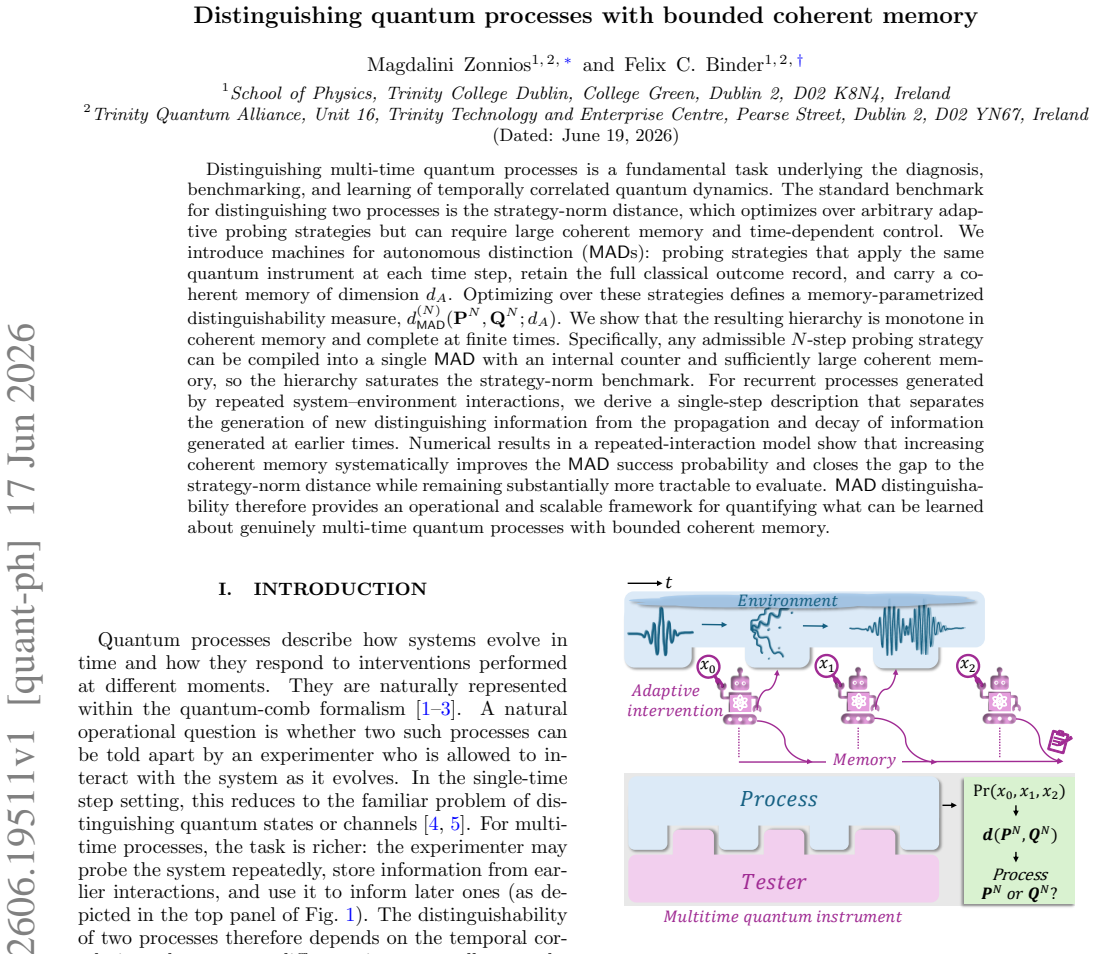
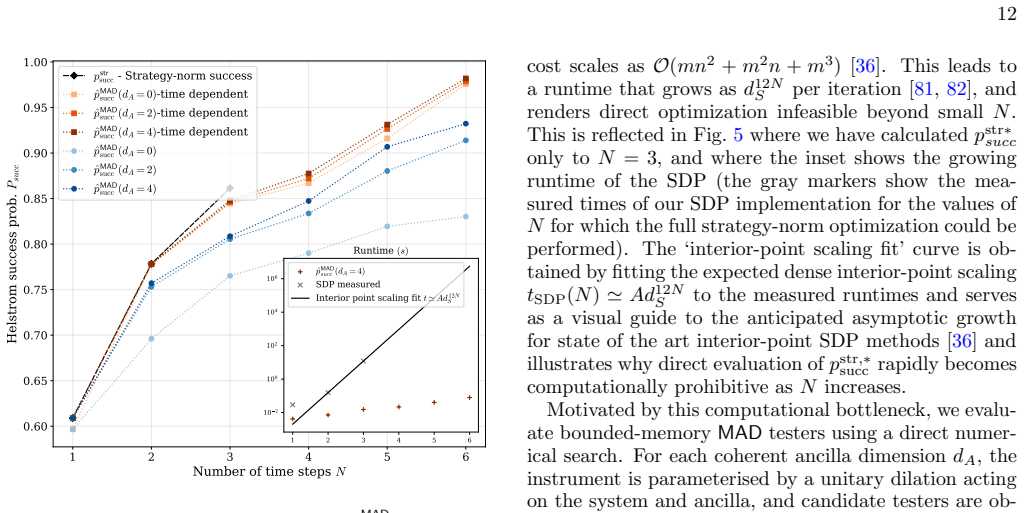
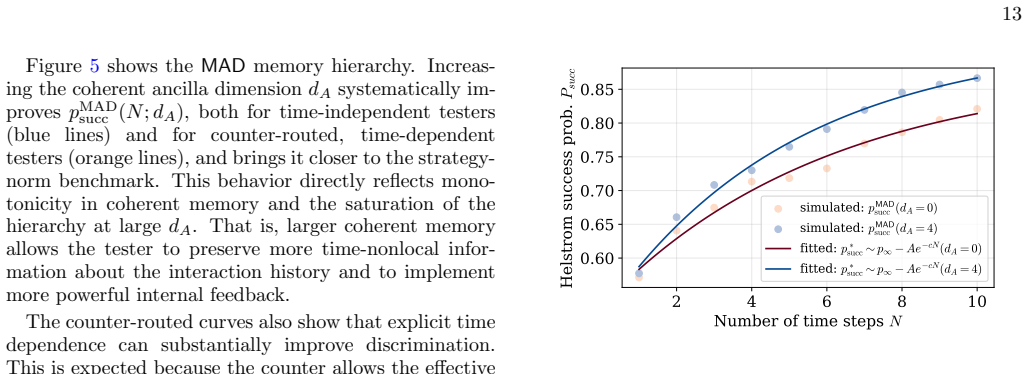
Distinguishing multi-time quantum processes is a fundamental task underlying the diagnosis, benchmarking, and learning of temporally correlated quantum dynamics. The standard benchmark for distinguishing two processes is the strategy-norm distance, which optimizes over arbitrary adaptive probing strategies but can require large coherent memory and time-dependent control. We introduce machines for autonomous distinction~($\mathsf{MAD}$s): probing strategies that apply the same quantum instrument at each time step, retain the full classical outcome record, and carry a coherent memory of dimension $d_A$. Optimizing over these strategies defines a memory-parametrized distinguishability measure, $d^{(N)}_{\mathsf{MAD}}(\mathbf{P}^N,\mathbf{Q}^N;d_A)$. We show that the resulting hierarchy is monotone in coherent memory and complete at finite times. Specifically, any admissible $N$-step probing strategy can be compiled into a single $\mathsf{MAD}$ with an internal counter and sufficiently large coherent memory, so the hierarchy saturates the strategy-norm benchmark. For recurrent processes generated by repeated system--environment interactions, we derive a single-step description that separates the generation of new distinguishing information from the propagation and decay of information generated at earlier times. Numerical results in a repeated-interaction model show that increasing coherent memory systematically improves the $\mathsf{MAD}$ success probability and closes the gap to the strategy-norm distance while remaining substantially more tractable to evaluate. $\mathsf{MAD}$ distinguishability therefore provides an operational and scalable framework for quantifying what can be learned about genuinely multi-time quantum processes with bounded coherent memory.
Editorial analysis
A structured set of objections, weighed in public.
Referee Report
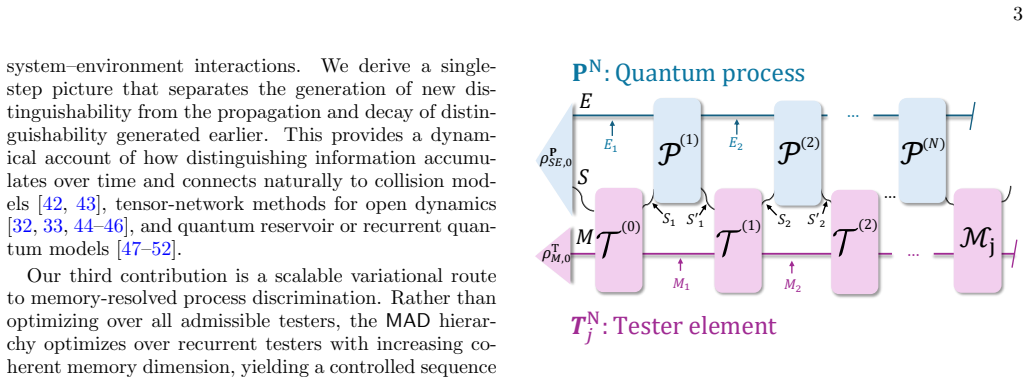
Summary. The manuscript introduces machines for autonomous distinction (MADs) as probing strategies for multi-time quantum processes that apply a fixed quantum instrument at each time step, retain the full classical outcome record, and carry coherent memory of dimension d_A. It defines the memory-parametrized distinguishability measure d^{(N)}_{MAD}(P^N, Q^N; d_A), proves that the resulting hierarchy is monotone in coherent memory dimension, and establishes completeness at finite N: any admissible N-step adaptive strategy can be compiled into a single MAD augmented by an internal counter and sufficiently large but finite d_A, thereby saturating the strategy-norm distance. For recurrent processes, a single-step description is derived that separates generation of new distinguishing information from propagation/decay of prior information. Numerical results in a repeated-interaction model illustrate that increasing d_A improves success probability and narrows the gap to the strategy-norm benchmark while remaining more tractable.
Significance. If the completeness and compilation results hold, the MAD hierarchy supplies an operational, resource-bounded framework for quantifying what can be learned about genuinely multi-time quantum processes, directly relevant to process benchmarking and learning under realistic memory constraints. The explicit single-step reduction for recurrent processes and the demonstration that bounded coherent memory plus a counter suffices to recover full adaptive power at finite N are notable strengths; the numerical evidence further supports practical utility by showing systematic improvement toward the strategy-norm limit.
minor comments (3)
- [§2] §2, definition of MAD: the precise form of the fixed instrument and how the internal counter is encoded in the coherent memory should be stated explicitly with an equation, as the compilation construction in the completeness theorem relies on this detail.
- The numerical section would benefit from an explicit statement of the optimization method used to evaluate d^{(N)}_{MAD} for finite d_A (e.g., SDP formulation or iterative solver), including any convergence criteria, to allow reproducibility.
- Figure 3 caption: the plotted quantities (success probability vs. d_A) should include error bars or indicate whether the values are exact or obtained from a relaxation, to clarify how close the MAD values are to the strategy-norm benchmark.
Simulated Author's Rebuttal
We thank the referee for their accurate summary of our manuscript, the positive significance assessment, and the recommendation for minor revision. No major comments were listed in the report.
Circularity Check
No significant circularity; derivation self-contained
full rationale
The paper defines the MAD class directly via fixed-instrument probing with classical record and coherent memory d_A, then proves monotonicity and completeness as independent mathematical results: any N-step adaptive strategy compiles into an equivalent MAD (with internal counter) for sufficiently large finite d_A. This saturates the externally defined strategy-norm distance without reducing to a fit, self-referential definition, or load-bearing self-citation. No equations equate a prediction to its own input by construction, and the completeness statement is a simulation theorem rather than an ansatz or renaming. The central claims therefore rest on explicit constructions and standard quantum instrument theory, remaining self-contained against external benchmarks.
Axiom & Free-Parameter Ledger
Reference graph
Works this paper leans on
-
[1]
Boundedness: 0≤d (N) MAD(PN ,Q N;d A)≤1
-
[2]
Symmetry: d(N) MAD(PN ,Q N;d A) =d (N) MAD(QN ,P N;d A)
-
[3]
Proof.Boundedness follows sinced (N) MAD is one half of a trace distance between two final classical–quantum states, hence lies in [0,1]
Triangle inequality: d(N) MAD(PN ,R N;d A)≤d (N) MAD(PN ,Q N;d A) +d (N) MAD(QN ,R N;d A). Proof.Boundedness follows sinced (N) MAD is one half of a trace distance between two final classical–quantum states, hence lies in [0,1]. Symmetry is immediate from ∥ρ−σ∥ 1 =∥σ−ρ∥ 1. For the triangle inequality, fix any MADtesterTand letρ T,H N denote the correspond...
-
[4]
Monotonicity in coherent memory: Ifd ′ A ≥d A, then d(N) MAD(PN ,Q N;d ′ A)≥d (N) MAD(PN ,Q N;d A)
-
[5]
Monotonicity in time: IfP N andQ N are theN- step restrictions of consistent(N+1)-step processes PN+1 andQ N+1, then d(N) MAD(PN ,Q N;d A)≤d (N+1) MAD (PN+1 ,Q N+1;d A)
-
[6]
Upper bound by the strategy-norm distance: For all dA, d(N) MAD(PN ,Q N;d A)≤d (N) str (PN ,Q N), whered (N) str (PN ,Q N)denotes the optimal distin- guishability over the full class of admissible testers, equivalently the strategy-norm-defined distinguisha- bility. Proof.For monotonicity ind A, embed anyMADtester with coherent memory dimensiond A into on...
2022
-
[7]
Chiribella, G
G. Chiribella, G. M. D’Ariano, and P. Perinotti, Physical Review A80, 022339 (2009)
2009
-
[8]
F. A. Pollock, C. A. Rodr´ ıguez-Rosario, T. Frauenheim, M. Paternostro, and K. Modi, Phys. Rev. A97, 012127 (2018)
2018
-
[10]
Watrous,The Theory of Quantum Information(Cam- bridge University Press, Cambridge, 2018)
J. Watrous,The Theory of Quantum Information(Cam- bridge University Press, Cambridge, 2018)
2018
-
[11]
Gilchrist, N
A. Gilchrist, N. K. Langford, and M. A. Nielsen, Phys. Rev. A71, 062310 (2005)
2005
-
[12]
Gutoski and J
G. Gutoski and J. Watrous, inProceedings of the 39th Annual ACM Symposium on Theory of Computing (STOC)(ACM, 2007) pp. 565–574
2007
-
[13]
Gutoski, Journal of Mathematical Physics53, 032202 (2012)
G. Gutoski, Journal of Mathematical Physics53, 032202 (2012)
2012
-
[14]
Zambon, Phys
G. Zambon, Phys. Rev. A110, 042210 (2024)
2024
-
[15]
F. A. Pollock, C. A. Rodr´ ıguez-Rosario, T. Frauenheim, M. Paternostro, and K. Modi, Phys. Rev. Lett.120, 040405 (2018)
2018
-
[16]
S. Milz, D. Egloff, P. Taranto, T. Theurer, M. B. Plenio, A. Smirne, and S. F. Huelga, Physical Review X10, 041049 (2020)
2020
-
[17]
Taranto, M
P. Taranto, M. T. Quintino, M. Murao, and S. Milz, Quantum8, 1328 (2024)
2024
-
[18]
Chiribella, G
G. Chiribella, G. M. D’Ariano, and P. Perinotti, Physical Review Letters101, 180501 (2008)
2008
-
[19]
Taranto, F
P. Taranto, F. A. Pollock, S. Milz, M. Tomamichel, and K. Modi, npj Quantum Information7, 149 (2021)
2021
-
[20]
Giarmatzi and F
C. Giarmatzi and F. Costa, Quantum7, 1036 (2023)
2023
-
[21]
T.-A. Ohst, S. Zhang, H. C. Nguyen, M. Pl´ avala, and M. T. Quintino, Quantum10, 1988 (2026), arXiv:2411.08110
arXiv 1988
-
[22]
Preskill, Quantum2, 79 (2018)
J. Preskill, Quantum2, 79 (2018)
2018
-
[23]
B. M. Terhal, Reviews of Modern Physics87, 307 (2015)
2015
-
[24]
Heshami, D
K. Heshami, D. G. England, P. C. Humphreys, P. J. Bus- tard, V. M. Acosta, J. Nunn, and B. J. Sussman, Journal of Modern Optics63, 2005 (2016)
2005
-
[25]
F. A. Pollock, C. Rodr´ ıguez-Rosario, T. Frauenheim, M. Paternostro, and K. Modi, Physical Review A97, 012127 (2018)
2018
-
[26]
M. M. Wilde, M. Berta, C. Hirche, and E. Kaur, Letters in Mathematical Physics110, 2277 (2020)
2020
-
[27]
Hirche, Quantum7, 1064 (2023)
C. Hirche, Quantum7, 1064 (2023)
2023
-
[28]
Katariya and M
V. Katariya and M. M. Wilde, Quantum Information Processing20, 78 (2021)
2021
-
[29]
Portmann and R
C. Portmann and R. Renner, Reviews of Modern Physics 94, 025008 (2022)
2022
-
[30]
Wang and M
X. Wang and M. M. Wilde, Physical Review Research1, 033169 (2019)
2019
-
[31]
Nakahira and K
K. Nakahira and K. Kato, Physical Review A103, 062606 (2021)
2021
-
[32]
S. Milz, F. A. Pollock, and K. Modi, Open Systems & Information Dynamics24, 1740016 (2017)
2017
-
[33]
Milz and K
S. Milz and K. Modi, PRX Quantum2, 030201 (2021)
2021
-
[34]
Ortega-Taberner, E
C. Ortega-Taberner, E. O’Neill, E. Butler, G. E. Fux, and P. R. Eastham, The Journal of Chemical Physics 161, 124119 (2024)
2024
-
[35]
G. A. L. White, C. D. Hill, F. A. Pollock, L. C. L. Hol- lenberg, and K. Modi, Nature Communications11, 6301 (2020)
2020
-
[36]
Zhang, B
H. Zhang, B. Pokharel, E. M. Levenson-Falk, and D. A. Lidar, Physical Review Applied17, 054018 (2022)
2022
-
[37]
Nakamura and J
K. Nakamura and J. Ankerhold, Physical Review Re- search6, 033215 (2024)
2024
-
[38]
M. R. Jørgensen and F. A. Pollock, Physical Review A 102, 052206 (2020)
2020
-
[39]
Dowling, K
N. Dowling, K. Modi, R. N. Mu˜ noz, S. Singh, and G. A. L. White, Physical Review X14, 041018 (2024)
2024
-
[40]
C. W. Helstrom, Journal of Statistical Physics1, 231 (1969)
1969
-
[41]
Bae and L.-C
J. Bae and L.-C. Kwek, Journal of Physics A: Mathemat- ical and Theoretical48, 083001 (2015)
2015
-
[42]
Jiang, T
H. Jiang, T. Kathuria, Y. T. Lee, S. Padmanabhan, and Z. Song, 2020 IEEE 61st Annual Symposium on Founda- tions of Computer Science (FOCS) , 910 (2020). 16
2020
-
[43]
A. W. Harrow, A. Hassidim, D. W. Leung, and J. Wa- trous, Physical Review A81, 032339 (2010)
2010
-
[44]
Jenˇ cov´ a and M
A. Jenˇ cov´ a and M. Pl´ avala, Journal of Mathematical Physics57, 122203 (2016)
2016
-
[45]
Bavaresco, M
J. Bavaresco, M. Murao, and M. T. Quintino, Physical Review Letters127, 200504 (2021)
2021
-
[46]
Salek, M
F. Salek, M. Hayashi, and A. Winter, Physical Review A105, 022419 (2022)
2022
-
[47]
Nakahira, Physical Review A104, 062609 (2021)
K. Nakahira, Physical Review A104, 062609 (2021)
2021
-
[48]
D. Kretschmann and R. F. Werner, Physical Review A 72, 062323 (2005), arXiv:quant-ph/0502106 [quant-ph]
Pith/arXiv arXiv 2005
-
[49]
Ciccarello, S
F. Ciccarello, S. Lorenzo, V. Giovannetti, and G. M. Palma, Physics Reports954, 1 (2022)
2022
-
[50]
Cygorek, M
M. Cygorek, M. Cosacchi, A. Vagov, V. M. Axt, B. W. Lovett, J. Keeling, and E. M. Gauger, Nature Physics 18, 662 (2022)
2022
-
[51]
G. E. Fux, E. P. Butler, P. R. Eastham, B. W. Lovett, and J. Keeling, Physical Review Letters126, 200401 (2021)
2021
-
[52]
Ivander, L
F. Ivander, L. P. Lindoy, and J. Lee, Nature Communi- cations15, 8087 (2024)
2024
-
[53]
Fujii and K
K. Fujii and K. Nakajima, inReservoir Computing: The- ory, Physical Implementations, and Applications, edited by K. Nakajima and I. Fischer (Springer Singapore, Sin- gapore, 2021) pp. 423–450
2021
-
[54]
Nakajima, K
K. Nakajima, K. Fujii, M. Negoro, K. Mitarai, and M. Kitagawa, Phys. Rev. Applied11, 034021 (2019)
2019
-
[55]
Mujal, R
P. Mujal, R. Mart´ ınez-Pe˜ na, J. Nokkala, J. Garc´ ıa-Beni, G. L. Giorgi, M. C. Soriano, and R. Zambrini, Advanced Quantum Technologies4, 2100027 (2021)
2021
-
[56]
L. C. G. Govia, G. J. Ribeill, G. E. Rowlands, H. K. Krovi, and T. A. Ohki, Physical Review Research3, 013077 (2021)
2021
-
[57]
Suzuki, Q
Y. Suzuki, Q. Gao, K. C. Pradel, K. Yasuoka, and N. Ya- mamoto, Scientific Reports12, 1353 (2022)
2022
-
[58]
Variational quantum dimension reduction for recurrent quantum models,
C. Lyu, X. Wang, M. Gu, T. J. Elliott, and C. Yang, “Variational quantum dimension reduction for recurrent quantum models,” (2026), arXiv:2603.09567 [quant-ph]
arXiv 2026
-
[59]
Or´ us, Annals of Physics349, 117 (2014)
R. Or´ us, Annals of Physics349, 117 (2014)
2014
-
[60]
J. I. Cirac, D. P´ erez-Garc´ ıa, N. Schuch, and F. Ver- straete, Rev. Mod. Phys.93, 045003 (2021)
2021
-
[61]
G. E. Fux, P. Fowler-Wright, J. Beckles, E. P. But- ler, P. R. Eastham, D. Gribben, J. Keeling, D. Kilda, P. Kirton, E. D. C. Lawrence, B. W. Lovett, E. O’Neill, A. Strathearn, and R. de Wit, Journal of Chemical Physics161, 124108 (2024)
2024
-
[62]
Cygorek and E
M. Cygorek and E. M. Gauger, Journal of Chemical Physics161, 074111 (2024)
2024
-
[63]
Process tensor approaches to non- markovian quantum dynamics,
J. Keeling, E. M. Stoudenmire, M.-C. Ba˜ nuls, and D. R. Reichman, “Process tensor approaches to non- markovian quantum dynamics,” (2025), invited perspec- tive, arXiv:2509.07661 [quant-ph]
Pith/arXiv arXiv 2025
-
[64]
Reinforcement learning for quantum processes with memory,
J. Lumbreras, R. C. Huang, Y. Hu, M. Fanizza, and M. Gu, “Reinforcement learning for quantum processes with memory,” (2026), arXiv:2603.25138 [quant-ph]
arXiv 2026
-
[65]
White, F
G. White, F. Pollock, L. Hollenberg, K. Modi, and C. Hill, PRX Quantum3, 020344 (2022)
2022
-
[66]
Zhang, B
H. Zhang, B. Pokharel, E. Levenson-Falk, and D. Lidar, Phys. Rev. Appl.17, 054018 (2022)
2022
-
[67]
G. A. L. White, K. Modi, and C. D. Hill, Phys. Rev. Lett.130, 160401 (2023)
2023
-
[68]
Tripathi, D
V. Tripathi, D. Kowsari, K. Saurav, H. Zhang, E. M. Levenson-Falk, and D. A. Lidar, Chemical Reviews125, 5745 (2024)
2024
-
[69]
Hashim, L
A. Hashim, L. B. Nguyen, N. Goss, B. Marinelli, R. K. Naik, T. Chistolini, J. Hines, J. Marceaux, Y. Kim, P. Gokhale, T. Tomesh, S. Chen, L. Jiang, S. Ferracin, K. Rudinger, T. Proctor, K. C. Young, I. Siddiqi, and R. Blume-Kohout, PRX Quantum6, 030202 (2025)
2025
-
[70]
G. A. L. White, P. Jurcevic, C. D. Hill, and K. Modi, Phys. Rev. X15, 021047 (2025)
2025
-
[71]
Zhang, Z
X. Zhang, Z. Wu, G. A. L. White, Z. Xiang, S. Hu, Z. Peng, Y. Liu, D. Zheng, X. Fu, A. Huang, D. Poletti, K. Modi, J. Wu, M. Deng, and C. Guo, Communications Physics8, 29 (2025)
2025
-
[72]
Ghosh, B
S. Ghosh, B. Opanchuk, L. Rosales-Z´ arate, B. Wilson, and M. D. Reid, npj Quantum Information5, 35 (2019)
2019
-
[73]
Nakajima, K
K. Nakajima, K. Fujii, M. Negoro, K. Mitarai, and M. Kitagawa, Physical Review Applied11, 034021 (2019)
2019
-
[74]
Sannia, R
A. Sannia, R. Mart´ ınez-Pe˜ na, M. C. Soriano, G. L. Giorgi, and R. Zambrini, Quantum8, 1291 (2024)
2024
-
[75]
R. Mart´ ınez-Pe˜ na and J.-P. Ortega, Physical Review E 111, 065306 (2025), arXiv:2412.08322 [quant-ph]
arXiv 2025
-
[76]
Wringe, S
C. Wringe, S. Stepney, and M. Trefzer, International Journal of Parallel, Emergent and Distributed Systems 40, 313 (2025)
2025
-
[77]
J. P. Crutchfield and K. Young, Phys. Rev. Lett.63, 105 (1989)
1989
-
[78]
C. R. Shalizi and J. P. Crutchfield, J. Stat. Phys.104, 817 (2001)
2001
-
[79]
M. Gu, K. Wiesner, E. Rieper, and V. Vedral, Nat. Com- mun.3, 762 (2012)
2012
-
[80]
Thompson, A
J. Thompson, A. J. P. Garner, V. Vedral, and M. Gu, npj Quantum Information3, 6 (2017)
2017
-
[81]
F. C. Binder, J. Thompson, and M. Gu, Phys. Rev. Lett. 120, 240502 (2018)
2018
discussion (0)
Sign in with ORCID, Apple, or X to comment. Anyone can read and Pith papers without signing in.