Explicit Factorization of X^n-1 over mathbb{Z}_(p^e) via Cofactor-Free Single-Seed Hensel Lifting
Pith reviewed 2026-06-28 17:54 UTC · model grok-4.3
The pith
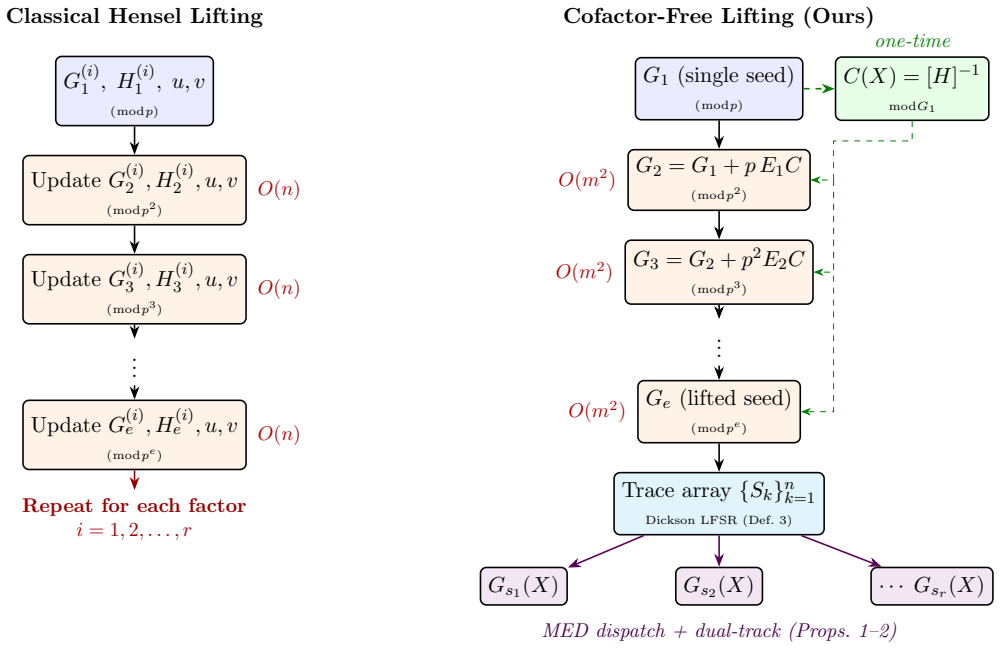
Cofactor-free Hensel lifting via a cached F_p inverse factors X^n-1 over Z_{p^e} with per-layer cost O(m^2).
A machine-rendered reading of the paper's core claim, the machinery that carries it, and where it could break.
Core claim
All irreducible factors of X^n-1 over Z_{p^e} are obtained by first extracting a multivariate Dickson polynomial ideal via the Ideal Derivation Modulo Principle whose roots are the factor coefficients, lifting one seed factor from F_p by cofactor-free Hensel iteration that reuses a single cached inverse, and reconstructing the full set of factors from the lifted seed's trace array via Newton-Girard formulas or quotient-ring Gaussian elimination as fallback.
What carries the argument
The Ideal Derivation Modulo Principle that produces a multivariate Dickson polynomial ideal characterizing all factor coefficients, together with cofactor-free single-seed Hensel lifting that reuses one polynomial inverse computed over F_p.
If this is right
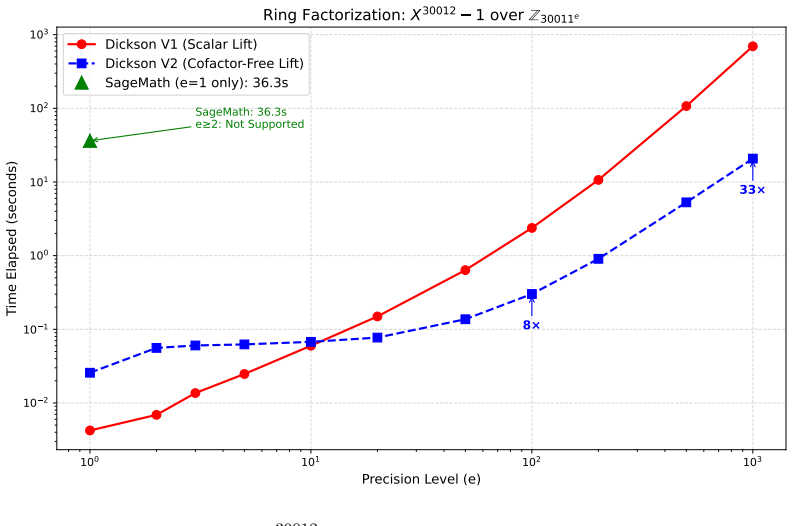
- Lifting cost remains O(m^2) per layer even when the exponent e exceeds 1000.
- Explicit factorization of X^n-1 becomes feasible without exponential slowdown from zero-divisors.
- The method supplies both a primary Newton-Girard reconstruction path and an unconditional Gaussian-elimination fallback when p is at most m.
- Grand-total complexity stays O(n + m^3 log p + e m^2) for any depth e.
Where Pith is reading between the lines
- The same ideal-derivation step could be adapted to produce explicit factors of other polynomials over Z_{p^e} that split completely over F_p.
- Near-constant per-layer cost opens the possibility of using the lifted factors inside iterative algorithms that require many successive powers of p.
- The dual-track reconstruction suggests an average-case analysis when p exceeds m, where the cheaper Newton-Girard path is expected to dominate.
Load-bearing premise
The roots of the multivariate Dickson polynomial ideal obtained by modular remainder extraction exactly match the coefficients of every irreducible factor of X^n-1 over Z_{p^e}.
What would settle it
Lift the factors of X^5-1 from F_3 to Z_{3^5} using the described method and check whether the product of the output polynomials equals X^5-1 exactly modulo 3^5.
Figures
read the original abstract
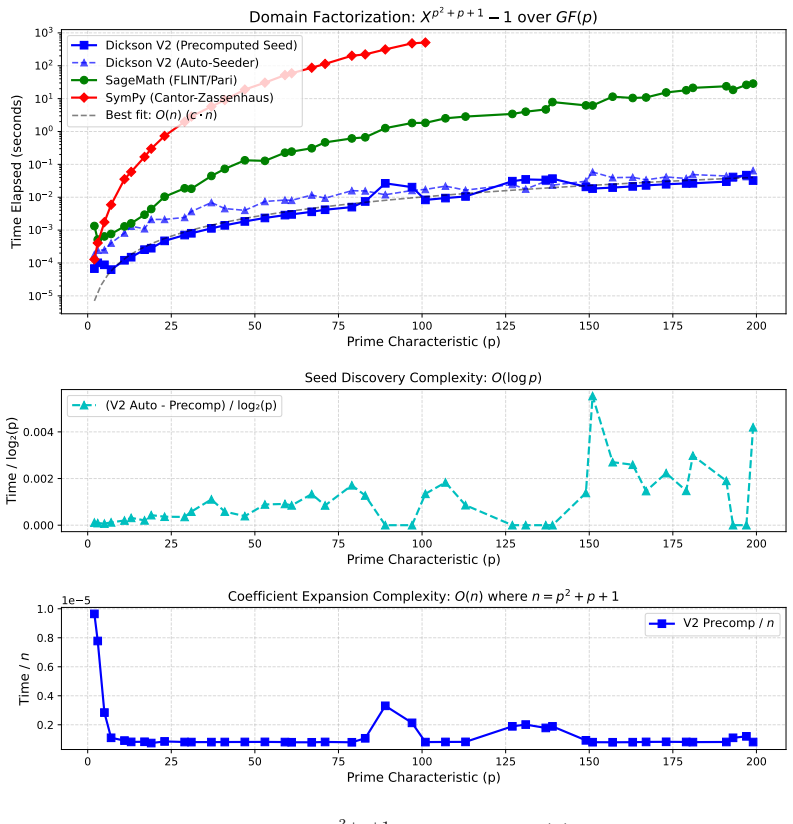
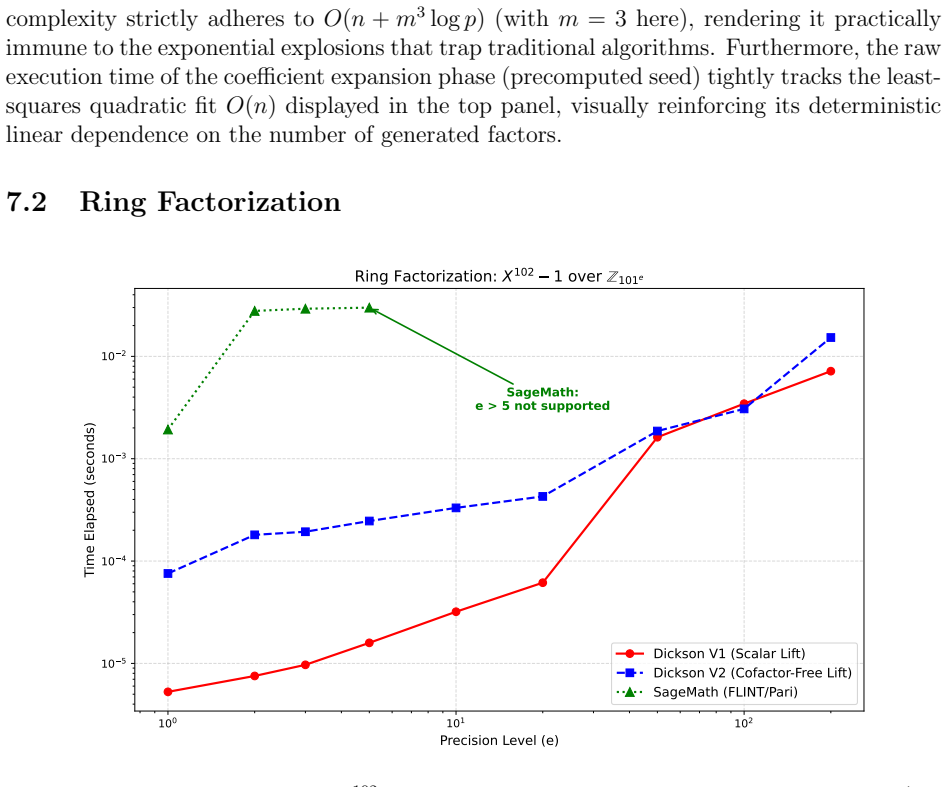
We present a complete framework for the explicit factorization of $X^n-1$ over integer residue rings $\mathbb{Z}_{p^e}$ for arbitrary $n$ with $\gcd(n, p)=1$. Classical approaches face fundamental bottlenecks: polynomial Hensel lifting requires updating global cofactors (scaling with $n$), while direct multivariate Newton--Hensel iteration on the factor coefficients requires Jacobian inversion (scaling exponentially as $O(p^{(m-1)^2})$ per layer due to zero-divisors, where $m$ is the coset dimension). Our framework eliminates both bottlenecks through three contributions: (1)~the \emph{Ideal Derivation Modulo Principle}, which characterizes all factor coefficients as roots of a multivariate Dickson polynomial ideal derived via modular remainder extraction; (2)~a \emph{cofactor-free Hensel lift} that elevates a single seed factor from $\mathbb{F}_p$ to $\mathbb{Z}_{p^e}$ using a cached polynomial inverse computed once over $\mathbb{F}_p$; and (3)~a \emph{dual-track coefficient reconstruction} mechanism that recovers all remaining factors from the lifted seed's trace array via MED-based coset dispatch, with Newton--Girard inversion as the primary path and quotient-ring Gaussian elimination as an unconditional fallback when $p \leq m$. Empirical evaluation confirms the theoretical grand total algebraic complexity of $O(n + m^3 \log p + e \cdot m^2)$ for explicitly factoring $X^n-1$ over $\mathbb{Z}_{p^e}$, validating the near-constant per-layer lifting cost $O(m^2)$ to depths exceeding $e = 1000$. The framework yields speedups of $445\times$ (including runtime auto-seeding overhead) over SageMath's C-backed FLINT/Pari engine and $33.5\times$ over the V1 scalar lift.
Editorial analysis
A structured set of objections, weighed in public.
Referee Report
Summary. The manuscript presents a framework for explicit factorization of X^n-1 over Z_{p^e} (gcd(n,p)=1) using three main contributions: the Ideal Derivation Modulo Principle for characterizing factor coefficients via a Dickson polynomial ideal, a cofactor-free single-seed Hensel lifting using a cached F_p inverse, and dual-track coefficient reconstruction. It claims an algebraic complexity of O(n + m^3 log p + e · m^2) and reports empirical speedups of 445× over SageMath's FLINT/Pari.
Significance. Should the method's correctness be established, particularly the validity of the cached inverse across lifting layers, this could offer a substantial improvement in efficiency for factoring cyclotomic polynomials over p-adic integer rings, with potential applications in algebraic number theory and cryptography. The near-constant per-layer cost to high e is noteworthy if proven.
major comments (2)
- [Section on cofactor-free Hensel lift (contribution 2)] The central claim that the single inverse computed over F_p remains valid for cofactor-free lifting through all e layers, despite the emergence of zero-divisors in Z_{p^e}, lacks an explicit inductive proof or error analysis showing no need for re-inversion or nilpotent corrections. This is load-bearing for the O(e · m^2) complexity and the reported speedups.
- [Empirical evaluation] The reported speedups and complexity validation are stated without accompanying data tables, benchmark details, or error analysis, making independent verification of the 445× claim and O(e · m^2) per-layer cost difficult.
minor comments (2)
- Clarify the definition of m (coset dimension) and its relation to n early in the paper.
- The abstract mentions 'MED-based coset dispatch' without prior definition; ensure all acronyms are expanded on first use.
Simulated Author's Rebuttal
We thank the referee for their thorough review and valuable feedback on our manuscript. We address each major comment below and will incorporate revisions to strengthen the presentation and verifiability of our results.
read point-by-point responses
-
Referee: [Section on cofactor-free Hensel lift (contribution 2)] The central claim that the single inverse computed over F_p remains valid for cofactor-free lifting through all e layers, despite the emergence of zero-divisors in Z_{p^e}, lacks an explicit inductive proof or error analysis showing no need for re-inversion or nilpotent corrections. This is load-bearing for the O(e · m^2) complexity and the reported speedups.
Authors: The referee is correct that the current manuscript does not contain an explicit inductive proof or accompanying error analysis for the validity of the cached F_p inverse across all lifting layers. In the revised version we will add a new subsection that supplies a complete inductive argument establishing that the single inverse remains sufficient without re-inversion or nilpotent corrections, thereby rigorously supporting the claimed per-layer cost of O(m^2). revision: yes
-
Referee: [Empirical evaluation] The reported speedups and complexity validation are stated without accompanying data tables, benchmark details, or error analysis, making independent verification of the 445× claim and O(e · m^2) per-layer cost difficult.
Authors: We agree that the absence of supporting data tables, benchmark specifications, and error analysis hinders independent verification. The revised manuscript will include detailed benchmark tables (covering ranges of n, p, e, and m), a full description of the experimental setup and hardware, per-layer timing measurements, and statistical error analysis to substantiate both the 445× speedup and the near-constant O(m^2) lifting cost. revision: yes
Circularity Check
No significant circularity; derivation self-contained
full rationale
The paper introduces three explicit algorithmic contributions (Ideal Derivation Modulo Principle, cofactor-free Hensel lift via cached F_p inverse, dual-track reconstruction) whose claimed O(n + m^3 log p + e m^2) complexity follows directly from the per-layer arithmetic cost of the new lift being O(m^2). No equation reduces a claimed prediction or result to a fitted parameter or prior self-citation by construction; the cached-inverse validity is asserted as an algebraic property of the method rather than derived from the target complexity itself. The manuscript is therefore self-contained against external benchmarks and receives the default non-circularity finding.
Axiom & Free-Parameter Ledger
axioms (1)
- domain assumption gcd(n, p) = 1
Reference graph
Works this paper leans on
-
[1]
Crystals - kyber: a lattice-based kem,
R. Avanzi, J. Bos, L. Ducas, E. Kiltz, T. Lepoint, V. Lyubashevsky, J. M. Schanck, P. Schwabe, G. Seiler, and D. Stehl´ e, “Crystals - kyber: a lattice-based kem,” inPro- ceedings of the 2018 IEEE European Symposium on Security and Privacy (EuroS&P), pp. 282–297, 2018
2018
-
[2]
Crystals - dilithium: Digi- tal signatures from module lattices,
L. D` ev` enyi, V. Lyubashevsky, G. Seiler, and D. Stehl´ e, “Crystals - dilithium: Digi- tal signatures from module lattices,” inAdvances in Cryptology – ASIACRYPT 2018, vol. 11274 ofLecture Notes in Computer Science, pp. 40–67, Springer, 2018
2018
-
[3]
(leveled) fully homomorphic en- cryption without bootstrapping,
Z. Brakerski, C. Gentry, and V. Vaikuntanathan, “(leveled) fully homomorphic en- cryption without bootstrapping,”ACM Transactions on Computation Theory (TOCT), vol. 6, no. 3, pp. 1–36, 2014
2014
-
[4]
Fully homomorphic simd operations,
N. P. Smart and F. Vercauteren, “Fully homomorphic simd operations,”Designs, Codes and Cryptography, vol. 71, no. 1, pp. 57–81, 2014
2014
-
[5]
Explicit factors of cyclotomic polynomials over finite fields,
R. W. Fitzgerald and J. L. Yucas, “Explicit factors of cyclotomic polynomials over finite fields,”Designs, Codes and Cryptography, vol. 44, no. 1, pp. 39–47, 2007
2007
-
[6]
On explicit factors of cyclotomic polynomials over finite fields,
L. Wang and Q. Wang, “On explicit factors of cyclotomic polynomials over finite fields,” Finite Fields and Their Applications, vol. 18, no. 6, pp. 1056–1069, 2012
2012
-
[7]
Factorization of Dickson polyno- mials over finite fields,
F. E. Brochero Mart´ ınez and N. E. Ar´ evalo Baquero, “Factorization of Dickson polyno- mials over finite fields,”arXiv preprint arXiv:1908.05508, 2019
-
[8]
Explicit factorization ofx p+1 −1 over Zpe: A structural approach via dickson polynomials,
Y. Wang, Y. Ding, J. Yang, and Z. Huang, “Explicit factorization ofx p+1 −1 over Zpe: A structural approach via dickson polynomials,” inProceedings of the 2026 IEEE International Symposium on Information Theory (ISIT), 2026
2026
-
[9]
The multiple equal-difference structure of cyclo- tomic cosets,
L. Zhu, J. Zhou, J. Liu, and H. Wu, “The multiple equal-difference structure of cyclo- tomic cosets,”CoRR, vol. abs/2501.03516, 2025. 22
-
[10]
R. Lidl, G. L. Mullen, and G. Turnwald,Dickson Polynomials, vol. 65 ofPitman Mono- graphs and Surveys in Pure and Applied Mathematics. Longman Scientific & Technical, 1993
1993
-
[11]
F. J. MacWilliams and N. J. A. Sloane,The Theory of Error-Correcting Codes. North- Holland, 1977
1977
-
[12]
I. G. Macdonald,Symmetric Functions and Hall Polynomials. Oxford University Press, 2nd ed., 1995
1995
-
[13]
The factorization of Dickson polynomials over finite fields,
W. S. Chou, “The factorization of Dickson polynomials over finite fields,”Finite Fields and Their Applications, vol. 3, no. 1, pp. 84–96, 1997
1997
-
[14]
Factors of Dickson polynomials over finite fields,
R. W. Fitzgerald and J. L. Yucas, “Factors of Dickson polynomials over finite fields,” Finite Fields and Their Applications, vol. 11, no. 4, pp. 724–737, 2005
2005
-
[15]
E. R. Berlekamp,Algebraic Coding Theory. New York: McGraw-Hill, 1968
1968
-
[16]
A new algorithm for factoring polynomials over finite fields,
D. G. Cantor and H. Zassenhaus, “A new algorithm for factoring polynomials over finite fields,”Mathematics of Computation, vol. 36, no. 154, pp. 587–592, 1981
1981
-
[17]
Factoring modular polynomials,
J. von zur Gathen and S. Hartlieb, “Factoring modular polynomials,”Journal of Sym- bolic Computation, vol. 26, no. 5, pp. 583–606, 1998
1998
-
[18]
Cohen,A Course in Computational Algebraic Number Theory, vol
H. Cohen,A Course in Computational Algebraic Number Theory, vol. 138 ofGraduate Texts in Mathematics. Berlin, Heidelberg: Springer-Verlag, 1993
1993
-
[19]
An approach to Hensel’s lemma,
G. McGuire, “An approach to Hensel’s lemma,”Irish Mathematical Society Bulletin, vol. 47, pp. 15–21, 2001
2001
-
[20]
SymPy: symbolic computing in Python,
A. Meurer, C. P. Smith, M. Paprocki, O. ˇCert´ ık, S. B. Kirpichev, M. Rocklin, A. Kumar, S. Ivanov, J. K. Moore, S. Singh, T. Rathnayake, S. Vig, B. E. Granger, R. P. Muller, F. Bonazzi, H. Gupta, S. Vats, F. Johansson, F. Pedregosa, M. J. Curry, A. R. Terrel, v. Rouˇ cka, A. Saboo, I. Fernando, S. Kulal, R. Cimrman, and A. Scopatz, “SymPy: symbolic comp...
2017
-
[21]
The Sage Developers,SageMath, the Sage Mathematics Software System (Version 10.6), 2025. 23
2025
discussion (0)
Sign in with ORCID, Apple, or X to comment. Anyone can read and Pith papers without signing in.