REVIEW 4 major objections 6 minor 117 references
Do we really need alternatives to the $\omega_0\omega_a$CDM parameterization after the DESI DR2?
T0 review · 4 major / 6 minor · reviewed 2026-08-06 · deepseek-v4-flash
Pith's one-line read Reparameterizing CPL at a density-level pivot removes its degeneracy, and in that common basis it remains favored over the fafbCDM density expansion and better reproduces quintessence backgrounds.
desk verdict A solid, honest reanalysis showing coordinate effects matter in the DESI dark energy comparison, but the statistical edge for CPL is weak and the 'common pivot basis' is less common than advertised. read the letter →
The pith
A machine-rendered reading of the paper's core claim, the machinery that carries it, and where it could break.
The reading
What carries the argument
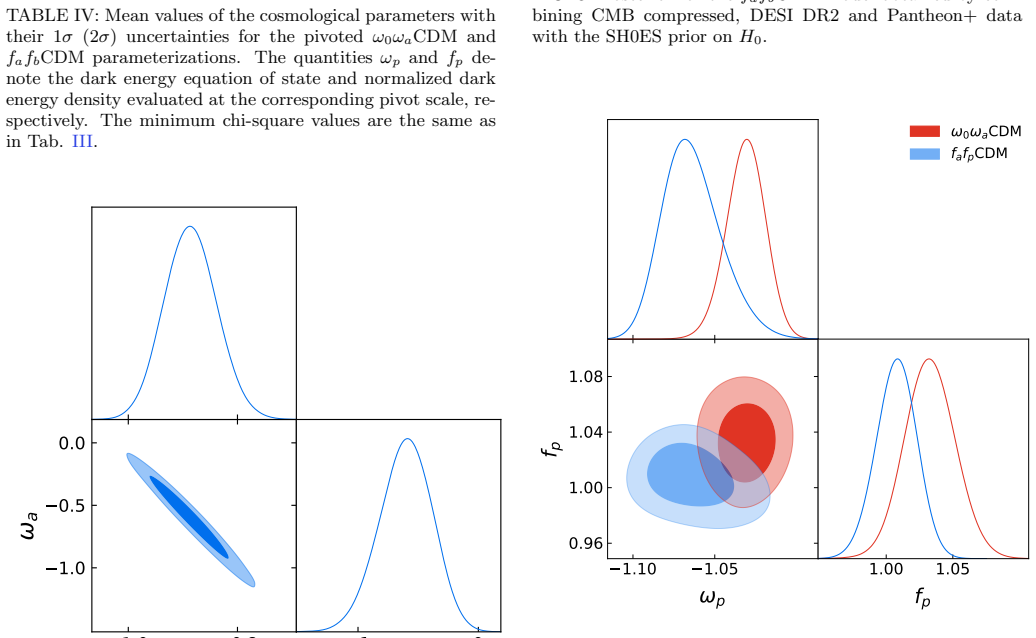
The central object is the density-level pivot pair $(\omega_p,f_p)\equiv(\omega(a_p), f_{\rm DE}(a_p))$, with the pivot scale factor $a_p$ selected by minimizing $|\mathrm{corr}[\omega(a), f(a)]|$ over the MCMC posterior. For CPL, the exact reparameterization is $\omega_a = [\ln f_p + 3(1+\omega_p)\ln a_p]/[3((a_p-1)-a_p\ln a_p)]$ and $\omega_0=\omega_p-(1-a_p)\omega_a$; the same pivot variables are built from $(f_a,f_b)$ for $f_af_b$CDM. Because the transformation leaves the cosmology unchanged, the pivot basis isolates the coordinate contribution to parameter degeneracies, revealing which expansion form the data actually constrain.
What would settle it
Re-run the analysis with the $H_0$ prior removed or with a full CMB likelihood; if the optimal $a_p$ for CPL no longer yields exact decorrelation, or if the AIC/DIC preference reverses, the coordinate-effect conclusion fails. Alternatively, if an independent reanalysis optimizes $f_af_b$CDM's pivot over a wider range and finds $\mathrm{corr}(\omega_p,f_p)=0$ with error contours as compact as CPL's, the claim that CPL is intrinsically the better approximation would be falsified.
Extended reading notes
Core claim
The paper's central claim is that the density-level pivot construction applied to CPL removes the parameter correlation that made the standard $(\omega_0,\omega_a)$ basis look degenerate, and that in this physically motivated basis $\omega_0\omega_a$CDM remains favored over $f_af_b$CDM and reproduces quintessence backgrounds more accurately. The transformation is exact: $(\omega_0,\omega_a)\leftrightarrow(\omega_p,f_p)$ leaves the expansion history and likelihood unchanged, so any statistical difference comes from the coordinate system. For CPL, the optimized pivot scale factor is $a_p\simeq0.76$, giving $\mathrm{corr}(\omega_p,f_p)\simeq0$; for $f_af_b$CDM, the same procedure leaves a resid
Load-bearing premise
The comparison assumes that a pivot scale factor estimated from the same MCMC posterior gives a fair, stable, and comparable coordinate system for both models; if the optimal $a_p$ shifts when the dataset or priors change, or if comparing CPL at $a_p\simeq0.76$ with $f_af_b$CDM at $a_p\simeq0.71$ is not a meaningful common basis, the conclusion that $f_af_b$CDM's disadvantage is a coordinate effect loses its footing.
Editorial extensions
If this is right
- The apparent DESI-driven preference for dark-energy models built from a density expansion may be a coordinate artifact: once $\omega_0\omega_a$CDM is expressed in $(\omega_p,f_p)$, it is at least as competitive as $f_af_b$CDM.
- Claims of evolving dark energy should be tested against physically motivated reparameterizations of the same model before interpreting them as evidence for new physics.
- The density-level pivot gives physically interpretable parameters at the epoch where data are most sensitive, with $\omega_p\simeq-1.03$ and $f_p\simeq1.03$ for CPL, close to a mild phantom behavior.
- The pivot is more effective for CPL (exact decorrelation) than for $f_af_b$CDM (residual correlation $0.13$), suggesting the density expansion is a less well-aligned coordinate system for the data.
- Both pivoted parameterizations recover quintessence Hubble histories to better than $0.1\%$ over $0\le z\le4$, with pivoted CPL generally the more accurate of the two.
Reading between the lines
- The same coordinate-effect argument should apply to any pair of dark-energy parameterizations related by an exact reparameterization: apparent statistical preferences in the original bases may vanish or reverse when both models are written in a common, data-aligned basis.
- A prior-independent check, using profile likelihoods or carefully chosen priors under the nonlinear transformation $(\omega_0,\omega_a)\to(\omega_p,f_p)$, could determine how much of the CPL preference is carried by the prior measure rather than by the data.
- Because $f_af_b$CDM's residual correlation cannot be minimized to zero, expanding the density around the pivot epoch itself rather than around the present epoch might yield a genuinely more physical density-level parameterization worth testing.
- The pivot scale factor $a_p\simeq0.76$ sits near matter-dark-energy equality and the cosmic transition epoch, hinting that the pivot could be interpreted as the epoch where dark energy begins to dominate, a possibility that independent probes of the expansion history could test.
Editorial analysis
A structured set of objections, weighed in public.
Referee Report
Summary. The paper introduces a 'density-level pivot' for the CPL parameterization, replacing (ω0, ωa) by (ωp, fp) with fp ≡ ρDE(ap)/ρDE,0 and ωp = ω(ap), where ap is chosen to minimize |corr(ω(a), f(a))| over the posterior (Eq. 33). The same pivot variables are constructed for the fa fb CDM density expansion (Eqs. 6, 12, 13). Using MontePython with compressed CMB, DESI DR2 BAO, cosmic chronometers, Pantheon+ SNe, and the SH0ES prior, the authors find ΔAIC = 2.31 and ΔDIC = 2.75 in favor of CPL, obtain a nearly decorrelated basis for CPL (ap ≃ 0.76) and only a partially decorrelated basis for fa fb CDM (ap ≃ 0.71, residual correlation 0.13), and compare both against exponential and Ratra-Peebles quintessence backgrounds. They conclude that pivoted CPL reconstructs those backgrounds slightly more accurately and that the apparent advantage of the density-level expansion is mostly a coordinate effect.
Significance. The central methodological insight is sound and worth stating: parameter correlations, contour shapes, and apparent stability are coordinate-dependent even when the likelihood is unchanged by an exact reparameterization. The algebraic transformations in Eqs. (10)–(13) are explicit and check out, and the MCMC setup is standard and reproducible, using public codes and data. If the pivot-basis comparison were shown to be fair and stable, the paper would be a useful cautionary note for the DESI dark-energy literature. However, the statistical preference is weak-to-moderate, the 'common basis' claim is not yet established because the pivot epochs differ between models, and the quintessence comparison has no error propagation. The headline conclusion therefore goes beyond what the current analysis rigorously supports.
major comments (4)
- [Sec. III.A, Eq. (33) and Table IV] The pivot scale factor is data-derived and model-dependent: ap ≃ 0.76 for CPL and ap ≃ 0.71 for fa fb CDM. The paper calls this a 'common physical coordinate system' (footnote 3 and Sec. V), but the same symbols (ωp, fp) correspond to different physical epochs in the two models. Each model is therefore presented at its own best-case decorrelation epoch. Since the stability of ap under other dataset combinations is explicitly deferred to future work in Sec. V, the central claim that fa fb CDM's advantage is a coordinate effect is not yet demonstrated. A concrete fix: repeat the comparison at a fixed ap (e.g., 0.73) or show that the ranking is insensitive to the pivot-selection rule.
- [Table III and Sec. III.A] The fa fb CDM parameter fb runs to the lower prior boundary; the reported 'fb < −0.24' is an upper limit set by the prior. The fit is therefore prior-dominated in one of its two dark-energy parameters. Because the two models are defined in different coordinates with different flat priors, the ΔAIC/ΔDIC comparison partly compares prior volumes and boundary behavior rather than the physical content of the models. This is particularly relevant for DIC, which depends on the effective number of parameters. The paper acknowledges priors only generally in Sec. V; sensitivity runs with different prior ranges or with priors placed directly on (ωp, fp) are needed to show that the CPL preference is not an artifact of the fa fb CDM prior boundary.
- [Sec. III.A, Eq. (39)] The reported ΔAIC = 2.31 and ΔDIC = 2.75 fall in the range that the paper itself labels 'moderate evidence against the model under consideration' (2 < Δ ≤ 6). Yet the Abstract and Conclusions describe the result as 'mildly favor' and 'remains favored,' and the Abstract asserts CPL 'emerges as the most suitable framework.' This is an overstatement: with these values, the correct reading is weak-to-moderate preference, not a decisive model selection. The language should be toned down to match the paper's own evidence scale.
- [Sec. IV, Eqs. (56)–(60)] The quintessence comparison is not a statistical model comparison. The differences in EH,min are tiny (e.g., 1.3×10⁻⁴ vs 1.8×10⁻⁴ for λ=0.7; 1.6×10⁻⁴ vs 3.5×10⁻⁴ for n=0.9) and no uncertainties are propagated from the MCMC posteriors. The contour-area ratios are explicitly non-invariant under nonlinear reparameterizations, as the paper acknowledges. These quantities therefore cannot support the strong statement that pivoted CPL 'accurately reproduces ... better than' fa fb CDM. The conclusion should be restricted to the specific optimized points, coordinate choices, and prior domains used here.
minor comments (6)
- [Fig. 4 caption] The caption appears to contain a typo: 'f0faCDM' should presumably read 'fa fb CDM'.
- [Table III] The fb entry is typeset as 'fb −<−0.24', which is ambiguous. It should be written as 'fb < −0.24 (95% CL)' or similar.
- [Sec. II, Eq. (10)] The inversion formula has denominators involving (ap − 1) − ap ln ap, which vanishes at ap = 1. It would be helpful to state the domain ap ∈ (0,1) and note the limiting behavior.
- [Sec. V] Minor typo: 'becaming uncorrelated' should be 'becoming uncorrelated'.
- [Abstract vs Table IV] The Abstract claims 'tighter and more stable constraints' after pivoting, but Table IV shows essentially unchanged uncertainties for H0 and Ωm. The improvement is specific to the dark-energy parameters; this should be stated more precisely.
- [Sec. IV] The paragraph after Eq. (55) says the upper limit z=4 'approximately covers' the redshift range of current BAO/SN data; DESI DR2 includes Lyman-α at z≈2.33 and Pantheon+ extends to z≈2.26, so a slightly higher cutoff is fine, but the rationale for exactly z=4 could be stated more explicitly.
Circularity Check
Minor self-definitional pivot decorrelation; central model comparison is independent.
-
self definitional
[Sec. III.A, Eqs. (33), (40)-(43); Sec. V]
"We define the pivot scale factor as the epoch at which ωp and fp are least correlated. Accordingly, ap is determined by the condition |corr [ω(ap), f(ap)]|= min a |corr [ω(a), f(a)]| ... At this scale, the residual correlation is numerically consistent with zero, corr(ωp, fp)≃0."
Because ap is defined as the minimizer of |corr[ω(a),f(a)]|, reporting that the correlation almost vanishes at the selected epoch, and concluding that the CPL basis is 'effectively decorrelated', is a restatement of the selection rule rather than an independent discovery. The further statement that the pivot construction is 'more effective' for CPL, where an exactly decorrelated basis exists, is likewise determined by whether the correlation function crosses zero under the same criterion. This is not load-bearing for the central model preference, however: the AIC/DIC and χ2 values are identical before and after pivoting (Tables III and IV), so the claimed preference for CPL over fafbCDM rests on the unchanged likelihood, not on the decorrelation itself.
full rationale
The paper is largely self-contained. The pivot transformation (Eqs. 10-11 and 12-13) is an exact reparameterization that leaves the expansion history, likelihood, and cosmology unchanged, as the authors explicitly state. The statistical comparison between w0waCDM and fafbCDM is performed on the original posteriors, and the AIC/DIC preference for CPL does not depend on the pivoted variables. The quintessence comparison is presented as an optimization/reconstruction (minimizing EH over (ωp,fp)), not as a prediction, so it does not reduce to its inputs. The cited density-expansion model [80] is not by the current authors, so no self-citation chain is load-bearing. The only circular element is the pivot-selection criterion itself: ap is chosen to minimize |corr[ω(a),f(a)]|, and the paper then highlights that the correlation is nearly zero (Eq. 41). This is a self-definitional observation, but it is explicitly framed as a construction and is not used to force the central conclusion. The paper also candidly notes in Sec. V the need to test pivot stability under different datasets and the prior dependence of nonlinear reparameterizations. Overall, circularity is minor and does not undermine the main model-comparison result.
Assumptions & free parameters
free parameters (10)
- pivot scale factor ap (CPL) =
0.76 (z_p = 0.31)
- pivot scale factor ap (fafbCDM) =
0.71 (z_p = 0.42)
- omega0 (CPL) =
-0.886 +/- 0.101
- omega_a (CPL) =
-0.604 +/- 0.452
- f_a (fafbCDM) =
-0.201 +0.177/-0.215
- f_b (fafbCDM) =
less than -0.24 (95% upper bound)
- H0 =
68.51 (CPL) / 68.61 (fafb)
- Omega_m =
0.2995 (CPL) / 0.2967 (fafb)
- optimized (wp, fp) for exponential quintessence =
E_H,min 0.013% (CPL), 0.018% (fafb)
- optimized (wp, fp) for Ratra-Peebles quintessence =
E_H,min 0.016% (CPL), 0.035% (fafb)
assumptions (5)
- domain assumption The universe is spatially flat FLRW, with a homogeneous dark energy component obeying the conservation equation d ln rho_DE / d ln a = -3(1+w(a)).
- domain assumption The compressed CMB likelihood with mean vector (0.0104110, 0.02223, 0.14208) and covariance (17) is a valid summary of Planck-era constraints.
- ad hoc to paper The fafbCDM parameter space is restricted to f(a)>0 for all a in [0,1], with priors f_a in [-1,1], f_b in [-1,2].
- domain assumption The quintessence models with exponential and inverse power-law potentials, and the selected thawing/tracker branches, are representative of dark energy dynamics.
- ad hoc to paper The pivot epoch minimizes |corr[omega(ap), f(ap)]| computed from the MCMC chains, and this is a meaningful epoch for comparing models.
Cite this review
Pith. "Pith review of Do we really need alternatives to the $\omega_0\omega_a$CDM parameterization after the DESI DR2?." pith.science (2026). https://pith.science/paper/7EYF444K
@misc{pith2026260801215,
  author       = {Pith},
  title        = {Pith review of: Do we really need alternatives to the $\omega_0\omega_a$CDM parameterization after the DESI DR2?},
  year         = {2026},
  howpublished = {\url{https://pith.science/paper/7EYF444K}},
  note         = {Machine review of arXiv:2608.01215}
}
abstract
We introduce a density-level pivot construction for the Chevallier-Polarski-Linder (CPL) parameterization by defining the normalized dark energy density $f_p\equiv f_{\rm DE}(a_p)$ and the equation of state $\omega_p\equiv \omega(a_p)$ at an optimized pivot scale factor $a_p$. This reparameterization leaves the underlying CPL cosmology unchanged and allows the two models to be compared using parameters with a direct physical interpretation at the epoch where the data are most sensitive. Accordingly, following the DESI DR2 results, we compare a newly proposed $f_a f_b$CDM parameterization, based on a second-order Taylor expansion of the normalized dark energy density, with the standard $w_0w_a$CDM model. In particular, we constrain the original and pivoted parameterizations using compressed cosmic microwave background (CMB), DESI DR2 baryon acoustic oscillations (BAO), cosmic chronometers (CC), and Pantheon+ Type Ia supernovae data, with the SH0ES prior imposed on $H_0$. We find that applying the same density-level pivot prescription to the $w_0w_a$CDM model substantially reduces the correlation between its dark energy parameters and provides tighter and more stable constraints. The statistical comparison shows that this model remains favored over the Taylor expansion of the dark energy density, even when both models are analyzed in the optimized parameter basis. Moreover, the pivoted CPL parameterization accurately reproduces the background evolution of quintessence models, providing a reliable phenomenological approximation to the underlying dark energy dynamics, better than the $f_af_b$CDM model. We conclude that changing the parameter basis improves the performance of the $w_0w_a$CDM model, which emerges as the most suitable framework to describe the dark energy sector within the class of models considered here.
Figures


Figures from the paper (3 more)


Reference graph
Works this paper leans on
- [1]
-
[2]
the second is the choice of coordinates used to repre- sent the same posterior distribution. Indeed, by applying the same pivot logic to both parameterizations, we show that a significant part of the apparent advantage of the density level expansion can be traced to the parameter basis and, therefore, not to the functional form itself. In particular, we f...
1929
-
[3]
[80, 113], al- lowing a direct comparison with previous quintessence reconstructions
It also coincides with the benchmark used in Refs. [80, 113], al- lowing a direct comparison with previous quintessence reconstructions. Then, we consider the inverse power-law potential in- troduced by Ratra and Peebles [114]. The form used in Eq. (48b) is equivalent to the con- ventional expression VRP(ϕ) = M 4+n ϕn ,(50) provided that V0 = M 4+n M n Pl...
2023
- [4]
-
[5]
I. D. Gialamas, G. H¨ utsi, K. Kannike, A. Racioppi, M. Raidal, M. Vasar, and H. Veerm¨ ae, Phys. Rev. D 111, 043540 (2025), 2406.07533
arXiv 2025
-
[6]
W. Giar` e, M. Najafi, S. Pan, E. Di Valentino, and J. T. Firouzjaee, JCAP10, 035 (2024), 2407.16689
arXiv 2024
- [7]
-
[8]
O. Luongo and H. Quevedo, in12th Marcel Grossmann Meeting on General Relativity(2010), pp. 1029–1031, 1005.4532
arXiv 2010
Show all 117 references
-
[9]
A. G. Riess et al. (Supernova Search Team), Astron. J. 116, 1009 (1998), astro-ph/9805201
1998 arXiv
-
[10]
Perlmutter et al
S. Perlmutter et al. (Supernova Cosmology Project), As- trophys. J.517, 565 (1999), astro-ph/9812133
1999 arXiv
-
[11]
E. J. Copeland, M. Sami, and S. Tsujikawa, Int. J. Mod. Phys. D15, 1753 (2006), hep-th/0603057
2006 arXiv
-
[12]
S. M. Carroll, Living Rev. Rel.4, 1 (2001), astro- ph/0004075
2001
-
[13]
P. J. E. Peebles and B. Ratra, Rev. Mod. Phys.75, 559 (2003), astro-ph/0207347
2003 arXiv
-
[14]
Frieman, M
J. Frieman, M. Turner, and D. Huterer, Ann. Rev. As- tron. Astrophys.46, 385 (2008), 0803.0982
2008 arXiv
-
[15]
Sahni, Lect
V. Sahni, Lect. Notes Phys.653, 141 (2004), astro- ph/0403324
2004
- [16]
-
[17]
R. R. Caldwell and M. Kamionkowski, Ann. Rev. Nucl. Part. Sci.59, 397 (2009), 0903.0866
2009 arXiv
-
[18]
A. C. Alfano, O. Luongo, and M. Muccino, JHEAp46, 100348 (2025), 2411.04878
2025 arXiv
- [19]
-
[20]
A. C. Alfano and O. Luongo, Phys. Dark Univ.51, 102205 (2026), 2501.15233
2026 arXiv
-
[21]
Boshkayev, T
K. Boshkayev, T. Konysbayev, O. Luongo, M. Muc- cino, and F. Pace, Phys. Rev. D104, 023520 (2021), 2103.07252
2021 arXiv
-
[22]
P. K. S. Dunsby, O. Luongo, and M. Muccino, Phys. Rev. D109, 023510 (2024), 2308.15776
2024 arXiv
-
[23]
A. C. Alfano, O. Luongo, and M. Muccino, JCAP12, 055 (2024), 2408.02536
2024 arXiv
-
[24]
Luongo and M
O. Luongo and M. Muccino, Mon. Not. Roy. Astron. Soc.518, 2247 (2022), 2207.00440
2022 arXiv
-
[25]
A. C. Alfano, S. Capozziello, O. Luongo, and M. Muc- cino, JHEAp42, 178 (2024), 2402.18967
2024 arXiv
- [26]
-
[27]
P. K. S. Dunsby, O. Luongo, and L. Reverberi, Phys. Rev. D94, 083525 (2016), 1604.06908
2016 arXiv
-
[28]
Muccino, L
M. Muccino, L. Izzo, O. Luongo, K. Boshkayev, L. Am- ati, M. Della Valle, G. B. Pisani, and E. Zaninoni, As- trophys. J.908, 181 (2021), 2012.03392
2021 arXiv
-
[29]
D. H. Weinberg, M. J. Mortonson, D. J. Eisenstein, C. Hirata, A. G. Riess, and E. Rozo, Phys. Rept.530, 87 (2013), 1201.2434
2013 arXiv
-
[30]
Aghanim et al
N. Aghanim et al. (Planck), Astron. Astrophys.641, A6 (2020), [Erratum: Astron.Astrophys. 652, C4 (2021)], 1807.06209
2020 arXiv
- [31]
-
[32]
T. M. C. Abbott et al. (DES), Phys. Rev. D105, 023520 (2022), 2105.13549
2022 arXiv
- [33]
-
[34]
Huterer and D
D. Huterer and D. L. Shafer, Rept. Prog. Phys.81, 016901 (2018), 1709.01091
2018 arXiv
-
[35]
D. N. Spergel et al. (WMAP), Astrophys. J. Suppl.148, 175 (2003), astro-ph/0302209
2003 arXiv
- [36]
-
[37]
Alam et al
S. Alam et al. (BOSS), Mon. Not. Roy. Astron. Soc. 470, 2617 (2017), 1607.03155
2017 arXiv
-
[38]
Sahni and A
V. Sahni and A. A. Starobinsky, Int. J. Mod. Phys. D 9, 373 (2000), astro-ph/9904398
2000 arXiv
-
[39]
Martin, Comptes Rendus Physique13, 566 (2012), 1205.3365
J. Martin, Comptes Rendus Physique13, 566 (2012), 1205.3365
2012 arXiv
-
[40]
Zlatev, L.-M
I. Zlatev, L.-M. Wang, and P. J. Steinhardt, Phys. Rev. Lett.82, 896 (1999), astro-ph/9807002
1999 arXiv
-
[41]
H. E. S. Velten, R. F. vom Marttens, and W. Zimdahl, Eur. Phys. J. C74, 3160 (2014), 1410.2509
2014 arXiv
-
[42]
C. P. Burgess, in100e Ecole d’Ete de Physique: Post- Planck Cosmology(2015), pp. 149–197, 1309.4133
2015 arXiv
-
[43]
Nobbenhuis, Found
S. Nobbenhuis, Found. Phys.36, 613 (2006), gr- qc/0411093
2006
-
[44]
Dalal, K
N. Dalal, K. Abazajian, E. E. Jenkins, and A. V. Manohar, Phys. Rev. Lett.87, 141302 (2001), astro- ph/0105317
2001
-
[45]
Luongo and H
O. Luongo and H. Quevedo, Int. J. Mod. Phys. D23, 1450012 (2014)
2014
- [46]
-
[47]
Belfiglio, Y
A. Belfiglio, Y. Carloni, and O. Luongo, Phys. Dark Univ.44, 101458 (2024), 2307.04739
2024 arXiv
-
[48]
Weinberg, Rev
S. Weinberg, Rev. Mod. Phys.61, 1 (1989)
1989
-
[49]
Martel, P
H. Martel, P. R. Shapiro, and S. Weinberg, Astrophys. J.492, 29 (1998), astro-ph/9701099
1998 arXiv
-
[50]
Weinberg, in4th International Symposium on Sources and Detection of Dark Matter in the Universe (DM 2000)(2000), pp
S. Weinberg, in4th International Symposium on Sources and Detection of Dark Matter in the Universe (DM 2000)(2000), pp. 18–26, astro-ph/0005265
2000 arXiv
-
[51]
Padmanabhan, Phys
T. Padmanabhan, Phys. Rept.380, 235 (2003), hep- th/0212290
2003
-
[52]
Cai and S.-J
R.-G. Cai and S.-J. Wang, Res. Astron. Astrophys.26, 084011 (2026), 2606.20434
2026 arXiv
-
[53]
Di Valentino, O
E. Di Valentino, O. Mena, S. Pan, L. Visinelli, W. Yang, A. Melchiorri, D. F. Mota, A. G. Riess, and J. Silk, Class. Quant. Grav.38, 153001 (2021), 2103.01183
2021 arXiv
-
[54]
Carloni, O
Y. Carloni, O. Luongo, and M. Muccino, Astron. Astro- phys.707, A383 (2026), 2506.11531
2026
- [55]
-
[56]
Pantos and L
I. Pantos and L. Perivolaropoulos, Phys. Dark Univ.52, 102286 (2026), 2602.12238
2026
-
[57]
A. G. Adame et al. (DESI), JCAP02, 021 (2025), 2404.03002
2025 arXiv
-
[58]
Abdul Karim et al
M. Abdul Karim et al. (DESI), Phys. Rev. D112, 083515 (2025), 2503.14738
2025 arXiv
- [59]
- [60]
-
[61]
W. J. Wolf, C. Garc ´ ıa-Garc ´ ıa, and P. G. Ferreira, JCAP 05, 034 (2025), 2502.04929
2025 arXiv
-
[62]
Vincenzi et al
M. Vincenzi et al. (DES), Mon. Not. Roy. Astron. Soc. 541, 2585 (2025), 2501.06664
2025 arXiv
- [63]
-
[64]
Carloni, O
Y. Carloni, O. Luongo, and M. Muccino, Phys. Rev. D 111, 023512 (2025), 2404.12068
2025 arXiv
- [65]
- [66]
-
[67]
Afroz and S
S. Afroz and S. Mukherjee, Phys. Rev. D113, 083514 (2026), 2504.16868
2026
-
[68]
de Souza, A
R. de Souza, A. Sousa-Neto, J. E. Gonz´ alez, and J. Al- caniz, Phys. Rev. D113, 103531 (2026), 2511.13666
2026
-
[69]
E. ´O. Colg´ ain and M. M. Sheikh-Jabbari, Mon. Not. Roy. Astron. Soc.542, L24 (2025), 2412.12905
2025 arXiv
-
[70]
E. ´O. Colg´ ain, M. G. Dainotti, S. Capozziello, S. Pouro- jaghi, M. M. Sheikh-Jabbari, and D. Stojkovic, JHEAp 49, 100428 (2026), 2404.08633
2026 arXiv
-
[71]
E. ´O. Colg´ ain, S. Pourojaghi, and M. M. Sheikh- Jabbari, Galaxies13, 133 (2025), 2505.19029
2025
-
[72]
E. ´O. Colg´ ain, S. Pourojaghi, M. M. Sheikh-Jabbari, and L. Yin, Phys. Dark Univ.52, 102268 (2026), 2504.04417
2026
-
[73]
R. E. Keeley, K. N. Abazajian, M. Kaplinghat, and A. Shafieloo, Phys. Rev. D112, 043501 (2025), 2502.12667
2025 arXiv
-
[74]
Sousa-Neto, C
A. Sousa-Neto, C. Bengaly, J. E. Gonzalez, and J. Al- caniz, Phys. Dark Univ.50, 102108 (2025), 2502.10506
2025 arXiv
-
[75]
Chevallier and D
M. Chevallier and D. Polarski, Int. J. Mod. Phys. D10, 213 (2001), gr-qc/0009008
2001 arXiv
-
[76]
Huterer and M
D. Huterer and M. S. Turner, Phys. Rev. D64, 123527 (2001), astro-ph/0012510
2001 arXiv
-
[77]
E. V. Linder, Phys. Rev. Lett.90, 091301 (2003), astro- ph/0208512
2003
- [78]
-
[79]
E. V. Linder, Astropart. Phys.26, 102 (2006), astro- ph/0604280
2006
-
[80]
W. Yang, S. Pan, E. Di Valentino, and E. N. Saridakis, Universe5, 219 (2019), 1811.06932
2019 arXiv
- [81]
-
[82]
Montefalcone and R
G. Montefalcone and R. Stiskalek (2026), 2603.25735
2026
- [83]
- [84]
-
[85]
Zhang, H
C. Zhang, H. Zhang, S. Yuan, T.-J. Zhang, and Y.- C. Sun, Res. Astron. Astrophys.14, 1221 (2014), 1207.4541
2014 arXiv
- [86]
-
[87]
Simon, L
J. Simon, L. Verde, and R. Jimenez, Phys. Rev. D71, 123001 (2005), astro-ph/0412269
2005 arXiv
-
[88]
Moresco et al., JCAP08, 006 (2012), 1201.3609
M. Moresco et al., JCAP08, 006 (2012), 1201.3609
2012 arXiv
-
[89]
Moresco, L
M. Moresco, L. Pozzetti, A. Cimatti, R. Jimenez, C. Maraston, L. Verde, D. Thomas, A. Citro, R. Tojeiro, and D. Wilkinson, JCAP05, 014 (2016), 1601.01701
2016 arXiv
-
[90]
A. L. Ratsimbazafy, S. I. Loubser, S. M. Craw- ford, C. M. Cress, B. A. Bassett, R. C. Nichol, and P. V¨ ais¨ anen, Mon. Not. Roy. Astron. Soc.467, 3239 (2017), 1702.00418
2017 arXiv
-
[91]
Stern, R
D. Stern, R. Jimenez, L. Verde, M. Kamionkowski, and S. A. Stanford, JCAP02, 008 (2010), 0907.3149
2010 arXiv
-
[92]
Borghi, M
N. Borghi, M. Moresco, and A. Cimatti, Astrophys. J. Lett.928, L4 (2022), 2110.04304
2022 arXiv
- [93]
-
[94]
A. G. Riess et al., Astrophys. J. Lett.934, L7 (2022), 2112.04510
2022 arXiv
-
[95]
Alestas, D
G. Alestas, D. Camarena, E. Di Valentino, L. Kazantzidis, V. Marra, S. Nesseris, and L. Perivolaropoulos, Phys. Rev. D105, 063538 (2022), 2110.04336
2022 arXiv
-
[96]
Kamionkowski and A
M. Kamionkowski and A. G. Riess, Ann. Rev. Nucl. Part. Sci.73, 153 (2023), 2211.04492
2023 arXiv
-
[97]
Z. Zhou, Z. Miao, S. Bi, C. Ai, and H. Zhang, Phys. Rev. D112, 103502 (2025), 2506.23556
2025
-
[98]
Carloni, O
Y. Carloni, O. Luongo, and M. Biesiada, Phys. Rev. D 113, 103525 (2026), 2511.15472
2026
-
[99]
M. Kunz, R. Trotta, and D. Parkinson, Phys. Rev. D 74, 023503 (2006), astro-ph/0602378
2006 arXiv
-
[100]
Sugiura, Communications in Statistics - Theory and Methods7, 13 (1978)
N. Sugiura, Communications in Statistics - Theory and Methods7, 13 (1978)
1978
-
[101]
Biesiada, JCAP02, 003 (2007), astro-ph/0701721
M. Biesiada, JCAP02, 003 (2007), astro-ph/0701721
2007 arXiv
-
[102]
Szydlowski, T
M. Szydlowski, T. Stachowiak, and R. Wojtak, Phys. Rev. D73, 063516 (2006), astro-ph/0511650
2006 arXiv
-
[103]
Szydlowski and A
M. Szydlowski and A. Kurek, AIP Conf. Proc.861, 1031 (2006), astro-ph/0603538
2006 arXiv
-
[104]
Melchiorri, L
A. Melchiorri, L. Pagano, and S. Pandolfi, Phys. Rev. D76, 041301 (2007), 0706.1314
2007 arXiv
-
[105]
Capozziello, P
S. Capozziello, P. K. S. Dunsby, and O. Luongo, Mon. Not. Roy. Astron. Soc.509, 5399 (2021), 2106.15579
2021 arXiv
-
[106]
A. C. Alfano, C. Cafaro, S. Capozziello, and O. Luongo, Phys. Dark Univ.42, 101298 (2023), 2306.08396
2023 arXiv
-
[107]
J. V. Cunha and J. A. S. Lima, Mon. Not. Roy. Astron. Soc.390, 210 (2008), 0805.1261
2008 arXiv
- [108]
-
[109]
Vargas dos Santos, R
M. Vargas dos Santos, R. R. R. Reis, and I. Waga, JCAP 02, 066 (2016), 1505.03814
2016 arXiv
-
[110]
Muccino, O
M. Muccino, O. Luongo, and D. Jain, Mon. Not. Roy. Astron. Soc.523, 4938 (2023), 2208.13700
2023 arXiv
-
[111]
R. R. Caldwell and E. V. Linder, Phys. Rev. Lett.95, 141301 (2005), astro-ph/0505494
2005 arXiv
-
[112]
R. J. Scherrer and A. A. Sen, Phys. Rev. D77, 083515 (2008), 0712.3450
2008 arXiv
-
[113]
E. J. Copeland, A. R. Liddle, and D. Wands, Phys. Rev. D57, 4686 (1998), gr-qc/9711068
1998 arXiv
-
[114]
O. F. Ramadan, J. Sakstein, and D. Rubin, Phys. Rev. D110, L041303 (2024), 2405.18747
2024 arXiv
-
[115]
M. W. Toomey, G. Montefalcone, E. McDonough, and K. Freese, Phys. Rev. D113, 123532 (2026), 2509.13318
2026
-
[116]
Ratra and P
B. Ratra and P. J. E. Peebles, Phys. Rev. D37, 3406 (1988)
1988
-
[117]
P. J. Steinhardt, L.-M. Wang, and I. Zlatev, Phys. Rev. D59, 123504 (1999), astro-ph/9812313
1999 arXiv
Reviewed August 6, 2026 · model on record in the stance chip above.
Discussion (0). Sign in to comment.