Pith. sign in

REVIEW 4 minor 2 references

Refined index obstructions for Brauer classes on an abelian variety

T0 review · 0 major / 4 minor · reviewed 2026-07-01 · grok-4.3

Pith's one-line read Refined index obstructions for topologically trivial Brauer classes on abelian varieties are stricter than de Jong-Perry versions and produce more counterexamples to the integral Hodge conjecture.

desk verdict Mackall refines de Jong-Perry obstructions to get stricter ones that produce extra counterexamples on abelian varieties, with explicit constructions and comparisons that hold up. read the letter →

arxiv 2605.26407 v1 pith:7FMGVQBW submitted 2026-05-26 math.AG math.KTmath.RA

classification math.AGmath.KTmath.RA
keywords BrauerclassesabelianvarietiesindexobstructionsintegralHodgeconjecturetopologicallytrivialcomplexprojectivealgebraicgeometry
verification ladder T0 review T1 audit T2 compute T3 formal

The pith

A machine-rendered reading of the paper's core claim, the machinery that carries it, and where it could break.

The reading

The paper constructs refined index obstructions for topologically trivial Brauer classes on smooth projective complex varieties by extending those introduced by de Jong and Perry. These obstructions are shown to impose stronger conditions than the earlier versions. The work concentrates on complex abelian varieties to develop algorithmic methods for evaluating the obstructions and to supply concrete examples. This stricter detection produces additional counterexamples to the integral Hodge conjecture. Algorithmic verification is emphasized as a central practical feature.

What carries the argument

Refined index obstructions for topologically trivial Brauer classes, which generalize the de Jong-Perry obstructions and apply stricter conditions on abelian varieties.

What would settle it

An explicit computation on a complex abelian variety and a specific topologically trivial Brauer class showing that the refined obstruction is nonzero while the de Jong-Perry obstruction is zero, or the failure to locate any such distinguishing example.

Watch

Extended reading notes

Core claim

We produce refined index obstructions, generalizing recently constructed index obstructions due to de Jong and Perry, for topologically trivial Brauer classes on smooth and projective complex varieties. We show that our refined obstructions are more stringent than previous obstructions and, as a consequence, we produce more counterexamples to the integral Hodge conjecture. Throughout this work, we focus on algorithmic aspects of these obstructions and we illustrate many of these aspects through the concrete examples of complex abelian varieties.

Load-bearing premise

The newly constructed refined obstructions are strictly more stringent than the de Jong and Perry obstructions for the Brauer classes on abelian varieties under consideration.

Editorial extensions

If this is right

  • More counterexamples to the integral Hodge conjecture appear on abelian varieties than those detected by prior obstructions.
  • Algorithmic procedures become available for computing the obstructions on concrete abelian varieties.
  • The refined obstructions apply to topologically trivial Brauer classes across smooth projective complex varieties.
  • Previous obstructions are recovered as special cases of the refined versions.

Reading between the lines

Editorial extensions of the paper, not claims the author makes directly.

  • The algorithmic focus on abelian varieties suggests that similar computational checks could be attempted on other varieties where Brauer classes arise.
  • The generalization beyond de Jong-Perry obstructions may allow systematic searches for Hodge conjecture failures in higher-dimensional examples.
  • Connections between these index obstructions and other topological invariants of Brauer classes remain available for further exploration.
Share X Bluesky LinkedIn Reddit HN

Editorial analysis

A structured set of objections, weighed in public.

Desk editor's note, referee report, simulated authors' rebuttal, and a circularity audit.

Referee Report

0 major / 4 minor

Summary. The manuscript constructs refined index obstructions for topologically trivial Brauer classes on smooth projective complex varieties, generalizing the index obstructions of de Jong and Perry. It shows via explicit constructions and direct computations on abelian varieties that the refined obstructions are strictly more stringent than prior ones, yielding additional counterexamples to the integral Hodge conjecture, with emphasis on algorithmic computability throughout.

Significance. If the central claims hold, the work supplies a concrete strengthening of obstruction theory for the integral Hodge conjecture on abelian varieties. The algorithmic focus and explicit examples on abelian varieties constitute a verifiable advance, as the strict improvement is established by direct comparison rather than abstract generality.

minor comments (4)
  1. [§1] §1, paragraph 3: the statement that the obstructions are 'more stringent' would benefit from an explicit cross-reference to the comparison theorem (likely Theorem 4.2 or 5.1) that establishes the strict inequality for the relevant classes.
  2. [Table 1] Table 1 (abelian variety examples): the column headers for the refined vs. de Jong-Perry obstructions are clear, but the caption should note the precise Brauer class (e.g., the 2-torsion class on the product of elliptic curves) used for each row.
  3. [§3.3] §3.3, Algorithm 3.4: the pseudocode for computing the refined obstruction is reproducible, but the termination criterion for the Gröbner-basis step is stated only informally; a brief complexity remark would aid readers implementing the procedure.
  4. [References] Reference list: the citation to de Jong-Perry (2023) appears twice (once as [DP23] and once as [dJP]); standardize the label.

Simulated Author's Rebuttal

0 responses · 0 unresolved

We thank the referee for their positive summary and recommendation of minor revision. No specific major comments appear in the provided report, so we have no individual points to address.

Circularity Check

0 steps flagged · score 0.0 of 10

No significant circularity detected

full rationale

The paper's central claims rest on generalizing index obstructions from de Jong-Perry via explicit constructions and direct computations on abelian varieties, with comparisons established through algorithmic verification on concrete Brauer classes. No self-definitional reductions, fitted inputs renamed as predictions, or load-bearing self-citations appear in the derivation chain; the strict improvement and additional counterexamples to the integral Hodge conjecture are presented as consequences of independent explicit examples rather than tautological redefinitions of prior inputs.

Assumptions & free parameters 0 free parameters · 0 assumptions · 0 invented entities

Abstract-only; no explicit free parameters, axioms, or invented entities are stated. The central claim rests on an unstated comparison that the new obstructions are strictly stronger, but details are absent.

how reviews work

0 comments
Cite this review

Pith. "Pith review of Refined index obstructions for Brauer classes on an abelian variety." pith.science (2026). https://pith.science/paper/7FMGVQBW

@misc{pith2026260526407,
  author       = {Pith},
  title        = {Pith review of: Refined index obstructions for Brauer classes on an abelian variety},
  year         = {2026},
  howpublished = {\url{https://pith.science/paper/7FMGVQBW}},
  note         = {Machine review of arXiv:2605.26407}
}
read the original abstract

We produce refined index obstructions, generalizing recently constructed index obstructions due to de Jong and Perry, for topologically trivial Brauer classes on smooth and projective complex varieties. We show that our refined obstructions are more stringent than previous obstructions and, as a consequence, we produce more counterexamples to the integral Hodge conjecture. Throughout this work, we focus on algorithmic aspects of these obstructions and we illustrate many of these aspects through the concrete examples of complex abelian varieties.

Figures

Figures reproduced from arXiv: 2605.26407 by the authors.

Figure 1
Figure 1. A collection of 96 Brauer classes of period 4 on a very general abelian 4-fold sampled uniformly at random from 2-forms of Hamming weight at most 6. Blue bubbles indicate that either the maximum possible index (determined from symbol length) was obtained by the de Jong–Perry obstructions, or the Chern obstructions pro￾vided no new bounds. Yellow bubbles indicate algebras where Chern obstructions provided higher inde… view at source ↗
Figure 2
Figure 2. A collection of 96 Brauer classes of period 4 on a very general abelian 4-fold sampled from 2-forms of Hamming weight at most 6, rotated [PITH_FULL_IMAGE:figures/full_fig_p024_2.png] view at source ↗
Figure 3
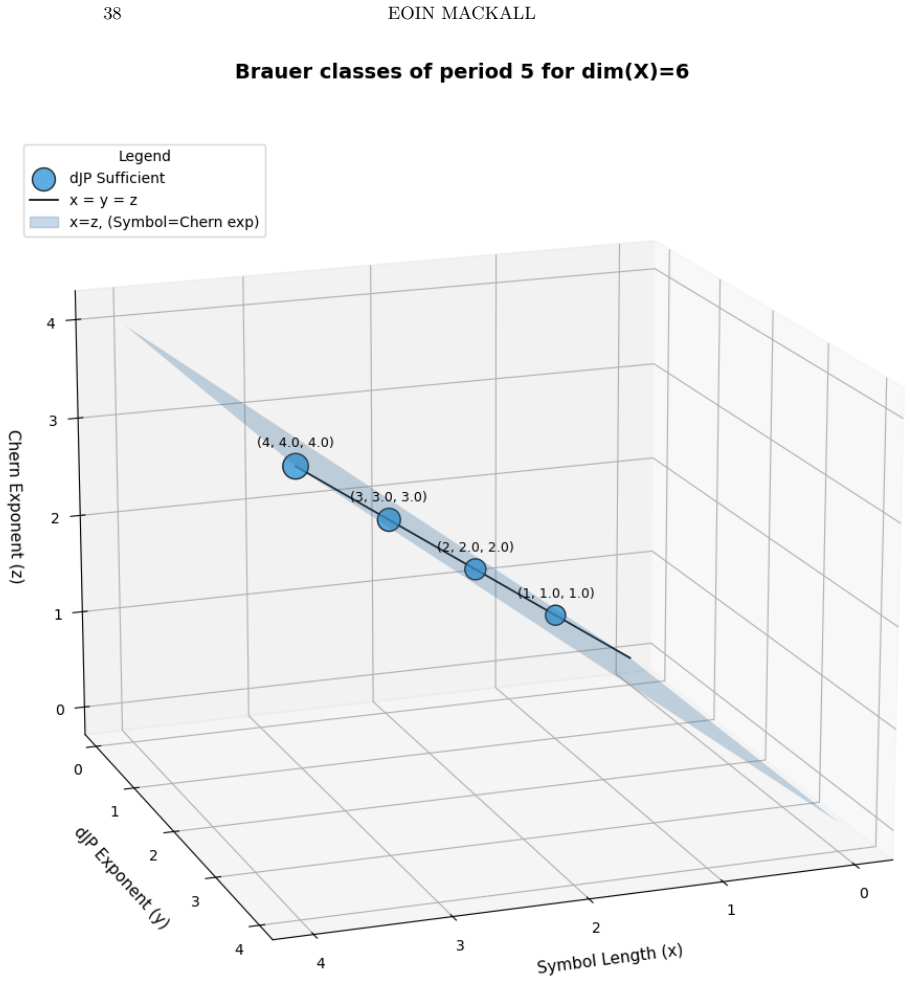
Figure 3. A collection of 96 Brauer classes of period 5 on a very general abelian 4-fold sampled uniformly at random from 2-forms of Hamming weight at most 6. Blue bubbles indicate that either the maximum possible index (determined from symbol length) was obtained by the de Jong–Perry obstructions, or the Chern obstructions pro￾vided no new bounds. Yellow bubbles indicate algebras where Chern obstructions provided higher inde… view at source ↗
Figures from the paper (21 more)
Figure 4
Figure 4. Figure 4: A collection of 96 Brauer classes of period 5 on a very general abelian 4-fold sampled from 2-forms of Hamming weight at most 6, rotated [PITH_FULL_IMAGE:figures/full_fig_p026_4.png]
Figure 5
Figure 5. Figure 5: A collection of 98 Brauer classes of period 4 on a very general abelian 5-fold sampled uniformly at random from 2-forms of Hamming weight at most 7. Blue bubbles indicate that either the maximum possible index (determined from symbol length) was obtained by the de Jong…
Figure 6
Figure 6. Figure 6: A collection of 98 Brauer classes of period 4 on a very general abelian 5-fold sampled from 2-forms of Hamming weight at most 7, rotated [PITH_FULL_IMAGE:figures/full_fig_p028_6.png]
Figure 7
Figure 7. Figure 7: A collection of 98 Brauer classes of period 5 on a very general abelian 5-fold sampled uniformly at random from 2-forms of Hamming weight at most 7. Blue bubbles indicate that either the maximum possible index (determined from symbol length) was obtained by the de Jong…
Figure 8
Figure 8. Figure 8: A collection of 98 Brauer classes of period 5 on a very general abelian 5-fold sampled from 2-forms of Hamming weight at most 7, rotated [PITH_FULL_IMAGE:figures/full_fig_p030_8.png]
Figure 9
Figure 9. Figure 9: A collection of 144 Brauer classes of period 2 on a very general abelian 6-fold sampled uniformly at random from 2-forms of Hamming weight at most 12. Blue bubbles indicate that either the maximum possible index (determined from symbol length) was obtained by the de Jo…
Figure 10
Figure 10. Figure 10: A collection of 144 Brauer classes of period 2 on a very general abelian 6-fold sampled from 2-forms of Hamming weight at most 12, rotated [PITH_FULL_IMAGE:figures/full_fig_p032_10.png]
Figure 11
Figure 11. Figure 11: A collection of 96 Brauer classes of period 3 on a very general abelian 6-fold sampled uniformly at random from 2-forms of Hamming weight at most 8. Blue bubbles indicate that either the maximum possible index (determined from symbol length) was obtained by the de Jon…
Figure 12
Figure 12. Figure 12: A collection of 96 Brauer classes of period 3 on a very general abelian 6-fold sampled from 2-forms of Hamming weight at most 8, rotated [PITH_FULL_IMAGE:figures/full_fig_p034_12.png]
Figure 13
Figure 13. Figure 13: A collection of 96 Brauer classes of period 4 on a very general abelian 6-fold sampled uniformly at random from 2-forms of Hamming weight at most 8. Blue bubbles indicate that either the maximum possible index (determined from symbol length) was obtained by the de Jon…
Figure 14
Figure 14. Figure 14: A collection of 96 Brauer classes of period 4 on a very general abelian 6-fold sampled from 2-forms of Hamming weight at most 8, rotated [PITH_FULL_IMAGE:figures/full_fig_p036_14.png]
Figure 15
Figure 15. Figure 15: A collection of 96 Brauer classes of period 5 on a very general abelian 6-fold sampled uniformly at random from 2-forms of Hamming weight at most 8. Blue bubbles indicate that either the maximum possible index (determined from symbol length) was obtained by the de Jon…
Figure 16
Figure 16. Figure 16: A collection of 96 Brauer classes of period 5 on a very general abelian 6-fold sampled from 2-forms of Hamming weight at most 8, rotated [PITH_FULL_IMAGE:figures/full_fig_p038_16.png]
Figure 17
Figure 17. Figure 17: A collection of 99 Brauer classes of period 2 on a very general abelian 7-fold sampled uniformly at random from 2-forms of Hamming weight at most 9. Blue bubbles indicate that either the maximum possible index (determined from symbol length) was obtained by the de Jon…
Figure 18
Figure 18. Figure 18: A collection of 99 Brauer classes of period 2 on a very general abelian 7-fold sampled from 2-forms of Hamming weight at most 9, rotated [PITH_FULL_IMAGE:figures/full_fig_p040_18.png]
Figure 19
Figure 19. Figure 19: A collection of 95 Brauer classes of period 3 on a very general abelian 7-fold sampled uniformly at random from 2-forms of Hamming weight at most 9. Blue bubbles indicate that either the maximum possible index (determined from symbol length) was obtained by the de Jon…
Figure 20
Figure 20. Figure 20: A collection of 95 Brauer classes of period 3 on a very general abelian 7-fold sampled from 2-forms of Hamming weight at most 9, rotated [PITH_FULL_IMAGE:figures/full_fig_p042_20.png]
Figure 21
Figure 21. Figure 21: A collection of 96 Brauer classes of period 4 on a very general abelian 7-fold sampled uniformly at random from 2-forms of Hamming weight at most 9. Blue bubbles indicate that either the maximum possible index (determined from symbol length) was obtained by the de Jon…
Figure 22
Figure 22. Figure 22: A collection of 96 Brauer classes of period 4 on a very general abelian 7-fold sampled from 2-forms of Hamming weight at most 9, rotated [PITH_FULL_IMAGE:figures/full_fig_p044_22.png]
Figure 23
Figure 23. Figure 23: A collection of 56 Brauer classes of period 2 on a very general abelian 8-fold sampled uniformly at random from 2-forms of Hamming weight at most 6. Blue bubbles indicate that either the maximum possible index (determined from symbol length) was obtained by the de Jon…
Figure 24
Figure 24. Figure 24: A collection of 56 Brauer classes of period 2 on a very general abelian 8-fold sampled from 2-forms of Hamming weight at most 6, rotated [PITH_FULL_IMAGE:figures/full_fig_p046_24.png]

Discussion (0). Continue with ORCID to comment.

Reference graph

Works this paper leans on

2 extracted references · 2 canonical work pages

  1. [1]

    Borel and J.-P

    MR 2062673 [BS53] A. Borel and J.-P. Serre,Groupes de Lie et puissances r´ eduites de Steen- rod, Amer. J. Math.75(1953), 409–448. MR 58213 [dJP22] Aise Johan de Jong and Alexander Perry,The period-index problem and hodge theory, 2022. [Gro68] Alexander Grothendieck,Le groupe de Brauer. I. Alg` ebres d’Azumaya et interpr´ etations diverses, Dix expos´ es ...

  2. [2]

    [HP24] James Hotchkiss and Alexander Perry,The period-index conjecture for abelian threefolds and donaldson-thomas theory, 2024

    MR 244269 [Hot22] James Hotchkiss,Hodge theory of twisted derived categories and the period-index problem, 2022. [HP24] James Hotchkiss and Alexander Perry,The period-index conjecture for abelian threefolds and donaldson-thomas theory, 2024. [Kar95a] N. A. Karpenko,On topological filtration for Severi-Brauer varieties,K- theory and algebraic geometry: con...

Pith tools

Reviewed July 1, 2026 · model on record in the stance chip above.