Deterministic single-photon sources in hexagonal boron nitride with electron-dose-tuned purity and reversible thermal quenching
Pith reviewed 2026-06-27 02:52 UTC · model grok-4.3
The pith
Focused electron beams create single-photon emitters in hBN with dose-tuned purity and reversible thermal quenching up to 300 C.
A machine-rendered reading of the paper's core claim, the machinery that carries it, and where it could break.
Core claim
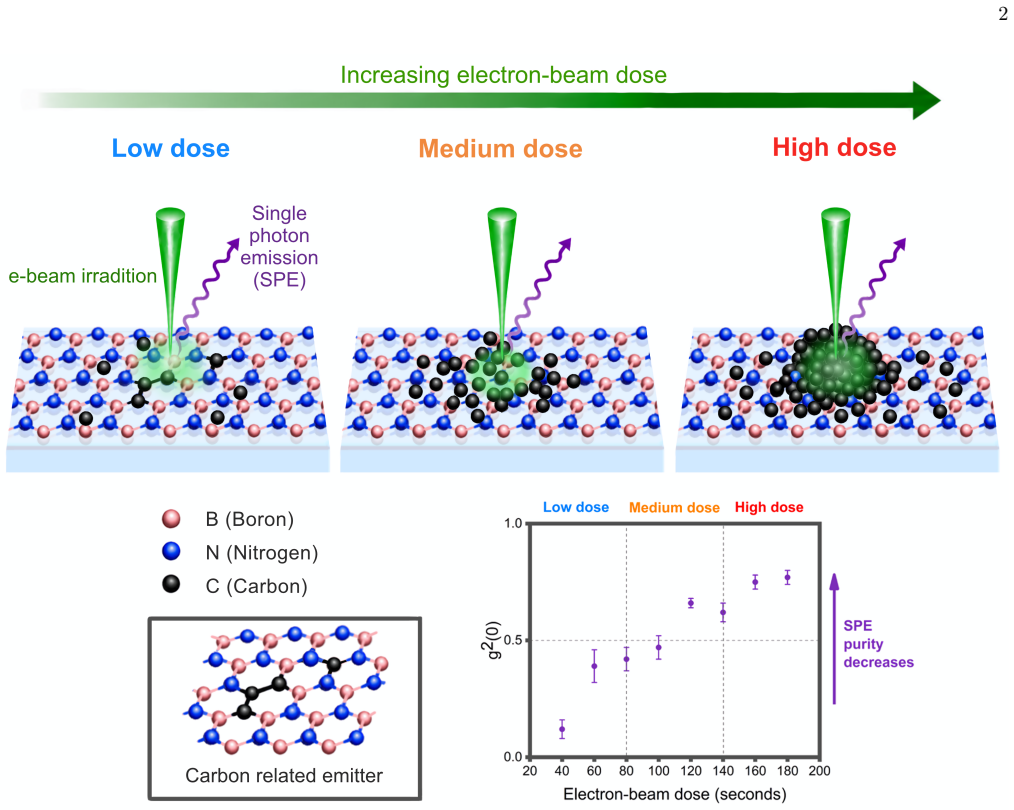
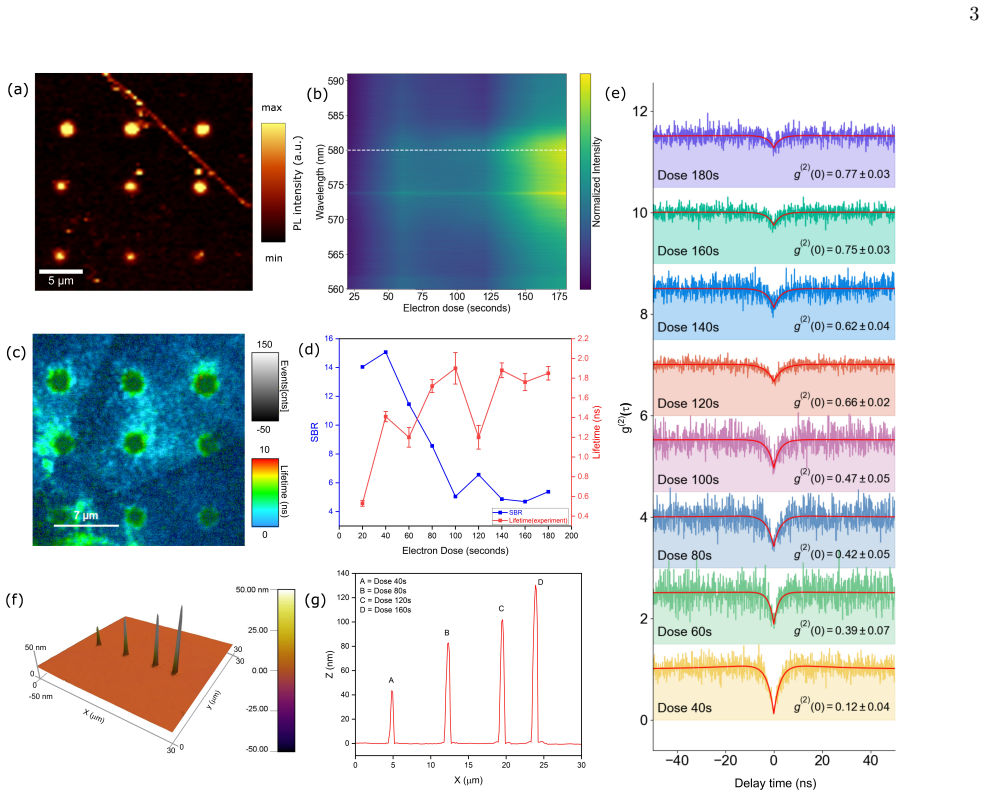
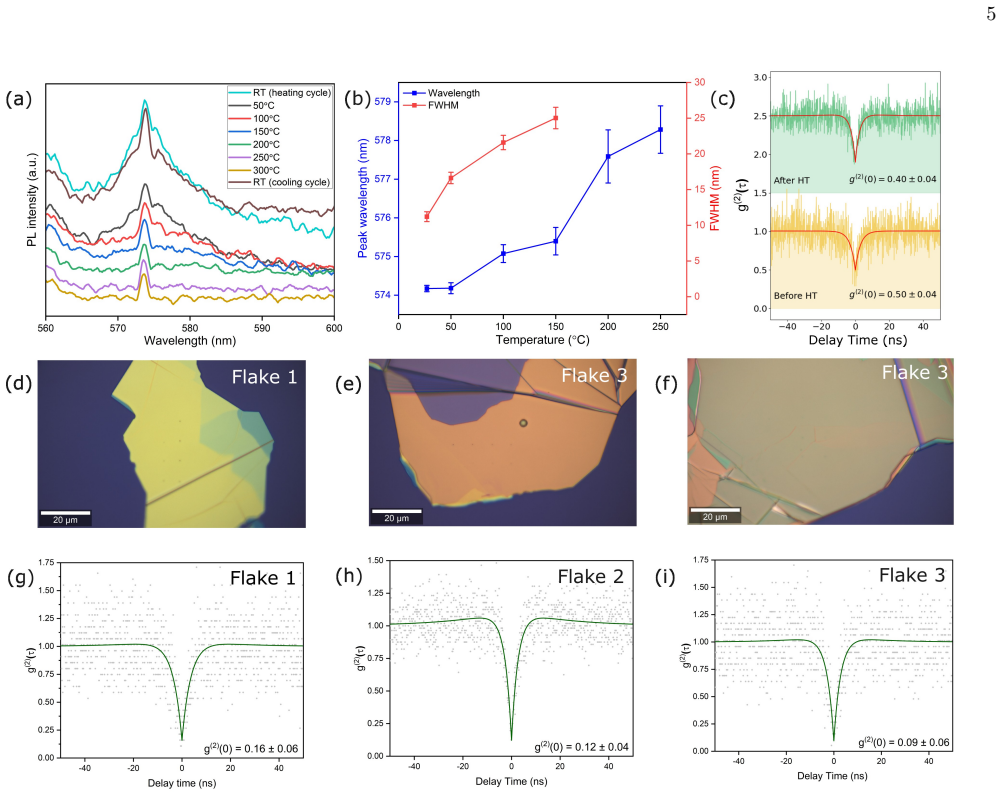
Electron-beam irradiation creates site-controlled room-temperature single-photon emitters in hBN. Varying the electron dose tunes the emitter yield, spectrum, lifetime, and photon purity, with an optimal window for high-purity emitters identified through measurements on multiple flakes showing g(2)(0) values of 0.09, 0.12, and 0.16. The bright feature near 575 nm is assigned to the phonon sideband of a green-yellow emitter with zero-phonon line near 548 nm. Temperature-dependent measurements show thermal quenching that reverses completely upon cooling from room temperature to 300 C, indicating no permanent damage from transient heating.
What carries the argument
The electron dose as a control parameter for creating and tuning the properties of color centers in hBN, along with in-situ temperature cycling to test quenching reversibility.
If this is right
- Optimal doses produce emitters with second-order correlation values below 0.2 confirming single-photon character.
- The emitters can be operated or processed at temperatures up to 300 C with full recovery of emission.
- The spectral assignment connects room-temperature observations to cryogenic studies of the same centers.
- Deterministic creation works consistently across different hBN flakes.
Where Pith is reading between the lines
- Arrays of such emitters could be patterned for integrated quantum photonic chips.
- The reversible nature suggests these centers might survive standard semiconductor processing steps involving heat.
- Similar dose-control methods could be tested in other van der Waals materials for quantum emitters.
Load-bearing premise
The room-temperature emission near 575 nm comes from the phonon sideband of an emitter with its zero-phonon line at approximately 548 nm.
What would settle it
Cooling the emitters to cryogenic temperatures and directly observing the zero-phonon line position would confirm or refute the 548 nm assignment; mismatch would undermine the link between the observed quenching and the identified centers.
Figures
read the original abstract
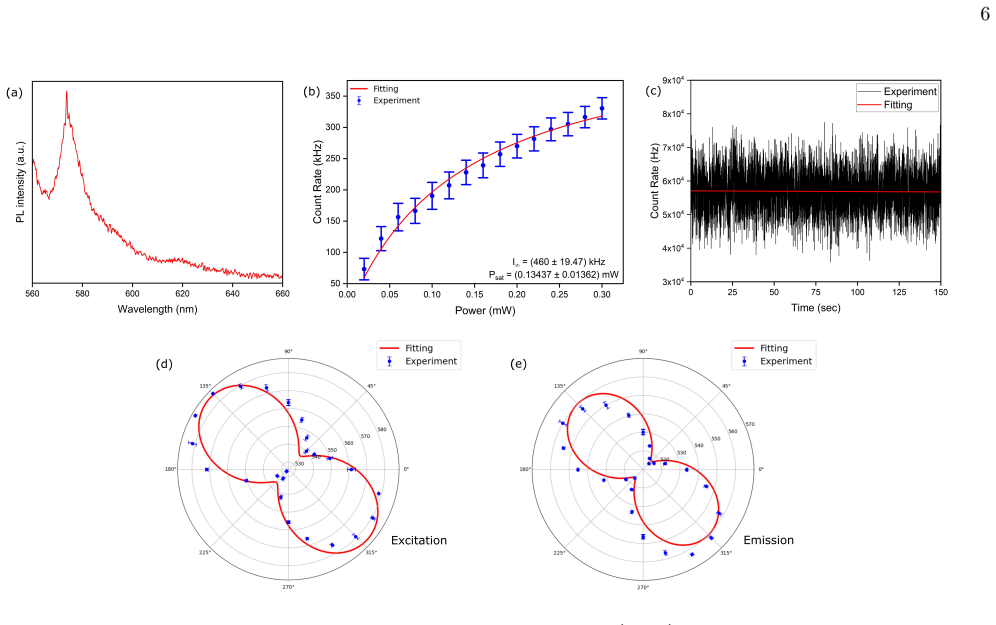
Electron-beam irradiation is an established route to create site-controlled, room-temperature single-photon emitters (SPEs) in hexagonal boron nitride (hBN), but two aspects remain underexplored: how the electron dose governs the properties of the resulting single emitters, and how the emission behaves when the host is heated above room temperature. Here, we create emitters deterministically with a focused electron beam and confirm single-photon emission across three independent flakes, with $g^{(2)}(0)=0.09$, $0.12$, and $0.16$. We map the single-emitter response (yield, spectrum, lifetime, and photon purity) as a function of electron dose, identifying an optimal window for high-purity single emitters. Consistent with recent cryogenic studies, we assign the bright room-temperature feature near 575 n to the phonon sideband (PSB) of a green--yellow emitter whose zero-phonon line (ZPL) lies near 548 nm. Temperature-dependent photoluminescence measured in situ under real-time from room temperature to 300 degrees C reveals a thermal quenching that is fully reversible upon cooling, in contrast to the irreversible annealing-induced degradation reported elsewhere, indicating that transient heating does not permanently damage the centers. These results add quantitative dose control and above-room-temperature operation to the toolbox for deterministic hBN quantum-light sources.
Editorial analysis
A structured set of objections, weighed in public.
Referee Report
Summary. The manuscript reports deterministic creation of single-photon emitters in hBN using a focused electron beam, with g^{(2)}(0) values of 0.09, 0.12, and 0.16 measured on three independent flakes. It maps yield, spectrum, lifetime, and purity versus electron dose to identify an optimal window, assigns the room-temperature 575 nm feature to the phonon sideband of a ~548 nm ZPL based on consistency with cryogenic literature, and shows that photoluminescence quenches reversibly upon heating to 300 °C.
Significance. If the central claims hold, the work supplies quantitative dose control for high-purity hBN emitters and the first demonstration of fully reversible thermal quenching above room temperature, both of which are practically relevant for integrating these sources into devices that may experience transient heating.
major comments (2)
- [Abstract / temperature-dependent photoluminescence] Abstract and temperature-dependent PL section: the claim that the observed 575 nm emission belongs to the same green-yellow centers whose ZPL lies near 548 nm rests only on external consistency; the manuscript provides no low-temperature spectra on the same emitters, no resonant excitation, no emergence of a 548 nm ZPL upon cooling, and no dose-dependent yield comparison between the 575 nm band and any 548 nm feature. Without this link the reversible-quenching data cannot be confidently attributed to the g^{(2)}-verified single-photon centers.
- [Abstract] Abstract: the three reported g^{(2)}(0) values are given without error bars, raw coincidence histograms, background-subtraction details, or the number of emitters examined per dose point. This absence makes it impossible to evaluate the statistical robustness of the claimed optimal dose window for high-purity emission.
Simulated Author's Rebuttal
We thank the referee for the constructive and detailed feedback. We address each major comment below and indicate the revisions made to the manuscript.
read point-by-point responses
-
Referee: [Abstract / temperature-dependent photoluminescence] Abstract and temperature-dependent PL section: the claim that the observed 575 nm emission belongs to the same green-yellow centers whose ZPL lies near 548 nm rests only on external consistency; the manuscript provides no low-temperature spectra on the same emitters, no resonant excitation, no emergence of a 548 nm ZPL upon cooling, and no dose-dependent yield comparison between the 575 nm band and any 548 nm feature. Without this link the reversible-quenching data cannot be confidently attributed to the g^{(2)}-verified single-photon centers.
Authors: We agree that the assignment of the room-temperature 575 nm feature to the phonon sideband of a ~548 nm ZPL relies on spectral consistency with cryogenic literature rather than direct low-temperature measurements on the identical emitters. Our work is performed at room temperature, and we do not include resonant excitation or cooling data. The g^{(2)}(0) values and thermal-quenching measurements were obtained on the 575 nm emitters themselves. In the revised manuscript we have added explicit language stating that the center identification is based on literature comparison and that the quenching results apply directly to the observed single-photon emitters at 575 nm. This clarifies the scope of the claim without overstating the evidence. revision: partial
-
Referee: [Abstract] Abstract: the three reported g^{(2)}(0) values are given without error bars, raw coincidence histograms, background-subtraction details, or the number of emitters examined per dose point. This absence makes it impossible to evaluate the statistical robustness of the claimed optimal dose window for high-purity emission.
Authors: We thank the referee for noting this omission. The revised manuscript now includes error bars derived from the fitting uncertainties on the three reported g^{(2)}(0) values. Raw coincidence histograms, the background-subtraction procedure, and the number of emitters measured per dose point (8–12 emitters across the three flakes) have been added to the supplementary information. These additions enable a clearer assessment of the statistical support for the optimal dose window. revision: yes
Circularity Check
No significant circularity; purely experimental observations
full rationale
The paper reports experimental creation of emitters via focused electron beam, g(2) measurements on three flakes, dose-dependent mapping of yield/spectrum/lifetime/purity, and in-situ temperature-dependent PL up to 300°C showing reversible quenching. No equations, derivations, or fitted parameters are presented as predictions. The spectral assignment to a PSB of a 548 nm ZPL is explicitly tied to consistency with external cryogenic studies rather than any self-referential construction or self-citation load-bearing step. All claims reduce to direct measurements without reduction to inputs by construction.
Axiom & Free-Parameter Ledger
axioms (1)
- standard math g^{(2)}(0) < 0.5 indicates single-photon emission
Reference graph
Works this paper leans on
-
[1]
A. J. Shields, Semiconductor quantum light sources, Na- ture Photonics1, 215 (2007)
2007
-
[2]
Gisin and R
N. Gisin and R. Thew, Quantum communication, Nature Photonics1, 165 (2007)
2007
-
[3]
H. J. Kimble, The quantum internet, Nature453, 1023 (2008)
2008
-
[4]
A. K. K. Singh, P. Sharma, K. K. Mandal, L. Eswaramoorthy, and A. Kumar, A perspective on solid-state quantum light sources: Materials and atomic defects, Nano Futures 10.1088/2399-1984/ae7242 (2026)
-
[5]
A. Zalogina, N. Coste, C. Chen, J. Kim, and I. Aharonovich, Engineering quantum light: Emit- ters, photonic structures, and on-chip integration, Laser & Photonics Reviews20, 10.1002/lpor.202502309 (2025)
-
[6]
Aharonovich, D
I. Aharonovich, D. Englund, and M. Toth, Solid-state single-photon emitters, Nature Photonics10, 631 (2016)
2016
-
[7]
Aharonovich and E
I. Aharonovich and E. Neu, Diamond nanophotonics, Ad- vanced Optical Materials2, 911 (2014)
2014
-
[8]
D. D. Awschalom, R. Hanson, J. Wrachtrup, and B. B. Zhou, Quantum technologies with optically interfaced solid-state spins, Nature Photonics12, 516 (2018)
2018
-
[9]
T. T. Tran, K. Bray, M. J. Ford, M. Toth, and I. Aharonovich, Quantum emission from hexagonal boron nitride monolayers, Nature nanotechnology11, 37 (2016)
2016
-
[10]
A. L. Exarhos, D. A. Hopper, R. R. Grote, A. Alkauskas, and L. C. Bassett, Optical signatures of quantum emit- ters in suspended hexagonal boron nitride, ACS nano11, 3328 (2017)
2017
-
[11]
N. R. Jungwirth, B. Calderon, Y. Ji, M. G. Spencer, M. E. Flatté, and G. D. Fuchs, Temperature dependence of wavelength selectable zero-phonon emission from sin- gle defects in hexagonal boron nitride, Nano letters16, 6052 (2016)
2016
-
[12]
Grosso, H
G. Grosso, H. Moon, B. Lienhard, S. Ali, D. K. Efe- tov, M. M. Furchi, P. Jarillo-Herrero, M. J. Ford, I. Aharonovich, and D. Englund, Tunable and high- purity room temperature single-photon emission from 10 atomic defects in hexagonal boron nitride, Nature com- munications8, 1 (2017)
2017
-
[13]
Toth and I
M. Toth and I. Aharonovich, Single photon sources in atomically thin materials, Annual review of physical chemistry70, 123 (2019)
2019
-
[14]
Dietrich, M
A. Dietrich, M. Bürk, E. S. Steiger, L. Antoniuk, T. T. Tran, M. Nguyen, I. Aharonovich, F. Jelezko, and A. Kubanek, Observation of fourier transform limited lines in hexagonal boron nitride, Physical Review B98, 081414 (2018)
2018
-
[15]
A. K. Singh, Utkarsh, P. Tieben, K. K. Mandal, B. Ku- mar, R. Vij, A. Majumder, I. Shyam, S. Kumar, K. Watanabe,et al., Plasmonic-strain engineering of quantum emitters in hexagonal boron nitride, Advanced Materials Interfaces12, 2500071 (2025)
2025
-
[16]
M. A. Sakib, B. Triplett, W. Harris, N. Hus- sain, A. Senichev, M. Momenzadeh, J. Bocanegra, P. Vabishchevich, R. Wu, A. Boltasseva,et al., Purcell- induced bright single photon emitters in hexagonal boron nitride, Nano Letters24, 12390 (2024)
2024
-
[17]
Fournier, A
C. Fournier, A. Plaud, S. Roux, A. Pierret, M. Rosticher, K.Watanabe, T.Taniguchi, S.Buil, X.Quélin, J.Barjon, et al., Position-controlled quantum emitters with repro- ducible emission wavelength in hexagonal boron nitride, Nature communications12, 3779 (2021)
2021
-
[18]
Shotan, H
Z. Shotan, H. Jayakumar, C. R. Considine, M. Mackoit, H. Fedder, J. Wrachtrup, A. Alkauskas, M. W. Doherty, V. M. Menon, and C. A. Meriles, Photoinduced modifica- tion of single-photon emitters in hexagonal boron nitride, Acs Photonics3, 2490 (2016)
2016
-
[19]
Chejanovsky, M
N. Chejanovsky, M. Rezai, F. Paolucci, Y. Kim, T. Rendler, W. Rouabeh, F. Fávaro de Oliveira, P. Her- linger, A.Denisenko, S.Yang,et al.,Structuralattributes andphotodynamicsofvisiblespectrumquantumemitters in hexagonal boron nitride, Nano letters16, 7037 (2016)
2016
-
[20]
Kumar, C
A. Kumar, C. Cholsuk, A. Zand, M. N. Mishuk, T. Matthes, F. Eilenberger, S. Suwanna, and T. Vogl, Localized creation of yellow single photon emitting car- boncomplexesinhexagonalboronnitride,APLmaterials 11(2023)
2023
-
[21]
Akkanaboina, R
M. Akkanaboina, R. Kumar, B. Kumar, H. Gawali, P. Sharma, I. Shyam, and A. Kumar, Deterministic single-photon emitter arrays in hexagonal boron nitride by carbon-assisted focused ion beam engineering (2026)
2026
-
[22]
Dollar, A
N.V.Proscia, Z.Shotan, H.Jayakumar, P.Reddy, C.Co- hen, M. Dollar, A. Alkauskas, M. Doherty, C. A. Mer- iles, and V. M. Menon, Near-deterministic activation of room-temperature quantum emitters in hexagonal boron nitride, Optica5, 1128 (2018)
2018
-
[23]
Ngoc My Duong, M
H. Ngoc My Duong, M. A. P. Nguyen, M. Kianinia, T. Ohshima, H. Abe, K. Watanabe, T. Taniguchi, J. H. Edgar, I. Aharonovich, and M. Toth, Effects of high-energy electron irradiation on quantum emitters in hexagonal boron nitride, ACS applied materials & inter- faces10, 24886 (2018)
2018
-
[24]
Hazra, M
M. Hazra, M. Rieger, A. Kumar, M. N. Mishuk, C. Chol- suk, K.Sripathy, V.Villafañe, K.Muller, J.J.Finley,and T. Vogl, Temperature-dependent emission spectroscopy of quantum emitters in hexagonal boron nitride, ACS Photonics13, 1176 (2026)
2026
-
[25]
M. Hazra, A. Rupp, M. N. Mishuk, J. Krause, A. Ku- mar, J. Chénedé, M. Kang, B. N. Tugchin, M. Rikers, T. Pertsch,et al., Insights into the nature of quantum emitters in electron-irradiated hexagonal boron nitride, arXiv preprint arXiv:2605.12663 (2026)
Pith/arXiv arXiv 2026
-
[26]
A. C. Ferrari, J. C. Meyer, V. Scardaci, C. Casiraghi, M. Lazzeri, F. Mauri, S. Piscanec, D. Jiang, K. S. Novoselov, S. Roth,et al., Raman spectrum of graphene and graphene layers, Physical review letters97, 187401 (2006)
2006
-
[27]
M. S. Dresselhaus, A. Jorio, M. Hofmann, G. Dressel- haus, and R. Saito, Perspectives on carbon nanotubes and graphene raman spectroscopy, Nano letters10, 751 (2010)
2010
-
[28]
T. T. Tran, C. Elbadawi, D. Totonjian, C. J. Lobo, G. Grosso, H. Moon, D. R. Englund, M. J. Ford, I. Aharonovich, and M. Toth, Robust multicolor single photon emission from point defects in hexagonal boron nitride, ACS nano10, 7331 (2016)
2016
-
[29]
T. Vogl, M. W. Doherty, B. C. Buchler, Y. Lu, and P. K. Lam, Atomic localization of quantum emitters in multilayer hexagonal boron nitride, Nanoscale11, 14362 (2019)
2019
-
[30]
R. H. Brown and R. Q. Twiss, Correlation between pho- tons in two coherent beams of light, Nature177, 27 (1956)
1956
-
[31]
Kitson, P
S. Kitson, P. Jonsson, J. Rarity, and P. Tapster, Inten- sity fluctuation spectroscopy of small numbers of dye molecules in a microcavity, Physical Review A58, 620 (1998)
1998
-
[32]
I. Utke, P. Hoffmann, and J. Melngailis, Gas-assisted fo- cused electron beam and ion beam processing and fab- rication, Journal of Vacuum Science & Technology B: Microelectronics and Nanometer Structures Processing, Measurement, and Phenomena26, 1197 (2008)
2008
-
[33]
Van Dorp and C
W. Van Dorp and C. W. Hagen, A critical literature re- view of focused electron beam induced deposition, Jour- nal of Applied Physics104(2008)
2008
-
[34]
J. Yin, Y. Cao, Y.-H. Li, S.-K. Liao, L. Zhang, J.-G. Ren, W.-Q. Cai, W.-Y. Liu, B. Li, H. Dai,et al., Satellite- based entanglement distribution over 1200 kilometers, Science356, 1140 (2017)
2017
-
[35]
Liao, W.-Q
S.-K. Liao, W.-Q. Cai, W.-Y. Liu, L. Zhang, Y. Li, J.-G. Ren, J. Yin, Q. Shen, Y. Cao, Z.-P. Li,et al., Satellite-to- ground quantum key distribution, Nature549, 43 (2017)
2017
-
[36]
J. L. O’brien, A. Furusawa, and J. Vučković, Photonic quantum technologies, Nature photonics3, 687 (2009)
2009
-
[37]
J. Wang, F. Sciarrino, A. Laing, and M. G. Thompson, Integrated photonic quantum technologies, Nature pho- tonics14, 273 (2020)
2020
-
[38]
Spencer, J
L. Spencer, J. Horder, S. Kim, M. Toth, and I. Aharonovich, Monolithic integration of single quantum emittersinhbnbullseyecavities,ACSPhotonics10,4417 (2023)
2023
-
[39]
C. Li, J. E. Froch, M. Nonahal, T. N. Tran, M. Toth, S. Kim, and I. Aharonovich, Integration of hbn quantum emitters in monolithically fabricated waveguides, ACS photonics8, 2966 (2021)
2021
discussion (0)
Sign in with ORCID, Apple, or X to comment. Anyone can read and Pith papers without signing in.