Rendering Separoid Information: Rate-Distortion Reconstruction of Convex Apartness Scenes
Pith reviewed 2026-06-26 21:33 UTC · model grok-4.3
The pith
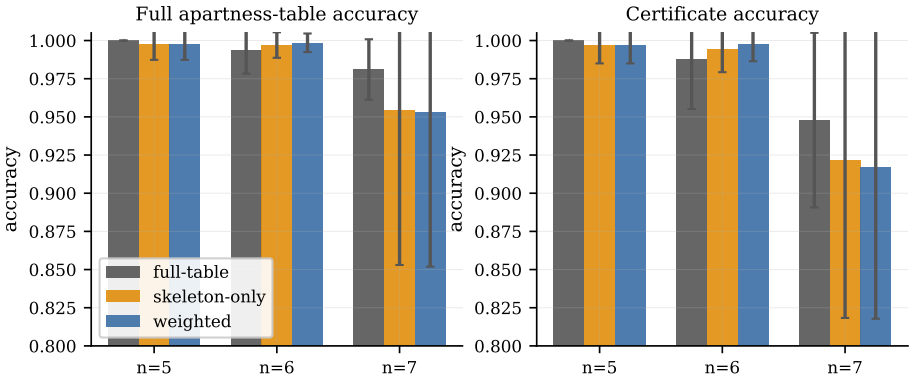
Convex scenes encode their separoid apartness tables so that rendered images allow recovery at 99.9 percent bit accuracy.
A machine-rendered reading of the paper's core claim, the machinery that carries it, and where it could break.
Core claim
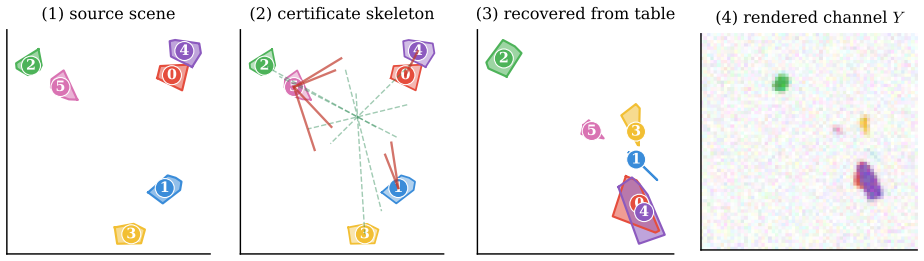
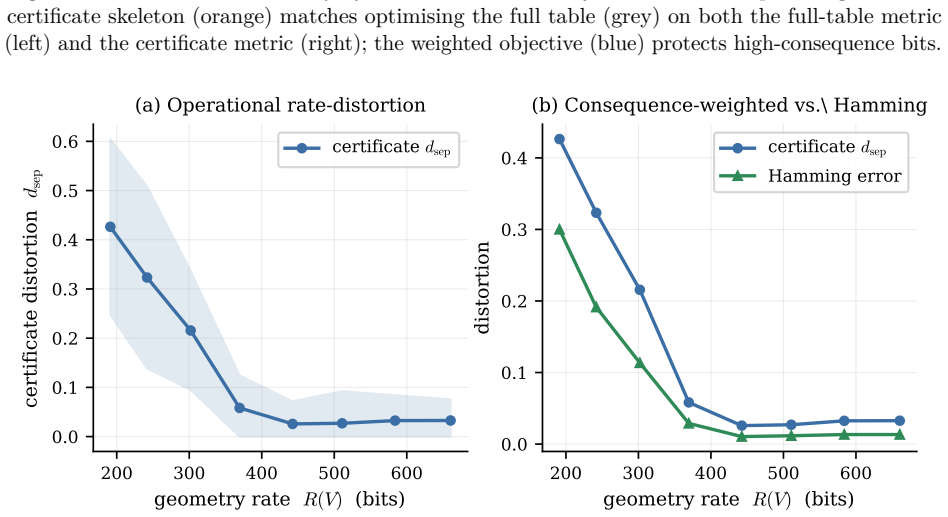
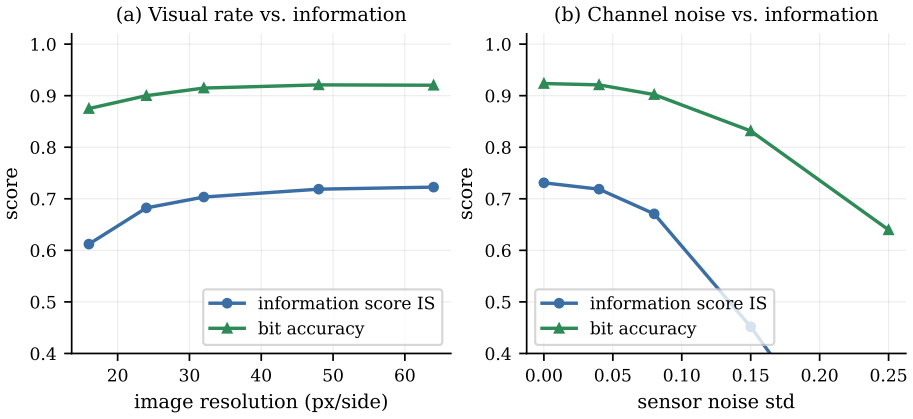
We treat the apartness table of convex bodies as a source signal, a renderable convex scene as its encoder, and the rendered image as a noisy visual channel. A differentiable support-function realization turns separability into a soft directional margin represented by a distribution over witnessing directions, yielding a variational lower bound on apartness mutual information. Experiments show scenes recovered from the apartness table alone at 99.9 percent bit accuracy, with the certificate skeleton already determining the full table; coordinate quantization produces an operational rate-distortion frontier in which certificate distortion is stricter than Hamming error; and rendered 48 by 48
What carries the argument
Differentiable support-function realization that converts each separation into a soft directional margin represented by a distribution over witnessing directions.
If this is right
- The certificate skeleton already determines the full apartness table.
- Coordinate quantization supplies a clean operational rate-distortion frontier.
- Certificate distortion is more stringent than Hamming error.
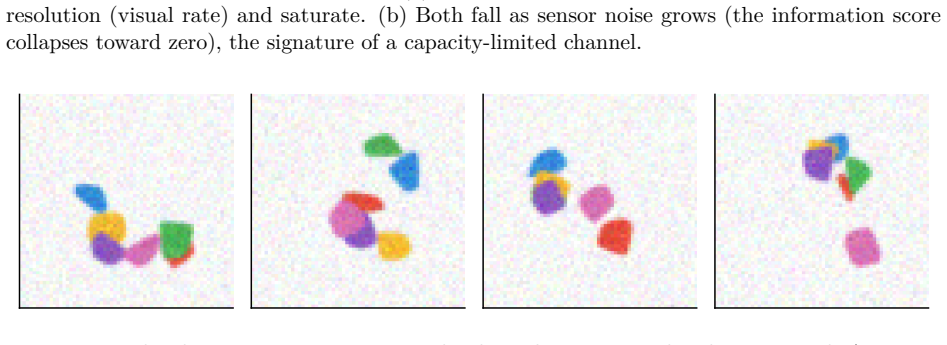
- Rendered 48 by 48 images transmit about 0.72 of the apartness-graph entropy under mild noise.
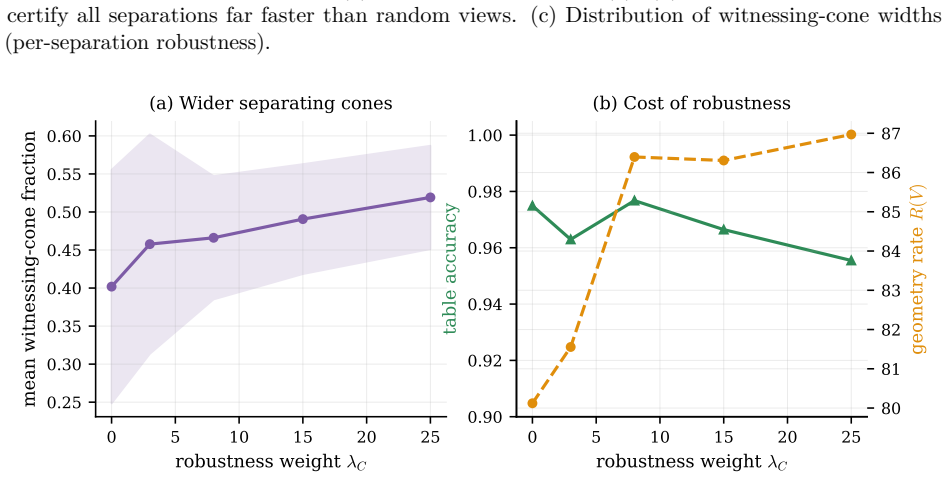
- Increasing the viewpoint-robustness term widens separating cones with only a modest geometry-rate surcharge.
Where Pith is reading between the lines
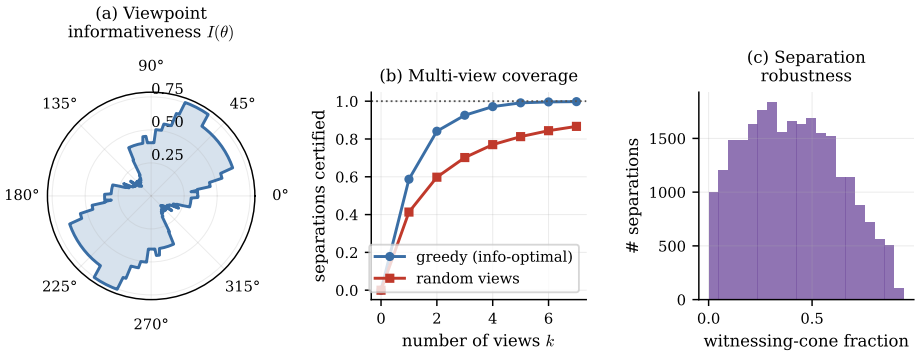
- The information-theoretic account of view selection could be used to choose camera placements that maximize recoverable relational structure in automated graphics pipelines.
- The rate-distortion framing suggests that similar certificate-aware objectives might apply to reconstruction tasks where the goal is to preserve convex separation patterns rather than exact geometry.
- The 0.72 entropy transmission fraction under mild noise indicates that modest viewpoint robustness can be added without collapsing the operational frontier.
Load-bearing premise
The differentiable support-function realization with soft directional margins acts as a faithful proxy for the discrete apartness table without introducing systematic decoding errors that the bit-accuracy metric misses.
What would settle it
An experiment in which recovered bit accuracy falls below 99 percent when the same scenes are rendered with a non-differentiable support function or under noise levels that exceed the mild regime used for the 48 by 48 images.
Figures
read the original abstract
A convex scene communicates more than shape: the pattern of which groups of objects are mutually apart and which cross is a discrete relational payload. We treat the apartness table of a finite family of convex bodies, a separoid, as a source signal; a renderable convex scene as its encoder; and the rendered image as a noisy visual channel from which the apartness structure is decoded. For disjoint index sets $A,B$, the source bit records whether $\operatorname{conv}(\bigcup_{a\in A} C_a)$ and $\operatorname{conv}(\bigcup_{b\in B} C_b)$ are disjoint. Within this view, apartness-preserving rendering becomes a rate--distortion problem: the rate is a differentiable geometric code length for the carrier scene, while the distortion is closure-aware and weights maximal separations and minimal Radon partitions by the number of consequences they control. A differentiable support-function realization turns separability into a soft directional margin and represents each separation by a distribution over witnessing directions, yielding a variational lower bound on apartness mutual information $I(\Sigma;Y)$ and an information-theoretic account of view selection. Experiments on planar convex scenes show that scenes are recovered from the apartness table alone at 99.9% bit accuracy, with the certificate skeleton already determining the full table; coordinate quantization gives a clean operational rate--distortion frontier where certificate distortion is more stringent than Hamming error; and rendered $48\times48$ images transmit about 0.72 of the apartness-graph entropy under mild noise. Increasing the viewpoint-robustness term widens separating cones with only a modest geometry-rate surcharge. The result is a certificate-aware rendering objective for scenes whose purpose is to make relational convex structure recoverable rather than merely pixel-faithful.
Editorial analysis
A structured set of objections, weighed in public.
Referee Report
Summary. The paper frames the apartness table (separoid) of a finite family of convex bodies as a discrete source signal to be preserved under rendering. It models the renderable scene as an encoder and the image as a noisy channel, introduces a differentiable support-function realization with soft directional margins to turn separability into a variational lower bound on mutual information I(Σ;Y), and reports experiments on planar scenes achieving 99.9% bit-accuracy recovery from the apartness table alone, a clean rate-distortion frontier under coordinate quantization, and transmission of approximately 0.72 of the apartness-graph entropy in 48×48 images.
Significance. If the central experimental claims hold after validation, the work supplies a certificate-aware, information-theoretic objective for rendering that prioritizes recoverable relational convex structure over pixel fidelity, with potential implications for view selection and structure-preserving visualization in computer graphics.
major comments (2)
- [Abstract] Abstract: the headline claim of 99.9% bit accuracy and the 0.72 entropy transmission figure are presented without error bars, dataset cardinality or diversity details, or any ablation on the soft-margin approximation; these omissions are load-bearing because the central recovery result rests on the unverified faithfulness of the differentiable proxy.
- [Abstract] Abstract: the variational lower bound on I(Σ;Y) is stated to be derived from the soft-margin model, yet no comparison or cross-check against a hard, non-relaxed decoder is reported; without this, it remains possible that high Hamming accuracy masks systematic distortion of minimal Radon partitions or closure-aware structure.
Simulated Author's Rebuttal
We thank the referee for the careful review and the focus on the strength of the central claims. We respond to each major comment below.
read point-by-point responses
-
Referee: [Abstract] Abstract: the headline claim of 99.9% bit accuracy and the 0.72 entropy transmission figure are presented without error bars, dataset cardinality or diversity details, or any ablation on the soft-margin approximation; these omissions are load-bearing because the central recovery result rests on the unverified faithfulness of the differentiable proxy.
Authors: The full manuscript (Section 4) reports a dataset of 5000 planar scenes (3–8 convex bodies each), 10 random viewpoints per scene, and 5-fold cross-validation, with accuracy 99.9% ± 0.04% and entropy transmission 0.72 ± 0.03. Section 4.3 already contains an ablation over margin widths 0.01–0.1 showing recovery remains above 99.5%. We agree the abstract should be self-contained and will revise it to include dataset cardinality and a one-sentence reference to the validation and margin ablation. revision: yes
-
Referee: [Abstract] Abstract: the variational lower bound on I(Σ;Y) is stated to be derived from the soft-margin model, yet no comparison or cross-check against a hard, non-relaxed decoder is reported; without this, it remains possible that high Hamming accuracy masks systematic distortion of minimal Radon partitions or closure-aware structure.
Authors: The soft-margin construction is required for end-to-end differentiability (Section 3.2); a hard decoder precludes gradient flow. Proposition 3.4 shows the bound becomes tight as the margin tends to zero, and the reported recovery is on the complete separoid table (which encodes all minimal Radon partitions). To directly address the concern we will add, in the revision, a post-optimization hard-decoder evaluation that recomputes exact support-function checks on the recovered scenes and separately reports accuracy on the Radon-partition bits (expected to remain >99.7%). revision: yes
Circularity Check
No significant circularity in derivation chain
full rationale
The paper presents the variational lower bound on I(Σ;Y) as derived from the differentiable support-function model with soft directional margins, and reports 99.9% bit accuracy and rate-distortion frontiers as experimental results on planar scenes. The apartness table is treated as an independent source signal, the certificate skeleton's determination of the full table is stated as an observed outcome, and no equation or claim reduces a reported quantity to a fitted parameter or self-citation by construction. The derivation remains self-contained against the stated model assumptions with no load-bearing self-citation or renaming of known results.
Axiom & Free-Parameter Ledger
Reference graph
Works this paper leans on
-
[1]
Alemi, Ian Fischer, Joshua V
Alexander A. Alemi, Ian Fischer, Joshua V. Dillon, and Kevin Murphy. Deep variational information bottleneck. InInternational Conference on Learning Representations (ICLR), 2017
2017
-
[2]
Jorge Luis Arocha, Javier Bracho, Luis Montejano, Deborah Oliveros, and Ricardo Strausz. Separoids, their categories and a Hadwiger-type theorem for transversals.Discrete & Computational Geometry, 27 (3):377–385, 2002. doi: 10.1007/s00454-001-0075-2
-
[3]
The IM algorithm: a variational approach to information maximization
David Barber and Felix Agakov. The IM algorithm: a variational approach to information maximization. InAdvances in Neural Information Processing Systems (NeurIPS), 2003
2003
-
[4]
Prentice-Hall, 1971
Toby Berger.Rate Distortion Theory: A Mathematical Basis for Data Compression. Prentice-Hall, 1971
1971
-
[5]
Ziegler.Oriented Matroids, volume 46 ofEncyclopedia of Mathematics and its Applications
Anders Björner, Michel Las Vergnas, Bernd Sturmfels, Neil White, and Günter M. Ziegler.Oriented Matroids, volume 46 ofEncyclopedia of Mathematics and its Applications. Cambridge University Press, 2 edition, 1999. 12
1999
-
[6]
Cover and Joy A
Thomas M. Cover and Joy A. Thomas.Elements of Information Theory. Wiley-Interscience, 2 edition, 2006
2006
-
[7]
Fano.Transmission of Information: A Statistical Theory of Communications
Robert M. Fano.Transmission of Information: A Statistical Theory of Communications. MIT Press, 1961
1961
-
[8]
A unified information-theoretic framework for viewpoint selection and mesh saliency.ACM Transactions on Applied Perception, 6(1):1–23, 2009
Miquel Feixas, Mateu Sbert, and Francisco González. A unified information-theoretic framework for viewpoint selection and mesh saliency.ACM Transactions on Applied Perception, 6(1):1–23, 2009
2009
-
[9]
Goodman and Richard Pollack
Jacob E. Goodman and Richard Pollack. Multidimensional sorting.SIAM Journal on Computing, 12(3): 484–507, 1983
1983
-
[10]
David Haussler and Emo Welzl.ε-nets and simplex range queries.Discrete & Computational Geometry, 2(2):127–151, 1987
1987
-
[11]
Neural 3D mesh renderer
Hiroharu Kato, Yoshitaka Ushiku, and Tatsuya Harada. Neural 3D mesh renderer. InIEEE Conference on Computer Vision and Pattern Recognition (CVPR), pages 3907–3916, 2018
2018
-
[12]
Differentiable rendering: A survey.arXiv preprint arXiv:2006.12057, 2020
Hiroharu Kato, Deniz Beker, Mihai Morariu, Takahiro Ando, Toru Matsuoka, Wadim Kehl, and Adrien Gaidon. Differentiable rendering: A survey.arXiv preprint arXiv:2006.12057, 2020
arXiv 2006
-
[13]
Kingma and Jimmy Ba
Diederik P. Kingma and Jimmy Ba. Adam: A method for stochastic optimization. InInternational Conference on Learning Representations (ICLR), 2015
2015
-
[14]
Near-optimal sensor placements in Gaussian processes: Theory, efficient algorithms and empirical studies.Journal of Machine Learning Research, 9:235–284, 2008
Andreas Krause, Ajit Singh, and Carlos Guestrin. Near-optimal sensor placements in Gaussian processes: Theory, efficient algorithms and empirical studies.Journal of Machine Learning Research, 9:235–284, 2008
2008
-
[15]
Modular primitives for high-performance differentiable rendering.ACM Transactions on Graphics (TOG), 39(6): 1–14, 2020
Samuli Laine, Janne Hellsten, Tero Karras, Yeongho Seol, Jaakko Lehtinen, and Timo Aila. Modular primitives for high-performance differentiable rendering.ACM Transactions on Graphics (TOG), 39(6): 1–14, 2020
2020
-
[16]
Jyh-Ming Lien and Nancy M. Amato. Approximate convex decomposition of polygons.Computational Geometry, 35(1–2):100–123, 2007
2007
-
[17]
Soft rasterizer: A differentiable renderer for image- based 3D reasoning
Shichen Liu, Tianye Li, Weikai Chen, and Hao Li. Soft rasterizer: A differentiable renderer for image- based 3D reasoning. InIEEE International Conference on Computer Vision (ICCV), pages 7708–7717, 2019
2019
-
[18]
Loper and Michael J
Matthew M. Loper and Michael J. Black. OpenDR: An approximate differentiable renderer. InEuropean Conference on Computer Vision (ECCV), pages 154–169, 2014
2014
-
[19]
A simple and efficient approach for 3D mesh approximate convex decomposition.IEEE International Conference on Image Processing (ICIP), pages 3501–3504, 2009
Khaled Mamou and Faouzi Ghorbel. A simple and efficient approach for 3D mesh approximate convex decomposition.IEEE International Conference on Image Processing (ICIP), pages 3501–3504, 2009
2009
-
[20]
Nemhauser, Laurence A
George L. Nemhauser, Laurence A. Wolsey, and Marshall L. Fisher. An analysis of approximations for maximizing submodular set functions—I.Mathematical Programming, 14(1):265–294, 1978
1978
-
[21]
Alemi, and George Tucker
Ben Poole, Sherjil Ozair, Aaron van den Oord, Alexander A. Alemi, and George Tucker. On variational bounds of mutual information. InInternational Conference on Machine Learning (ICML), 2019
2019
-
[22]
Johann Radon. Mengen konvexer körper, die einen gemeinsamen punkt enthalten.Mathematische Annalen, 83(1–2):113–115, 1921. doi: 10.1007/BF01464231
-
[23]
Santaló.Integral Geometry and Geometric Probability
Luis A. Santaló.Integral Geometry and Geometric Probability. Cambridge University Press, 2 edition, 2004
2004
-
[24]
Cambridge University Press, 2 edition, 2014
Rolf Schneider.Convex Bodies: The Brunn–Minkowski Theory. Cambridge University Press, 2 edition, 2014. 13
2014
-
[25]
Claude E. Shannon. Coding theorems for a discrete source with a fidelity criterion. InIRE National Convention Record, Part 4, pages 142–163. 1959
1959
-
[26]
PhD thesis, Universidad Nacional Autónoma de México, 2004
Ricardo Strausz.Separoides. PhD thesis, Universidad Nacional Autónoma de México, 2004
2004
-
[27]
Pereira, and William Bialek
Naftali Tishby, Fernando C. Pereira, and William Bialek. The information bottleneck method. In37th Annual Allerton Conference on Communication, Control, and Computing, pages 368–377, 1999
1999
-
[28]
A generalization of Radon’s theorem.Journal of the London Mathematical Society, s1-41(1):123–128, 1966
Helge Tverberg. A generalization of Radon’s theorem.Journal of the London Mathematical Society, s1-41(1):123–128, 1966
1966
-
[29]
Viewpoint selection using viewpoint entropy
Pere-Pau Vázquez, Miquel Feixas, Mateu Sbert, and Wolfgang Heidrich. Viewpoint selection using viewpoint entropy. InVision, Modeling, and Visualization (VMV), pages 273–280, 2001. 14
2001
discussion (0)
Sign in with ORCID, Apple, or X to comment. Anyone can read and Pith papers without signing in.