Microwave Crosstalk in Planar Superconducting Quantum Devices
Pith reviewed 2026-06-28 14:30 UTC · model grok-4.3
The pith
Physical models quantitatively explain microwave crosstalk from drive lines near qubits and air-bridge crossovers in superconducting devices.
A machine-rendered reading of the paper's core claim, the machinery that carries it, and where it could break.
Core claim
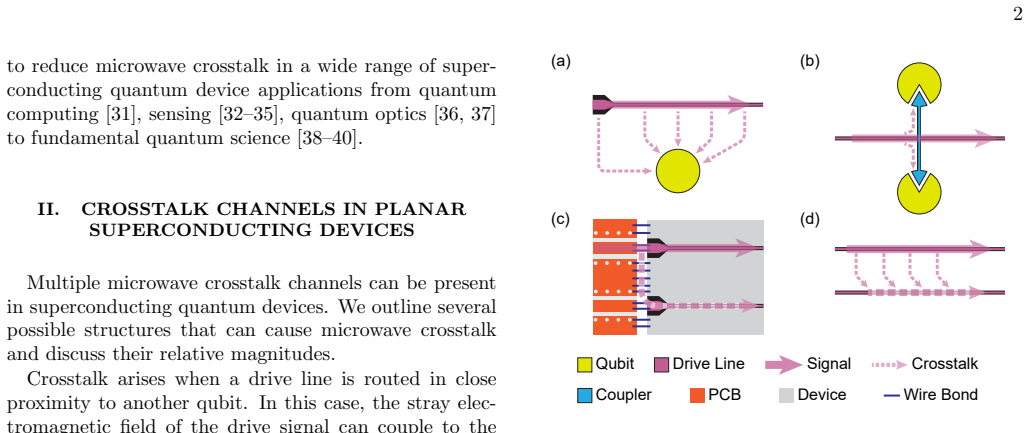
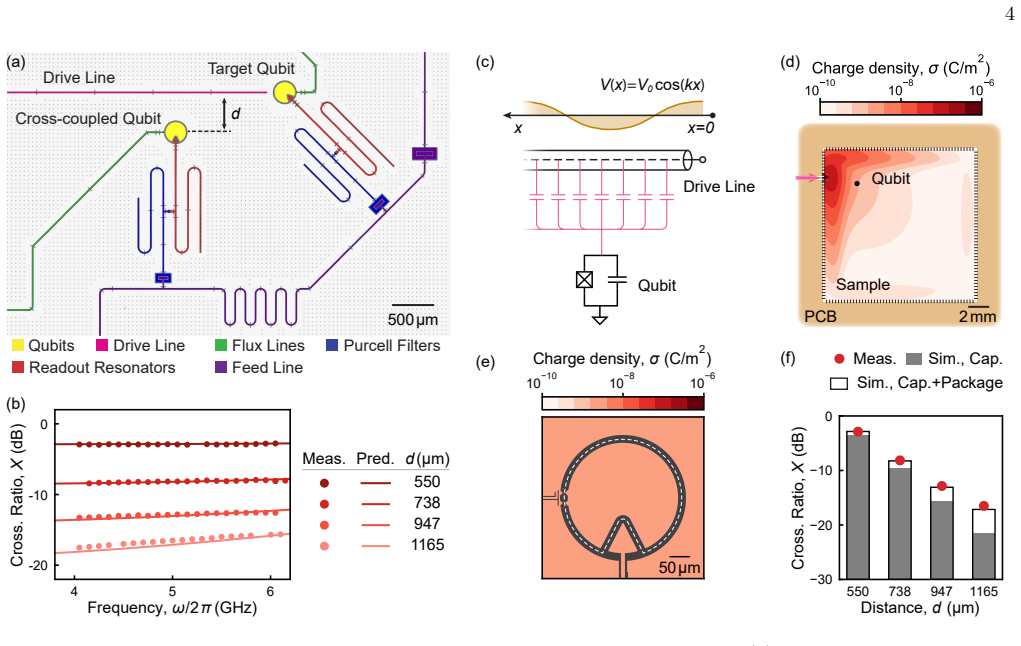
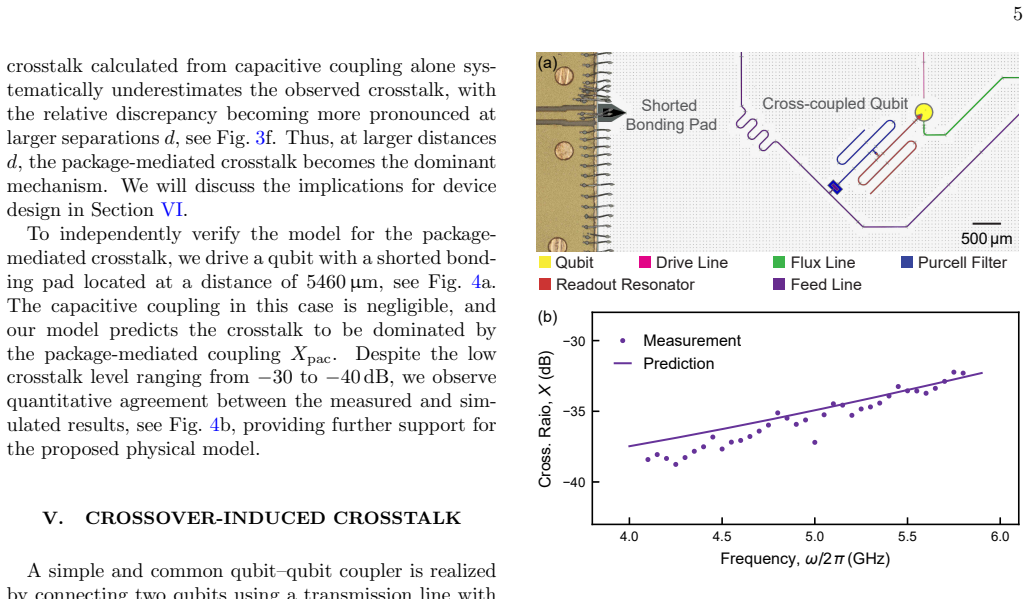
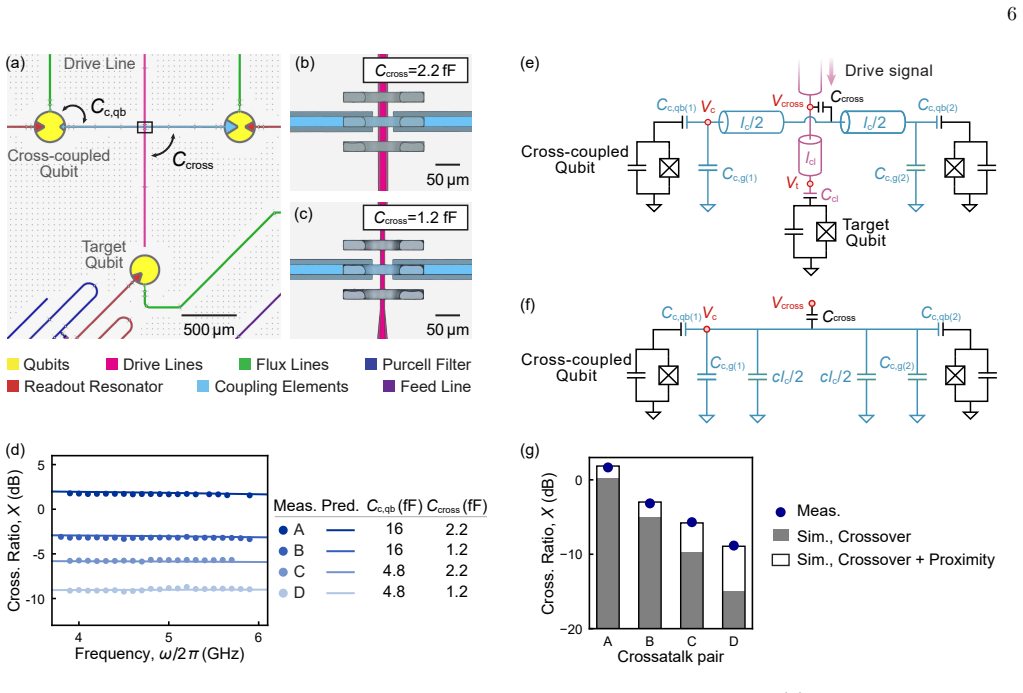
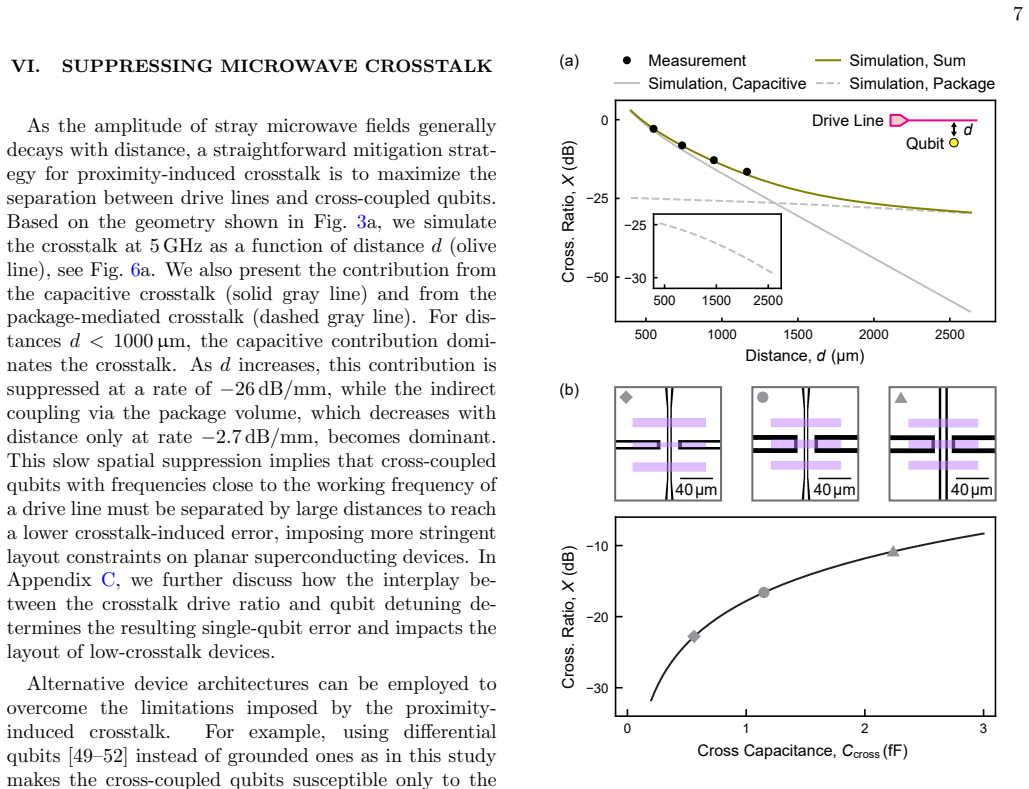
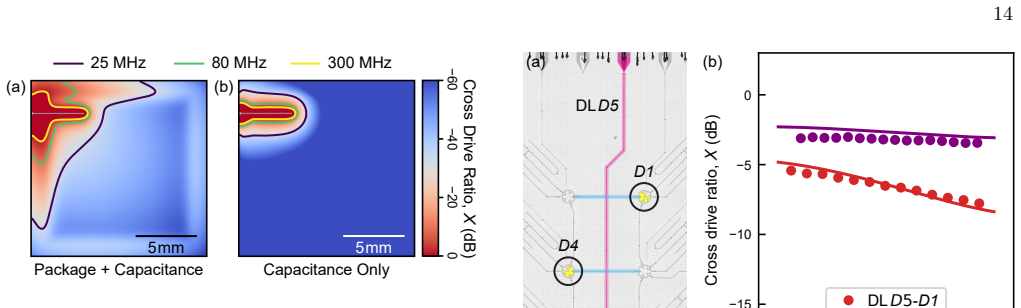
We identify two structures that can lead to strong crosstalk: a drive line routed in close proximity to another qubit, and a drive line crossing a qubit-qubit coupler using an air bridge. We design and characterize devices involving these structures and develop physical models that quantitatively explain the experimentally observed crosstalk. Based on these models, we discuss the design considerations for reducing microwave crosstalk, providing practical guidance for low-crosstalk device layouts.
What carries the argument
Electromagnetic coupling models for the two identified geometries (drive-line proximity and air-bridge crossover)
If this is right
- Avoiding close routing of drive lines to qubits lowers crosstalk.
- Reducing coupling at air-bridge crossovers over couplers decreases control errors.
- Layout choices informed by the models improve overall device fidelity.
- Once these dominant sources are controlled, weaker crosstalk mechanisms can be isolated and studied.
Where Pith is reading between the lines
- The same modeling approach could be applied to predict crosstalk in larger arrays with more complex routing networks.
- Geometric effects identified here may appear in other microwave-controlled platforms beyond planar superconductors.
- Embedding the models in automated layout software would allow rapid screening of candidate designs for low crosstalk.
- Varying bridge height or lateral spacing in follow-up devices would test how sensitive the predictions are to fabrication tolerances.
Load-bearing premise
The measured crosstalk is dominated by the two identified geometric structures and that no other uncharacterized mechanisms contribute significantly to the observed values.
What would settle it
A device containing one of the two structures in which the measured crosstalk deviates substantially from the quantitative prediction of the corresponding physical model.
Figures
read the original abstract
Microwave crosstalk poses a major challenge to scaling superconducting quantum devices as it introduces excess control errors. Although its magnitude and impact have been explored in various experimental settings, quantitative physical models capable of explaining measured crosstalk for a given device geometry remain scarce. Here, we address this gap by investigating microwave crosstalk in planar superconducting devices with crossovers. We identify two structures that can lead to strong crosstalk: a drive line routed in close proximity to another qubit, and a drive line crossing a qubit-qubit coupler using an air bridge. We design and characterize devices involving these structures and develop physical models that quantitatively explain the experimentally observed crosstalk. Based on these models, we discuss the design considerations for reducing microwave crosstalk. Our results provide practical guidance for low-crosstalk device layouts and establish a basis for the systematic investigation of weaker crosstalk mechanisms.
Editorial analysis
A structured set of objections, weighed in public.
Referee Report
Summary. The manuscript claims that two geometric structures in planar superconducting quantum devices—a drive line routed near another qubit and a drive line crossing a qubit-qubit coupler via an air bridge—produce strong microwave crosstalk, and that physical models of these structures quantitatively explain the experimentally observed crosstalk values in the tested devices. The work characterizes devices incorporating these structures and offers design considerations for crosstalk reduction.
Significance. If the models are shown to be predictive with proper isolation of mechanisms and validation statistics, the results would provide practical value for low-crosstalk layouts in scaling superconducting quantum processors, addressing a key source of control errors. The combination of targeted device design and physical modeling could establish a template for studying additional crosstalk channels.
major comments (2)
- [Device Design and Characterization] The manuscript designs and measures devices that include the two identified structures but does not report control devices that exclude both structures while holding all other layout, fabrication, and packaging parameters fixed. Without such controls or explicit upper bounds on residual crosstalk from other sources (substrate modes, packaging, etc.), it is not possible to confirm that the modeled terms dominate the measured values rather than uncharacterized parallel paths.
- [Abstract and Modeling] Abstract and model sections: the claim of quantitative agreement between models and data is asserted, yet the provided text supplies no details on model derivation from first principles, number of free parameters, error bars on measurements or predictions, or statistical measures of fit quality (e.g., reduced chi-squared). This information is load-bearing for evaluating whether the agreement is non-trivial.
minor comments (2)
- [Abstract] The abstract would benefit from inclusion of at least one concrete quantitative result (e.g., measured vs. modeled crosstalk in dB at a specific frequency) to allow readers to gauge the strength of the agreement immediately.
- [Modeling] Notation for the physical models (e.g., definitions of capacitances or inductances used in the crosstalk calculations) should be introduced with explicit equations or a table to improve readability for experimentalists.
Simulated Author's Rebuttal
We thank the referee for the constructive feedback, which highlights important aspects of experimental controls and modeling transparency. We address each major comment below and outline revisions to strengthen the manuscript.
read point-by-point responses
-
Referee: [Device Design and Characterization] The manuscript designs and measures devices that include the two identified structures but does not report control devices that exclude both structures while holding all other layout, fabrication, and packaging parameters fixed. Without such controls or explicit upper bounds on residual crosstalk from other sources (substrate modes, packaging, etc.), it is not possible to confirm that the modeled terms dominate the measured values rather than uncharacterized parallel paths.
Authors: We agree that dedicated control devices excluding the identified structures under identical conditions would provide stronger isolation of the crosstalk mechanisms. Fabricating such controls while maintaining all other parameters fixed presents practical challenges in our multi-qubit processor layouts. In the revised manuscript, we will add explicit upper bounds on residual crosstalk from other sources, drawing from separate measurements on devices without these structures and from literature values for substrate and packaging contributions. We will also include a dedicated discussion clarifying why the modeled terms are expected to dominate based on the observed quantitative agreement and geometry-specific scaling. revision: partial
-
Referee: [Abstract and Modeling] Abstract and model sections: the claim of quantitative agreement between models and data is asserted, yet the provided text supplies no details on model derivation from first principles, number of free parameters, error bars on measurements or predictions, or statistical measures of fit quality (e.g., reduced chi-squared). This information is load-bearing for evaluating whether the agreement is non-trivial.
Authors: We acknowledge that the current text lacks sufficient detail on the modeling methodology to fully substantiate the quantitative agreement. The models are based on electromagnetic finite-element simulations derived from device geometry and material properties, with a small number of free parameters (primarily effective dielectric constants). In the revision, we will expand the model sections to include step-by-step derivation outlines, reported measurement error bars (typically 0.5 dB), prediction uncertainties, and statistical fit metrics such as R^2 values. The abstract will be updated to reference these improvements where appropriate. revision: yes
Circularity Check
No circularity in derivation; models are geometry-based and externally benchmarked.
full rationale
The paper identifies two geometric structures, fabricates devices containing them, measures crosstalk, and develops physical models that quantitatively match the data. No quoted equations or steps reduce a claimed prediction to a fitted parameter by construction, invoke self-citation as the sole justification for a uniqueness theorem, or rename a known empirical pattern. The derivation chain is self-contained: device layouts are chosen, measurements are performed, and models are constructed from electromagnetic principles applied to the explicit geometries, with no load-bearing step that collapses to the input data by definition.
Axiom & Free-Parameter Ledger
Reference graph
Works this paper leans on
-
[1]
M., C´ orcoles, A
Gambetta, J. M., C´ orcoles, A. D., Merkel, S. T.,et al., Characterization of addressability by simultaneous ran- domized benchmarking, Phys. Rev. Lett.109, 240504 (2012)
2012
-
[2]
D., Rahamim, J., Tsunoda, T.,et al., Calibration of the cross-resonance two-qubit gate be- tween directly-coupled transmons, Phys
Patterson, A. D., Rahamim, J., Tsunoda, T.,et al., Calibration of the cross-resonance two-qubit gate be- tween directly-coupled transmons, Phys. Rev. Applied 12, 064013 (2019)
2019
-
[3]
W., Naik, R
Rudinger, K., Hogle, C. W., Naik, R. K.,et al., Exper- imental characterization of crosstalk errors with simul- 15 taneous gate set tomography, PRX Quantum2, 040338 (2021)
2021
-
[4]
and Wellens, T., Characterizing crosstalk of superconducting transmon processors, Phys
Ketterer, A. and Wellens, T., Characterizing crosstalk of superconducting transmon processors, Phys. Rev. Ap- plied20, 034065 (2023)
2023
-
[5]
C., Role of parasitic interactions and mi- crowave crosstalk in dispersive control of two super- conducting artificial atoms, Phys
Santos, A. C., Role of parasitic interactions and mi- crowave crosstalk in dispersive control of two super- conducting artificial atoms, Phys. Rev. A107, 012602 (2023)
2023
-
[6]
M.,et al., Optimizing frequency allocation for fixed-frequency superconduct- ing quantum processors, Phys
Morvan, A., Chen, L., Larson, J. M.,et al., Optimizing frequency allocation for fixed-frequency superconduct- ing quantum processors, Phys. Rev. Research4, 023079 (2022)
2022
-
[7]
Osman, A., Fern´ andez-Pend´ as, J., Warren, C.,et al., Mitigation of frequency collisions in superconducting quantum processors, Phys. Rev. Research5, 043001 (2023)
2023
-
[8]
Kosen, S., Li, H.-X., Rommel, M.,et al., Signal crosstalk in a flip-chip quantum processor, PRX Quantum5, 030350 (2024)
2024
-
[9]
J., and Emerson, J., Simulating and mitigating crosstalk, Phys
Winick, A., Wallman, J. J., and Emerson, J., Simulating and mitigating crosstalk, Phys. Rev. Lett.126, 230502 (2021)
2021
-
[10]
Dai, X., Tennant, D., Trappen, R.,et al., Calibration of flux crosstalk in large-scale flux-tunable superconducting quantum circuits, PRX Quantum2, 040313 (2021)
2021
-
[11]
Nuerbolati, W., Han, Z., Chu, J.,et al., Canceling microwave crosstalk with fixed-frequency qubits, Appl. Phys. Lett.120, 174001 (2022)
2022
-
[12]
Wang, R., Zhao, P., Jin, Y., and Yu, H., Control and mitigation of microwave crosstalk effect with supercon- ducting qubits, Appl. Phys. Lett.121, 152602 (2022)
2022
-
[13]
N., Karamlou, A
Barrett, C. N., Karamlou, A. H., Muschinske, S. E., et al., Learning-based calibration of flux crosstalk in transmon qubit arrays, Phys. Rev. Applied20, 024070 (2023)
2023
-
[14]
Wesdorp, J. J., Hyypp¨ a, E., Andersson, J.,et al., Mitigating crosstalk errors for simultaneous single- qubit gates on a superconducting quantum processor, arXiv:2603.11018 (2026)
arXiv 2026
-
[15]
Huang, S., Lienhard, B., Calusine, G.,et al., Microwave Package Design for Superconducting Quantum Proces- sors, PRX Quantum2, 020306 (2021)
2021
-
[16]
C.,et al., Wire- bond crosstalk and cavity modes in large chip mounts for superconducting qubits, Supercond
Wenner, J., Neeley, M., Bialczak, R. C.,et al., Wire- bond crosstalk and cavity modes in large chip mounts for superconducting qubits, Supercond. Sci. Technol.24, 065001 (2011)
2011
-
[17]
A., Cao, S., Tsunoda, T.,et al., High coher- ence and low cross-talk in a tileable 3d integrated su- perconducting circuit architecture, Sci
Spring, P. A., Cao, S., Tsunoda, T.,et al., High coher- ence and low cross-talk in a tileable 3d integrated su- perconducting circuit architecture, Sci. Adv.8, eabl6698 (2022)
2022
-
[18]
Krinner, S., Lacroix, N., Remm, A.,et al., Realizing re- peated quantum error correction in a distance-three sur- face code, Nature605, 669 (2022)
2022
-
[19]
H., Rosen, I
Karamlou, A. H., Rosen, I. T., Muschinske, S. E.,et al., Probing entanglement in a 2d hard-core bose–hubbard lattice, Nature629, 561 (2024)
2024
-
[20]
A., Aghababaie-Beni, L.,et al., Quantum error correction below the surface code thresh- old, Nature638, 920 (2025)
Acharya, R., Abanin, D. A., Aghababaie-Beni, L.,et al., Quantum error correction below the surface code thresh- old, Nature638, 920 (2025)
2025
-
[21]
Vahidpour, M., OBrien, W., Whyland, J. T.,et al., Superconducting through-silicon vias for quantum inte- grated circuits, arXiv:1708.02226 (2017)
Pith/arXiv arXiv 2017
-
[22]
Yost, D. R. W., Schwartz, M. E., Mallek, J.,et al., Solid- state qubits integrated with superconducting through- silicon vias, npj Quantum Inf.6, 59 (2020)
2020
-
[23]
Mallek, J. L., Yost, D.-R. W., Rosenberg, D.,et al., Fabrication of superconducting through-silicon vias, arXiv:2103.08536 (2021)
arXiv 2021
-
[24]
Quantum Eng.3, 1 (2022)
Grigoras, K., Yurttag¨ ul, N., Kaikkonen, J.-P.,et al., Qubit-compatible substrates with superconducting through-silicon vias, IEEE Trans. Quantum Eng.3, 1 (2022)
2022
-
[25]
Rosenberg, D., Kim, D., Das, R.,et al., 3d integrated superconducting qubits, npj Quantum Inf.3, 42 (2017)
2017
-
[26]
P., Stockklauser, A.,et al., Entan- glement across separate silicon dies in a modular super- conducting qubit device, npj Quantum Inf.7, 142 (2021)
Gold, A., Paquette, J. P., Stockklauser, A.,et al., Entan- glement across separate silicon dies in a modular super- conducting qubit device, npj Quantum Inf.7, 142 (2021)
2021
-
[27]
Technol.7, 035018 (2022)
Kosen, S., Li, H.-X., Rommel, M.,et al., Building blocks of a flip-chip integrated superconducting quantum pro- cessor, Quantum Sci. Technol.7, 035018 (2022)
2022
-
[28]
J., Dalton, K., Colao Zanuz, D.,et al., Per- formance characterization of a multi-module quantum processor with static inter-chip couplers, EPJ Quantum Technol.13, 29 (2026)
Norris, G. J., Dalton, K., Colao Zanuz, D.,et al., Per- formance characterization of a multi-module quantum processor with static inter-chip couplers, EPJ Quantum Technol.13, 29 (2026)
2026
-
[29]
Q., Scharmann, B.,et al., Modu- lar superconducting-qubit architecture with a multichip tunable coupler, Phys
Field, M., Chen, A. Q., Scharmann, B.,et al., Modu- lar superconducting-qubit architecture with a multichip tunable coupler, Phys. Rev. Applied21, 054063 (2024)
2024
-
[30]
Dalton, K., Kn¨ orzer, J., Hoehne, F.,et al., Resource- efficient cross-platform verification with modular super- conducting devices, PRX Quantum6, 040365 (2025)
2025
-
[31]
Wendin, G., Quantum information processing with su- perconducting circuits: a review, Rep. Prog. Phys.80, 106001 (2017)
2017
-
[32]
J., M¨ uller, C.,et al., Obser- vation of directly interacting coherent two-level systems in an amorphous material, Nat
Lisenfeld, J., Grabovskij, G. J., M¨ uller, C.,et al., Obser- vation of directly interacting coherent two-level systems in an amorphous material, Nat. Commun.6, 6182 (2015)
2015
-
[33]
C.,et al., Single-shot quantum non-demolition detection of individ- ual itinerant microwave photons, Phys
Besse, J.-C., Gasparinetti, S., Collodo, M. C.,et al., Single-shot quantum non-demolition detection of individ- ual itinerant microwave photons, Phys. Rev. X8, 021003 (2018)
2018
-
[34]
P., Lachance-Quirion, D., Tabuchi, Y.,et al., Dissipation-based quantum sensing of magnons with a superconducting qubit, Phys
Wolski, S. P., Lachance-Quirion, D., Tabuchi, Y.,et al., Dissipation-based quantum sensing of magnons with a superconducting qubit, Phys. Rev. Lett.125, 117701 (2020)
2020
-
[35]
Kristen, M., Schneider, A., Stehli, A.,et al., Ampli- tude and frequency sensing of microwave fields with a superconducting transmon qudit, npj Quantum Inf.6, 57 (2020)
2020
-
[36]
F., Miranowicz, A.,et al., Microwave photonics with superconducting quantum circuits, Phys
Gu, X., Kockum, A. F., Miranowicz, A.,et al., Microwave photonics with superconducting quantum circuits, Phys. Rep.718-719, 1 (2017)
2017
-
[37]
L., Girvin, S
Blais, A., Grimsmo, A. L., Girvin, S. M., and Wallraff, A., Circuit quantum electrodynamics, Rev. Mod. Phys. 93, 025005 (2021)
2021
-
[38]
M., Palken, D
Backes, K. M., Palken, D. A., Kenany, S. A.,et al., A quantum enhanced search for dark matter axions, Nature 590, 238 (2021)
2021
-
[39]
V., Chakram, S., He, K.,et al., Searching for Dark Matter with a Superconducting Qubit, Phys
Dixit, A. V., Chakram, S., He, K.,et al., Searching for Dark Matter with a Superconducting Qubit, Phys. Rev. Lett.126, 141302 (2021)
2021
-
[40]
Braggio, C., Balembois, L., Di Vora, R.,et al., Quantum- enhanced sensing of axion dark matter with a transmon- based single microwave photon counter, Phys. Rev. X15, 021031 (2025)
2025
-
[41]
Steffen, L., Salathe, Y., Oppliger, M.,et al., Determin- istic quantum teleportation with feed-forward in a solid state system, Nature500, 319 (2013). 16
2013
-
[42]
Chen, Z., Megrant, A., Kelly, J.,et al., Fabrication and characterization of aluminum airbridges for super- conducting microwave circuits, Appl. Phys. Lett.104, 052602 (2014)
2014
-
[43]
Dunsworth, A., Megrant, A., Barends, R.,et al., A method for building low loss multi-layer wiring for su- perconducting microwave devices, Appl. Phys. Lett.112, 063502 (2018)
2018
-
[44]
F., Varbanov, B
Marques, J. F., Varbanov, B. M., Moreira, M. S.,et al., Logical-qubit operations in an error-detecting surface code, Nat. Phys.18, 80 (2022)
2022
-
[45]
W.,et al., Long- distance transmon coupler with CZ-gate fidelity above 99.8%, PRX Quantum4, 010314 (2023)
Marxer, F., Vepalainen, A., Jolin, S. W.,et al., Long- distance transmon coupler with CZ-gate fidelity above 99.8%, PRX Quantum4, 010314 (2023)
2023
-
[46]
B., Djordjevic, A
Bazdar, M. B., Djordjevic, A. R., Harrington, R. F., and Sarkar, T. K., Evaluation of quasi-static matrix parameters for multiconductor transmission lines using galerkin’s method, IEEE Trans. Microw. Theory Techn. 42, 1223 (1994)
1994
-
[47]
Egger, D., Ganzhorn, M., Salis, G.,et al., Entanglement generation in superconducting qubits using holonomic operations, Phys. Rev. Applied11, 014017 (2019)
2019
-
[48]
Krantz, P., Kjaergaard, M., Yan, F.,et al., A quantum engineer’s guide to superconducting qubits, Appl. Phys. Rev.6, 021318 (2019)
2019
-
[49]
Place, A. P. M., Rodgers, L. V. H., Mundada, P.,et al., New material platform for superconducting transmon qubits with coherence times exceeding 0.3 milliseconds, Nat. Commun.12, 1779 (2021)
2021
-
[50]
P.,et al., Me- diated interactions beyond the nearest neighbor in an array of superconducting qubits, Phys
Yanay, Y., Braum¨ uller, J., Orlando, T. P.,et al., Me- diated interactions beyond the nearest neighbor in an array of superconducting qubits, Phys. Rev. Applied17, 034060 (2022)
2022
-
[51]
Commun.13, 1 (2022)
Pan, X., Yuan, H., Zhou, Y.,et al., Engineering super- conducting qubits to reduce quasiparticles and charge noise, Nat. Commun.13, 1 (2022)
2022
-
[52]
P., Bahrami, F., Martinez, J
Bland, M. P., Bahrami, F., Martinez, J. G. C.,et al., Millisecond lifetimes and coherence times in 2d transmon qubits, Nature647, 343 (2025)
2025
-
[53]
Janzen, N., Kononenko, M., Ren, S., and Lupascu, A., Aluminum air bridges for superconducting quantum de- vices realized using a single-step electron-beam lithogra- phy process, Appl. Phys. Lett.121, 094001 (2022)
2022
-
[54]
Valles-Sanclemente, S., van der Meer, S. L. M., Finkel, M.,et al., Post-fabrication frequency trimming of coplanar-waveguide resonators in circuit qed quantum processors, Appl. Phys. Lett.123, 034004 (2023)
2023
-
[55]
N.,Coplanar waveguide circuits, components and systems, Wiley Series in Microwave and Optical En- gineerging (John Wiley & Sons, Inc., 2001)
Simons, R. N.,Coplanar waveguide circuits, components and systems, Wiley Series in Microwave and Optical En- gineerging (John Wiley & Sons, Inc., 2001)
2001
-
[56]
Potts, A., Parker, G., Baumberg, J., and de Groot, P., CMOS compatible fabrication methods for submicron Josephson junction qubits, IEE Proc. - Sci. Meas. Tech- nol.148, 225 (2001)
2001
-
[57]
V., Bridoux, G., Neumann, I., and Valen- zuela, S
Costache, M. V., Bridoux, G., Neumann, I., and Valen- zuela, S. O., Lateral metallic devices made by a multian- gle shadow evaporation technique, J. Vac. Sci. Technol. B30, 04E105 (2012)
2012
-
[58]
Colao Zanuz, D., Ficheux, Q., Michaud, L.,et al., Miti- gating losses of superconducting qubits strongly coupled to defect modes, Phys. Rev. Applied23, 044054 (2025)
2025
-
[59]
Krinner, S., Storz, S., Kurpiers, P.,et al., Engineering cryogenic setups for 100-qubit scale superconducting cir- cuit systems, EPJ Quantum Technol.6, 2 (2019)
2019
-
[60]
Macklin, C., O’Brien, K., Hover, D.,et al., A near- quantum-limited Josephson traveling-wave parametric amplifier, Science350, 307 (2015)
2015
-
[61]
R., Nation, P
Johansson, J. R., Nation, P. D., and Nori, F., Qutip: An open-source python framework for the dynamics of open quantum systems, Comput. Phys. Commun.183, 1760 (2012)
2012
-
[62]
Phys.22, 189 (2026)
Besedin, I., Kerschbaum, M., Knoll, J.,et al., Lattice surgery realized on two distance-three repetition codes with superconducting qubits, Nat. Phys.22, 189 (2026)
2026
discussion (0)
Sign in with ORCID, Apple, or X to comment. Anyone can read and Pith papers without signing in.