Asteroseismology of neutron stars with both hyperons and Delta resonances
Pith reviewed 2026-06-25 23:32 UTC · model grok-4.3
The pith
Delta resonances allow neutron stars to match recent pulsar mass and radius data while sharply raising g-mode frequencies.
A machine-rendered reading of the paper's core claim, the machinery that carries it, and where it could break.
Core claim
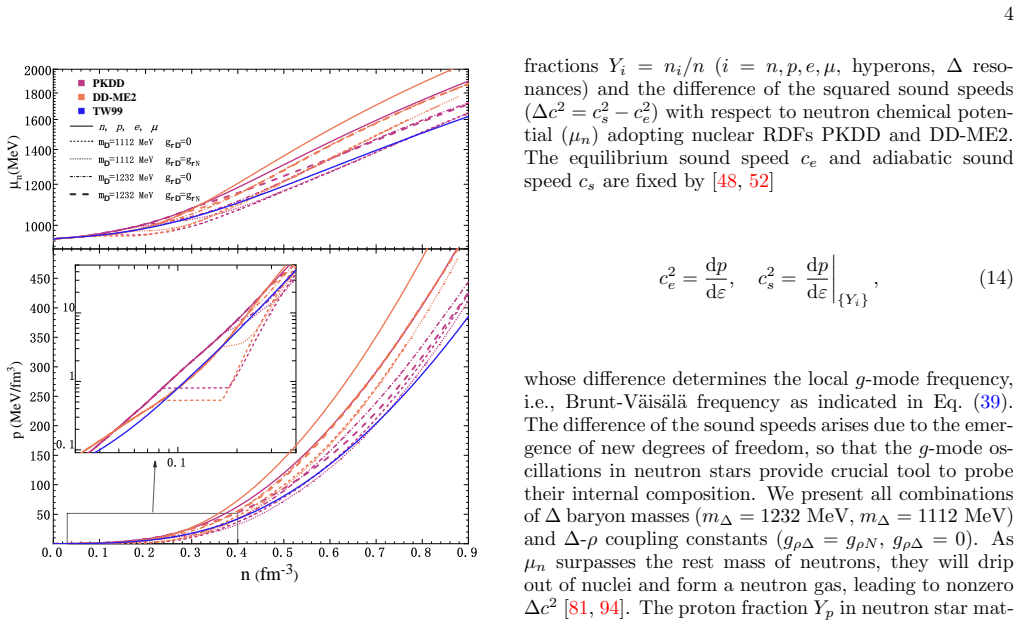
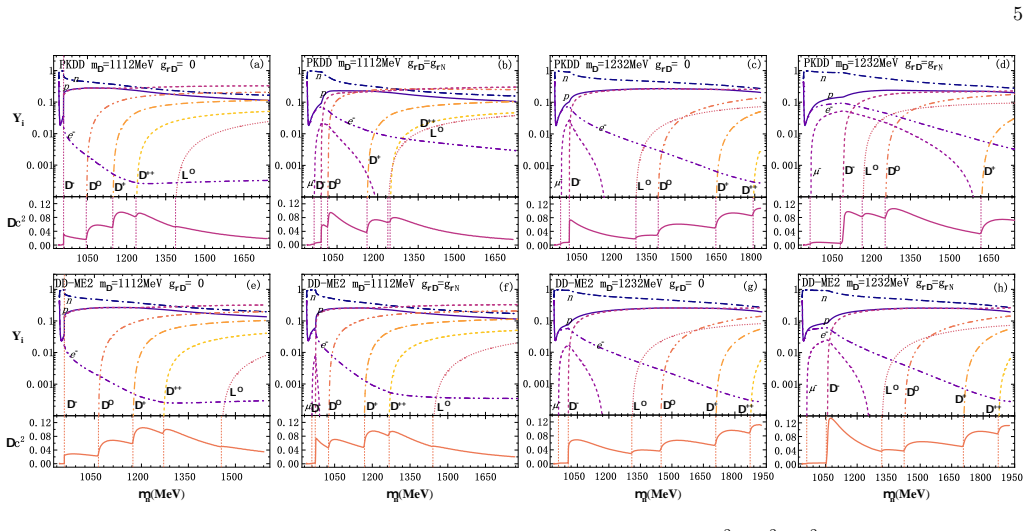
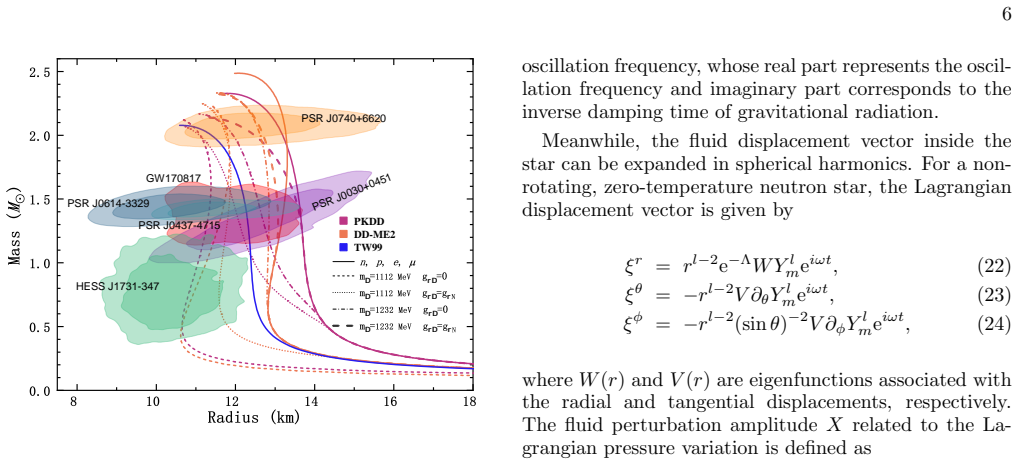
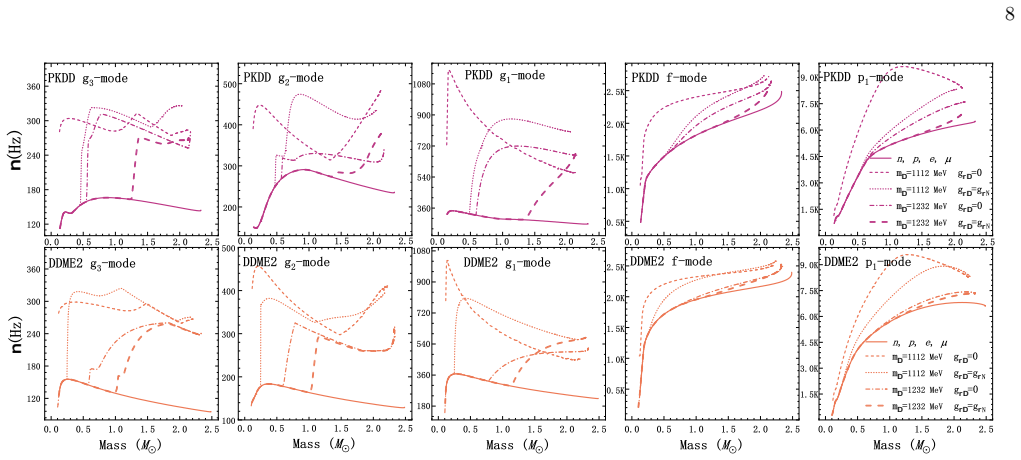
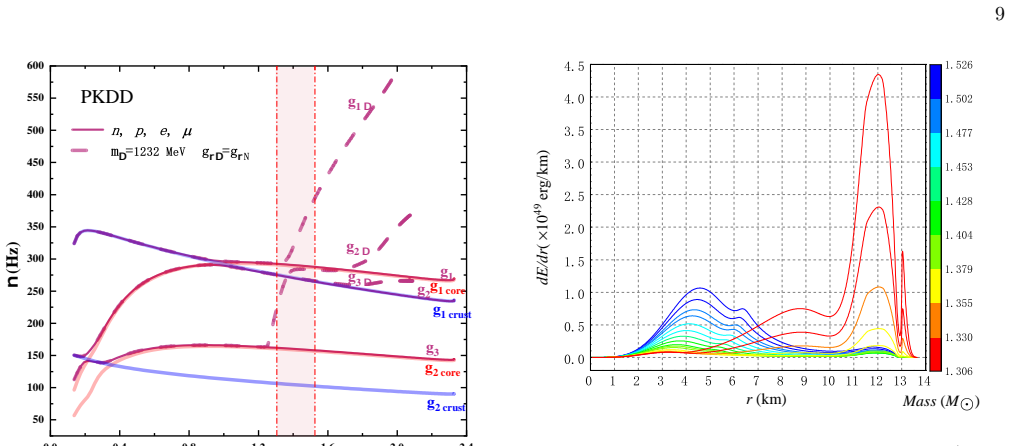
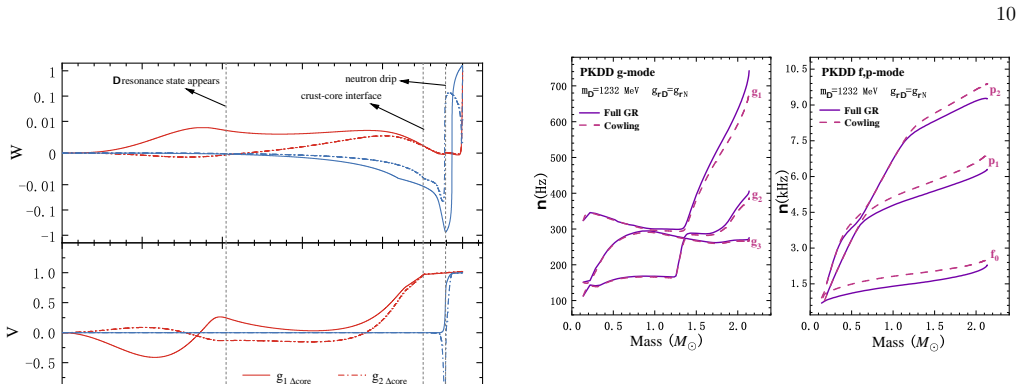
Employing various relativistic energy density functionals for nucleon-nucleon interactions and the universal coupling scheme for the delta-meson couplings, the inclusion of delta resonances is essential for neutron stars to accommodate the recent mass and radius measurements of PSR J0030+0451, PSR J0740+6620, PSR J0437-4715, PSR J0614-3329, and HESS J1731-347. As delta resonances start to emerge in neutron stars' inner core, the g-mode oscillation energy becomes concentrated within the delta-admixed region, leading to a sharp increase in the g-mode frequency. The impact of delta resonances on f-mode and p-mode oscillations is less pronounced.
What carries the argument
Concentration of g-mode oscillation energy within the delta-admixed region of the inner core.
If this is right
- Neutron star models including delta resonances reproduce the mass-radius data for the listed pulsars.
- g-mode frequencies increase sharply as soon as delta resonances populate the inner core.
- f-mode and p-mode frequencies respond more weakly to the presence of delta resonances.
- The Cowling approximation introduces errors of approximately 20 percent for f-modes and within 10 percent for g-modes.
Where Pith is reading between the lines
- Future asteroseismology measurements of g-mode frequencies could constrain the onset density of delta resonances in neutron star cores.
- Similar energy-concentration effects might appear in models that replace delta resonances with other exotic degrees of freedom at high density.
- Gravitational-wave signals from oscillating neutron stars could carry distinct signatures once delta resonances are included in the equation of state.
Load-bearing premise
The universal coupling scheme for delta-meson couplings and the chosen relativistic energy density functionals correctly capture the physics of hyperons and delta resonances at the densities present in neutron star cores.
What would settle it
A pulsar whose mass and radius lie within the observed ranges but whose measured g-mode frequency shows no sharp increase once the core density allows delta resonances.
Figures
read the original abstract
Employing various relativistic energy density functionals for nucleon-nucleon interactions, we investigate the impact of hyperons and $\Delta$ resonances on the frequencies of non-radial oscillations in neutron stars, where the universal coupling scheme is adopted for the $\Delta$-meson couplings. It is found that the inclusion of $\Delta$ resonances is essential for neutron stars to accommodate the recent mass and radius measurements of PSR J0030+0451, PSR J0740+6620, PSR J0437-4715, PSR J0614-3329, and HESS J1731-347. As $\Delta$ resonances start to emerge in neutron stars' inner core, the $g$-mode oscillation energy becomes concentrated within the $\Delta$-admixed region, leading to a sharp increase in the $g$-mode frequency. We also examine the $f$-mode and $p$-mode oscillations and find that the impact of $\Delta$ resonances on these modes is less pronounced than the $g$-modes. The oscillation frequencies calculated in the Cowling approximation are then compared with those from full general relativity, confirming that the Cowling approximation introduces an error of approximately 20\% for the $f$-modes and within 10\% for the $g$-modes. The notable effect of $\Delta$ resonances on neutron stars' $g$-mode frequencies holds important implications for probing the internal composition of neutron stars.
Editorial analysis
A structured set of objections, weighed in public.
Referee Report
Summary. The paper employs multiple relativistic mean-field energy-density functionals to model neutron-star equations of state that include both hyperons and Δ resonances under a universal Δ-meson coupling scheme. It reports that Δ resonances are required to simultaneously satisfy the mass-radius constraints from PSR J0030+0451, PSR J0740+6620, PSR J0437-4715, PSR J0614-3329 and HESS J1731-347 while still supporting ~2 M⊙ stars, and that the appearance of Δ resonances produces a sharp rise in g-mode frequencies because the mode energy concentrates inside the Δ-admixed core. The work also computes f- and p-modes, quantifies the Cowling-approximation error (~20 % for f-modes, <10 % for g-modes), and discusses implications for asteroseismology.
Significance. If the central result survives variation of the Δ couplings, the reported g-mode discontinuity would constitute a potentially observable signature of Δ resonances and therefore a new compositional diagnostic. The use of several nucleon functionals and the explicit Cowling-to-GR comparison are positive features that strengthen the technical contribution.
major comments (2)
- [Abstract and EOS section] Abstract and § on EOS construction: the claim that Δ resonances are 'essential' to accommodate the cited mass-radius data rests entirely on the fixed universal coupling ratios (g_σΔ/g_σN = g_ωΔ/g_ωN = 1). No scan over plausible alternative ratios (e.g., reduced vector couplings motivated by quark-model or SU(6) constraints) is presented; a shift in Δ onset density of only 0.1–0.2 fm⁻³ would remove both the necessity for Δ in the M–R fits and the reported g-mode frequency jump. This assumption is load-bearing for the central claim.
- [g-mode results section] § on g-mode results: the reported sharp increase in g-mode frequency is shown only for the universal coupling choice; without a corresponding calculation at neighboring coupling values it is impossible to judge whether the discontinuity is a generic consequence of Δ appearance or an artifact of the particular onset density produced by the chosen ratios.
minor comments (2)
- The manuscript should state explicitly how many and which relativistic functionals were employed and whether the hyperon couplings were held fixed or re-tuned when Δ resonances were added.
- Figure captions should indicate the precise coupling ratios used for each curve so that readers can reproduce the onset densities.
Simulated Author's Rebuttal
We are grateful to the referee for the detailed review and valuable suggestions. The comments correctly identify that our results are based on the universal Δ-meson coupling scheme. We address each point below and will make revisions to clarify the assumptions and their implications.
read point-by-point responses
-
Referee: [Abstract and EOS section] Abstract and § on EOS construction: the claim that Δ resonances are 'essential' to accommodate the cited mass-radius data rests entirely on the fixed universal coupling ratios (g_σΔ/g_σN = g_ωΔ/g_ωN = 1). No scan over plausible alternative ratios (e.g., reduced vector couplings motivated by quark-model or SU(6) constraints) is presented; a shift in Δ onset density of only 0.1–0.2 fm⁻³ would remove both the necessity for Δ in the M–R fits and the reported g-mode frequency jump. This assumption is load-bearing for the central claim.
Authors: We acknowledge that the necessity of Δ resonances for fitting the mass-radius data is demonstrated within the universal coupling framework adopted in our work. This scheme is widely used in studies of Δ-admixed neutron stars. However, we agree that exploring variations in the coupling ratios would provide a more robust assessment. In the revised manuscript, we will add a dedicated subsection discussing the sensitivity of our results to the choice of Δ-meson couplings, including references to alternative schemes from the literature, and note the potential impact on the onset density and observational constraints. revision: partial
-
Referee: [g-mode results section] § on g-mode results: the reported sharp increase in g-mode frequency is shown only for the universal coupling choice; without a corresponding calculation at neighboring coupling values it is impossible to judge whether the discontinuity is a generic consequence of Δ appearance or an artifact of the particular onset density produced by the chosen ratios.
Authors: The referee is correct that the g-mode frequency jump is illustrated specifically for the universal couplings. This feature arises because the g-mode energy concentrates in the Δ-admixed core once Δ resonances appear. To address the concern, we will revise the g-mode section to include a qualitative discussion on how changes in coupling ratios (and thus onset density) would affect the mode frequencies, and we will emphasize that the discontinuity is linked to the presence of the Δ core rather than the exact onset value. If computational resources allow, we may include one additional coupling set in the revision. revision: partial
Circularity Check
No significant circularity; results follow from explicit EOS construction and mode calculations
full rationale
The paper adopts relativistic energy-density functionals and the universal Δ-meson coupling scheme as fixed inputs, then computes the resulting EOS, composition profiles, and non-radial oscillation frequencies. The statements that Δ resonances are 'essential' for matching the listed M-R data and that g-mode energy concentrates in the Δ-admixed region are direct numerical outcomes of those inputs, not redefinitions or statistical fits that rename the inputs as predictions. No self-citation chains, uniqueness theorems, or ansatz smuggling are quoted in the provided text, and the derivation remains independent of the target observables once the couplings and functionals are chosen.
Axiom & Free-Parameter Ledger
free parameters (1)
- Delta-meson coupling constants
axioms (1)
- domain assumption Relativistic energy density functionals with hyperons and Delta resonances accurately describe the equation of state inside neutron stars.
Reference graph
Works this paper leans on
-
[1]
Dutra, O
M. Dutra, O. Louren¸ co, J. S. S´ a Martins, A. Delfino, J. R. Stone, and P. D. Stevenson, Phys. Rev. C85, 035201 (2012)
2012
-
[2]
Dutra, O
M. Dutra, O. Louren¸ co, S. S. Avancini, B. V. Carlson, A. Delfino, D. P. Menezes, C. Providˆ encia, S. Typel, and J. R. Stone, Phys. Rev. C90, 055203 (2014)
2014
-
[3]
G. Baym, T. Hatsuda, T. Kojo, P. D. Powell, Y. Song, and T. Takatsuka, Rep. Prog. Phys.81, 056902 (2018)
2018
-
[4]
C.-J. Xia, T. Maruyama, N. Yasutake, T. Tatsumi, H. Shen, and H. Togashi, Phys. Rev. D102, 023031 (2020)
2020
-
[5]
Xia, W.-J
C.-J. Xia, W.-J. Xie, and M. Bakhiet, Phys. Rev. D 110, 114009 (2024)
2024
-
[6]
LIGO Scientific and Virgo Collaborations, Phys. Rev. Lett.121, 161101 (2018)
2018
-
[8]
T. E. Riley, A. L. Watts, P. S. Ray, S. Bogdanov, S. Guillot, S. M. Morsink, A. V. Bilous, Z. Arzou- manian, D. Choudhury, J. S. Deneva, K. C. Gen- dreau, A. K. Harding, W. C. G. Ho, J. M. Lattimer, M. Loewenstein, R. M. Ludlam, C. B. Markwardt, T. Okajima, C. Prescod-Weinstein, R. A. Remillard, M. T. Wolff, E. Fonseca, H. T. Cromartie, M. Kerr, T. T. Pen...
2021
-
[11]
Choudhury, T
D. Choudhury, T. Salmi, S. Vinciguerra, T. E. Riley, Y. Kini, A. L. Watts, B. Dorsman, S. Bogdanov, S. Guil- lot, P. S. Ray, D. J. Reardon, R. A. Remillard, A. V. Bilous, D. Huppenkothen, J. M. Lattimer, N. Ruther- ford, Z. Arzoumanian, K. C. Gendreau, S. M. Morsink, and W. C. G. Ho, Astrophys. J. Lett.971, L20 (2024)
2024
-
[12]
Mauviard, S
L. Mauviard, S. Guillot, T. Salmi, D. Choudhury, B. Dorsman, and et al., Astrophys. J.995, 60 (2025)
2025
-
[14]
Togashi, E
H. Togashi, E. Hiyama, Y. Yamamoto, and M. Takano, Phys. Rev. C93, 035808 (2016)
2016
-
[15]
Sun, S.-S
T.-T. Sun, S.-S. Zhang, Q.-L. Zhang, and C.-J. Xia, Phys. Rev. D99, 023004 (2019)
2019
-
[16]
Malfatti, M
G. Malfatti, M. G. Orsaria, I. F. Ranea-Sandoval, G. A. Contrera, and F. Weber, Phys. Rev. D102, 063008 (2020)
2020
-
[17]
J. J. Li, A. Sedrakian, and F. Weber, Phys. Lett. B 810, 135812 (2020)
2020
-
[18]
K. D. Marquez, D. P. Menezes, H. Pais, and C. m. c. Providˆ encia, Phys. Rev. C106, 055801 (2022)
2022
-
[19]
Issifu, K
A. Issifu, K. D. Marquez, M. R. Pelicer, and D. P. Menezes, Mon. Not. R. Astron. Soc.522, 3263 (2023)
2023
-
[20]
Gao, Y.-K
B. Gao, Y.-K. Kong, and Y.-L. Ma, Phys. Rev. D112, 083041 (2025)
2025
-
[21]
Grundler and B.-A
X. Grundler and B.-A. Li, Phys. Rev. D112, 103012 (2025)
2025
-
[22]
Tang, Y.-J
S.-P. Tang, Y.-J. Huang, and Y.-Z. Fan, Phys. Rev. D 112, 083009 (2025)
2025
-
[23]
C. Xia, X. Lai, and R. Xu, Int. J. Mod. Phys. A40, 2550180 (2025)
2025
-
[24]
Albino, T
M. Albino, T. Malik, M. Ferreira, and C. Providˆ encia, Phys. Rev. D113, 083019 (2026)
2026
-
[25]
P. J. Kalita, T. Malik, T. Zhao, B. Kumar, and J. M. Lattimer, (2025), arXiv:2510.23405 [nucl-th]
arXiv 2025
-
[26]
A. Ayriyan, O. Ivanytskyi, and D. Blaschke, Phys. Rev. D (2026), 10.1103/h4bk-8nry
-
[27]
Luo, L.-S
J. Luo, L.-S. Chen, H.-Z. Duan, Y.-G. Gong, S. Hu, J. Ji, Q. Liu, J. Mei, V. Milyukov, M. Sazhin, C.-G. Shao, V. T. Toth, H.-B. Tu, Y. Wang, Y. Wang, H.-C. Yeh, M.-S. Zhan, Y. Zhang, V. Zharov, and Z.-B. Zhou, Class. Quantum Gravity33, 035010 (2016)
2016
-
[28]
Hu and Y.-L
W.-R. Hu and Y.-L. Wu, Natl. Sci. Rev.4, 685 (2017)
2017
-
[29]
Maggiore, C
M. Maggiore, C. V. D. Broeck, N. Bartolo, E. Belgacem, D. Bertacca, M. A. Bizouard, M. Branchesi, S. Clesse, S. Foffa, J. Garc´ ıa-Bellido, S. Grimm, J. Harms, T. Hin- derer, S. Matarrese, C. Palomba, M. Peloso, A. Ric- ciardone, and M. Sakellariadou, J. Cosmol. Astropart. Phys.2020, 050 (2020)
2020
-
[30]
K. D. Kokkotas and B. G. Schmidt, Living Rev. Relativ. 2, 2 (1999)
1999
-
[31]
W. C. G. Ho, D. I. Jones, N. Andersson, and C. M. Espinoza, Phys. Rev. D101, 103009 (2020)
2020
-
[32]
Yu and N
H. Yu and N. N. Weinberg, Mon. Not. R. Astron. Soc. 470, 350 (2017)
2017
-
[33]
D. Dey, J. A. Pattnaik, R. N. Panda, and S. K. Patra, (2025)
2025
-
[34]
K. D. Kokkotas and B. F. Schutz, Mon. Not. Roy. As- tron. Soc.225, 119 (1992)
1992
-
[35]
Lai, Mon
D. Lai, Mon. Not. R. Astron. Soc.270, 611 (1994)
1994
-
[36]
Xu and D
W. Xu and D. Lai, Phys. Rev. D96, 083005 (2017)
2017
-
[37]
K. S. Thorne and A. Campolattaro, Astrophys. J. , 591 (1967)
1967
-
[38]
Punturo, M
M. Punturo, M. Abernathy, F. Acernese, B. Allen, N. Andersson, K. Arun, and F. B. et al., Class. Quant. Grav.27, 194002 (2010)
2010
-
[39]
Regimbau, M
T. Regimbau, M. Evans, N. Christensen, E. Katsavouni- dis, B. Sathyaprakash, and S. Vitale, Phys. Rev. Lett. 118, 151105 (2017). 13
2017
-
[40]
B. P. Abbott, R. Abbott, T. D. Abbott, and et al., Class. Quant. Grav.34, 044001 (2017)
2017
-
[41]
B. P. Abbott, R. Abbott, T. D. Abbott, and et al., Living Rev. Relativ.23, 3 (2020)
2020
-
[42]
Parmar, V
V. Parmar, V. B. Thapa, M. Sinha, and I. Bombaci, Phys. Rev. D112, 023016 (2025)
2025
-
[43]
O. P. Jyothilakshmi, P. E. S. Krishnan, V. Sreekanth, H. Chandrakar, and T. K. Jha, Symmetry17(2025), 10.3390/sym17020230
-
[44]
I. A. Rather, K. D. Marquez, G. Panotopoulos, and I. Lopes, Phys. Rev. D107, 123022 (2023)
2023
-
[45]
I. A. Rather, K. D. Marquez, P. Thakur, and O. Louren¸ co, Phys. Rev. D112, 023013 (2025)
2025
-
[46]
P. J. Kalita, P. Routaray, S. Ghosh, B. Kumar, and B. Agrawal, J. Cosmol. Astropart. Phys.2024, 65 (2024)
2024
-
[47]
V. Tran, S. Ghosh, N. Lozano, D. Chatterjee, and P. Jaikumar, Phys. Rev. C108, 015803 (2023)
2023
-
[48]
Jaikumar, A
P. Jaikumar, A. Semposki, M. Prakash, and C. Con- stantinou, Phys. Rev. D103, 123009 (2021)
2021
-
[49]
W. Wei, M. Salinas, T. Kl¨ ahn, P. Jaikumar, and M. Barry, Astrophys. J.904, 187 (2020)
2020
-
[50]
Constantinou, S
C. Constantinou, S. Han, P. Jaikumar, and M. Prakash, Phys. Rev. D104, 123032 (2021)
2021
-
[51]
T. Zhao, C. Constantinou, P. Jaikumar, and M. Prakash, Phys. Rev. D105, 103025 (2022)
2022
-
[52]
Zheng, T.-T
Z.-Y. Zheng, T.-T. Sun, H. Chen, J.-B. Wei, G. F. Burgio, and H.-J. Schulze, Phys. Rev. D107, 103048 (2023)
2023
-
[53]
T. G. Cowling, Mon. Not. R. Astron. Soc.101, 367 (1941)
1941
-
[54]
Brockmann and W
R. Brockmann and W. Weise, Phys. Lett. B69, 167 (1977)
1977
-
[55]
Boguta and S
J. Boguta and S. Bohrmann, Phys. Lett. B102, 93 (1981)
1981
-
[56]
Mareˇ s and J.ˇZofka, Z
J. Mareˇ s and J.ˇZofka, Z. Phys. A333, 209 (1989)
1989
-
[57]
Mareˇ s and B
J. Mareˇ s and B. K. Jennings, Phys. Rev. C49, 2472 (1994)
1994
-
[58]
Sugahara and H
Y. Sugahara and H. Toki, Prog. Theor. Phys.92, 803 (1994)
1994
-
[59]
C. Y. Song, J. M. Yao, H. F. L¨ u, and J. Meng, Int. J. Mod. Phys. E19, 2538 (2010)
2010
-
[60]
Tanimura and K
Y. Tanimura and K. Hagino, Phys. Rev. C85, 014306 (2012)
2012
-
[61]
Wang, H.-Y
X.-S. Wang, H.-Y. Sang, J.-H. Wang, and H.-F. L¨ u, Commun. Theor. Phys.60, 479 (2013)
2013
-
[62]
P. G. Reinhard, Rep. Prog. Phys.52, 439 (1989)
1989
-
[63]
Ring, Prog
P. Ring, Prog. Part. Nucl. Phys.37, 193 (1996)
1996
-
[64]
J. Meng, H. Toki, S. Zhou, S. Zhang, W. Long, and L. Geng, Prog. Part. Nucl. Phys.57, 470 (2006)
2006
-
[65]
N. Paar, D. Vretenar, E. Khan, and G. Col` o, Rep. Prog. Phys.70, R02 (2007)
2007
-
[66]
Meng and S
J. Meng and S. G. Zhou,42, 093101 (2015)
2015
-
[67]
Typel and H
S. Typel and H. Wolter, Nucl. Phys. A656, 331 (1999)
1999
-
[68]
Vretenar, W
D. Vretenar, W. P¨ oschl, G. A. Lalazissis, and P. Ring, Phys. Rev. C57, R1060 (1998)
1998
-
[69]
Lu, E.-G
B.-N. Lu, E.-G. Zhao, and S.-G. Zhou, Phys. Rev. C 84, 014328 (2011)
2011
-
[70]
S. F. Ban, J. Li, S. Q. Zhang, H. Y. Jia, J. P. Sang, and J. Meng, Phys. Rev. C69, 045805 (2004)
2004
-
[71]
Weber, R
F. Weber, R. Negreiros, P. Rosenfield, and M. Ste- jner, Prog. Part. Nucl. Phys.59, 94 (2007), international Workshop on Nuclear Physics 28th Course
2007
-
[72]
W. H. Long, B. Y. Sun, K. Hagino, and H. Sagawa, Phys. Rev. C85, 025806 (2012)
2012
-
[73]
T. T. Sun, B. Y. Sun, and J. Meng, Phys. Rev. C86, 014305 (2012)
2012
-
[74]
S. Wang, H. F. Zhang, and J. M. Dong, Phys. Rev. C 90, 055801 (2014)
2014
-
[75]
Fedoseew and H
A. Fedoseew and H. Lenske, Phys. Rev. C91, 034307 (2015)
2015
-
[76]
Z.-F. Gao, N. Wang, H. Shan, X.-D. Li, and W. Wang, Astrophys. J.849, 19 (2017)
2017
-
[77]
W. Long, J. Meng, N. V. Giai, and S.-G. Zhou, Phys. Rev. C69, 034319 (2004)
2004
-
[78]
G. A. Lalazissis, T. Nikˇ si´ c, D. Vretenar, and P. Ring, Phys. Rev. C71, 024312 (2005)
2005
-
[79]
Meng, Relativistic Density Functional for Nuclear Structure (WORLD SCIENTIFIC, 2016)
J. Meng, Relativistic Density Functional for Nuclear Structure (WORLD SCIENTIFIC, 2016)
2016
-
[80]
Malik, K
T. Malik, K. Banerjee, T. K. Jha, and B. K. Agrawal, Phys. Rev. C96, 035803 (2017)
2017
-
[81]
J.-X. Niu, H. Sun, C.-J. Xia, and T. Maruyama, Phys. Rev. C113, 025804 (2026)
2026
-
[82]
S. Huth, P. T. H. Pang, I. Tews, T. Dietrich, A. Le F` evre, A. Schwenk, W. Trautmann, K. Agarwal, M. Bulla, M. W. Coughlin, and C. Van Den Broeck, Nature606, 276 (2022)
2022
-
[83]
Sun, C.-J
T.-T. Sun, C.-J. Xia, S.-S. Zhang, and M. S. Smith, Chin. Phys. C42, 025101 (2018)
2018
-
[84]
Schaffner and I
J. Schaffner and I. N. Mishustin, Phys. Rev. C53, 1416 (1996)
1996
discussion (0)
Sign in with ORCID, Apple, or X to comment. Anyone can read and Pith papers without signing in.