REVIEW 2 major objections 5 minor 1 cited by
Floquet Reservoir Engineering for Remote Logical Entanglement
T0 review · 2 major / 5 minor · reviewed 2026-08-01 · deepseek-v4-flash
Pith's one-line read This paper introduces a Floquet reservoir-engineering protocol that stabilizes a remote logical Bell state deterministically, with no measurements or classical communication.
desk verdict A new Floquet dissipative stabilization scheme for remote logical Bell states—clever and mostly sound, but the headline uniqueness claim is weaker than stated and the loss advantage hides a slow-convergence catch. read the letter →
The pith
A machine-rendered reading of the paper's core claim, the machinery that carries it, and where it could break.
The reading
What carries the argument
The central object is the composite Floquet channel E = E_ZZ ∘ E_XX, where each subroutine is a composition of two finite-time dissipation channels M(τ_stb) and M(τ_conv), generated by a time-independent entangling Lindbladian L_ent, and two fast controlled-logical gates (controlled-Z in E_ZZ, controlled-X in E_XX). The key quantity is the conversion probability p_conv(τ_conv): the probability that the dissipation segment M(τ_conv) turns the parity-encoded communication state |ψ_det> into an odd-parity communication state, making the logical parity locally readable. The bath's unique pure dark state |ψ_ss> supplies the resource, and the non-invariance of the even-parity subspace guarantees p
What would settle it
Directly compute the steady state of E = E_ZZ ∘ E_XX for a specific reservoir (e.g., the TMS dissipator) at finite τ_stb and τ_conv where the analytic proof does not apply; if the fixed point's logical concurrence is below 1, or if under controlled waveguide loss ε the steady-state concurrence error scales as ε^{1/2} rather than ε, the central claims fail. The paper itself notes that uniqueness is proven analytically only in the τ_stb ≫ τ_ent limit and relies on numerics otherwise, so an independent scan across the (τ_stb, τ_conv, r) parameter space would settle whether the claimed unique pure
Extended reading notes
Core claim
The paper's central discovery is that a time-periodic, non-unitary channel E = E_ZZ ∘ E_XX, built from two finite-time dissipation segments M(τ)=exp(τ L_ent) on a pair of communication qubits and two node-local controlled-logical gates per subroutine, has the product state |Φ_L^+> ⊗ |ψ_ss> as its unique pure steady state whenever the entangling Lindbladian L_ent has a unique pure entangled dark state |ψ_ss> = u|0c_A 0c_B> + v|1c_A 1c_B> with |u|,|v|>0 and the even-parity subspace is not invariant. Each E_ZZ subroutine uses the dissipation twice: first to refresh the communication qubits into |ψ_ss>, then, after a controlled-Z gate has encoded the logical ZZ parity into a global phase, to con
Load-bearing premise
The protocol collapses if the physical entangling reservoir does not possess a unique pure entangled steady state |ψ_ss> with |u|,|v|>0 and does not break the even-parity subspace, because then the parity-encoding map and the conversion probability p_conv that drive the feedback loop cannot be established.
Editorial extensions
If this is right
- If the central claim holds, any pair of remote communication qubits that can be dissipatively entangled can be upgraded to a protected logical Bell pair using only local controlled-logical gates, independent of the specific logical encoding.
- The protocol removes the time-entanglement tradeoff that limits time-independent dissipative entanglement: the logical steady state reaches unit fidelity for any p_conv>0, not only in the limit of maximal bath entanglement.
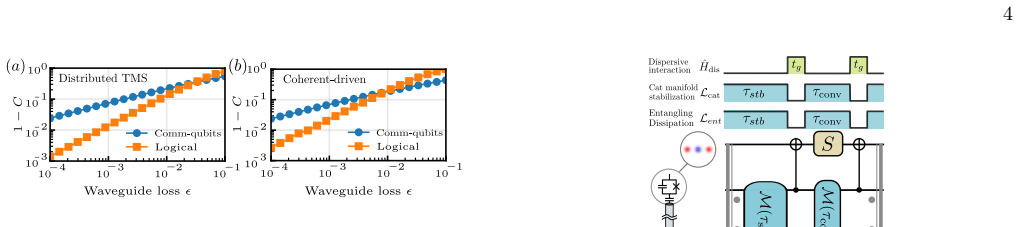
- Under waveguide loss, the logical concurrence error scales as O(ε) instead of O(ε^{1/2}); the paper identifies an operating point at weak bath squeezing where the error floor is about 16ε for the TMS reservoir.
- The scheme runs autonomously, with no measurements or classical communication, a practical advantage for remote nodes without a fast classical link.
- Because the construction treats the logical encoding as a black box, it extends naturally to cat, GKP, and surface-code logical qubits, as demonstrated explicitly for a cat-transmon superconducting circuit.
Reading between the lines
- Beyond the paper: the p_conv>0 condition suggests a testable trade-off—weakly entangled reservoirs with slow stabilization may be optimal under loss, because the error coefficient c grows with entanglement while p_conv grows only quadratically; the paper notes this at r→0, and one could verify it for the Rabi scheme as well.
- Beyond the paper: the linear loss scaling should persist for other logical encodings as long as the local controlled-logical gates are bias-preserving; the paper analyzes cat qubits, but the black-box argument suggests a broader pattern that could be checked in GKP or surface-code simulations.
- Beyond the paper: if p_conv is small, the number of cycles to steady state grows as 1/p_conv, so in practice the effective stabilization rate may be limited by logical memory errors during long preparation times; this suggests an optimal τ_stb that balances idling error against conversion rate, an optimization the paper's cat-qubit analysis hints at.
Editorial analysis
A structured set of objections, weighed in public.
Referee Report
Summary. The paper introduces a Floquet reservoir engineering protocol for stabilizing a maximally entangled Bell state between two remote logical qubits. The protocol repeatedly applies two subroutines, E_ZZ and E_XX, each consisting of entangling dissipation on communication qubits interleaved with fast local controlled-logical gates. The authors argue that the composite channel E has the unique pure steady state |Φ_L^+>⊗|ψ_c^ss> for essentially arbitrary timing parameters, provide analytic rate equations for the stabilizer correlators in the τ_stb ≫ τ_ent limit, derive a closed-form conversion probability p_conv for the two-mode-squeezing reservoir, and show numerically and via perturbation theory that waveguide loss yields a linear (∝ε) steady-state concurrence error, outperforming the ε^{1/2} scaling of direct communication-qubit stabilization. They also map the protocol to a cat-qubit/transmon architecture.
Significance. If the central claims hold, this is a valuable proposal: it overcomes known time-entanglement tradeoffs, provides autonomous entanglement distillation, and offers a concrete path to remote logical entanglement in modular superconducting systems. The paper contains several strong elements: (i) the analytic derivation of p_conv for the TMS reservoir via quantum trajectories (SM SIII), (ii) the transparent two-correlator rate equations (Eqs. (8)-(9)), (iii) numerical verification of the convergence and loss scaling, and (iv) a detailed, bias-preserving experimental implementation for cat qubits. The main weakness is that the headline uniqueness claim is not proven in the claimed generality and, as stated, is false at τ_conv = 0; this is acknowledged in footnote [49] but the unqualified statement in Eq. (5) remains a load-bearing issue. A second concern is that the loss-optimal operating point has vanishing stabilization rate, so the reported steady-state advantage may not translate to finite-time experiments.
major comments (2)
- [Stabilization mechanism, Eq. (5) and footnote [49]; SM SI.C] The claim that E has a unique pure steady state for 'no matter what the choice of time intervals τ_stb, τ_conv' is not established and is literally false at τ_stb=τ_conv=0, where E reduces to a unitary (products of C_Z and C_X) with many steady states. At τ_conv=0 with finite τ_stb, p_conv=0 and the rate equations (8)-(9) give no convergence, so additional fixed points exist. The analytic treatment in SI.C assumes τ_stb→∞ and tracks only parity populations; it does not constrain off-diagonal logical coherences or finite-τ_stb corrections. Since the loss-protection results (Fig. 3, SM SV.B) compute a steady state of E, an unproven non-uniqueness could make the reported concurrence initial-state dependent. Please either prove uniqueness under precise conditions (e.g., τ_stb sufficiently large and p_conv>0) or qualify the claim and demonstrate numerically that the same steady state is reach
- [End Matter Eq. (A.12) and SM SV.C] The optimal steady-state concurrence under loss is found at r→0 (TMS), where p_conv∝r^2 and the stabilization rate Γ = -ln(1-p_conv) vanishes. Thus the reported linear scaling 1-C≲16ε is an infinite-time steady-state result, and the time needed to reach it diverges. The main-text discussion of Fig. 3 does not mention this, and the 'advantage' over communication-qubit-only stabilization may not persist at any finite run time. Please add a finite-time analysis or a rate constraint to the loss optimization, or clearly state in the main text that the advantage is only asymptotic in the number of cycles.
minor comments (5)
- [Eq. (5) / Footnote [49]] The unqualified wording 'no matter what the choice of time intervals' should be replaced by a statement that includes the conditions under which uniqueness is actually shown or expected.
- [SM Eq. (S22)] The closed form for p_conv is a highlight, but the notation γ' = γ cosh 2r is introduced only in the text; define it next to the equation.
- [Fig. 3] The figure caption and text should state whether the entanglement parameter r (or Ω/γ) is also optimized at each ε. SM SV.C suggests r→0 is optimal, which is not visible from Fig. 3.
- [SM SIV] The saturation of Γ with τ_stb is shown in Fig. S1, but the analytic equation for the residual finite-τ_stb correction is not given; a bound or explicit exponential form would strengthen the argument.
- [General] Several self-references to the supplemental material use placeholder [53]; include the actual link or reference. Also, the notation for the controlled gates alternates between C_Z and CZ; pick one style.
Circularity Check
No significant circularity: the construction makes the target state a steady state by design, but the predictive claims (rate, loss scaling) are derived independently and checked numerically; the footnote-admitted uniqueness gap is a missing proof, not a circular reduction.
full rationale
The derivation chain is not circular in the sense prohibited by the rubric. The target |Φ_L^+>⊗|ψ_c^ss> is indeed a fixed point of the constructed channel E by design, since |ψ_c^ss> is the dark state of L_ent and the controlled gates are chosen to leave the target invariant. However, the paper's substantive predictions do not stop at this fixed-point check. The convergence rate Γ=-ln(1-p_conv) is derived from a state-level walkthrough (SM SI.B-C) with p_conv computed analytically for the TMS dissipator (SM SIII) and numerically for the Rabi dissipator; it is not fitted to the target state. The loss scaling 1-C≲8cε/p_conv follows from Lindblad perturbation theory and the parity-accounting equations (SM SV.A-B), with optimal parameters determined from the derived expressions rather than set to force the result. The headline uniqueness statement in Eq. (5) is stronger than what is proven: footnote [49] explicitly states 'we do not have an analytic proof of uniqueness for arbitrary parameter regime; ... Our conclusion relies on numerics beyond this scope.' This is an admitted missing proof/overclaim and therefore a correctness risk, but it is not circularity, because the analytic argument does not assume the desired uniqueness to derive convergence of the stabilizers. Self-citations, notably Ref. [34] for the ε^{1/2} benchmark, are to a separate parameter-free theoretical derivation by one of the present authors; the paper also reproduces a heuristic version of that argument (End Matter, Eqs. (A.15)-(A.16)), so the comparison is not imported as an unverified premise. No circular step can be exhibited by quoting an equation where a prediction equals its input by construction. Honest finding: no significant circularity, score 0.
Assumptions & free parameters
free parameters (3)
- τ_stb (preparation time) =
optimized; e.g. 5 τ_ent
- τ_conv (conversion time) =
optimized; closed-form for TMS: γ'τ*_conv = (1/α_r) ln((3+α_r)/(3−α_r))
- entanglement parameter r (TMS) or Ω/γ (Rabi) =
optimized (e.g., r→0 in the loss-only TMS limit)
assumptions (6)
- domain assumption The engineered reservoir L_ent has a unique pure entangled steady state |ψ^c_ss> = u|0c_A0c_B>+v|1c_A1c_B> and does not close the even-parity subspace.
- domain assumption Local unitary gates are effectively instantaneous on the dissipative timescale.
- standard math The open-system dynamics is Markovian and described by a Lindblad master equation after elimination of the waveguide.
- domain assumption Waveguide loss is modeled as a beam splitter with power transmissivity |η|^2 and loss ε=1−|η|^2, combined through the SLH input-output formalism.
- ad hoc to paper First-order Lindblad perturbation theory with the heuristic coefficient c(r)≈tanh^2(2r) (Eq. S36) describes the steady-state loss correction.
- domain assumption The cat-qubit controlled-X gate implemented by χ-matched dispersive coupling is bias-preserving, with all gate errors Z-type.
Cite this review
Pith. "Pith review of Floquet Reservoir Engineering for Remote Logical Entanglement." pith.science (2026). https://pith.science/paper/7GAA72LC
@misc{pith2026260721360,
  author       = {Pith},
  title        = {Pith review of: Floquet Reservoir Engineering for Remote Logical Entanglement},
  year         = {2026},
  howpublished = {\url{https://pith.science/paper/7GAA72LC}},
  note         = {Machine review of arXiv:2607.21360}
}
read the original abstract
Implementing controlled dissipative dynamics is a powerful approach for state preparation in a variety of contexts, including the preparation of remote entangled states. Here, we show that by going beyond the standard setting of time-independent dissipative dynamics, one can realize even more powerful non-unitary protocols. We introduce dissipative Floquet protocols for stabilizing remote entanglement of logical qubits, where continuously-running dissipation is interleaved with a periodic sequence of unitary gates. These protocols harness existing experimental capabilities, and overcome time-entanglement limits that constrain standard approaches. They also implement an autonomous form of entanglement distillation. We show how these protocols give enhanced protection against waveguide loss, and as an example, analyze a specific implementation using cat-qubits and transmons in a superconducting circuit.
Figures


Figures from the paper (2 more)


Forward citations
Cited by 1 Pith paper
-
Entanglement and non-local magic in a non-unitarily deformed non-Hermitian bipartite system
A non-unitary similarity deformation of a Hermitian two-qubit Hamiltonian keeps the degenerate spectrum fixed while right eigenstates interpolate from product to maximally entangled, with Schmidt-gauged magic peaking ...
Reference graph
Works this paper leans on
-
[49]
While one can easily check analytically that this is a steady state of the channel, we do not have an ana- lytic proof of uniqueness for arbitrary parameter regime; we can analytically confirm the convergence for the case τstb ≫τ ent with Eq. (7). Our conclusion relies on numer- ics beyond this scope
-
[1]
J. F. Poyatos, J. I. Cirac, and P. Zoller, Phys. Rev. Lett. 77, 4728 (1996)
1996
-
[2]
Diehl, A
S. Diehl, A. Micheli, A. Kantian, B. Kraus, H. P. B¨ uchler, and P. Zoller, Nature Physics4, 878 (2008)
2008
-
[3]
Verstraete, M
F. Verstraete, M. M. Wolf, and J. Ignacio Cirac, Nature Physics5, 633 (2009)
2009
-
[4]
M. B. Plenio, S. F. Huelga, A. Beige, and P. L. Knight, Phys. Rev. A59, 2468 (1999)
1999
-
[5]
Kraus, H
B. Kraus, H. P. B¨ uchler, S. Diehl, A. Kantian, A. Micheli, and P. Zoller, Phys. Rev. A78, 042307 (2008)
2008
-
[6]
J. T. Barreiro, M. M¨ uller, P. Schindler, D. Nigg, T. Monz, M. Chwalla, M. Hennrich, C. F. Roos, P. Zoller, and R. Blatt, Nature470, 486 (2011)
2011
-
[7]
Shankar, M
S. Shankar, M. Hatridge, Z. Leghtas, K. M. Sliwa, A. Narla, U. Vool, S. M. Girvin, L. Frunzio, M. Mir- rahimi, and M. H. Devoret, Nature504, 419 (2013)
2013
Show all 72 references
-
[8]
Y. Lin, J. P. Gaebler, F. Reiter, T. R. Tan, R. Bowler, A. S. Sørensen, D. Leibfried, and D. J. Wineland, Nature 504, 415 (2013)
2013
-
[9]
Krauter, C
H. Krauter, C. A. Muschik, K. Jensen, W. Wasilewski, J. M. Petersen, J. I. Cirac, and E. S. Polzik, Phys. Rev. Lett.107, 080503 (2011)
2011
-
[10]
R. Ma, B. Saxberg, C. Owens, N. Leung, Y. Lu, J. Simon, and D. I. Schuster, Nature566, 51 (2019)
2019
-
[11]
Kienzler, H.-Y
D. Kienzler, H.-Y. Lo, B. Keitch, L. de Clercq, F. Le- upold, F. Lindenfelser, M. Marinelli, V. Negnevitsky, and J. P. Home, Science347, 53 (2015)
2015
-
[13]
Lescanne, M
R. Lescanne, M. Villiers, T. Peronnin, A. Sarlette, M. Delbecq, B. Huard, T. Kontos, M. Mirrahimi, and Z. Leghtas, Nat. Phys.16, 509 (2020)
2020
-
[14]
K. W. Murch, U. Vool, D. Zhou, S. J. Weber, S. M. Girvin, and I. Siddiqi, Phys. Rev. Lett.109, 183602 (2012)
2012
-
[15]
J. M. Gertler, B. Baker, J. Li, S. Shirol, J. Koch, and C. Wang, Nature590, 243 (2021)
2021
-
[16]
Lachance-Quirion, M.-A
D. Lachance-Quirion, M.-A. Lemonde, J. O. Simoneau, L. St-Jean, P. Lemieux, S. Turcotte, W. Wright, A. Lacroix, J. Fr´ echette-Viens, R. Shillito, F. Hopf- mueller,et al., Phys. Rev. Lett.132, 150607 (2024)
2024
-
[17]
Z. Li, T. Roy, D. Rodr ´ ıguez P´ erez, K.-H. Lee, E. Kapit, and D. I. Schuster, Nat. Commun.15, 1681 (2024)
2024
-
[18]
Gonzalez-Tudela, D
A. Gonzalez-Tudela, D. Martin-Cano, E. Moreno, L. Martin-Moreno, C. Tejedor, and F. J. Garcia-Vidal, Phys. Rev. Lett.106, 020501 (2011)
2011
-
[19]
Pichler, T
H. Pichler, T. Ramos, A. J. Daley, and P. Zoller, Phys. Rev. A91, 042116 (2015)
2015
-
[20]
Lingenfelter, M
A. Lingenfelter, M. Yao, A. Pocklington, Y.-X. Wang, A. Irfan, W. Pfaff, and A. A. Clerk, Phys. Rev. X14, 021028 (2024). 6
2024
-
[22]
Motzoi, E
F. Motzoi, E. Halperin, X. Wang, K. B. Whaley, and S. Schirmer, Phys. Rev. A94, 032313 (2016)
2016
-
[27]
Almanakly, A
A. Almanakly, A. Soro, A. Vivas-Via˜ na, B. Yankelevich, C. Groiseau, D. Pahl, J. An, G. Cutter, M. E. Gin- gras, B. M. Niedzielski,et al., arXiv [quant-ph] (2026), arXiv:2606.13375 [quant-ph]
2026 arXiv
-
[28]
Brown, E
T. Brown, E. Doucet, D. Rist` e, G. Ribeill, K. Cicak, J. Aumentado, R. Simmonds, L. Govia, A. Kamal, and L. Ranzani, Nat. Commun.13, 3994 (2022)
2022
-
[29]
Ramos, H
T. Ramos, H. Pichler, A. J. Daley, and P. Zoller, Phys. Rev. Lett.113, 237203 (2014)
2014
-
[30]
Didier, J
N. Didier, J. Guillaud, S. Shankar, and M. Mirrahimi, Phys. Rev. A (Coll. Park.)98, 012329 (2018)
2018
-
[31]
C. A. Muschik, E. S. Polzik, and J. I. Cirac, Phys. Rev. A83, 052312 (2011)
2011
-
[32]
H. J. Kimble, Nature453, 1023 (2008)
2008
-
[33]
Kn¨ orzer, X
J. Kn¨ orzer, X. Liu, B. F. Schiffer, and J. Tura, arXiv [quant-ph] 10.48550/arXiv.2510.15630 (2025)
2025 doi
-
[35]
Ciccarello, S
F. Ciccarello, S. Lorenzo, V. Giovannetti, and G. M. Palma, Phys. Rep.954, 1 (2022)
2022
-
[36]
Karevski and T
D. Karevski and T. Platini, Phys. Rev. Lett.102, 207207 (2009)
2009
-
[37]
Schindler, M
P. Schindler, M. M¨ uller, D. Nigg, J. T. Barreiro, E. A. Martinez, M. Hennrich, T. Monz, S. Diehl, P. Zoller, and R. Blatt, Nat. Phys.9, 361 (2013)
2013
-
[38]
X. Mi, A. A. Michailidis, S. Shabani, K. C. Miao, P. V. Klimov, J. Lloyd, E. Rosenberg, R. Acharya, I. Aleiner, T. I. Andersen, M. Ansmann, F. Arute, K. Arya, A. As- faw, J. Atalaya, J. C. Bardin,et al., Science383, 1332 (2024)
2024
-
[40]
S. Puri, L. St-Jean, J. A. Gross, A. Grimm, N. E. Frattini, P. S. Iyer, A. Krishna, S. Touzard, L. Jiang, A. Blais, S. T. Flammia, and S. M. Girvin, Sci. Adv.6, 10.1126/sciadv.aay5901 (2020)
2020 doi
-
[41]
Reinhold, S
P. Reinhold, S. Rosenblum, W.-L. Ma, L. Frunzio, L. Jiang, and R. J. Schoelkopf, Nat. Phys.16, 822 (2020)
2020
-
[42]
R. W. Heeres, P. Reinhold, N. Ofek, L. Frunzio, L. Jiang, M. H. Devoret, and R. J. Schoelkopf, Nat. Commun.8, 94 (2017)
2017
-
[43]
K. G. H. Vollbrecht, C. A. Muschik, and J. I. Cirac, Phys. Rev. Lett.107, 120502 (2011)
2011
-
[44]
Kraus and J
B. Kraus and J. I. Cirac, Phys. Rev. Lett.92, 013602 (2004)
2004
-
[46]
L. C. G. Govia, A. Lingenfelter, and A. A. Clerk, Phys. Rev. Res.4, 023010 (2022)
2022
-
[47]
Lindblad, Commun
G. Lindblad, Commun. Math. Phys.48, 119 (1976)
1976
-
[48]
Gorini, A
V. Gorini, A. Kossakowski, and E. C. G. Sudarshan, J. Math. Phys.17, 821 (1976)
1976
-
[50]
Rist` e, M
D. Rist` e, M. Dukalski, C. A. Watson, G. de Lange, M. J. Tiggelman, Y. M. Blanter, K. W. Lehnert, R. N. Schouten, and L. DiCarlo, Nature502, 350 (2013)
2013
-
[51]
N. Roch, M. E. Schwartz, F. Motzoi, C. Macklin, R. Vi- jay, A. W. Eddins, A. N. Korotkov, K. B. Whaley, M. Sarovar, and I. Siddiqi, Phys. Rev. Lett.112, 170501 (2014)
2014
-
[52]
C. K. Andersen, A. Remm, S. Lazar, S. Krinner, J. Hein- soo, J.-C. Besse, M. Gabureac, A. Wallraff, and C. Eich- ler, NPJ Quantum Inf.5, 69 (2019)
2019
-
[53]
See supplemental material at ... for
-
[54]
Note that both of these examples satisfy the needed con- ditions: a pure entangled steady state, with dynamics that does not preserve the even parity subspace
-
[55]
Buˇ ca and T
B. Buˇ ca and T. Prosen, New J. Phys.14, 073007 (2012)
2012
-
[56]
V. V. Albert and L. Jiang, Phys. Rev. A89, 022118 (2014)
2014
-
[57]
Putterman, K
H. Putterman, K. Noh, C. T. Hann, G. S. MacCabe, S. Aghaeimeibodi, R. N. Patel, M. Lee, W. M. Jones, H. Moradinejad, R. Rodriguez, N. Mahuli, J. Rose,et al., Nature638, 927 (2025)
2025
-
[58]
R´ eglade, A
U. R´ eglade, A. Bocquet, R. Gautier, J. Cohen, A. Marquet, E. Albertinale, N. Pankratova, M. Hall´ en, F. Rautschke, L.-A. Sellem, P. Rouchon, A. Sarlette, M. Mirrahimi, P. Campagne-Ibarcq, R. Lescanne, S. Je- zouin, and Z. Leghtas, Nature629, 778 (2024)
2024
-
[59]
Leghtas, S
Z. Leghtas, S. Touzard, I. M. Pop, A. Kou, B. Vlastakis, A. Petrenko, K. M. Sliwa, A. Narla, S. Shankar, M. J. Ha- tridge, M. Reagor, L. Frunzio, R. J. Schoelkopf, M. Mir- rahimi, and M. H. Devoret, Science347, 853 (2015)
2015
-
[60]
N. Ofek, A. Petrenko, R. Heeres, P. Reinhold, Z. Leghtas, B. Vlastakis, Y. Liu, L. Frunzio, S. M. Girvin, L. Jiang, M. Mirrahimi, M. H. Devoret, and R. J. Schoelkopf, Na- ture536, 441 (2016)
2016
-
[61]
Y. Liu, S. Singh, K. C. Smith, E. Crane, J. M. Martyn, A. Eickbusch, A. Schuckert, R. D. Li, J. Sinanan-Singh, M. B. Soley, T. Tsunoda, I. L. Chuang, N. Wiebe, and S. M. Girvin, PRX Quantum7, 010201 (2026)
2026
-
[62]
The exactly orthogonal states spanning the steady-state manifold ofL cat are the even- and odd-parity cat states |C± α ⟩= (|α⟩ ± |−α⟩)/N±. The code words are their equal superpositions,|0 L⟩= (|C + α ⟩+|C − α ⟩)/ √ 2 and|1 L⟩= (|C+ α ⟩−|C − α ⟩)/ √ 2, which coincide with the c...
-
[63]
Eisert, K
J. Eisert, K. Jacobs, P. Papadopoulos, and M. B. Ple- nio, Physical Review A62, 10.1103/physreva.62.052317 (2000)
2000 doi
-
[64]
communication qubits end in odd parity
S. Bandyopadhyay, G. Brassard, S. Kimmel, and W. K. Wootters, Physical Review A80, 10.1103/phys- reva.80.012313 (2009). 7 End Matter Comparison to explicit measurement and feedback dynamics.— For two co-located logical qubits, stabiliza- tion via parity measurement and feedbac...
2009 doi
-
[65]
Agust ´ ı, Y
J. Agust ´ ı, Y. Minoguchi, J. M. Fink, and P. Rabl, arXiv [quant-ph] 10.1103/PhysRevA.105.062454 (2022)
2022 doi
-
[66]
Andr´ es-Juanes, J
A. Andr´ es-Juanes, J. Agust ´ ı, R. Sett, E. S. Redchenko, L. Kapoor, S. Hawaldar, P. Rabl, and J. M. Fink, arXiv [quant-ph] 10.48550/ARXIV.2510.07139 (2025)
2025 doi
-
[67]
Pocklington and A
A. Pocklington and A. A. Clerk, PRX quantum5, 040305 (2024)
2024
-
[68]
Stannigel, P
K. Stannigel, P. Rabl, and P. Zoller, New J. Phys.14, 063014 (2012)
2012
-
[69]
Irfan, K
A. Irfan, K. Singirikonda, M. Yao, A. Lingenfelter, M. Mollenhauer, X. Cao, A. A. Clerk, and W. Pfaff, arXiv [quant-ph] (2025)
2025
-
[70]
P. S. Shah, F. Yang, C. Joshi, and M. Mirhosseini, PRX quantum5, 10.1103/prxquantum.5.030346 (2024)
2024 doi
-
[71]
Irfan, M
A. Irfan, M. Yao, A. Lingenfelter, X. Cao, A. A. Clerk, and W. Pfaff, Phys. Rev. Res.6, 033212 (2024)
2024
-
[72]
H. M. Wiseman, Phys. Rev. A49, 2133 (1994)
1994
-
[73]
Pocklington, Y.-X
A. Pocklington, Y.-X. Wang, Y. Yanay, and A. A. Clerk, Phys. Rev. B: Condens. Matter Mater. Phys.105, 140301 (2022)
2022
-
[74]
Guillaud and M
J. Guillaud and M. Mirrahimi, Phys. Rev. X.9, 041053 (2019)
2019
-
[75]
Gottesman, A
D. Gottesman, A. Kitaev, and J. Preskill, Phys. Rev. A64, 012310 (2001)
2001
-
[76]
Campagne-Ibarcq, A
P. Campagne-Ibarcq, A. Eickbusch, S. Touzard, E. Zalys-Geller, N. E. Frattini, V. V. Sivak, P. Reinhold, S. Puri, S. Shankar, R. J. Schoelkopf, L. Frunzio, M. Mirrahimi, and M. H. Devoret, Nature584, 368 (2020)
2020
-
[77]
A. L. Grimsmo and S. Puri, arXiv [quant-ph] (2021)
2021
-
[78]
Royer, S
B. Royer, S. Singh, and S. M. Girvin, Phys. Rev. Lett.125, 260509 (2020)
2020
-
[79]
A. Y. Kitaev, Ann. Phys. (N. Y.)303, 2 (2003)
2003
-
[80]
Dennis, A
E. Dennis, A. Kitaev, A. Landahl, and J. Preskill, J. Math. Phys.43, 4452 (2002)
2002
-
[81]
A. G. Fowler, M. Mariantoni, J. M. Martinis, and A. N. Cleland, Phys. Rev. A86, 032324 (2012)
2012
Reviewed August 1, 2026 · model on record in the stance chip above.
Discussion (0). Continue with ORCID to comment.