REVIEW 4 major objections 5 minor 54 references
Erasure surface code circuit without mid-circuit erasure checks
T0 review · 4 major / 5 minor · reviewed 2026-08-04 · deepseek-v4-flash
Pith's one-line read A time-reversed surface-code circuit can preserve erasure-level error suppression without mid-circuit erasure checks.
desk verdict Moonwalking circuit result is real but idealization-dependent; worth a serious referee. read the letter →
The pith
A machine-rendered reading of the paper's core claim, the machinery that carries it, and where it could break.
The reading
What carries the argument
The central object is the moonwalking surface code, the time-reversal of the walking surface code, built by inserting SWAP operations between reset and the first two-qubit gate and commuting them into the circuit so no real swaps or extra depth are needed. It is paired with three-state readout, skip-gate leakage behavior, and a branch-and-bound quasi-MLE decoder. The circuit reassigns data and ancilla roles every round so every qubit is measured and reset every other cycle, letting three-state readout catch all leakage without additional checks. The decoder's load-bearing job is to enforce leakage disjointness: when an erasure check fires, the true leakage location is one of several possibil
What would settle it
Enumerate all pairs of leakage events in a 3×3 moonwalking surface code with three-state readout and skip-gate leakage that produce the same erasure-check and detector outcomes but different logical outcomes. The paper's t_E = ℓ claim predicts no such pair; a single such pair, of the kind the paper itself finds for the walking code, would falsify the central claim.
Extended reading notes
Core claim
The paper introduces the moonwalking surface code and claims it achieves erasure-like logical error rate scaling, p_L ∝ p^ℓ, without mid-circuit erasure checks. The recipe: use three-state readout wherever the circuit measures; let leaked qubits cause any two-qubit gate they participate in to be skipped; and decode with a branch-and-bound algorithm that enforces that each detected erasure corresponds to exactly one leakage event. Under those conditions the paper finds that the minimum number of leakage events that can produce an uncorrectable logical error is t_E = ℓ, the full code distance, whereas the original walking surface code degrades to t_E = ⌈ℓ/2⌉ under the same schedule because two
Load-bearing premise
The argument assumes the three-state readout is perfect and a leaked qubit never seeps back into the computational subspace; if readout misclassifies leakage or seepage occurs, the erasure information is corrupted and the t_E = ℓ bound need not hold.
Editorial extensions
If this is right
- For an ℓ×ℓ moonwalking surface code with three-state readout only and skip-gate leakage, logical error rate scales as p_L ∝ p^ℓ, equivalent to what explicit erasure detection would give.
- The walking surface code, despite using the same gates and readout schedule, only reaches an exponent near 1/2 under skip-gate leakage; the time direction of the circuit changes how many leakage events are correctable.
- The static surface code can match the moonwalking scaling with three-state readout only at the cost of a leakage-SWAP gate per data qubit; the moonwalking circuit removes that overhead.
- If the decoder does not respect the one-leak-per-qubit constraint, the claimed t_E = ℓ can fail: the paper shows a marginal decoder can misdecode two leakage events in the moonwalking code.
- For hardware where leakage instead depolarizes or induces tailored Pauli errors, infrequent checks are not enough — schedules without mid-circuit checks drop to ⌈ℓ/2⌉ distance, so skip-gate behavior is the enabling ingredient.
Reading between the lines
- A direct experimental prediction follows for dual-rail superconducting or trapped-ion systems: a memory experiment with three-state readout, no mid-circuit checks, and leakage that skips gates should show a logical error exponent near 1 in code size, provided readout errors stay below the physical error rate.
- The strong dependence on time reversal suggests similar asymmetry could be found in other time-dynamic or foliated circuits; the controlling quantity is the size and nesting of the leakage Pauli envelope between reset and readout.
- If finite readout misclassification or seepage is added, the t_E = ℓ bound likely degrades continuously; mapping that crossover is the natural follow-up that would tell experimentalists when mid-circuit checks are actually worth their cost.
- The slow branch-and-bound decoder is the main practical bottleneck; a faster decoder that solves the same anti-correlated error problem would make the zero-overhead advantage usable at larger code distances.
Editorial analysis
A structured set of objections, weighed in public.
Referee Report
Summary. The paper maps the design space of erasure-qubit error correction for surface codes by considering three leaked-qubit effects (depolarizing, tailored, skip-gate), three syndrome-extraction circuits (static, walking, moonwalking), and four erasure-check schedules. Its central contribution is the moonwalking surface code—the time reversal of the walking surface code—which, when combined with end-of-line three-state readout (EC schedule 8), skip-gate leakage, and a new branch-and-bound decoder, is claimed to achieve t_E = d_L = ℓ and hence erasure-like logical-error-rate scaling p_L ∝ p^ℓ without mid-circuit erasure checks. The evidence is an exhaustive weight-1/2 fault enumeration on a 3×3, 4-round circuit and Stim circuit-level simulations up to ℓ = 11, from which LER scaling exponents and thresholds are fitted.
Significance. If the idealizations hold, this is a significant design-space result. It identifies concrete circuit and decoder conditions under which the doubled erasure-correction capacity of the surface code can be realized without mid-circuit erasure-check overhead, and it explains why the walking surface code fails in the skip-gate regime while the time-reversed moonwalking circuit succeeds. The paper is methodologically transparent: circuits are generated and sampled with Stim, the decoder and sampling code are released on GitHub, and the predicted scaling exponents are checked against independent simulations. It also provides a useful comparative survey across leakage models, check schedules, and circuit geometries. However, the headline result is conditional on ideal three-state readout and the absence of seepage, and both the decoder's finite-bias optimality and the ℓ-scaling verification are only partial. These points need to be addressed or clearly bounded before the claims can be taken as stated.
major comments (4)
- [Sec. II B, Sec. VI] The headline zero-overhead erasure-like scaling claim relies on ideal three-state readout and zero seepage, as stated in Sec. II B and deferred to future work in Sec. VI. With false positives/negatives in the three-state readout, or with seepage, the one-to-one and disjoint mapping between a triggered erasure check and a unique leakage location breaks—precisely the structure that the branch-and-bound decoder enforces. The t_E = d_L = ℓ entry for the moonwalking code in Table IV and the p_L ∝ p^ℓ scaling in Sec. V B are therefore not established outside this idealization. This is a disclosed limitation rather than an internal inconsistency, but the abstract and conclusions should state the condition explicitly, and it would strengthen the paper to quantify the impact, for example by extending the imperfect-erasure-check framework of Ref. [23] to three-state readout.
- [Sec. V A, Tables III and IV] The transfer from the 3×3 exhaustive enumeration to ℓ×ℓ codes is asserted through the 'tiled nature' of the surface code. The enumeration rules out weight-1/2 uncorrectable faults only for a distance-3 patch; it does not prove that two leakage events in different tiles of a larger patch cannot produce the same syndrome/erasure-check pattern as an uncorrectable logical error. A rigorous lower-bound argument for arbitrary ℓ, or at least explicit adversarial constructions for ℓ = 5, 7, 9, 11, is needed to support the t_E = d_L = ℓ claim for all ℓ.
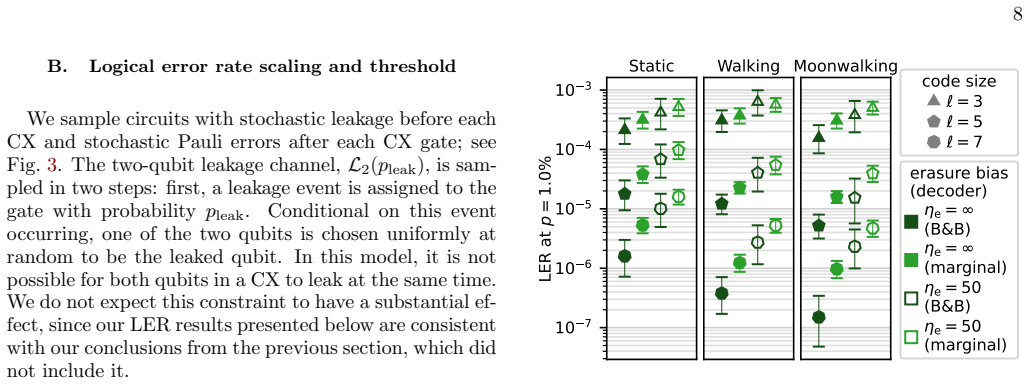
- [Sec. V B, Fig. 5] The central moonwalking/EC8/skip-gate combination requires branch-and-bound decoding to reach t_E = ℓ according to Table IV, but Sec. V B states that branch-and-bound decoding was performed only for ℓ ≤ 7. If the α ≈ 1 points at ℓ = 9, 11 come from marginal decoding, they do not test the claimed t_E = ℓ regime. The manuscript should report the ℓ range of every branch-and-bound data point in Fig. 5 and either extend the branch-and-bound simulations to larger ℓ or state explicitly that the large-ℓ scaling is an extrapolation.
- [Appendix B 4 b] The branch-and-bound decoder is claimed to solve the quasi-MLE problem exactly only for infinite erasure bias; for finite erasure bias it is heuristic. Since finite-bias data (e.g., η = 50 in Fig. 5) are used to support the scaling claim, the paper should either provide a stronger optimality argument for finite bias or explicitly characterize the possible failure modes. As written, the finite-bias result is evidence, not a proof, and the text should not imply that the decoder is quasi-MLE-optimal in that regime.
minor comments (5)
- [Abstract and Sec. II B] The abstract should mention that the result assumes ideal three-state readout and no seepage; these conditions are stated only later in the paper.
- [Fig. 5] The categorical x-axis with horizontal offsets and many markers is difficult to read; small multiples or separate panels by decay model would improve clarity.
- [Footnote [38]] Typo: 'leakage a some point' should read 'leakage at some point.'
- [Table II and Sec. III B] The EC schedule labels 1/2/4/8 are counterintuitive because they refer to the maximum number of two-qubit gates between checks. The text explains this, but repeating the definition in the Table II caption would prevent reader confusion.
- [Appendix C] Figures 12 and 13 include Stim-style gate identifiers that are not human-readable. Replacing or annotating these with a schematic circuit diagram would improve reproducibility and accessibility.
Circularity Check
No significant circularity: the t_E values are computed from the circuit and noise model, and the predicted p_L ∝ p^ℓ scaling is checked against independent Stim circuit-level simulations rather than imported from a fit.
full rationale
The derivation chain is self-contained rather than circular. In Sec. V A the minimum uncorrectable leakage-fault weight t_E is obtained by explicit enumeration of weight-1 and weight-2 leakage faults on a 3×3 circuit using the actual circuit and noise model, with the ℓ×ℓ values inferred from the tiled structure of the surface code. In Sec. V B the logical error rate is independently sampled with Stim for ℓ ∈ {3,5,7,9,11} and fit to p_L = c(p/p_th)^{αℓ}; the extracted scaling exponent α is then compared with t_E, and the agreement is presented as verification, not as an input. The branch-and-bound decoder's role is also not circular: it enforces the leakage-disjointness constraint that is explicitly derived from the skip-gate leakage model, and its ability to restore t_E = ℓ is demonstrated by simulation and by explicit fault-pair examples in Appendix C. The moonwalking circuit is obtained from explicit circuit equivalences and compared with prior circuits, not introduced as a definition of the claimed result. The paper's self-citations are background (e.g., erasure-qubit hardware demonstrations, imperfect erasure-check studies) and are not load-bearing for the central scaling claim; the key external tools (Stim, PyMatching, the Pauli-envelope framework [25]) are either independently reproducible or re-derived in the appendices. The stated idealizations—100%-fidelity three-state readout and no seepage—are genuine limitations that condition the headline claim, but they do not make the derivation circular.
Assumptions & free parameters
assumptions (9)
- domain assumption Surface code fault distances for ℓ×ℓ codes follow by tiling from a 3×3 circuit.
- domain assumption Leakage occurs with probability p_leak before each CX; two-qubit depolarizing noise p_pauli after each CX; only one qubit leaks per gate.
- domain assumption Leakage is equally likely from |0⟩ and |1⟩ (arranged by design or twirling).
- domain assumption Skip-gate leaked-qubit effect: a leaked qubit deterministically cancels/skips a two-qubit gate.
- domain assumption Erasure checks (mid-circuit and three-state) are 100% faithful; leakage-SWAP gates are noiseless.
- domain assumption No seepage: a leaked qubit remains leaked until reset; a qubit can leak at most once between checks.
- standard math Pauli-envelope replacement of resets by full depolarization is a valid over-approximation for decoding.
- domain assumption All candidate leakage locations for a triggered erasure check are equally likely (Pi,j ≈ 1/Ni).
- ad hoc to paper Branch-and-bound decoding exactly solves quasi-MLE for infinite erasure bias and approximates it for finite bias.
Cite this review
Pith. "Pith review of Erasure surface code circuit without mid-circuit erasure checks." pith.science (2026). https://pith.science/paper/7GJF44OP
@misc{pith2026260729443,
  author       = {Pith},
  title        = {Pith review of: Erasure surface code circuit without mid-circuit erasure checks},
  year         = {2026},
  howpublished = {\url{https://pith.science/paper/7GJF44OP}},
  note         = {Machine review of arXiv:2607.29443}
}
read the original abstract
Quantum error correction (QEC) codes can correct twice as many erasure errors as Pauli errors. Because of this scaling advantage, there is significant interest in developing qubits whose dominant error channel can be converted into erasures via mid-circuit erasure checks. However, such erasure checks come with hardware overhead in practice. End-of-the-line three-state readout, in which one simultaneously measures a qubit's erasure status and computational state, is an alternative to mid-circuit erasure checks that is generally simpler to implement. In this work, we systematically study the conditions required to enable erasure performance---the doubled error-correction capacity---in the surface code with and without mid-circuit erasure checks. We introduce the moonwalking surface code, the time-reversal of the walking surface code, as a zero-overhead circuit with superior handling of leakage and erasure. Specifically, we show that it enables erasure-like logical error rate scaling when combined with three-state measurement if leaked qubits cause two-qubit gates to be skipped and an appropriate decoder is used. Our decoder, based on a branch-and-bound algorithm, specifically incorporates the noise structure of the skip-gate leaked-qubit effect.
Figures


Figures from the paper (9 more)


Reference graph
Works this paper leans on
-
[23]
Chang, S
K. Chang, S. Singh, J. Claes, K. Sahay, J. Teoh, and S. Puri, Surface Code with Imperfect Erasure Checks, PRX Quantum 6, 040355 (2025)
2025
-
[1]
C. H. Bennett, D. P. DiVincenzo, and J. A. Smolin, Ca- pacities of Quantum Erasure Channels, Phys. Rev. Lett. 78, 3217 (1997)
1997
-
[2]
Grassl, Th
M. Grassl, Th. Beth, and T. Pellizzari, Codes for the quantum erasure channel, Phys. Rev. A 56, 33 (1997)
1997
-
[3]
A. G. Fowler, Coping with qubit leakage in topological codes, Phys. Rev. A 88, 042308 (2013)
2013
-
[4]
S. Gu, A. Retzker, and A. Kubica, Fault-tolerant quan- tum architectures based on erasure qubits, Phys. Rev. Res. 7, 013249 (2025)
2025
-
[6]
N. Mehta, J. D. Teoh, T. Noh, A. Agrawal, A. An- derson, B. Birdsall, A. Brahmbhatt, W. Byrd, M. Ca- cioppo, A. Cabrera, L. Carroll, J. Chen, T.-C. Chien, R. Chamberlain, J. C. Curtis, D. Danso, S. R. Desigan, F. D’Acounto, B. H. Elfeky, S. M. Farzaneh, C. Foley, B. Gudlewski, H. Hastings, R. Johnson, N. Khedkar, T. Keen, A. Kumar, C. Kurter, K. Krawczuk,...
arXiv 2025
-
[7]
Y. Wu, S. Kolkowitz, S. Puri, and J. D. Thompson, Era- sure conversion for fault-tolerant quantum computing in alkaline earth Rydberg atom arrays, Nat Commun 13, 4657 (2022)
2022
-
[8]
Scholl, A
P. Scholl, A. L. Shaw, R. B.-S. Tsai, R. Finkelstein, J. Choi, and M. Endres, Erasure conversion in a high- fidelity Rydberg quantum simulator, Nature 622, 273 (2023)
2023
Show all 54 references
-
[9]
S. Ma, G. Liu, P. Peng, B. Zhang, S. Jandura, J. Claes, A. P. Burgers, G. Pupillo, S. Puri, and J. D. Thompson, High-fidelity gates and mid-circuit erasure conversion in an atomic qubit, Nature 622, 279 (2023)
2023
-
[10]
M. Kang, W. C. Campbell, and K. R. Brown, Quan- tum Error Correction with Metastable States of Trapped Ions Using Erasure Conversion, PRX Quantum4, 020358 (2023)
2023
-
[11]
Quinn, G
A. Quinn, G. J. Gregory, I. D. Moore, S. Brudney, J. Metzner, E. R. Ritchie, J. O’Reilly, D. J. Wineland, and D. T. C. Allcock, High-fidelity entanglement of metastable trapped-ion qubits with integrated erasure conversion, Phys. Rev. A 113, L040601 (2026)
2026
-
[12]
Kubica, A
A. Kubica, A. Haim, Y. Vaknin, H. Levine, F. Brand˜ ao, and A. Retzker, Erasure Qubits: Overcoming the t1 Limit in S uperconducting Circuits, Phys. Rev. X 13, 041022 (2023)
2023
-
[13]
J. D. Teoh, P. Winkel, H. K. Babla, B. J. Chapman, J. Claes, S. J. de Graaf, J. W. O. Garmon, W. D. Kalfus, Y. Lu, A. Maiti, K. Sahay, N. Thakur, T. Tsun- oda, S. H. Xue, L. Frunzio, S. M. Girvin, S. Puri, and R. J. Schoelkopf, Dual-rail encoding with supercon- ducting cavitie...
2023
-
[14]
Levine, A
H. Levine, A. Haim, J. S. C. Hung, N. Alidoust, M. Kalaee, L. DeLorenzo, E. A. Wollack, P. Arrangoiz- Arriola, A. Khalajhedayati, R. Sanil, H. Moradinejad, Y. Vaknin, A. Kubica, D. Hover, S. Aghaeimeibodi, J. A. Alcid, C. Baek, J. Barnett, K. Bawdekar, P. Bienias, H. A. Carson...
2024
-
[15]
Koottandavida, I
A. Koottandavida, I. Tsioutsios, A. Kargioti, C. R. Smith, V. R. Joshi, W. Dai, J. D. Teoh, J. C. Curtis, L. Frunzio, R. J. Schoelkopf, and M. H. Devoret, Erasure Detection of a Dual-Rail Qubit Encoded in a Double-Post Superconducting Cavity, Phys. Rev. Lett. 132, 180601 (2024)
2024
-
[16]
Liu, Y.-Y
B.-J. Liu, Y.-Y. Wang, Y.-X. Wang, M. Badbaria, S. Puri, and C. Wang, Hardware-efficient erasure qubits with superconducting transmon qutrits (2026), arXiv:2604.08672 [quant-ph]
2026 arXiv
-
[17]
Knill, R
E. Knill, R. Laflamme, and G. J. Milburn, A scheme for efficient quantum computation with linear optics, Nature 409, 46 (2001)
2001
-
[18]
T.-Y. Wu, A. Kumar, F. Giraldo, and D. S. Weiss, Stern–Gerlach detection of neutral-atom qubits in a state-dependent optical lattice, Nat. Phys. 15, 538 (2019)
2019
-
[19]
Bluvstein, A
D. Bluvstein, A. A. Geim, S. H. Li, S. J. Evered, J. P. Bonilla Ataides, G. Baranes, A. Gu, T. Manovitz, M. Xu, M. Kalinowski, S. Majidy, C. Kokail, N. Maskara, E. C. Trapp, L. M. Stewart, S. Hollerith, H. Zhou, M. J. Gullans, S. F. Yelin, M. Greiner, V. Vuleti´ c, M. Cain, an...
2026
-
[20]
Neeley, M
M. Neeley, M. Ansmann, R. C. Bialczak, M. Hofheinz, E. Lucero, A. D. O’Connell, D. Sank, H. Wang, J. Wen- ner, A. N. Cleland, M. R. Geller, and J. M. Martinis, Emulation of a Quantum Spin with a Superconducting Phase Qudit, Science 325, 722 (2009)
2009
-
[21]
Bianchetti, S
R. Bianchetti, S. Filipp, M. Baur, J. M. Fink, C. Lang, L. Steffen, M. Boissonneault, A. Blais, and A. Wallraff, Control and Tomography of a Three Level Superconduct- ing Artificial Atom, Phys. Rev. Lett. 105, 223601 (2010)
2010
-
[22]
Chen, H.-X
L. Chen, H.-X. Li, Y. Lu, C. W. Warren, C. J. Kriˇ zan, S. Kosen, M. Rommel, S. Ahmed, A. Osman, J. Bizn´ arov´ a, A. Fadavi Roudsari, B. Lienhard, M. Ca- puto, K. Grigoras, L. Gr¨ onberg, J. Govenius, A. F. Kockum, P. Delsing, J. Bylander, and G. Tancredi, Transmon qubit read...
2023
-
[24]
Yu, Z.-H
C.-C. Yu, Z.-H. Chen, Y.-H. Deng, C.-Y. Lu, M.-C. Chen, and J.-W. Pan, Taming Rydberg Decay with Measurement-Based Quantum Computation, Phys. Rev. Lett. 136, 160601 (2026)
2026
-
[25]
P. Liu, S. J. S. Tan, E. Huang, U. A. Acar, H. Zhou, and C. Zhao, Achieving optimal-distance atom-loss correction via pauli envelope (2026), arXiv:2603.04156 [quant-ph]
2026 arXiv
-
[26]
J. J. Wallman and J. Emerson, Noise tailoring for scalable quantum computation via randomized compiling, Phys. Rev. A 94, 052325 (2016)
2016
-
[27]
Ghosh, A
J. Ghosh, A. G. Fowler, J. M. Martinis, and M. R. Geller, Understanding the effects of leakage in superconduct- ing quantum-error-detection circuits, Phys. Rev. A 88, 062329 (2013)
2013
-
[28]
Suchara, A
M. Suchara, A. W. Cross, and J. M. Gambetta, Leakage suppression in the Toric code, Quantum Info. Comput. 15, 997–1016 (2015)
2015
-
[29]
N. C. Brown and K. R. Brown, Comparing Zeeman qubits to hyperfine qubits in the context of the surface code: 174Yb+ and 171Yb+, Phys. Rev. A 97, 052301 (2018)
2018
-
[30]
N. C. Brown and K. R. Brown, Leakage mitigation for quantum error correction using a mixed qubit scheme, Phys. Rev. A 100, 032325 (2019)
2019
-
[31]
S. Gu, Y. Vaknin, A. Retzker, and A. Kubica, Optimiz- ing Quantum Error-Correction Protocols with Erasure Qubits, PRX Quantum 6, 040354 (2025)
2025
-
[32]
If the ancilla is to be reset to |+⟩, we suppose it is reset to |0⟩, then the leakage-SW AP gate is applied, then a Hadamard is applied to the ancilla qubit
-
[33]
Gidney, Stim: A fast stabilizer circuit simulator, Quantum 5, 497 (2021)
C. Gidney, Stim: A fast stabilizer circuit simulator, Quantum 5, 497 (2021)
2021
-
[34]
McEwen, D
M. McEwen, D. Bacon, and C. Gidney, Relaxing Hard- ware Requirements for Surface Code Circuits using Time- dynamics, Quantum 7, 1172 (2023)
2023
-
[35]
[31], as ours label period, whereas theirs label the frequency
Note that our EC schedule labels are reversed relative to Ref. [31], as ours label period, whereas theirs label the frequency
-
[36]
Higgott and C
O. Higgott and C. Gidney, Sparse Blossom: Correcting a million errors per core second with minimum-weight matching, Quantum 9, 1600 (2025)
2025
-
[37]
Pavlovich, github.com/magzpavz/surface-code- leakage-erasure (2026)
M. Pavlovich, github.com/magzpavz/surface-code- leakage-erasure (2026)
2026
-
[38]
If we have taken N samples and have seen m unique syndromes, the probability of there being a syndrome we have not sampled is less than (1 − 1 m+1 )N
Because the Pauli envelopes for leakage events consist of fully depolarizing or dephasing errors, every possible syndrome is equally likely. If we have taken N samples and have seen m unique syndromes, the probability of there being a syndrome we have not sampled is less than ...
-
[39]
Raussendorf, J
R. Raussendorf, J. Harrington, and K. Goyal, A fault- tolerant one-way quantum computer, Annals of Physics 321, 2242 (2006)
2006
-
[40]
Raussendorf, J
R. Raussendorf, J. Harrington, and K. Goyal, Topologi- cal fault-tolerance in cluster state quantum computation, New J. Phys. 9, 199 (2007)
2007
-
[41]
A. Bolt, G. Duclos-Cianci, D. Poulin, and T. M. Stace, Foliated Quantum Error-Correcting Codes, Phys. Rev. Lett. 117, 070501 (2016)
2016
-
[42]
B. J. Brown and S. Roberts, Universal fault-tolerant measurement-based quantum computation, Phys. Rev. Res. 2, 033305 (2020)
2020
-
[43]
Claes, J
J. Claes, J. E. Bourassa, and S. Puri, Tailored cluster states with high threshold under biased noise, npj Quan- tum Inf. 9, 9 (2023)
2023
-
[44]
T. B. Smith et al., in Preparation
-
[45]
A. G. Fowler, Proof of Finite Surface Code Threshold for Matching, Phys. Rev. Lett. 109, 180502 (2012)
2012
-
[46]
The deviation of this from a flat 1 /Ni distribution is negligible as p ≲ 10−2 and Ni ≤ 8
The probability that the leakage occurred at the jth (where j = 1 is the earliest) possible leakage location for erasure check i is Pi,j = (1−p)j−1p 1−(1−p)Ni ≈ 1−(j−1)p Ni , where p is the a priori probability of leakage at any given location and Ni is the total number of pos...
-
[47]
Since the goal here is simply to demonstrate the necessity of the statistical independence of errors, this does not affect the conclusion
This expression for the probability of a fault also assumes that there is only one decomposition for the fault. Since the goal here is simply to demonstrate the necessity of the statistical independence of errors, this does not affect the conclusion. Appendix A: Construction o...
-
[48]
A DEM is simply the set of errors that may occur in a circuit
Detector error models and graphs Both decoding strategies we employ in this work are based on calculating and manipulating detector error models (DEMs). A DEM is simply the set of errors that may occur in a circuit. For each error, we have 13 its probability, which detectors i...
-
[49]
The Pauli envelope framework was introduced in [25]
Pauli envelopes The impact of a particular leakage event can be bounded by a Pauli channel called itsPauli envelope[25]. The Pauli envelope framework was introduced in [25]. We expand its usage to different leakage effects and provide an intuitive derivation of the Pauli envel...
-
[50]
Marginal decoding In most cases, we use only the marginal decoding strategy because it is fast. It is identical to the effec- tive circuit construction of [4] for depolarizing leakage, but we formulate it in terms of DEM composition for computational efficiency and for easier ...
-
[51]
disjointness of leakage events
Quasi-MLE decoding We are motivated by the failure of the marginal de- coding strategy to maintain the expected minimum fault weight for all EC schedules to develop a new strategy which strictly enforces the disjointness of leakage events. This new strategy is described in thi...
-
[52]
Constructing a partially constrained candidate graph and decoding on it
-
[53]
Checking if a proposed solution is valid, i.e., if it is consistent with the disjointness constraint of leak- age locations
-
[54]
problematic
Further constraining the candidate graph based on inconsistencies with disjointness. (1) Recall that there are M = |{ECi}| triggered era- sure checks. A partially constrained candidate graph has (1) Construct marginal graph by averaging over each erasure check’s possible leaka...
-
[55]
This X error arises from the qubit being depolarized when it is reset to the logical subspace after the triggered erasure check
The second X error on qubit 4 in the lower panel flips the code’s logical ¯Z operator. This X error arises from the qubit being depolarized when it is reset to the logical subspace after the triggered erasure check. The initial and final states show detecting regions as descri...
Reviewed August 4, 2026 · model on record in the stance chip above.
Discussion (0). Continue with ORCID to comment.