REVIEW 4 major objections 5 minor 68 references
Hallucinate, Ground, Repeat: A Framework for Generalized Visual Relationship Detection
T0 review · 4 major / 5 minor · reviewed 2026-08-07 · deepseek-v4-flash
Pith's one-line read The paper claims that a visual relationship detector can be trained to recognize predicates that never appeared in its training data, using only LLM-hallucinated relationship triplets that are iteratively grounded in image evidence.
desk verdict Useful benchmark and honest writing, but the unseen-generalization claim collapses once you notice the unseen predicates are in the LLM-generated training set. read the letter →
The pith
A machine-rendered reading of the paper's core claim, the machinery that carries it, and where it could break.
The reading
What carries the argument
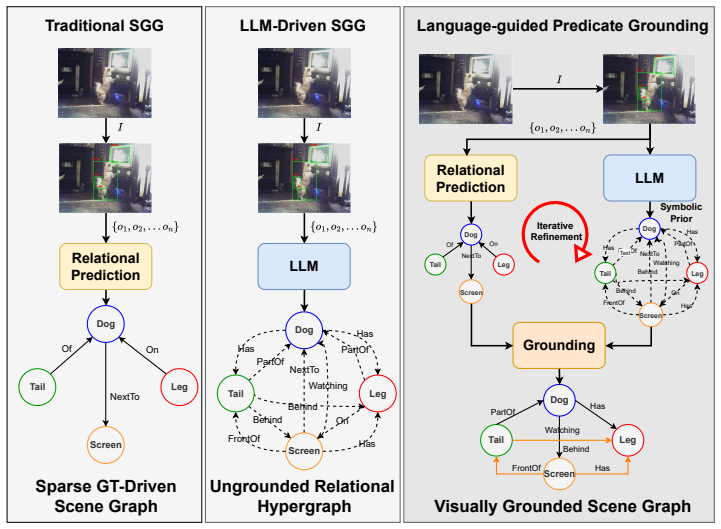
The central object is a semantic relational hypergraph: for each ordered pair of detected objects, the LLM proposes multiple predicates, so each pair carries a set of plausible relations rather than a single edge. This overcomplete symbolic prior, combined with an EM-style refinement loop, carries the argument. The expectation step instantiates the prior with GPT-4o (prompted with object classes, ordered pairs, and a fixed predicate list); the maximization step trains the visual grounding model to maximize log-likelihood of the hallucinated triplets given the image; and the loop closes by adding the model's own high-confidence seen-predicate predictions (above threshold τ = 0.8) to the training set and iterating until convergence (about three iterations). The visual model itself is a decoder-only transformer that builds query embeddings from RoI-pooled visual features and semantic word embeddings of subject and object, and attends over frozen DETR features for global scene context.
What would settle it
Feed the LLM corrupted object labels (e.g., swap 'bottle' with 'bird') while keeping the images fixed, retrain EM-Grounding, and check whether its predicate predictions shift accordingly; if the model's errors track the corrupted hallucinations, then the visual grounding step is not filtering the prior using image evidence. Alternatively, build a test set of images with unusual spatial arrangements where the LLM's most plausible relation for a pair is false, and verify whether the model still predicts the LLM's top-ranked predicate at high confidence.
Extended reading notes
Core claim
The central discovery is that semantically plausible but visually ungrounded relationship hypotheses—hallucinated by an LLM from object category names alone—can be turned into a training signal for visual relationship detection by an iterative expectation-maximization style loop. In the expectation step, GPT-4o generates a multi-relational hypergraph: for each ordered object pair, up to five ranked predicates with confidence scores, based only on the list of detected classes and the fixed 50-predicate vocabulary. In the maximization step, a decoder-only transformer (adapted from IS-GGT, with DETR image features as global context) is trained to predict those triplets from the image, then its high-confidence within-vocabulary predictions above a threshold are added to the training set, and the model is fine-tuned again. With no ground-truth triplets used at any point, this refinement produces mean recall mR@50 of 15.9 on seen, 13.1 on unseen, and 11.7 on mixed predicates, and on the full Visual Genome test set the model trained on just 475 images and 2.2k hallucinated triplets outperforms fully supervised IMP+ and Neural Motifs. The authors claim that visual grounding of symbolic priors enables generalization to novel relationships.
Load-bearing premise
The load-bearing premise (Sec 4.1) is that relationship triplets hallucinated by the LLM from object class names alone—with no spatial layout, attributes, or image content—are true often enough that training a visual model to predict them improves generalization; if those priors are systematically wrong for a scene, the model learns false relationships, and the refinement loop (Sec 4.3) only adds back high-confidence seen-predicate predictions, amplifying rather than correcting the error.
Editorial extensions
If this is right
- A relationship classifier can be trained with zero human-annotated predicate labels: the fully grounded EM-Grounding model reaches mR@50 of 15.9 on seen predicates, outperforming the fully supervised GGT baseline's 13.0.
- The same training loop transfers to held-out predicates: on the unseen-only split, EM-Grounding reaches mR@50 of 13.1, where fully supervised models (GGT, FGPL, HiKER-SGG) collapse to 0.0.
- On mixed scenes containing both seen and unseen predicates, EM-Grounding reaches mR@50 of 11.7, indicating that refinement supports compositional generalization rather than memorizing the seen predicate set.
- The framework bridges a large supervision gap on the full Visual Genome test set: despite training on only 475 images and 2.2k triplets versus 57k images and 405k triplets for fully supervised models, the paper reports that it outperforms IMP+ and Neural Motifs and approaches VCTree.
Reading between the lines
- If the LLM prior itself carries bias, the grounding loop is more likely to amplify than correct it, since the model maximizes likelihood of the hallucinated triplets and refinement only adds back confident seen-predicate predictions; the paper acknowledges inherited bias but does not measure it.
- The overcomplete hypergraph may act as a regularizer independently of the LLM's semantic content; a testable extension would replace the LLM with a frequency- or randomness-based prior and compare unseen-set recall to isolate the contribution of semantic plausibility.
- The same hallucinate-ground-repeat loop could transfer to other structured prediction tasks with scarce annotation, such as video action graphs or affordance prediction, where LLM knowledge of everyday interactions is rich.
- Feeding spatial layout or attribute information into the LLM prompt, or using a vision-language model to build the prior, could reduce false grounding in unusual scenes; the paper names this direction as future work.
Editorial analysis
A structured set of objections, weighed in public.
Referee Report
Summary. The paper proposes EM-Grounding, a weakly supervised framework for visual relationship detection that uses GPT-4o to hallucinate candidate (subject, predicate, object) triplets from object category labels alone, then trains an IS-GGT-style visual model on those pseudo-labels (Eq. 2) and iteratively augments the training set with high-confidence seen-predicate predictions (Eq. 3). The authors introduce a new Visual Genome benchmark split into seen, unseen, and mixed predicate subsets and report PredCls/SGCls/SGDet results, with headline PredCls mR@50 values of 15.9 (seen), 13.1 (unseen), and 11.3 (mixed). The central claim is that visual grounding of LLM priors enables generalization to unseen predicates without human relationship labels.
Significance. If the claims were sound, the paper would be a useful contribution: it attacks a real limitation of closed-world SGG, proposes a low-supervision training recipe, releases a structured benchmark with seen/unseen/mixed splits, and compares against several supervision regimes including few-shot and debiased baselines. The iterative hallucinate-and-ground loop is a reasonable design idea, and the ablation of the confidence threshold (Fig. 3b) is a useful practical detail. However, the central generalization claim is currently undercut by a training-set leakage problem: the LLM prompt lists all 50 predicates, including the 21 predicates later classified as unseen, and Eq. 2 trains on the resulting pseudo-labels. Because the 'unseen' evaluation is therefore not blind, the reported unseen-predicate gains do not yet establish generalization to novel relationships.
major comments (4)
- [Section 5, Sec 4.1, App. 11.2, Eq. 2] The statement in Section 5 that 'the training set is disjoint from any unseen predicates' is inconsistent with the pipeline described in Sec 4.1 and App 11.2. The GPT-4o prompt in App 11.2 lists all 50 predicates, including the 21 predicates that are later designated unseen, and the hallucinated set T_hat produced from this prompt is used directly as the supervision in Eq. 2. Consequently, the pseudo-label training set contains unseen-predicate triplets, and the unseen-split results in Table 1 measure the model's ability to learn noisy labels for test-vocabulary predicates rather than its ability to visually ground a prior over novel relationships. This is a load-bearing issue for the paper's central claim and must be fixed, ideally by filtering T_hat to the seen predicate set (or by constraining the LLM prompt to seen predicates only) and then re-running all experiments and tables.
- [Eq. 2, Eq. 3, Table 1] The training objective in Eq. 2 maximizes the likelihood of positive LLM-generated triplets only; there is no negative or background term, so nothing in the loss directly forces the model to reject plausible-but-absent triplets. The refinement step in Eq. 3 adds only high-confidence seen-predicate predictions and never removes or downweights incorrect hallucinated edges. The empirical evidence that the grounding/refinement loop is what drives the unseen-predicate scores is weak: in Table 1, EM-Grounding (None) reaches 13.1 mR@50 on unseen vs. 12.9 for GPT4o+GGT (which uses the same pseudo-labels without refinement) and 11.4 for the ungrounded GPT-4o baseline, while on mixed mR@50 it is 11.3 vs. 11.4 for GPT4o+GGT. These margins do not support the claim that visual grounding of symbolic priors, rather than the LLM prior itself, produces the unseen-predicate performance.
- [App. 11.2, Sec 4.1] The appendix states that 'In all our experiments we only use the predicate with the highest score from these predictions in order to get the triplets.' This contradicts Sec 4.1's description of a multi-relational symbolic prior that returns up to five ranked predicates per object pair and forms a semantic relational hypergraph. If only the highest-scoring predicate per pair is used, then Eq. 2 is trained on single-label triplets, and the claimed hypergraph formulation and the ambiguity-resolution mechanism are not actually exercised. The authors should clarify which protocol was used and, if the hypergraph claim is to be retained, rerun the experiments with the full ranked set of predicates as training targets.
- [Sec 5, Table 3, Table 1] The unseen-only evaluation set is very small (167 images, 19 predicates, 361 triplets), and all reported mR@K values are point estimates with no confidence intervals or significance tests. Given that the margins between methods on unseen and mixed mR@50 are around 0.1–0.2 points, the reported ordering of baselines should not be treated as established without variance estimates or repeated-seed results.
minor comments (5)
- [Table 1 caption] The caption says EM-Grounding 'consistently outperforms' all weakly- and few-shot baselines, but on mixed mR@50 the Ours (None) row is 11.3 vs. 11.4 for GPT4o+GGT; the word 'consistently' is too strong for this table.
- [Table 3] The table uses rows labeled 'Val - Seen', 'Val - Unseen', and 'Val - Mixed', but the text in Section 5 says the evaluation set merges the original VG validation and test splits; the table heading or text should be made consistent.
- [Eq. 1] Equation 1 has a typographical oddity ('max θ ; EI,O') and the surrounding sentence 'where {T*, T̂} ∈ T is the space of all candidate triplets' is grammatically unclear; please rewrite this notation.
- [Fig. 3] Figure 3 reports ablation results but does not define the axes or include error bars; adding axis labels and indicating the number of runs would help the reader interpret the threshold and iteration curves.
- [Section 6, 'Generalized Prediction'] The text claims EM-Grounding 'significantly outperforms all baselines' on the mixed split, but the reported mixed mR@50 is not above GPT4o+GGT; please temper this claim or provide statistical support.
Circularity Check
Unseen predicates are present in the LLM-generated training pseudo-labels, so the 'unseen' evaluation is not blind.
-
fitted input called prediction
[Sec. 4.1 and Sec. 4.2, Eq. (2)]
"The LLM is prompted with the full list of object categories, all possible ordered object pairs from the image, and a fixed list of 50 predicates (aligning with Visual Genome semantics). ... We supervise the model using only the hallucinated triplets ˆT from the LLM and train it to align symbolic hypotheses with visual content by minimizing: Lalign = − X (s,p,o) ∈ ˆT log Pθ(p | s,o,I)."
The fixed 50-predicate list in the prompt is the same vocabulary from which the seen/unseen splits are carved, so the 19-21 'held-out' predicates are among the labels the LLM is allowed to propose. The pseudo-label set ˆT is therefore not disjoint from the unseen test vocabulary, and Eq. (2) trains Pθ directly on those unseen-predicate labels. The later 'unseen' evaluation then measures learning of the LLM-generated labels for those predicates, not generalization from a prior over novel predicates; the refinement loop adds only seen high-confidence triplets but never removes the unseen-predicate supervision already present in ˆT.
-
self definitional
[Sec. 5, Experimental Setup]
"Importantly, the training set is disjoint from any unseen predicates. For evaluation, we merge the original VG validation and test splits to create a combined set of 5,777 images, comprising 40,884 annotated triplets across 50 predicates."
The sentence defines the training set as the 2,226 human-annotated triplets from 475 images, which indeed contain only the 29 'seen' predicates. But the actual model supervision in Eq. (2) is the LLM hallucinated set ˆT, not the human annotations. Because the LLM prompt explicitly allows all 50 predicates, ˆT includes the predicates that Sec. 5 later labels 'unseen,' so the claim that training is disjoint from unseen predicates is true only for the human labels and false for the pseudo-labels used to train the model. Consequently, the 'unseen' split is not unseen relative to the training signal.
full rationale
The score is 6 because a central 'prediction' — generalization to unseen predicates — reduces by construction to training on LLM pseudo-labels that already contain those unseen predicate labels. The paper's own equations show that Eq. (2) maximizes likelihood over every triplet in ˆT, and Sec. 4.1 shows that ˆT is generated under a prompt restricted to a fixed list of all 50 predicates, which is the same vocabulary later partitioned into seen and unseen. The claimed disjointness of the training set from unseen predicates in Sec. 5 refers only to human-annotated triplets, not to the actual pseudo-label supervision. This is a concrete, quotable reduction rather than a vague concern. The circularity is not driven by self-citation: IS-GGT is used as an architecture, and GPT-4o is an external knowledge source, so those aspects are independently grounded. Even so, the headline unseen-predicate results (e.g., mR@50 = 13.1) are contaminated by the presence of those labels in the training signal, so the paper's central generalization claim is not yet supported by its benchmark.
Assumptions & free parameters
free parameters (3)
- confidence threshold tau =
0.8
- number of refinement iterations =
3
- LLM predicate ranking depth =
top-1 (up to 5 requested)
assumptions (5)
- domain assumption LLM-generated triplets derived only from object category names are a useful prior for visual relationships.
- domain assumption Maximizing likelihood of LLM pseudo-labels learns visual grounding without any negative examples.
- domain assumption The 475-image and 29-predicate training subset is representative enough to support generalization claims.
- domain assumption GPT-4o is treated as a reliable external knowledge source; its hallucination distribution is not validated against Visual Genome statistics.
- domain assumption The GGT graph decoder used for edge sampling can be trained from scratch without leaking ground-truth labels.
invented entities (2)
-
Latent grounding variable T*
-
Semantic relational hypergraph
Cite this review
Pith. "Pith review of Hallucinate, Ground, Repeat: A Framework for Generalized Visual Relationship Detection." pith.science (2026). https://pith.science/paper/7GRQVU4A
@misc{pith2026250605651,
  author       = {Pith},
  title        = {Pith review of: Hallucinate, Ground, Repeat: A Framework for Generalized Visual Relationship Detection},
  year         = {2026},
  howpublished = {\url{https://pith.science/paper/7GRQVU4A}},
  note         = {Machine review of arXiv:2506.05651}
}
read the original abstract
Understanding relationships between objects is central to visual intelligence, with applications in embodied AI, assistive systems, and scene understanding. Yet, most visual relationship detection (VRD) models rely on a fixed predicate set, limiting their generalization to novel interactions. A key challenge is the inability to visually ground semantically plausible, but unannotated, relationships hypothesized from external knowledge. This work introduces an iterative visual grounding framework that leverages large language models (LLMs) as structured relational priors. Inspired by expectation-maximization (EM), our method alternates between generating candidate scene graphs from detected objects using an LLM (expectation) and training a visual model to align these hypotheses with perceptual evidence (maximization). This process bootstraps relational understanding beyond annotated data and enables generalization to unseen predicates. Additionally, we introduce a new benchmark for open-world VRD on Visual Genome with 21 held-out predicates and evaluate under three settings: seen, unseen, and mixed. Our model outperforms LLM-only, few-shot, and debiased baselines, achieving mean recall (mR@50) of 15.9, 13.1, and 11.7 on predicate classification on these three sets. These results highlight the promise of grounded LLM priors for scalable open-world visual understanding.
Figures


Figures from the paper (6 more)


Reference graph
Works this paper leans on
-
[1]
S. N. Aakur, S. Kundu, and N. Gunti. Knowledge guided learning: Open world egocentric action recognition with zero supervision. Pattern recognition letters, 156:38–45, 2022
work page 2022
-
[2]
A. Bendale and T. Boult. Towards open world recognition. In Proceedings of the IEEE conference on computer vision and pattern recognition, pages 1893–1902, 2015
work page 1902
-
[3]
B. Brattoli, J. Tighe, F. Zhdanov, P. Perona, and K. Chalupka. Rethinking zero-shot video classification: End-to-end training for realistic applications. In Proceedings of the IEEE/CVF conference on computer vision and pattern recognition, pages 4613–4623, 2020
work page 2020
- [4]
-
[5]
D. Chatterjee, F. Sener, S. Ma, and A. Yao. Opening the vocabulary of egocentric actions. Advances in Neural Information Processing Systems, 36:33174–33187, 2023
work page 2023
-
[6]
T. Chen, W. Yu, R. Chen, and L. Lin. Knowledge-embedded routing network for scene graph generation. In Proceedings of the IEEE/CVF Conference on Computer Vision and Pattern Recognition, pages 6163–6171, 2019
work page 2019
-
[7]
Z. Chen, J. Wu, Z. Lei, Z. Zhang, and C. W. Chen. Expanding scene graph boundaries: fully open-vocabulary scene graph generation via visual-concept alignment and retention. In European Conference on Computer Vision, pages 108–124. Springer, 2024
work page 2024
- [8]
Show all 68 references
-
[9]
Y . Cong, M. Y . Yang, and B. Rosenhahn. Reltr: Relation transformer for scene graph generation. IEEE Transactions on Pattern Analysis and Machine Intelligence, 45(9):11169–11183, 2023. 10
2023
-
[10]
Dhamo, A
H. Dhamo, A. Farshad, I. Laina, N. Navab, G. D. Hager, F. Tombari, and C. Rupprecht. Semantic image manipulation using scene graphs. In Proceedings of the IEEE/CVF conference on computer vision and pattern recognition, pages 5213–5222, 2020
2020
-
[11]
N. Dong, Y . Zhang, M. Ding, and G. H. Lee. Open World DETR: Transformer based Open World Object Detection, Dec. 2022. URLhttp://arxiv.org/abs/2212.02969. arXiv:2212.02969 [cs]
2022 arXiv
-
[12]
Y . Du, F. Wei, Z. Zhang, M. Shi, Y . Gao, and G. Li. Learning to Prompt for Open-V ocabulary Object Detection with Vision-Language Model. In 2022 IEEE/CVF Conference on Computer Vision and Pattern Recognition (CVPR), pages 14064–14073, New Orleans, LA, USA, June
2022
-
[13]
C. L. Folk, R. W. Remington, and J. C. Johnston. Involuntary covert orienting is contingent on attentional control settings. Journal of Experimental Psychology: Human perception and performance, 18(4):1030, 1992
1992
-
[14]
Gu, T.-Y
X. Gu, T.-Y . Lin, W. Kuo, and Y . Cui. Open-vocabulary Object Detection via Vision and Language Knowledge Distillation, May 2022. URL http://arxiv.org/abs/2104.13921. arXiv:2104.13921 [cs]
2022 arXiv
-
[15]
X. Hu, J. Chen, X. Li, Y . Guo, L. Wen, P. S. Yu, and Z. Guo. Towards understanding factual knowledge of large language models. In The Twelfth International Conference on Learning Representations, 2024
2024
-
[16]
Hurst, A
A. Hurst, A. Lerer, A. P. Goucher, A. Perelman, A. Ramesh, A. Clark, A. Ostrow, A. Welihinda, A. Hayes, A. Radford, et al. Gpt-4o system card. arXiv preprint arXiv:2410.21276, 2024
2024 arXiv
-
[17]
Itti and C
L. Itti and C. Koch. Computational modelling of visual attention. Nature Reviews Neuroscience, 2(3):194–203, 2001
2001
-
[18]
Johnson, R
J. Johnson, R. Krishna, M. Stark, L.-J. Li, D. Shamma, M. Bernstein, and L. Fei-Fei. Image retrieval using scene graphs. In Proceedings of the IEEE conference on computer vision and pattern recognition, pages 3668–3678, 2015
2015
-
[19]
D. P. Kingma. Adam: A method for stochastic optimization. arXiv preprint arXiv:1412.6980, 2014
2014 arXiv
-
[20]
Krishna, Y
R. Krishna, Y . Zhu, O. Groth, J. Johnson, K. Hata, J. Kravitz, S. Chen, Y . Kalantidis, L.-J. Li, D. A. Shamma, et al. Visual genome: Connecting language and vision using crowdsourced dense image annotations. International journal of computer vision, 123:32–73, 2017
2017
-
[21]
Kundu and S
S. Kundu and S. N. Aakur. Is-ggt: Iterative scene graph generation with generative transformers. In Proceedings of the IEEE/CVF Conference on Computer Vision and Pattern Recognition , pages 6292–6301, 2023
2023
-
[22]
Kundu, S
S. Kundu, S. Trehan, and S. N. Aakur. Discovering novel actions from open world egocentric videos with object-grounded visual commonsense reasoning. In European Conference on Computer Vision, pages 39–56. Springer, 2024
2024
-
[23]
Kundu, S
S. Kundu, S. Vellamchetti, and S. N. Aakur. Probres: Probabilistic jump diffusion for open-world egocentric activity recognition. arXiv preprint arXiv:2504.03948, 2025
2025
-
[24]
J. Li, D. Li, C. Xiong, and S. Hoi. Blip: Bootstrapping language-image pre-training for unified vision-language understanding and generation. In International conference on machine learning, pages 12888–12900. PMLR, 2022
2022
-
[25]
L. Li, L. Chen, Y . Huang, Z. Zhang, S. Zhang, and J. Xiao. The devil is in the labels: Noisy label correction for robust scene graph generation. In Proceedings of the IEEE/CVF Conference on Computer Vision and Pattern Recognition, pages 18869–18878, 2022
2022
-
[26]
R. Li, S. Zhang, B. Wan, and X. He. Bipartite graph network with adaptive message passing for unbiased scene graph generation. In Proceedings of the IEEE/CVF conference on computer vision and pattern recognition, pages 11109–11119, 2021. 11
2021
-
[27]
W. Li, H. Zhang, Q. Bai, G. Zhao, N. Jiang, and X. Yuan. Ppdl: Predicate probability distribution based loss for unbiased scene graph generation. In Proceedings of the IEEE/CVF Conference on Computer Vision and Pattern Recognition, pages 19447–19456, 2022
2022
-
[28]
X. Lin, C. Ding, J. Zhang, Y . Zhan, and D. Tao. Ru-net: Regularized unrolling network for scene graph generation. In Proceedings of the IEEE/CVF Conference on Computer Vision and Pattern Recognition, pages 19457–19466, 2022
2022
-
[29]
J. Loo, Z. Wu, and D. Hsu. Open scene graphs for open world object-goal navigation. arXiv preprint arXiv:2407.02473, 2024
2024 arXiv
-
[30]
X. Lyu, L. Gao, Y . Guo, Z. Zhao, H. Huang, H. T. Shen, and J. Song. Fine-grained predicates learning for scene graph generation. In Proceedings of the IEEE/CVF Conference on Computer Vision and Pattern Recognition, pages 19467–19475, 2022
2022
-
[31]
X. Lyu, L. Gao, P. Zeng, H. T. Shen, and J. Song. Adaptive fine-grained predicates learning for scene graph generation. IEEE Transactions on Pattern Analysis and Machine Intelligence, 45 (11):13921–13940, 2023
2023
-
[32]
A. J. Maule and A. C. Edland. The effects of time pressure on human judgement and decision making. In Decision making, pages 203–218. Routledge, 2002
2002
-
[33]
Nguyen, S
K. Nguyen, S. Tripathi, B. Du, T. Guha, and T. Q. Nguyen. In defense of scene graphs for image captioning. In Proceedings of the IEEE/CVF international conference on computer vision , pages 1407–1416, 2021
2021
-
[34]
S. V . Nuthalapati, R. Chandradevan, E. Giunchiglia, B. Li, M. Kayser, T. Lukasiewicz, and C. Yang. Lightweight visual question answering using scene graphs. In Proceedings of the 30th ACM International Conference on Information & Knowledge Management, pages 3353–3357, 2021
2021
-
[35]
J. Z. Pan, S. Razniewski, J.-C. Kalo, S. Singhania, J. Chen, S. Dietze, H. Jabeen, J. Omeliya- nenko, W. Zhang, M. Lissandrini, et al. Large language models and knowledge graphs: Opportunities and challenges. arXiv preprint arXiv:2308.06374, 2023
2023 arXiv
-
[36]
Petroni, T
F. Petroni, T. Rocktäschel, P. Lewis, A. Bakhtin, Y . Wu, A. H. Miller, and S. Riedel. Language models as knowledge bases? arXiv preprint arXiv:1909.01066, 2019
1909 arXiv
-
[37]
Radford, J
A. Radford, J. W. Kim, C. Hallacy, A. Ramesh, G. Goh, S. Agarwal, G. Sastry, A. Askell, P. Mishkin, J. Clark, et al. Learning transferable visual models from natural language supervision. In International conference on machine learning, pages 8748–8763. PmLR, 2021
2021
-
[38]
Ravichandran, L
Z. Ravichandran, L. Peng, N. Hughes, J. D. Griffith, and L. Carlone. Hierarchical representations and explicit memory: Learning effective navigation policies on 3d scene graphs using graph neural networks. In 2022 International Conference on Robotics and Automation (ICRA), pag...
2022
-
[39]
S. Shit, R. Koner, B. Wittmann, J. Paetzold, I. Ezhov, H. Li, J. Pan, S. Sharifzadeh, G. Kaissis, V . Tresp, and B. Menze. Relationformer: A unified framework for image-to-graph generation. In S. Avidan, G. Brostow, M. Cissé, G. M. Farinella, and T. Hassner, editors,Computer V...
2022
-
[40]
L. Shu, H. Xu, and B. Liu. Unseen class discovery in open-world classification. arXiv preprint arXiv:1801.05609, 2018
2018 arXiv
-
[41]
D. J. Simons and C. F. Chabris. Gorillas in our midst: Sustained inattentional blindness for dynamic events. Perception, 28(9):1059–1074, 1999
1999
-
[42]
K. P. Singh, J. Salvador, L. Weihs, and A. Kembhavi. Scene graph contrastive learning for embodied navigation. In Proceedings of the IEEE/CVF International Conference on Computer Vision (ICCV), pages 10884–10894, October 2023
2023
-
[43]
Snell, K
J. Snell, K. Swersky, and R. Zemel. Prototypical networks for few-shot learning. Advances in neural information processing systems, 30, 2017. 12
2017
-
[44]
Suhail, A
M. Suhail, A. Mittal, B. Siddiquie, C. Broaddus, J. Eledath, G. Medioni, and L. Sigal. Energy- based learning for scene graph generation. In Proceedings of the IEEE/CVF Conference on Computer Vision and Pattern Recognition (CVPR), pages 13936–13945, June 2021
2021
-
[45]
K. Tang, H. Zhang, B. Wu, W. Luo, and W. Liu. Learning to compose dynamic tree structures for visual contexts. In Proceedings of the IEEE/CVF Conference on Computer Vision and Pattern Recognition (CVPR), June 2019
2019
-
[46]
K. Tang, Y . Niu, J. Huang, J. Shi, and H. Zhang. Unbiased scene graph generation from biased training. In Proceedings of the IEEE/CVF Conference on Computer Vision and Pattern Recognition (CVPR), June 2020
2020
-
[47]
X. Wang, Q. Yang, Y . Qiu, J. Liang, Q. He, Z. Gu, Y . Xiao, and W. Wang. Knowledgpt: Enhancing large language models with retrieval and storage access on knowledge bases. arXiv preprint arXiv:2308.11761, 2023
2023 arXiv
-
[48]
J. M. Wolfe. Guided search 2.0 a revised model of visual search. Psychonomic Bulletin & Review, 1:202–238, 1994
1994
-
[49]
T. Wu, S. Ge, J. Qin, G. Wu, and L. Wang. Open-vocabulary spatio-temporal action detection. arXiv preprint arXiv:2405.10832, 2024
2024 arXiv
-
[50]
X. Xi, Y . Huang, Z. Zhong, and R. Luo. UMB: Understanding Model Behavior for Open-World Object Detection. 2024
2024
-
[51]
D. Xu, Y . Zhu, C. B. Choy, and L. Fei-Fei. Scene graph generation by iterative message passing. In Proceedings of the IEEE conference on computer vision and pattern recognition , pages 5410–5419, 2017
2017
-
[52]
H. Xu, G. Ghosh, P.-Y . Huang, D. Okhonko, A. Aghajanyan, F. Metze, L. Zettlemoyer, and C. Feichtenhofer. Videoclip: Contrastive pre-training for zero-shot video-text understanding. arXiv preprint arXiv:2109.14084, 2021
2021 arXiv
-
[53]
S. Yan, C. Shen, Z. Jin, J. Huang, R. Jiang, Y . Chen, and X.-S. Hua. Pcpl: Predicate-correlation perception learning for unbiased scene graph generation. In Proceedings of the 28th ACM international conference on multimedia, pages 265–273, 2020
2020
-
[54]
J. Yang, J. Lu, S. Lee, D. Batra, and D. Parikh. Graph r-cnn for scene graph generation. In Proceedings of the European conference on computer vision (ECCV), pages 670–685, 2018
2018
-
[55]
J. Yu, Y . Chai, Y . Wang, Y . Hu, and Q. Wu. Cogtree: Cognition tree loss for unbiased scene graph generation. arXiv preprint arXiv:2009.07526, 2020
2009 arXiv
-
[56]
Q. Yu, J. Li, Y . Wu, S. Tang, W. Ji, and Y . Zhuang. Visually-prompted language model for fine- grained scene graph generation in an open world. InProceedings of the IEEE/CVF International Conference on Computer Vision (ICCV), pages 21560–21571, October 2023
2023
-
[57]
Zareian, S
A. Zareian, S. Karaman, and S.-F. Chang. Bridging knowledge graphs to generate scene graphs. In Computer Vision–ECCV 2020: 16th European Conference, Glasgow, UK, August 23–28, 2020, Proceedings, Part XXIII 16, pages 606–623. Springer, 2020
2020
-
[58]
Zellers, M
R. Zellers, M. Yatskar, S. Thomson, and Y . Choi. Neural motifs: Scene graph parsing with global context. In Proceedings of the IEEE conference on computer vision and pattern recognition, pages 5831–5840, 2018
2018
-
[59]
Zhang, Y
A. Zhang, Y . Yao, Q. Chen, W. Ji, Z. Liu, M. Sun, and T.-S. Chua. Fine-grained scene graph generation with data transfer. In European conference on computer vision , pages 409–424. Springer, 2022
2022
-
[60]
Zhang, S
C. Zhang, S. Stepputtis, J. Campbell, K. Sycara, and Y . Xie. Hiker-sgg: Hierarchical knowledge enhanced robust scene graph generation. In Proceedings of the IEEE/CVF Conference on Computer Vision and Pattern Recognition, pages 28233–28243, 2024. 13
2024
-
[61]
Zhang, J
Q. Zhang, J. Dong, H. Chen, D. Zha, Z. Yu, and X. Huang. Knowgpt: Knowledge graph based prompting for large language models. Advances in Neural Information Processing Systems, 37: 6052–6080, 2024
2024
-
[62]
Zhao and H
S. Zhao and H. Xu. Less is more: Toward zero-shot local scene graph generation via foundation models. arXiv preprint arXiv:2310.01356, 2023
2023 arXiv
-
[63]
Zhong, J
Y . Zhong, J. Shi, J. Yang, C. Xu, and Y . Li. Learning to generate scene graph from natural language supervision. In Proceedings of the IEEE/CVF International Conference on Computer Vision (ICCV), pages 1823–1834, October 2021
2021
-
[64]
unknowns
Z. Zhou, Z. Zhu, H. Caesar, and M. Shi. Openpsg: Open-set panoptic scene graph generation via large multimodal models. In European Conference on Computer Vision, pages 199–215. Springer, 2024. 14 Split #Images #Predicates #Triplets Train 475 29 2,226Val - Seen 4,461 29 28,322V...
2024
-
[66]
(’human’,’tree’); ’under’,0.9; ’near’,0.9; ’in front of’,0.8; ’behind ’,0.8; ’looking at’,0.6
-
[67]
(’fruit’,’tree’); ’growing on’,0.9; ’hanging from’,0.9; ’attached to’,0.9; ’under’,0.8; ’near’,0.8
-
[68]
For fair comparison we use the GGT graph decoder to obtain the edges and then filtering the GPT4o triplets to include only these edges for computing metrics
(’tree’,’fruit’); ’over’,0.9; ’near’,0.9; ’attached to’,0.9; ’behind’,0.6; ’across’,0.5 In all our experiments we only use the predicate with the highest score from these predictions in order to get the triplets. For fair comparison we use the GGT graph decoder to obtain the e...
-
[2022]
ISBN 978-1-6654-6946-3
IEEE. ISBN 978-1-6654-6946-3. doi: 10.1109/CVPR52688.2022.01369. URL https: //ieeexplore.ieee.org/document/9878606/
2022
Reviewed August 7, 2026 · model on record in the stance chip above.
Discussion (0). Sign in to comment.