REVIEW 1 major objections 2 minor 154 references
Holographic $s$- and $p$-wave superconductors from the $4D$ regularization of Einstein-Lovelock theory
T0 review · 1 major / 2 minor · reviewed 2026-06-26 · grok-4.3
Pith's one-line read In regularized 4D Einstein-Lovelock gravity, higher curvature order K raises the critical temperature of both s-wave and p-wave holographic superconductors, especially for negative coupling alpha.
desk verdict The paper pushes 4D-regularized Einstein-Lovelock gravity to arbitrary K and applies it to holographic s- and p-wave superconductors, but the regularization's consistency for K>2 is the load-bearing claim that needs direct verification. read the letter →
The pith
A machine-rendered reading of the paper's core claim, the machinery that carries it, and where it could break.
The reading
What carries the argument
Exact black-brane solutions of the 4D-regularized Einstein-Lovelock gravity with tuned coupling alpha and maximal curvature order K, which serve as the bulk geometry for the holographic dual of the superconductors.
What would settle it
An explicit calculation of the black-brane metric or the condensate equations showing that Tc stops rising or the geometry becomes singular for K greater than 2 would falsify the central claim.
Extended reading notes
Core claim
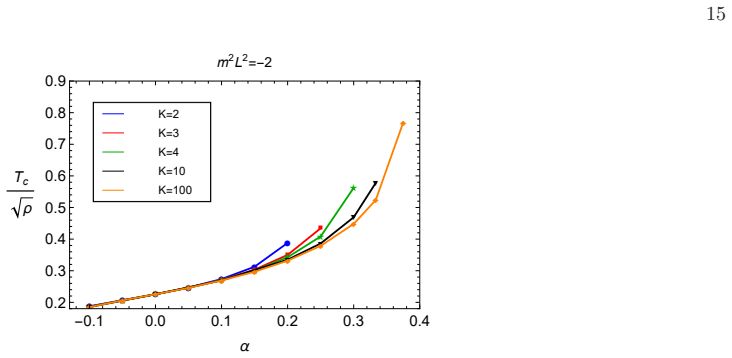
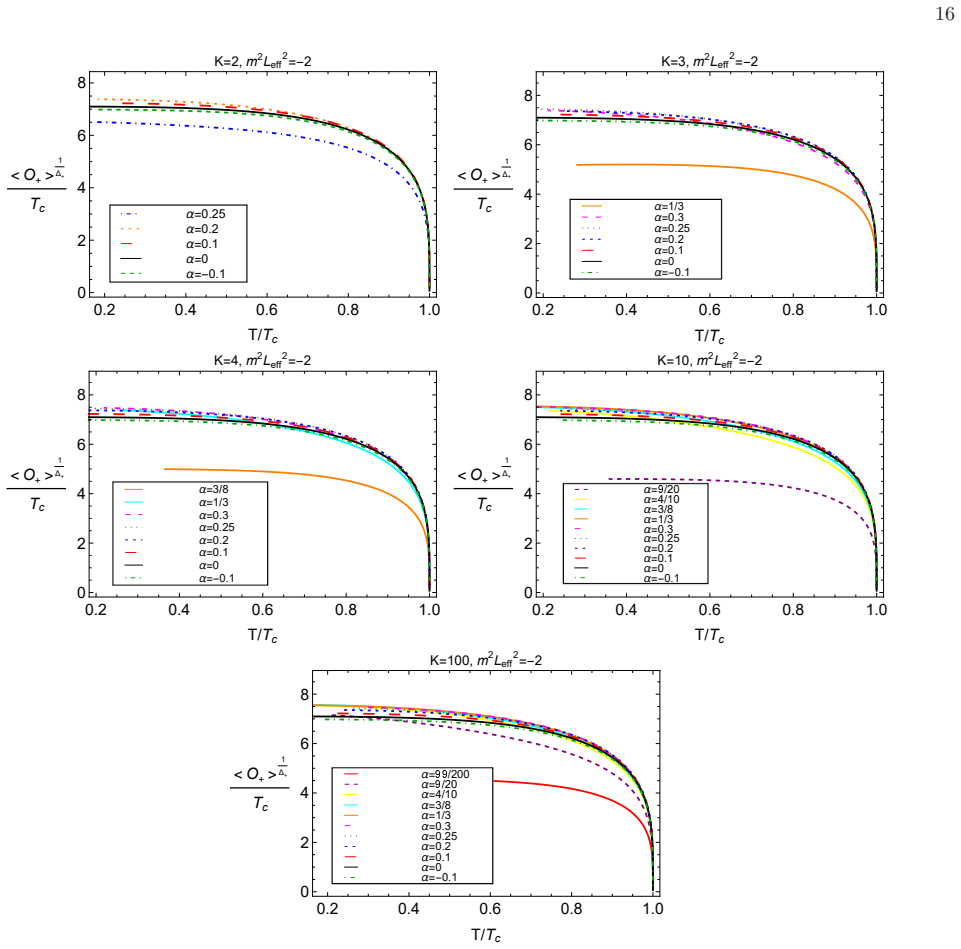
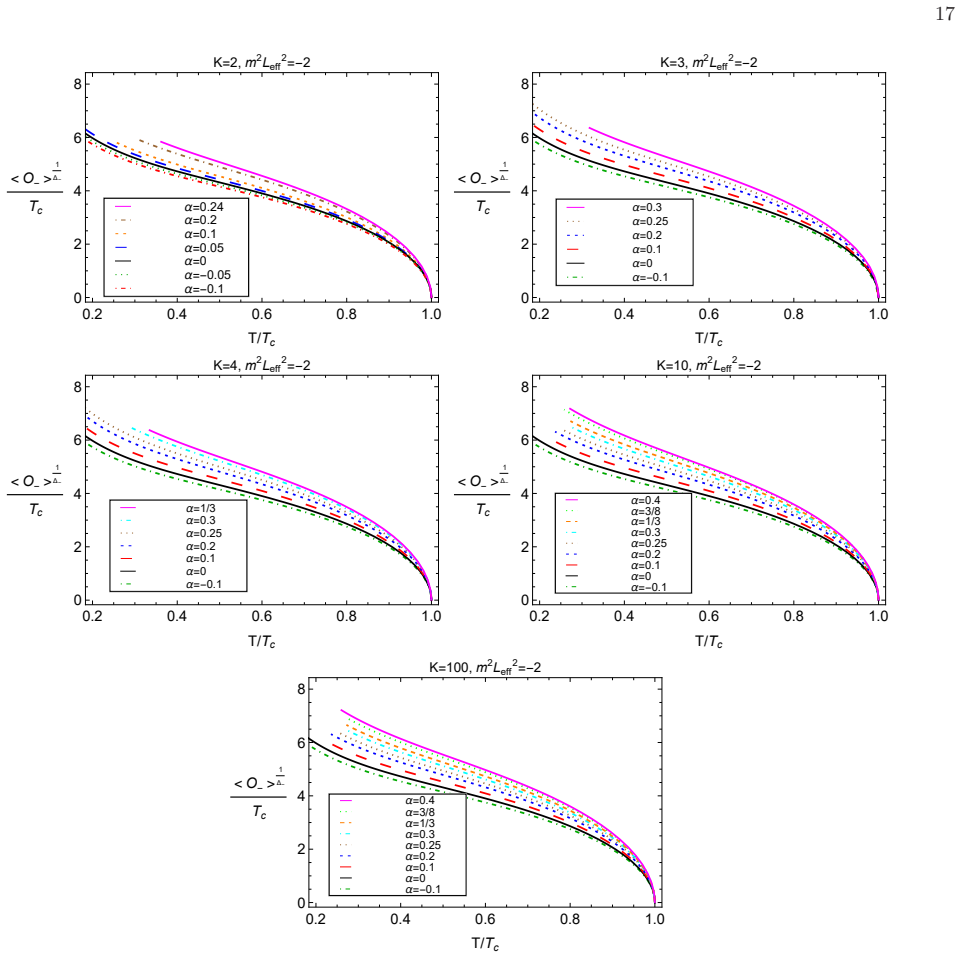
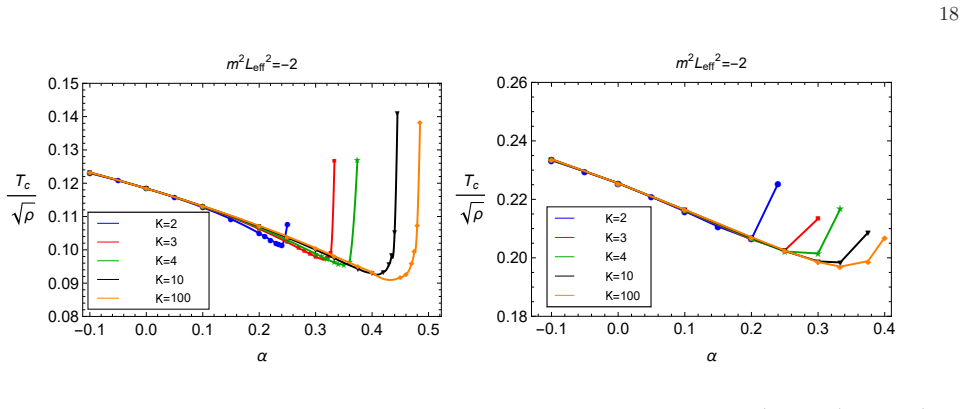
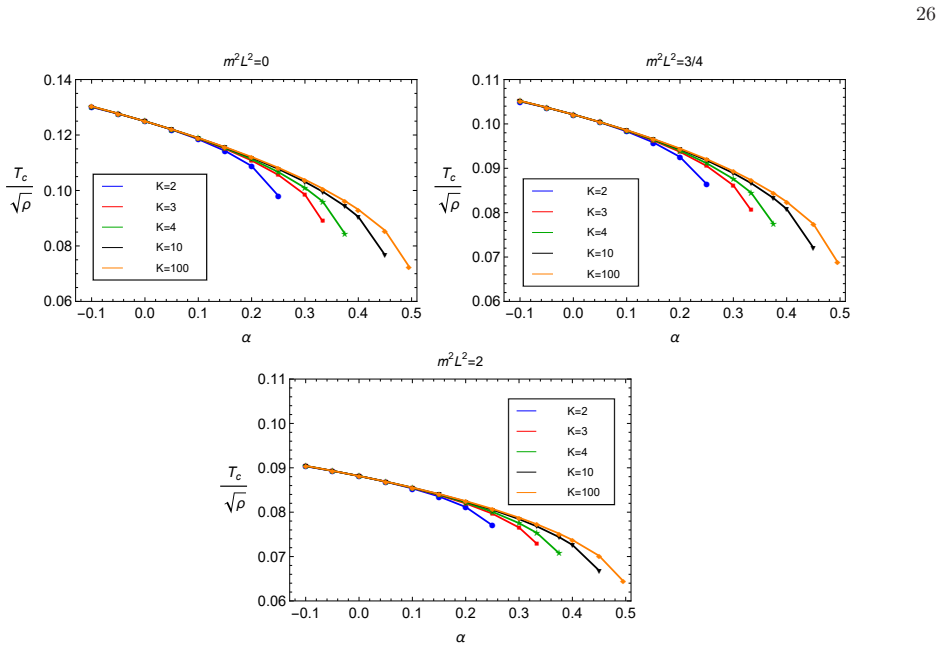
The regularized four-dimensional Einstein-Lovelock theory with finely tuned couplings yields exact black-brane geometries whose curvature corrections up to order K modify the holographic phase structure: critical temperatures increase with K and are enhanced by negative alpha, the gap in conductivity grows, and both s-wave and p-wave condensates become more sensitive to the gravitational parameters than in pure Einstein gravity.
Load-bearing premise
The 4D regularization procedure with finely tuned Lovelock couplings remains valid and yields consistent black-brane solutions at every order K.
Editorial extensions
If this is right
- Increasing the maximal curvature order K produces higher-Tc superconducting phases for both s-wave and p-wave systems.
- Negative alpha strengthens condensation and raises Tc while positive alpha weakens it relative to Einstein gravity.
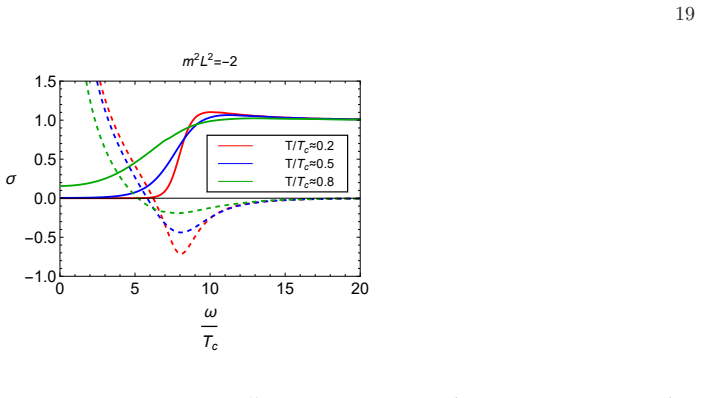
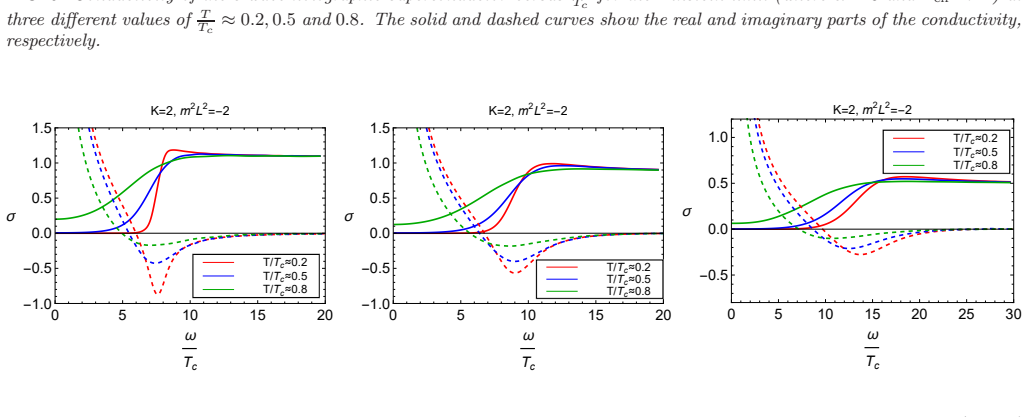
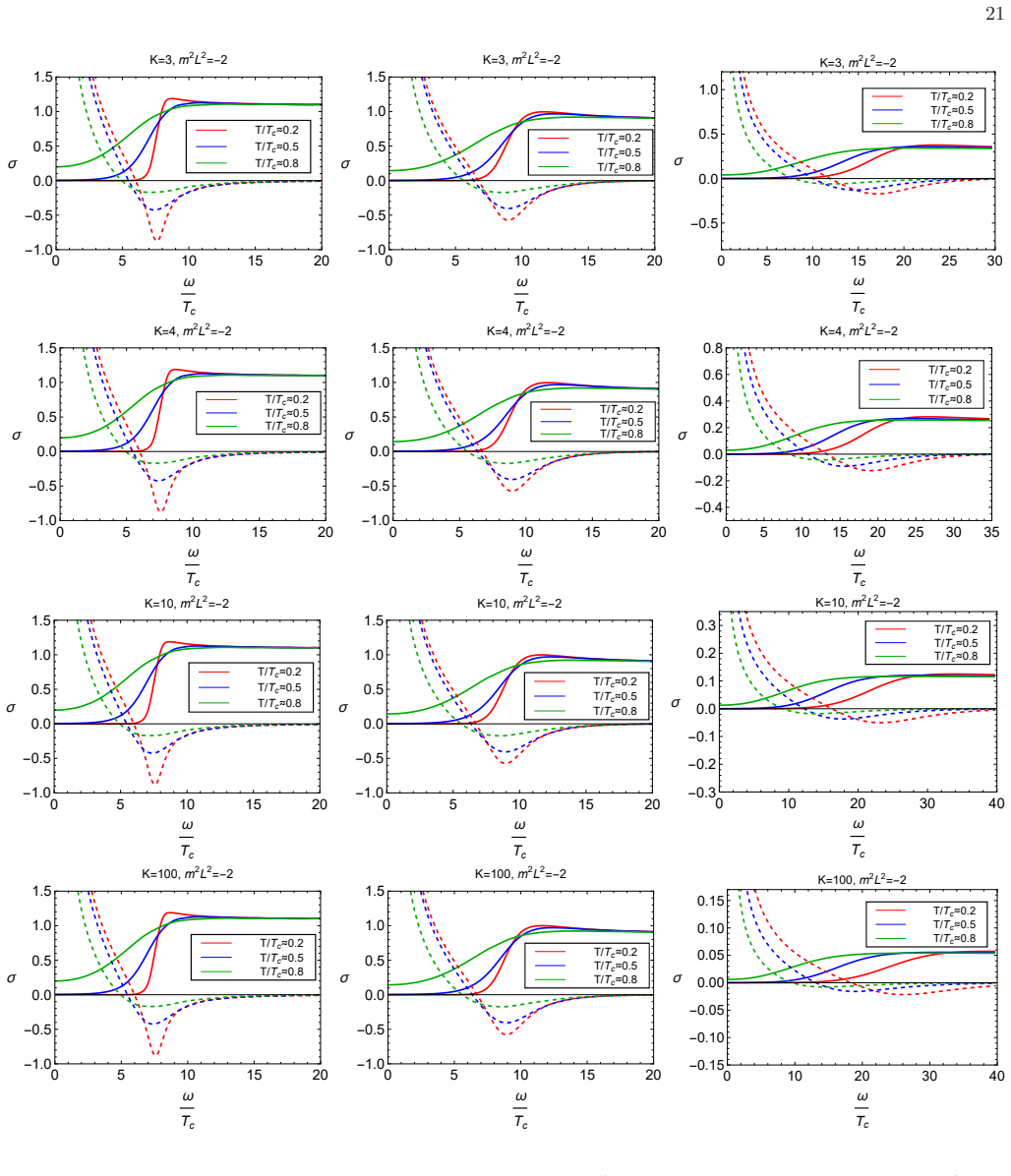
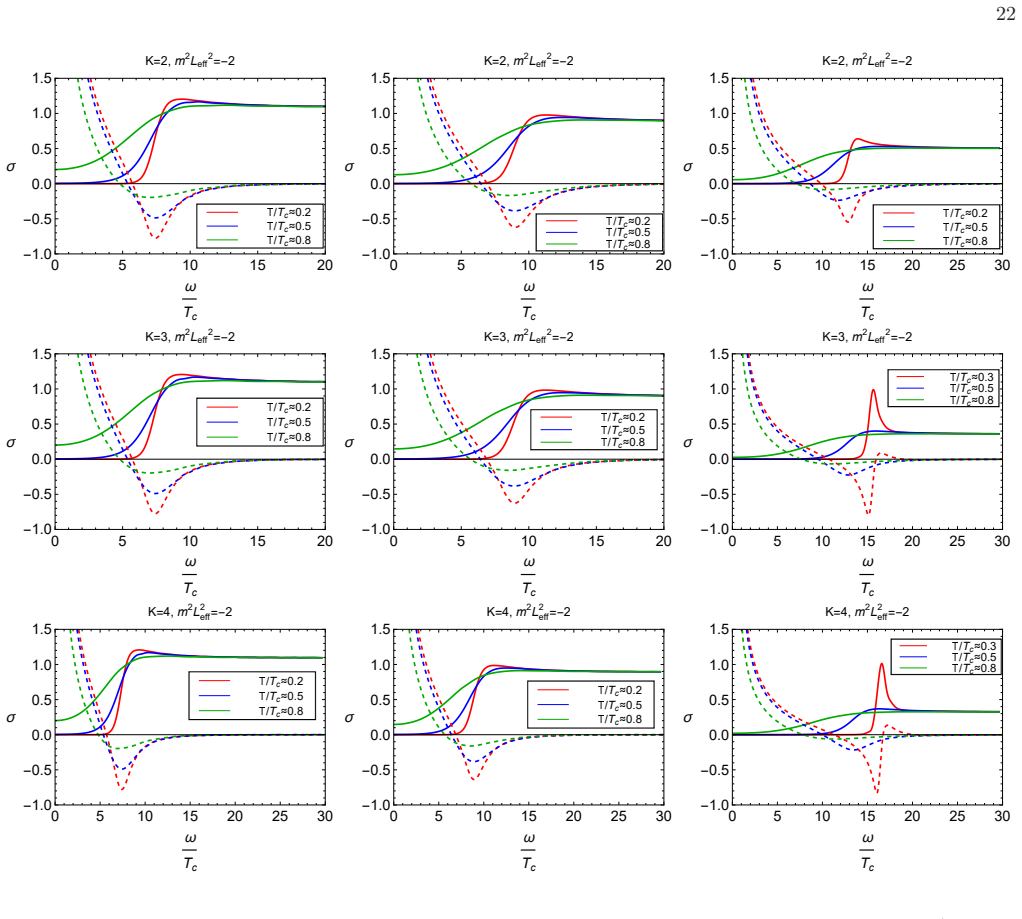
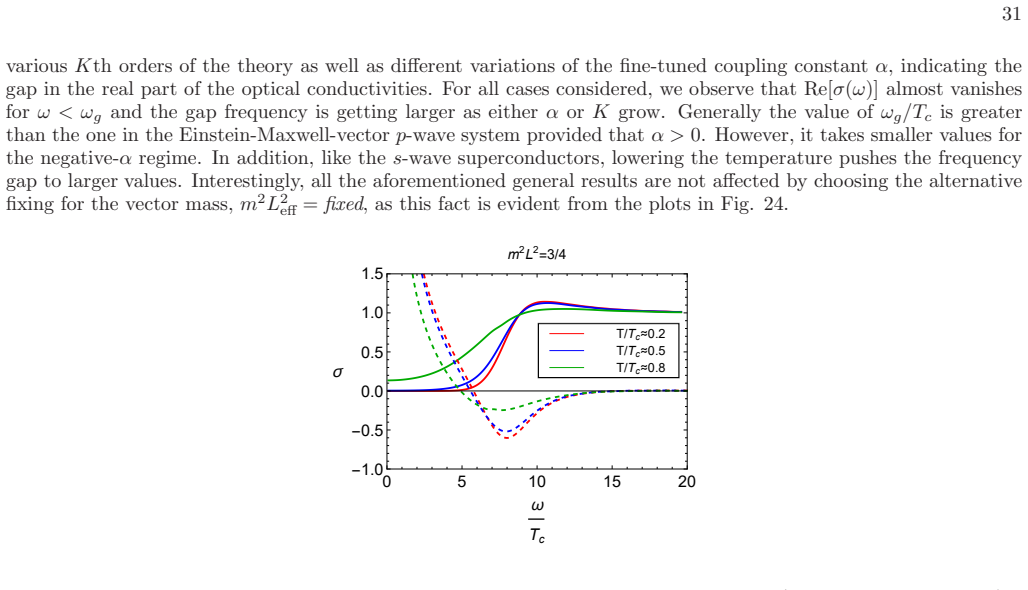
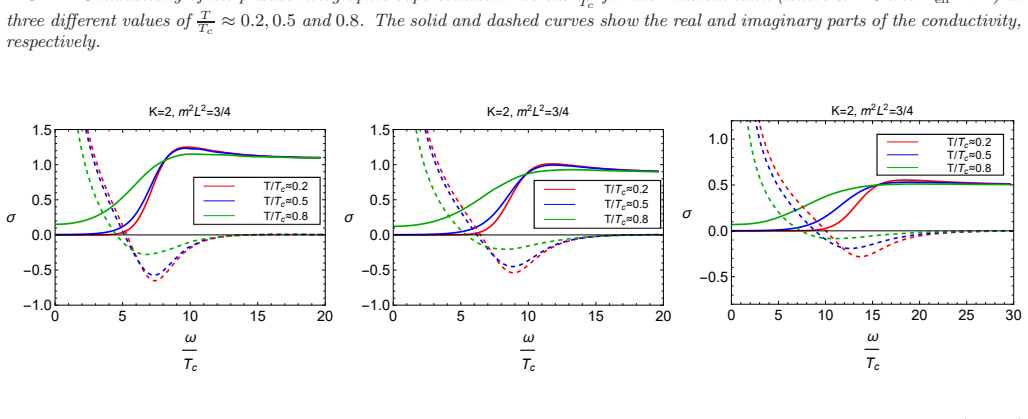
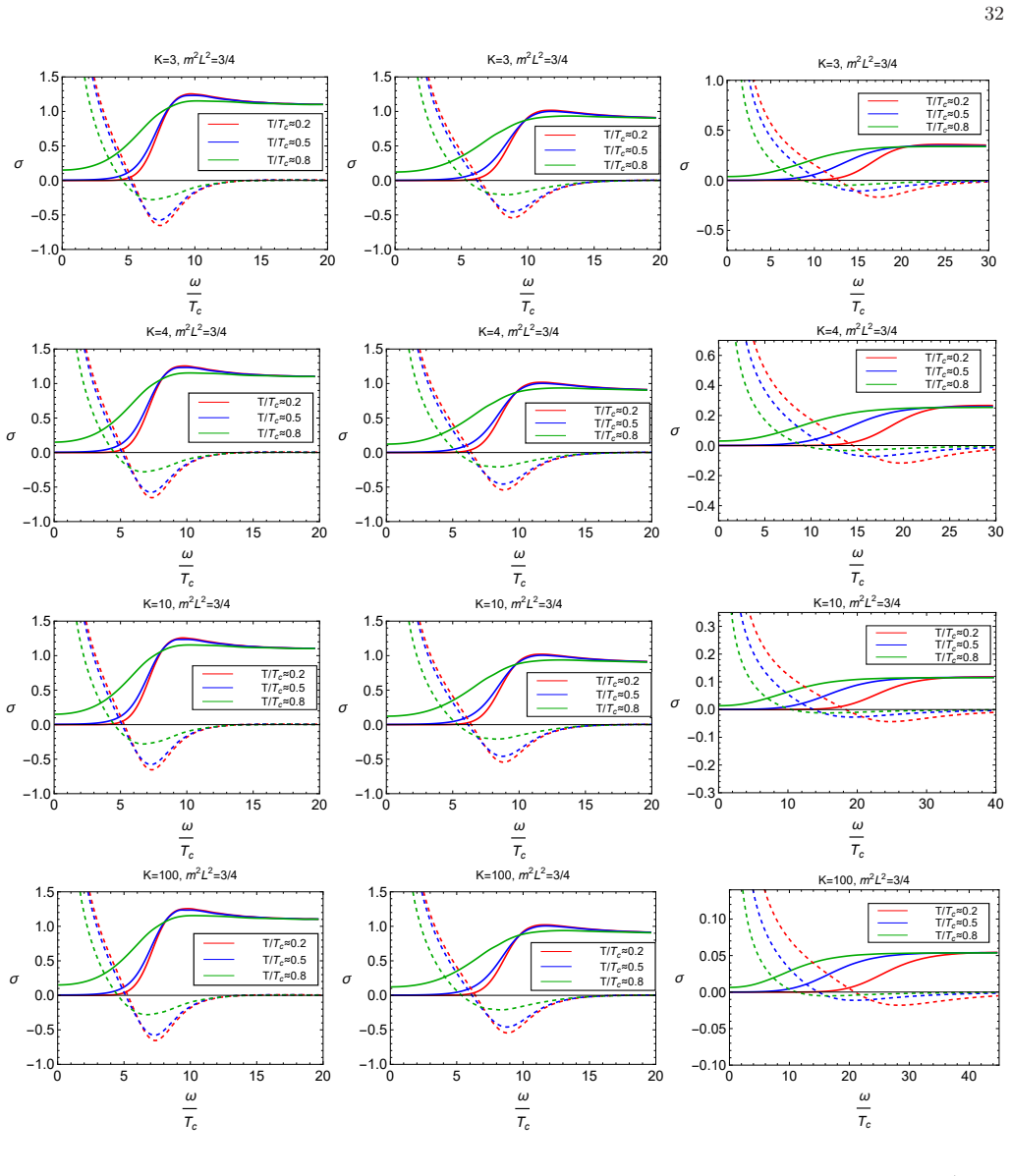
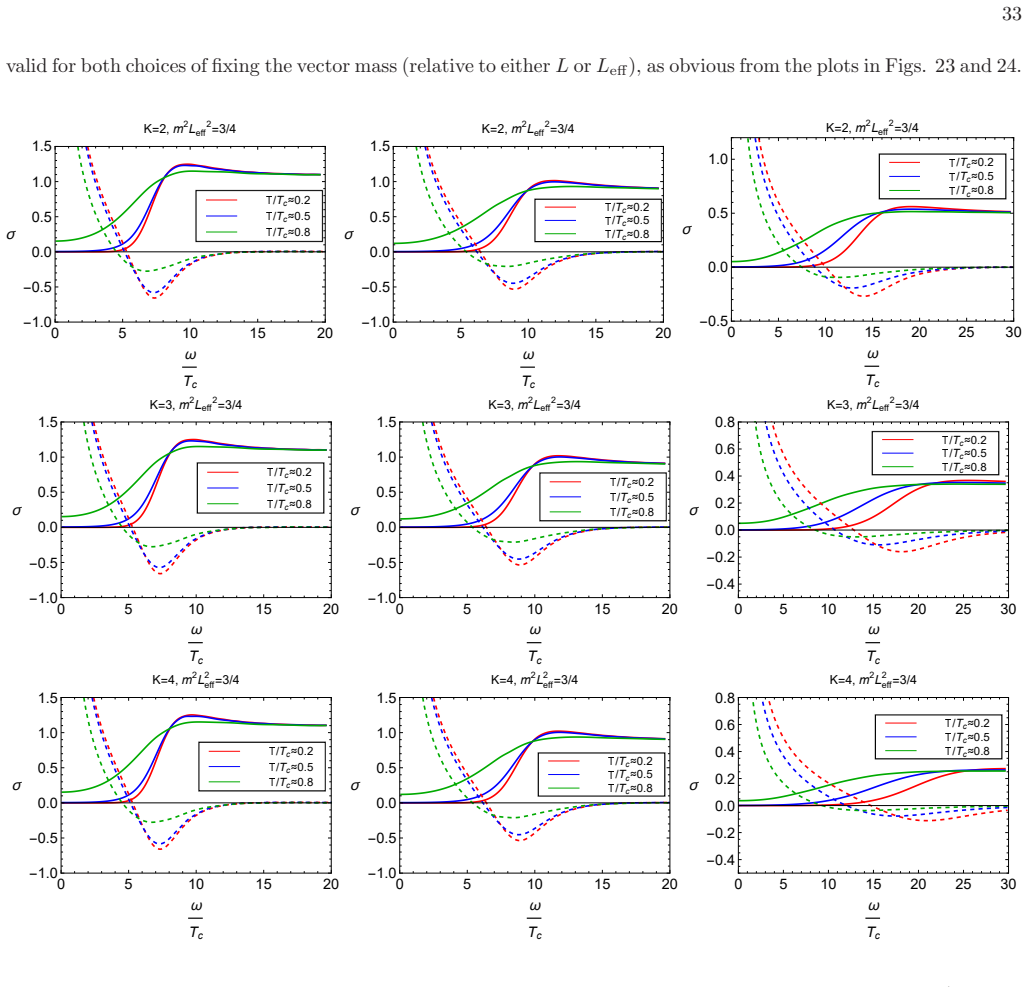
- The optical gap frequency and the ratio omega_g/Tc grow with K and depend on the sign of alpha.
- The p-wave condensate is more sensitive than the s-wave condensate to the choice of bulk mass prescription.
Reading between the lines
- The same regularization could be applied to other holographic models, such as those for Fermi surfaces or quantum critical points, to test whether higher K systematically alters transport coefficients.
- The observed enhancement of Tc with negative alpha suggests a concrete way to engineer effective higher-curvature duals that mimic stronger coupling in condensed-matter systems.
- If the mass-prescription dependence persists in other observables, it would indicate that the choice of bulk field mass is not merely technical but selects distinct regimes of the dual theory.
Signed reviews
Editorial analysis
A structured set of objections, weighed in public.
Referee Report
Summary. The manuscript studies holographic duals of (2+1)-dimensional s-wave and p-wave superconductors in 4D-regularized Einstein-Lovelock gravity. Exact black-brane backgrounds are constructed with a single tuned coupling α and arbitrary curvature order K; scalar and vector matter fields are then solved on these backgrounds for two mass prescriptions. The authors report that Tc generally rises with K (especially for negative α), that positive α suppresses condensation while negative α enhances it relative to Einstein gravity, and that both the gap frequency ωg and the ratio ωg/Tc deviate from the Einstein-gravity value, with stronger sensitivity in the p-wave case.
Significance. If the regularized solutions are consistent, the work supplies a controlled setting in which higher-curvature corrections can be varied continuously via K and α, allowing quantitative statements about how such terms shift critical temperatures and optical gaps in holographic superconductors. The use of exact black-brane metrics and the comparison of two mass prescriptions are concrete strengths.
major comments (1)
- [§2–3] The central construction rests on the claim (§2 and §3) that the 4D-regularized Einstein-Lovelock equations admit exact black-brane solutions for arbitrary K with a single parameter α. No explicit substitution of the metric ansatz into the regularized field equations is shown for K ≥ 3; given known consistency issues with the regularization procedure beyond Gauss-Bonnet order, this verification is load-bearing for all subsequent results on condensation and conductivity.
minor comments (2)
- The two mass prescriptions are introduced without a clear statement of which bulk mass corresponds to which boundary operator dimension; a short table would improve readability.
- Figure captions for the conductivity plots should explicitly state the values of α and K used in each panel.
Simulated Author's Rebuttal
We thank the referee for their careful review and for recognizing the potential of our work in providing a controlled setting for higher-curvature effects in holographic superconductors. We address the major comment regarding the verification of the black-brane solutions point by point below.
read point-by-point responses
-
Referee: [§2–3] The central construction rests on the claim (§2 and §3) that the 4D-regularized Einstein-Lovelock equations admit exact black-brane solutions for arbitrary K with a single parameter α. No explicit substitution of the metric ansatz into the regularized field equations is shown for K ≥ 3; given known consistency issues with the regularization procedure beyond Gauss-Bonnet order, this verification is load-bearing for all subsequent results on condensation and conductivity.
Authors: We agree that an explicit verification would strengthen the presentation. The 4D regularization of Einstein-Lovelock gravity is performed by tuning the Lovelock couplings in a specific way that allows the theory to be well-defined in four dimensions while retaining higher-order curvature terms. For the black-brane metric ansatz, which is a solution in the higher-dimensional Lovelock theory, the tuning ensures that the same metric satisfies the regularized 4D equations for any K with a fixed α. This is because the contributions from higher orders factorize in a manner that the equation of motion reduces to the same algebraic relation for α independent of K. Although this substitution was not explicitly displayed for K ≥ 3 in the original manuscript, it follows directly from the regularization procedure described in §2. We will include the explicit substitution in an appendix in the revised version. On the consistency issues beyond Gauss-Bonnet, we note that our construction uses the standard regularization that has been applied in the literature for higher-order terms, and for the vacuum black-brane solutions, the equations are satisfied without encountering the known pathologies, as verified by the existence of the solutions we employ. revision: yes
Circularity Check
No significant circularity; results from direct EOM solutions
full rationale
The derivation proceeds by first implementing the 4D regularization to obtain black-brane metrics parameterized by α and K, then solving the coupled bulk equations of motion for the matter fields (scalar for s-wave, vector for p-wave) to extract condensation curves, critical temperatures, and optical conductivity. These quantities are outputs of the numerical integration for given input parameters rather than being fitted to data or defined in terms of themselves. No self-definitional relations, fitted-input predictions, or load-bearing self-citations appear in the abstract or described chain; the dependence of Tc on K and α emerges from the dynamics of the regularized theory. The skeptic concern targets consistency of the regularization itself, which is an external validity question rather than a circularity within the derivation.
Assumptions & free parameters
free parameters (2)
- α
- K
assumptions (2)
- domain assumption Holographic duality applies to the regularized Einstein-Lovelock gravity theory.
- ad hoc to paper The 4D regularization procedure with finely tuned couplings is consistent and yields valid gravity theories.
Cite this review
Pith. "Pith review of Holographic $s$- and $p$-wave superconductors from the $4D$ regularization of Einstein-Lovelock theory." pith.science (2026). https://pith.science/paper/7GTFYFKB
@misc{pith2026260626546,
  author       = {Pith},
  title        = {Pith review of: Holographic $s$- and $p$-wave superconductors from the $4D$ regularization of Einstein-Lovelock theory},
  year         = {2026},
  howpublished = {\url{https://pith.science/paper/7GTFYFKB}},
  note         = {Machine review of arXiv:2606.26546}
}
abstract
We investigate holographically dual descriptions of $(2+1)$-dimensional s-wave and p-wave superconductors in the framework of regularized four-dimensional Einstein-Lovelock gravity theories, incorporating higher curvature corrections beyond the Gauss-Bonnet sector. We first implement the 4D regularization of Einstein-Lovelock gravity with finely tuned coupling constants to include corrections up to any $K$th order in curvature. The bulk geometry is constructed from exact black-brane solutions characterized by the fine-tuned Lovelock coupling $\alpha$ and the highest power of curvature in the Lagrangian K. We then analyze the condensation of scalar and vector operators dual to minimally coupled matter fields, focusing on two bulk-field mass prescriptions, which significantly affect the superconducting phase. Our results demonstrate that higher curvature terms significantly modify the phase structure of both s-wave and p-wave systems and enhance the sensitivity of the condensates and critical temperatures to the gravitational couplings. In both cases, the critical temperature generally increases with the maximal curvature order K, leading to higher-$T_c$ phases compared to Einstein gravity, particularly for negative $\alpha$. The coupling $\alpha$ effectively governs the strength of higher curvature interactions in the bulk: positive $\alpha$ suppresses condensation and lowers $T_c$, whereas negative $\alpha$ enhances superconducting order and promotes higher-$T_c$ phases relative to Einstein gravity. We further study the optical conductivity and find that both the gap frequency and the ratio $\omega_g/T_c$ exhibit a strong dependence on $\alpha$ and $K$, deviating from the universal Einstein-gravity result. Higher curvature effects enhance the superconducting gap scale. Notably, the p-wave system shows a stronger sensitivity to the mass-fixing prescription compared to the s-wave case.
Figures
Figures from the paper (21 more)
Reference graph
Works this paper leans on
-
[1]
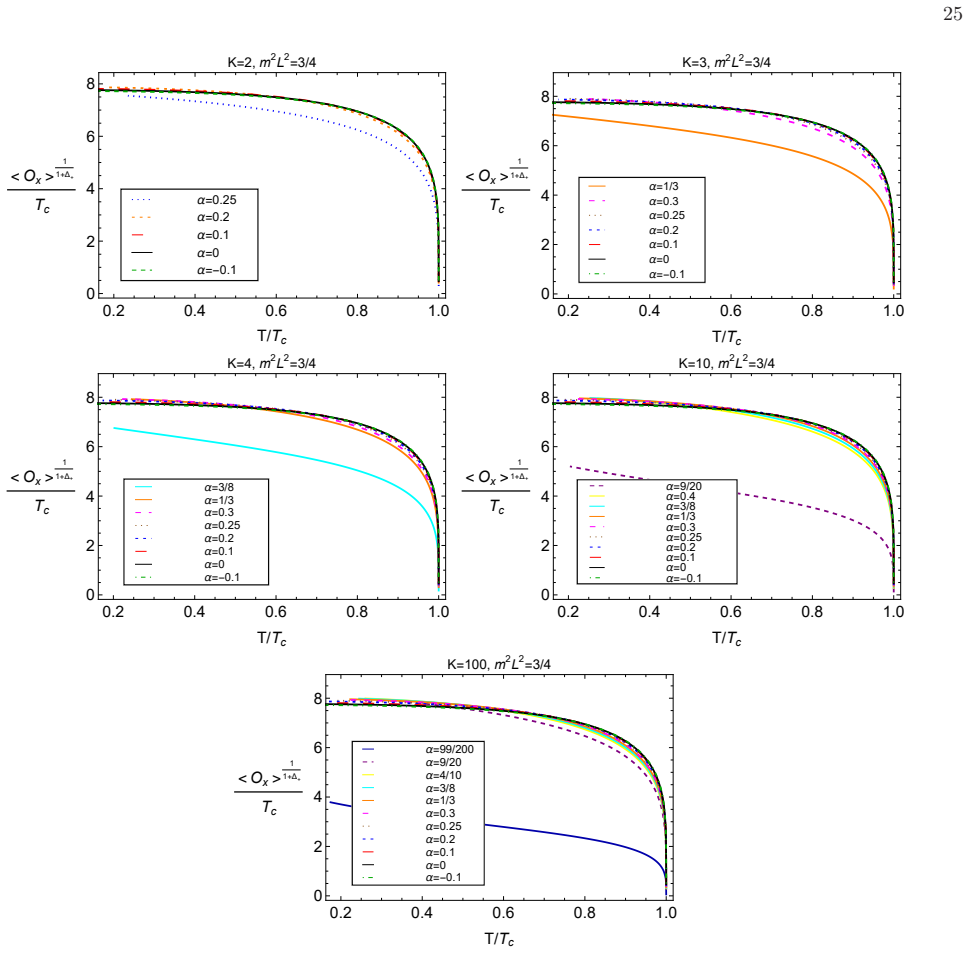
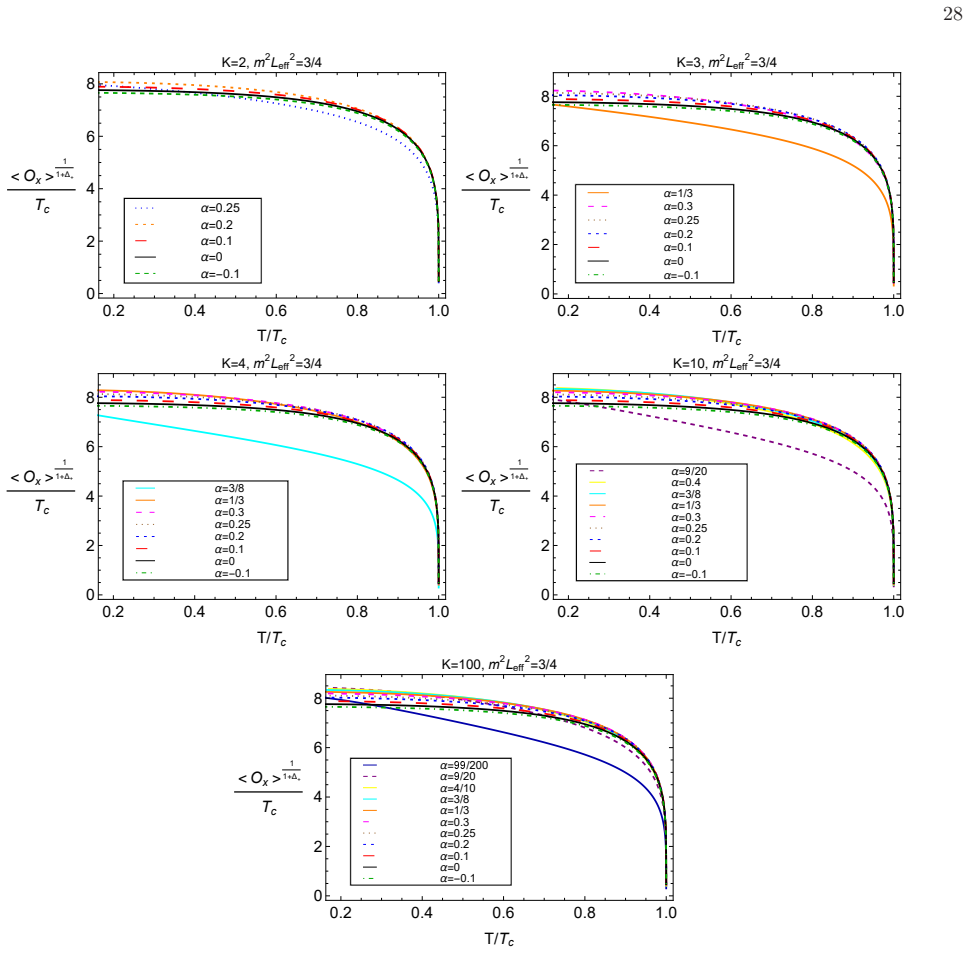
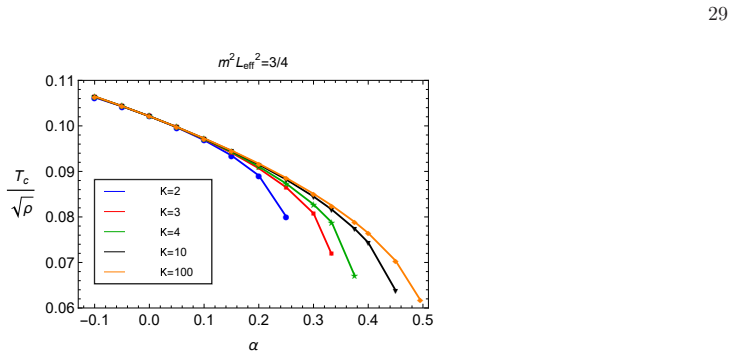
Considering m2L2 = 3/ 4, in Fig
Vector condensate with m2L2 = fixed Imposing ρ− x = 0 as the dual source and ρ+ x as the spontaneous condensation of the operator Ox, we compute the condensation associated with this case, ρ+ x = ⟨Ox⟩. Considering m2L2 = 3/ 4, in Fig. 13, condensation of the operator Ox as a function of temperature has been depicted for a variety of va lues of K and α . Fo...
-
[2]
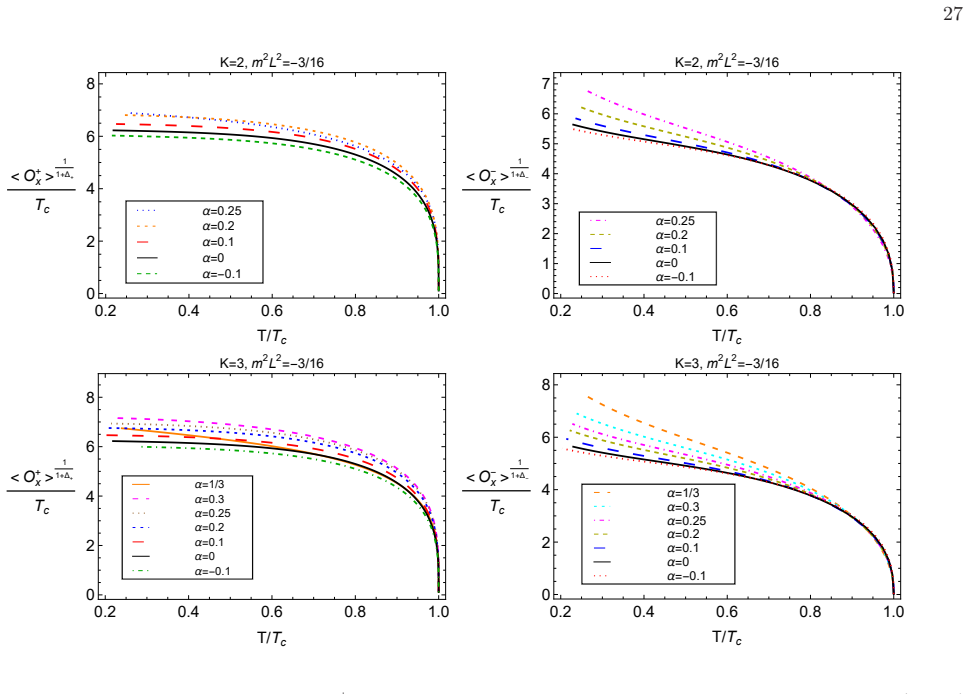
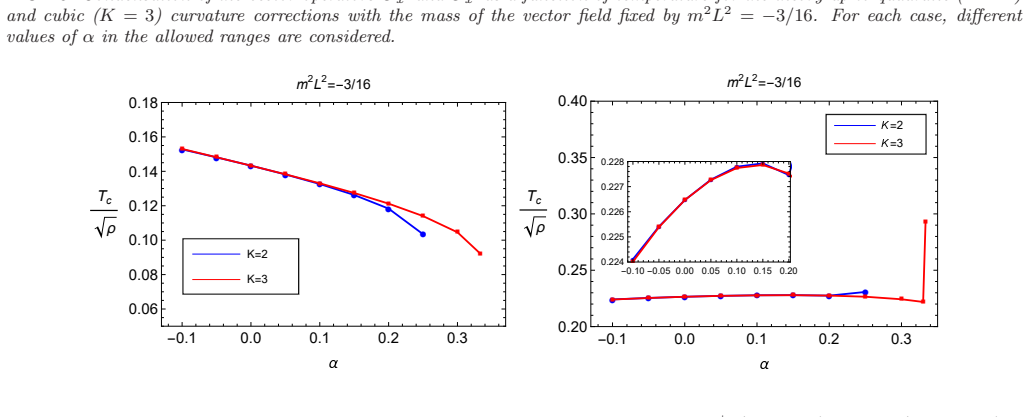
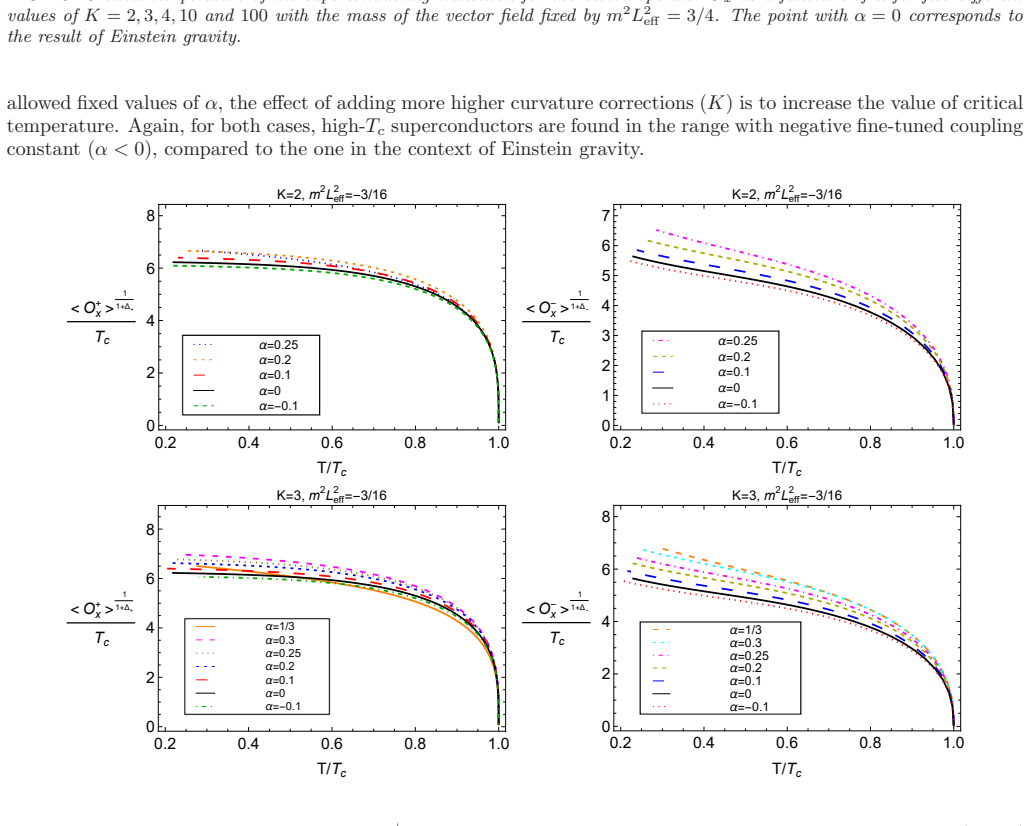
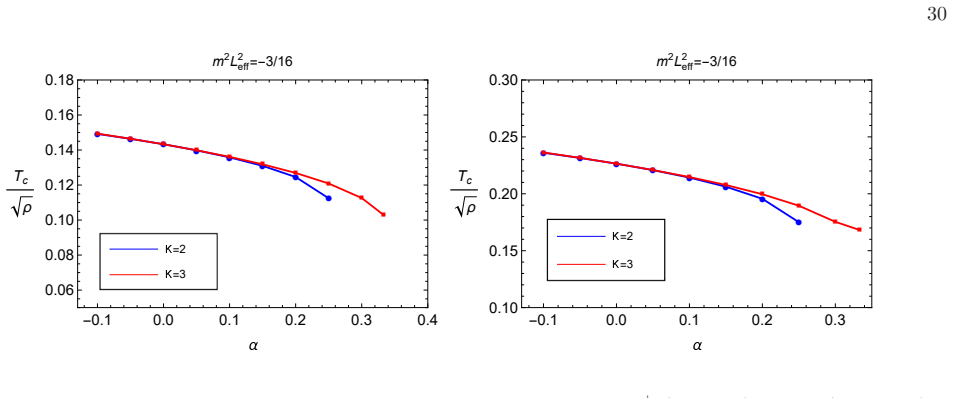
fast falloff ↔ response
Vector condensate with m2L2 eff = fixed We now consider the mass of the complex vector field ( ρµ ) to obey m2L2 eff = 3/ 4, in order for making contact with the results of Einstein gravity as well as 4 D Einstein-Gauss-Bonnet gravity theories [92]. m2L2 eff = 3 / 4 implies the standard picture automatically since the conformal dimension for t he slow falloff i...
-
[3]
Maldacena, The large-N limit of superconformal field theories and super gravity, Adv
J.M. Maldacena, The large-N limit of superconformal field theories and super gravity, Adv. Theor. Math. Phys. 2 (1998) 231 [also published in: Int. J. Theor. Phys. 38 (1999) 1113]
1998
-
[4]
Aharony, S.S
O. Aharony, S.S. Gubser, J. Maldacena, H. Ooguri, and Y. O z, Large N field theories, string theory and gravity , Physics Reports 323 (2000) 183
2000
-
[5]
Witten, Anti de Sitter Space and Holography , Adv
E. Witten, Anti de Sitter Space and Holography , Adv. Theor. Math. Phys. 2 (1998) 253
1998
-
[6]
Gubser, I.R
S.S. Gubser, I.R. Klebanov, A.M. Polyakov, Gauge theory correlators from noncritical string theory , Phys. Lett. B 428 (1998) 105
1998
-
[7]
Witten, Anti-de Sitter Space, Thermal Phase Transition, And Confine ment In Gauge Theories , Adv
E. Witten, Anti-de Sitter Space, Thermal Phase Transition, And Confine ment In Gauge Theories , Adv. Theor. Math. Phys. 2 (1998) 505
1998
-
[8]
Rey, J.-T
S.-J. Rey, J.-T. Yee, Macroscopic strings as heavy quarks: Large- N gauge theory and anti-de Sitter supergravity . Eur. Phys. J. C 22 394 (2001) 379
2001
Show all 154 references
-
[9]
Policastro, D.T
G. Policastro, D.T. Son, A.O. Starinets, The shear viscosity of strongly coupled N = 4 super-symmetric Yang-Mills plasma, Phys. Rev. Lett. 87 (2001) 081601
2001
-
[10]
Policastro, D.T
G. Policastro, D.T. Son, and A.O. Starinets, From AdS/CFT correspondence to hydrodynamics , JHEP 09 (2002) 043
2002
-
[11]
Policastro, D.T
G. Policastro, D.T. Son, and A.O. Starinets, From AdS/CFT correspondence to hydrodynamics. II. Sound wa ves, JHEP 12 (2003) 054
2003
-
[12]
Hartnoll, Lectures on holographic methods for condensed matter physi cs, Class
S.A. Hartnoll, Lectures on holographic methods for condensed matter physi cs, Class. Quant. Grav. 26 (2009) 224002
2009
-
[13]
Zaanen, Y
J. Zaanen, Y. Liu, Y.-W. Sun, and K. Schalm, Holographic duality in condensed matter physics (Cambridge University Press, 2015)
2015
-
[14]
N˘ astase,Introduction to the AdS/CFT Correspondence (Cambridge University Press, 2015)
H. N˘ astase,Introduction to the AdS/CFT Correspondence (Cambridge University Press, 2015)
2015
-
[15]
Erdmenger and M
J. Erdmenger and M. Ammon, Gauge/Gravity Duality Foundations and Applications , (Cambridge University Press, Cambridge, 2015)
2015
-
[16]
Natsuume, AdS/CFT Duality User Guide (Springer, Germany, 2015)
M. Natsuume, AdS/CFT Duality User Guide (Springer, Germany, 2015)
2015
-
[17]
Gubser, Breaking an Abelian gauge symmetry near a black hole horizon , Phys
S.S. Gubser, Breaking an Abelian gauge symmetry near a black hole horizon , Phys. Rev. D 78 (2008) 065034
2008
-
[18]
Hartnoll, C.P
S.A. Hartnoll, C.P. Herzog, and G.T. Horowitz, Building a holographic superconductor , Phys. Rev. Lett. 101 (2008) 031601
2008
-
[19]
Hartnoll, C.P
S.A. Hartnoll, C.P. Herzog, and G.T. Horowitz, Holographic superconductors, JHEP 12 (2008) 015
2008
-
[20]
Bardeen, L.N
J. Bardeen, L.N. Cooper, and J.R. Schrieffer, Theory of superconductivity, Phys. Rev. 108 (1957) 1175
1957
-
[21]
Annett, Superconductivity, superfluids and condensates (Oxford University Press, 2004)
J.F. Annett, Superconductivity, superfluids and condensates (Oxford University Press, 2004)
2004
-
[22]
Herzog, Lectures on holographic superfluidity and superconductivi ty, J
C.P. Herzog, Lectures on holographic superfluidity and superconductivi ty, J. Phys. A 42 (2009) 343001
2009
-
[23]
Horowitz and M.M
G.T. Horowitz and M.M. Roberts, Holographic superconductors with various condensates , Phys. Rev. D 78 (2008) 126008
2008
-
[24]
Gubser and S.S
S.S. Gubser and S.S. Pufu, The gravity dual of a p-wave superconductor, JHEP 11 (2008) 033
2008
-
[25]
Aprile, D
F. Aprile, D. Rodriguez-Gomez and J.G. Russo, p-wave Holographic Superconductors and five-dimensional ga uged Super- gravity, JHEP 01 (2011) 056
2011
-
[26]
R.-G. Cai, S. He, L. Li and L.-F. Li, A holographic study on vector condensate induced by a magnet ic field , JHEP 12 (2013) 036
2013
-
[27]
R.-G. Cai, L. Li, and L.-F. Li, A holographic p-wave superconductor model , JHEP 01 (2014) 032
2014
-
[28]
Benini, C.P
F. Benini, C.P. Herzog, R. Rahman and A. Yarom, Gauge gravity duality for d-wave superconductors: prospects and challenges, JHEP 11 (2010) 137
2010
-
[29]
Chen, Y.-J
J.-W. Chen, Y.-J. Kao, D. Maity, W.-Y. Wen and C.-P. Yeh, Towards a holographic model of D-wave superconductors, Phys. Rev. D 81 (2010) 106008
2010
-
[30]
R.-G. Cai, L. Li, L.-F. Li, and R.-Q. Yang, Introduction to holographic superconductor models , Sci. China Phys. Mech. Astron. 58 (2015) 060401
2015
-
[31]
Cai and H.-Q
R.-G. Cai and H.-Q. Zhang, Holographic superconductors with Hoˇ rava-Lifshitz blackholes, Phys. Rev. D 81 (2010) 066003
2010
-
[32]
Gout´ reraux, B.S
B. Gout´ reraux, B.S. Kim and R. Meyer, Charged Dilatonic Black Holes and their Transport Properti es, Fortsch. Phys. 59 (2011) 723
2011
-
[33]
Banerjee, S
R. Banerjee, S. Gangopadhyay, D. Roychowdhury, and A. L ala, Holographic s-wave condensate with nonlinear electrody- namics: A nontrivial boundary value problem , Phys Rev D 87 (2013) 104001
2013
-
[34]
Zeng and J.-P
H.B. Zeng and J.-P. Wu, Holographic superconductors from the massive gravity , Phys. Rev. D 90 (2014) 046001
2014
-
[35]
Parai, D.Ghorai, and S
D. Parai, D.Ghorai, and S. Gangopadhyay, Noncommutative effects of charged black hole on holographic s uperconductors, Gen. Relativ. Gravit. 50 (2018) 149
2018
-
[36]
Pramanik and S
S. Pramanik and S. Ghosh, AdS-CFT correspondence in noncommutative background, rel ated thermodynamics and holo- graphic superconductor in magnetic field , Gen. Relativ. Gravit. 51 (2019) 7
2019
-
[37]
Lu, H.-F
J.-W. Lu, H.-F. Li, and Y.-B. Wu, Holographic s-wave superconductors with conformal anomaly correction , Eur. Phys. J. Plus 135 (2020) 903
2020
-
[38]
Nam, Effects of massive gravity on p-wave holographic superconductor, Phys
C.H. Nam, Effects of massive gravity on p-wave holographic superconductor, Phys. Lett. B 807 (2020) 135547 38
2020
-
[39]
Stelle, Renormalization of higher-derivative quantum gravity , Phys
S.K. Stelle, Renormalization of higher-derivative quantum gravity , Phys. Rev. D 16 (1977) 953
1977
-
[40]
J. F. Donoghue, General relativity as an effective field theory: The leading qu antum corrections, Phys. Rev. D 50 (1994) 3874
1994
-
[41]
Smolin, How far are we from the quantum theory of gravity? , arXiv preprint hep-th/0303185 (2003)
L. Smolin, How far are we from the quantum theory of gravity? , arXiv preprint hep-th/0303185 (2003)
2003 arXiv
-
[42]
Burgess, Quantum gravity in everyday life: General relativity as an e ffective field theory , Living Rev
C.P. Burgess, Quantum gravity in everyday life: General relativity as an e ffective field theory , Living Rev. Rel. 7 (2004) 5
2004
-
[43]
Woodard, How far are we from the quantum theory of gravity? , Reports on Progress in Physics 72 (2009) 126002
R.P. Woodard, How far are we from the quantum theory of gravity? , Reports on Progress in Physics 72 (2009) 126002
2009
-
[44]
Donoghue, The effective field theory treatment of quantum gravity , AIP Conf
J.F. Donoghue, The effective field theory treatment of quantum gravity , AIP Conf. Proc. 1483 (2012) 73
2012
-
[45]
Donoghue and B.R
J.F. Donoghue and B.R. Holstein, Low energy theorems of quantum gravity from effective field the ory, Journal of Physics G: Nuclear and Particle Physics 42 (2015) 103102
2015
-
[46]
Donoghue and G
J.F. Donoghue and G. Menezes, Gauge assisted quadratic gravity: A framework for UV comple te quantum gravity , Phys. Rev. D 97 (2018) 126005
2018
-
[47]
Hartman, Lectures on quantum gravity and black holes , available at http://www.hartmanhep.net/topics2015/
T. Hartman, Lectures on quantum gravity and black holes , available at http://www.hartmanhep.net/topics2015/
-
[48]
Dvali, G
G. Dvali, G. Gabadadze, M. Kolanovi´ c, and F. Nitti, Scales of gravity , Phys. Rev. D 65 (2001) 024031
2001
-
[49]
Ezawa, H
Y. Ezawa, H. Iwasaki, M. Ohmori, S. Ueda, N. Yamada, and T . Yano, Cosmology in a higher-curvature gravity , Class. Quant. Grav. 20 (2003) 4933
2003
-
[50]
Yunes and X
N. Yunes and X. Siemens, Gravitational-wave tests of general relativity with groun d-based detectors and pulsar-timing arrays, Living Reviews in Relativity 16 (2013) 9
2013
-
[51]
Alavirad and J.M
H. Alavirad and J.M. Weller, Modified gravity with logarithmic curvature corrections an d the structure of relativistic stars , Phys. Rev. D 88 (2013) 124034
2013
-
[52]
Modesto, T
L. Modesto, T. de Paula Netto, and I.L. Shapiro, On Newtonian singularities in higher derivative gravity mo dels, JHEP 04 (2015) 98
2015
-
[53]
Ghosh, S
A. Ghosh, S. Jana, A.K. Mishra, and S. Sarkar, Constraints on higher curvature gravity from time delay bet ween GW170817 and GRB 170817A , Phys. Rev. D 100 (2019) 084054
2019
-
[54]
Cho and I.P
Y.M. Cho and I.P. Neupane, Anti-de Sitter black holes, thermal phase transition and ho lography in higher curvature gravity, Phys. Rev. D 66 (2002) 024044
2002
-
[55]
Brigante, H
M. Brigante, H. Liu, R.C. Myers, S. Shenker, and S. Yaida , Viscosity Bound Violation in Higher Derivative Gravity , Phys. Rev. D 77 (2008) 126006
2008
-
[56]
de Boer, M
J. de Boer, M. Kulaxizi and A. Parnachev, Holographic Lovelock Gravities and Black Holes , JHEP 06 (2010) 008
2010
-
[57]
Camanho and J.D
X.O. Camanho and J.D. Edelstein, Causality in AdS/CFT and Lovelock theory , JHEP 06 (2010) 099
2010
-
[58]
Camanho, J.D
X.O. Camanho, J.D. Edelstein, and J.M. S´ anchez de Sant os, Lovelock theory and the AdS/CFT correspondence , Gen. Relativ. Gravit. 46 (2014) 1637
2014
-
[59]
Camanho, Lovelock gravity, black holes and holography , Ph.D
X.O. Camanho, Lovelock gravity, black holes and holography , Ph.D. thesis, Unviersity of Santiago de Compostela, Spain (2013)
2013
-
[60]
Sinamuli and R.B
M. Sinamuli and R.B. Mann, Higher order corrections to holographic black hole chemist ry, Phys. Rev.D 96 (2017) 086008
2017
-
[61]
Kovtun, D.T
P.K. Kovtun, D.T. Son, and A.O. Starinets, Viscosity in strongly interacting quantum field theories fr om black hole physics, Phys. Rel. Lett. 94 (2005) 111601
2005
-
[62]
Gregory, S
R. Gregory, S. Kanno and J. Soda, Holographic superconductors with higher curvature correc tions, JHEP 10 (2009) 010
2009
-
[63]
Barclay, R
L. Barclay, R. Gregory, S. Kanno and P. Sutcliffe, Gauss-Bonnet holographic superconductors, JHEP 12 (2010) 029
2010
-
[64]
Cai, Z.-Y
R.-G. Cai, Z.-Y. Nie and H.-Q. Zhang, Holographic p-wave superconductors from Gauss-Bonnet gra vity, Phys. Rev. D 82 (2010) 066007
2010
-
[65]
Kuang, W.-J
X.-M. Kuang, W.-J. Li, and Y. Ling, Holographic superconductors in quasi-topological gravit y, JHEP 12 (2010) 069
2010
-
[66]
Siani, Holographic Superconductors and Higher Curvature Correct ions, JHEP 12 (2010) 035
M. Siani, Holographic Superconductors and Higher Curvature Correct ions, JHEP 12 (2010) 035
2010
-
[67]
Y. Liu, G. Fu, H.-L. Li, J.-P. Wu, and X. Zhang, Holographic p-wave superconductivity from higher derivat ive theory, Eur. Phys. J. C 81 (2021) 568
2021
-
[68]
Y. Bao, H. Guo, and X.-M. Kuang, Excited states of holographic superconductor with scalar fi eld coupled to Gauss-Bonnet invariance, Phys. Lett. B 822 (2021) 136646
2021
-
[69]
Lovelock, The Einstein tensor and its generalizations , J
D. Lovelock, The Einstein tensor and its generalizations , J. Math. Phys. 12 (1971) 498
1971
-
[70]
Lovelock, The four-dimensionality of space and the Einstein tensor , J
D. Lovelock, The four-dimensionality of space and the Einstein tensor , J. Math. Phys. 13 (1972) 874
1972
-
[71]
Tomozawa, Quantum corrections to gravity , arXiv: 1107.1424
Y. Tomozawa, Quantum corrections to gravity , arXiv: 1107.1424
-
[72]
Cognola, R
G. Cognola, R. Myrzakulov, L. Sebastiani, and S. Zerbin i, Einstein gravity with Gauss-Bonnet entropic corrections , Phys. Rev. D 88 (2013) 024006
2013
-
[73]
Glavan and C
D. Glavan and C. Lin, Einstein-Gauss-Bonnet Gravity in Four-Dimensional Space time, Phys. Rev. Lett. 124 (2020) 081301
2020
-
[74]
Casalino, A
A. Casalino, A. Colleaux, M. Rinaldi, and S. Vicentini, Regularized Lovelock gravity , Phys. Dark Universe 31 (2021) 100770
2021
-
[75]
Konoplya and A
R.A. Konoplya and A. Zhidenko, Black holes in the four-dimensional Einstein-Lovelock gra vity, Phys. Rev. D 101 (2020) 084038
2020
-
[76]
Konoplya and A
R.A. Konoplya and A. Zhidenko, BTZ black holes with higher curvature corrections in the 3D E instein-Lovelock gravity, Phys. Rev. D 102 (2020) 064004
2020
-
[77]
Konoplya and A
R.A. Konoplya and A. Zhidenko, 4D Einstein-Lovelock black holes: Hierarchy of orders in cu rvature, Phys. Lett. B 807 (2020) 135607
2020
-
[78]
Konoplya and A
R.A. Konoplya and A. Zhidenko, (In) stability of black holes in the 4D Einstein-Gauss-Bonn et and Einstein-Lovelock gravities, Phys. Dark Universe 30 (2020) 100697
2020
-
[79]
Mermin and H
N.D. Mermin and H. Wagner, Absence of ferromagnetism or antiferromagnetism in one-di mensional or two-dimensional 39 isotropic Heisenberg models , Phys. Rev. Lett. 17 (1966) 1133
1966
-
[80]
Coleman, There are no Goldstone bosons in two-dimensions , Commun
S.R. Coleman, There are no Goldstone bosons in two-dimensions , Commun. Math. Phys. 31 (1973) 259
1973
-
[81]
Zee, Quantum Field Theory in a Nutshell (Princeton University Press, Princeton, 2010)
A. Zee, Quantum Field Theory in a Nutshell (Princeton University Press, Princeton, 2010)
2010
-
[82]
Bednorz and K.A
J.G. Bednorz and K.A. M¨ uller, Possible high Tc superconductivity in the Ba-La-Cu-O system , Z. Physik B 64 (1986) 189
1986
-
[83]
Balestrino, A
G. Balestrino, A. Nigro, R. Vaglio, and M. Marinelli, Thermodynamic fluctuations in the 110-K Bi-Sr-Ca-Cu-O supe r- conductor: Evidence for two-dimensional behavior , Phys. Rev. B 39 (1989) 12264
1989
-
[84]
Takada, H
K. Takada, H. Sakurai, E. Takayama-Muromachi, F. Izumi , R.A. Dilanian, and T. Sasaki, Superconductivity in two- dimensional CoO 2 layers, Nature 422 (2003) 53
2003
-
[85]
L. Li, C. Richter, J. Mannhart, and R.C. Ashoori, Coexistence of magnetic order and two-dimensional superco nductivity at LaAlO 3/ SrTiO3 interfaces Nature Phys. 7 (2011) 762
2011
-
[86]
C. Brun, T. Cren, and D. Roditchev, Review of 2D superconductivity: the ultimate case of epitax ial monolayers, Supercond. Sci. Technol. 30 (2017) 013003
2017
-
[87]
Bollinger and I
A.T. Bollinger and I. Boˇ zovi´ c,Two-dimensional superconductivity in the cuprates reveal ed by atomic-layer-by-layer molec- ular beam epitaxy , Supercond. Sci. Technol. 29 (2016) 103001
2016
-
[88]
Uchihashi, Two-dimensional superconductors with atomic-scale thick ness, Supercond
T. Uchihashi, Two-dimensional superconductors with atomic-scale thick ness, Supercond. Sci. Technol. 30 (2017) 013002
2017
-
[89]
Saito, T
Y. Saito, T. Nojima, and Y. Iwasa, Gate-induced superconductivity in two-dimensional atomi c crystals , Supercond. Sci. Technol. 29 (2016) 093001
2016
-
[90]
L. Wang, X. Ma, and Q.-K. Xue, Interface high-temperature superconductivity, Supercond. Sci. Technol. 29 (2016) 123001
2016
-
[91]
Saito, T
Y. Saito, T. Nojima, and Y. Iwasa, Highly crystalline 2D superconductors , Nat. Rev. Mater. 2 (2017) 16094
2017
-
[92]
J. Li, P. Song, J. Zhao et al, Printable two-dimensional superconducting monolayers , Nat. Mater. 20 (2021) 181
2021
-
[93]
T. Soma, K. Yoshimatsu, K. Horiba, H. Kumigashira, and A . Ohtomo, Two-dimensional superconductivity in single-band correlated 2H-type Nb O 2 layers, Phys. Rev. B 105 (2022) 104504
2022
-
[94]
X. Qiao, L. OuYang, D. Wang, Q. Pan, and J. Jing, Holographic superconductors in 4D Einstein-Gauss-Bonnet gravity, JHEP 12 (2020) 192
2020
-
[95]
J. Pan, X. Qiao, D. Wang, Q. Pan, Z.-Y. Nie, and J. Jing, Holographic superconductors in 4D Einstein-Gauss-Bonnet gravity with backreactions , Phys. Lett. B 823 (2021) 136755
2021
-
[96]
Ghorai and S
D. Ghorai and S. Gangopadhyay, Analytical study of holographic superconductor with backr eaction in 4d Gauss-Bonnet gravity, Phys. Lett. B 822 (2021) 136699
2021
-
[97]
Mohammadi and A
M. Mohammadi and A. Sheykhi, Gauss-Bonnet holographic superconductors in lower dimens ions, Eur. Phys. J. Plus 137 (2022) 852
2022
-
[98]
Edelstein, N
J.D. Edelstein, N. Grandi, and A.R. S´ anchez, Holographic superconductivity in Einsteinian cubic gravi ty, JHEP 05 (2022) 188
2022
-
[99]
Sotiriou and V
T.P. Sotiriou and V. Faraoni, f (R) theories of gravity , Rev. Mod. Phys. 82 (2010) 451
2010
-
[100]
Zwiebach, Curvature squared terms and string theories , Phys
B. Zwiebach, Curvature squared terms and string theories , Phys. Lett. B 156 (1985) 315
1985
-
[101]
Boulware and S
D.G. Boulware and S. Deser, String-Generated Gravity Models , Phys. Rev. Lett. 55 (1985) 2656
1985
-
[102]
Zumino, Gravity theories in more than four dimensions , Phys
B. Zumino, Gravity theories in more than four dimensions , Phys. Rep. 137 (1986) 109
1986
-
[103]
Candelas, G.T
P. Candelas, G.T. Horowitz, A. Strominger, and E. Witt en, Vacuum configurations for superstrings , Nucl. Phys. B 258 (1985) 46
1985
-
[104]
Gross, J.A
D.J. Gross, J.A. Harvey, E. Martinec, and R. Rohm, Heterotic String , Phys. Rev. Lett. 54 (1985) 502
1985
-
[105]
Gross and E
D.J. Gross and E. Witten, Superstring modifications of Einstein ’s equations, Nucl. Phys. B 277 (1986) 1
1986
-
[106]
Gross and J.H
D.J. Gross and J.H. Sloan, The quartic effective action for the heterotic string , Nucl. Phys. B 291 (1987) 41
1987
-
[107]
Metsaev and A.A
R.R. Metsaev and A.A. Tseytlin, Order α ′ (Two Loop) Equivalence of the String Equations of Motion and the σ Model Weyl Invariance Conditions: Dependence on the Dilaton and t he Antisymmetric Tensor , Nucl. Phys. B 293 (1987) 385
1987
-
[108]
Charmousis, Christos, A
C. Charmousis, Christos, A. Leh´ ebel, E. Smyrniotis, and N. Stergioulas, Astrophysical constraints on compact objects in 4D Einstein-Gauss-Bonnet gravity , JCAP 02 (2022) 033
2022
-
[109]
Dehghani and M.R
A. Dehghani and M.R. Setare, Absence of isolated critical points with nonstandard criti cal exponents in the four- dimensional regularization of Lovelock gravity , Gen. Relativ. Gravit. 54 (2022) 128
2022
-
[110]
Dehghani, Conformal regularization of Einstein-Lovelock theory in f our spacetime dimensions , in progress
A. Dehghani, Conformal regularization of Einstein-Lovelock theory in f our spacetime dimensions , in progress
-
[111]
G¨ urses, T.C ¸
M. G¨ urses, T.C ¸ . S ¸i¸ sman, and B. Tekin,Is there a novel Einstein-Gauss-Bonnet theory in four dimen sions?, Eur. Phys. J. C 80 (2020) 647
2020
-
[112]
Mahapatra, A note on the total action of 4D Gauss-Bonnet theory , Eur
S. Mahapatra, A note on the total action of 4D Gauss-Bonnet theory , Eur. Phys. J. C 80 (2020) 992
2020
-
[113]
Ai, A note on the novel 4D Einstein-Gauss-Bonnet gravity , Commun
W.-Y. Ai, A note on the novel 4D Einstein-Gauss-Bonnet gravity , Commun. Theor. Phys. 72 (2020) 095402
2020
-
[114]
Bonifacio, K
J. Bonifacio, K. Hinterbichler, and L.A. Johnson, Amplitudes and 4D Gauss-Bonnet theory , Phys. Rev. D 102 (2020) 024029
2020
-
[115]
Hohmann, C
M. Hohmann, C. Pfeifer, and N. Voicu, Canonical variational completion and 4D Gauss-Bonnet grav ity, Eur. Phys. J. Plus 136 (2021) 180
2021
-
[116]
Hennigar, R.A., D
R.A. Hennigar, R.A., D. Kubizˇ n´ ak, R.B. Mann, and C. P ollack, On taking the D → 4 limit of Gauss-Bonnet gravity: theory and solutions , JHEP 07 (2020) 027
2020
-
[117]
Kobayashi, Effective scalar-tensor description of regularized Loveloc k gravity in four dimensions , J
T. Kobayashi, Effective scalar-tensor description of regularized Loveloc k gravity in four dimensions , J. Cosmol. Astropart. Phys. 07 (2020) 013
2020
-
[118]
H. L¨ u, Y. Pang, Horndeski gravity as D → 4 limit of Gauss-Bonnet , Phys. Lett. B 809 (2020) 135717
2020
-
[119]
Aoki, M.A
K. Aoki, M.A. Gorji, and S. Mukohyama, A consistent theory of D → 4 Einstein-Gauss-Bonnet gravity , Phys. Lett. B 810 (2020) 135843
2020
-
[120]
Fernandes, P
P.G.S. Fernandes, P. Carrilho, T. Clifton, and D.J. Mu lryne, The 4D Einstein-Gauss-Bonnet theory of gravity: a review , 40 Class. Quant. Grav. 39 (2022) 063001
2022
-
[121]
Lanczos, A Remarkable property of the Riemann–Christoffel tensor in fo ur dimensions , Ann
C. Lanczos, A Remarkable property of the Riemann–Christoffel tensor in fo ur dimensions , Ann. Math. 39 (1938) 842
1938
-
[122]
Alka¸ c, G.D
G. Alka¸ c, G.D. ¨Ozen, and G. S¨ uer,Lower-dimensional limits of cubic Lovelock gravity , Nucl. Phys. B 985 (2022) 116027
2022
-
[123]
Dolan, A
B.P. Dolan, A. Kostouki, D. Kubizˇ n´ ak, and R.B. Mann,Isolated critical point from Lovelock gravity , Class. Quant. Grav. 31 (2014) 242001
2014
-
[124]
Frassino, D
A.M. Frassino, D. Kubizˇ n´ ak, R. B. Mann, and F. Simovi c, Multiple reentrant phase transitions and triple points in Lovelock thermodynamics, JHEP 09 (2014) 080
2014
-
[125]
Dehghani, Thermodynamics of black holes in massive gravity with highe r order corrections, PhD thesis, Shiraz Univer- sity
A. Dehghani, Thermodynamics of black holes in massive gravity with highe r order corrections, PhD thesis, Shiraz Univer- sity
-
[126]
Mansoori, Thermodynamic geometry of the novel 4-D Gauss-Bonnet AdS bl ack hole , Phys
S.A.H. Mansoori, Thermodynamic geometry of the novel 4-D Gauss-Bonnet AdS bl ack hole , Phys. Dark Universe 31 (2021) 100776
2021
-
[127]
Cris´ ostomo, R
J. Cris´ ostomo, R. Troncoso, and J. Zanelli, Black hole scan , Phys. Rev. D 62 (2000) 084013
2000
-
[128]
Zanelli, Lecture Notes on Chern–Simons (Super-)Gravities
J. Zanelli, Lecture Notes on Chern–Simons (Super-)Gravities. Second e dition (February 2008) , arXiv: hep-th/0502193
2008 arXiv
-
[129]
de Boer, M
J. de Boer, M. Kulaxizi, and A. Parnachev, Holographic Lovelock gravities and black holes , JHEP 03 (2010) 087
2010
-
[130]
Ge and S.-J
X.-H. Ge and S.-J. Sin, Causality of black holes in 4-dimensional Einstein-Gauss- Bonnet-Maxwell theory , Eur. Phys. J. C 80 (2020) 695
2020
-
[131]
Hawking, Particle creation by black holes , Commun
S.W. Hawking, Particle creation by black holes , Commun. Math. Phys. 43 (1975) 199
1975
-
[132]
Bardeen, B
J.M. Bardeen, B. Carter, and S.W. Hawking, The four laws of black hole mechanics , Comm. Math. Phys. 31, 161 (1973)
1973
-
[133]
Gibbons and S.W
G.W. Gibbons and S.W. Hawking, Action integrals and partition functions in quantum gravit y, Phys. Rev. D 15 (1977) 2752
1977
-
[134]
Hawking and D
S. Hawking and D. N. Page, Thermodynamics of black hole s in Anti-de Sitter space, Commun. Math. Phys. 87 (1983) 577
1983
-
[135]
Breitenlohner and D.Z
P. Breitenlohner and D.Z. Freedman, Stability in gauged extended supergravity , Ann. Phys. 144 (1982) 249
1982
-
[136]
Hertog and G.T
T. Hertog and G.T. Horowitz, Towards a big crunch dual , JHEP 07 (2004) 073
2004
-
[137]
Son and A.O
D.T. Son and A.O. Starinets, Minkowski-space correlators in AdS/CFT correspondence: R ecipe and applications , JHEP 09 (2002) 042
2002
-
[138]
Balian and N.R
R. Balian and N.R. Werthamer, Superconductivity with Pairs in a Relative p Wave, Phys. Rev. 131 (1963) 1553
1963
-
[139]
Buchholtz and G
L.J. Buchholtz and G. Zwicknagl, Identification of p-wave superconductors, Phys. Rev. B 23 (1981) 5788
1981
-
[140]
H.R. Ott, H. Rudigier, T.M. Rice, K. Ueda, Z. Fisk, and J .L. Smith, p-Wave Superconductivity in UBe 13, Phys. Rev. Lett. 52 (1984) 1915
1984
-
[141]
Mackenzie and Y
A.P. Mackenzie and Y. Maeno, p-wave superconductivity, Physica B 280 (2000) 148
2000
-
[142]
Ivanov, Non-Abelian Statistics of Half-Quantum Vortices in p-Wave Superconductors, Phys
D.A. Ivanov, Non-Abelian Statistics of Half-Quantum Vortices in p-Wave Superconductors, Phys. Rev. Lett. 86 (2001) 268
2001
-
[143]
Gurarie and L
V. Gurarie and L. Radzihovsky, Zero modes of two-dimensional chiral p-wave superconductors, Phys. Rev. B 75 (2007) 212509
2007
-
[144]
Nakosai, Y
S. Nakosai, Y. Tanaka, and N. Nagaosa, Two-dimensional p-wave superconducting states with magnetic moments on a conventional s-wave superconductor, Phys. Rev. B 88 (2013) 180503(R)
2013
-
[145]
Kinnunen, Z
J.J. Kinnunen, Z. Wu, and G.M. Bruun, Induced p-Wave Pairing in Bose-Fermi Mixtures , Phys. Rev. Lett. 121 (2018) 253402
2018
-
[146]
Shimizu, D
Y. Shimizu, D. Braithwaite, D. Aoki, B. Salce, and J.-P . Brison, Spin-Triplet p-Wave Superconductivity Revealed under High Pressure in UBe13, Phys. Rev. Lett. 122 (2019) 067001
2019
-
[147]
Tummuru, O
T. Tummuru, O. Can, and M. Franz, Chiral p-wave superconductivity in a twisted array of proxi mitized quantum wires , Phys. Rev. B 103 (2021) L100501
2021
-
[148]
Link and I.F
J.M. Link and I.F. Herbut, p-wave superconductivity in Luttinger semimetals , Phys. Rev. B 105 (2022) 134522
2022
-
[149]
X. Zhu, W. Han, S. Feng, and H. Guo, An approach to achieving p-wave triplet superconductivity in Hubbard models , Physica B 683 (2024) 415902
2024
-
[150]
Arias and I.S
R.E. Arias and I.S. Landea, Backreacting p-wave superconductors, J. High Energ. Phys. 01 (2013) 157
2013
-
[151]
Natsuume, Comments on higher-derivative corrections in the AdS/CFT d uality, arXiv:2605.15478 (2026)
M. Natsuume, Comments on higher-derivative corrections in the AdS/CFT d uality, arXiv:2605.15478 (2026)
2026 arXiv
-
[152]
Zarepour and A
S. Zarepour and A. Dehghani, Holographic superconductivity from four-dimensional cub ic Einstein-Lovelock theory , Con- ference Proceedings of the 2nd International Conference on Holography and its Applications (ICHA2, 2023) 28
2023
-
[153]
Dehghani, M.R
A. Dehghani, M.R. Setare, and S. Zarepour, Self-energy problem, vacuum polarization, and dual symmet ry in Born-Infeld- type U (1) gauge theories, Eur. Phys. J. Plus 137 (2022) 859
2022
-
[154]
Sorokin, Introductory Notes on Non-linear Electrodynamics and its A pplications, Fortsch
D.P. Sorokin, Introductory Notes on Non-linear Electrodynamics and its A pplications, Fortsch. Phys., 70 (2022) Article 2200092 [arXiv:2112.12118]
2022
Reviewed June 26, 2026 · model on record in the stance chip above.
Discussion (0). Continue with ORCID to comment.