REVIEW 3 major objections 8 minor 155 references
Recent Progress in Studies of Cobalt-based Quasi-1-dimensional Quantum Magnets
T0 review · 3 major / 8 minor · reviewed 2026-08-07 · deepseek-v4-flash
Pith's one-line read Cobalt quasi-1D magnets share a common origin: Co2+ Kramers ions in Ising-like chains.
desk verdict A solid topical review whose only novelty is organizational; useful to the subfield and worth full peer review. read the letter →
The pith
A machine-rendered reading of the paper's core claim, the machinery that carries it, and where it could break.
The reading
What carries the argument
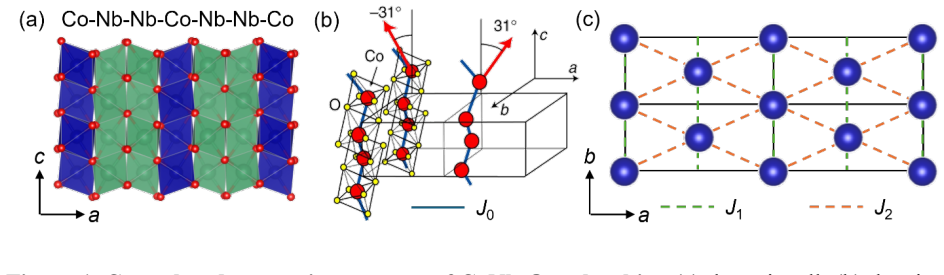
The load-bearing mechanism is the effective spin-1/2 Kramers doublet of the Co2+ (3d7) ion in a crystal field. Spin-orbit coupling splits the 3d7 configuration so that, at low temperature, only a two-level system remains along an easy axis; this is the 'upspin/down-spin' Ising degree of freedom. The second ingredient is the quasi-1D chain of edge-sharing or face-sharing CoO6 octahedra, which sets up a strong intra-chain exchange (denoted J0) and much weaker inter-chain couplings (J1, J2); the ratio of these couplings tunes the effective dimensionality from a pure 1D quantum chain to a frustrated 2D triangular lattice or a 3D ordered magnet. The review uses this single framework to explain the appearance of quantum phase transitions, confined spinons, E8 particles, Bethe strings, magnetization plateaus, and field-induced metamagnetic transitions across otherwise dissimilar materials.
What would settle it
A decisive test is to measure the 1/3 plateau in clean CoGeO3 single crystals with controlled chain dilution (e.g., Zn substitution for Co): if the plateau is unchanged at a few percent dilution, the isolated-chain interpretation fails, and if it disappears immediately, the plateau belongs to the chain physics itself.
Extended reading notes
Core claim
The paper is a topical review rather than a new measurement, and its central claim is that the properties of cobalt-based quasi-1D magnets emerge from the interplay of the Kramers-ion nature of Co2+ (3d7) and the quasi-1D chain structural motif. The review presents this as a two-step mechanism: the anisotropic crystal field around Co2+ forces an effective S = 1/2 ground state with Ising-like up/down spins, and the weak coupling between chains preserves one-dimensional quantum behavior while allowing enough inter-chain exchange to produce long-range order, frustration, or tunable phase diagrams. On this basis it organizes a large body of observed phenomena—transverse-field quantum criticality and kink bound states in CoNb2O6, spinon confinement and E8 particles in (Ba/Sr)Co2V2O8, Bethe strings in SrCo2V2O8 under longitudinal field, 1/3 magnetization plateaus in CoGeO3 and CaCoSi2O6, and quantum tunneling of magnetization in Ca3Co2O6—into a single framework. It also claims that many chemically distinct families, including pyroxenes, garnets, halide salts, and organic–inorganic hybrids, show analogous signatures and deserve deeper study.
Load-bearing premise
The review's usefulness depends on the unstated premise that each cited experiment and model assignment—CoNb2O6 as a faithful transverse-field Ising magnet, Bethe strings in SrCo2V2O8, the no-triangular-lattice origin of the CoGeO3 plateau—is essentially correct, since the review does not re-derive or re-check those results.
Editorial extensions
If this is right
- If the framework is right, then any cobalt compound with edge- or face-sharing CoO6 chains and weak inter-chain coupling should show at least one of the family's signatures—quantum criticality, confinement, plateaus, or field-induced transitions—making the search for new quantum magnets a matter of crystal chemistry rather than luck.
- CoNb2O6's measured kink bound states and E8-related response, taken together with the review's argument, imply that transverse-field Ising physics is experimentally accessible in a real material, so other weakly coupled Ising chains should be tested with the same neutron and terahertz probes.
- For (Ba/Sr)Co2V2O8, the observation of spinon confinement below the Néel temperature and Bethe strings in longitudinal fields means that the integrable Heisenberg–Ising (XXZ) model is realized in solids and can be used to compare theory and experiment quantitatively.
- The pyroxene results—especially the 1/3 plateau in CoGeO3 and multiple plateaus in CaCoSi2O6—imply that magnetization plateaus do not require a triangular lattice of chains, which widens the set of candidate plateau materials to simpler orthorhombic or monoclinic chain structures.
Reading between the lines
- Our inference: the same Kramers-ion + Ising-chain principle suggests that other 3d7 configurations (for instance, low-spin Ir2+ or Rh2+ analogs) and even 4d/5d ions with strong spin-orbit coupling could realize similar Ising-chain physics, though the review itself only hints at this through Nb/Ta substitution ideas.
- Our inference: the review's repeated emphasis on crystal-growth obstacles implies a concrete testable program—growing ultra-clean single crystals of pyroxenes and garnets and measuring whether the predicted plateaus and spinon-confinement gaps sharpen as the crystals improve; the paper does not itself report such data.
- Our inference: because the review lists many materials but does not compile a quantitative cross-family phase diagram, one could extract J1/J0 ratios from the cited neutron and magnetization experiments and test whether the observed phenomena (confinement vs. plateau vs. tunneling) sort by this ratio; that sorting is not demonstrated in the review.
Signed reviews
Editorial analysis
A structured set of objections, weighed in public.
Referee Report
Summary. This topical review surveys recent progress in cobalt-based quasi-one-dimensional quantum magnets, organizing the materials by structural motif: edge-sharing CoO6 chains (columbites, pyroxenes, A(II)Co2V2O8), face-sharing CoO6 chains (Ca3Co2O6 and derivatives), and other systems including garnets, halides, and hybrid compounds. The central assertion, stated in Section 1, is that the combination of the Kramers-ion nature of Co2+ (3d7) with the quasi-1D chain motif produces effective S=1/2 Ising-like behavior that underlies a broad range of exotic phenomena, including quantum phase transitions, spinon confinement, E8 particles, Bethe strings, and magnetization plateaus. The review does not present new derivations; it synthesizes the existing literature and flags several open debates, such as deviations from the ideal transverse-field Ising model in CoNb2O6 and controversies over oxidation states in Ca3Co2O6.
Significance. If the synthesis is accurate, the review provides a valuable cross-referenced map of a diverse materials family, connecting structural chemistry to quantum magnetism and highlighting promising directions such as Kitaev physics in pyroxenes and the tunability of the A(II)Co2V2O8 family. The authors are established practitioners, and the review covers a substantial body of both experimental and theoretical work, including very recent results (e.g., refs [43], [53], [76]). Its main utility is as an entry point for researchers seeking a comparative view across cobalt chain compounds. The review is largely descriptive and relies on the primary literature for correctness; this is inherent to the genre, and the authors do acknowledge several unresolved controversies. I found no internal inconsistency or unsupported quantitative claim that would invalidate the central characterization.
major comments (3)
- [Section 2.1, α-CoV2O6 paragraph] The sentence "quantum annealing resulting from time-reversal symmetry breaking in a tiny transverse field" is a strong, unusual claim that is not defined or contextualized. "Quantum annealing" is a term with specific connotations in optimization, and using it here without explanation could mislead readers. Moreover, the mechanism (time-reversal symmetry breaking from a tiny transverse field) is a specific interpretation from a single paper (ref [43]); the review presents it as an established finding. Please either clarify the terminology, explain the physical content in the context of the original study, or soften the claim to reflect that it is a recent proposal from one group.
- [Section 2.2, CoGeO3 discussion] The review states that 1/3 plateaus in CoGeO3 appear "despite the absence of an apparent triangular lattice in the structural motif." This phrasing invites immediate confusion. The cited paper (ref [6]) explains the plateau through an anisotropic frustrated square lattice with one diagonal exchange; the review should mention this mechanism in the main text so that the claim is not presented as a paradox. Adding one sentence about the proposed model would greatly improve clarity.
- [Section 4.4, Co2+-containing chalcogenides] This subsection consists of a single sentence: "these systems warrant a separate review." While a limitation statement is honest, its placement as a titled subsection in a review that promises to cover cobalt-based quasi-1D quantum magnets is disproportionate. The authors should either provide a brief account of representative chalcogenide materials and their magnetic behavior, or remove the subsection and explicitly state in the introduction/conclusions that chalcogenides are excluded from the present scope.
minor comments (8)
- [Abstract] "Th is topical review" contains a typo and should be "This topical review."
- [Section 2.2, last paragraph] "revel an effective spin-½" should be "reveal an effective spin-½."
- [Figure 5 caption] The formulas in the caption are incorrect: "CaCoXO6" should be "CaCoX2O6," and "CaCoGeO6" / "CaCoSiO6" should be "CaCoGe2O6" / "CaCoSi2O6," consistent with the main text.
- [References] Reference [15] is garbled: the authors should be "E. Lieb, T. Schultz, and D. Mattis," not "E. Lier, T. Schultz, D.J. MATTE Thomas Watson." Please correct this. Reference [12] also appears to have a stray "Physics World" prefix; it should simply cite S. Sachdev, Quantum Phase Transitions, Cambridge University Press, 1999. Reference [64] contains an HTML entity "Roõ&tild;m" and should read "T. Rõõm."
- [Throughout] There are numerous formatting artifacts with spurious spaces in author initials (e.g., "V .", "Y .") and in text (e.g., "Th is" in the abstract). A careful proofreading pass is needed.
- [Section 2.3] "picked up from the alkaline group" should likely be "chosen from the alkaline-earth group" or simply "divalent cations," since Pb2+ is not an alkaline-earth ion.
- [Section 3.1] "the two most agreed combinations" is awkward; consider rewriting as "the two most commonly proposed oxidation-state/electron-configuration combinations."
- [Section 5, Conclusions] The sentence "affirming Co-based quasi-1-dimensional materials an active playground" is missing a verb; it should be "affirming that Co-based quasi-1-dimensional materials are an active playground."
Circularity Check
No significant circularity: the review summarizes external experimental and theoretical results and contains no derivation that reduces to its own inputs.
full rationale
This paper is a topical review rather than an original derivation or prediction. Its central characterization, that cobalt-based quasi-1D materials show complex quantum magnetism arising from the Kramers-ion nature of Co2+ and the quasi-1D chain motif, is presented as a synthesis of previously published experimental and theoretical findings, each of which is cited to primary literature. No equation in the review is derived from another equation, and no fitted parameter is subsequently renamed as a prediction. The highlighted phenomena, such as the transverse-field Ising behavior of CoNb2O6, the Bethe strings in SrCo2V2O8, the E8 excitations in BaCo2V2O8, and the 1/3 magnetization plateau in CoGeO3, are explicitly attributed to external measurements and analyses rather than being established within this review. Some of those supporting papers are coauthored by the present reviewers (e.g., refs. [2], [7], [22], [29], [51]), but those citations point to specific experimental results with independent data, and the review does not rely on them as an unverified premise to force a conclusion. Because the paper makes no new falsifiable derivation and its claims are not equivalent by construction to any input, there is no circularity under the stated criteria.
Assumptions & free parameters
assumptions (2)
- domain assumption The experimental and theoretical results in the cited references are factually correct and have been interpreted correctly by the reviewers.
- domain assumption The mapping of each material to an idealized low-dimensional spin model (transverse-field Ising, XXZ, Kitaev chain) is valid for the phenomena highlighted.
Cite this review
Pith. "Pith review of Recent Progress in Studies of Cobalt-based Quasi-1-dimensional Quantum Magnets." pith.science (2026). https://pith.science/paper/7HFAXRQ3
@misc{pith2026250209012,
  author       = {Pith},
  title        = {Pith review of: Recent Progress in Studies of Cobalt-based Quasi-1-dimensional Quantum Magnets},
  year         = {2026},
  howpublished = {\url{https://pith.science/paper/7HFAXRQ3}},
  note         = {Machine review of arXiv:2502.09012}
}
read the original abstract
The interplay of crystal electric field, temperature, and spin-orbit coupling can yield a Kramers ion and thus an effective S = 1/2 ground state for Co2+ ions (3d7), which is often the case for low dimensional materials. This is because a highly anisotropic structural motif can force the spins to point either up or down, hence becoming a system where spins communicate via Ising interactions. Cobalt-based quasi-1-dimensional materials have been studied in this context since the latter half of the 20th century, but due to the development of modern characterization techniques and advances in sample preparation, the exotic physical phenomena that have generated the most interest have only emerged in the most recent three to four decades. This topical review mainly summarizes progress in cobalt-based quasi-1-dimensional quantum magnets, and comments on a few research directions of potential future interest.
Figures


Figures from the paper (6 more)


Reference graph
Works this paper leans on
-
[43]
Y . Zhao, Z. Ma, Z. He, H. Liao, Y .C. Wang, J. Wang, Y . Li, Quantum annealing of a frustrated magnet, Nat Commun 15 (2024) 3495. https://doi.org/10.1038/s41467-024-47819-y
-
[53]
P.A. Maksimov, A. V . Ushakov, A.F. Gubkin, G.J. Redhammer, S.M. Winter, A.I. Kolesnikov, A.M. dos Santos, Z. Gai, M.A. McGuire, A. Podlesnyak, S. V . Streltsov, Cobalt-based pyroxenes: A new playground for Kitaev physics, Proc Natl Acad Sci U S A 121 (2024) e2409154121. https://doi.org/10.1073/pnas.2409154121
-
[76]
K. Puzniak, C. Aguilar-Maldonado, R. Feyerherm, K. Prokeš, A.T.M.N. Islam, Y . Skourski, L. Keller, B. Lake, Magnetic structure and phase diagram of the Heisenberg-Ising spin chain antiferromagnetic PbCo2V2O8, Phys Rev B 108 (2023) 144432. https://doi.org/10.1103/PhysRevB.108.144432
-
[6]
H. Guo, L. Zhao, M. Baenitz, X. Fabrèges, A. Gukasov, A. Melendez Sans, D.I. Khomskii, L.H. Tjeng, A.C. Komarek, Emergent 1/3 magnetization plateaus in pyroxene CoGeO 3, Phys Rev Res 3 (2021) L032037. https://doi.org/10.1103/PhysRevResearch.3.L032037
-
[1]
S. Lee, R.K. Kaul, L. Balents, Interplay of quantum criticality and geometric frustration in columbite, Nat Phys 6 (2010) 702–706. https://doi.org/10.1038/nphys1696
-
[2]
T. Liang, S.M. Koohpayeh, J.W. Krizan, T.M. McQueen, R.J. Cava, N.P. Ong, Heat capacity peak at the quantum critical point of the transverse Ising magnet CoNb 2O6, Nat Commun 6 (2015) 7611. https://doi.org/10.1038/ncomms8611
-
[3]
Wannier, The Triangular Ising Net, Physical Review 79 (1950) 357–364
G.H. Wannier, The Triangular Ising Net, Physical Review 79 (1950) 357–364. https://doi.org/10.1103/PhysRev.79.357
-
[4]
W. Scharf, H. Weitzel, I. Yaeger, I. Maartense, B.M. Wanklyn, Magnetic Structures of CoNb2O6, J Magn Magn Mater 13 (1979) 121–124. https://doi.org/10.1016/0304-8853(79)90044-1
Show all 155 references
-
[5]
Hardy, V
V . Hardy, V . Caignaert, O. Pérez, L. Hervé, N. Sakly, B. Raveau, M.M. Seikh, F. Damay, Pretransitional short-range ordering in a triangular lattice of Ising spin chains, Phys Rev B 98 (2018) 144414. https://doi.org/10.1103/PhysRevB.98.144414
2018 doi
-
[7]
L. Jin, S. Peng, A. Nakano Rutherford, X. Xu, D. Ni, C. Yang, Y . Ji Byeon, W. Xie, H. Zhou, X. Dai, R.J. Cava, A pyroxene-based quantum magnet with multiple magnetization plateaus, Sci Adv 10 (2024) eadp4685. https://doi.org/10.1126/sciadv.adp4685
2024 doi
-
[8]
Agrestini, L.C
S. Agrestini, L.C. Chapon, A. Daoud-Aladine, J. Schefer, A. Gukasov, C. Mazzoli, M.R. Lees, O.A. Petrenko, Nature of the magnetic order in Ca 3Co2O6, Phys Rev Lett 101 (2008) 097207. https://doi.org/10.1103/PhysRevLett.101.097207
2008 doi
-
[9]
Kobayashi, S
S. Kobayashi, S. Mitsuda, K. Prokes, Low-temperature magnetic phase transitions of the geometrically frustrated isosceles triangular Ising antiferromagnet CoNb2O6, Phys Rev B 63 (2000) 024415. https://doi.org/10.1103/PhysRevB.63.024415
2000 doi
-
[10]
Canévet, B
E. Canévet, B. Grenier, M. Klanjšek, C. Berthier, M. Horvatić, V . Simonet, P. Lejay, Field- induced magnetic behavior in quasi-one-dimensional Ising-like antiferromagnet BaCo2V2O8: A single-crystal neutron diffraction study, Phys Rev B 87 (2013) 054408. https://doi.org/10.110...
2013 doi
-
[11]
Zamolodchikov, Integrals of motion and S-matrix of the (scaled) T=Tc Ising model with magnetic field, Int J Mod Phys A 4 (1989) 4235–4248
A.B. Zamolodchikov, Integrals of motion and S-matrix of the (scaled) T=Tc Ising model with magnetic field, Int J Mod Phys A 4 (1989) 4235–4248. https://doi.org/10.1142/S0217751X8900176X
1989 doi
-
[12]
Sachdev, Physics World Quantum phase transitions, Cambridge Univ
S. Sachdev, Physics World Quantum phase transitions, Cambridge Univ. Press, 1999
1999
-
[13]
Ghosh, T.F
S. Ghosh, T.F. Rosenbaum, G. Aeppli, S.N. Coppersmith, Entangled quantum state of magnetic dipoles, Nature 425 (2003) 48–51. https://doi.org/10.1038/nature01888
2003 doi
-
[14]
Coldea, D.A
R. Coldea, D.A. Tennant, E.M. Wheeler, E. Wawrzynska, D. Prabhakaran, M. Telling, K. Habicht, P. Smeibidl, K. Kiefer, Quantum Criticality in an Ising Chain: Experimental Evidence for Emergent E 8 Symmetry, Science 327 (2010) 177–180. https://doi.org/10.1126/science.1180085
2010 doi
-
[15]
E. Lier, T. Schultz, D.J. MATTE Thomas Watson, Two Soluble Models of an Antiferromagnetic Chain, Ann Phys (NY) 16 (1961) 407–466
1961
-
[16]
Hanawa, K
T. Hanawa, K. Shinkawa, M. Ishikawa, K. Miyatani, K. Saito, K. Kohn, Anisotropic specific heat of CoNb 2O6 in magnetic fields, J Physical Soc Japan 63 (1994) 2706–2715. https://doi.org/https://doi.org/10.1143/JPSJ.63.2706
1994 doi
-
[17]
C. Heid, H. Weitzel, B.M. Bonnet W Gonschorek, T.J. V ogt Norwig, H. Fuess, Magnetic phase diagram of CoNb 2O6: a neutron diffraction study, J Magn Magn Mater 151 (1995) 123–131. https://doi.org/10.1016/0304-8853(95)00394-0
1995 doi
-
[18]
Kobayashi, S
S. Kobayashi, S. Mitsuda A’, K. Hosoya, H. Yoshizawa, T. Hanawa, M. Ishikawa, K. Miyatani, K. Saito, K. Kohn, Competition between the inter-chain interaction and single-ion anisotropy in CoNb 2O6, Physica B Condens Matter 213 (1995) 176–178. https://doi.org/10.1016/0921- 4526(...
1995 doi
-
[19]
Kobayashi, S
S. Kobayashi, S. Mitsuda, M. Ishikawa, K. Miyatani, K. Kohn, Three-dimensional magnetic ordering in the quasi-one-dimensional Ising magnet CoNb2O6 with partially released geometrical frustration, Phys Rev B 60 (1999) 3331. https://doi.org/10.1103/PhysRevB.60.3331
1999 doi
-
[20]
Kinross, M
A.W. Kinross, M. Fu, T.J. Munsie, H.A. Dabkowska, G.M. Luke, S. Sachdev, T. Imai, Evolution of quantum fluctuations near the quantum critical point of the transverse field ising chain system CoNb 2O6, Phys Rev X 4 (2014) 031008. https://doi.org/10.1103/PhysRevX.4.031008
2014 doi
-
[21]
Matsuura, P.T
K. Matsuura, P.T. Cong, S. Zherlitsyn, J. Wosnitza, N. Abe, T.H. Arima, Anomalous Lattice Softening Near a Quantum Critical Point in a Transverse Ising Magnet, Phys Rev Lett 124 (2020) 127205. https://doi.org/10.1103/PhysRevLett.124.127205
2020 doi
-
[22]
Morris, R
C.M. Morris, R. Valdés Aguilar, A. Ghosh, S.M. Koohpayeh, J. Krizan, R.J. Cava, O. Tchernyshyov, T.M. McQueen, N.P. Armitage, Hierarchy of bound states in the one-dimensional ferromagnetic Ising Chain CoNb 2O6 investigated by high-resolution time-domain terahertz spectroscopy,...
2014 doi
-
[23]
Kjäll, F
J.A. Kjäll, F. Pollmann, J.E. Moore, Bound states and E8 symmetry effects in perturbed quantum Ising chains, Phys Rev B 83 (2011) 020407(R). https://doi.org/10.1103/PhysRevB.83.020407
2011 doi
-
[24]
Robinson, F.H.L
N.J. Robinson, F.H.L. Essler, I. Cabrera, R. Coldea, Quasiparticle breakdown in the quasi-one- dimensional Ising ferromagnet CoNb 2O6, Phys Rev B 90 (2014) 174406. https://doi.org/10.1103/PhysRevB.90.174406
2014 doi
-
[25]
M. Fava, R. Coldea, S.A. Parameswaran, Glide symmetry breaking and Ising criticality in the quasi-1D magnet CoNb2O6, Proc Natl Acad Sci U S A 117 (2020) 25219–25224. https://doi.org/10.1073/pnas.2007986117
2020 doi
-
[26]
Sarkis, S
C.L. Sarkis, S. Säubert, V . Williams, E.S. Choi, T.R. Reeder, H.S. Nair, K.A. Ross, Low- temperature domain-wall freezing and nonequilibrium dynamics in the transverse-field Ising model material CoNb2O6, Phys Rev B 104 (2021) 214424. https://doi.org/10.1103/PhysRevB.104.214424
2021 doi
-
[27]
Woodland, D
L. Woodland, D. Macdougal, I.M. Cabrera, J.D. Thompson, D. Prabhakaran, R.I. Bewley, R. Coldea, Tuning the confinement potential between spinons in the Ising chain compound CoNb 2O6 using longitudinal fields and quantitative determination of the microscopic Hamiltonian, Phys R...
2023 doi
-
[28]
Birnkammer, J
S. Birnkammer, J. Knolle, M. Knap, Signatures of Domain-Wall Confinement in Raman Spectroscopy of Ising Spin Chains, Phys Rev B 110 (2024) 134408. https://doi.org/10.1103/PhysRevB.110.134408
2024 doi
-
[29]
Morris, N
C.M. Morris, N. Desai, J. Viirok, D. Hüvonen, U. Nagel, T. Rõõm, J.W. Krizan, R.J. Cava, T.M. McQueen, S.M. Koohpayeh, R.K. Kaul, N.P. Armitage, Duality and domain wall dynamics in a twisted Kitaev chain, Nat Phys 17 (2021) 832–836. https://doi.org/10.1038/s41567-021-01208-0
2021 doi
-
[30]
Churchill, H.Y
D. Churchill, H.Y . Kee, Transforming from Kitaev to Disguised Ising Chain: Application to CoNb 2O6, Phys Rev Lett 133 (2024) 056703. https://doi.org/10.1103/PhysRevLett.133.056703
2024 doi
-
[31]
Reimers, J.E
J.N. Reimers, J.E. Greedan, C. V Stager, R. Kremer, Crystal Structure and Magnetism in CoSb2O6 and CoTa2O6, J Solid State Chem 83 (1989) 20–30. https://doi.org/10.1016/0022- 4596(89)90049-2
1989 doi
-
[32]
Mulla, N
I.S. Mulla, N. Natarajan, A.B. Gaikwad, V . Samuel, U.N. Guptha, V . Ravi, A coprecipitation technique to prepare CoTa2O6 and CoNb2O6, Mater Lett 61 (2007) 2127–2129. https://doi.org/10.1016/j.matlet.2006.08.024
2007 doi
-
[33]
Kinast, C.A
E.J. Kinast, C.A. dos Santos, D. Schmitt, O. Isnard, M.A. Gusmão, J.B.M. da Cunha, Magnetic structure of the quasi-two-dimensional compound CoTa2O6, J Alloys Compd 491 (2010) 41–44. https://doi.org/10.1016/j.jallcom.2009.10.241
2010 doi
-
[34]
Christian, A.T
A.B. Christian, A.T. Schye, K.O. White, J.J. Neumeier, Magnetic, thermal, and optical properties of single-crystalline CoTa2O6 and FeTa2O6 and their anisotropic magnetocaloric effect, J Condens Matter Phys 30 (2018) 195803. https://doi.org/10.1088/1361-648X/aab884
2018 doi
-
[35]
Z. He, M. Itoh, Single crystal flux growth of the Ising spin-chain system γ-CoV2O6, J Cryst Growth 388 (2014) 103–106. https://doi.org/10.1016/j.jcrysgro.2013.11.078
2014 doi
-
[36]
Kimber, H
S.A.J. Kimber, H. Mutka, T. Chatterji, T. Hofmann, P.F. Henry, H.N. Bordallo, D.N. Argyriou, J.P. Attfield, Metamagnetism and soliton excitations in the modulated ferromagnetic Ising chain CoV2O6, Phys Rev B 84 (2011) 104425. https://doi.org/10.1103/PhysRevB.84.104425
2011 doi
-
[37]
Markkula, A.M
M. Markkula, A.M. Arévalo-López, J.P. Attfield, Field-induced spin orders in monoclinic CoV2O6, Phys Rev B 86 (2012) 134401. https://doi.org/10.1103/PhysRevB.86.134401
2012 doi
-
[38]
Markkula, A.M
M. Markkula, A.M. Arevalo-Lopez, J.P. Attfield, Neutron diffraction study of monoclinic brannerite-type CoV2O6, J Solid State Chem 192 (2012) 390–393. https://doi.org/10.1016/j.jssc.2012.04.029
2012 doi
-
[39]
Lenertz, J
M. Lenertz, J. Alaria, D. Stoeffler, S. Colis, A. Dinia, O. Mentré, G. André, F. Porcher, E. Suard, Magnetic structure of ground and field-induced ordered states of low-dimensional α-CoV 2O6: Experiment and theory, Phys Rev B 86 (2012) 214428. https://doi.org/10.1103/PhysRevB....
2012 doi
-
[40]
A. Saúl, D. V odenicarevic, G. Radtke, Theoretical study of the magnetic order in α-CoV 2O6, Phys Rev B 87 (2013) 024403. https://doi.org/10.1103/PhysRevB.87.024403
2013 doi
-
[41]
Z. He, J.I. Yamaura, Y . Ueda, W. Cheng, CoV2O6 single crystals grown in a closed crucible: Unusual magnetic behaviors with large anisotropy and 1/3 magnetization plateau, J Am Chem Soc 131 (2009) 7554–7555. https://doi.org/10.1021/ja902623b
2009 doi
-
[42]
Drees, S
Y . Drees, S. Agrestini, O. Zaharko, A.C. Komarek, Floating zone single crystal growth of γ- CoV 2O6 with substantially enhanced crystal size and quality, Cryst Growth Des 15 (2015) 1168–
2015
-
[44]
Durand, S
G. Durand, S. Vilminot, P. Rabu, A. Derory, J.P. Lambour, E. Ressouche, Synthesis, Structure, and Magnetic Properties of CaMSi2O6(M= Co, Ni) Compounds and Their Solid Solutions, J Solid State Chem 124 (1996) 374–380. https://doi.org/10.1006/JSSC.1996.0252
1996
-
[45]
Redhammer, G
G.J. Redhammer, G. Roth, W. Treutmann, W. Paulus, G. André, C. Pietzonka, G. Amthauer, Magnetic ordering and spin structure in Ca-bearing clinopyroxenes CaM2+(Si, Ge)2O6, M=Fe, Ni, Co, Mn, J Solid State Chem 181 (2008) 3163–3176. https://doi.org/10.1016/j.jssc.2008.08.014
2008 doi
-
[46]
Jodlauk, P
S. Jodlauk, P. Becker, J.A. Mydosh, D.I. Khomskii, T. Lorenz, S. V Streltsov, D.C. Hezel, L. Bohatý, Pyroxenes: a new class of multiferroics, J Condens Matter Phys 19 (2007) 432201. https://doi.org/10.1088/0953-8984/19/43/432201
2007 doi
-
[47]
Kim, B.-G
I. Kim, B.-G. Jeon, D. Patil, S. Patil, G. Nénert, K.H. Kim, Observation of multiferroic properties in pyroxene NaFeGe 2O6, J Condens Matter Phys 24 (2012) 306001. https://doi.org/10.1088/0953-8984/24/30/306001
2012 doi
-
[48]
Ackermann, L
M. Ackermann, L. Andersen, T. Lorenz, L. Bohatý, P. Becker, Anisotropy study of multiferroicity in the pyroxene NaFeGe 2O6, New J Phys 17 (2015) 013045. https://doi.org/10.1088/1367- 2630/17/1/013045
2015 doi
-
[49]
L. Ding, C. V . Colin, C. Darie, J. Robert, F. Gay, P. Bordet, One-dimensional short-range magnetic correlations in the magnetoelectric pyroxene CaMnGe2O6, Phys Rev B 93 (2016). https://doi.org/10.1103/PhysRevB.93.064423
2016 doi
-
[50]
Redhammer, G
G.J. Redhammer, G. Roth, A. Senyshyn, G. Tippelt, C. Pietzonka, Crystal and magnetic spin structure of Germanium-Hedenbergite, CaFeGe 2O6, and a comparison with other magnetic/magnetoelectric/ multiferroic pyroxenes, Zeitschrift Fur Kristallographie 228 (2013) 140–150. https:/...
2013
-
[51]
O’Connell, X
J. O’Connell, X. Xu, L. Jin, R.J. Cava, The ferromagnetic to antiferromagnetic crossover in chromium-based pyroxenes tuned via the Ge to Si ratio, J Solid State Chem 339 (2024) 124919. https://doi.org/10.1016/j.jssc.2024.124919
2024
-
[52]
L. Zhao, Z. Hu, H. Guo, C. Geibel, H.J. Lin, C. Te Chen, D. Khomskii, L.H. Tjeng, A.C. Komarek, Single crystal growth and physical properties of pyroxene CoGeO 3, Crystals (Basel) 11 (2021) 378. https://doi.org/10.3390/cryst11040378
2021 doi
-
[54]
Okutani, T
A. Okutani, T. Kida, T. Usui, T. Kimura, K. Okunishi, M. Hagiwara, High Field Magnetization of Single Crystals of the S=1/2 Quasi-1D Ising-like Antiferromagnet SrCo2V2O8, in: Phys Procedia, Elsevier B.V ., 2015: pp. 779–784. https://doi.org/10.1016/j.phpro.2015.12.101
2015 doi
-
[55]
Faure, S
Q. Faure, S. Takayoshi, S. Petit, V . Simonet, S. Raymond, L.P. Regnault, M. Boehm, J.S. White, M. Månsson, C. Rüegg, P. Lejay, B. Canals, T. Lorenz, S.C. Furuya, T. Giamarchi, B. Grenier, Topological quantum phase transition in the Ising-like antiferromagnetic spin chain BaCo...
2018 doi
-
[56]
Kimura, H
S. Kimura, H. Yashiro, M. Hagiwara, K. Okunishi, K. Kindo, Z. He, T. Taniyama, M. Itoh, High field magnetism of the quasi one-dimensional anisotropic antiferromagnet BaCo 2V2O8, in: J Phys Conf Ser, Institute of Physics Publishing, 2006: pp. 99–102. https://doi.org/10.1088/174...
2006 doi
-
[57]
Grenier, S
B. Grenier, S. Petit, V . Simonet, E. Canévet, L.P. Regnault, S. Raymond, B. Canals, C. Berthier, P. Lejay, Longitudinal and transverse Zeeman ladders in the Ising-like chain antiferromagnet BaCo2V2O8, Phys Rev Lett 114 (2015) 017201. https://doi.org/10.1103/PhysRevLett.114.017201
2015 doi
-
[58]
Z. Wang, M. Schmidt, A.K. Bera, A.T.M.N. Islam, B. Lake, A. Loidl, J. Deisenhofer, Spinon confinement in the one-dimensional Ising-like antiferromagnet SrCo2V2O8, Phys Rev B 91 (2015) 140404(R). https://doi.org/10.1103/PhysRevB.91.140404
2015 doi
-
[59]
A.K. Bera, B. Lake, F.H.L. Essler, L. Vanderstraeten, C. Hubig, U. Schollwöck, A.T.M.N. Islam, A. Schneidewind, D.L. Quintero-Castro, Spinon confinement in a quasi-one-dimensional anisotropic Heisenberg magnet, Phys Rev B 96 (2017) 054423. https://doi.org/10.1103/PhysRevB.96.054423
2017 doi
-
[60]
Kimura, K
S. Kimura, K. Okunishi, M. Hagiwara, K. Kindo, Z. He, T. Taniyama, M. Itoh, K. Koyama, K. Watanabe, Collapse of magnetic order of the quasi one-dimensional ising-like antiferromagnet BaCo 2V2O8 in transverse fields, J Physical Soc Japan 82 (2013) 033706. https://doi.org/10.756...
2013 doi
-
[61]
Niesen, G
S.K. Niesen, G. Kolland, M. Seher, O. Breunig, M. Valldor, M. Braden, B. Grenier, T. Lorenz, Magnetic phase diagrams, domain switching, and quantum phase transition of the quasi-one- dimensional Ising-like antiferromagnet BaCo 2V2O8, Phys Rev B 87 (2013) 224413. https://doi.or...
2013 doi
-
[62]
Y . Cui, H. Zou, N. Xi, Z. He, Y .X. Yang, L. Shu, G.H. Zhang, Z. Hu, T. Chen, R. Yu, J. Wu, W. Yu, Quantum Criticality of the Ising-like Screw Chain Antiferromagnet SrCo2V2O8 in a Transverse Magnetic Field, Phys Rev Lett 123 (2019) 067203. https://doi.org/10.1103/PhysRevLett....
2019 doi
-
[63]
Faure, S
Q. Faure, S. Takayoshi, B. Grenier, S. Petit, S. Raymond, M. Boehm, P. Lejay, T. Giamarchi, V . Simonet, Solitonic excitations in the Ising anisotropic chain BaCo2V2O8 under large transverse magnetic field, Phys Rev Res 3 (2021) 043227. https://doi.org/10.1103/PhysRevResearch.3.043227
2021 doi
-
[64]
Zhang, K
Z. Zhang, K. Amelin, X. Wang, H. Zou, J. Yang, U. Nagel, T. Roõ&tild;m, T. Dey, A.A. Nugroho, T. Lorenz, J. Wu, Z. Wang, Observation of E 8 particles in an Ising chain antiferromagnet, Phys Rev B 101 (2020) 220411(R). https://doi.org/10.1103/PhysRevB.101.220411
2020 doi
-
[65]
X. Wang, K. Puzniak, K. Schmalzl, C. Balz, M. Matsuda, A. Okutani, M. Hagiwara, J. Ma, J. Wu, B. Lake, Spin dynamics of the E 8 particles, Sci Bull (Beijing) 69 (2024) 2974–2977. https://doi.org/10.1016/j.scib.2024.07.040
2024 doi
-
[66]
H. Zou, Y . Cui, X. Wang, Z. Zhang, J. Yang, G. Xu, A. Okutani, M. Hagiwara, M. Matsuda, G. Wang, G. Mussardo, K. Hódsági, M. Kormos, Z. He, S. Kimura, R. Yu, W. Yu, J. Ma, J. Wu, E8 Spectra of Quasi-One-Dimensional Antiferromagnet BaCo 2V2O8 under Transverse Field, Phys Rev L...
2021 doi
-
[67]
X. Wang, H. Zou, K. Hódsági, M. Kormos, G. Takács, J. Wu, Cascade of singularities in the spin dynamics of a perturbed quantum critical Ising chain, Phys Rev B 103 (2021) 235117. https://doi.org/10.1103/PhysRevB.103.235117
2021 doi
-
[68]
Grenier, V
B. Grenier, V . Simonet, B. Canals, P. Lejay, M. Klanjšek, M. Horvatić, C. Berthier, Neutron diffraction investigation of the H-T phase diagram above the longitudinal incommensurate phase of BaCo2V2O8, Phys Rev B 92 (2015) 134416. https://doi.org/10.1103/PhysRevB.92.134416
2015 doi
-
[69]
L. Shen, O. Zaharko, J.O. Birk, E. Jellyman, Z. He, E. Blackburn, Magnetic phase diagram of the quantum spin chain compound SrCo2V2O8: A single-crystal neutron diffraction study, New J Phys 21 (2019) 073014. https://doi.org/10.1088/1367-2630/ab2b7a
2019 doi
-
[70]
V on Bethe, Zur Theorie der Metalle, Zeitschrift Für Physik 71 (1931) 205–226
H. V on Bethe, Zur Theorie der Metalle, Zeitschrift Für Physik 71 (1931) 205–226
1931
-
[71]
Z. Wang, J. Wu, W. Yang, A.K. Bera, D. Kamenskyi, A.T.M.N. Islam, S. Xu, J.M. Law, B. Lake, C. Wu, A. Loidl, Experimental observation of Bethe strings, Nature 554 (2018) 219–223. https://doi.org/10.1038/nature25466
2018 doi
-
[72]
Z. Wang, M. Schmidt, A. Loidl, J. Wu, H. Zou, W. Yang, C. Dong, Y . Kohama, K. Kindo, D.I. Gorbunov, S. Niesen, O. Breunig, J. Engelmayer, T. Lorenz, Quantum Critical Dynamics of a Heisenberg-Ising Chain in a Longitudinal Field: Many-Body Strings versus Fractional Excitations,...
2019 doi
-
[73]
A.K. Bera, J. Wu, W. Yang, R. Bewley, M. Boehm, J. Xu, M. Bartkowiak, O. Prokhnenko, B. Klemke, A.T.M.N. Islam, J.M. Law, Z. Wang, B. Lake, Dispersions of many-body Bethe strings, Nat Phys 16 (2020) 625–630. https://doi.org/10.1038/s41567-020-0835-7
2020 doi
-
[74]
Z. He, Y . Ueda, M. Itoh, Synthesis, structure and magnetic properties of new vanadate PbCo2V2O8, J Solid State Chem 180 (2007) 1770–1774. https://doi.org/10.1016/j.jssc.2007.03.026
2007 doi
-
[75]
Z. He, Y . Ueda, M. Itoh, Field-induced order-disorder transition in quasi-one-dimensional spin system PbCo2V2O8, Solid State Commun 142 (2007) 404–406. https://doi.org/10.1016/j.ssc.2007.03.012
2007 doi
-
[77]
Fjellvå, E
H. Fjellvå, E. Gulbrandsen, S. Aasland, A. Olsen, B.C. Hauback, Crystal Structure and Possible Charge Ordering in One-Dimensional Ca3Co2O6, J Solid State Chem 124 (1996) 190–194. https://doi.org/10.1006/jssc.1996.0224
1996
-
[78]
Mazzoli, A
C. Mazzoli, A. Bombardi, S. Agrestini, M.R. Lees, Resonant X-ray scattering study of Ca3Co2O6 ground state: Preliminary results of magnetic field effects, Physica B Condens Matter 404 (2009) 3042–3044. https://doi.org/10.1016/j.physb.2009.07.008
2009 doi
-
[79]
Aasland, H
S. Aasland, H. Fjellvåg, B. Haubackb, Magnetic properties of the one-dimensional Ca3Co2O6, Solid State Commun 101 (1997) 187–192. https://doi.org/10.1016/S0038-1098(96)00531-5
1997 doi
-
[80]
Kageyama, K
H. Kageyama, K. Yoshimura, K. Kosuge, M. Azuma, M. Takano, H. Mitamura, T. Goto, Magnetic Anisotropy of Ca3Co2O6 with Ferromagnetic Ising Chains, J Physical Soc Japan 66 (1997) 3996–4000. https://doi.org/10.1143/JPSJ.66.3996
1997 doi
-
[81]
Maignan, C
A. Maignan, C. Michel, A.C. Masset, C. Martin, B. Raveau, Single crystal study of the one dimensional Ca3Co2O6 compound: five stable configurations for the Ising triangular lattice, Eur. Phys. J. B 15 (2000) 657–663. https://doi.org/10.1007/PL00011051
2000 doi
-
[82]
Maignan, V
A. Maignan, V . Hardy, S. Hébert, M. Drillon, M.R. Lees, O. Petrenko, D.M.K. Paul, D. Khomskii, Quantum tunneling of the magnetization in the Ising chain compound Ca 3Co2O6, J Mater Chem 14 (2004) 1231–1234. https://doi.org/10.1039/b316717h
2004 doi
-
[83]
Vidya, P
R. Vidya, P. Ravindran, H. Fjellvåg, A. Kjekshus, O. Eriksson, Tailor-made electronic and magnetic properties in one-dimensional pure and Y-substituted Ca3Co2O6, Phys Rev Lett 91 (2003) 186404. https://doi.org/10.1103/PhysRevLett.91.186404
2003 doi
-
[84]
Hardy, S
V . Hardy, S. Lambert, R. Lees, D. McK. Paul, Specific heat and magnetization study on single crystals of the frustrated quasi-one-dimensional oxide Ca 3Co2O6, Phys Rev B 68 (2003) 014424. https://doi.org/10.1103/PhysRevB.68.014424
2003 doi
-
[85]
Eyert, C
V . Eyert, C. Laschinger, T. Kopp, R. Frésard, Extended moment formation and magnetic ordering in the trigonal chain compound Ca3Co2O6, Chem Phys Lett 385 (2004) 249–254. https://doi.org/10.1016/j.cplett.2003.12.105
2004 doi
-
[86]
H. Wu, M.W. Haverkort, Z. Hu, D.I. Khomskii, L.H. Tjeng, Nature of magnetism in Ca3Co2O6, Phys Rev Lett 95 (2005) 186401. https://doi.org/10.1103/PhysRevLett.95.186401
2005 doi
-
[87]
Takubo, T
K. Takubo, T. Mizokawa, S. Hirata, J.Y . Son, A. Fujimori, D. Topwal, D.D. Sarma, S. Rayaprol, E. V . Sampathkumaran, Electronic structure of Ca 3CoXO6 (X=Co, Rh, Ir) studied by x-ray photoemission spectroscopy, Phys Rev B 71 (2005) 073406. https://doi.org/10.1103/PhysRevB.71.073406
2005 doi
-
[88]
Burnus, Z
T. Burnus, Z. Hu, M.W. Haverkort, J.C. Cezar, D. Flahaut, V . Hardy, A. Maignan, N.B. Brookes, A. Tanaka, H.H. Hsieh, H.J. Lin, C.T. Chen, L.H. Tjeng, Valence, spin, and orbital state of Co ions in one-dimensional Ca 3Co2O6: An X-ray absorption and magnetic circular dichroism ...
2006 doi
-
[89]
Chapon, Origin of the long-wavelength magnetic modulation in Ca3Co2O6, Phys Rev B 80 (2009) 172405
L.C. Chapon, Origin of the long-wavelength magnetic modulation in Ca3Co2O6, Phys Rev B 80 (2009) 172405. https://doi.org/10.1103/PhysRevB.80.172405
2009 doi
-
[90]
Moyoshi, K
T. Moyoshi, K. Motoya, Incommensurate magnetic structure and its long-time variation in a geometrically frustrated magnet Ca3Co2O6, J Physical Soc Japan 80 (2011) 034701. https://doi.org/10.1143/JPSJ.80.034701
2011 doi
-
[91]
Agrestini, C
S. Agrestini, C. Mazzoli, A. Bombardi, M.R. Lees, Incommensurate magnetic ground state revealed by resonant x-ray scattering in the frustrated spin system Ca3Co2O6, Phys Rev B 77 (2008) 140403(R). https://doi.org/10.1103/PhysRevB.77.140403
2008 doi
-
[92]
Lampen, N.S
P. Lampen, N.S. Bingham, M.H. Phan, H. Srikanth, H.T. Yi, S.W. Cheong, Macroscopic phase diagram and magnetocaloric study of metamagnetic transitions in the spin chain system Ca3Co2O6, Phys Rev B 89 (2014) 144414. https://doi.org/10.1103/PhysRevB.89.144414
2014 doi
-
[93]
Kageyama, K
H. Kageyama, K. Yoshimura, K. Kosuge, H. Mitamura, T. Goto, Field-Induced Magnetic Transitions in the One-Dimensional Compound Ca3Co2O6, J Physical Soc Japan 66 (1997) 1607–
1997
-
[94]
Hardy, M.R
V . Hardy, M.R. Lees, O.A. Petrenko, D.M.K. Paul, D. Flahaut, S. Hébert, A. Maignan, Temperature and time dependence of the field-driven magnetization steps in Ca3Co2O6 single crystals, Phys Rev B 70 (2004) 064424. https://doi.org/10.1103/PhysRevB.70.064424
2004 doi
-
[95]
Kudasov, Steplike magnetization in a spin-chain system: Ca3Co2O6, Phys Rev Lett 96 (2006) 027212
Y .B. Kudasov, Steplike magnetization in a spin-chain system: Ca3Co2O6, Phys Rev Lett 96 (2006) 027212. https://doi.org/10.1103/PhysRevLett.96.027212
2006 doi
-
[96]
Fleck, M.R
C.L. Fleck, M.R. Lees, S. Agrestini, G.J. McIntyre, O.A. Petrenko, Field-driven magnetisation steps in Ca3Co2O6 : A single-crystal neutron-diffraction study, Europhys Lett 90 (2010) 67006. https://doi.org/10.1209/0295-5075/90/67006
2010 doi
-
[97]
X.Y . Yao, S. Dong, J.M. Liu, Steplike magnetization of spin chains in a triangular lattice: Monte Carlo simulations, Phys Rev B 73 (2006) 212415. https://doi.org/10.1103/PhysRevB.73.212415
2006 doi
-
[98]
X. Yao, S. Dong, H. Yu, J. Liu, Monte Carlo simulation of magnetic behavior of a spin-chain system on a triangular lattice, Phys Rev B 74 (2006) 134421. https://doi.org/10.1103/PhysRevB.74.134421
2006 doi
-
[99]
Qin, K.F
M.H. Qin, K.F. Wang, J.M. Liu, Two-step magnetization in a spin-chain system on the triangular lattice: Wang-Landau simulation, Phys Rev B 79 (2009) 172405. https://doi.org/10.1103/PhysRevB.79.172405
2009 doi
-
[100]
R. Soto, G. Martínez, M.N. Baibich, J.M. Florez, P. Vargas, Metastable states in the triangular- lattice Ising model studied by Monte Carlo simulations: Application to the spin-chain compound Ca3Co2O6, Phys Rev B 79 (2009) 184422. https://doi.org/10.1103/PhysRevB.79.184422
2009 doi
-
[101]
Kudasov, A.S
Y .B. Kudasov, A.S. Korshunov, V .N. Pavlov, D.A. Maslov, Dynamics of magnetization in frustrated spin-chain system Ca 3Co2O6, Phys Rev B 78 (2008) 132407. https://doi.org/10.1103/PhysRevB.78.132407
2008 doi
-
[102]
Paddison, S
J.A.M. Paddison, S. Agrestini, M.R. Lees, C.L. Fleck, P.P. Deen, A.L. Goodwin, J.R. Stewart, O.A. Petrenko, Spin correlations in Ca3Co2O6: Polarized-neutron diffraction and Monte Carlo study, Phys Rev B 90 (2014) 014411. https://doi.org/10.1103/PhysRevB.90.014411
2014 doi
-
[103]
Nekrashevich, X
I. Nekrashevich, X. Ding, F. Balakirev, H.T. Yi, S.W. Cheong, L. Civale, Y . Kamiya, V .S. Zapf, Reaching the equilibrium state of the frustrated triangular Ising magnet Ca 3Co2O6, Phys Rev B 105 (2022) 024426. https://doi.org/10.1103/PhysRevB.105.024426
2022 doi
-
[104]
Kamiya, C.D
Y . Kamiya, C.D. Batista, Formation of magnetic microphases in Ca3Co2O6, Phys Rev Lett 109 (2012) 067204. https://doi.org/10.1103/PhysRevLett.109.067204
2012 doi
-
[105]
Kamiya, Magnetic field induced deformation of the spin density wave microphases in Ca 3Co2O6, Phys Rev B 107 (2023) 134409
Y . Kamiya, Magnetic field induced deformation of the spin density wave microphases in Ca 3Co2O6, Phys Rev B 107 (2023) 134409. https://doi.org/10.1103/PhysRevB.107.134409
2023 doi
-
[106]
Agrestini, C.L
S. Agrestini, C.L. Fleck, L.C. Chapon, C. Mazzoli, A. Bombardi, M.R. Lees, O.A. Petrenko, Slow magnetic order-order transition in the spin chain antiferromagnet Ca 3Co2O6, Phys Rev Lett 106 (2011) 197204. https://doi.org/10.1103/PhysRevLett.106.197204
2011 doi
-
[107]
Motoya, T
K. Motoya, T. Kihara, H. Nojiri, Y . Uwatoko, M. Matsuda, T. Hong, Time and magnetic field variations of magnetic structure in the triangular lattice magnet Ca3Co2O6, J Physical Soc Japan 87 (2018). https://doi.org/10.7566/JPSJ.87.114703
2018 doi
-
[108]
Kozlenko, N.T
D.P. Kozlenko, N.T. Dang, N.O. Golosova, S.E. Kichanov, E. V . Lukin, P.J. Lampen Kelley, E.M. Clements, K. V . Glazyrin, S.H. Jabarov, T.L. Phan, B.N. Savenko, H. Srikanth, M.H. Phan, Pressure-induced modifications of the magnetic order in the spin-chain compound Ca3Co2O6, Ph...
2018 doi
-
[109]
Leedahl, M
B. Leedahl, M. Sundermann, A. Amorese, A. Severing, H. Gretarsson, L. Zhang, A.C. Komarek, A. Maignan, M.W. Haverkort, L.H. Tjeng, Origin of Ising magnetism in Ca3Co2O6 unveiled by orbital imaging, Nat Commun 10 (2019) 5447. https://doi.org/10.1038/s41467-019-13273-4
2019 doi
-
[110]
Allodi, P
G. Allodi, P. Santini, S. Carretta, S. Agrestini, C. Mazzoli, A. Bombardi, M.R. Lees, R. De Renzi, Exchange interactions in Ca3Co2O6 probed locally by NMR, Phys Rev B 89 (2014) 104401. https://doi.org/10.1103/PhysRevB.89.104401
2014 doi
-
[111]
Sugiyama, H
J. Sugiyama, H. Nozaki, Y . Ikedo, K. Mukai, D. Andreica, A. Amato, J.H. Brewer, E.J. Ansaldo, G.D. Morris, T. Takami, H. Ikuta, Evidence of two dimensionality in quasi-one-dimensional cobalt oxides, Phys Rev Lett 96 (2006) 197206. https://doi.org/10.1103/PhysRevLett.96.197206
2006 doi
-
[112]
Choi, H.T
Y .J. Choi, H.T. Yi, S. Lee, Q. Huang, V . Kiryukhin, S.W. Cheong, Ferroelectricity in an ising chain magnet, Phys Rev Lett 100 (2008) 047601. https://doi.org/10.1103/PhysRevLett.100.047601
2008 doi
-
[113]
H. Wu, T. Burnus, Z. Hu, C. Martin, A. Maignan, J.C. Cezar, A. Tanaka, N.B. Brookes, D.I. Khomskii, L.H. Tjeng, Ising magnetism and ferroelectricity in Ca3CoMnO6, Phys Rev Lett 102 (2009) 026404. https://doi.org/10.1103/PhysRevLett.102.026404
2009 doi
-
[114]
Kim, E.D
J.W. Kim, E.D. Mun, X. Ding, A. Hansen, M. Jaime, N. Harrison, H.T. Yi, Y . Chai, Y . Sun, S.W. Cheong, V .S. Zapf, Metastable states in the frustrated triangular compounds Ca 3Co2-xMnxO6 and Ca3Co2O6, Phys Rev B 98 (2018) 024407. https://doi.org/10.1103/PhysRevB.98.024407
2018 doi
-
[115]
Niitaka, K
S. Niitaka, K. Yoshimura, K. Kosuge, M. Nishi, K. Kakurai, Partially disordered antiferromagnetic phase in Ca3CoRhO6, Phys Rev Lett 87 (2001) 177202. https://doi.org/10.1103/PhysRevLett.87.177202
2001 doi
-
[116]
Whangbo, D
M.-H. Whangbo, D. Dai, H.-J. Koo, S. Jobic, Investigations of the oxidation states and spin distributions in Ca3Co2O6 and Ca3CoRhO6 by spin-polarized electronic band structure calculations, Solid State Commun 125 (2003) 413–417. https://doi.org/10.1016/S0038- 1098(02)00872-4
2003 doi
-
[117]
J. An, C.W. Nan, Electronic structure and transport of Ca3Co2O6 and Ca3CoNiO6, Solid State Commun 129 (2004) 51–56. https://doi.org/10.1016/j.ssc.2003.09.013
2004 doi
-
[118]
Takami, H
T. Takami, H. Ikuta, U. Mizutani, Thermoelectric properties of An+2Con+1O3n+3 (A = Ca, Sr, Ba, n = 1-5), Jpn J Appl Phys 43 (2004) 8208–8212. https://doi.org/10.1143/JJAP.43.8208
2004 doi
-
[119]
Sugiyama, H
J. Sugiyama, H. Nozaki, J.H. Brewer, E.J. Ansaldo, T. Takami, H. Ikuta, U. Mizutani, Appearance of a two-dimensional antiferromagnetic order in quasi-one-dimensional cobalt oxides, Phys Rev B 72 (2005) 064418. https://doi.org/10.1103/PhysRevB.72.064418
2005 doi
-
[120]
Sugiyama, H
J. Sugiyama, H. Nozaki, Y . Ikedo, K. Mukai, D. Andreica, A. Amato, J.H. Brewer, E.J. Ansaldo, G.D. Morris, T. Takami, H. Ikuta, Two dimensionality in quasi-one-dimensional cobalt oxides confirmed by muon-spin spectroscopy, J Magn Magn Mater 310 (2007) 2719–2721. https://doi.o...
2007 doi
-
[121]
Melkozerova, G
M.A. Melkozerova, G. V . Bazuev, Quasi-one-dimensional oxides Sr4Co3-xMnxO9 (0 ≤ x ≤ 3): Synthesis and magnetic properties, Russian Journal of Inorganic Chemistry 51 (2006) 362–367. https://doi.org/10.1134/S0036023606030053
2006 doi
-
[122]
Boulahya, M
K. Boulahya, M. Parras, J.M. González-Calbet, J.L. Martínez, Synthesis, structural characterization, and magnetic study of Sr4Mn2CoO9, Chemistry of Materials 15 (2003) 3537–
2003
-
[123]
Boulahya, M
K. Boulahya, M. Hernando, M. Parras, J.M. González-Calbet, New stabilized phases in the Sr/Ca-Mn-Co-O system: Structural-magnetic properties relationship, J Mater Chem 17 (2007) 1620–1626. https://doi.org/10.1039/b613844f
2007 doi
-
[124]
Seikh, V
M.M. Seikh, V . Caignaert, O. Perez, B. Raveau, V . Hardy, Single-ion and single-chain magnetism in triangular spin-chain oxides, Phys Rev B 95 (2017) 174417. https://doi.org/10.1103/PhysRevB.95.174417
2017 doi
-
[125]
Hernando, K
M. Hernando, K. Boulahya, M. Parras, A. Varela, J.M. González-Calbet, J.L. Martínez, Structural and magnetic study of Sr3.3Ca0.7CoRh2O9: A new partially ordered antiferromagnetic system, Chemistry of Materials 14 (2002) 4948–4954. https://doi.org/10.1021/cm0211756
2002 doi
-
[126]
Chupakhina, M.A
T.I. Chupakhina, M.A. Melkozerova, G. V . Bazuev, Phase formation features and magnetic properties of complex oxides in the systems Sr-Co-M-O (M = Zn, Cu), Russian Journal of Inorganic Chemistry 58 (2013) 253–258. https://doi.org/10.1134/S0036023613030054
2013 doi
-
[127]
A.J. Neer, J. Milam-Guerrero, J.E. So, B.C. Melot, K.A. Ross, Z. Hulvey, C.M. Brown, A.A. Sokol, D.O. Scanlon, Ising-like antiferromagnetism on the octahedral sublattice of a cobalt- containing garnet and the potential for quantum criticality, Phys Rev B 95 (2017) 144419. http...
2017 doi
-
[128]
Neer, J.A
A.J. Neer, J.A. Milam-Guerrero, V .A. Fischer, M. Zheng, N.R. Spence, C. Cozzan, M. Gu, J.M. Rondinelli, C.M. Brown, B.C. Melot, Magnetic-Field-Induced Dielectric Anomalies in Cobalt- Containing Garnets, Inorg Chem 61 (2022) 5452–5458. https://doi.org/10.1021/acs.inorgchem.1c03792
2022 doi
-
[129]
Johnstone, D.J
I.W. Johnstone, D.J. Lockwood, M.W.C. Dharma-wardana, Influence of interchain coupling on the one-dimensional magnon Raman spectrum of CsCoBr3, Solid State Commun 36 (1980) 593–
1980
-
[130]
Lehmann, W
W.P. Lehmann, W. Breitlingc, R. Weber, Raman scattering study of spin dynamics in the quasi- 1D Ising antiferromagnets CsCoCl3, and CsCoBr3, J. Phys. C: Solid State Phys 14 (1981) 4655–
1981
-
[131]
Lockwood, I.W
D.J. Lockwood, I.W. Johnstone, Raman scattering from magnons and excitons in the 3-D ordered phases of CsCoBr3, J Appl Phys 53 (1982) 8169–8171. https://doi.org/10.1063/1.330281
1982 doi
-
[132]
Matsubara, S
F. Matsubara, S. Inawashiro, H. Ohhara, On the magnetic Raman scattering in CsCoCl3, CsCoBr3 and RbCoCl3, J. Phys.: Condens. Matter 3 (1991) 1815–1826. https://doi.org/10.1088/0953-8984/3/12/012
1991 doi
-
[133]
Nagler, W.J.L
S.E. Nagler, W.J.L. Buyers, R.L. Armstrong, B. Briat, Ising-like spin-, quasi-one-dimensional antiferromagnets: Spin-wave response in CsCoX3 salts, Phys Rev B 27 (1983) 1784–1799. https://doi.org/10.1103/PhysRevB.27.1784
1983 doi
-
[134]
Nagler, W.J.L
S.E. Nagler, W.J.L. Buyers, R.L. Armstrong, B. Briat, Propagating Domain Walls in CsCoBr3, Phys Rev Lett 49 (1982) 590–592
1982
-
[135]
Yoshizawa’, K
H. Yoshizawa’, K. Hirakawa, S.K. Satija, G. Shirane, Dynamical correlation functions in a one- dimensional Ising-like antiferromagnetic CsCoCl3. A neutron scattering study, Phys Rev B 23 (1981) 2298–2307. https://doi.org/10.1103/PhysRevB.23.2298
1981 doi
-
[136]
Villain, Propagative spin relaxation in the Ising-like antiferromagnetic linear chain, Physica B+C 79 (1975) 1–12
J. Villain, Propagative spin relaxation in the Ising-like antiferromagnetic linear chain, Physica B+C 79 (1975) 1–12. https://doi.org/10.1016/0378-4363(75)90101-1
1975 doi
-
[137]
Nagler, W.J.L
S.E. Nagler, W.J.L. Buyers, R.L. Armstrong, B. Briat, Solitons in the one-dimensional antiferromagnet CsCoBr3, Phys Rev B 28 (1983) 3873–3885. https://doi.org/10.1103/PhysRevB.28.3873
1983 doi
-
[138]
H. Shiba, Quantization of Magnetic Excitation Continuum Due to lnterchain Coupling in Nearly One-Dimensional Ising-Like Antiferromagnets, Progress of Theoretical Physics 64 (1980) 466–
1980
-
[139]
Ishimura, H
N. Ishimura, H. Shiba, Dynamical Correlation Functions of One-Dimensional Anisotropic Heisenberg Model with Spin 1/2. I: Ising-Like Antiferromagnets, Progress of Theoretical Physics 63 (1980) 743–758. https://doi.org/10.1143/PTP.63.743
1980 doi
-
[140]
Matsubara, S
F. Matsubara, S. Inawashiro, Pair States and Bound States of Solitons in an Ising-Like S=1/2 Antiferromagnet with a Weak Next-Nearest-Neighbor Interaction on a Linear Chain, J Physical Soc Japan 58 (1989) 4284–4287. https://doi.org/10.1143/JPSJ.58.4284
1989 doi
-
[141]
Goff, D.A
J.P. Goff, D.A. Tennant, S.E. Nagler, Exchange mixing and soliton dynamics in the quantum spin chain CsCoCl 3, Phys Rev B 52 (1995) 15992–16000. https://doi.org/10.1103/PhysRevB.52.15992
1995 doi
-
[142]
Jorke, U
R. Jorke, U. Durr, Properties of magnetic excitations in RbCoCl3, J. Phys. C: Solid State Phys. 16 (1983) L1129–L1136. https://doi.org/10.1088/0022-3719/16/31/007
1983 doi
-
[143]
Lockwood, I.W
D.J. Lockwood, I.W. Johnstone, H.J. Labbet, B. Briat, Raman scattering from the 1D antiferromagnets RbCoCl3 and RbNiCl3, J. Phys. C: Solid State Phys. 16 (1983) 6451–6474. https://doi.org/10.1088/0022-3719/16/33/018
1983 doi
-
[144]
M. Mena, N. Hänni, S. Ward, E. Hirtenlechner, R. Bewley, C. Hubig, U. Schollwöck, B. Normand, K.W. Krämer, D.F. McMorrow, C. Rüegg, Thermal Control of Spin Excitations in the Coupled Ising-Chain Material RbCoCl3, Phys Rev Lett 124 (2020) 257201. https://doi.org/10.1103/PhysRev...
2020 doi
-
[145]
Hänni, D
N.P. Hänni, D. Sheptyakov, M. Mena, E. Hirtenlechner, L. Keller, U. Stuhr, L.P. Regnault, M. Medarde, A. Cervellino, C. Rüegg, B. Normand, K.W. Krämer, Magnetic order in the quasi-one- dimensional Ising system RbCoCl 3, Phys Rev B 103 (2021) 094424. https://doi.org/10.1103/Phy...
2021 doi
-
[146]
Cottam, D.J
M.G. Cottam, D.J. Lockwood, Zeeman-ladder analysis of the Raman magnon energies in the quasi-one-dimensional antiferromagnet RbCoCl3, Phys Rev B 105 (2022) 064411. https://doi.org/10.1103/PhysRevB.105.064411
2022 doi
-
[147]
Cottam, D.J
M.G. Cottam, D.J. Lockwood, Unusual behaviour of the spin-phonon coupling in the quasi-one- dimensional antiferromagnet RbCoCl3, Sci Rep 12 (2022) 14065. https://doi.org/10.1038/s41598-022-18073-3
2022 doi
-
[148]
Calder, L.D
S. Calder, L.D. Sanjeewa, V .O. Garlea, J. Xing, R.J. Terry, J.W. Kolis, Magnetic interactions in the one-dimensional spin-chain metal-organic compounds M(N2H5)2(SO4)2 (M=Cu, Co, Mn), Phys Rev Mater 6 (2022) 124407. https://doi.org/10.1103/PhysRevMaterials.6.124407
2022 doi
-
[149]
Böhme, M
M. Böhme, M. Rams, C. Krebs, S. Mangelsen, I. Jess, W. Plass, C. Näther, Co(NCS)2Chain Compound with Alternating 5- and 6-Fold Coordination: Influence of Metal Coordination on the Magnetic Properties, Inorg Chem 61 (2022) 16841–16855. https://doi.org/10.1021/acs.inorgchem.2c02813
2022 doi
-
[478]
https://doi.org/10.1143/PTP.64.466
-
[597]
https://doi.org/10.1016/0038-1098(80)90094-0
-
[1172]
https://doi.org/10.1021/cg5015303
-
[1610]
https://doi.org/10.1143/JPSJ.66.1607
-
[3542]
https://doi.org/10.1021/cm034130t
-
[4676]
https://doi.org/10.1088/0022-3719/14/31/014
Reviewed August 7, 2026 · model on record in the stance chip above.
Discussion (0). Continue with ORCID to comment.