REVIEW 3 major objections 5 minor 24 references
Utility-Scale Energy Storage in an Imperfectly Competitive Power Sector
T0 review · 3 major / 5 minor · reviewed 2026-08-14 · deepseek-v4-flash
Pith's one-line read Market power, not investor goals, decides where utility-scale storage is built.
desk verdict A transparent, useful bi-level study of storage investment; the headline claim about market structure vs investor objectives is plausible but rests on a coarse 0/100 MWh grid and unchecked week-count robustness. read the letter →
The pith
A machine-rendered reading of the paper's core claim, the machinery that carries it, and where it could break.
The reading
What carries the argument
The load-bearing machinery is a bi-level optimization model: an upper-level investor (welfare-maximizer or standalone merchant) chooses discrete storage sizes at network nodes, while a lower-level independent system operator clears the market under either perfect competition or Cournot oligopoly, with the Cournot case represented by a quadratic objective with an added conjectural-variation term. Because the resulting mixed-integer quadratically constrained quadratic program could not be solved at realistic scale, the authors reformulate the lower level through primal-dual (MPPDC) strong-duality conditions for small instances and, for the Western European case, replace the full model by an exhaustive search: they solve the lower-level QP for every combination of 0 or 100 MWh at the seven demand nodes and pick the investor-optimal outcome. The argument's transmission mechanism is the set of equilibrium nodal price differences - temporal spreads for arbitrage and spatial spreads for congestion - which Cournot competition flattens even as it raises the average price level. This price-flattening is what reverses the location ranking and can eliminate investment altogether.
What would settle it
Solve the same exhaustive-search model under Cournot oligopoly with a finer investment grid (e.g., 50 MWh increments at all seven nodes) and with, say, 25 representative weeks, then check whether the optimal location is still Germany and whether the merchant still invests nothing at 50 e/MWh; if the location moves to France or Belgium, or investment becomes positive at the base cost, the paper's headline comparison fails.
Extended reading notes
Core claim
The paper's central claim is that the state of competition in the wholesale market is the dominant determinant of storage investment outcomes, outweighing the investor's objective. A welfare-maximizing investor under perfect competition reproduces the central-planning outcome and buys 300 MWh of batteries (100 MWh at each of the French and two Belgian nodes), while an otherwise identical welfare-maximizer facing Cournot producers buys only 100 MWh at the German node, and a profit-maximizing merchant under Cournot also invests only there. At the base amortized cost of 50 e/MWh, the merchant under Cournot does not invest at all; investments under Cournot become profitable only below roughly 15-25 e/MWh, compared with 65-80 e/MWh under perfect competition. Price spreads are the mechanism: Cournot producers raise average prices but flatten their temporal variation, destroying the arbitrage value that storage captures. Consumers, not investors, are the main beneficiaries in every scenario, and a welfare-maximizer may invest even when the storage asset itself loses money, because the system-wide gains exceed the investor's loss.
Load-bearing premise
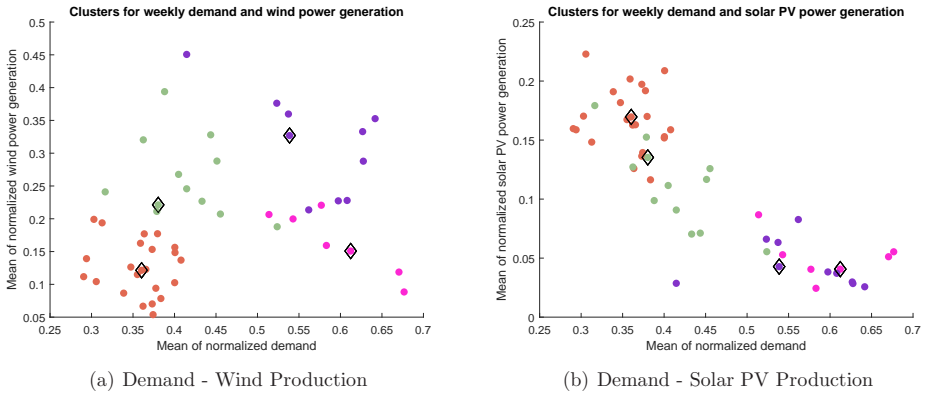
The results rest on a coarse decision grid - only 0 or 100 MWh at each of seven nodes - and on four representative weeks, with week-count robustness checked only for the central-planning variant; if a finer grid or more representative weeks change which locations are optimal or which investor invests, the comparison between market structure and investor objectives weakens.
Editorial extensions
If this is right
- If the central claim is right, regulatory assessment of storage support must model producer market power; a competitive-market model will overstate storage capacity and point to the wrong nodes (France and Belgium instead of Germany).
- Under Cournot oligopoly, the profitability threshold for merchant storage drops dramatically (from roughly 65-80 e/MWh under perfect competition to below about 25 e/MWh), so storage support policies must anticipate that merchant entry needs much cheaper batteries or additional revenue streams.
- Consumers are the main beneficiaries of storage investment in all modeled regimes, so consumer-side benefits justify considering storage as a public-good investment even when investor surplus is negative.
- A welfare-maximizing investor under perfect competition is equivalent to central planning and thus can serve as a benchmark for evaluating market-based storage deployment.
- Reducing transmission capacity under perfect competition leaves the investment pattern unchanged, while removing transmission limits entirely kills storage investment - implying congestion is a necessary driver of storage value in this system.
Reading between the lines
- If storage could also earn revenue from ancillary services or reserve markets, the Cournot profitability thresholds would likely drop further and possibly revive merchant investment at locations the day-ahead-only model finds unattractive, changing the policy conclusions.
- The exhaustive-search grid (0 or 100 MWh at seven nodes) may hide intermediate optimal sizes; a finer grid under Cournot could reveal that the socially optimal investment is not 'smaller but at the same node' but different in kind, so the headline 'location shifts to Germany' should be tested before being used prescriptively.
- The paper's four-week sample is validated only for the central-planning case; applying the same week-count robustness check to the Cournot and merchant cases is a cheap, concrete test of whether the market-power comparison is stable.
- Because the merchant is modeled as a price-taker with a minor position, the analysis excludes the case of a strategic merchant whose storage operations themselves influence prices; such a merchant would likely invest less to preserve spreads, reinforcing the market-power result.
Signed reviews
Editorial analysis
A structured set of objections, weighed in public.
Referee Report
Summary. The paper analyzes how utility-scale battery storage investment is affected by the investor's objective (welfare maximization vs. merchant profit maximization) and by the competitiveness of the wholesale market (perfect competition vs. Cournot oligopoly). The authors formulate bi-level optimization models, reformulate them as MIQCQPs via an MPPDC approach, and then, for a Western European case study, replace the intractable MIQCQP with an exhaustive enumeration of 128 discrete investment combinations (0 or 100 MWh at seven nodes) and solve the lower-level QP for each combination. In the base case, both investor types invest in the same nodes under each market structure (n2, n3, n6 under perfect competition; n1 under Cournot), leading the authors to conclude that market competition affects storage investment more than investor objectives do. Sensitivity analyses over investment cost and transmission capacity show some investor-type divergences. The paper argues that policy makers need to anticipate producer market power when designing storage support.
Significance. If the headline finding is robust, the paper provides a valuable policy insight: storage-support policies evaluated under perfect competition may be misleading because market power changes whether and where storage is built. The paper's strengths include a careful MPPDC derivation, an explicit and transparent discussion of solver failures, an exact enumeration of the chosen discrete investment set, and a broad set of sensitivity analyses. The central claim, however, rests on a coarse 0/100 MWh investment grid and on four representative weeks, and the paper's own sensitivity results show investor-objective effects at other cost levels. The conclusion is therefore plausible but not yet established at the level of generality claimed in the abstract.
major comments (3)
- [Section 3.2.3 and Section 3.3.1] The headline finding that investor objectives do not matter in the base case is an artifact of the extremely coarse investment grid. With only two discrete options per node (0 or 100 MWh), any divergence between the welfare-maximizing size and the profit-maximizing size that does not cross the 100 MWh threshold is invisible: both are forced to the same discrete choice. The paper's own sensitivity analysis (Tables 7 and 8) shows investor-objective effects at other cost levels, e.g., at e15/MWh under Cournot the merchant invests 600 MWh while the welfare-maximizer invests 500 MWh, and at e55/MWh the welfare-maximizer invests while the merchant does not. To support the claim that investor objectives matter less than market structure, the authors should either solve a finer or continuous investment grid for the base case and the diverging cost levels, or otherwise demonstrate that the base-case equivalence is invariant to grid refinement. As it stands, the central comparison may reflect the grid rather than an economic property.
- [Footnote 10 and Section 3.2.3] The representative-week robustness check is reported only for the central-planning variant. The paper states that with 4, 6, 8, 15, 20, and 25 weeks, social welfare and storage investment size remain similar under central planning, but the headline results concerning Cournot and merchant cases are computed with only four representative weeks. Since the number of weeks affects the temporal price spread and hence the profitability of arbitrage, the authors should repeat the iterative QP enumeration for the SW-CO and M-CO models with, say, 8 and 15 weeks to verify that investment locations, sizes, and the equivalence between welfare-maximizing and merchant investors are stable. Without this check, the claim that market structure dominates investor objectives is not robust to the temporal representation.
- [Abstract and Section 4] The abstract's statement that market competition affects storage investment sizes, locations, and profitability 'more than the investor's objectives' is stronger than the evidence presented. The base case shows exact equality between SW-PC and M-PC and between SW-CO and M-CO, but the sensitivity analysis contains several counterexamples: at e65/MWh under perfect competition the merchant invests less than the welfare-maximizer; at e55/MWh under Cournot the welfare-maximizer invests while the merchant does not; and at e15/MWh under Cournot the merchant invests more than the welfare-maximizer. The paper should either qualify the headline claim to the base case or provide a systematic comparison across cost levels and model dimensions that actually measures the relative influence of market structure versus investor objective.
minor comments (5)
- [Section 3.2.2] The sentence 'we make an exhaustive search and now that the optimal investments are unique' appears to contain a typo ('now' for 'know'); please also clarify how ties among investment combinations are handled, since multiple optima would make the reported investment pattern non-unique.
- [Section 2.3.2] After Eq. (26), the phrase 'The right-hand side of Eq. (26)' is confusing because the bilinear terms appear on the right-hand side; please rephrase to refer to the products of lower-level dual variables and the investment decision in the last four terms of Eq. (26).
- [Footnotes 1 and 2] The footnotes refer to 'bold font' to distinguish Cournot terms from perfect-competition terms; since this formatting may be lost in some rendering or printing environments, please label the Cournot terms explicitly in the equations or add a note identifying them by equation number.
- [References] The method for clustering representative weeks relies on a reference listed as 'Submitted for publication' (Reichenberg and Hedenus, 2019); please provide a published version or a more accessible citation, since the temporal aggregation is central to the case study.
- [Section 3.2.1] The solver name 'BONMINH 1.8' appears to be a typo for 'BONMIN'.
Circularity Check
No circularity found: the paper's results are equilibrium outputs of an optimization model, and its self-citations are not load-bearing.
full rationale
The paper's central quantitative claims—storage investment sizes, locations, and welfare effects under perfect competition versus Cournot oligopoly and under welfare-maximizing versus merchant investors—are outputs of explicit optimization models (Eqs. (1), (24), (28), and their MPPDC reformulations), not quantities fitted to target data. The only equivalence that holds by construction is that the welfare-maximizer under perfect competition equals central planning, and the paper explicitly identifies this as expected: "This is expected because the two models effectively represent the same objectives" (Section 3.1). This is a benchmark validation, not a concealed circularity. Self-citations (Virasjoki et al. 2016 for the network data and earlier storage-operations model; Siddiqui et al. 2019 for a stylized analytical benchmark) supply inputs or points of comparison, but the headline conclusion is not derived from them; indeed, the paper reports its case-study results as "somewhat conflicting with Siddiqui et al. [2019]" (Section 4). The clustering method is cited to external work (Reichenberg and Hedenus 2019). The acknowledged limitations—the 0/100 MWh discrete investment grid, the four representative weeks, and the central-planning-only week-count robustness check (footnote 10; Section 4)—affect robustness and generalizability, but they do not make any prediction equal to an input by construction. No specific circular step can be exhibited, so the appropriate finding is no significant circularity.
Assumptions & free parameters
free parameters (4)
- Inverse demand slope (Dslp) =
calibrated from assumed price elasticity -0.25
- Amortized storage investment cost (I) =
50 EUR/MWh base; sensitivity 15-80 EUR/MWh
- Discrete storage investment options (R^d_y) =
{0, 100} MWh
- Number of representative weeks =
4
assumptions (6)
- domain assumption DC load-flow linearization adequately represents the Western European transmission network
- domain assumption VRES production is deterministic with priority dispatch and zero marginal cost
- domain assumption The storage investor is a price-taker with negligible market impact
- standard math The lower-level market problem is convex, so the primal-dual strong-duality MPPDC reformulation is exact
- domain assumption Cournot competition is an adequate model of producer market power
- domain assumption Four hierarchical-cluster representative weeks capture the annual arbitrage opportunities relevant to storage
Cite this review
Pith. "Pith review of Utility-Scale Energy Storage in an Imperfectly Competitive Power Sector." pith.science (2026). https://pith.science/paper/7HPBBX4Z
@misc{pith2026190803167,
  author       = {Pith},
  title        = {Pith review of: Utility-Scale Energy Storage in an Imperfectly Competitive Power Sector},
  year         = {2026},
  howpublished = {\url{https://pith.science/paper/7HPBBX4Z}},
  note         = {Machine review of arXiv:1908.03167}
}
read the original abstract
Interest in sustainability has increased the share of variable renewable energy sources (VRES) in power generation. Energy storage systems' potential to mitigate intermittencies from non-dispatchable VRES has enhanced their appeal. However, the impacts of storage vary based on the owner and market conditions. We examine the policy implications of investments in utility-scale battery storage via a bi-level optimization model. The lower level depicts power system operations, modeled as either perfect competition or Cournot oligopoly to allow for the assessment of producer market power. The upper-level investor is either a welfare-maximizer or a profit-maximizing standalone merchant to reflect either welfare enhancement or arbitrage, respectively. We implement a realistic case study for Western Europe based on all possible size-location storage investment combinations. We find that market competition affects investment sizes, locations, and their profitability more than the investor's objectives. A welfare-maximizer under perfect competition invests the most in storage capacity. Consumers typically gain most from storage investments in all cases, exceeding the gains for the investors. Specifically, our results show that storage investments may either not occur or be located differently than at social optimum, if market power is exerted. Thus, policy makers need to anticipate producer market power when setting regulation.
Figures


Figures from the paper (3 more)


Reference graph
Works this paper leans on
-
[1]
L. Baringo and A. J. Conejo. Transmission and Wind Power Investment . IEEE Transactions on Power Systems, 27 0 (2): 0 885--893, 2012
work page 2012
-
[2]
H. C. Bylling, S. A. Gabriel, and T. K. Boomsma. A Parametric Programming Approach to Bilevel Optimisation with Lower-Level Variables in the Upper Level . Journal of the Operational Research Society, pages 1--20, 2019
work page 2019
-
[3]
W. S. Dorn. Duality in Quadratic Programming . Quarterly of Applied Mathematics, 18: 0 155--162, 1960
work page 1960
-
[4]
Y. Dvorkin, R. Fern\' a ndez-Blanco, Y. Wang, B. Xu, D. S. Kirschen, H. Pand z i\' c , J.-P. Watson, and C. A. Silva-Monroy. Co-Planning of Investments in Transmission and Merchant Energy Storage . IEEE Transactions on Power Systems, 33 0 (1): 0 245--256, 2018
work page 2018
-
[5]
EC. Directive 2009/28/EC of the European Parliament and of the Council of 23 April 2009 on the Promotion of the Use of Energy from Renewable Sources and Amending and Subsequently Repealing Directives 2001/77/EC and 2003/30/EC . Official Journal of the European Union, L 140: 0 16--62, 2009
work page 2009
-
[6]
Energy Storage - The Role of Electricity
EC. Energy Storage - The Role of Electricity . Commission Staff Working Document , European Commission, 2017. Brussels, 1.2.2017, SWD(2017) 61 final
work page 2017
-
[7]
S. A. Gabriel and F. U. Leuthold. Solving Discretely-Constrained MPEC Problems with Applications in Electric Power Markets . Energy Economics, 32 0 (1): 0 3--14, 2010
work page 2010
-
[8]
S. A. Gabriel, A. J. Conejo, J. D. Fuller, B. F. Hobbs, and C. Ruiz. Complementarity Modeling in Energy Markets. Springer, 2013. New York, NY, USA
work page 2013
Show all 24 references
-
[9]
Gonzalez-Romero, S
I.-C. Gonzalez-Romero, S. Wogrin, and T. Gomez. Proactive Transmission Expansion Planning with Storage Considerations . Energy Strategy Reviews, 24: 0 154--165, 2019
2019
-
[10]
Huppmann and J
D. Huppmann and J. Egerer. National-Strategic Investment in European Power Transmission Capacity . European Journal of Operational Research, 247 0 (1): 0 191--203, 2015
2015
-
[11]
Electricity Storage and Renewables: Costs and Markets to 2030
IRENA. Electricity Storage and Renewables: Costs and Markets to 2030 . Technical report, International Renewable Energy Agency, 2017
2017
-
[12]
Lueken and J
R. Lueken and J. Apt. The Effects of Bulk Electricity Storage on the PJM Market . Energy Systems, 5 0 (4): 0 677--704, 2014
2014
-
[13]
Nahmmacher, E
P. Nahmmacher, E. Schmid, L. Hirth, and B. Knopf. Carpe Diem: A Novel Approach to Select Representative Days for Long-Term Power System Modeling . Energy, 112: 0 430--442, 2016
2016
-
[14]
Nasrolahpour, S
E. Nasrolahpour, S. J. Kazempour, H. Zareipour, and W. D. Rosehart. Strategic Sizing of Energy Storage Facilities in Electricity Markets . IEEE Transactions on Sustainable Energy, 7 0 (4): 0 1462--1472, 2016
2016
-
[15]
Neuhoff, J
K. Neuhoff, J. Barquin, M. G. Boots, A. Ehrenmann, B. F. Hobbs, F. A. Rijkers, and M. V \' a zquez. Network-Constrained Cournot Models of Liberalized Electricity Markets: The Devil Is in the Details . Energy Economics, 27 0 (3): 0 495--525, 2005
2005
-
[16]
Reichenberg and F
L. Reichenberg and F. Hedenus. What Can Capacity Expansion Models with Reduced Temporal Representation Tell Us About Optimal Power Systems? Submitted for publication, 2019
2019
-
[17]
Reichenberg, A
L. Reichenberg, A. S. Siddiqui, and S. Wogrin. Policy Implications of Downscaling the Time Dimension in Power System Planning Models to Represent Variability in Renewable Output . Energy, 159: 0 870--877, 2018
2018
-
[18]
DOE Global Energy Storage Database , 2018
Sandia National Laboratories . DOE Global Energy Storage Database , 2018. URL http://www.energystorageexchange.org/. Online, Accessed 13.2.2018
2018
-
[19]
Schill and C
W.-P. Schill and C. Kemfert. Modeling Strategic Electricity Storage: The Case of Pumped Hydro Storage in Germany . The Energy Journal, 32 0 (3): 0 59--87, 2011
2011
-
[20]
A. S. Siddiqui, R. Sioshansi, and A. J. Conejo. Merchant Storage Investment in a Restructured Electricity Industry . The Energy Journal, 2019. Forthcoming
2019
-
[21]
Sioshansi
R. Sioshansi. Welfare Impacts of Electricity Storage and the Implications of Ownership Structure . The Energy Journal, 31 0 (2): 0 173--198, 2010
2010
-
[22]
Sioshansi
R. Sioshansi. Using Storage-Capacity Rights to Overcome the Cost-Recovery Hurdle for Energy Storage . IEEE Transactions on Power Systems, 32 0 (3): 0 2028--2040, 2017
2017
-
[23]
Virasjoki, P
V. Virasjoki, P. Rocha, A. S. Siddiqui, and A. Salo. Market Impacts of Energy Storage in a Transmission-Constrained Power System . IEEE Transactions on Power Systems, 31 0 (5): 0 4108--4117, 2016
2016
-
[24]
B. Xu, Y. Wang, Y. Dvorkin, R. Fern\' a ndez-Blanco, C. A. Silva-Monroy, J.-P. Watson, and D. S. Kirschen. Scalable Planning for Energy Storage in Energy and Reserve Markets . IEEE Transactions on Power Systems, 32 0 (6): 0 4515--4527, 2017
2017
Reviewed August 14, 2026 · model on record in the stance chip above.
Discussion (0). Continue with ORCID to comment.