REVIEW 23 references
Complex-BP-Neural-Network-based Hybrid Precoding for Millimeter Wave Multiuser Massive MIMO Systems
T0 review · reviewed 2026-08-14 · deepseek-v4-flash
Pith's one-line read A complex BP neural network is trained to mimic zero-forcing precoding in mmWave multiuser massive MIMO; the authors claim it outperforms conventional hybrid precoders in simulation.
The pith
A machine-rendered reading of the paper's core claim, the machinery that carries it, and where it could break.
The reading
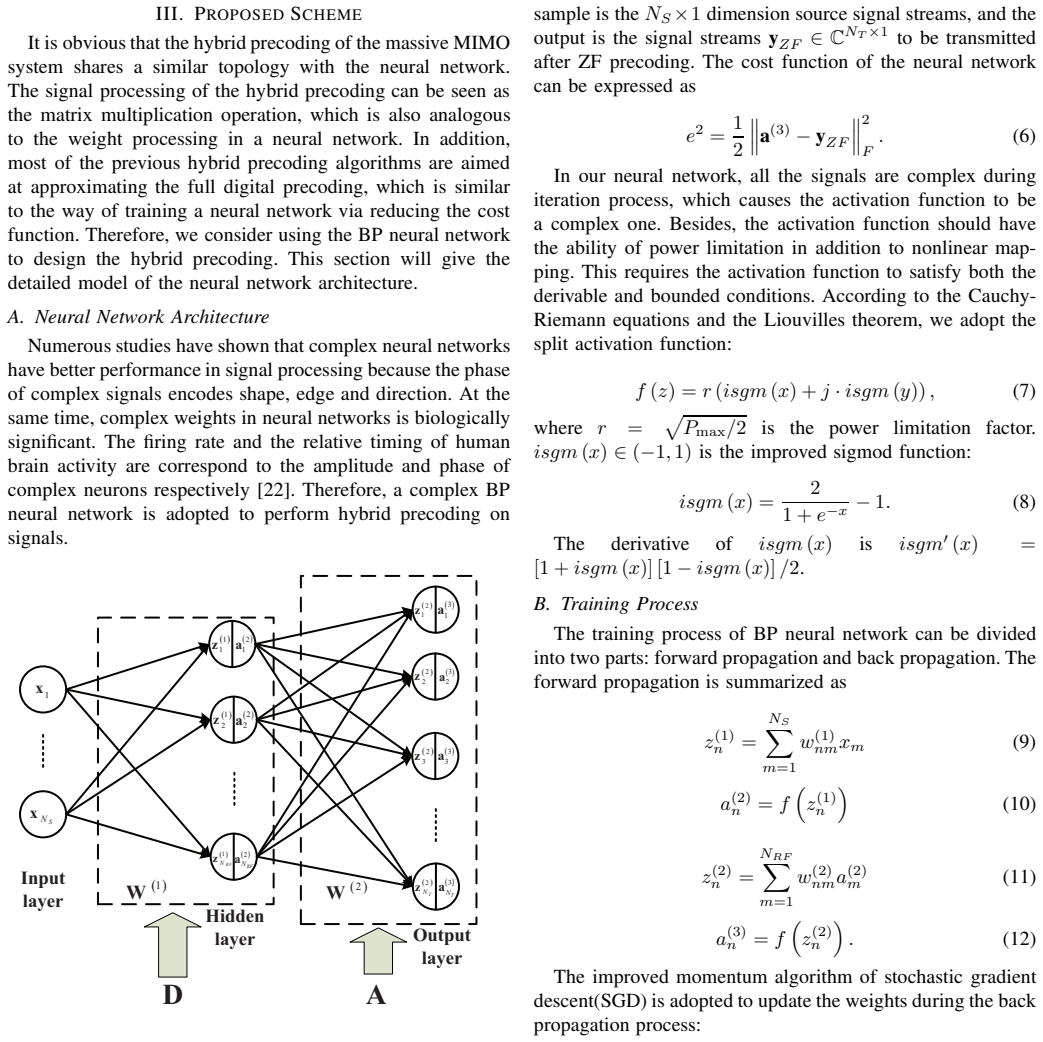
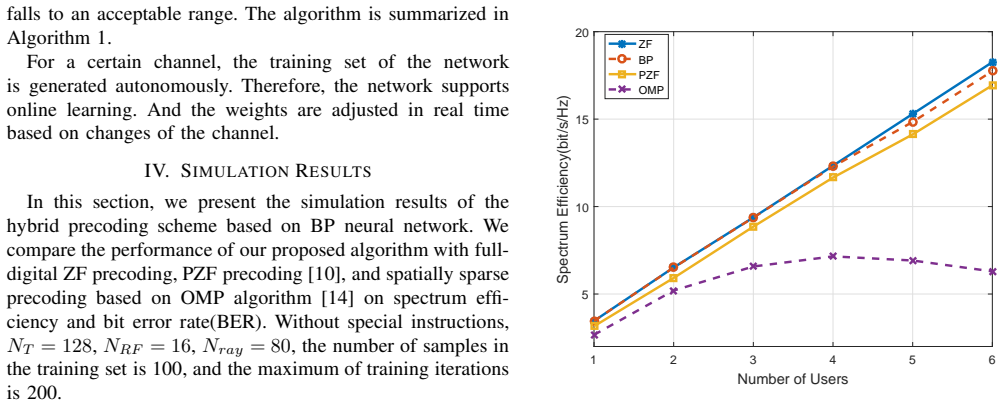
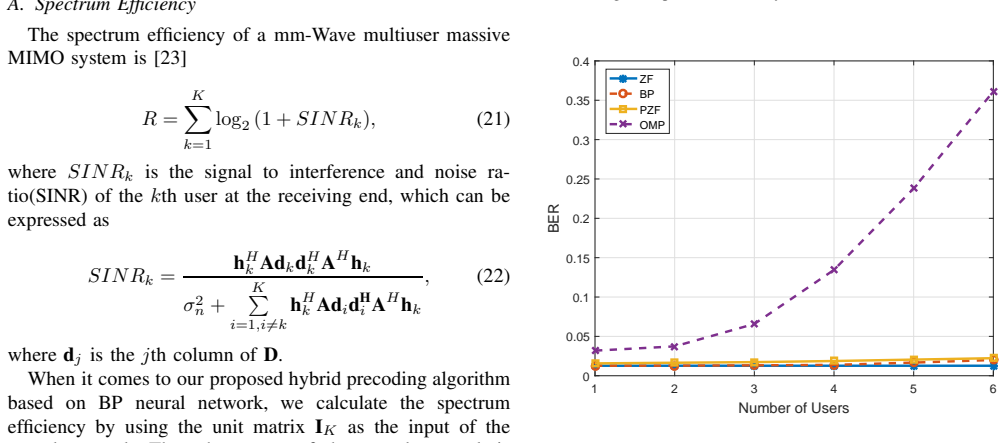
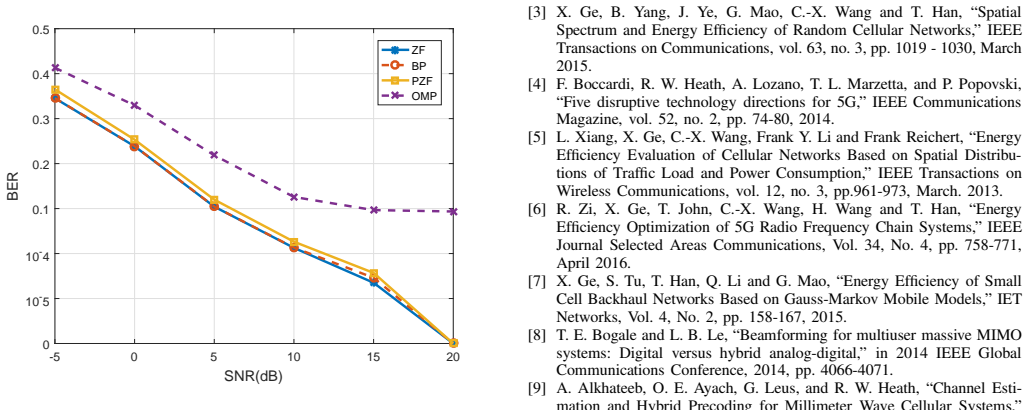
The authors report spectrum efficiency and bit-error-rate curves showing the neural network close to ZF and better than two conventional hybrid precoders, phased-ZF and OMP-based precoding. However, the network output is a complex matrix with entries whose magnitudes vary; it is never decomposed into a unit-modulus analog part and a baseband part. The constant-modulus constraint that defines a phase-shifting network is not enforced or verified. In addition, the network is trained on random complex Gaussian input vectors, but evaluated by feeding the identity matrix, a distribution shift that should have been discussed. The paper also lacks important simulation details such as learning rate, momentum, and channel angle distributions, and provides no code.
For these reasons, the results do not establish a practical hybrid precoding scheme, although they demonstrate that a complex neural network can be trained to approximate a linear precoder on a specific input distribution.
Extended reading notes
Core claim
The paper's central assertion, stated in the Abstract and Conclusion, is that "the performance of the proposed hybrid precoding algorithm can optimally approximate the ZF precoding" and that the algorithm "have a better performance on spectral efficiency and BER than the current hybrid precoding algorithm based on mathematical methods." If correct, the complex BP network would provide a low-complexity way to approach full-digital ZF precoding using fewer RF chains.
Load-bearing premise
The neural network output F is assumed to be a valid hybrid precoding matrix, meaning F can be implemented as AD with A being a constant-modulus phase-shifting matrix. In Section III.A, the authors state that the weight matrix W(2) and the activation function "play the role of the RF precoding", but the split activation function (7) only bounds the magnitude of each output element and does not enforce constant modulus. If this assumption is false, the network is not a hybrid precoder, and the performance comparison against phase-shifter-constrained algorithms (PZF and OMP) is not meaningful.
Signed reviews
Editorial analysis
A structured set of objections, weighed in public.
Assumptions & free parameters
free parameters (5)
- learning rate mu
- momentum factor alpha
- number of training samples =
100
- max training epochs =
200
- error threshold =
1e-8
assumptions (4)
- domain assumption Geometric channel model with Nray=80 paths accurately represents the mmWave multiuser channel (eq. 4)
- domain assumption Perfect channel state information is available at the base station
- ad hoc to paper A single-hidden-layer complex network with NRF neurons and split activation can approximate the ZF map on the training distribution
- standard math SGD with momentum converges to a low-error solution within 200 epochs
Cite this review
Pith. "Pith review of Complex-BP-Neural-Network-based Hybrid Precoding for Millimeter Wave Multiuser Massive MIMO Systems." pith.science (2026). https://pith.science/paper/7HTM3LS3
@misc{pith2026190800404,
  author       = {Pith},
  title        = {Pith review of: Complex-BP-Neural-Network-based Hybrid Precoding for Millimeter Wave Multiuser Massive MIMO Systems},
  year         = {2026},
  howpublished = {\url{https://pith.science/paper/7HTM3LS3}},
  note         = {Machine review of arXiv:1908.00404}
}
read the original abstract
The high energy consumption of massive multi-input multi-out (MIMO) system has become a prominent problem in the millimeter wave(mm-Wave) communication scenario. The hybrid precoding technology greatly reduces the number of radio frequency(RF) chains by handing over part of the coding work to the phase shifting network, which can effectively improve energy efficiency. However, conventional hybrid precoding algorithms based on mathematical means often suffer from performance loss and high computational complexity. In this paper, a novel BP-neural-network-enabled hybrid precoding algorithm is proposed, in which the full-digital zero-forcing(ZF) precoding is set as the training target. Considering that signals at the base station are complex, we choose the complex neural network that has a richer representational capacity. Besides, we present the activation function of the complex neural network and the gradient derivation of the back propagation process. Simulation results demonstrate that the performance of the proposed hybrid precoding algorithm can optimally approximate the ZF precoding.
Figures

Figures from the paper (2 more)
Reference graph
Works this paper leans on
-
[1]
User Mobility Evaluation f or 5G Small Cell Networks Based on Individual Mobility Model,
X. Ge, J. Y e, Y . Y ang and Q. Li, “User Mobility Evaluation f or 5G Small Cell Networks Based on Individual Mobility Model,” IEEE Jou rnal Selected Areas Communications, V ol. 34, No. 3, pp. 528-541, March 2016
work page 2016
-
[2]
Heterogeneous Cellular Networ ks with Spatio-Temporal Traffic: Delay Analysis and Scheduling,
Y . Zhong, T. Quek, X. Ge, “Heterogeneous Cellular Networ ks with Spatio-Temporal Traffic: Delay Analysis and Scheduling,” I EEE Journal Selected Areas Communications, V ol.35, No.6, pp.1373-138 6, June, 2017
work page 2017
-
[3]
Spatia l Spectrum and Energy Efficiency of Random Cellular Networks,
X. Ge, B. Y ang, J. Y e, G. Mao, C.-X. Wang and T. Han, “Spatia l Spectrum and Energy Efficiency of Random Cellular Networks, ” IEEE Transactions on Communications, vol. 63, no. 3, pp. 1019 - 10 30, March 2015
work page 2015
-
[4]
Five disruptive technology directions for 5G,
F. Boccardi, R. W. Heath, A. Lozano, T. L. Marzetta, and P . Popovski, “Five disruptive technology directions for 5G,” IEEE Commu nications Magazine, vol. 52, no. 2, pp. 74-80, 2014
work page 2014
-
[5]
L. Xiang, X. Ge, C.-X. Wang, Frank Y . Li and Frank Reichert , “Energy Efficiency Evaluation of Cellular Networks Based on Spatial Distribu- tions of Traffic Load and Power Consumption,” IEEE Transacti ons on Wireless Communications, vol. 12, no. 3, pp.961-973, March . 2013
work page 2013
-
[6]
Energ y Efficiency Optimization of 5G Radio Frequency Chain Systems ,
R. Zi, X. Ge, T. John, C.-X. Wang, H. Wang and T. Han, “Energ y Efficiency Optimization of 5G Radio Frequency Chain Systems ,” IEEE Journal Selected Areas Communications, V ol. 34, No. 4, pp. 7 58-771, April 2016
work page 2016
-
[7]
Energy Efficiency of S mall Cell Backhaul Networks Based on Gauss-Markov Mobile Models ,
X. Ge, S. Tu, T. Han, Q. Li and G. Mao, “Energy Efficiency of S mall Cell Backhaul Networks Based on Gauss-Markov Mobile Models ,” IET Networks, V ol. 4, No. 2, pp. 158-167, 2015
work page 2015
-
[8]
Beamforming for multiuser mass ive MIMO systems: Digital versus hybrid analog-digital,
T. E. Bogale and L. B. Le, “Beamforming for multiuser mass ive MIMO systems: Digital versus hybrid analog-digital,” in 2014 IE EE Global Communications Conference, 2014, pp. 4066-4071
work page 2014
Show all 23 references
-
[9]
Chann el Esti- mation and Hybrid Precoding for Millimeter Wave Cellular Sy stems,
A. Alkhateeb, O. E. Ayach, G. Leus, and R. W. Heath, “Chann el Esti- mation and Hybrid Precoding for Millimeter Wave Cellular Sy stems,” IEEE Journal of Selected Topics in Signal Processing, vol. 8 , no. 5, pp. 831-846, 2014
2014
-
[10]
Low-Complexity Hybrid Pre coding in Massive Multiuser MIMO Systems,
L. Liang, W. Xu, and X. Dong, “Low-Complexity Hybrid Pre coding in Massive Multiuser MIMO Systems,” IEEE Wireless Communicat ions Letters, vol. 3, no. 6, pp. 653-656, 2014
2014
-
[11]
SVD-Based Low-Com plexity Hybrid Precoding for Millimeter-Wave MIMO Systems,
D. Zhang, P . Pan, R. Y ou, and H. Wang, “SVD-Based Low-Com plexity Hybrid Precoding for Millimeter-Wave MIMO Systems,” IEEE C om- munications Letters, vol. 22, no. 10, pp. 2176-2179, 2018
2018
-
[12]
Hybrid precoding and combining d esign for millimeter-wave multi-user MIMO based on SVD,
A. Li and C. Masouros, “Hybrid precoding and combining d esign for millimeter-wave multi-user MIMO based on SVD,” in 2017 I EEE International Conference on Communications (ICC), 2017, p p. 1-6
2017
-
[13]
Low Comp lexity Hybrid Precoding for Multiuser Millimeter Wave Systems Ove r Fre- quency Selective Channels,
H. Y uan, J. An, N. Y ang, K. Y ang, and T. Q. Duong, “Low Comp lexity Hybrid Precoding for Multiuser Millimeter Wave Systems Ove r Fre- quency Selective Channels,” IEEE Transactions on V ehicula r Technol- ogy, vol. 68, no. 1, pp. 983-987, 2019
2019
-
[14]
Spatially Sparse Precoding in Millimeter Wave MIMO System s,
O. E. Ayach, S. Rajagopal, S. Abu-Surra, Z. Pi, and R. W. H eath, “Spatially Sparse Precoding in Millimeter Wave MIMO System s,” IEEE Transactions on Wireless Communications, vol. 13, no. 3, pp . 1499- 1513, 2014
2014
-
[15]
Unsuper- vised Learning-Based Fast Beamforming Design for Downlink MIMO,
H. Huang, W. Xia, J. Xiong, J. Y ang, G. Zheng, and X. Zhu, “ Unsuper- vised Learning-Based Fast Beamforming Design for Downlink MIMO,” IEEE Access, vol. 7, pp. 7599-7605, 2019
2019
-
[16]
Joint Machine Learning Based Resource Allocation and Hybrid Beamforming Design for Massive MIMO S ys- tems,
I. Ahmed and H. Khammari, “Joint Machine Learning Based Resource Allocation and Hybrid Beamforming Design for Massive MIMO S ys- tems,” in 2018 IEEE Globecom Workshops (GC Wkshps), 2018, pp . 1-6
2018
-
[17]
A Deep-Lea rning- Based Radio Resource Assignment Technique for 5G Ultra Dens e Networks,
Y . Zhou, Z. M. Fadlullah, B. Mao, and N. Kato, “A Deep-Lea rning- Based Radio Resource Assignment Technique for 5G Ultra Dens e Networks,” IEEE Network, vol. 32, no. 6, pp. 28-34, 2018
2018
-
[18]
A Deep Learning-Based Approach to Power Minimization in Mu lti- Carrier NOMA With SWIPT,
J. Luo, J. Tang, D. K. C. So, G. Chen, K. Cumanan, and J. A. C hambers, “A Deep Learning-Based Approach to Power Minimization in Mu lti- Carrier NOMA With SWIPT,” IEEE Access, vol. 7, pp. 17450-174 60, 2019
2019
-
[19]
Deep Learn ing Aided Grant-Free NOMA Toward Reliable Low-Latency Access i n Tactile Internet of Things,
N. Y e, X. Li, H. Y u, A. Wang, W. Liu, and X. Hou, “Deep Learn ing Aided Grant-Free NOMA Toward Reliable Low-Latency Access i n Tactile Internet of Things,” IEEE Transactions on Industri al Informatics, vol. 15, no. 5, pp. 2995-3005, 2019
2019
-
[20]
Exploiting Wireless Channel State Information Structure s Beyond Lin- ear Correlations: A Deep Learning Approach,
Z. Jiang, S. Chen, A. F. Molisch, R. V annithamby, S. Zhou , and Z. Niu, “Exploiting Wireless Channel State Information Structure s Beyond Lin- ear Correlations: A Deep Learning Approach,” IEEE Communic ations Magazine, vol. 57, no. 3, pp. 28-34, 2019
2019
-
[21]
Deep-L earning- based Millimeter-Wave Massive MIMO for Hybrid Precoding,
H. Huang, Y . Song, J. Y ang, G. Gui, and F. Adachi, “Deep-L earning- based Millimeter-Wave Massive MIMO for Hybrid Precoding,” IEEE Transactions on V ehicular Technology, pp. 1-1, 2019
2019
-
[22]
Deep complex networks,
C. Trabelsi et al., “Deep complex networks,” arXiv prep rint arXiv:1705.09792, 2017
2017 arXiv
-
[23]
Capaci ty anal- ysis of a multi-cell multi-antenna cooperative cellular ne twork with co- channel interference,
X. Ge, K. Huang, C.-X. Wang, X. Hong, and X. Y ang, “Capaci ty anal- ysis of a multi-cell multi-antenna cooperative cellular ne twork with co- channel interference,” IEEE Transactions on Wireless Comm unications, vol. 10, no. 10, pp.3298-3309, Oct. 2011
2011
Reviewed August 14, 2026 · model on record in the stance chip above.
Discussion (0). Continue with ORCID to comment.