REVIEW 4 major objections 3 minor 66 references
Local-available quantum correlation swapping in one-parameter X states
T0 review · 4 major / 3 minor · reviewed 2026-08-06 · deepseek-v4-flash
Pith's one-line read This paper claims that local-available quantum correlations (LAQC) can be redistributed through a projective measurement on two pairs of X states, and that in several one-parameter families the final state is separable yet still…
desk verdict New combination, but the central Bloch formulas have sign errors and the headline separability claims are false; needs major recalculation. read the letter →
The pith
A machine-rendered reading of the paper's core claim, the machinery that carries it, and where it could break.
The reading
What carries the argument
The workhorse is the closed-form LAQC quantifier for X states, $L(\rho_X)=\max\{u(T_1),u(T_2),g_3(x_3,y_3,T_3)\}$ with $u(x)=(1+x)\log_2(1+x)+(1-x)\log_2(1-x)$, together with the post-measurement Bloch-parameter formulas (51a--e). The quantifier reduces the question 'does the swapped state have LAQC?' to checking whether the final $T_1$ or $T_2$ parameters are non-zero, and those parameters factor as $T_1^{AD}=T_1^{AB}T_1^{CD}\sin\xi$ and $T_2^{AD}=T_2^{AB}T_2^{CD}\sin\xi$. That multiplicative structure is the mechanism behind Theorems 1 and 2: non-zero input coherences propagate through the measurement unless one input lacks $T_1$ and the other lacks $T_2$.
What would settle it
Take two $\alpha$-states with $\alpha_{AB}=\alpha_{CD}=1$ and project onto $|\phi^+\rangle$ ($\xi=\pi/2$), then compute the output state directly from the trace definition $T_{ij}=\mathrm{Tr}((\sigma_i\otimes\sigma_j)\rho_{AD}^X)$. If the output has $T_1=T_2=1$ as Eqs. (56c--d) claim, it violates the X-state positivity bound $(T_1+T_2)^2\le 1$ from Eq. (9), so the $\alpha$-state swapping claim would be unphysical; this single calculation settles the matter.
Extended reading notes
Core claim
The paper's central claim is that LAQC is a swappable correlation for 2-qubit X states. Starting from the post-measurement Bloch parameters (51a--e), it proves Theorem 1: whenever both initial X states have non-null $T_1$ and $T_2$, the final state $\rho_{AD}^X$ has non-null LAQC; Theorem 2 gives the only way two non-classical X inputs can produce a classical output, namely a crossing of zero $T_1$ in one input with zero $T_2$ in the other. The author then evaluates the exact X-state LAQC formula for Werner, $\alpha$, $\beta$, $\rho_v$, and MEMS one-parameter families. The distinctive results are that $\alpha$-state and MEMS outputs have vanishing concurrence yet non-vanishing LAQC, and $\rho_v$ outputs are separable over a wide parameter range while keeping non-zero LAQC.
Load-bearing premise
The central load-bearing premise is that the post-measurement Bloch-parameter formulas (51a--e) are correct; the paper states them without derivation, and the $\alpha$-state specialization gives $T_1=T_2=1$ at $\alpha_{AB}=\alpha_{CD}=1$, $\xi=\pi/2$, which would violate the positivity constraint $(T_1+T_2)^2\le 1$, so the formulas are the point that must hold for the conclusions to stand.
Editorial extensions
If this is right
- Any X-state quantum correlation swapping scheme with non-classical inputs and an entangled measurement state transfers LAQC unless the cross-zero $T_1$/$T_2$ pattern of Theorem 2 occurs.
- For Werner and $\beta$ inputs, the output LAQC has a closed analytic form and vanishes only when an input is separable or the measurement state is unentangled ($\xi=0$).
- For $\alpha$ and MEMS inputs, the output can be completely separable while LAQC stays positive, so entanglement need not be the distributed resource.
- Since LAQC vanishes only on classical states, the range of parameters with non-zero swapped LAQC is generically larger than the range with non-zero concurrence.
Reading between the lines
- Because $T_1^{AD}$ and $T_2^{AD}$ are products of input coherence parameters, a multi-hop repeater chain built on this scheme would accumulate LAQC multiplicatively, changing error-threshold and noise-robustness estimates relative to additive figures of merit.
- The separable-but-LAQC-positive outputs are directly testable: preparing two $\alpha$-state or MEMS pairs, performing the Bell projection, and tomographing the output would verify $L>0$ together with zero concurrence without relying on the paper's algebraic formulas.
- The unproved status and apparent positivity violation of Eqs. (51a--e) deserves a direct re-derivation from the trace definition before the $\alpha$-state and MEMS conclusions are used as design rules.
Editorial analysis
A structured set of objections, weighed in public.
Referee Report
Summary. The paper analyzes the redistribution of local-available quantum correlations (LAQC) in a quantum correlation swapping protocol for two-qubit X states. It uses the exact LAQC expression for X states from earlier work (refs. [46,47]) and states, without derivation, a general Bloch-parameter transformation (Eq. (51)) for the post-measurement state after a projective measurement on two subsystems. It then applies this transformation to five one-parameter X-state families (Werner, alpha, beta, rho_v, and MEMS) and claims, among other things, that for alpha-states and MEMS the final state is separable while having non-zero LAQC. Theorems 1 and 2 give conditions for non-null and vanishing LAQC in the final state.
Significance. If the central results were correct, the paper would provide a useful extension of correlation swapping to a less-studied quantum correlation, including the notable claim that LAQC can be transferred to separable final states. The use of an exact closed form for LAQC of X states is a legitimate and potentially valuable starting point. However, the main illustrative claims depend on a general transformation that is both unproven and, in its currently stated form, incorrect; the advertised phenomenon of separable final states with non-zero LAQC is not established and is false at the maximally entangled endpoints.
major comments (4)
- [Section III, Eqs. (51c)-(51d) and Section III.B, Eq. (56d)] The general transformation has a sign error in the T2 component. Direct calculation for alpha_AB = alpha_CD = 1 and xi = pi/2, where both initial states are |Phi+> and the projective state is |Phi+>_BC, gives the final state |Phi+>_AD, whose Bloch parameters are T1 = 1 and T2 = -1. Equation (56d), however, gives T2 = alpha_AB alpha_CD sin(xi) = +1. This is not a harmless endpoint artifact: with the correct sign, the equal-parameter alpha-state final state has concurrence alpha(3alpha - 2) for alpha >= 2/3, so it is entangled. The claim in Section III.B that C(rho_AD_alpha) = 0 for all alpha is therefore false.
- [Section III.E, Eqs. (65c)-(65d)] The same sign error propagates into the MEMS family. For gamma_AB = gamma_CD = 1, the initial states are again |Phi+>, and the post-measurement state is |Phi+>_AD with T2 = -1. Equation (65d) instead gives T2 = + (1/2) gamma_AB gamma_CD sin(xi) before normalization, which after normalization is +1. The statement in Section III.E that the MEMS swapping protocol always produces a separable state is consequently unsupported and is false at gamma_AB = gamma_CD = 1. The quantitative LAQC expression for MEMS, which relies on these parameters, is also affected.
- [Section III, Eq. (51)] Equation (51) is the load-bearing result of the paper, but no derivation or reference is provided for it. Since the subsequent family-specific formulas are obtained by substitution into Eq. (51), the sign error in Eq. (51d) directly invalidates all later results that involve T2. The manuscript needs a complete derivation of Eq. (51) and a verification against direct computation for simple cases such as two |Phi+> inputs.
- [Section III, Theorems 1 and 2] Theorems 1 and 2 are stated without the hypothesis that the projective state is entangled, i.e., that sin(xi) is non-zero. As stated, for xi = 0 or xi = pi, Eqs. (51c)-(51d) give T_AD1 = T_AD2 = 0 even when the initial T1 and T2 parameters are non-zero, so the final state can be classical. The proofs implicitly assume sin(xi) != 0, which should be made an explicit condition in both theorem statements.
minor comments (3)
- [Section I, after Eq. (9)] There are several typos: 'we proceed' appears as 'w proceed', 'rely on' appears as 'relay on', and 'TWe' appears in the conclusions. These should be corrected.
- [Section II.A, Eqs. (41), (43), (47), (49)] The factor of 1/2 in the LAQC expressions for Werner, alpha, rho_v, and MEMS states is not accounted for by the definition of u(x) in Eq. (39). For example, Eq. (40) gives L = max{u(T1), u(T2), g3}, so for Werner states one expects u(z), not u(z)/2. Please clarify the intended formula and make the notation consistent.
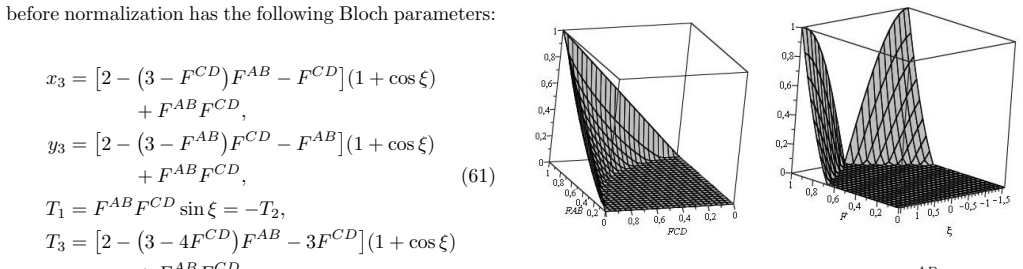
- [Section III.D, Eq. (61)] The expressions for x3, y3, and T3 in Eq. (61) are complicated and are not derived; given the sign error found in the general formulas, these should also be rechecked against direct calculation.
Circularity Check
No structural circularity: the results are substitutions into the authors' previously derived exact LAQC formula for X states; heavy self-citation creates a minor transparency burden but no by-construction reduction.
full rationale
The claimed derivation chain is: (1) take the exact LAQC quantifier for two-qubit X states, Eq. (40), from the group's earlier published results [46,47]; (2) state the post-measurement Bloch-parameter map, Eqs. (51a-e); (3) substitute the five one-parameter families to obtain LAQC and concurrence values. No parameter is fitted and no output quantity is renamed as an input. Theorem 1 is a direct consequence of Eq. (40) together with the multiplicative relations T1_AD = T1_AB T1_CD sin xi and T2_AD = T2_AB T2_CD sin xi, but Eq. (40) is a parameter-free published formula whose assumptions do not include the swapping result, so the self-citation is independent support rather than a circular reduction. The heavy use of refs [44-47] by the same group is a self-citation burden, and the unproven status of Eqs. (51a-e), including possible sign errors, is an omitted-proof/correctness concern rather than circularity. No equation in the paper is equivalent to its input by construction, so the circularity score is minor rather than structural.
Assumptions & free parameters
assumptions (3)
- domain assumption The closed-form LAQC quantifier L(ρX)=max{u(T1),u(T2),g3} from refs. [46,47] is correct.
- domain assumption The post-measurement state of an X-state QCS protocol is again an X state with Bloch parameters given by Eqs. (51a-e).
- domain assumption The projective measurement state |φ⟩=cos(ξ/2)|00⟩+sin(ξ/2)|11⟩, together with the unitary U=1⊗σ2, covers the relevant entangled measurement bases.
Cite this review
Pith. "Pith review of Local-available quantum correlation swapping in one-parameter X states." pith.science (2026). https://pith.science/paper/7I7QL7V5
@misc{pith2026250723142,
  author       = {Pith},
  title        = {Pith review of: Local-available quantum correlation swapping in one-parameter X states},
  year         = {2026},
  howpublished = {\url{https://pith.science/paper/7I7QL7V5}},
  note         = {Machine review of arXiv:2507.23142}
}
read the original abstract
Although introduced for entanglement, quantum repeaters and swapping protocols have been analyzed for other quantum correlations (QC), such as quantum discord. In 2015, Mundarain and Ladr\'on de Guevara [Quantum Inf. Process. 14, 4493 (2015)] introduced local-available quantum correlations (LAQC), which are a promising yet understudied quantum correlation. Recently, Bellorin et al. [Int. J. Mod. Phys. B 36, 22500990 (2022), Int. J. Mod. Phys. B 36, 2250154 (2022)] obtained exact analytical results for the LAQC quantifier of general 2-qubit X states. Building up from those results, we analyzed the LAQC swapping for 2-qubit X states. As expected, we find that if the initial states are non-classical and the one used for the projective measurement is entangled, the final state will generally have non-zero LAQC. Using the properties of this quantum correlation, we establish the conditions for a QCS scheme that leads to a final state with a non-zero LAQC measure. We illustrate these results by analyzing five families of one-parameter 2-qubit X states, including families where the projective measure leads to a separable state, but whose LAQC measure is non-zero. This feature opens the possibility for this quantum correlation to be considered a genuine resource in quantum information technology.
Figures


Figures from the paper (7 more)



Reference graph
Works this paper leans on
-
[1]
M. Nakahara and T. Ohmi,Quantum Computing: From Linear Algebra to Physical Realizations(CRC Press, 2008), ISBN 9781420012293
work page 2008
-
[2]
M. Nielsen and I. Chuang,Quantum Computation and Quantum Information: 10th Anniversary Edition(Cam- bridge University Press, 2010), ISBN 9781139495486
work page 2010
-
[3]
S. I. Davis, R. Valivarthi, A. Cameron, C. Pena, S. Xie, L. Narvaez, N. Lauk, C. Li, K. Taylor, R. Youssef, et al., arXiv (2025), 2503.18906, URLhttps://arxiv. org/abs/2503.18906
arXiv 2025
-
[4]
G. Chiribella, G. M. D’Ariano, and P. Perinotti, Phys. Rev. A80(2009), ISSN 1050-2947, URLhttp://dx. doi.org/10.1103/PhysRevA.80.022339. 10
-
[5]
J. Nokkala, J. Piilo, and G. Bianconi, J. Phys. A: Math. Theor.57, 233001 (2024), ISSN 1751-8113, URLhttp: //dx.doi.org/10.1088/1751-8121/ad41a6
- [6]
-
[7]
R. Horodecki, P. Horodecki, M. Horodecki, and K. Horodecki, Rev. Mod. Phys.81, 865 (2009), arXiv:quant-ph/0702225, URLhttps://link.aps.org/ doi/10.1103/RevModPhys.81.865
arXiv 2009
-
[8]
H. Ollivier and W. Zurek, Phys. Rev. Lett.88, 017901 (2001), arXiv:quant-ph/0105072
arXiv 2001
Show all 66 references
-
[9]
Henderson and V
L. Henderson and V. Vedral, J. Phys. A34, 6899 (2001), arXiv:quant-ph/0105028
2001 arXiv
-
[10]
K. Modi, A. Brodutch, H. Cable, T. Paterek, and V. Ve- dral, Rev. Mod. Phys.84, 1655 (2012), arXiv:1112.6238
2012 arXiv
-
[11]
Einstein, B
A. Einstein, B. Podolsky, and N. Rosen, Phys. Rev.47, 777 (1935), URLhttps://link.aps.org/doi/10.1103/ PhysRev.47.777
1935
-
[12]
C. H. Bennett, G. Brassard, C. Cr´ epeau, R. Jozsa, A. Peres, and W. K. Wootters, Phys. Rev. Lett.70, 1895 (1993), ISSN 0031-9007, URLhttp://dx.doi.org/10. 1103/PhysRevLett.70.1895
1993
-
[13]
Vaidman, Phys.l Rev
L. Vaidman, Phys.l Rev. A49, 1473 (1994), ISSN 1050- 2947, URLhttp://dx.doi.org/10.1103/physreva.49. 1473
1994 doi
-
[14]
Gisin, G
N. Gisin, G. Ribordy, W. Tittel, and H. Zbinden, Re- views of Modern Physics74, 145 (2002), ISSN 0034-6861, URLhttp://dx.doi.org/10.1103/RevModPhys.74.145
2002 doi
-
[15]
Pirandola, U
S. Pirandola, U. L. Andersen, L. Banchi, M. Berta, D. Bunandar, R. Colbeck, D. Englund, T. Gehring, C. Lupo, C. Ottaviani, et al., Advances in Optics and Photonics12, 1012 (2020), ISSN 1943-8206, URLhttp: //dx.doi.org/10.1364/AOP.361502
2020 doi
-
[16]
Cavalcanti, L
D. Cavalcanti, L. Aolita, S. Boixo, K. Modi, M. Piani, and A. Winter, Physical Review A83(2011), ISSN 1050- 2947, URLhttp://dx.doi.org/10.1103/PhysRevA.83. 032324
2011 doi
-
[17]
M. Gu, H. M. Chrzanowski, S. M. Assad, T. Symul, K. Modi, T. C. Ralph, V. Vedral, and P. K. Lam, Na- ture Phys.8, 671 (2012), ISSN 1745-2473, URLhttp: //dx.doi.org/10.1038/nphys2376
2012 doi
-
[18]
Daki´ c, Y
B. Daki´ c, Y. O. Lipp, X. Ma, M. Ringbauer, S. Kropatschek, S. Barz, T. Paterek, V. Vedral, A. Zeilinger, ˇC. Brukner, et al., Nature Phys.8, 666 (2012), ISSN 1745-2473, URLhttp://dx.doi.org/10. 1038/nphys2377
2012
-
[19]
Madhok and A
V. Madhok and A. Datta, Int. J. Mod. Phys. B27, 1345041 (2012), ISSN 0217-9792, URLhttp://dx.doi. org/10.1142/S0217979213450410
2012 doi
-
[20]
Datta and V
A. Datta and V. Madhok, inQuantum Science and Tech- nology(Springer International Publishing, 2017), pp. 241–255, ISBN 9783319534107
2017
-
[21]
Pirandola, Scientific Reports4(2014), ISSN 2045- 2322, URLhttp://dx.doi.org/10.1038/srep06956
S. Pirandola, Scientific Reports4(2014), ISSN 2045- 2322, URLhttp://dx.doi.org/10.1038/srep06956
2014 doi
-
[22]
Yurke and D
B. Yurke and D. Stoler, Phys. Rev. Lett.68, 1251 (1992), ISSN 0031-9007, URLhttp://dx.doi.org/10. 1103/PhysRevLett.68.1251
1992
-
[23]
Yurke and D
B. Yurke and D. Stoler, Phys. Rev. A46, 2229 (1992), URLhttps://link.aps.org/doi/10.1103/PhysRevA. 46.2229
1992 doi
-
[24]
˙Zukowski, A
M. ˙Zukowski, A. Zeilinger, M. A. Horne, and A. K. Ekert, Phys. Rev. Lett.71, 4287 (1993), ISSN 0031-9007, URL http://dx.doi.org/10.1103/PhysRevLett.71.4287
1993 doi
-
[25]
Walln¨ ofer, F
J. Walln¨ ofer, F. Hahn, F. Wiesner, N. Walk, and J. Eis- ert, PRX Quantum5(2024), ISSN 2691-3399, URL http://dx.doi.org/10.1103/PRXQuantum.5.010351
2024 doi
-
[26]
J.-W. Pan, D. Bouwmeester, H. Weinfurter, and A. Zeilinger, Phys. Rev. Lett.80, 3891 (1998), ISSN 0031-9007, URLhttp://dx.doi.org/10.1103/ PhysRevLett.80.3891
1998
-
[27]
Jennewein, G
T. Jennewein, G. Weihs, J.-W. Pan, and A. Zeilinger, Phys. Rev. Lett.88(2001), ISSN 0031-9007, URLhttp: //dx.doi.org/10.1103/PhysRevLett.88.017903
2001 doi
-
[28]
Boulant, E
N. Boulant, E. M. Fortunato, M. A. Pravia, G. Tekle- mariam, D. G. Cory, and T. F. Havel, Phys. Rev. A 65, 024302 (2002), URLhttps://link.aps.org/doi/ 10.1103/PhysRevA.65.024302
2002 doi
-
[29]
Gl¨ ockl, S
O. Gl¨ ockl, S. Lorenz, C. Marquardt, J. Heersink, M. Brownnutt, C. Silberhorn, Q. Pan, P. van Loock, N. Korolkova, and G. Leuchs, Phys. Rev. A68, 012319 (2003), URLhttps://link.aps.org/doi/10. 1103/PhysRevA.68.012319
2003
-
[30]
Xiao-Juan, F
Z. Xiao-Juan, F. Mao-Fa, C. Jian-Wu, and L. Xiang- Ping, Chinese Phys.15, 492 (2006), ISSN 1009- 1963, URLhttp://dx.doi.org/10.1088/1009-1963/ 15/3/007
2006 doi
-
[31]
Riebe, T
M. Riebe, T. Monz, K. Kim, A. S. Villar, P. Schindler, M. Chwalla, M. Hennrich, and R. Blatt, Nat. Phys.4, 839 (2008), ISSN 1745-2473, URLhttp://dx.doi.org/ 10.1038/nphys1107
2008 doi
-
[32]
Schmid, N
C. Schmid, N. Kiesel, U. K. Weber, R. Ursin, A. Zeilinger, and H. Weinfurter, New J. Phys.11, 033008 (2009), ISSN 1367-2630, URLhttp://dx.doi.org/10. 1088/0031-8949/11/3/033008
2009
-
[33]
J. M. Torres, J. Z. Bern´ ad, and G. Alber, Phys. Rev. A90, 012304 (2014), URLhttps://link.aps.org/doi/ 10.1103/PhysRevA.90.012304
2014 doi
-
[34]
Z. Cai, C. Ren, T. Feng, X. Zhou, and J. Chen, Phys. Rep.1098, 1 (2025), ISSN 0370-1573, URLhttp://dx. doi.org/10.1016/j.physrep.2024.10.003
2025 doi
-
[35]
L. Roa, A. Mu˜ noz, and G. Gr¨ uning, Phys. Rev. A89 (2014), ISSN 1050-2947, URLhttp://dx.doi.org/10. 1103/PhysRevA.89.064301
2014
-
[36]
C. Xie, Y. Liu, H. Xing, J. Chen, and Z. Zhang, Quantum Information Processing14, 653 (2014), ISSN 1570-0755, URLhttp://dx.doi.org/10.1007/ s11128-014-0875-y
2014
-
[37]
Luo, Phys
S. Luo, Phys. Rev. A77, 022301 (2008), URLhttps: //link.aps.org/doi/10.1103/PhysRevA.77.022301
2008 doi
-
[38]
Girolami, M
D. Girolami, M. Paternostro, and G. Adesso, J. Phys. A: Math. Theor.44, 352002 (2011), URLhttps://doi. org/10.1088/1751-8113/44/35/352002
2011 doi
-
[39]
S. Wu, U. Poulsen, and K. Mølmer, Phys. Rev. A80, 032319 (2009), ISSN 1094-1622, URLhttps://doi.org/ 10.1103/PhysRevA.80.032319
2009 doi
-
[40]
C. Xie, Y. Liu, J. Chen, and Z. Zhang, Quantum In- formation Processing18(2019), ISSN 1570-0755, URL http://dx.doi.org/10.1007/s11128-019-2222-9
2019 doi
-
[41]
Girolami, T
D. Girolami, T. Tufarelli, and G. Adesso, Phys. Rev. Lett.110(2013), ISSN 0031-9007, URLhttp://dx.doi. org/10.1103/PhysRevLett.110.240402
2013 doi
-
[42]
C. Xie, S. Tian, Z. Zhang, J. Yu, J. Chen, and X. Yin, Laser Physics Letters22, 075205 (2025), ISSN 1612-2011, URLhttp://dx.doi.org/10.1088/1612-202X/adf046
2025 doi
-
[43]
Mundarain and M
D. Mundarain and M. de Guevara, Quantum Inf. Process. 14, 4493 (2015). 11
2015
-
[44]
Albrecht Q., M
H. Albrecht Q., M. Caicedo S., and D. Mundarain, Rev. Mex. F ´ ıs.64, 662 (2018), arXiv:1803.02426
2018 arXiv
-
[45]
Bellorin and H
D. Bellorin and H. Albrecht Q., Rev. Mex. F ´ ıs.67, 052301 (2021), arXiv:2105.15166
2021 arXiv
-
[46]
Albrecht Q., D
H. Albrecht Q., D. Bellorin, and D. F. Mundarain, Int. J. Mod. Phys. B36, 22500990 (2022), arXiv:2107.00158., URLhttps://www.worldscientific.com/doi/10. 1142/S0217979222500990
2022 arXiv
-
[47]
Bellorin, H
D. Bellorin, H. Albrecht Q., and D. F. Mundarain, Int. J. Mod. Phys. B36, 2250154 (2022), arXiv:2104.07552., URLhttps://www.worldscientific.com/doi/abs/10. 1142/S0217979222501545
2022 arXiv
-
[48]
Werner, Phys
R. Werner, Phys. Rev. A40, 4277 (1989)
1989
-
[49]
Al-Qasimi and D
A. Al-Qasimi and D. F. V. James, Phys. Rev. A83, 032101 (2011), URLhttps://link.aps.org/doi/10. 1103/PhysRevA.83.032101
2011
-
[50]
Verstraete and H
F. Verstraete and H. Verschelde, Phys. Rev. Lett.90, 097901 (2003), arXiv:quant-ph/0303007
2003 arXiv
-
[51]
W. J. Munro, D. F. V. James, A. G. White, and P. G. Kwiat, Physical Review A64(2001), ISSN 1050- 2947, URLhttp://dx.doi.org/10.1103/PhysRevA.64. 030302
2001 doi
-
[52]
Yu and J
T. Yu and J. H. Eberly, Quantum Info. Comput.7, 459 (2007), arXiv:quant-ph/0503089
2007 arXiv
-
[53]
Quesada, A
N. Quesada, A. Al-Qasimi, and D. James, J. Mod. Opt. 59, 1322 (2012), arXiv:1207.3689
2012 arXiv
-
[54]
P. E. M. F. Mendon¸ ca, M. A. Marchiolli, and D. Galetti, Ann. Phys.351, 79 (2014), arXiv:1407.3021
2014 arXiv
- [55]
-
[56]
Zhou, T.-G
C. Zhou, T.-G. Zhang, S.-M. Fei, N. Jing, and X. Li- Jost, Phys. Rev. A86, 010303 (2012), URLhttps:// link.aps.org/doi/10.1103/PhysRevA.86.010303
2012 doi
-
[57]
Fano, Rev
U. Fano, Rev. Mod. Phys.55, 855 (1983), URLhttps: //link.aps.org/doi/10.1103/RevModPhys.55.855
1983 doi
-
[58]
S. A. Hill and W. K. Wootters, Phys. Rev. Lett. 78, 5022 (1997), URLhttps://link.aps.org/doi/10. 1103/PhysRevLett.78.5022
1997
-
[59]
Schwinger, Proceedings of the Na- tional Academy of Sciences46, 570 (1960), https://www.pnas.org/doi/pdf/10.1073/pnas.46.4.570, URLhttps://www.pnas.org/doi/abs/10.1073/pnas
J. Schwinger, Proceedings of the Na- tional Academy of Sciences46, 570 (1960), https://www.pnas.org/doi/pdf/10.1073/pnas.46.4.570, URLhttps://www.pnas.org/doi/abs/10.1073/pnas. 46.4.570
1960 doi
-
[60]
Bengtsson, AIP Conference Proceedings889, 40 (2007), ISSN 0094-243X, URLhttp://dx.doi.org/10
I. Bengtsson, AIP Conference Proceedings889, 40 (2007), ISSN 0094-243X, URLhttp://dx.doi.org/10. 1063/1.2713445
2007
-
[61]
Durt, B.-G
T. Durt, B.-G. Englert, I. Bengtsson, and K. ˙Zyczkowski, Int. J. Quantum Inf.8, 535 (2010), ISSN 0219-7499, URL http://dx.doi.org/10.1142/S0219749910006502
2010 doi
-
[62]
Girolami and G
D. Girolami and G. Adesso, Phys. Rev. A83, 052108 (2011), URLhttps://link.aps.org/doi/10. 1103/PhysRevA.83.052108
2011
-
[63]
Huang, Phys
Y. Huang, Phys. Rev. A88, 014302 (2013), URLhttps: //link.aps.org/doi/10.1103/PhysRevA.88.014302
2013 doi
-
[64]
Luo, Phys
S. Luo, Phys. Rev. A77(2008), ISSN 1050-2947, URL http://dx.doi.org/10.1103/PhysRevA.77.042303
2008 doi
-
[65]
Wootters, Phys
W. Wootters, Phys. Rev. Lett.80, 2245 (1998), arXiv:quantph/9709029
1998
- [66]
Reviewed August 6, 2026 · model on record in the stance chip above.
Discussion (0). Sign in to comment.