GloResNet: A lightweight 3D CNN with global topological features for preterm brain injury prediction
Pith reviewed 2026-06-28 14:58 UTC · model grok-4.3
The pith
A lightweight 3D CNN with global topology mapping predicts preterm brain injury from MRI.
A machine-rendered reading of the paper's core claim, the machinery that carries it, and where it could break.
Core claim
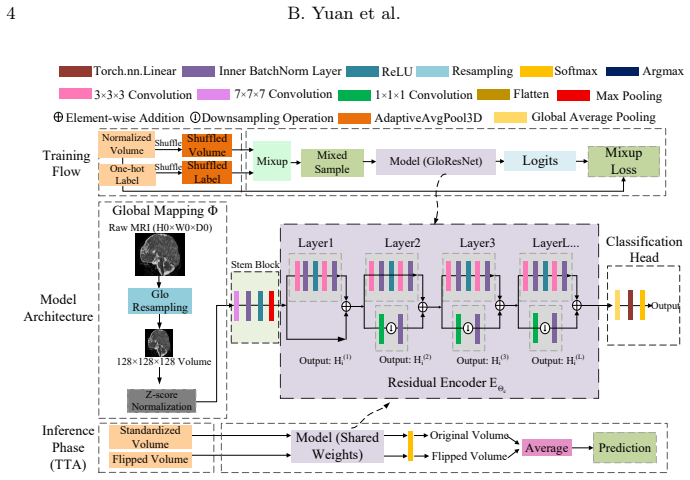
GloResNet uses a lightweight 3D ResNet-10 backbone with pretraining and a global manifold mapping strategy of resampling each volume to 128x128x128 followed by subject-wise z-score normalization to preserve global topology; combined with mixup, class weighting, and test-time augmentation, the model reaches 75.18 percent average accuracy in 5-fold cross-validation for neonatal brain injury prediction on the dHCP dataset.
What carries the argument
The global manifold mapping strategy that resamples each 3D volume to 128x128x128 and applies subject-wise z-score intensity normalization to preserve global topology while standardizing appearance.
If this is right
- Delivers a non-invasive screening tool for preterm brain injury.
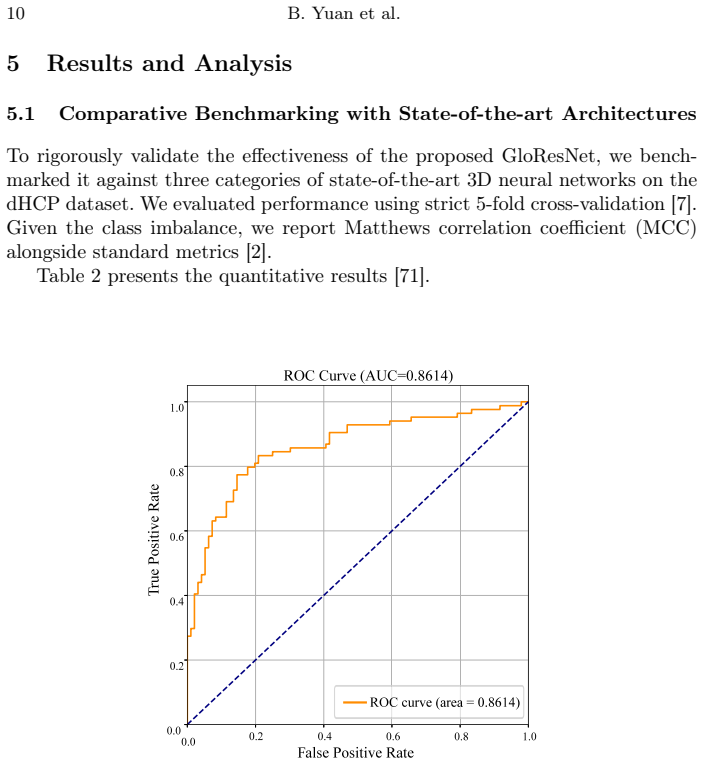
- Reaches 75.18 percent average accuracy with 0.81 specificity and 0.76 sensitivity in 5-fold cross-validation.
- Handles data scarcity through MedicalNet pretraining plus mixup and test-time augmentation.
- Produces a deployable lightweight architecture suitable for limited clinical compute.
Where Pith is reading between the lines
- The same fixed-size resampling and per-subject normalization could transfer to other 3D MRI classification tasks where global shape matters.
- Testing on an external preterm cohort separate from dHCP would show whether the reported accuracy generalizes.
- If accuracy holds on new data, the pipeline could reduce reliance on later invasive assessments for high-risk neonates.
Load-bearing premise
The resampling to a fixed 128 cubed grid plus subject-wise z-score normalization preserves global topology in a way that measurably improves prediction over standard preprocessing.
What would settle it
Run the identical model on the dHCP dataset once with the global manifold mapping and once with only standard intensity normalization, then check whether accuracy falls below 70 percent or loses statistical significance without the mapping step.
Figures
read the original abstract
This study introduces an automated deep learning framework for predicting brain injury (BI) in preterm infants from T2-weighted MRI (dHCP dataset). We propose GloResNet, a lightweight 3D CNN based on ResNet-10, pretrained on MedicalNet to address data scarcity. A global manifold mapping strategy first resamples each 3D volume to 128x128x128 and then applies subject-wise z-score intensity normalization, thereby preserving global topology while standardizing appearance. Training integrates mixup, class weighting, and test-time augmentation for robustness. In 5-fold cross-validation, GloResNet achieved 75.18% average accuracy (peak 81.82%), with specificity 0.81 and sensitivity 0.76. Results demonstrate that a topology-aware lightweight CNN has the capability to effectively predict neonatal BI, offering a non-invasive screening tool. The source code of this paper can be obtained from the GitHub repository: https://github.com/ICL-SUST/GloResNet-Preterm-Brain
Editorial analysis
A structured set of objections, weighed in public.
Referee Report
Summary. The manuscript introduces GloResNet, a lightweight 3D CNN based on ResNet-10 and pretrained on MedicalNet, for predicting brain injury (BI) in preterm infants from T2-weighted MRI scans in the dHCP dataset. The core contribution is a 'global manifold mapping' preprocessing step that resamples each volume to 128×128×128 followed by subject-wise z-score normalization, claimed to preserve global topology. Training incorporates mixup, class weighting, and test-time augmentation. 5-fold cross-validation yields 75.18% average accuracy (peak 81.82%), specificity 0.81, and sensitivity 0.76. The authors conclude that the topology-aware model provides an effective non-invasive screening tool, with code released on GitHub.
Significance. If the performance claims are substantiated with proper controls, the work could offer a practical, lightweight deep-learning approach for early BI detection in preterm neonates, where timely intervention matters. The release of source code is a positive step toward reproducibility. However, the significance is currently constrained by the absence of dataset details, baselines, and ablations that would isolate whether the claimed topological benefit is real or merely conventional preprocessing.
major comments (3)
- [Abstract] Abstract: The reported 5-fold CV metrics (75.18% accuracy, specificity 0.81, sensitivity 0.76) are presented without any statement of the number of subjects, positive/negative class counts, or the specific dHCP subset used. This omission makes it impossible to assess statistical power, class imbalance handling, or risk of overfitting.
- [Abstract] Abstract: The central claim attributes performance gains to a 'topology-aware' model enabled by 'global manifold mapping' (resampling to 128×128×128 then subject-wise z-score). This procedure is standard intensity normalization and grid resampling; no topological invariants (e.g., Betti numbers, persistent homology) are computed, and no ablation against a plain ResNet-10 baseline is supplied to show that the mapping step contributes beyond conventional preprocessing.
- [Abstract] Abstract: No baseline comparisons (standard 3D CNNs, other preterm-BI methods) or statistical significance tests (p-values, confidence intervals) are mentioned. Without these, the claim that GloResNet 'effectively predict[s] neonatal BI' cannot be evaluated as an advance over existing approaches.
minor comments (1)
- [Abstract] The GitHub link is provided, which supports reproducibility; future versions should include a requirements file and exact training scripts referenced in the methods.
Simulated Author's Rebuttal
We thank the referee for the constructive comments, which highlight important areas for improving clarity and rigor. We address each major comment below and will revise the manuscript accordingly where appropriate.
read point-by-point responses
-
Referee: [Abstract] Abstract: The reported 5-fold CV metrics (75.18% accuracy, specificity 0.81, sensitivity 0.76) are presented without any statement of the number of subjects, positive/negative class counts, or the specific dHCP subset used. This omission makes it impossible to assess statistical power, class imbalance handling, or risk of overfitting.
Authors: We agree that dataset details are essential for evaluating the results. In the revised abstract and methods section, we will explicitly state the number of subjects, the positive/negative class counts for brain injury cases, and the specific dHCP subset used. This revision will directly address concerns about statistical power and class imbalance. revision: yes
-
Referee: [Abstract] Abstract: The central claim attributes performance gains to a 'topology-aware' model enabled by 'global manifold mapping' (resampling to 128×128×128 then subject-wise z-score). This procedure is standard intensity normalization and grid resampling; no topological invariants (e.g., Betti numbers, persistent homology) are computed, and no ablation against a plain ResNet-10 baseline is supplied to show that the mapping step contributes beyond conventional preprocessing.
Authors: We clarify that 'global manifold mapping' is intended to denote consistent resampling to a fixed 128×128×128 grid to preserve the overall spatial proportions and global anatomical layout across subjects (avoiding variable cropping or distortion), combined with per-subject z-score normalization. The term 'topology' is used descriptively for global structure preservation rather than formal topological invariants, which are not computed. We acknowledge the absence of an explicit ablation against plain ResNet-10 and will add this comparison in the revised experiments section to isolate the contribution of the mapping step. revision: yes
-
Referee: [Abstract] Abstract: No baseline comparisons (standard 3D CNNs, other preterm-BI methods) or statistical significance tests (p-values, confidence intervals) are mentioned. Without these, the claim that GloResNet 'effectively predict[s] neonatal BI' cannot be evaluated as an advance over existing approaches.
Authors: We agree that baseline comparisons and statistical tests strengthen the evaluation. The revised manuscript will include comparisons against standard 3D CNN architectures and relevant preterm BI methods from the literature, along with p-values or confidence intervals for the reported metrics. These additions will better position the results relative to existing approaches. revision: yes
Circularity Check
No circularity in derivation or performance claims
full rationale
The paper reports empirical 5-fold CV accuracy (75.18%) on the external public dHCP dataset after standard preprocessing (resample to 128^3 + subject-wise z-score). No equations, fitted parameters, or predictions are shown to reduce to inputs by construction. The 'global manifold mapping' description is a label on conventional steps and does not create a self-definitional loop or load-bearing self-citation chain. Results remain externally falsifiable via the stated dataset and GitHub code.
Axiom & Free-Parameter Ledger
axioms (1)
- domain assumption The dHCP dataset supplies representative samples of preterm infants for training a model that generalizes to clinical use.
Reference graph
Works this paper leans on
-
[1]
Signal, Image and Video Processing17(7), 3767– 3774 (2023)
An, Y., Jing, J., Zhang, W.: Edge detection using multi-directional anisotropic gaussian directional derivative. Signal, Image and Video Processing17(7), 3767– 3774 (2023)
2023
-
[2]
Anderson, P.J.: Predicting neurodevelopmental outcome in children born very preterm - does neonatal MRI have a role? Pediatric Research94(3), 868–869 (2023)
2023
-
[3]
PLOS One19(5), e0298227 (2024)
Awudong, B., Li, Q., Liang, Z., Tian, L., Yan, J.: Attentional adversarial training for few-shot medical image segmentation without annotations. PLOS One19(5), e0298227 (2024)
2024
-
[4]
Multimedia Tools and Appli- cations81(20), 28729–28754 (2022) Title Suppressed Due to Excessive Length 19
Bao, J., Jing, J., Zhang, W., Liu, C., Gao, T.: A corner detection method based on adaptive multi-directional anisotropic diffusion. Multimedia Tools and Appli- cations81(20), 28729–28754 (2022) Title Suppressed Due to Excessive Length 19
2022
-
[5]
IEEE Transactions on Medical Imaging42(1), 3–14 (2023)
Byrne, N., Clough, J.R., Valverde, I., Montana, G., King, A.P.: A persistent homology-based topological loss for CNN-based multiclass segmentation of CMR. IEEE Transactions on Medical Imaging42(1), 3–14 (2023)
2023
-
[6]
Journal of Imaging11(12) (2025)
Cao, K., Lu, Z., Zhao, C., Du, J., Li, L., Jung, H., et al.: Lightweight 3D CNN for MRI analysis in alzheimer’s disease: Balancing accuracy and efficiency. Journal of Imaging11(12) (2025)
2025
-
[7]
IEEE Transactions on Medical Imaging43(9), 3224–3239 (2024)
Chakravarty, A., Emre, T., Leingang, O., Riedl, S., Mai, J., Scholl, H.P.N., et al.: Morph-SSL: Self-supervision with longitudinal morphing for forecasting AMD progression from OCT volumes. IEEE Transactions on Medical Imaging43(9), 3224–3239 (2024)
2024
-
[8]
Applied Sciences13(3211) (2023)
Chioma, R., Sbordone, A., Patti, M.L., Perri, A., Vento, G., Nobile, S.: Applica- tions of artificial intelligence in neonatology. Applied Sciences13(3211) (2023)
2023
-
[9]
bioRxiv : The Preprint Server for Biology (2026)
Chiu, H., Richie-Halford, A.C., Lazarus, M.F., Rokem, A., Poblaciones, R.V., Marchman, V.A., et al.: Neonatal brain-age models in full- and preterm infants. bioRxiv : The Preprint Server for Biology (2026)
2026
-
[10]
medRxiv : The Preprint Server for Health Sciences (2022)
Cullen, H., Dimitrakopoulou, K., Patel, H., Curtis, C., Batalle, D., Gale-Grant, O., et al.: Common genetic variation important in early subcortical brain devel- opment. medRxiv : The Preprint Server for Health Sciences (2022)
2022
-
[11]
The British Journal of Radiology94(1117), 20200975 (2021)
Davendralingam, N., Sebire, N.J., Arthurs, O.J., Shelmerdine, S.C.: Artificial in- telligence in paediatric radiology: Future opportunities. The British Journal of Radiology94(1117), 20200975 (2021)
2021
-
[12]
Frontiers in Neuroscience16, 886772 (2022)
Edwards, A.D., Rueckert, D., Smith, S.M., Abo Seada, S., Alansary, A., Almal- bis, J., et al.: The developing human connectome project neonatal data release. Frontiers in Neuroscience16, 886772 (2022)
2022
-
[13]
Brain : A Journal of Neurology144(7), 2199– 2213 (2021)
Eyre, M., Fitzgibbon, S.P., Ciarrusta, J., Cordero-Grande, L., Price, A.N., Poppe, T., et al.: The developing human connectome project: Typical and disrupted perinatal functional connectivity. Brain : A Journal of Neurology144(7), 2199– 2213 (2021)
2021
-
[14]
Developmental Cognitive Neuroscience54, 101103 (2022)
Fenchel, D., Dimitrova, R., Robinson, E.C., Batalle, D., Chew, A., Falconer, S., et al.: Neonatal multi-modal cortical profiles predict 18-Month developmental outcomes. Developmental Cognitive Neuroscience54, 101103 (2022)
2022
-
[15]
IEEE Access8, 194092–194104 (2020)
Gao, T., Jing, J., Liu, C., Zhang, W., Gao, Y., Sun, C.: Fast corner detection using approximate form of second-order gaussian directional derivative. IEEE Access8, 194092–194104 (2020)
2020
-
[16]
BMC Pediatrics15, 123 (2015)
George, J.M., Boyd, R.N., Colditz, P.B., Rose, S.E., Pannek, K., Fripp, J., et al.: PPREMO: A prospective cohort study of preterm infant brain structure and function to predict neurodevelopmental outcome. BMC Pediatrics15, 123 (2015)
2015
-
[17]
IEEE Transactions on Medical Imaging 41(11), 3332–3343 (2022)
Gong, H., Chen, G., Mao, M., Li, Z., Li, G.: VQAMix: Conditional triplet mixup for medical visual question answering. IEEE Transactions on Medical Imaging 41(11), 3332–3343 (2022)
2022
-
[18]
International Journal of Machine Learning and Cybernetics17(5), 207 (2026)
Guo, G., Wan, J., Zhang, W.: Gattenrnn: a recurrent neural network for spati- temporal prediction learning based on gated transformer. International Journal of Machine Learning and Cybernetics17(5), 207 (2026)
2026
-
[19]
IEEE Transactions on Medical Imaging40(10), 2857–2868 (2021)
Haghighi, F., Taher, M.R.H., Zhou, Z., Gotway, M.B., Liang, J.: Transferable visual words: Exploiting the semantics of anatomical patterns for self-supervised learning. IEEE Transactions on Medical Imaging40(10), 2857–2868 (2021)
2021
-
[20]
Proceedings of the National Academy of Sciences119(33), e2121748119 (2022) 20 B
Huang, Y., Wu, Z., Wang, F., Hu, D., Li, T., Guo, L., et al.: Mapping developmen- tal regionalization and patterns of cortical surface area from 29 post-menstrual weeks to 2 years of age. Proceedings of the National Academy of Sciences119(33), e2121748119 (2022) 20 B. Yuan et al
2022
-
[21]
Scientific Reports14(1), 9331 (2024)
Jang, Y.H., Ham, J., Kasani, P.H., Kim, H., Lee, J.Y., Lee, G.Y., et al.: Pre- dicting 2-year neurodevelopmental outcomes in preterm infants using multimodal structural brain magnetic resonance imaging with local connectivity. Scientific Reports14(1), 9331 (2024)
2024
-
[22]
IEEE Transactions on Pattern Analysis and Machine Intelligence45(4), 4694–4712 (2022)
Jing, J., Gao, T., Zhang, W., Gao, Y., Sun, C.: Image feature information extrac- tion for interest point detection: A comprehensive review. IEEE Transactions on Pattern Analysis and Machine Intelligence45(4), 4694–4712 (2022)
2022
-
[23]
Expert Systems with Applications211, 118673 (2023)
Jing, J., Liu, C., Zhang, W., Gao, Y., Sun, C.: ECFRNet: Effective corner fea- ture representations network for image corner detection. Expert Systems with Applications211, 118673 (2023)
2023
-
[24]
In: International Conference on Intelligent Computing
Jing, J., Liu, S., Liu, C., Gao, T., Zhang, W., Sun, C.: A novel decision mechanism for image edge detection. In: International Conference on Intelligent Computing. pp. 274–287 (2021)
2021
-
[25]
Neurocomputing503, 259–271 (2022)
Jing, J., Liu, S., Wang, G., Zhang, W., Sun, C.: Recent advances on image edge detection: A comprehensive review. Neurocomputing503, 259–271 (2022)
2022
-
[26]
Imaging Neuroscience3, imag_a_00512 (2025)
Karolis, V.R., Cordero-Grande, L., Price, A.N., Hughes, E., Fitzgibbon, S.P., Kyriakopoulou, V., et al.: The developing human connectome project fetal func- tional MRI release: Methods and data structures. Imaging Neuroscience3, imag_a_00512 (2025)
2025
-
[27]
IEEE Transactions on Radiation and Plasma Medical Sciences9(4), 421–432 (2024)
Lei, T., Song, W., Zhang, W., Du, X., Li, C., He, L., Nandi, A.K.: Semi- supervised 3-D medical image segmentation using multiconsistency learning with fuzzy perception-guided target selection. IEEE Transactions on Radiation and Plasma Medical Sciences9(4), 421–432 (2024)
2024
-
[28]
Li, Y., Feng, B., Zhang, W.: Mutual interference mitigation of millimeter-wave radarbased onvariationalmodedecompositionandsignal reconstruction.Remote Sensing15(3), 557 (2023)
2023
-
[29]
Scientific reports13(1), 642 (2023)
Li, Y., Zhang, W.: Traffic flow digital twin generation for highway scenario based on radar-camera paired fusion. Scientific reports13(1), 642 (2023)
2023
-
[30]
IEEE Trans- actions on Vehicular Technology74(3), 3854–3869 (2024)
Li, Y., Zhang, W., Ji, L.: Automotive radar mutual interference mitigation based on power-weighted hough transform in the time-frequency domain. IEEE Trans- actions on Vehicular Technology74(3), 3854–3869 (2024)
2024
-
[31]
Applied Sciences13(16), 9409 (2023)
Li, Y., Bi, Y., Zhang, W., Ren, J., Chen, J.: M 2gf: Multi-scale and multi- directional gabor filters for image edge detection. Applied Sciences13(16), 9409 (2023)
2023
-
[32]
IEEE Access8, 1803–1812 (2019)
Li, Y., Bi, Y., Zhang, W., Sun, C.: Multi-scale anisotropic gaussian kernels for image edge detection. IEEE Access8, 1803–1812 (2019)
2019
-
[33]
Processes 11(3284) (2023)
Liang, W., Liang, Y., Jia, J.: MiAMix: Enhancing image classification through a multi-stage augmented mixed sample data augmentation method. Processes 11(3284) (2023)
2023
-
[34]
arXiv preprint arXiv:2307.05017 (2023)
Liao, Y., Gao, Y., Zhang, W.: Feature activation map: Visual explanation of deep learning models for image classification. arXiv preprint arXiv:2307.05017 (2023)
-
[35]
Pattern Recognition165, 111607 (2025)
Liao, Y., Gao, Y., Zhang, W.: Dynamic accumulated attention map for interpret- ing evolution of decision-making in vision transformer. Pattern Recognition165, 111607 (2025)
2025
-
[36]
IEEE Transactions on Pattern Analysis and Machine Intelligence (2026)
Liao, Y., Gao, Y., Zhang, W.: Neuron abandoning attention flow: Visual explana- tion of dynamics inside cnn models. IEEE Transactions on Pattern Analysis and Machine Intelligence (2026)
2026
-
[37]
In: 2025 31st International Conference on Mechatronics and Machine Vision in Practice (M2VIP)
Liao, Y., Nikzad, N., Zhang, J., Zhang, W., Gao, Y.: Learning multiple receptive fields for few-shot image classification. In: 2025 31st International Conference on Mechatronics and Machine Vision in Practice (M2VIP). pp. 85–92 (2025) Title Suppressed Due to Excessive Length 21
2025
-
[38]
In: Interna- tional Conference on Pattern Recognition and Artificial Intelligence
Liao, Y., Zhang, W., Gao, Y., Sun, C., Yu, X.: Asrsnet: Automatic salient re- gion selection network for few-shot fine-grained image classification. In: Interna- tional Conference on Pattern Recognition and Artificial Intelligence. pp. 627–638. Springer (2022)
2022
-
[39]
Liu, T., Xu, J., Lei, T., Wang, Y., Du, X., Zhang, W., Lv, Z., Gong, M.: Aekan: Exploring superpixel-based autoencoder kolmogorov-arnold network for unsuper- visedmultimodalchangedetection.IEEETransactionsonGeoscienceandRemote Sensing63, 1–14 (2024)
2024
-
[40]
arXiv preprint arXiv:2602.13335 (2026)
Lu, J., Wu, W., Gao, K., Mao, P., Zhang, W., Wang, T., Ma, L., Guo, J., Wu, Z., Hu, Y., et al.: Meningioma analysis and diagnosis using limited labeled samples. arXiv preprint arXiv:2602.13335 (2026)
-
[41]
Scientific Reports12(1), 19205 (2022)
Lu, J., Zhang, W., Zhao, Y., Sun, C.: Image local structure information learning for fine-grained visual classification. Scientific Reports12(1), 19205 (2022)
2022
-
[42]
IEEE Transactions on Medical Imaging42(12), 3590–3601 (2023)
Lu, S., Liu, J., Wang, X., Zhou, Y.: Collaborative multi-metadata fusion to im- prove the classification of lumbar disc herniation. IEEE Transactions on Medical Imaging42(12), 3590–3601 (2023)
2023
-
[43]
Medical Physics50(10), 6190–6200 (2023)
Ma,B.,Guo,J.,Zhai,T.T.,vanderSchaaf,A.,Steenbakkers,R.J.,vanDijk,L.V., Both, S., Langendijk, J.A., Zhang, W., Qiu, B., et al.: Ct-based deep multi-label learning prediction model for outcome in patients with oropharyngeal squamous cell carcinoma. Medical Physics50(10), 6190–6200 (2023)
2023
-
[44]
Medical Image Analysis100, 103394 (2025)
Ma, Q., Liang, K., Li, L., Masui, S., Guo, Y., Nosarti, C., et al.: The develop- ing human connectome project: A fast deep learning-based pipeline for neonatal cortical surface reconstruction. Medical Image Analysis100, 103394 (2025)
2025
-
[45]
Stroke; A Journal of Cerebral Circulation46(10), 3006–3011 (2015)
Mallard, C., Vexler, Z.S.: Modeling ischemia in the immature brain. Stroke; A Journal of Cerebral Circulation46(10), 3006–3011 (2015)
2015
-
[46]
Genes15(772) (2024)
Manna, I., De Benedittis, S., Porro, D.: Extracellular vesicles in multiple sclerosis: Their significance in the development and possible applications as therapeutic agents and biomarkers. Genes15(772) (2024)
2024
-
[47]
Ming, Y., Wu, Z., Yang, J., Li, D., Gao, Y., Gao, C., et al.: Few-shot learning for annotation-efficientnucleusinstancesegmentation.IEEETransactionsonMedical Imaging44(8), 3311–3322 (2025)
2025
-
[48]
Biology and Life Sciences Forum27(1) (2023)
Moreira, G., Magalhães, S.A., dos Santos, F.N., Cunha, M.: Automated infield grapevine inflorescence segmentation based on deep learning models. Biology and Life Sciences Forum27(1) (2023)
2023
-
[49]
Magnetic Resonance Imaging64, 171–189 (2019)
Mostapha, M., Styner, M.: Role of deep learning in infant brain MRI analysis. Magnetic Resonance Imaging64, 171–189 (2019)
2019
-
[50]
Mathematics 12(4003) (2024)
Nazzal, W., Thurnhofer-Hemsi, K., López-Rubio, E.: Improving medical im- age segmentation using test-time augmentation with MedSAM. Mathematics 12(4003) (2024)
2024
-
[51]
AI5(4), 2260–2278 (2024)
Neghawi, E., Liu, Y.: Enhancing medical image classification with unified model agnostic computation and explainable AI. AI5(4), 2260–2278 (2024)
2024
-
[52]
Frontiers in Physiology15, 1426468 (2024)
Nijiati, M., Tuerdi, M., Damola, M., Yimit, Y., Yang, J., Abulaiti, A., et al.: A deep learning radiomics model based on CT images for predicting the biologi- cal activity of hepatic cystic echinococcosis. Frontiers in Physiology15, 1426468 (2024)
2024
-
[53]
Seminars in Fetal & Neonatal Medicine29(2–3), 101561 (2024)
Ouyang, M., Whitehead, M.T., Mohapatra, S., Zhu, T., Huang, H.: Machine- learning based prediction of future outcome using multimodal MRI during early childhood. Seminars in Fetal & Neonatal Medicine29(2–3), 101561 (2024)
2024
-
[54]
Journal of Imaging8(141) (2022) 22 B
Oza, P., Sharma, P., Patel, S., Adedoyin, F., Bruno, A.: Image augmentation techniques for mammogram analysis. Journal of Imaging8(141) (2022) 22 B. Yuan et al
2022
-
[55]
Journal of King Saud University–Computer and Information Sciences34(8), 6199–6207 (2022)
Özdemir, Ö., Sönmez, E.B.: Attention mechanism and mixup data augmentation for classification of COVID-19 computed tomography images. Journal of King Saud University–Computer and Information Sciences34(8), 6199–6207 (2022)
2022
-
[56]
IEEE transactions on neural networks and learning systems36(4), 7116–7129 (2024)
Pan, Z., Yu, X., Zhang, M., Zhang, W., Gao, Y.: DyCR: A dynamic clustering and recovering network for few-shot class-incremental learning. IEEE transactions on neural networks and learning systems36(4), 7116–7129 (2024)
2024
-
[57]
Pattern Recognition 158, 111025 (2025)
Pan, Z., Yu, X., Zhang, W., Gao, Y.: Overcoming learning bias via prototypi- cal feature compensation for source-free domain adaptation. Pattern Recognition 158, 111025 (2025)
2025
-
[58]
Pattern Recog- nition155, 110686 (2024)
Pan, Z., Zhang, W., Yu, X., Zhang, M., Gao, Y.: Pseudo-set frequency refinement architecture for fine-grained few-shot class-incremental learning. Pattern Recog- nition155, 110686 (2024)
2024
-
[59]
IEEE Transactions on Medical Imaging43(1), 351–365 (2024)
Park, J., Chłędowski, J., Jastrzębski, S., Witowski, J., Xu, Y., Du, L., et al.: An efficient deep neural network to classify large 3D images with small objects. IEEE Transactions on Medical Imaging43(1), 351–365 (2024)
2024
-
[60]
Bioengineering10(1435) (2023)
Pinto-Coelho, L.: How artificial intelligence is shaping medical imaging technol- ogy: A survey of innovations and applications. Bioengineering10(1435) (2023)
2023
-
[61]
IEEE Transactions on Circuits and Systems for Video Technology35(5), 4661–4674 (2025)
Qiao, Q., Qu, M., Wang, W., Jiang, B., Guo, Q.: Effective global context inte- gration for lightweight 3D medical image segmentation. IEEE Transactions on Circuits and Systems for Video Technology35(5), 4661–4674 (2025)
2025
-
[62]
Journal of personalized medicine11(6), 492 (2021)
Qiu, B., Guo, J., Kraeima, J., Glas, H.H., Zhang, W., Borra, R.J., Witjes, M.J.H., van Ooijen, P.M.: Recurrent convolutional neural networks for 3d mandible seg- mentation in computed tomography. Journal of personalized medicine11(6), 492 (2021)
2021
-
[63]
Scientific Reports16(1), 6512 (2026)
Raza, A., Hanif, F., Mohammed, H.A.: Clinical validation of lightweight CNN architectures for reliable multi-class classification of lung cancer using histopatho- logical imaging techniques. Scientific Reports16(1), 6512 (2026)
2026
-
[64]
Pe- diatrics150(6), e2022057442 (2022)
Rees, P., Callan, C., Chadda, K.R., Vaal, M., Diviney, J., Sabti, S., et al.: Preterm brain injury and neurodevelopmental outcomes: A meta-analysis. Pe- diatrics150(6), e2022057442 (2022)
2022
-
[65]
Pattern Recognition p
Ren, J., An, Y., Lei, T., Yang, J., Zhang, W., Pan, Z., Liao, Y., Gao, Y., Sun, C., Zhang, W.: Adaptive feature selection-based feature reconstruction network for few-shot learning. Pattern Recognition p. 112289 (2025)
2025
-
[66]
AI5(1), 405–425 (2024)
Ren, J., Li, C., An, Y., Zhang, W., Sun, C.: Few-shot fine-grained image classifi- cation: A comprehensive review. AI5(1), 405–425 (2024)
2024
-
[67]
Scientific Reports15(1), 10932 (2025)
Ren, J., Zhao, Y., Zhang, W., Sun, C.: Zero-shot incremental learning using spatial-frequency feature representations. Scientific Reports15(1), 10932 (2025)
2025
-
[68]
arXiv preprint arXiv:2601.11944 (2026)
Ren, L., Lu, J., Zhang, W., Wu, B., Wang, T., Liao, Y., Guo, J., Sun, C., Guo, L.: Deep learning-based neurodevelopmental assessment in preterm infants. arXiv preprint arXiv:2601.11944 (2026)
-
[69]
Frontiers in Neuroinformatics16(2022)
Richter, L., Fetit, A.E.: Accurate segmentation of neonatal brain MRI with deep learning. Frontiers in Neuroinformatics16(2022)
2022
-
[70]
Sym- metry17(1108) (2025)
S, C., U, B.: ARE-PaLED: Augmented reality-enhanced patch-level explainable deep learning system for alzheimer’s disease diagnosis from 3D brain sMRI. Sym- metry17(1108) (2025)
2025
-
[71]
Clinical Neuroradiology34(2), 421–429 (2024) Title Suppressed Due to Excessive Length 23
Schmidbauer, V.U., Yildirim, M.S., Dovjak, G.O., Goeral, K., Buchmayer, J., We- ber, M., et al.: Quantitative magnetic resonance imaging for neurodevelopmental outcome prediction in neonates born extremely premature-an exploratory study. Clinical Neuroradiology34(2), 421–429 (2024) Title Suppressed Due to Excessive Length 23
2024
-
[72]
Brain Sciences11(6) (2021)
Shaari, H., Kevrić, J., Jukić, S., Bešić, L., Jokić, D., Ahmed, N., et al.: Deep learning-based studies on pediatric brain tumors imaging: Narrative review of techniques and challenges. Brain Sciences11(6) (2021)
2021
-
[73]
Brain Sciences13(2) (2023)
Shen, X., Lin, L., Xu, X., Wu, S.: Effects of patchwise sampling strategy to three- dimensional convolutional neural network-based alzheimer’s disease classification. Brain Sciences13(2) (2023)
2023
-
[74]
Pattern Recognition45(2), 806–820 (2012)
Shui, P.L., Zhang, W.C.: Noise-robust edge detector combining isotropic and anisotropic gaussian kernels. Pattern Recognition45(2), 806–820 (2012)
2012
-
[75]
IEEE Transactions on Image Processing 22(8), 3204–3218 (2013)
Shui, P.L., Zhang, W.C.: Corner detection and classification using anisotropic directional derivative representations. IEEE Transactions on Image Processing 22(8), 3204–3218 (2013)
2013
-
[76]
Sensors (Basel, Switzerland)20(18) (2020)
Singh, S.P., Wang, L., Gupta, S., Goli, H., Padmanabhan, P., Gulyás, B.: 3D deep learning on medical images: A review. Sensors (Basel, Switzerland)20(18) (2020)
2020
-
[77]
Knowledge-Based Systems p
Song, J., Sowmya, A., Zhang, W., Sun, C.: Efficient transformer with compressed attention for stereo image super-resolution. Knowledge-Based Systems p. 114844 (2025)
2025
-
[78]
IEEE Transactions on Medical Imaging23(4), 501–509 (2004)
Staal, J., Abramoff, M., Niemeijer, M., Viergever, M., van Ginneken, B.: Ridge- based vessel segmentation in color images of the retina. IEEE Transactions on Medical Imaging23(4), 501–509 (2004)
2004
-
[79]
Sun, L., Zhao, T., Liang, X., Xia, M., Li, Q., Liao, X., et al.: Functional connec- tome through the human life span. (2024)
2024
-
[80]
IEEE Transactions on Medical Imaging45(1), 98–111 (2026)
Tang, L., Zhang, Z., Yang, J., Feng, Y., Wang, Q., Sun, S., et al.: Intervention- based mixup augmentation for multiple instance learning in whole-slide image survival analysis. IEEE Transactions on Medical Imaging45(1), 98–111 (2026)
2026
discussion (0)
Sign in with ORCID, Apple, or X to comment. Anyone can read and Pith papers without signing in.